Two images that came through my Twitter feed over the last few days. The first: a rather succinct overview of Trump supporters.

Then a graphic representation of the same idea.

Two images that came through my Twitter feed over the last few days. The first: a rather succinct overview of Trump supporters.
Then a graphic representation of the same idea.



Like an aspic or a bit of blood sausage, pickle soup is one of those dishes that initially makes people say, “Hold on, now — are you sure that’s a good idea?”

Pickles belong on hamburgers and other sandwiches. Some of us even like it on the once-a-year hot dog we might eat. Dill pickle is a good flavor for a chip, especially if you’re already fond of sea salt and vinegar chips. You might skewer a pickle and bit of meat on a toothpick and call it an appetizer.
But in a soup?

Of course — where else? Tangy and sour are notes that pair well with just about any other savory flavor.


The Boy’s first games with his new soccer team took place today. It was a tough start to the season: 0-4 and 0-5 losses. I was expecting him to be terribly disappointed about it, but he was surprisingly stoic: “We have some things we need to fix, but we could be good.”
The Girl’s high school varsity team, for which L plays middle, won their first tournament today.
A day of contrasts.

It’s a quote I’ve used twice here:
[Belief] may be the battle of your life, but emotionally and intellectually, it could also be the most exhilarating one you’ve ever engaged in. Whether you experience God’s reality or are just intellectually intrigued by the idea, God can be a very real force in peoples’ lives – spiritual, emotional, supportive – that almost no other system can offer. But you must gird yourself for a fight and know that you’re going to have to try to reconcile very difficult things. Or at least hold them in suspension and bounce them back and forth and get tired. There’s no quick fix, but we have the benefit of drawing on thousands of years of religious thinking. You can’t learn it over a weekend. It’s an engagement for the rest of your life.
Burton Visotzky
I originally included it while discussing Winifred Galligher’s Working on God, in which it’s originally quoted.
I also reposted the quote on its own a few years later, undoubtedly just to have an easy way out of keeping up some artificial posting streak:
In some ways, I think I admired that quote, but now, I view it so very differently.
Visotzky writes that believers are “going to have to try to reconcile very difficult things. Or at least hold them in suspension and bounce them back and forth and get tired.” I originally read this very ambiguously, not really thinking about what exactly one must reconcile. As I’ve returned to my skeptical positions of the past after a sojourn in faith, I see it simply: you’re going to have to reconcile contradictions or ignore them. Contradictions between faith claims and scientific claims. Contradictions between various faiths’ claims. Contradictions between claims of omnipotence and omnibenevolence and the evil we see around us. Contradictions within traditions’ holy books. You might “get tired,” he suggests. I think that’s what happened to me: I got tired of the continual cognitive disonance.
Far from being a wise quote, I see this now as the dysfunctional heart of faith itself: it’s seeing one thing that has an abundance of evidence and believing another that has little to no real evidence.
The first week is about to enter the books — one week down, thirty-five to go. Some might view it that way, and some years it’s tempting for me: when in the first week of school students are already being disrespectful and incorrigible, it’s difficult not to think wistfully about the far-in-the-future summer. “It’s going to be a long year,” becomes the common thought.

But this year’s first week is not like that at all. The Terrences and Teresas haven’t appeared, haven’t even shown a glimmer of appearing.

Kids staying focused, working together effectively, showing each other respect…
I know it’s still the honeymoon period, but I can’t help but be hopeful about this year.
of the Biltmore house must undoubtedly be the main staircase from outside.

Nana and Papa helping us move from Ashville to Greenville — fifteen years ago.


The Boy had a rough day of it: he’s been in a multi-age classroom for four years, meaning he’s been with the same group of people (mostly) for those four years. Fifth grade, though, doesn’t have a multi-age program, so he’s back out in the general population — and none too thrilled about it. All his closest friends from the last four years — all of them — ended up in different classes. A few of them got grouped together, but none of them are in E’s class. Which makes him less than thrilled about school after this first day.
We tried to help the Boy see things from a different perspective, but for the longest time, he just wasn’t interested. It was going to be a disastrous year, he was sure of it. There was no way it could get better — he was convinced. He might as well just switch to homeschool.
After some time in the pool and a lot of reassurance, he informed us on the way home that “all of Mama’s speeches” had made him a little more excited about tomorrow.
As for the Girl, she sat down in the car after volleyball practice, looked at me, and said, “Guess what we have in English class?” I raised my eyebrows in anticipation. “Articles of the week!”
I’ve been giving my students an article of the week for almost ten years now. It’s one of the most effective tools I use.
“Do you know what this is?” one of the Girl’s friends asked her.
“Yes,” she whispered back. “I’ve been grading them for years.” Which is dramatic sounding, and it probably got a laugh, but it’s not quite true. I’ve had her checking multiple choice questions, adding up the points, and using my scale to determine and write the grade on the paper, but that’s not really grading them.
“Same difference!” L playfully huffed when I pointed this out.
Today is our eighteenth wedding anniversary. Eighteen years of putting up with me — I don’t know how she does it. We decided to spend the day at Biltmore since we have season passes, but this time, we didn’t even go into the house. Instead, we wandered the gardens, sat on benches, and ate a tasty lunch.















There’s an infographic I’ve seen several times on several social media platforms. It’s meant to encourage Christian parents to take concrete steps to make sure that their children stay Christian.
The fact that such an infographic exists let alone that it has gone somewhat viral speaks to the crisis in which contemporary Christianity finds itself. The “Nones” are the fastest-growing demographic in the States. This has a lot to do with the explosion of social media in the last decade. Skeptics have made good use of these media and present opposing viewpoints that churches were otherwise historically able to keep somewhat hidden from young people. No more — now skeptics are explaining why Christian theology makes little to no sense and young people are listening. Additionally, Christianity’s historic position on gay rights and its relative opposition to science (the Catholic Church’s weak protests notwithstanding) leave young believers out of step with church teachings.
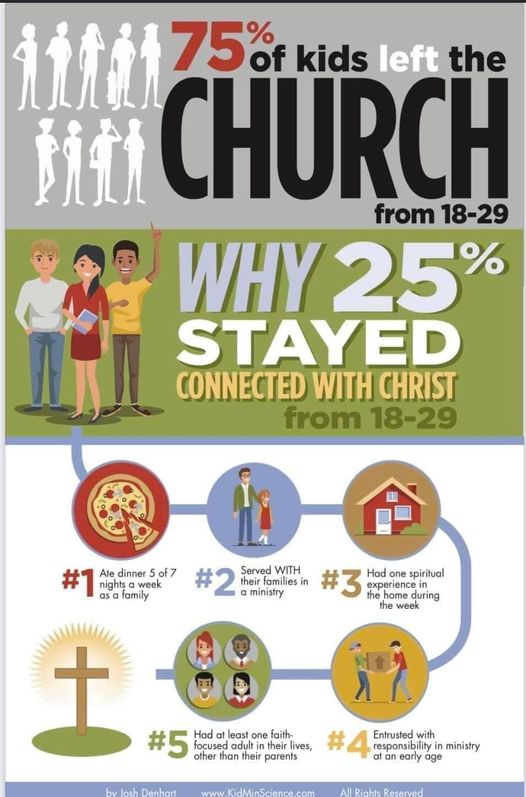
If they’re connected with Christ, why are there so many people involved in this? If Jesus is real and the connection is real, why does it need to be so supported socially? Each one of these is a social connection. Each one is an example of what sociologists call plausibility structures. The more people someone has around them supporting their beliefs, the more likely they are to hold those beliefs.
If we look at the wording of each one, we see that it’s obvious how this is using social psychology and sociology to enforce belief systems.
I, of course, rose to the bait when this appeared on a friend’s feed:
If Jesus is real and the connection is real, why does it need so much social support? These are all examples of what sociologists of religion call plausibility structures: the more people you have around you believing the same thing and suggesting, directly and indirectly, that such belief is plausible and logical, the more likely an individual is to accept that belief as such.
The individual who posted this meme responded:
[H]ow long can one coal burn (even with regular blowing) apart from the rest of the fire? We aren’t closed systems…the World, the Flesh, & the Devil are actively pulling us away from God. Driftwood doesn’t move upstream…it must be acted upon.
It’s interesting that this response doesn’t deny the fact that these are, in essence, plausibility structures. Instead, the response only highlights it. Sociologist Peter Berger suggests that the only way to maintain a given belief in the face of competing beliefs is to surround yourself with like-minded people. He calls this a “cognitive ghetto.” The response posits that just such mental sequestration is necessary to keep out the three enemies:
Of course, in such a Christian’s worldview, these three can all be subsumed under the last one: the devil. But attributing one’s loss of faith when confronted with conflicting viewpoints to the devil does little: it’s an untested and unfalsifiable hypothesis without evidence, and as such, it can be dismissed without evidence.
Another person asked,
[D]on’t all relationships require some sort of support to survive? The very word relationship indicates two or more things, factors or people.
I replied:
I just don’t understand why a relationship with a supposedly omnipotent being needs support. It seems to me that the omnipotent being could make it so obvious to the believer that it would be folly to reject it. As it is, in my experience with a believer, I only had my own inner experiences and other people’s assurances that those experiences were of God.
My interlocutor did not respond.
On Wednesday 03 August, my wife and I had you come out to work on our HVAC system at [address removed]. The technician said that the reversing valve had a coolant leak, and he gave us two options: replace the valve for [a ridiculous amount of money] or add refrigerant and Stop Leak for [a somewhat-less ridiculous but still draw-dropping amount of money]. He explained that the second option, while cheaper, would only be a temporary fix. I asked him how long “temporary” meant, and he explained that he had seen it work for a few months and even on occasion for a couple of years. We decided to go with the second option (WO# [redacted]). However, the next day (Thursday 04 August), the system was again failing to cool the house. We had you come to check again. The second technician came Friday 05 August and determined that the reversing valve was still leaking and thus the system was low on refrigerant once again (WO# [redacted]). When I spoke with him about the addition of the Stop Leak two days earlier and asked why it was leaking again so quickly, he said that the Stop Leak sometimes works and sometimes doesn’t work. This obviously is not what the first technician told me. Had I known that there was a possibility of spending [an asinine amount of money] and it not working at all, I certainly would not have taken that risk. In fact, I’m not even certain why a company would sell a product that might not even work at all. I called to discuss getting a refund, and the individual I spoke with told me that everyone in accounting was gone. She said she would let them know and that they would contact me Monday 08 August. I never heard from them.
I was sold a product based on misleading information which led me to take a risk I did not even know I was taking. That is questionable at best, immoral at worst. In short, I want a refund of my money. Please contact me as soon as possible to let me know how you intend on processing this refund.
For the last six years now, we’ve watched Donald Trump and over and over thought, “Okay, that’s surely the new low. He can’t sink lower than that.” And then he does. And we all think, “Okay, surely that’s the new low. How could he sink lower?” And then he does.
We watch his cult and wonder, “Will that be the thing that will break some supporters away from him?” And we know it won’t, but then the new low comes, and we think, “Surely they won’t put up with that.” And they do.
So now it appears that Trump had nuclear secrets in his basement, was asked to return them and refused, was subpoenaed to return them and refused. Surely this is the new low. Surely this — just shy of espionage at best — is the breaking point.
Of course, it isn’t.
“Surely, Donald Trump stealing nuclear secrets will be enough to break away Republicans from him.”
if y’all haven’t learned this lesson now you never will.
The man can eat a live baby on national television and not a single Republican voter would give a shit.
Rick Wilson
Lestje B. Juddged elucidated it:
If it’s anything shy of the ACTUAL launch codes, then Fox et. al. will minimize it to the point where the rank and file cultist can buy into it.
And even if it IS actual launch codes, it’s still 90/10 that it doesn’t move the needle a single bit.
Lestje B. Juddged
Tristan Snell framed the significance succinctly:
He did not take a few innocent items for memorabilia. He took the Crown Jewels of classified government documents to his home in Florida.
Tristan Snell
The GOP’s reaction will be predictable, and it will show that the party has become a threat to national security.
I really don’t know why I do it. I follow some of these Catholic groups online for no good reason, I think. Am I there just to pick a fight? I guess.
Today, this one popped up as a joke.

Everyone was laughing about it, so I guess humor is the new way of dealing with the awful things God commands in Leviticus. Of course, I replied: “But both come from God. Both are commands from God. That’s the problem.”
A user named Joseph responded, “no there is no problem. None of the levitical laws are valid anymore. Thus any command from Chirst is superior.”
People just don’t get it, though. Jesus might have done away with these laws, but because of the trinity doctrine, it was Jesus who created the commands in the first place. I responded to Joseph:
But the fact that they were commanded in the first place — that’s the problem I’m referring to. That God commanded his people to stone to death incorrigible children, stone homosexuals, stone people for breaking the sabbath — THAT is the problem. Whether or not he did away with those laws is not as troubling as the fact that he made them in the first place.
At this point, Jesse jumped in to help:
[I]f you listened to the first couple of episodes, Fr. Mike clarified it. Some laws were “allowed”, just as what Jesus said about the law on divorce. Also that some must be understood that they were given to a savage, nomadic, tent-living, and with frequent streaks of going astray kind of people who lived thousands of years ago.
I’ve heard this so many times I’m sick of it. No one sees the problem that the same god who gave us the kinder, gentler Jesus also gave us these commands in Leviticus! In fact, because of the trinity, it’s the same being! I tried to explain this:
No, that doesn’t fly. God didn’t allow those laws. He didn’t see them stoning people and say, “Well, I’ll let you do that for a while.” It was God who COMMANDED the stoning. Why does no one get that distinction?
There were a few more responses — I replied to them all. And then everyone just stopped responding to me. Questions are unwelcome, I guess, and even more so follow-up questions.
In some ways, Papa’s passing was much more difficult for me than Nana’s. When Nana died in 2019, I was more worried about Papa than I was myself. I was heartbroken, to be sure, but Papa was devastated. The love of his life, the woman who, in many ways, literally saved his life, was gone. His constant companion for decades was no longer by his side. How would he take it? Would the sorrow he was buried in bury him, too? So when Nana passed, I had a job to do, and a very important job: look after Papa, physically and emotionally (and, while he could still get out of the house, spiritually as we made sure he got to church for the services and community that did so much for him).

We played family games with him, sat and talked to him, watch movies with him, helped him with his exercise and, after his Parkinsons kicked in fully, his physical therapy. As Parkinsons took control, we took on even more responsibilities, more basic responsibilities, more primal responsibilities: feeding him, cleaning him, and all the complications a more bed-bound existence comprise.

Nana’s death was also easier for me emotionally because I had all the support around me that Papa had around him. K and the kids gave me as much support, directly and indirectly, as we gave Papa.


We had our first day back at school today — teachers have a week of preparation before the kids come back. To be honest, a lot of it is less preparation and more endless meetings: three hours this morning; meetings in both the morning and afternoon tomorrow.

In the afternoon, returning home, I discovered that the Boy had painted the ramp into Papa’s room (always it will be Papa’s room) in the morning. After dinner, he applied a quick second coat and now we have a lovely, freshly-painted ramp.