matching tracksuits

fun in threes, sometimes fours

at risk

Karma

5

Written several years ago during the school year.

A young man this morning had a run-in with me. I say "he had a run-in with me," but I guess the opposite is equally true: I had a run-in with him. But in a way, it's a matter of semantics, for it seems all our interactions are negative like this morning's. In short, he does not like being told what to do by anyone, and though I don't teach him, I am still responsible for him as a teacher on the hall, so I have to tell him to do things. Like get in dress code. Or take off the headphones. Or stop chasing this or that girl. Or get to class. Or get to your locker. Any number of things that he knows perfectly well he's expected to do. This morning's encounter was another in a long line of meaningless conflicts that arise from his instant disrespect whenever he's told to do something.

At about six-two, Terrence is taller than almost all his eighth-grade peers, perhaps because he's supposed to be in ninth grade. He struts down the hall and is admired by boys and girls alike. Boys and girls who see his supposed toughness as a virtue. Boys and girls for whom his probation-related ankle-bracelet adds to his prestige. Most teachers think a little less highly of him than do his peers.

"Terrence, you need to get to your class. It's girls' locker time, not boys'."

Instant conflict: "Man, you see my teacher ain't here. You see I gotta wait in the hall!" in such a bellicose and hateful yelled tone that it's a wonder he was surprised at all what was coming next: a reprimand for disrespect.

"There's no need to talk to me that way..." and he turned his back on me and stood with his back to me. Fairly typical behavior.

"That's fine, Terrence. I'll refer this matter to the administrator." Which means really nothing because he'll get a day or to OSS for it, and kicking a kid like this out of school is no kind of punishment at all. It is, of course, a relief to his teachers because they don't have to deal with his nonsense. It's a relief to his classmates because now they can get some work done. But for Terrence? It's meaningless, and he didn't mind telling me so.

"Man, I don't even care."

That could be his mantra, and he's not the only student like that. They're the ones that are the toughest to care about because they don't even seem to care about themselves or others enough to see the harm their behavior causes, to themselves or to others. Their lack of self-confidence displays itself in bellicosity and anger, and the only way to get through a protective shell like that is not to take their verbal strutting personally -- much easier said than done. And so such students just jostle about through the day, bouncing from one conflict to another, all of which serves as just more evidence to their victim mentality that the whole world is out to get them.

Later in the day, he was sauntering down the hall while I was out working with a couple of students who'd asked to work in the hall to avoid a potential conflict in the classroom (Some days, it's all about the "drama" as the kids call it). Terrence stopped briefly to chat with a friend who was returning to another classroom from the bathroom. He explained that he had a day of OSS.

"Why?" his friend asked.

"Because of him," he said, pointing at me.

I'd written the administrative referral during my morning planning period, and the grade-level administrator had already processed it. It's telling because of the simple fact that Terrence's referral received top-level priority. I'm not sure he would have grasped the significance or irony. In honesty, though, none of that entered my mind at the moment. I simply replied with my own mantra of sorts, the standard response I give to students who blame a teacher for their behavior issues: "No, Terrence, it was because of the choices you made."

"Man, I didn't even want to talk to you," he sneered.

There, in less than ten words, was the summation of his whole problem. In fact, he only needed four: "I didn't even want..." If Terrence doesn't want something, he doesn't do it; if he wants something, he does it. Anything that gets in the way is going to cause a conflict, and Terrence has learned that if he is aggressive enough, disrespectful enough, and consistent enough, he can get what he wants from a lot of people who in fact are in positions of authority over him. Clearly, he behaves thus with his parents (or, more likely, with  his mother -- statistically speaking, he's likely from a single-parent home), and clearly it works, else he wouldn't do it. It's probably also worked with teachers who are just tired of the fight and give in from exhaustion. But I'll stand my ground with a Terrence. I'll be part of the wall that he crashes himself against. "It's better that he learn now when the stakes are not as high," I might even justify it to myself. Truth be told, a significant portion of it is pride -- same as Terrence.

"It doesn't matter whether you wanted to talk to me or not. I'm the one in authority, and when you don't..." but it was useless.

What I really wanted to say was, "Well, there will be lots of people you don't want to talk to, like the judges you'll appear before throughout your life. But they won't really care whether or not you want to talk to them, and if you talk to them as you speak to any and all adults in this building, you'll have some pretty hefty consequences." I thought of Ebony Burks and her encounter with a judge during her arraignment.

We might be troubled by the way the judge seems to antagonize the situation, but in the end, Ms. Burks is responsible for what comes out of Ms. Burks's mouth, and she could have stopped at any moment. Terrence is easy to imagine responding in a similar fashion.

That's what I wanted to say but of course would never say. "Less said, easier mended" our previous principal's email signature read, and it was something I really took to heart. Besides, to tell Terrence that would be to tell him one day he's going to sprout wings and become a flying turnip: he'd never believe it.

Terrence is the type that has such an impact on the hall that when he's missing, it's immediately obvious, and so in the afternoon, I noticed he was missing but assumed he'd just been sent to ISS for the remainder of the day. Perhaps he'd given another teacher trouble, and the teacher simply sent Terrence to the administrator straight from the classroom.

It turns out he'd continued making poor decisions after our first encounter, but the decisions of the morning were nothing compared to the decisions he'd made even earlier in the day, before he left for school, as he was packing his materials, such as they are, for a day of instruction -- choices so dire that his hypothetical appearance before a judge I'd been imagining transformed to the afternoon's certainty. In short, having brought a pistol to school, he is in about as much trouble as a young man can be in, and he will not be coming back to school.

And my reaction? I smiled at the thought of almost-instant karma. In fact, walking out to the car, I couldn't wipe the stupid grin from my face. It was as if I'd experienced the greatest "I told you so" moment in my life. "Of all the kids to bring a gun to school," all the teachers had been saying, "I would have picked him." Of all the students to do something that would land him in front of a judge, I would have picked Terrence. Our clairvoyance instantaneously confirmed.

And now? I think to myself, why in the hell was I smiling at another human being's misfortune? Certainly his misfortune was a self-created condition, borne of his consecutive poor decisions. In short, from a certain point of view, he got what he deserved. But for a child of that age, no more than fourteen, perhaps fifteen (if he's been held back a year), it's tragic to think that his worldview, his reactions, his existence has been so poorly shaped that he already has virtually no future. He had no input regarding his environment. He had no input into the involvement of his father in his life. He adapted to the laws of the street and simply never learned to turn those behaviors off when in a situation with said behaviors were no longer positive but in fact detrimental.

I'm not saying he's just a victim, for he's had seven or even eight, possibly nine, full years of school in which to watch other students who don't find themselves constantly in trouble and learn to copy their behavior. Still, there is an element of victimization here that only leaves me shaking my head, determined to try to get through to the next Terrence I meet (I have a couple in my own classes every year) and thankful that I am able to provide my own children with the stability that these children never experienced.

Addendum: Background

The above was written some time ago--I held off publishing it because I really didn't know how the story would end.

I know now.

Terrence appeared before a judge and faced charges. He appeared before the school board and was expelled. And he committed another crime in the meantime and is now locked up.

I held off publishing also because I thought he might end up back at our school if he'd been expelled. Unlikely, but a possibility, for expulsion in our county means expulsion for a full year, after which, the student can return to the school and pick up where he left off, so to speak. With his later charges, Terrence likely won't be coming back ever again.

We heard more about his situation as the year progressed. Apparently, his father had just gotten out of prison when all this started. I can only imagine the sense of complete failure his father felt when he learned what his son had done, the frustration he felt driving to the school to meet with administrators and police officers about the choices his son had made. I can imagine a conversation like this when he sees his son:

"Didn't I teach you anything going to prison?"

"Yeah, you taught me plenty."
KB departs

A traumatized kid enrolls in our school, and only weeks later, he's gone, entangled in the court system with all the fatalism and unfulfilled dreams that that entails for a fourteen-year-old black boy. 

That sentence itself is a tangle of contradictions and enigmas. "A traumatized kid enrolls" suggests that the kid made the decision, completed the paperwork, and entered our school community. Or it implies a parent made the decision to enroll him in our school and completed the requisite paperwork to enroll. In this child's case, neither is likely: the kid, of course, is a minor and couldn't do it; the parent (and statistically likely only one, and most statistically likely only the mother) seems from all accounts to be relatively uninvolved. 

“Only weeks later, he’s gone” suggests more volition that he likely lacked. It implies that he just didn’t like it — wasn’t challenged or felt the dress code too stifling. In truth, he was taken away, with all the ambiguity that passive-voice sentence suggests. More accurate from our perspective is simple: “only weeks later, he disappears.” That still suggests he is in some sense a agent in the decision, and while his behavior certainly played a role in it all, that behavior was likely not entirely consciously volitional and at least in part the crusted-over habit of years of surviving a trauma-filled life no kid should endure.

When I first met him, he was respectful, demure even: "I don't like saying I came from West Greenville," he quietly began when we first met, referring to one of the district's alternative schools, "because they think I'm a bad kid."

"Well, we all make mistakes in life," I reassured him. "I'm sure no one will judge you on where you came from but rather on your behavior."

Yet his record suggested he was what quick judgment would label a "bad kid." He came to us from alternative school, and as teachers reviewed his records, we saw that he had been in not one but two different alternative schools that year. A kid who makes a single bad decision that lands him in alternative school -- say, bringing a vape to school -- would not have such a record.

Still, he knew how to play the game: he knew first impressions count, and he made a good one. Once he got into class, though, it was another story. Passive incorrigibility and even the occasional aggressive defiance became the norm. Once, in the hallway when I was trying to direct him where he needed to go, he shouted, "Man, this is why I hate white people."

Over a few weeks, I'd managed to establish a decent relationship outside of class, though, and that helped inside the class. He began applying himself just a bit, here and there, occasionally. But much like an abused dog will bear its teeth at any perceived threat or provocation, KB’s interactions continually belied that demure front he’d put on at the start of his time with us. 

“Who’s that kid?” A teacher on another team asked as KB passed by. I told her, and she replied, “He’s really something.” Soon, everyone on the hall knew who he was, and not because of the sterling impression he was making on everyone. 

Occasionally he would be absent and return to school a few days later explaining he’d had a court appearance. “For days?” I’d think, but I kept my doubts to myself. 

There are kids teachers encounter that we know will disappear into the vast cracks in our system and appear on the evening news as a suspect in some crime or other (one former student), or perhaps as a fatality after a police chase involving a stolen car (another former student). We all pay for these kids: our tax dollars will support them in one form or another. But they pay for it as well with lost and wasted lives that represent a net negative on our society, indicting us all: that’s the true price we pay.

Parent Exchange

Chess Claims

Every now and then, a student will challenge me to a chess game with much braggadocio and bravado.

"I'm going to beat you so bad, Mr. Scott!" comes the claim. "You don't stand a chance."

My response is usually simple: "Perhaps." There are plenty of thirteen-year-old chess players in the world (probably in the county) who could, indeed, thrash me. When facing an opponent for the first time, I prefer humility. Usually.

What I was thinking, though, was anything but humble: "Perhaps. But remember, young one, I have worked with you for quite some time now. I know how you think. I know your critical thinking abilities. I know how much patience you have (or in this case, don't have). I know how easily (or not) you make connections between seemingly disparate passages of the text. I know how well you infer. Very strong chess players do all these things better than the average person; you do most of these at about an average (or even below average) level. Also, to beat me, you'll need to know chess theory better than I do, which requires study and focus -- two things you don't always excel at. Therefore, taking all of this into consideration, it's highly unlikely that you will beat me."

Now, thinking all these things, I often just play along with the trash talk: "Buddy, I'm going to kick you so hard your grandmother is going to feel it." The most brutal trash talk I do is when, after a couple of moves, I just give the player my queen. "I won't be needing that." Among those who have a basic understanding of chess, this always elicits hoots and laughs. One student might run over to someone not watching the game and recount excitedly what I just did.

I thought about that today as students in my last period class struggled mightily with making claims for an argumentative writing assignment with which we're concluding the semester. I thought I'd set everything up perfectly for them to see some connections that would lead to good claims. We were annotating the text for things illustrating the narrator's family's poverty and the acts of kindness they perform and in turn receive. I made sure students saw two passages:

  • We were one of the last families to leave because Papa felt obligated to stay until the rancher’s cotton had all been picked, even though other farmers had better crops. Papa thought it was the right thing to do; after all, the rancher had let us live in his cabin free while we worked for him.
  • She made up a story and told the butcher the bones were for the dog. The butcher must have known the bones were for us and not for the dog because he left more and more pieces of meat on the bones each time Mama went back.

Here we have two acts of kindness that directly contribute to the family's survival. Yet none of the students could make the connections and inferences necessary to come up with a simple claim about this: "The family receives basic needs from the actions of others."

The co-teacher in the class, seeing the same problem, started searching online for some sentence stems to help them with their claims. When working with struggling students, sentence stems (also known as frames) help students orient their thinking and direct their writing.

"Since claims can be so varied," I told her, "I doubt you'll find much." She's a great special education teacher and a real advocate for all students: she didn't give up. Still, she found nothing.

"I just don't know how to teach these kids such basic critical thinking skills," I said. I've tried logic puzzles and similar ideas, but I'm just not good at that. I feel that's teaching skills (inferring, categorizing, comparing/contrasting) that most kids have learned years ago. It's something an elementary teacher would be trained to teach. Not someone who studied secondary education.

It's from classes like this that the "I'm going to beat you badly!" chess claims emerge. One such kid kept bragging while I set up pieces, and he put his class materials away. He sat down across from me and said, "Okay, so how do you play this game?"

Absent

If any of my colleagues ever suggested -- or simply thought (then how would I know?) -- that they were more productive a given day because I wasn't there, I would feel such shame that it might be difficult to show my face again among those folks. I would reflect on my behavior, on what I'd always considered my contributions, and I would likely realize that I shouldn't have simply been second-guessing myself; I would realize I'd had a completely false self-image.

Today, several students were absent, with most of them were suspended. The types that are likely to get suspended are the types that are likely to disrupt class, and so today, two classes that generally leave me wondering about my decision to stay in education were absolute pleasures. They were productive, polite, focused. They were unlike they'd been in a long time, if ever. (Is it really only September? Are we really only in the second half of the first quarter?! I feel so tired of it all that everything in me screams that it must be March.)

What if I tell these students that? How would that conversation go? I think we all know: they would be indifferent. At least one of the students admitted openly that he is disruptive because he knows it annoys other students, and he likes to annoy other students.

Several of them will be back tomorrow -- will it be business as usual? No. I've seen what we can accomplish: if they are unwilling to cooperate, I will do what is necessary to protect the education of all the other students.

Tuesday School Thoughts

On the one hand, I'm responsible for teaching them to read and write better. That's my bottom-line assignment at work. Traditionally, that's all a teacher has ever been expected to do: teach the course material.

Yet some of my students fall under the rubric "at-risk" in one form or another. They can't stay focused for more than five minutes (at best) or five seconds (literally, at worst). They can't keep up with their materials until the next day (at best) or the next minute (at worst). They can't accept "no" as an answer, and they take everything personally and turn things into battles that have no business being fights to begin with. They come in without materials -- no pencil, no paper, no nothing.

These are the kids whose behavior, quite honestly, disrupts the learning of anyone and everyone else in the room. They are black holes for attention: their every second is a new event horizon to resist. Interactions with them can be quicksand, pulling everyone in and restricting movement completely. Working with them for five minutes can be utterly exhausting; working with them for a whole class period can have one questioning one's sanity.

Yet what option do we have as teachers? No one else is teaching these kids (only a few -- perhaps 7-10%, and not even that many who are so demanding and high-maintenance) these skills. At least it seems no one else is teaching them the skills. And someone has to teach these kids the basics of how to interact successfully with the world.

But it's so exhausting...

Socratic Seminar

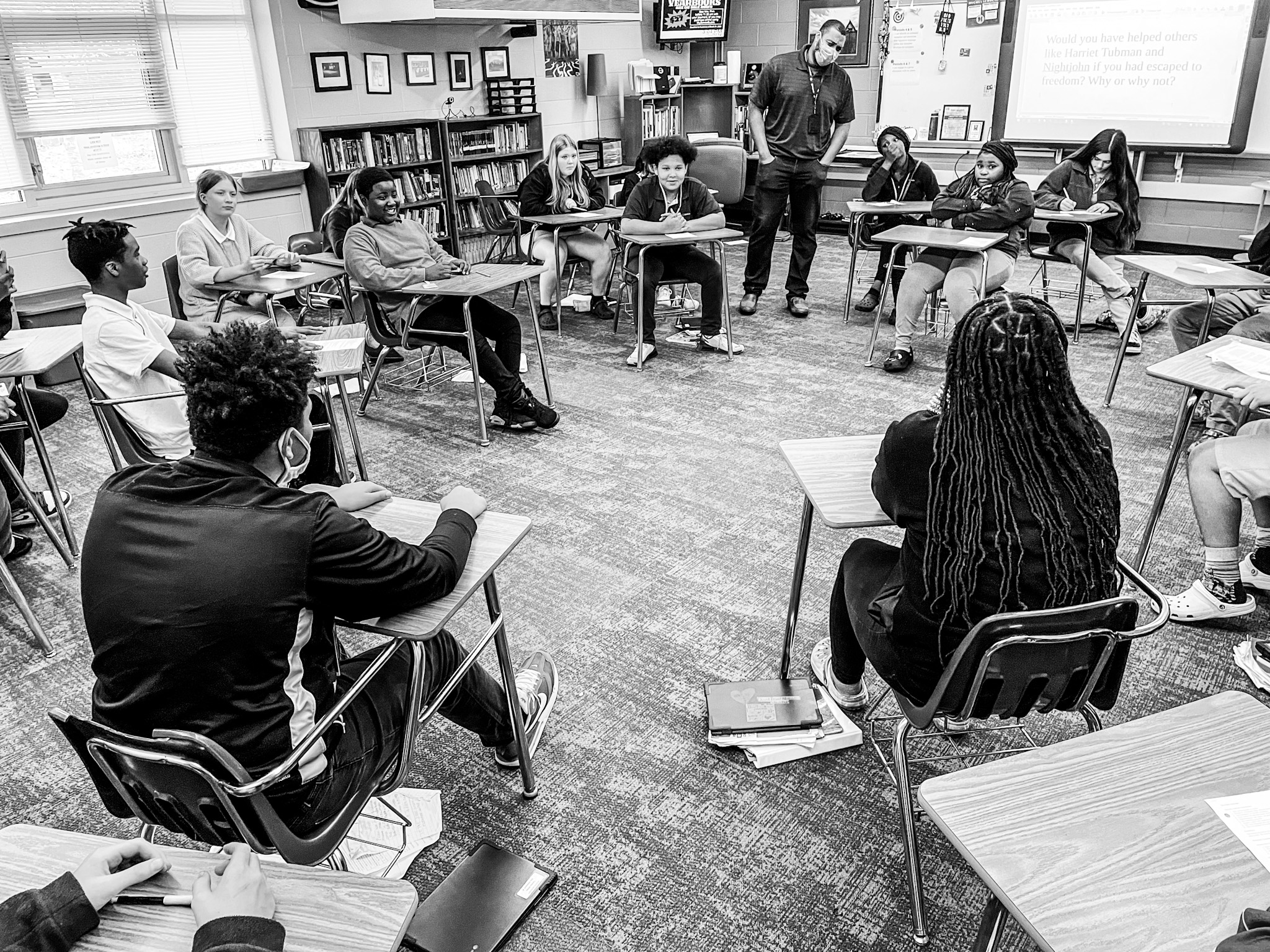
They're tough classes at times, filled with a mix of students with mixed motivations and mixed ability levels. And all of this manifests itself in students' behavior: several students are focused and hardworking while a few are determined to gain attention by any means necessary, with the vast majority simply there, engaged sometimes, bored and checked out others.

But there's one activity that always gets good results: Socratic Seminars.

If I could have these on a biweekly basis, I think I could have a serious motivator for the students. So why don't I do it? That's a very good question, indeed. I shall be working them into plans one way or another on a much more regular basis based on how well students engaged in their first seminar of the year.

And I haven't even done one with my honors students yet...

Perception

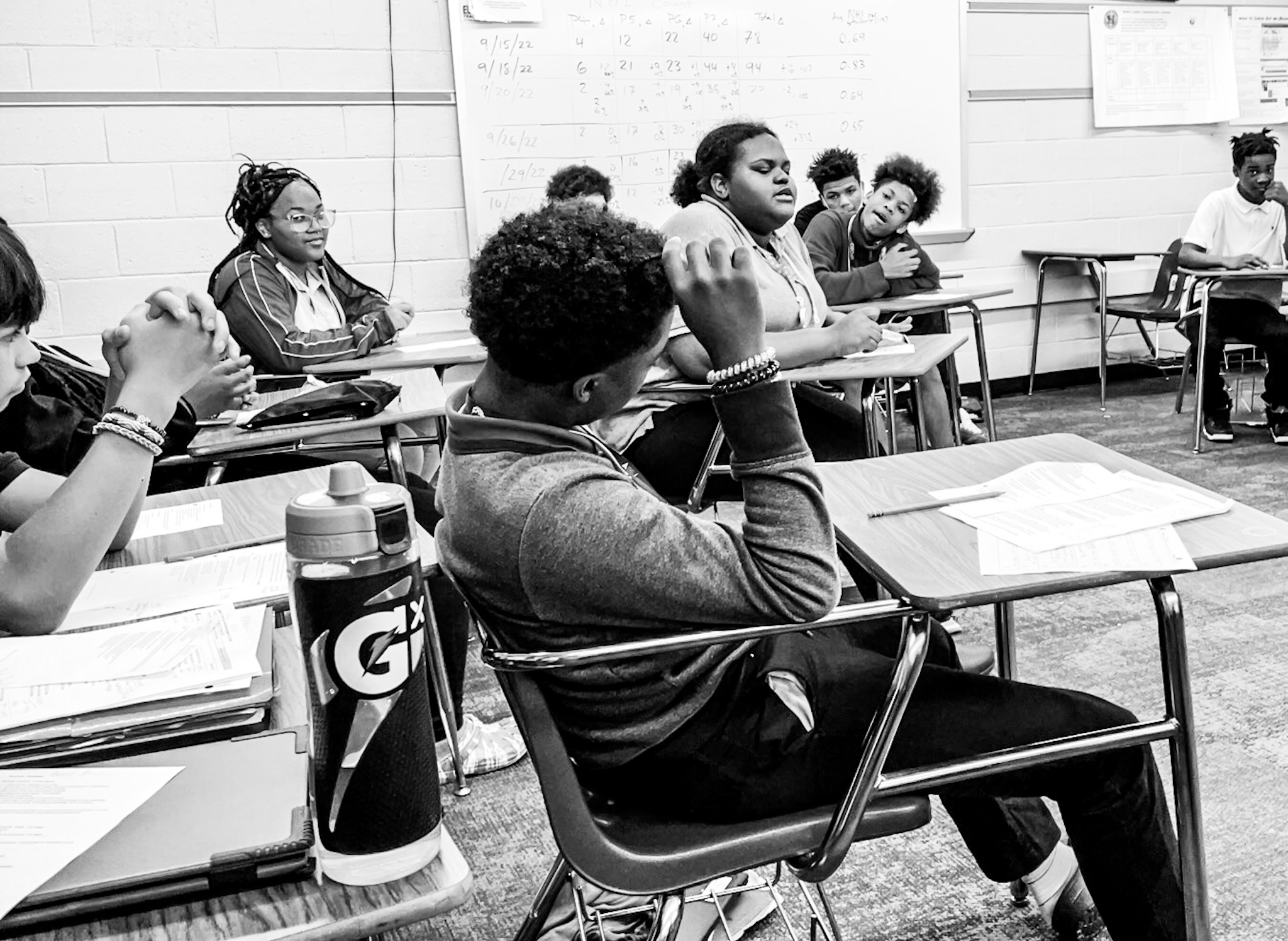
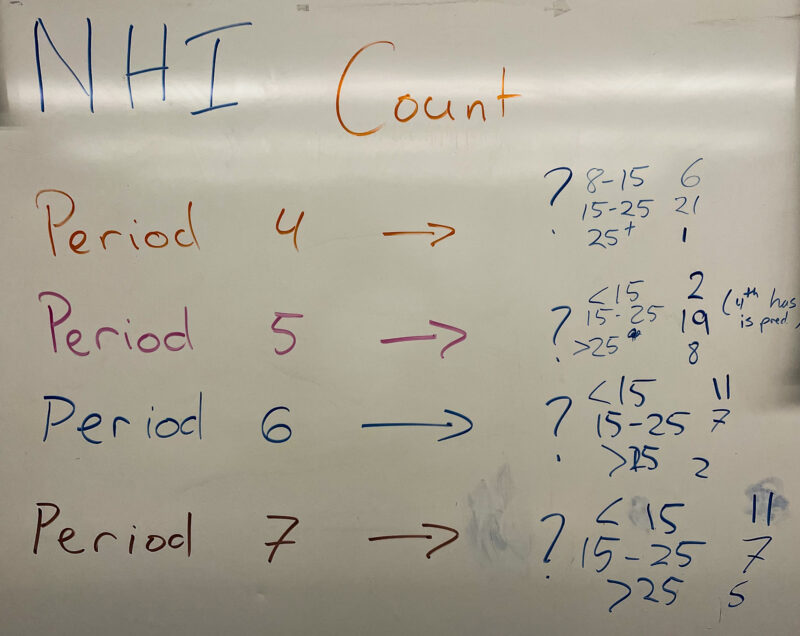
We have an epidemic of NHIs in the eighth grade. NHI is the code we enter for a graded assignment the student failed to turn in. Not Handed In.

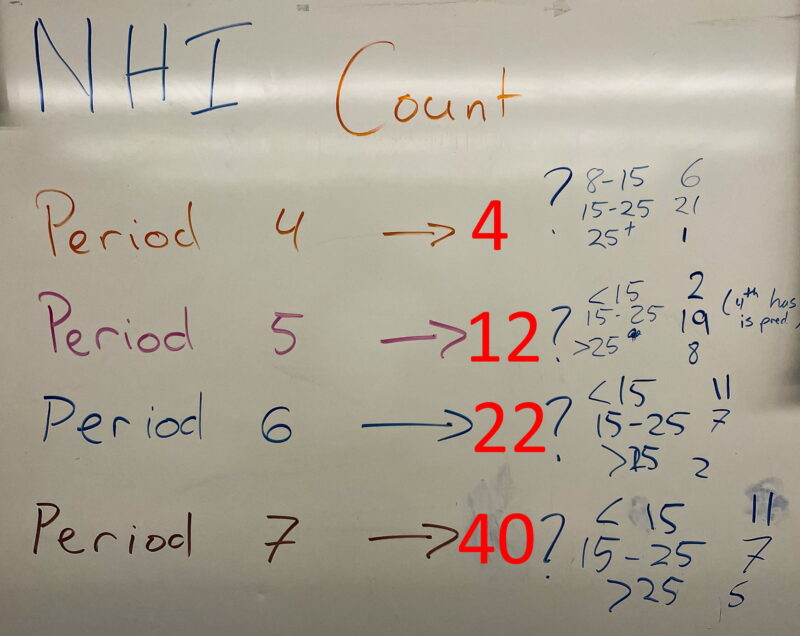
I had a talk with my classes about the issue. On Thursday, I had students in each class guess the number of NHIs in their class for English. There were three options:

  • Fewer than 15
  • Between 15 and 25
  • More than 25

The two English I classes were certain they had between 15 and 25 per class. The two English 8 classes were certain they had fewer than 15.

The results for all classes were the exact opposite of what they expected.

The English 8 students refer to the English I (high school English) classes as "the smart kids' class."

"They're not the smart kids class," I always reply, but Friday, when I revealed the results, I added, "They're simply the do-the-work kids class."

Fluke?

I was so excited about how well things went with my toughest class yesterday: we did such good and focused work, though, that I should have expected today. Frustrating all around.

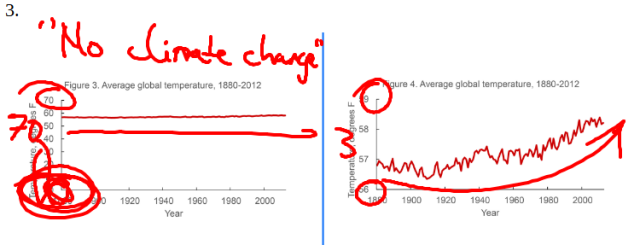
During the bell ringer, when we were going over some of their work, trying to get a student to say that the highest value on the Y axis of a graph (we're reading a cross-curricular text about deception in graphing) was 70. Even when I pointed to it. Even when I said, "The first number is seven." Even when I added, "The second number is zero." Even when I said "70." Even when I said, "Say '70.'"

My Promethean Board pen was acting up...

Later in the lesson, when we were going over how to do something, I did the first half of the work for them -- for all intents and purposes -- in the name of modeling, even though we should be past modeling now. Be all that as it may, some of the kids didn't even make use of the modeling -- and really all they had to do is copy what we came up with as a class.

Every class has tough days, I guess. But they're even tougher when the happen on the heels of a great day.

K pretending to drown this weekend

Mindfulness

I tried something today, sort of spur of the moment, with one of my more struggling classes. It's filled with impulsive students who are generally very sweet (at least toward me) but can be very chatty. Very focused on other things than the work at hand. So before we started our main part of the day's lesson, I had the kids do a little mindfulness work.

"Close your eyes," I told them.

"Did they trust you enough to close their eyes?" my principal asked when I was telling him about the experience later in the day.

"Yes, they did," I replied, thinking of what his question suggested about the relationship I have with the kids already.

"Close your eyes," I said, a few times. There were some stragglers. Some were still focused on something else. "Just close your eyes and breath slowly for a moment." I led them through some slow breathing, then had them visualize the work we were about to do, seeing themselves working in a focused manner and meeting success instead of frustration.

They opened their eyes, we began the main part of today's lesson, and they had the most successful day we've had so far.