Ribbon Cutting

education and teaching

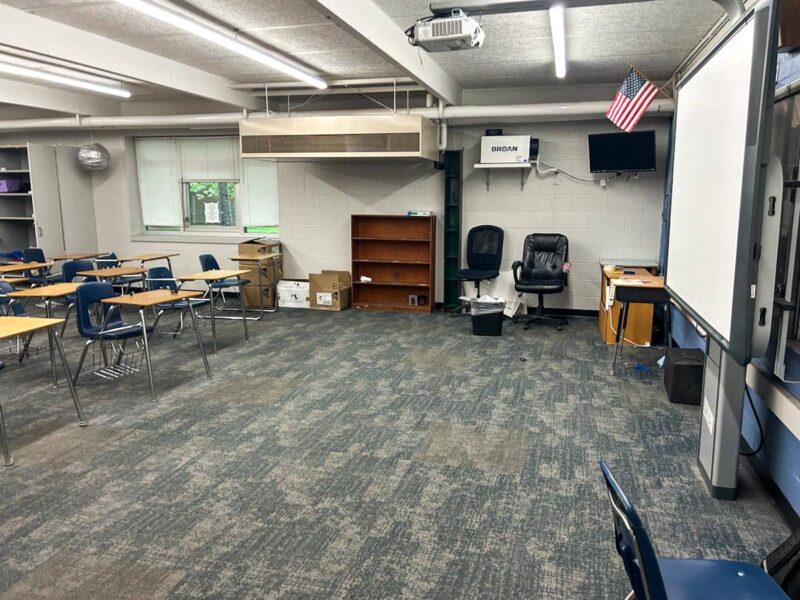
Tomorrow is the last day of school for our small charter school. It will be the final day of my twenty-eighth or twenty-ninth year as a teacher. (I can't recall recall; I don't really care to count them.) It is the end of my least stressful school year in recent memory. It is the first time in eighteen years that I've not worried about how my students will do on the state year-end test that is ostensibly to measure student mastery but is in fact an awkward and inaccurate measure of teacher effectiveness. It is the end of my first year of teaching primarily sixth graders. And it is the end of my first year teaching a new subject. Each of these firsts impact me differently.
For all the years I taught English, pacing was of utmost importance. The state gave me a list of topics that my students would be tested on at the end of the year; the district gave me a pacing guide that was to dictated the order and duration I taught each topic; I had my own classroom experience that often conflicted with the district pacing guide; and I had 180 days with the students. Add to this (or rather, subtract from that last element) all the testing days we had for worthless benchmark tests, even more useless common formative assessments (CFAs -- educators love acronyms), equally futile common summative assessments (CSAs, as one might guess), PSATs (actually useful for the students), and a handful of other required assessments, and it's easy to see why any unit that needed more than my planned time became an instant stressor. That time had to come from somewhere: more time on topic x means less time on topic y, which could easily affect the results of the ever-important end of year test. This year, though, if I felt we needed more time for a given topic, I simply added more time. No stress; no worries; no issues. Having that freedom was more liberating than I'd imagined.
The previous eighteen years of my teaching career were in an eighth-grade classroom. I knew eighth graders as well as I knew anything. I knew their likely behavior, their maturity, their level of abstract thinking, their enthusiasm (or rather, their lack thereof as often as not). Moving into a position in which two thirds of my students were sixth graders was initially stressful, but I soon realized that sixth graders are the best middle school group to teach. They are so very funky, silly, energetic, and excited that every day seems a dance more than a drudge.
Finally, teaching an entirely new course with only a very skeletal curriculum was a daunting prospect when I first accepted the position. What could I not teach?
In all, a great year that leaves me excited about next year instead of dreading it.


As we move into the last quarter of this inaugural GPA year, the students in my class are embarking on one of the most challenging topics of the year: public speaking. We'll be working toward a straightforward (but certainly not simple) goal: a five-minute speech.
"Five minutes?!" was a fairly common refrain. "There's no way I can give a speech that long!"
A few students reacted with incredulity of a different nature: "Only five minutes?!"
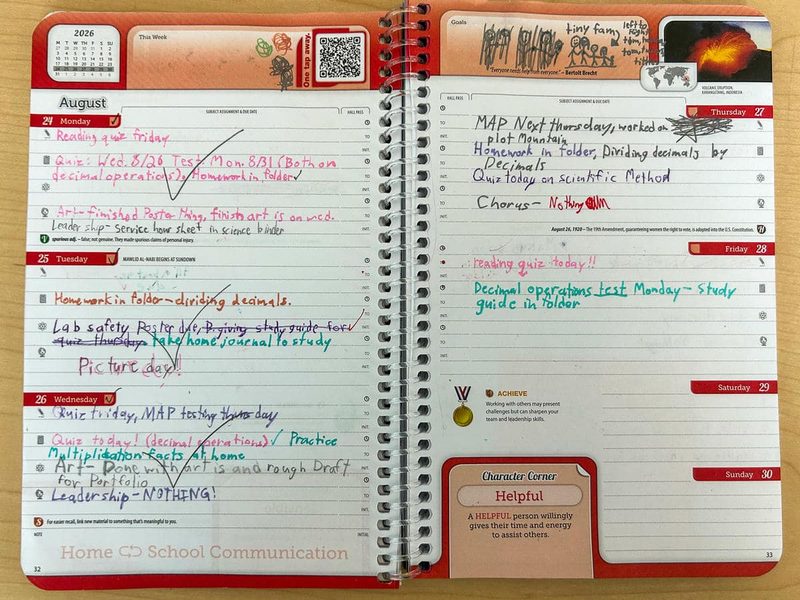
Our preparation toward the seemingly daunting goal will roughly follow the template we established today. We began with a writing prompted that served as the basis for the rest of the day: "How was your spring break? What was the best part of it? What would you relive if you could? Why?"
After students wrote their responses, they had short conversations to share their ideas. (A secondary focus this quarter is social/conversational skills -- we'll be talking all quarter.) From there, they used rock/paper/scissors to determine who from each table would go first.
"Go first, Mr. Scott? In what?"
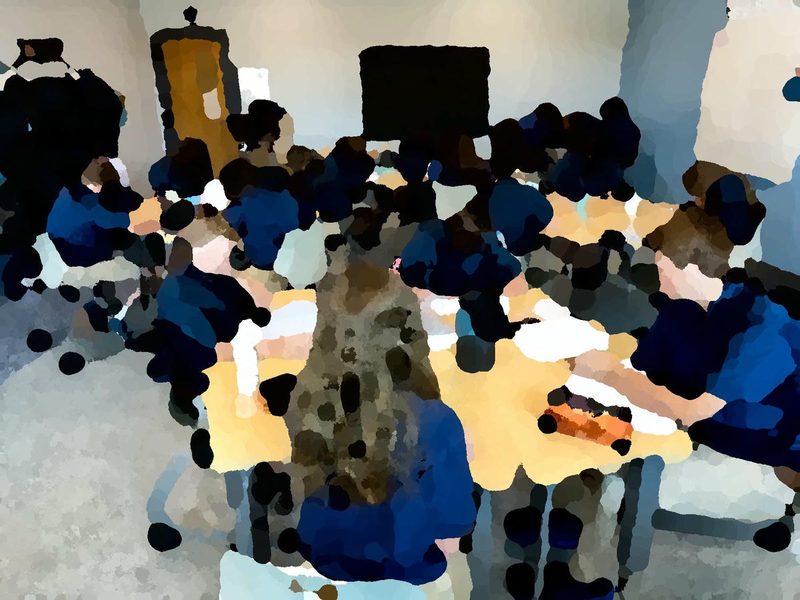
"The first speech!" Anxiety washed over several faces until I explained it was only a one-minute speech, and their audience would be limited to their tables. After a short time to prepare for the modified topic ("Make an argument that your spring break, no matter what you did, was the best imaginable spring break"), students took turns giving their short speeches to their groups. Listeners were to pay attention to four different elements depending on which speaker was presenting:
Use of fillers and repeated words/phrases
After each speech, the three audience members gave a bit of feedback on the element in question. Once all four group members completed their speech, we used Class Dojo to choose randomly one student.
"You're the class winner!" I exclaimed.
"What did I win?"
"The privilege of giving your speech to the whole class!"
After the student gave her short presentation (Class Dojo chose only girls for some reason), I explained that what we'd just done would serve as something of a template for most of the lessons for the next couple of weeks. We'll have mini-lessons on a number of topics including but not limited to:
Finally, we'll end the quarter by using all the discussions we've been having as inspiration for our speeches.
It will be a busy quarter, but we're finishing the year with a challenge because that's what we do at GPA.
From class website update.
Some days every class seems to go so perfectly. that teachers wish they could have videoed for posterity. Everything seems to click. Every student seems to be focused and hardworking. Every class seems to take a noticeable step forward.
Today was such a day.
We've been looking at how people communicate in the 21st century with an eye to how leaders should communicate in the 21st century. Specifically, we have been examining how leaders might or might not use social media, in general, and memes, and emojis, in particular.
Yesterday, we began the setup for today's Socratic seminar. Students were divided into groups, and these groups were assigned a position. They didn't have choice in the matter. They weren't consulted regarding what their personal opinions were. I simply assigned them a position.
Students meant yesterday, brainstorming reasons to support their own positions, counterclaims the other side might make, and rebuttals they could, in turn, make to those counterclaims. Today, we ran the Socratic seminars.
They were, in a word, spectacular. If you could've been a fly on the wall, you would have seen six and seventh graders, behaving with decorum and dignity. Listening to each other's positions, not interrupting each other, respectfully disagreeing, respectfully pushing each other for evidence and justification of their claims. And even occasionally, laughing. All while arguing positions they might or might not have personally held since they're positions were randomly assigned.
If I could have, I would have recorded today for future years, for future school years. That way, when I taught students how to do a Socratic seminar in the future, it would be easy. I would simply show what those students did today and say, "Here, watch them. Do what they did."
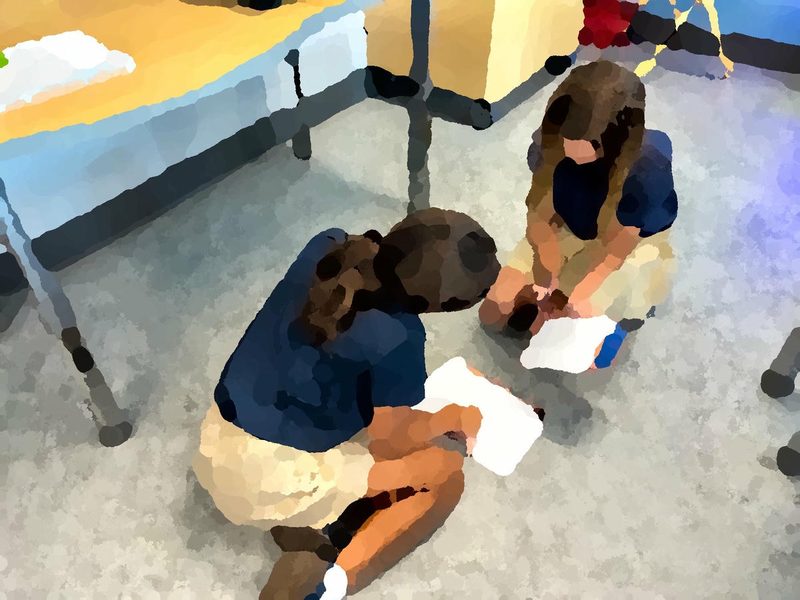
Today, we continued working on our critical thinking/problem solving unit with a gallery walk of riddles. Spread around the room were nine different riddles of varying difficulty:
Students moved in their table groups from riddle to riddle and discussed them as groups. Some of the riddles were quite easy for the groups (numbers 1 and 3); some were a bit trickier (numbers 2 and 5); one was all but impossible (number 8), which stumped all but one student, a sixth-grade girl.

We used three riddle classifications to identify them as we went through the answers:
We discussed how the riddles work and how various riddles use language to trick our brains to ineffective ways of thinking based on how we usually use language.
I went into the teachers’ workroom to make a coffee. It was the first day back, and some teachers had brought their kids with them. When I opened the door, I found three energetic children playing with balloons.
“Do you want to see what we’re doing?” a small blonde girl asked, her ringleted hair bouncing with excitement.
“Of course I do,” I said.
She grabbed a balloon, puffed out her cheeks, and forced air into it with all her might until it inflated just a little. Then she opened her mouth. The blue balloon shot across the room, and she erupted—squealing, jumping, delighted. She chased it down and did it again.
I smiled and walked away. Hearing her repeat it a third time, I felt unexpectedly envious.
It was such a simple act, yet it held her completely. Children can endow the smallest things with meaning, with such intensity that repetition never dulls the pleasure. Each time is new—better, even.
Fifteen or twenty minutes later, when I went back downstairs to get pork for my lunch, the kids were still there, still playing with the balloons, still just as excited.
When did we lose that kind of wonder? Why do childish pleasures cease to be adult ones? As a fifty-three-year-old, I find nothing remotely appealing about blowing up a balloon and letting it fly away. I wouldn’t do it once, let alone again and again. If I did it at all, it would be to entertain children—and even then, my pleasure would be borrowed, derivative of theirs. Otherwise, it would feel like a chore, something to check off before a birthday party. And knowing I could pay someone else to do it, I probably would.
Children don’t outsource joy. They might share it, but even that has to be taught. Their pleasures are closely held.
What, then, are mine?
I don’t think I have many. Most of what I enjoy I’m happy to share—or no one else wants. I’m the only one in my family who likes whiskey. I’ll offer a puff of my cigar, though I know my wife won’t take it. And what pleasures I do have, I pass easily to my children.
Just before Christmas break, I came home with small treasures from my students and gave most of them away. Lena claimed the Starbucks cards. Both kids went for the candy. Ginger took the restaurant gift cards and tucked them away for busy weekends. I let them—all of it—without hesitation.
That ease, too, is a kind of privilege.
It must be a particular first-world luxury to carve out moments so carefree that our troubles dissolve into the fog during an evening walk. We have worries, yes, but nothing dire. Poverty is distant, almost unthinkable. We do not worry about our next meal.
And yet, how quickly could it all unravel? How quickly could democracy slide into chaos? How fast could our civilization collapse and leave us worse off than before? We like to imagine that people in poorer parts of the world know how to survive with less, that hunter-gatherers endured without any of the technologies we now depend on.
The preppers who populate my social media feeds—once you watch one, the algorithm supplies the rest—are convinced collapse is imminent. They warn us where not to go, what to stockpile, how to survive martial law and total disorder. But can anyone live a fulfilled life while obsessing over collapse? To call oneself a prepper seems to require abandoning nearly every other concern.
Perhaps that is the core of first-world nonchalance. We live in a world that feels inevitable, permanent, destined. Even its collapse is hard to imagine. To suggest that food might one day be hard to get—or that entertainment might disappear—feels as absurd as waking up without arms or legs. We are too accustomed to having the world at our fingertips, carried in the microcomputers we casually call phones.
So what do we make of first-world luxury? Of privilege? Of the innocence of childhood?
I see it in small rituals: walking the dog at night, schedules snapping back into place, students lining the halls—eager, a little sad that break is over. The Christmas decorations came down at school today. Our own sad little tree will linger until the weekend, or until my mid-January birthday passes, and then it too will be gone. Another Christmas season ended.
And yet each one seems to close with more uncertainty than the last. Political turmoil deepens. Environmental collapse feels less abstract. There is a troubling naivety—perhaps even selfishness—in those who greet this with confidence that, before it gets too bad, salvation will arrive.
A new year. Another war. New threats of evil.
And still, we go about our business.
What else could we do?


Old obligations that are no more.
Obligations
- One grade per week per student
- One Common Formative Assessment per class per three weeks
- One Common Summative Assessment per class per grading period
- Contacting all homeroom parents by phone within the next three weeks
- One collaborative team meeting per week
- One grade-level English teacher meeting per week
- One grade-level meeting per week
- Assorted meetings with district personal about various topics
- Assorted 504 and IEP meetings
- Lesson plans in a very detailed required format that include
- Differentiation for ML (multi-lingual) students for each lesson
- Differentiation for special education students for each lesson
- Differentiation for early finishers
- Plans for collaborative teaching with co-teacher in inclusion classes
- Plans for integration of ML strategies
- Data chats with students every Monday
- Faculty or department meeting every other week
- Positive notes to three students each week
- Create a list of every book in my classroom library
- Make publically available every resource I use