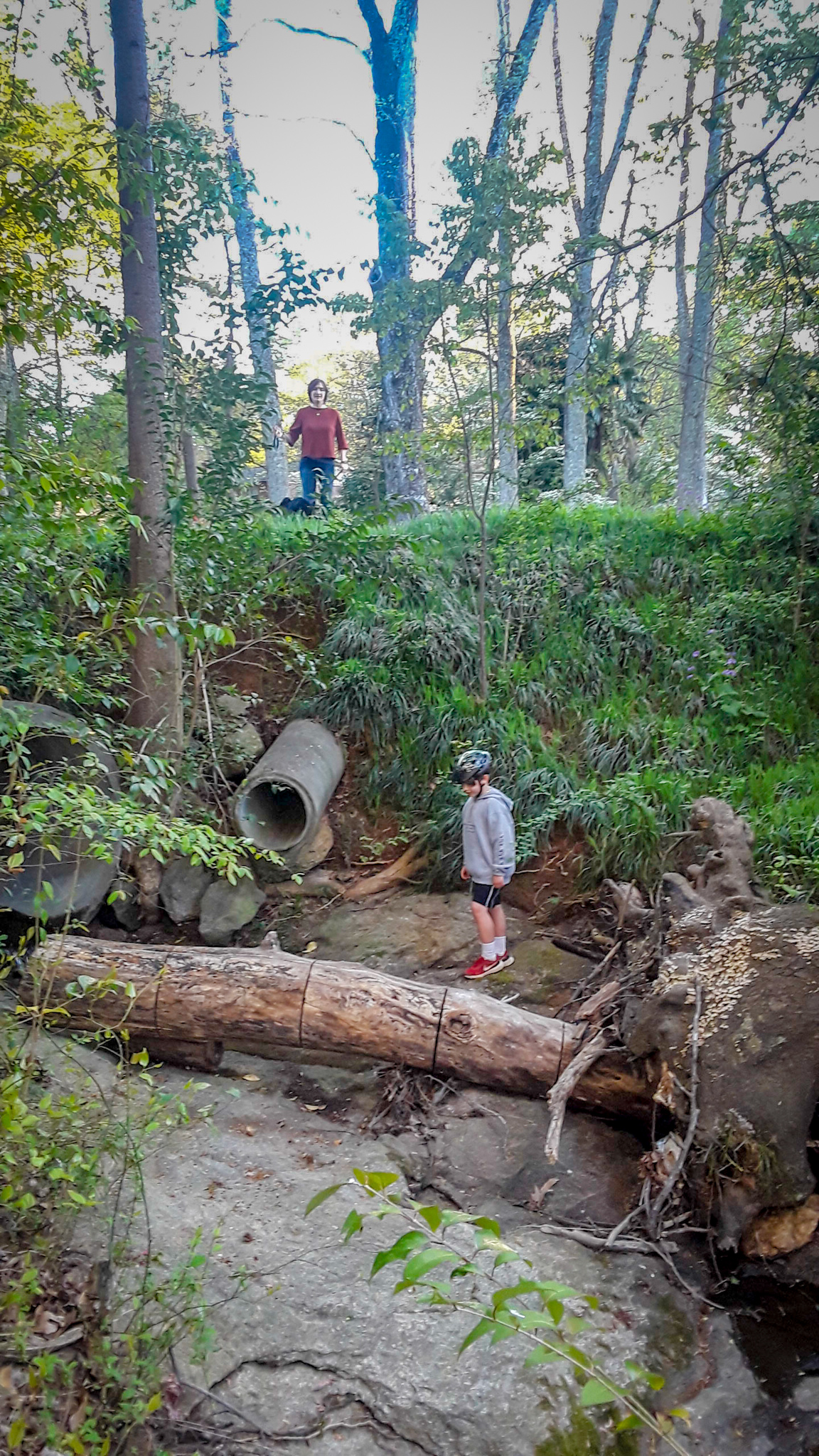
Month: April 2020

Day 27: Holy Saturday 2020

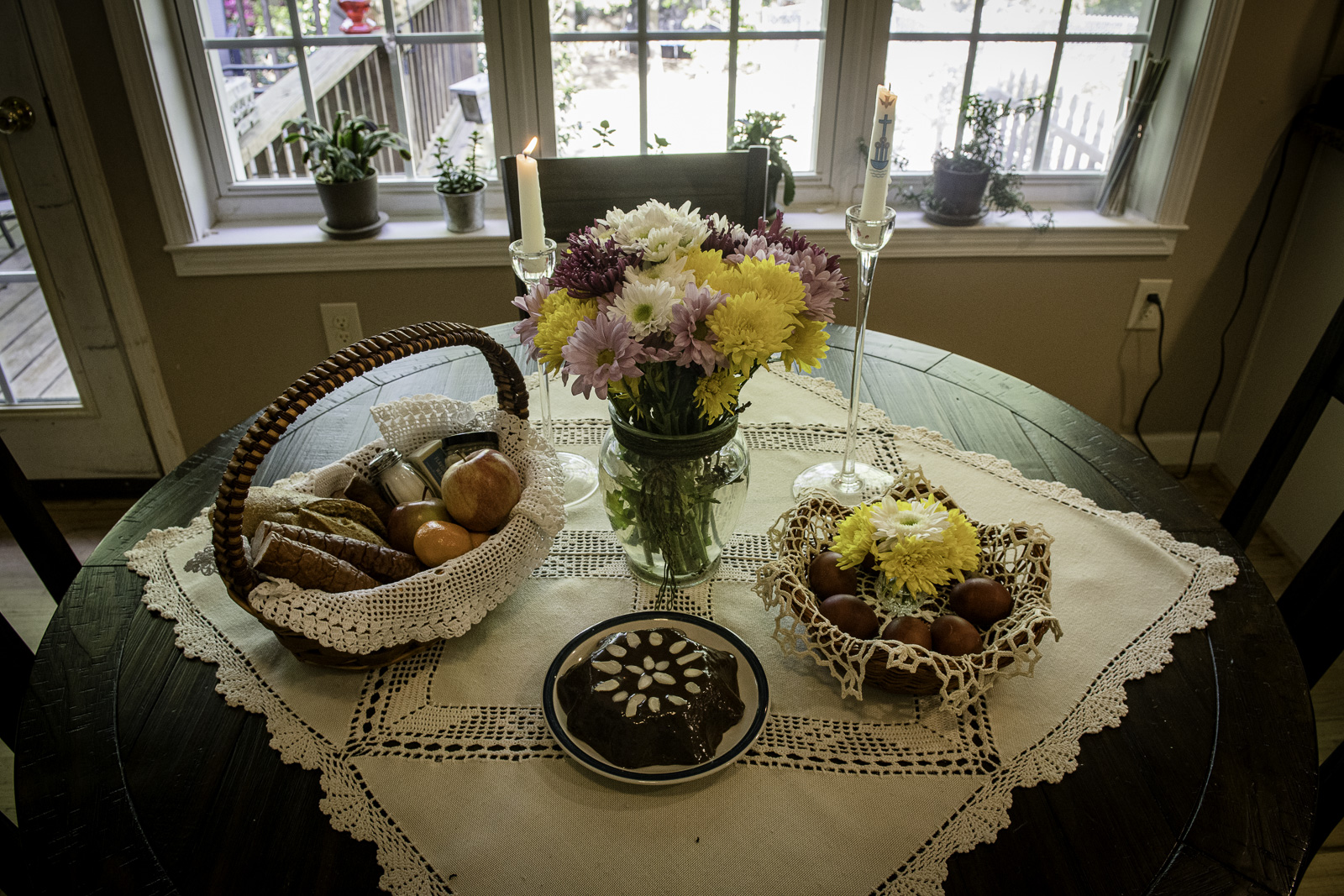
For everyone in the local Polish community, Holy Saturday has meant one thing: a visible continuation of traditions from the Old Country — the blessing of the Easter baskets. When we began the tradition, the parish pastor had no idea what it was. He quickly learned and just as quickly fell in love with the tradition.
This year, then, was the first Holy Saturday in a decade that we didn’t have a basket blessing here in Greenville. In some ways, that made Holy Saturday wholly different. But some things were the same.
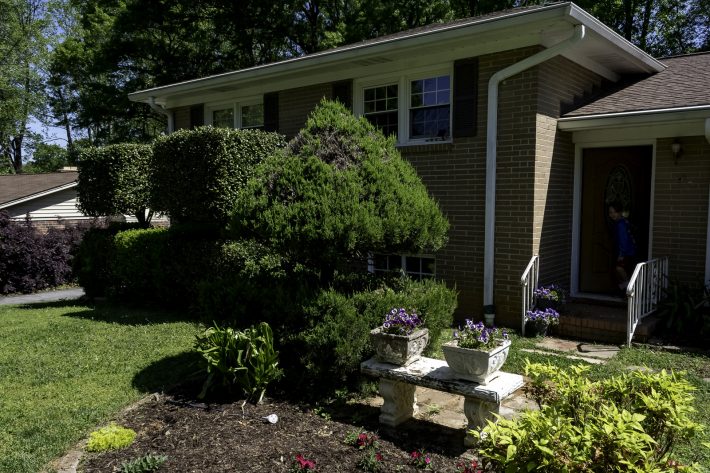
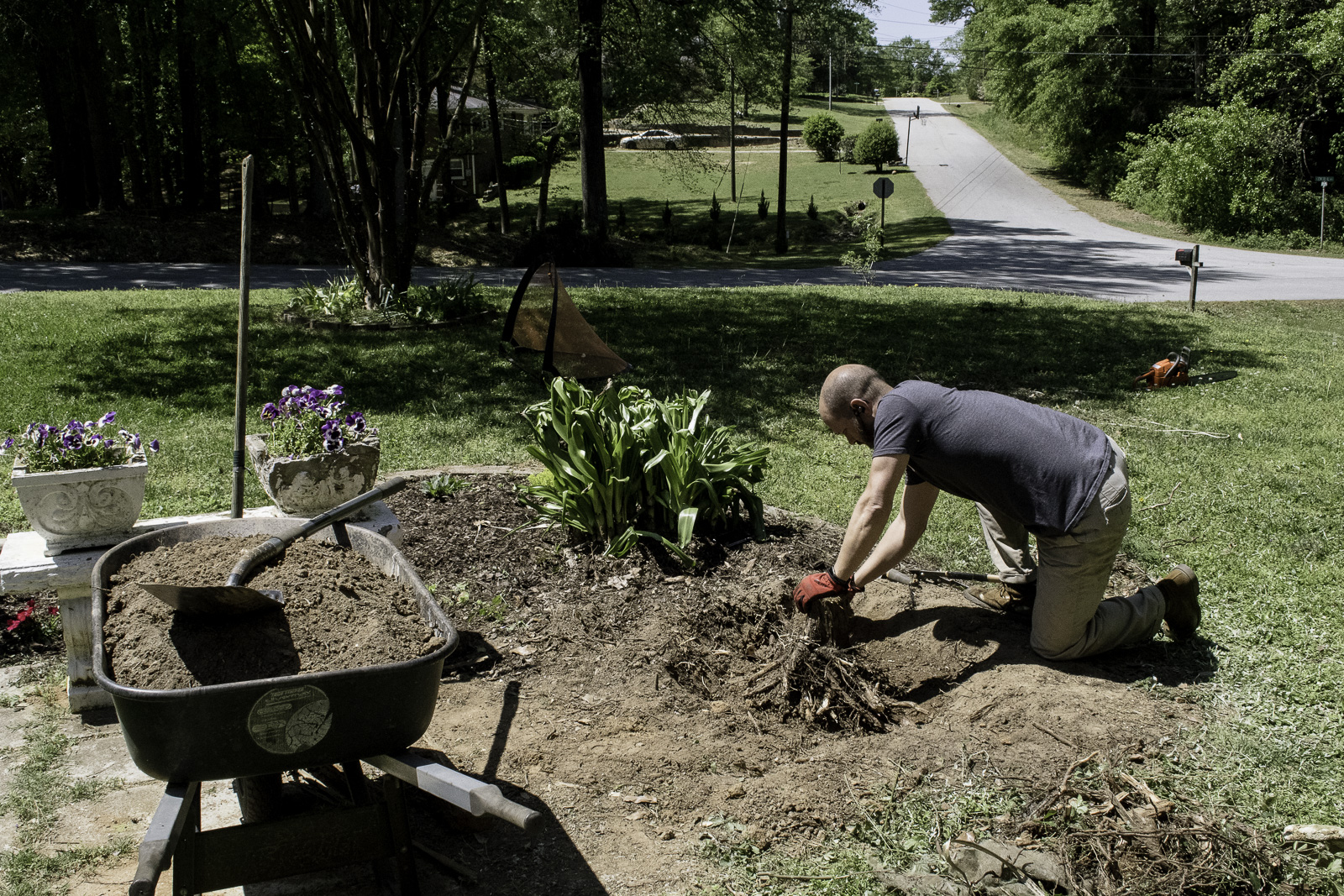
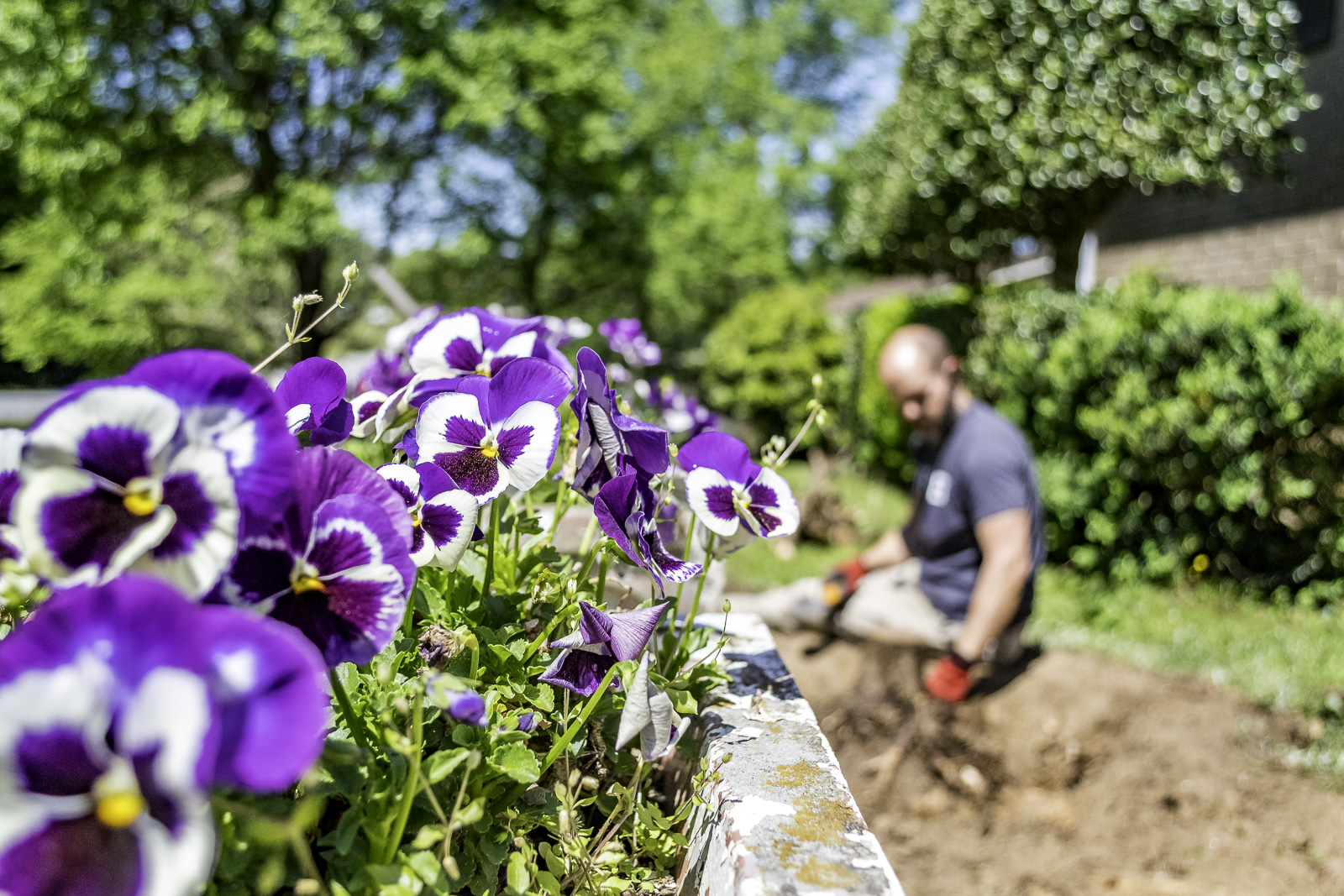
That tree in the front yard that I wanted to cut down yesterday? It’s now gone, along with my back.
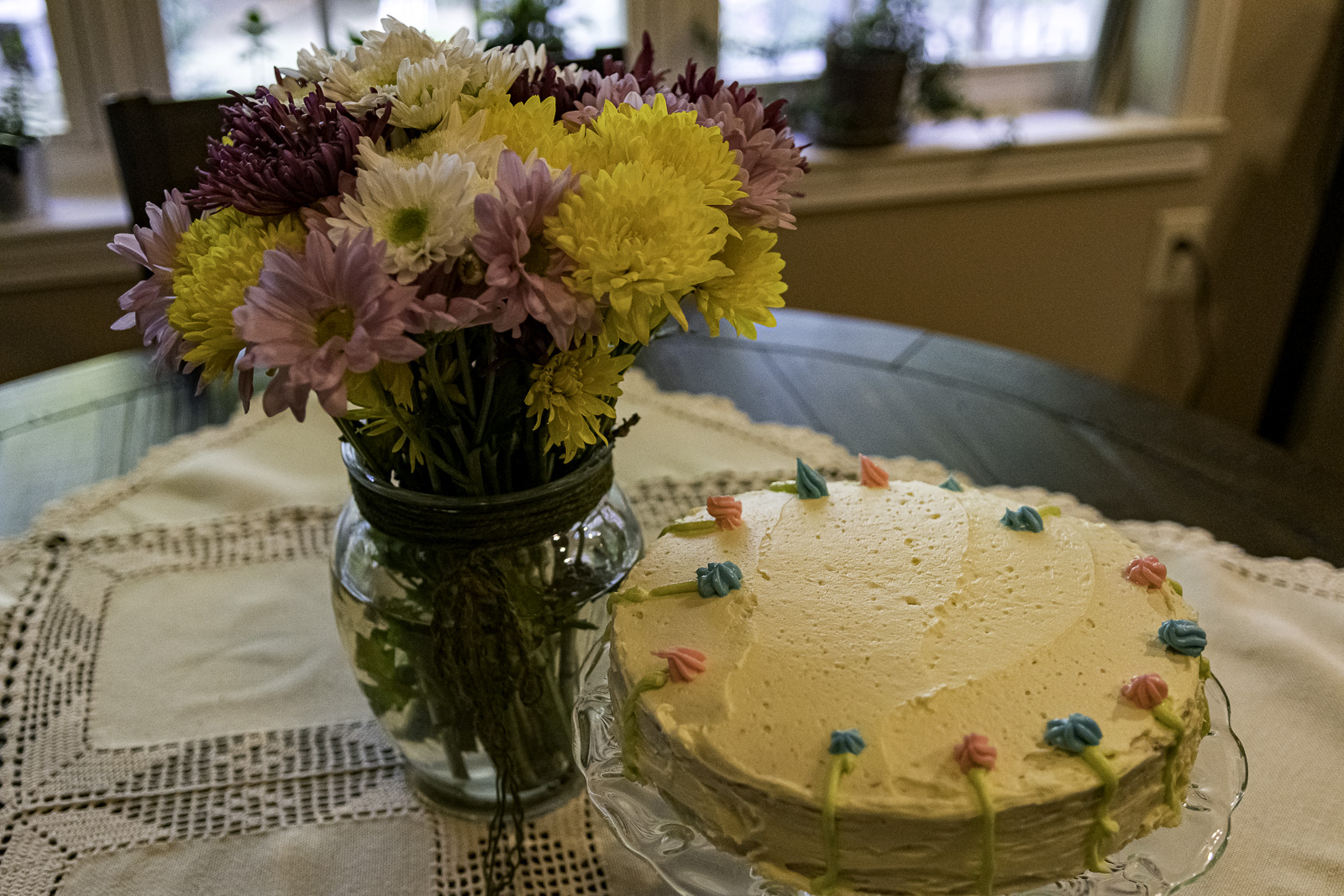
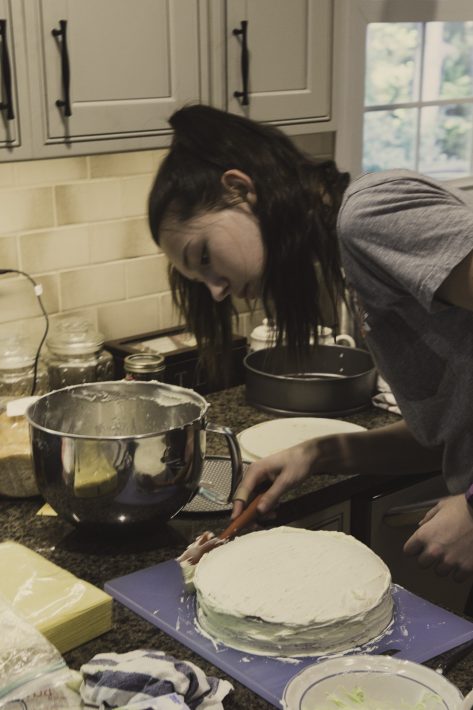
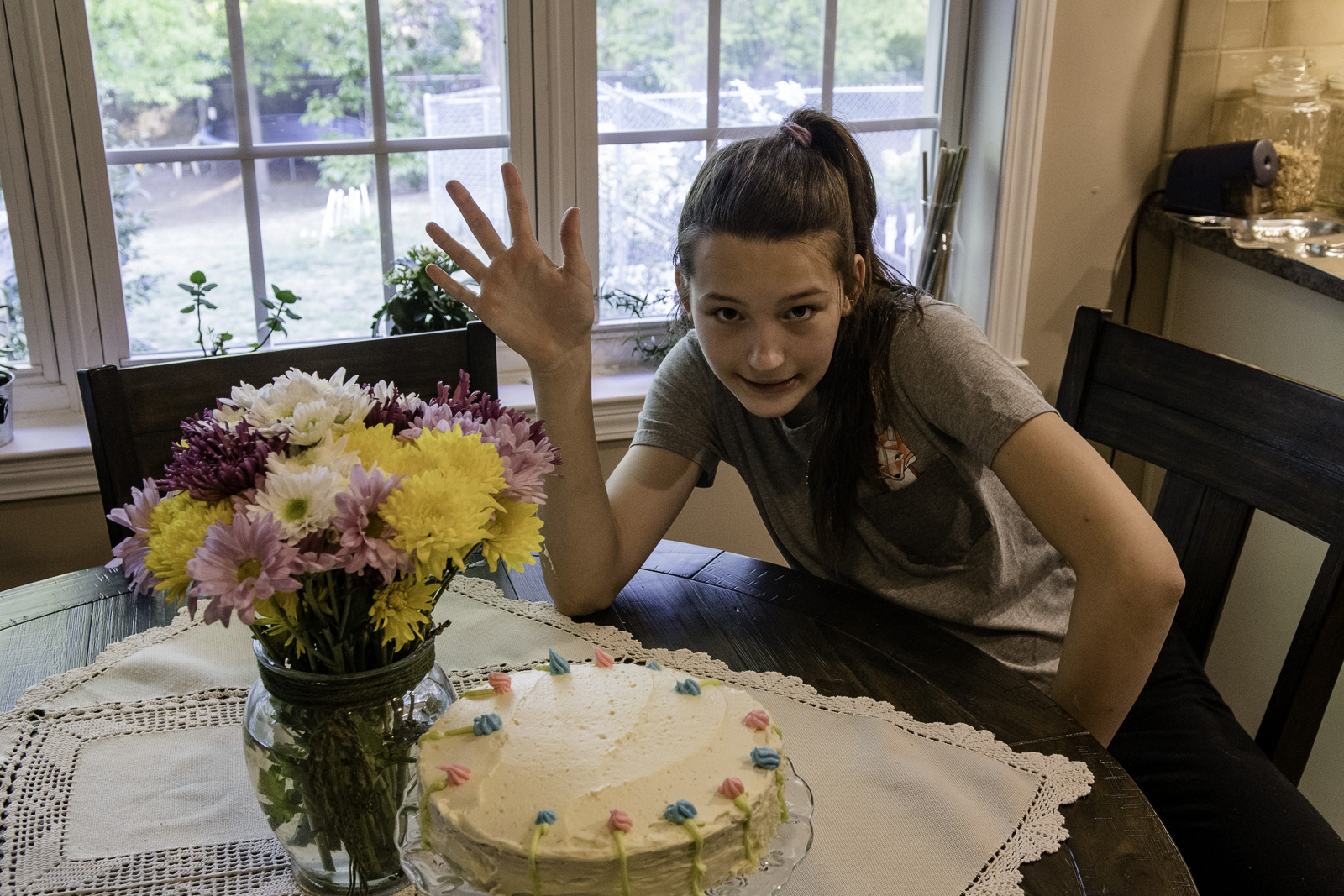
More similarities: there was baking, baking, baking. For whom? For our family. For friends. For our neighbors. For anyone who wanted it, I guess. The difference? The Girl was involved — not just involved, but insisting on seeing the whole process through to the end alone. Well, almost alone — moving it to the cake stand was a bit too scary for her.
What else was the same? The kitchen was a disaster area for most of the day.
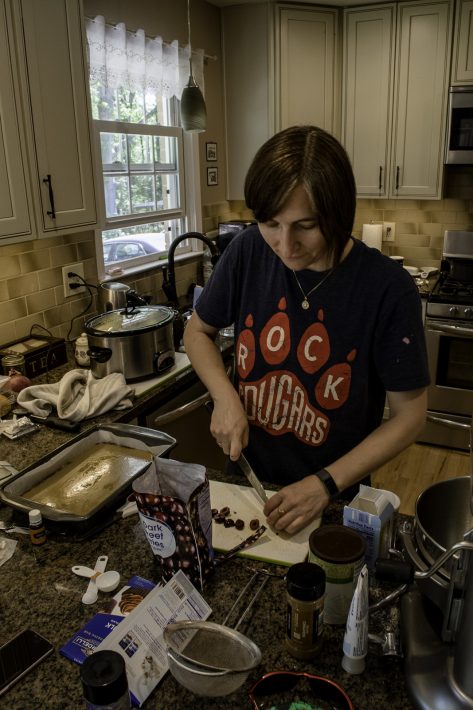
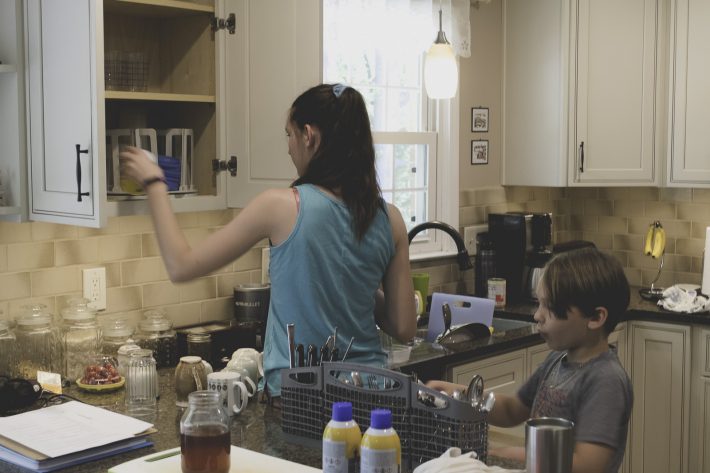
An artist at work always leaves behind a mess. And one of our culinary artists is better at cleaning up the mess she leaves behind than the other, and I’m much more likely to jump in and help clean with one of the artists than I am with the other. Lessons to learn.
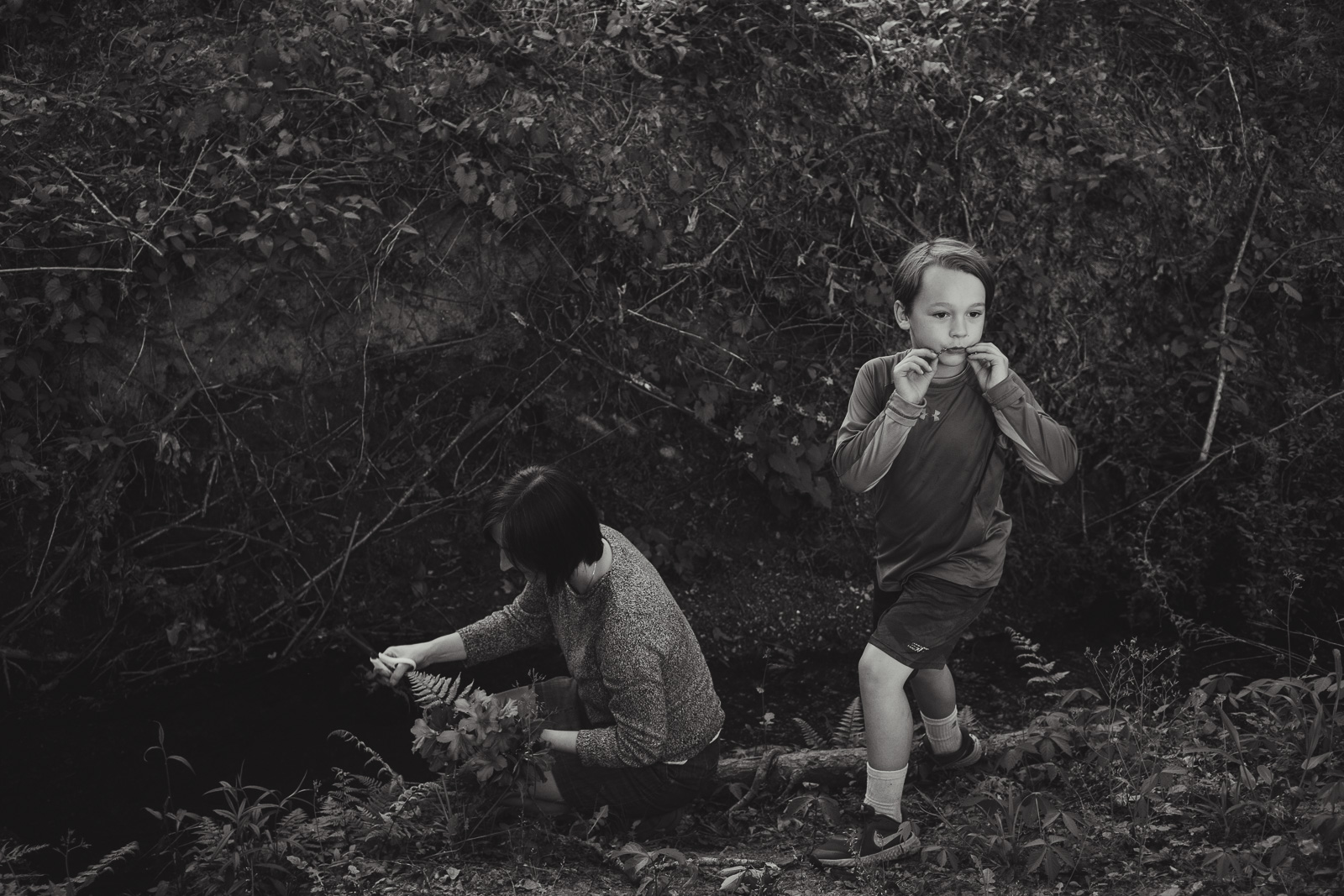
Previous Years

Basket Blessing 2019

Basket Blessing 2018

Baskets 2015

Blessing the Baskets

Day 26: Good Friday

Good Friday is always a work-filled day among Poles, which I’ve always found somewhat ironic. In some ways, it’s the most solemn day of the Catholic calendar, and you would think that devout Catholics — of which in Poland, particularly rural Poland — would spend the day in prayer. In my experience, they usually spend the day cleaning and cooking (often things they don’t eat because it’s a fast day, though Catholic fasting is hardly a discipline compared to some forms of fasting).

Today’s job for me: take care of the leaves in the backyard. “After all, it is April,” K smiled at breakfast. I wanted to cut down a topiary tree in the front yard that we’ve decided is dying and needs to come down. I’ve wanted to take it down for years, but I guess that’s for tomorrow.

Day 25: Chores, a Trip, and an Old Friend

Chores

The kids have one chore that they do together. They have other chores, but one is a co-chore: emptying the dishwasher. If we tell L to start emptying the dishwasher, she will fuss if E is not there to help immediately; if we tell E to start emptying the dishwasher, he will fuss if L is not there to help immediately.

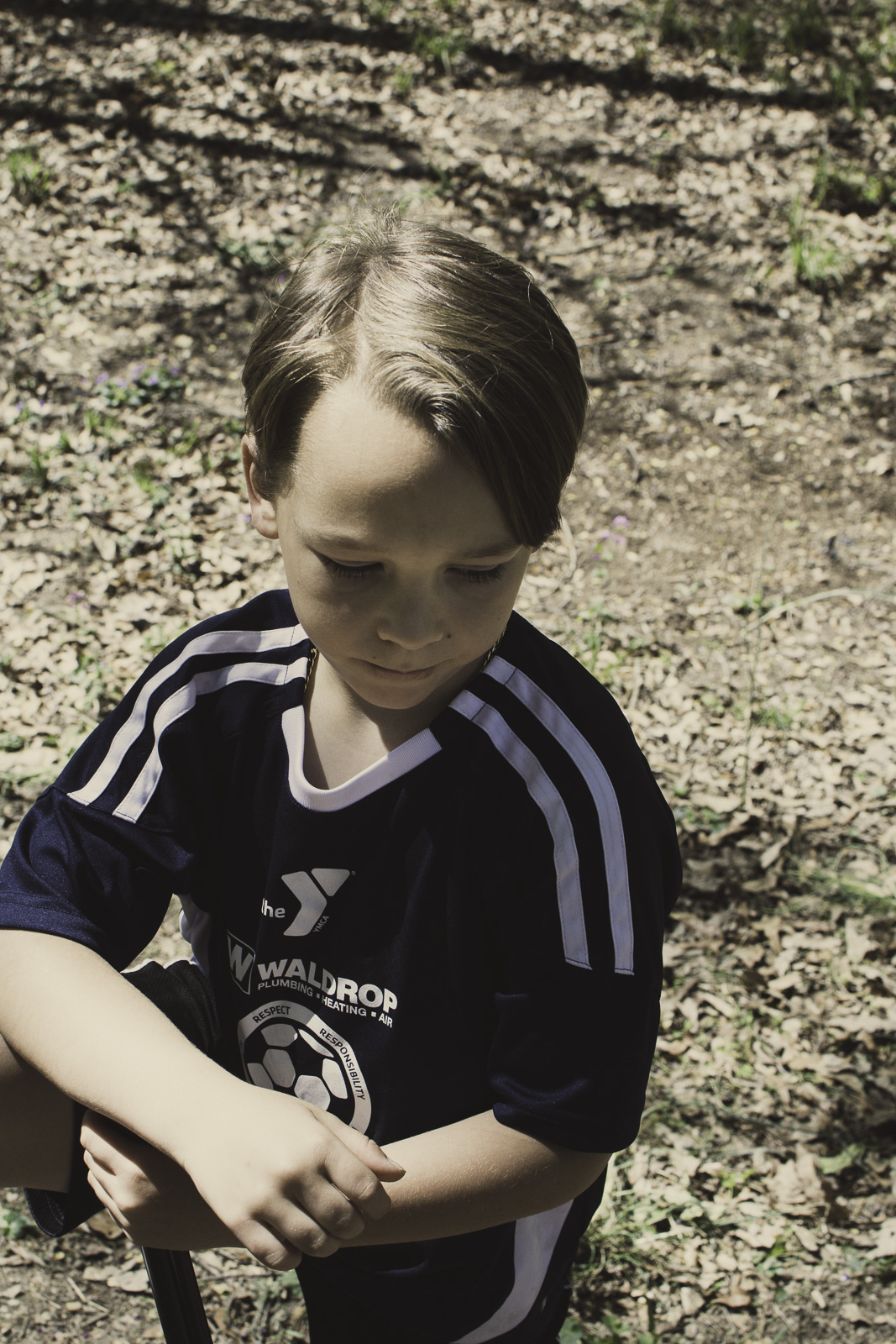
And yet there are things that one would think should be a chore but are a joy — at least to the Boy. That’s right: the weed eating obsession continues.

He has trimmed every inch of the backyard and is ready to go back to the front to start again.

A Trip

We are finally allowed to go back into the school building. That’s not to say school has resumed, but if we need anything from our rooms, we can head back and pick up whatever we need.

Today, I decided I would head over to the school, not for professional reasons (I have everything I need for remote teaching) but for personal reasons: the Girl has run out of reading materials. With the library system closed for about as long as the school system, there’s no chance of getting a new book through the usual channels.

But when you’re an English teacher, and an eighth-grade English teacher at that, you have quite a substantial classroom library to choose from.

I offered to take the kids, thinking that when they heard that they would have to stay in the car that they would be reluctant to go. Not so. They were thrilled just to get out of the house.

Old Friend

A few years before we turned the carport into Papa’s room K discovered a little turtle in the laundry room. “It’s a snapping turtle,” I confirmed. It was probably four or five inches in diameter, and I reasoned it must live in the creek behind our house.

Some time ago, we discovered an enormous snapping turtle living in the creek. It looked to be at least a foot in diameter. Most of the creek is a couple of inches deep, with a few spots probably getting to a couple of feet, so I found myself wondering how in the world a snapping turtle that large could survive in such an environment. What could it possibly be eating?

The same turtle? I don’t really know. I don’t know how quickly snappers grow. According to turtleowners.com,

The growth rate of a Snapping turtle is influenced by a lot of things like genetics, diet, and environmental conditions. But in general, they will grow around 4 inches during its first year, and then around 1 or 2 inches per year.

So I guess it could have been the same turtle. After all, my measurements are guess-timates: I didn’t exactly jump down into the water with a tape measure to determine the size of a turtle that, whatever the exact dimensions, was big enough to separate me from one of my digits.

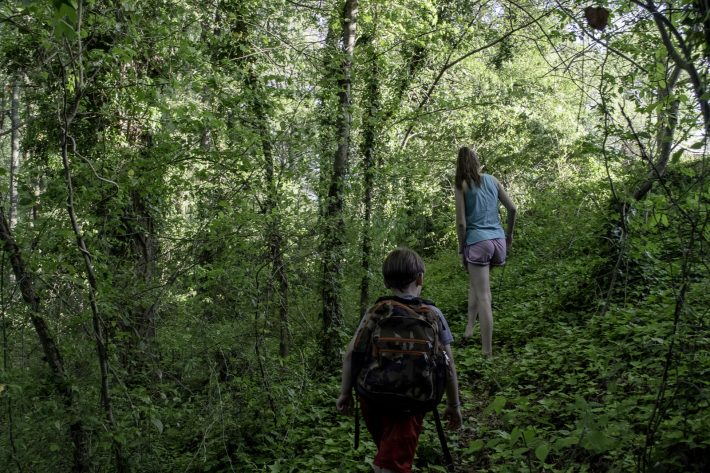
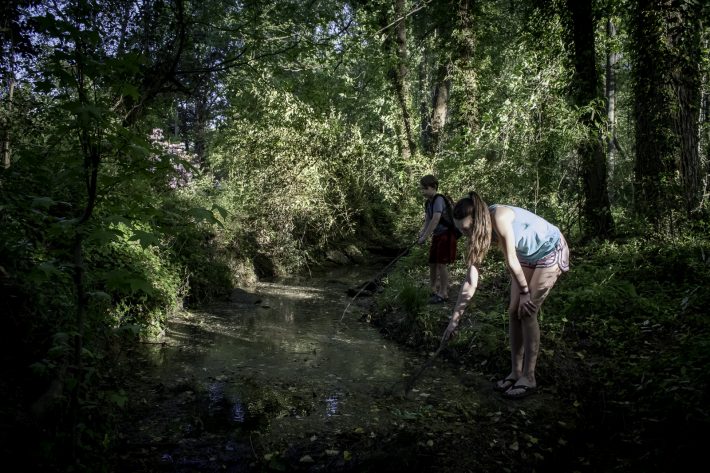
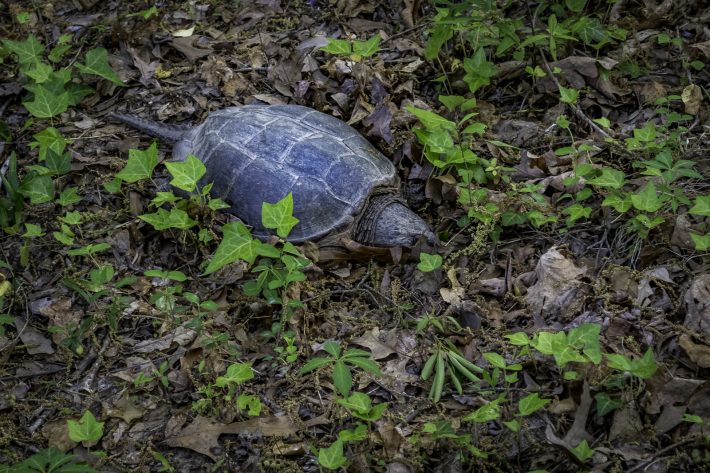
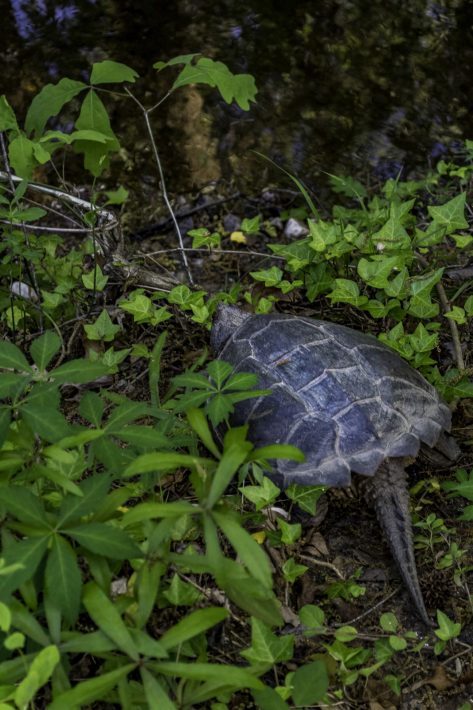
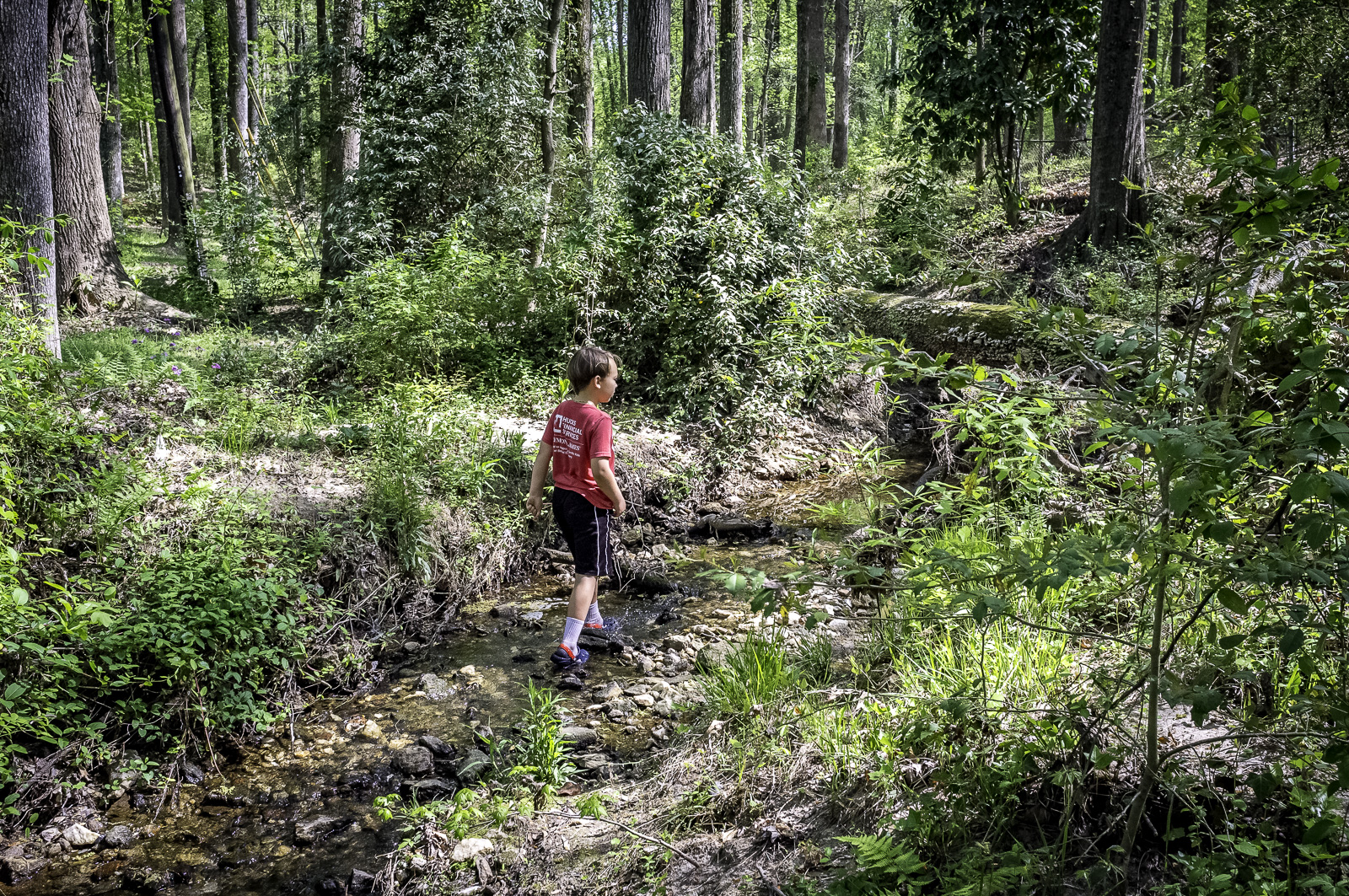
Today, as we were in one of our exploring modes, the Boy just about stepped on the snapping turtle as it sat on the bank.

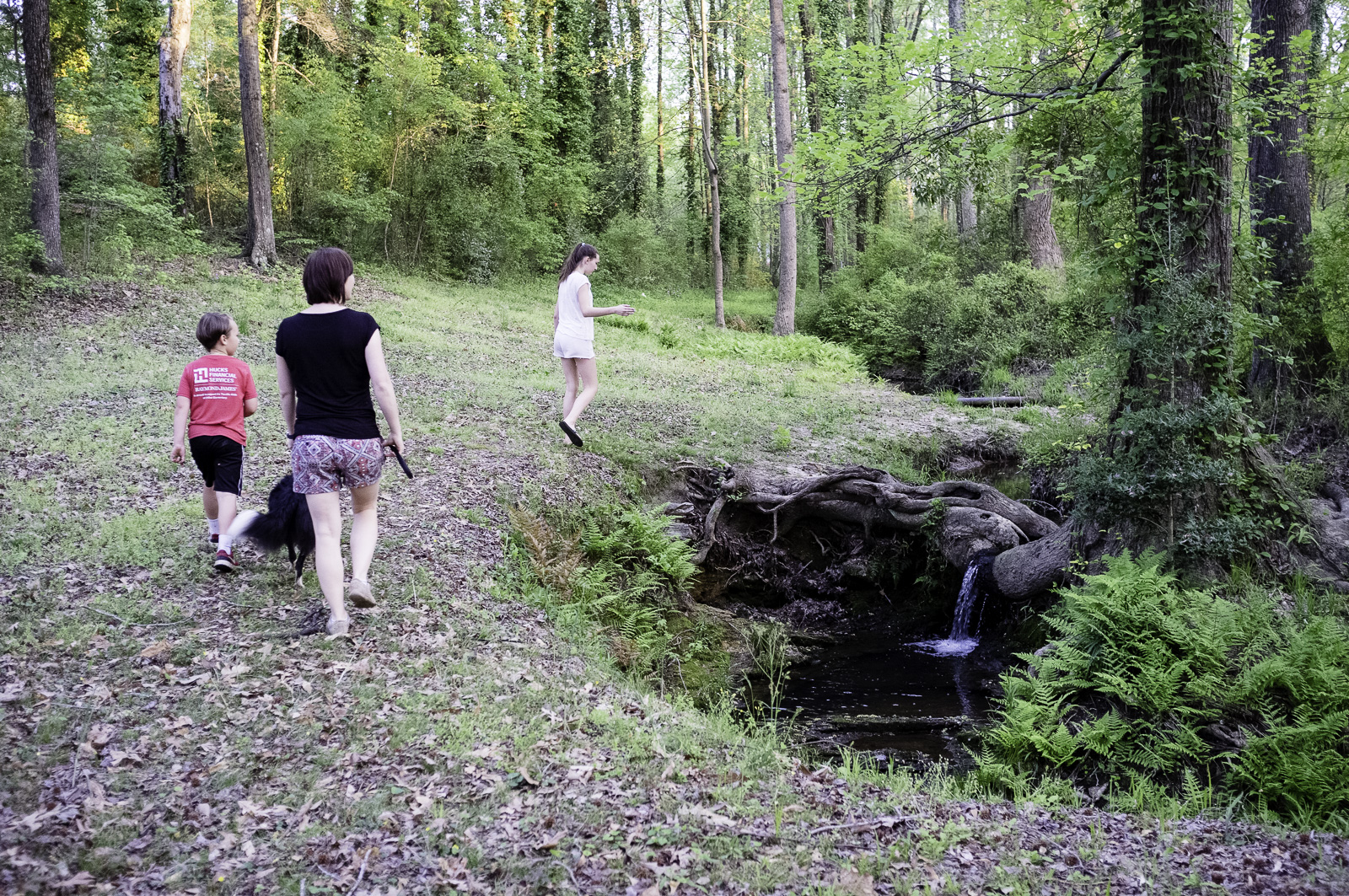
“Dad, come here!” I heard. I was snapping a picture of one of the little waterfalls, trying to smooth the water with a slow shutter speed without a tripod — a balancing act, literally and figuratively.

I walked over and there she was, sitting motionless after having climbed out of the creek at a point where the bank seemed prohibitively steep. I took a stick, turned her around, and encouraged her back to the water.

She swam off into a deep part of the creek where the bank had washed out, leaving a tree’s roots exposed and stretching into the water.

“The perfect place for her,” L exclaimed.

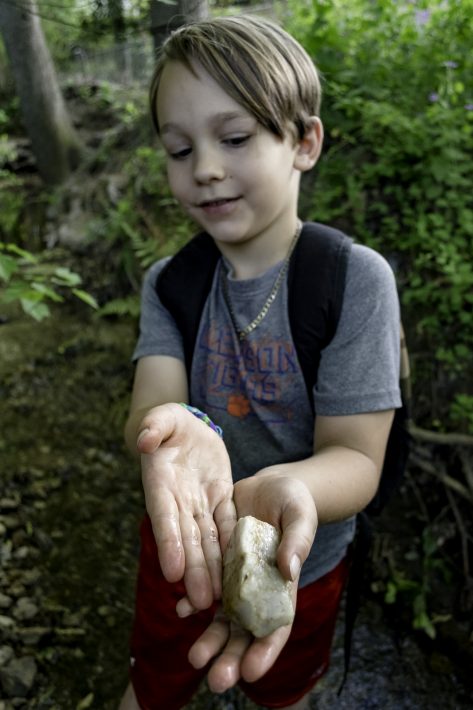
On the way back, we stopped for some rocks for the Boy. He’s been collecting rocks and minerals. We’re not sure why.

We’re happy to help.

The day ends with the Boy and me cuddled in the hammock, making each other laugh with silly jokes.

“I love when we do this,” the Boy admitted.

“I do, too, buddy. I do too.”

Day 24: Legos and “Weeds”

The Boy got a fair amount of money from Babcia for a) his first communion and b) his birthday. Both are over a month away; the latter is sure to happen, the former, not so much. But Babcia sent the money early because she wanted to be sure it got here in time.

“I’m rich!” he squealed and began plotting how to spend the money.

“Not so fast!” K jumped in. The money for first communion must go toward something, well, churchy. “Do you know what Ciocia Z bought me for my first communion?” K asked E. “The image of Saint K that’s over our bed.”

“In your bedroom?”

“Yes.”

“You still have it?” We tried to explain that yes, that is the point.

As for his birthday money, well, that’s his to spend as he wishes. Within reason. “You’re not spending it all on Pokemon cards!” K and I said in chorus — or if we didn’t, we at least thought it at the same time. Roughly.

There is, of course, one thing we’re always willing to let him buy: Legos. Anything that simultaneously builds, I don’t know, the ability to follow technical directions (when building the sets) and encourages creativity (when building everything else after the set has been demolished and all the blocks added to the growing collection) is to be valued.

“Daddy, I’m going to take my time with this set!” he proclaimed as he opened all the numbered bags and carefully poured them into bowls (that’s where they are, K, when you’re looking for them).

With all the free time he has now, that’s a good idea. But even if it goes faster than he planned, there’s always some trimming to do.

Day 23: Conferencing and Apologizing

Conferencing

We had a chat in English I today about the mad dog scene.

I was helping the kids see the significance of this seemingly out-of-nowhere scene. Students’ reaction to the chapter was fairly unified:

S1: It opened up a lot of questions to me about Atticus; what was his past life? How did he have the knowledge to shoot, and how did he shoot so well?

S2: I was in shock, mostly because of how I was pondering it’s relevance to the book. The act it’s self didn’t perturb me but it did show how close the community is.

Once I got the kids to see that the scene is there to set up one way that Atticus has, contrary to his children’s view, hero qualities in the traditional sense (read: macho sense), we’re ready for them to understand why he kept it under wraps for so long. (The Mrs. Dubose scene is critical for that.)

At the end of the conversation, one student asked me about our dog. (When experimenting with Flipgrid, I made a video for the kids, and in it, I showed them our dog.) There was a bit of a misunderstanding in our conversation today, though:

S1: How’s your dog?

Mr. Scott: She’s in heaven

S1: Wait, did she die???

Mr. Scott: She’s never had so much attention or gone on so many walks

S1: OH

S2: I was worried.

S3: I thought she died too-

S4: O I thought you meant she died

It struck me as odd that they thought I might use a phrase like “She’s in heaven” to tell them the dog had died.

Apologizing

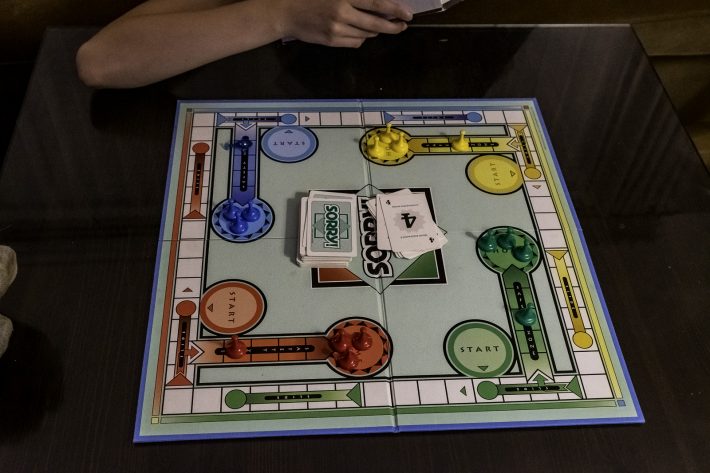
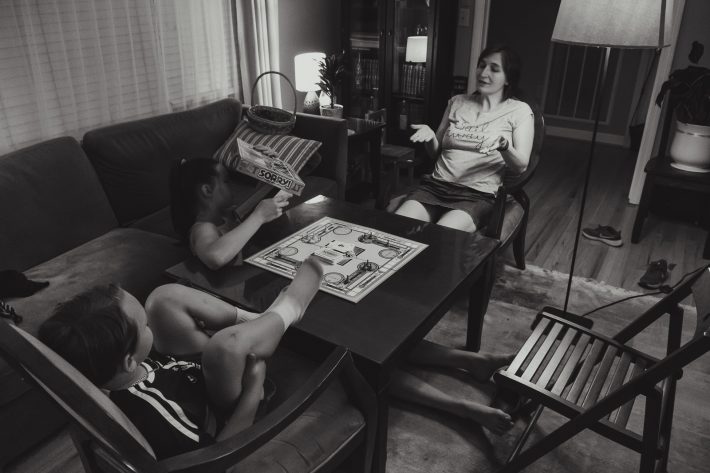
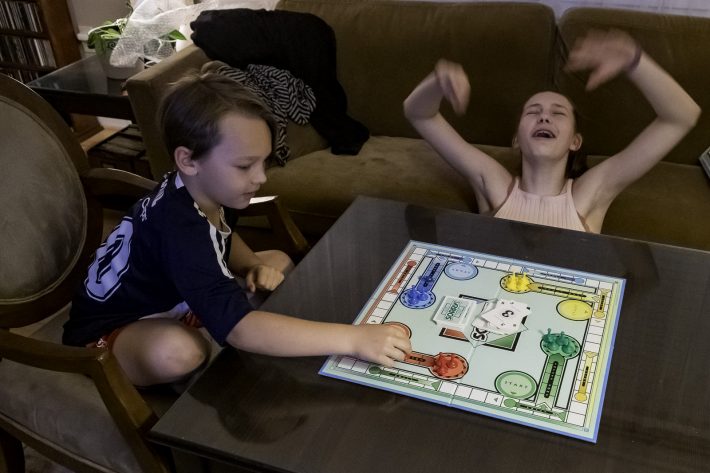
We go on a walk just about every single evening these days, and when we come back, if we have time, the kids want to play a game. Monopoly has held a monopoly lately, but today, the Girl talked E into trying Sorry again.

She was probably sorry she did.

E jumped into the lead and before almost any of us had more than one pawn in the “Home” circle, he had three. And his remaining pawn was stuck at “Start.” Forever. And ever. So long that we all caught up to him.

I have to admit, I was really rooting for him. When I drew I “One,” which would have allowed him to start moving, I wished I could slip it back in the deck for him. He’s so frustrated with board games because he never seems to win.

I wasn’t exactly helping L, though. I Sorry’ed her a couple of times, and at least once, when I drew the “Move forward ten or back one” card, I moved back one just to knock her back to start. Part of it was to see how she dealt with frustration. She did admirably well — that girl is growing up. (Slowly, but I guess we wouldn’t have it any other way. Well, about most aspects.)

The game kept going until it was a four-way tie: all four of us had three of our four pawns in the “Home” circle and the other pawn three or four moves away from victory. K stole the win from E, which is fair in a sense: in Monopoly, we’ve taken to calling her “slum lord” because of her property choices and indebtedness. She deserved a win. (Though she did come out fairly strong on the last time we played Monopoly…)

“Can we play for second?” L asked.

I somehow managed to get second place, which I really didn’t want. Again, hoping for the Boy to get a little bit of an upset.

“Can we play for third?” the Girl asked.

And the Boy swooped in to steal third.

Day 22: Time, Organization, and Aim

Time

“How long have you been home from school?” K asked as we took our now-nightly, post-dinner family walk. “Is this the second or the third week?”

Not willing to pull out our phones mid-walk, we couldn’t figure it out. Such are our days now: one day blends into another as effortlessly as — as what? I can’t remember a time when time itself seemed so free, so floating, so held down by so little. With the only thing to distinguish a school day from a non-school day being how the kids spend their mornings, the days are a blur now, a smear of time and virus.

How long have we been worrying about this? How long have these precautions been in place? The powers that be suggest that we’re not even at the halfway point, but it already feels as if this has been our reality for as long as we can remember.

It’s not that I’m complaining. We all understand why we’re doing it. We simply didn’t realize how quickly this would be how we define “normal.”

Organization

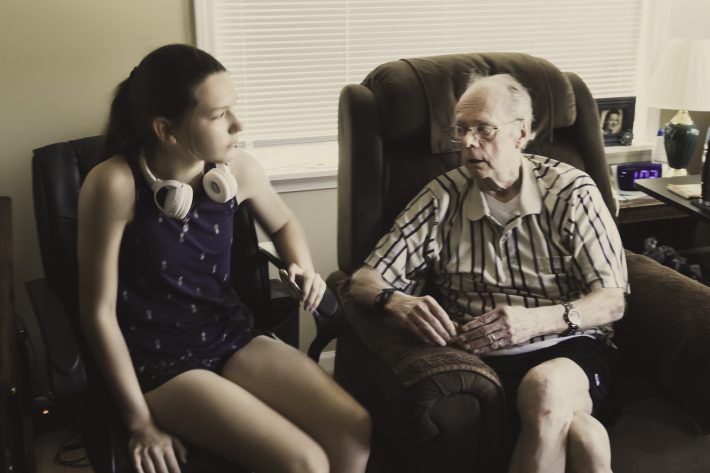
Today, L started a project with Papa to rearrange and reorganize all his file folders. Nana was a thorough bookkeeper, and she kept track of just about every significant (and many less-than-significant) documents that came through their house. Take receipts, for example: in case of audit, they’d kept tax records for years, including receipts. Every month’s receipts in separate monthly envelopes, all envelopes for a given year in a box for the year.  We still haven’t burned all those. So that gives an idea of the granularity of their record-keeping.

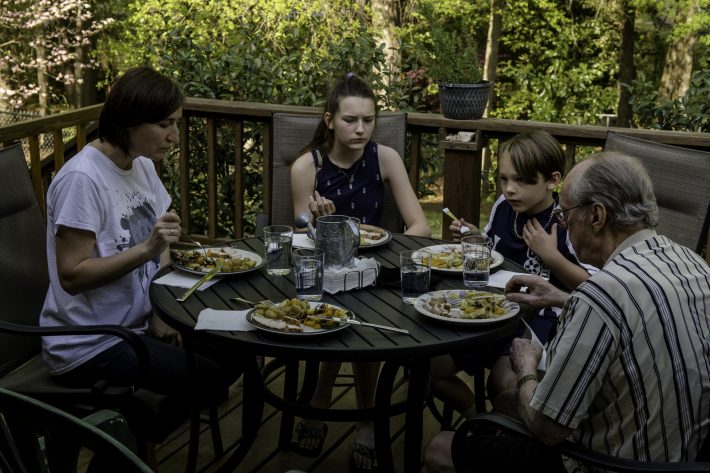
Papa has decided he doesn’t need all the other records as well, so he’s thinning everything and reorganizing it. That’s where L’s responsibility begins: she is a fastidious organizer. She likes for us to sit in order of decreasing age at the table for dinner. You can see it in this picture, minus me. Some — namely I — might suggest that this is a bit much, a bit obsessive-compulsive. But when it comes to reorganizing, that’s just the mentality you want.

Aim

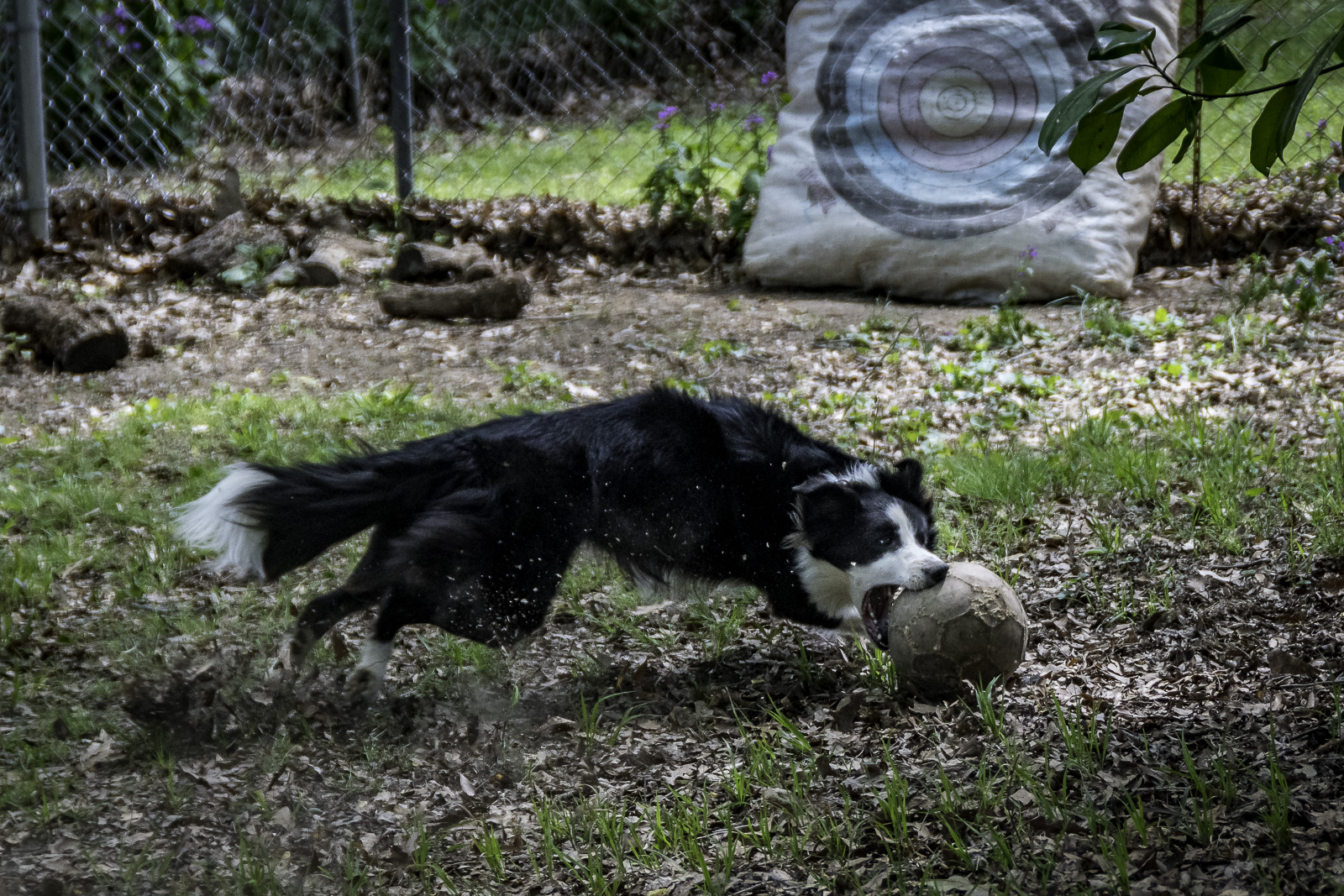
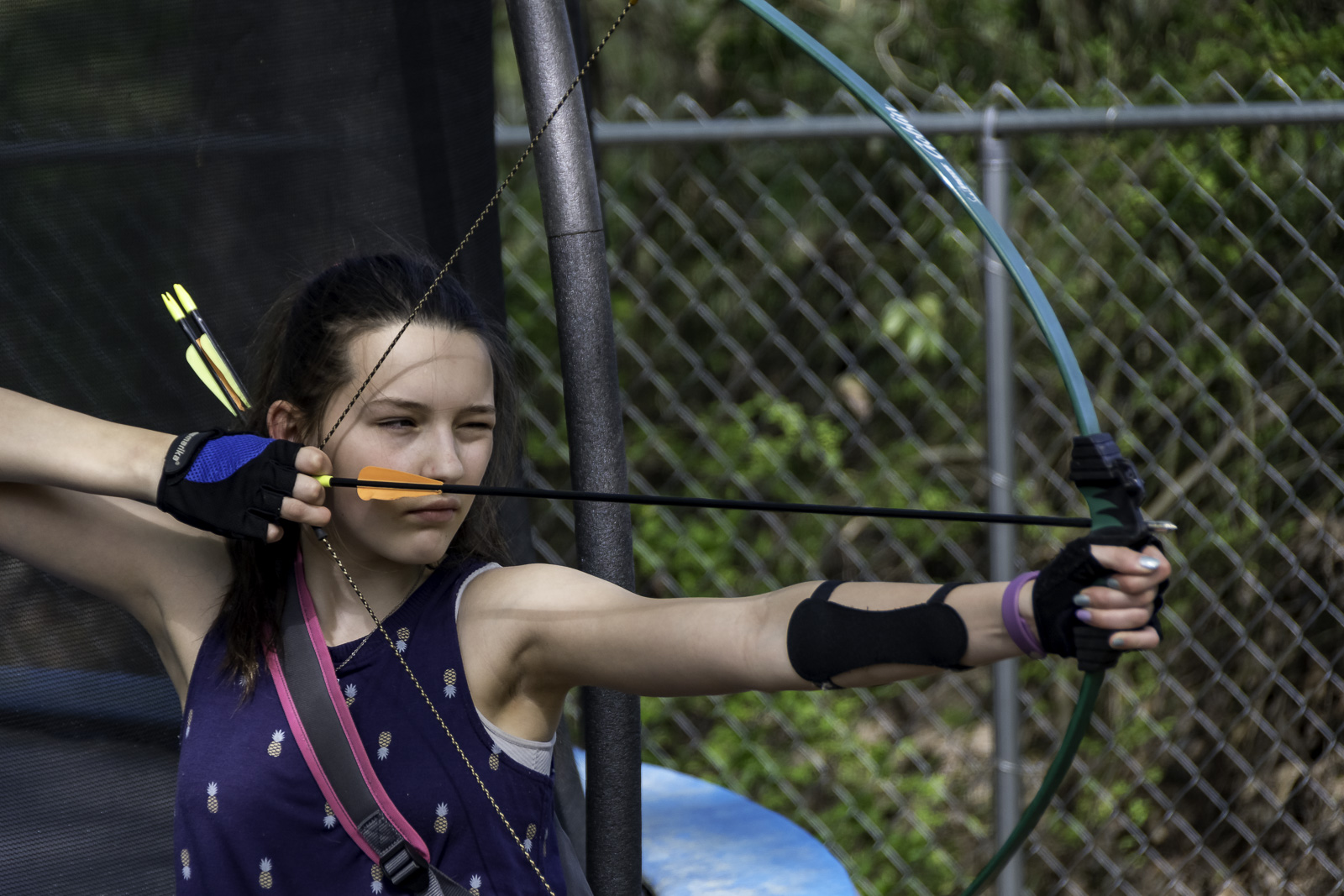
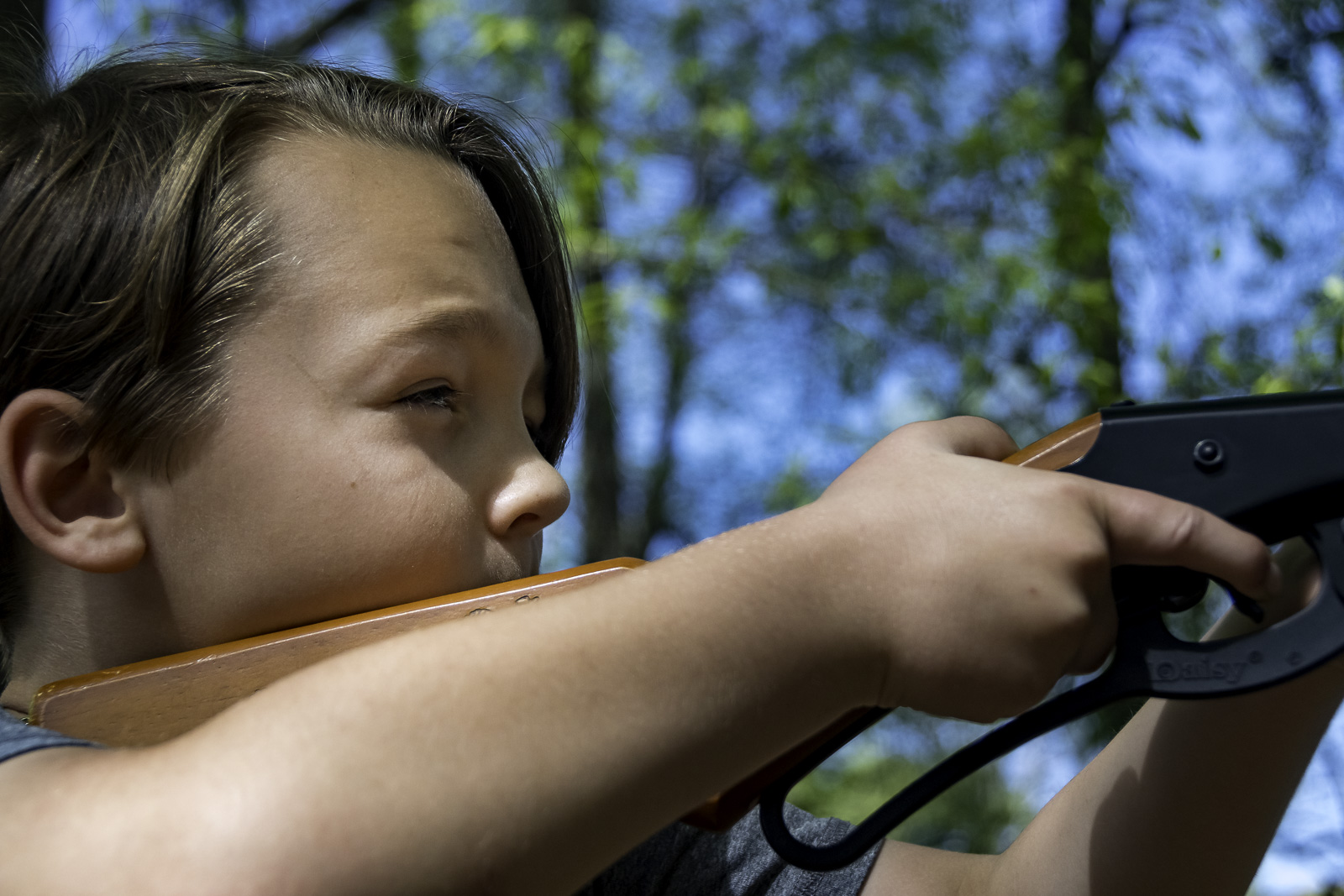
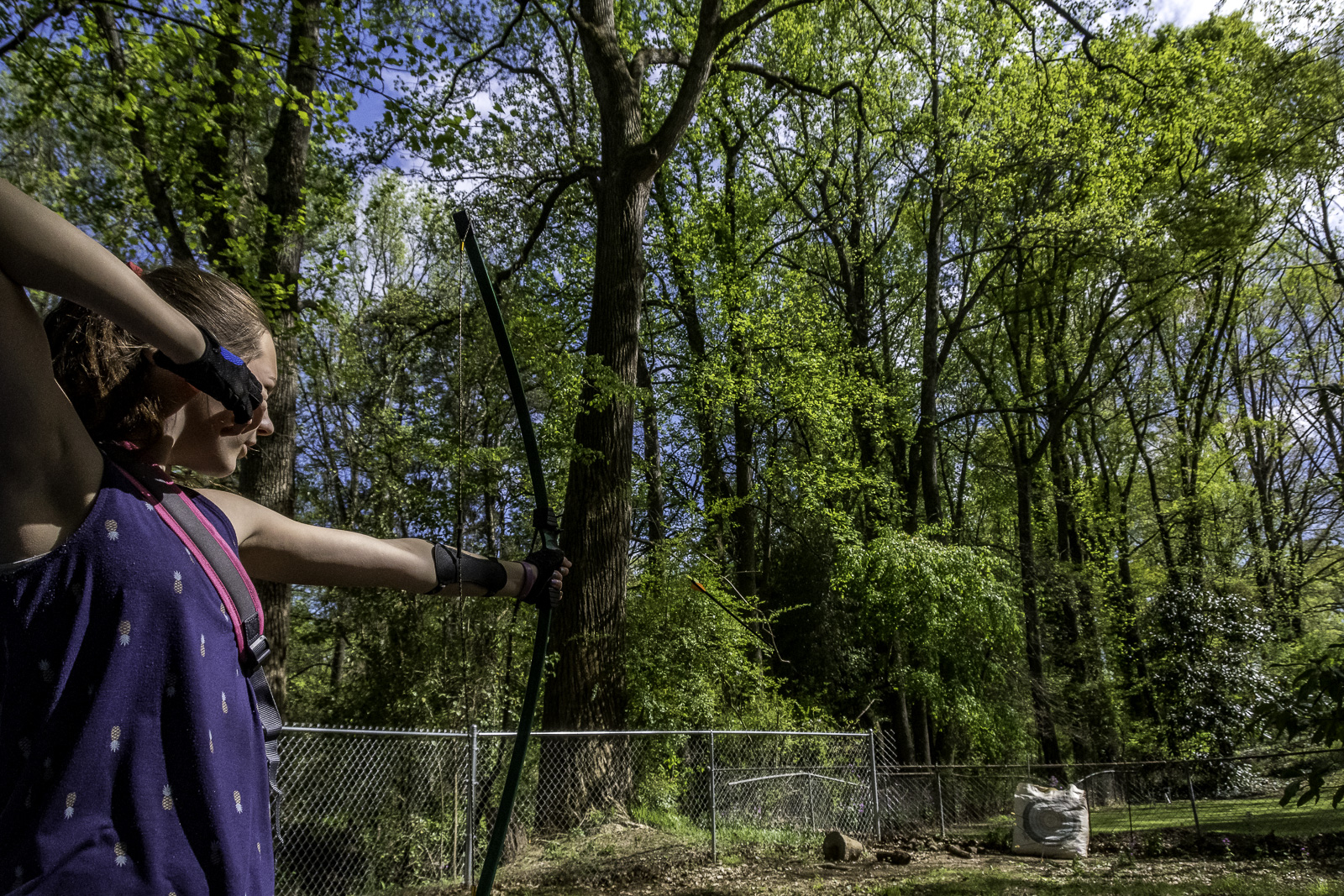
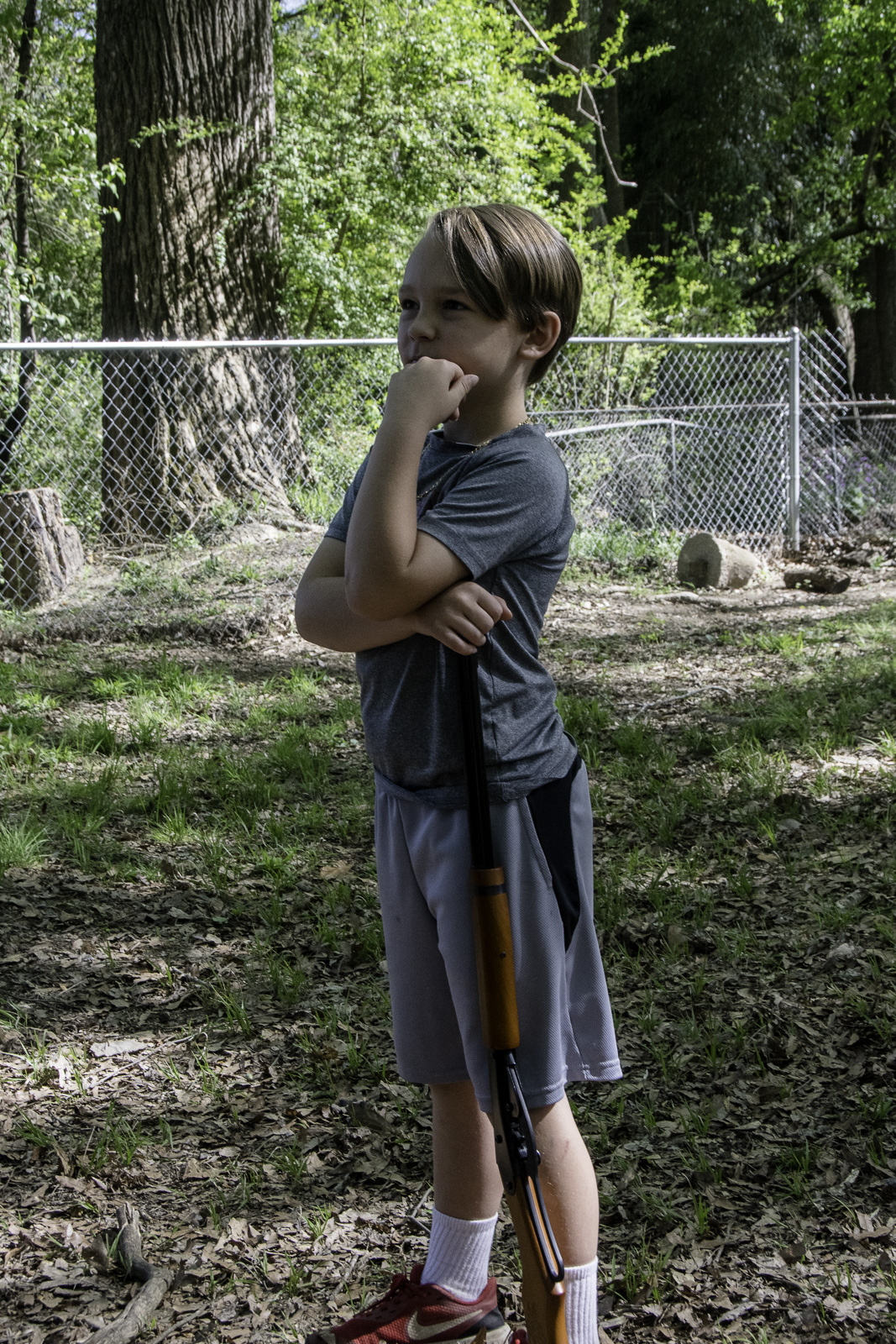
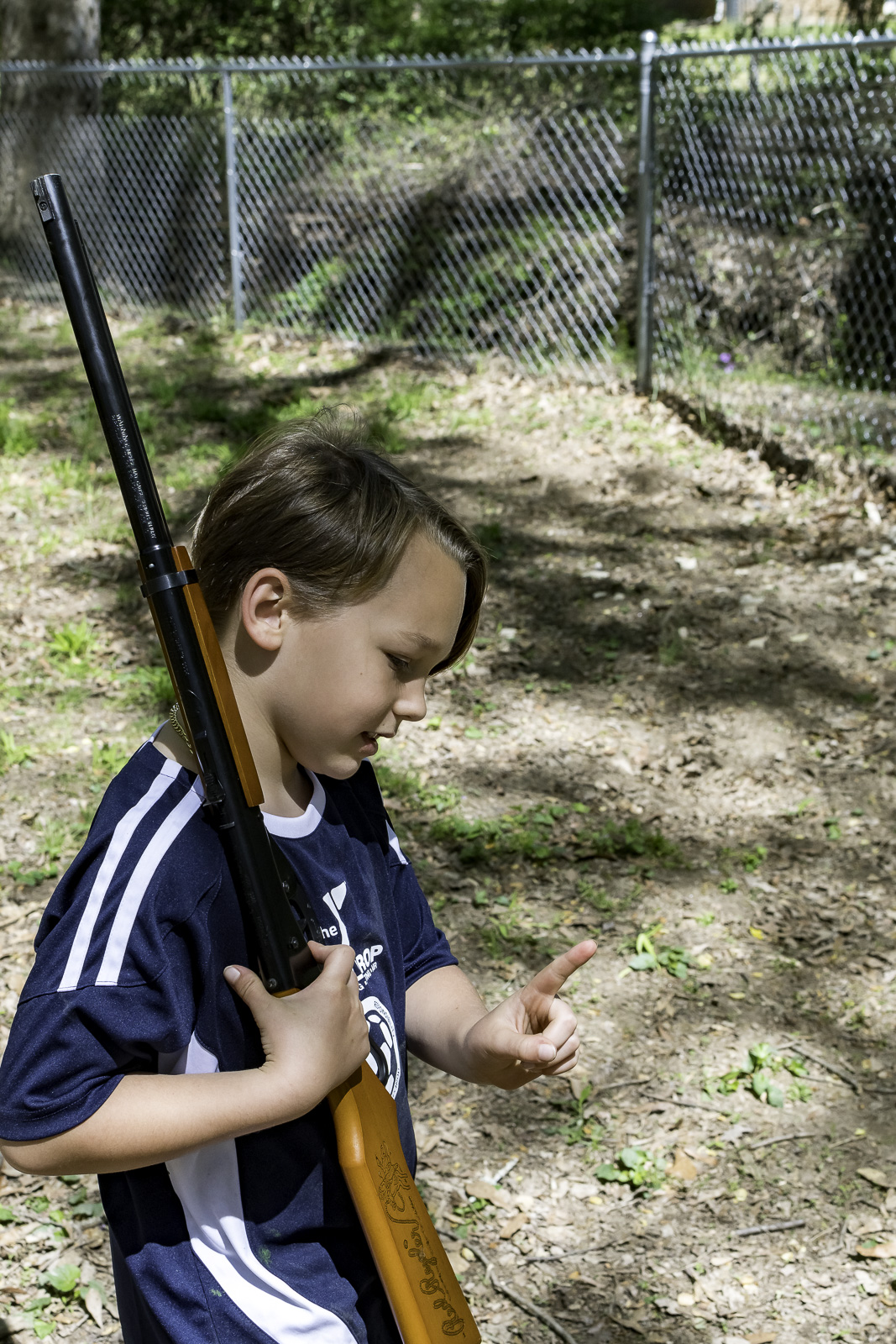
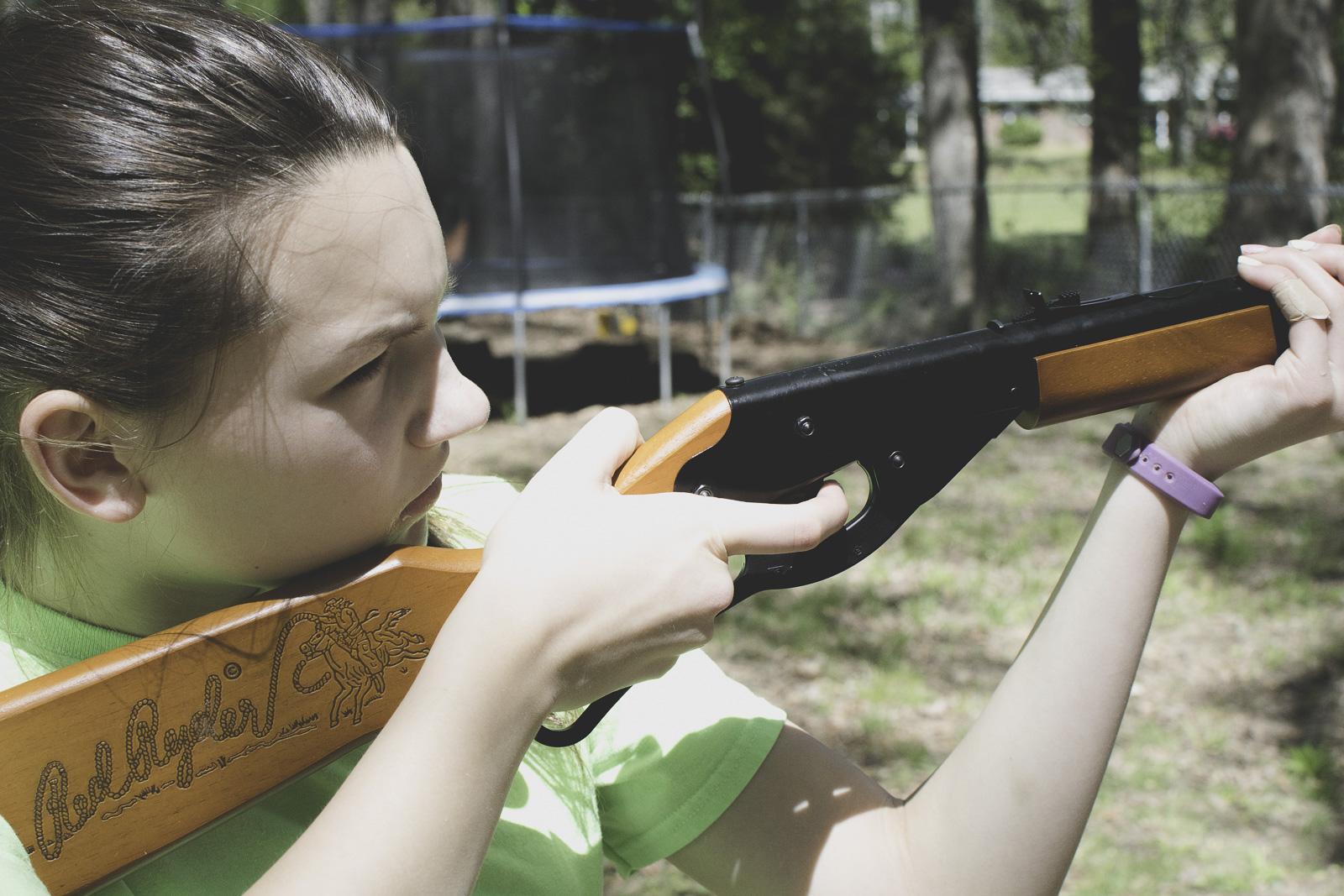
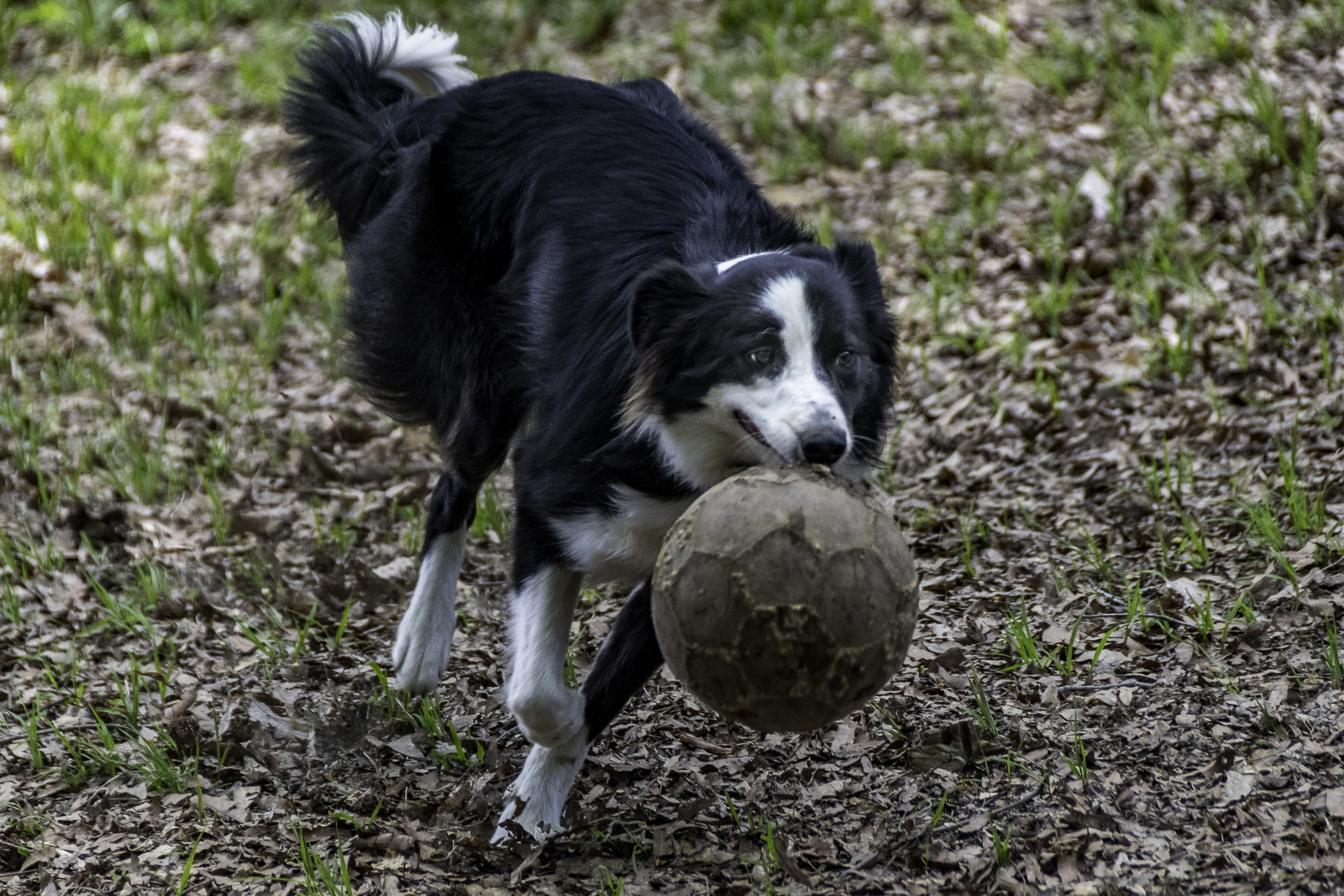
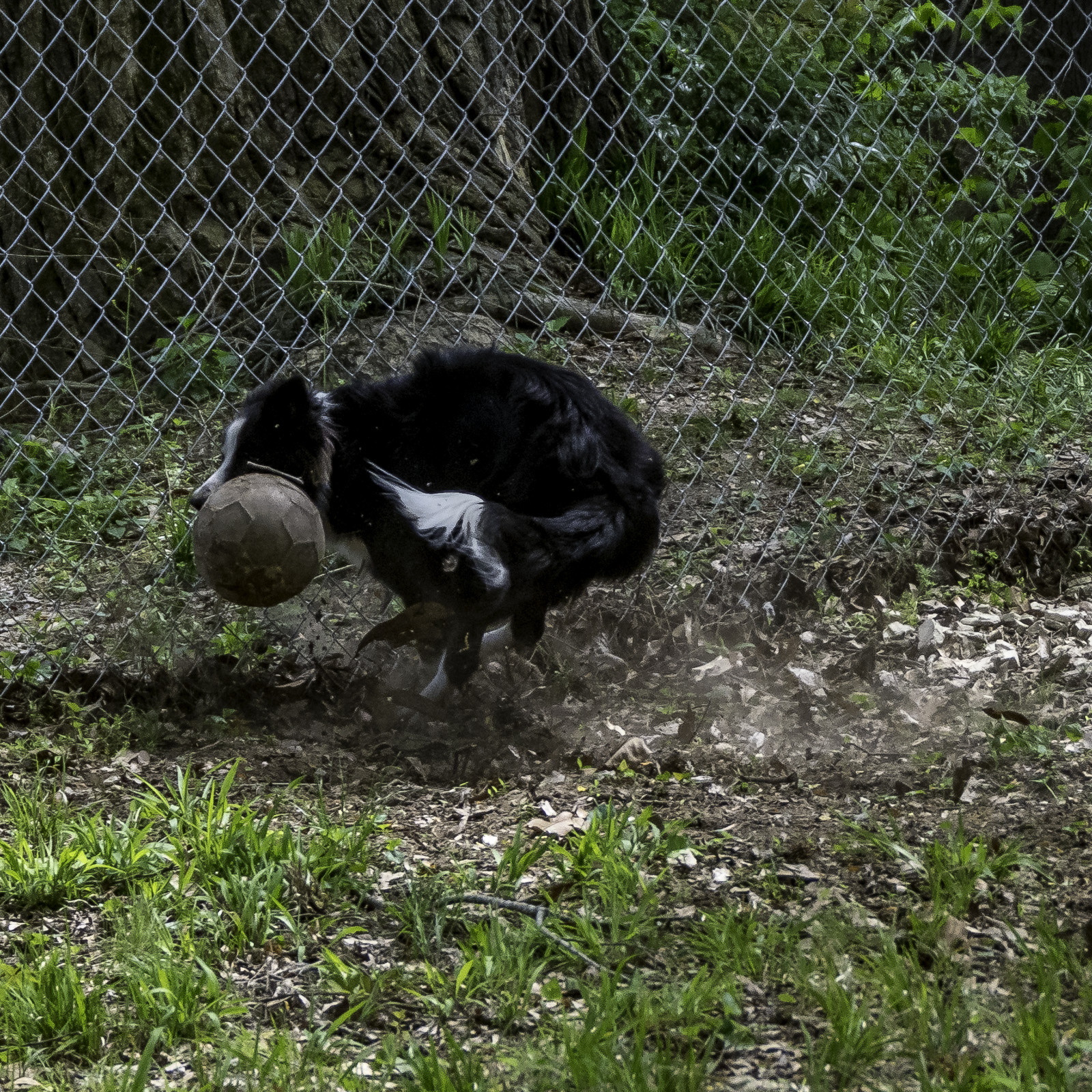
The Boy and I have been shooting his bb gun quite a bit these last few weeks. We have a few standard targets in the backyard: L’s archery target, a clump of trees backed by a forest of bamboo behind our neighbors’ lot (it’s possible to see the flight of the bb as it moves toward that clump of darkness), Clover’s ball (if she’s not out; if she’s out, we have to keep her away by kicking the ball to the opposite side of the yard where we’re shooting, always keeping an eye on her), the Boy’s basketball — a lot of targets. Lately, a favorite has been the Boy’s basketball, as it sits at the bottom of the hill and we stand on our deck. Google measures that distance at 69 feet. That’s a fairly impressive range for a seven-year-old to hit a basketball, but once I taught him to compensate for the effect of gravity on such a long shot (“Aim high, really high” I told him), he’s done it fairly consistently

In the late afternoon, when the sun had moved to the front of the house enough to provide some shade to the back deck, E sat with Papa on the back deck. They were shooting E’s bb gun at one of the small plastic cups (perhaps a little bigger than a shot glass) into which we put Papa’s meds every day. Papa took a couple of shots and missed; E took a couple of shots and nailed the cup; Papa missed another shot. “Do you want me to go get a bigger cup?” the Boy asked.

Day 21: Palm Sunday 2020

Palm Sunday — always an important Sunday for Christians, but it’s especially significant for Polish Catholic expatriates. It’s one of those times when the ceremonies and traditions of Poland shine for a brief moment in our community. What to do when we’re all shut-in like this, though? Continue as usual.

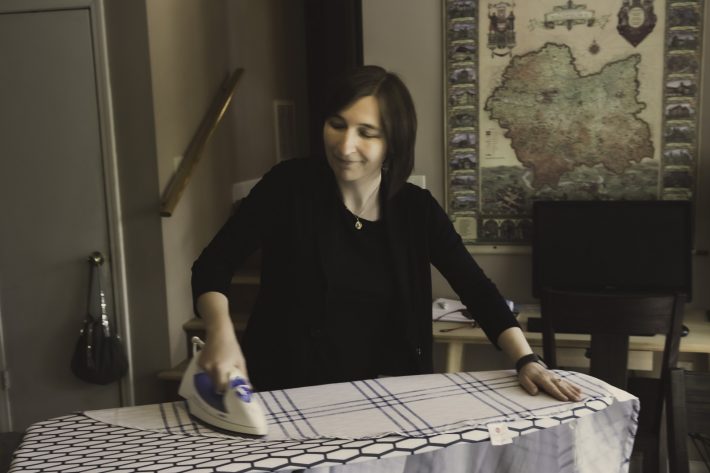
First, breakfast on new, freshly-ironed linen.

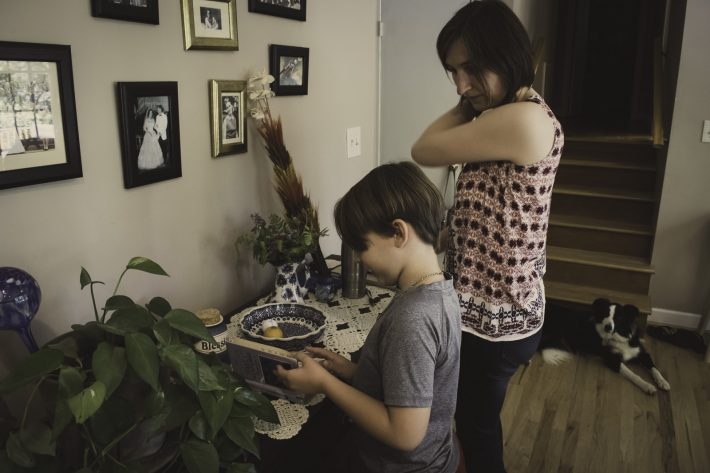
Holy Week in a Polish highlander house means the iron is out a lot. There’s all the linens and such, but there’s also much linen in the traditional outfits they wear to Mass, and even though we won’t be going anywhere this year, I fully expect the ironing equipment to stay out for much of the week. (K’s mother always irons on a table: she throws down a couple of blankets and off she goes. She’s tried an ironing board but she’s gotten so used to her table method that she just prefers it, and to be honest, it is more convenient when ironing a table cover.)
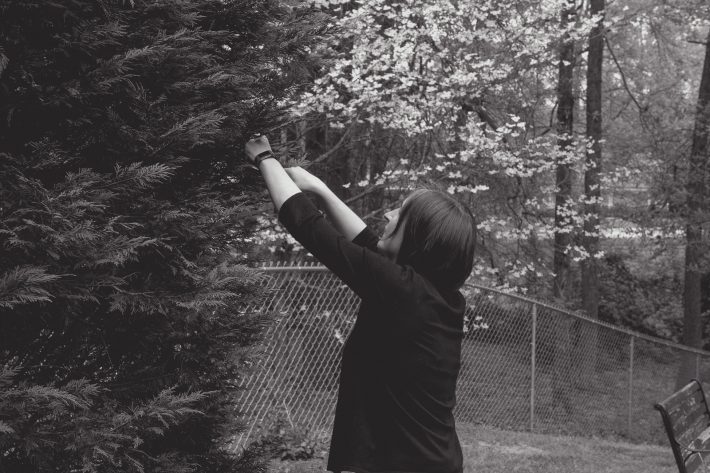
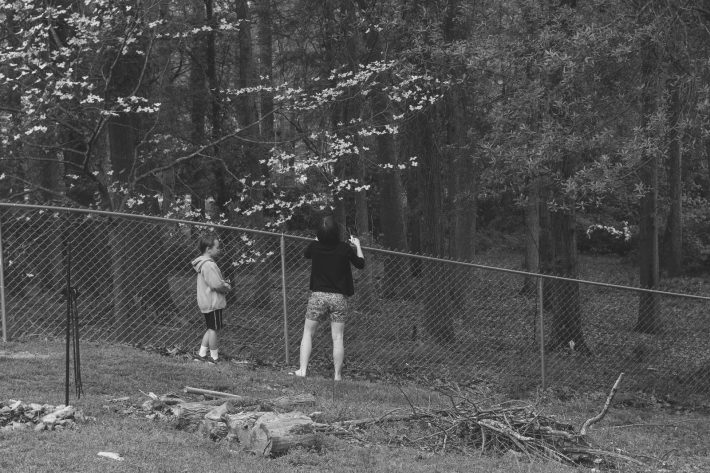
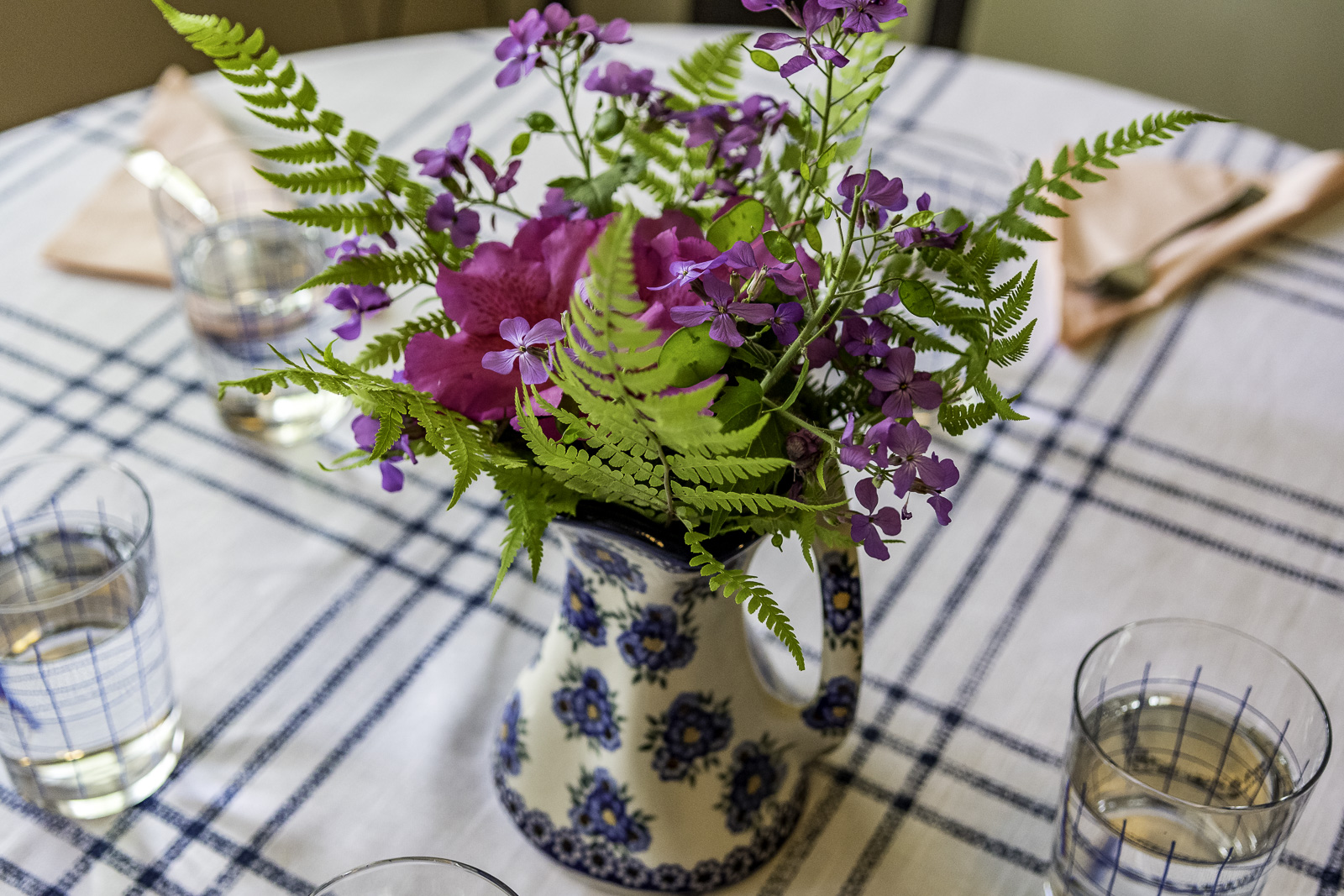
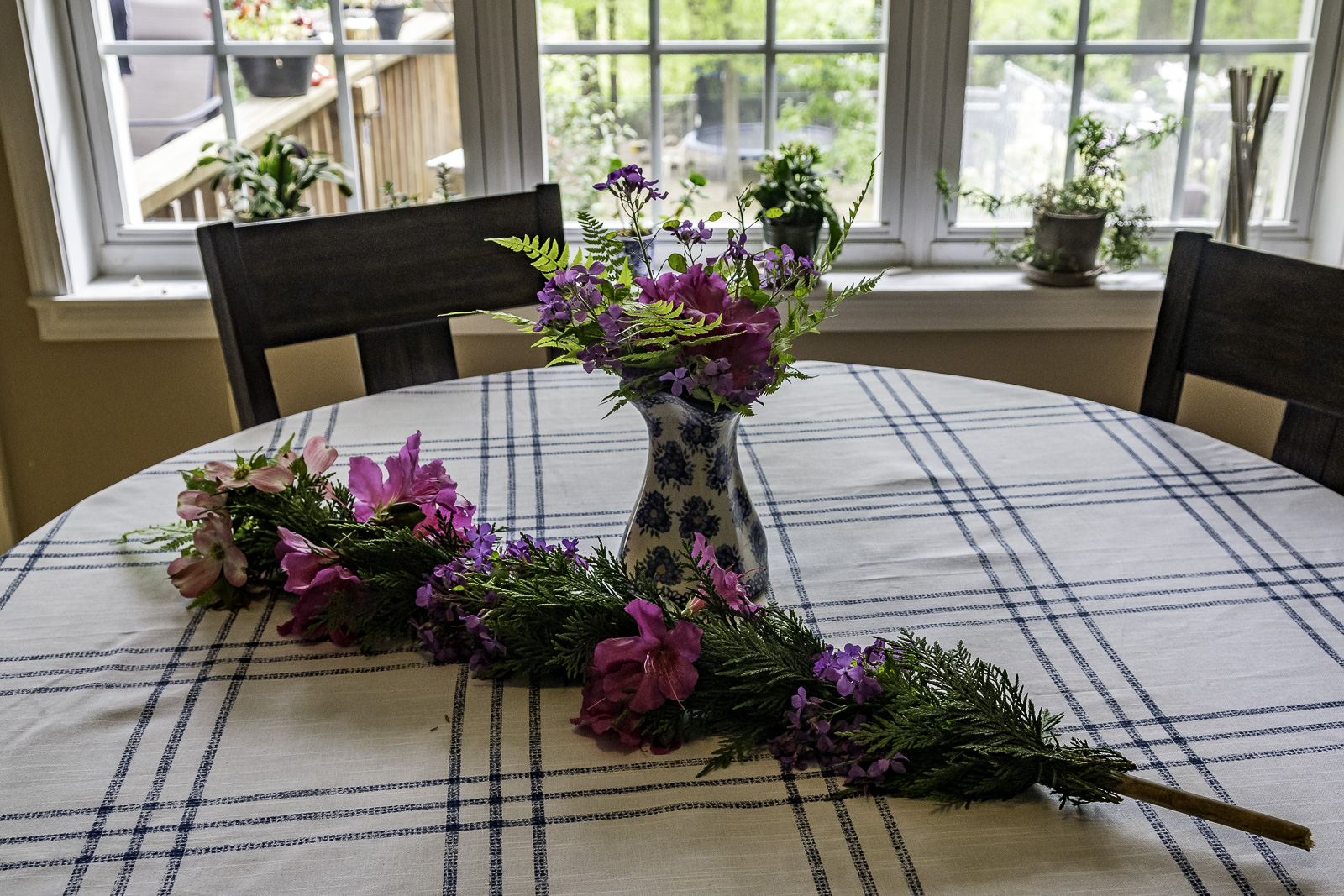
First, there’s the palm. K and the Boy went outside to gather blossoms and foliage for the creation, taking some branches from our Leyland cypresses,

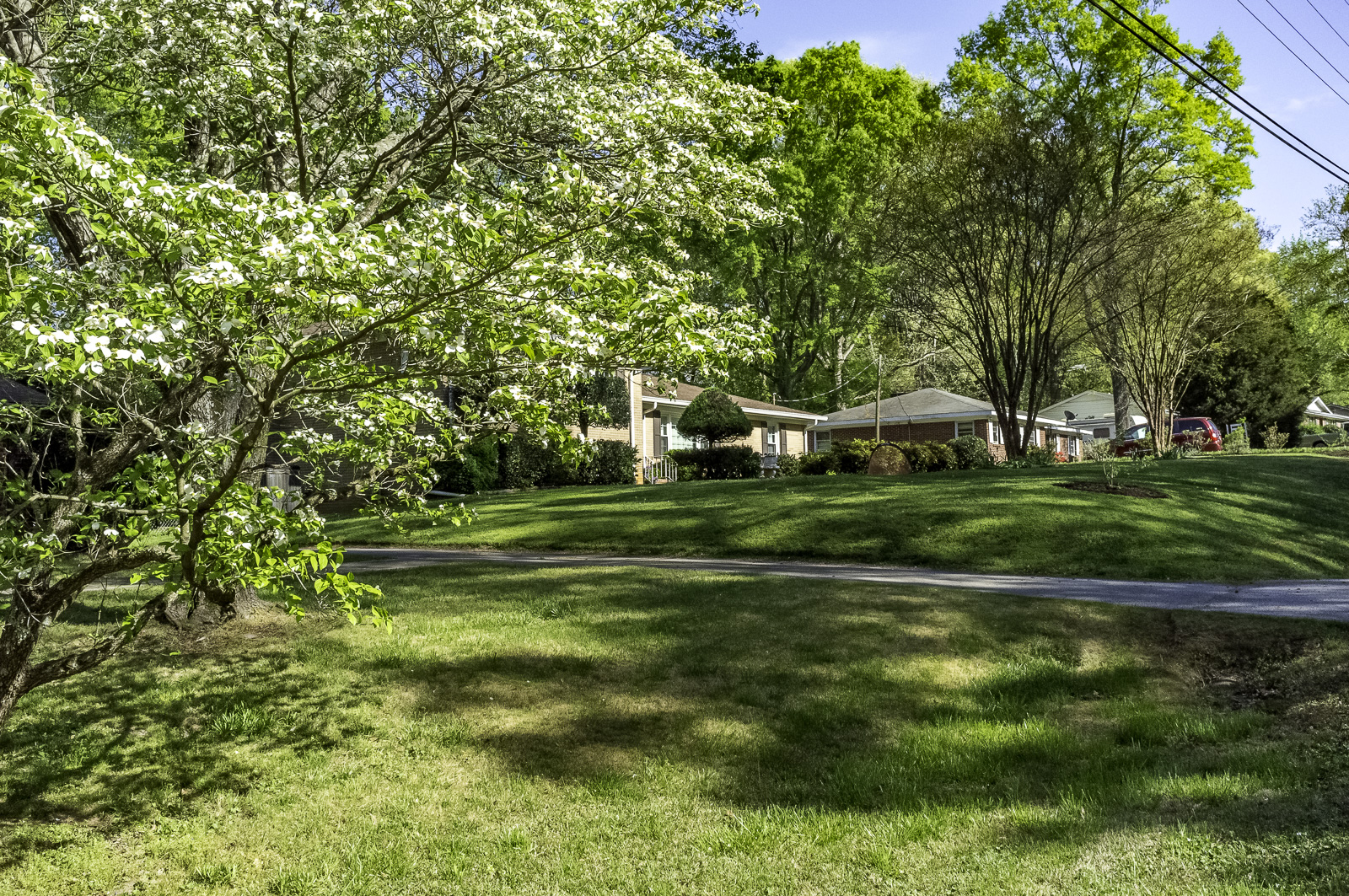
some blossoms from our neighbors’ dogwood (surely they won’t mind),

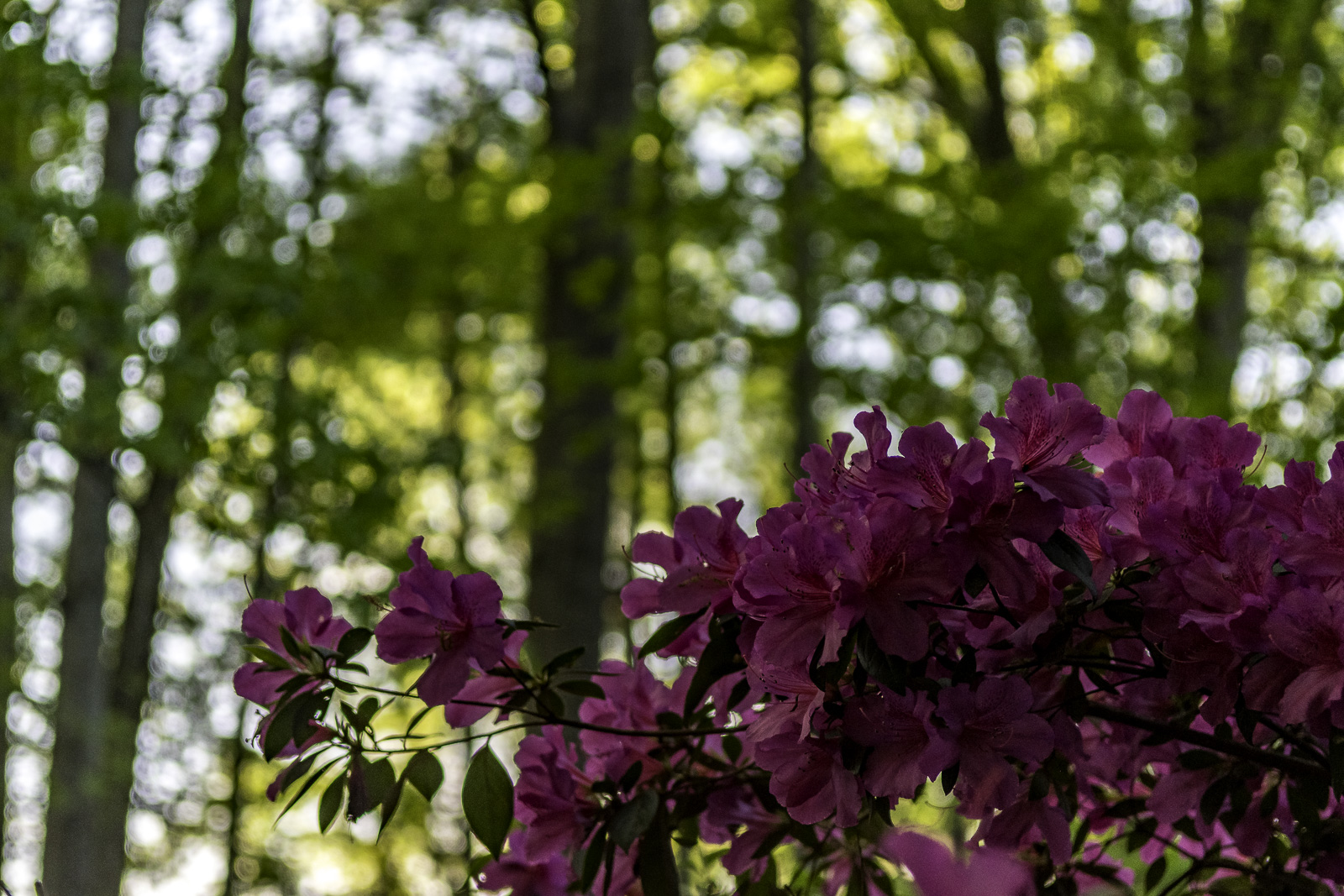
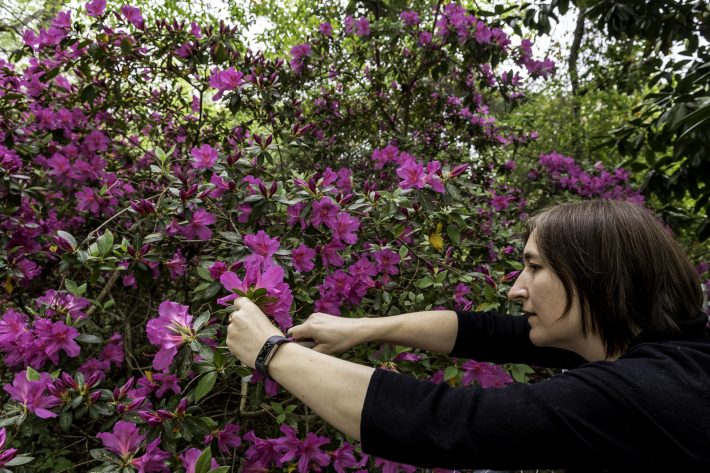
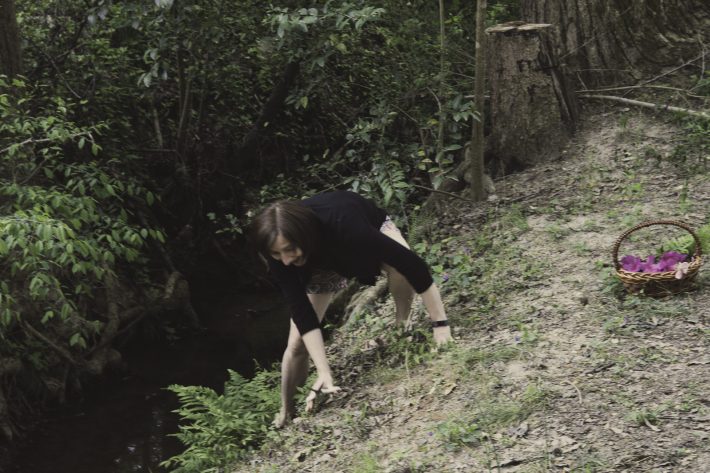
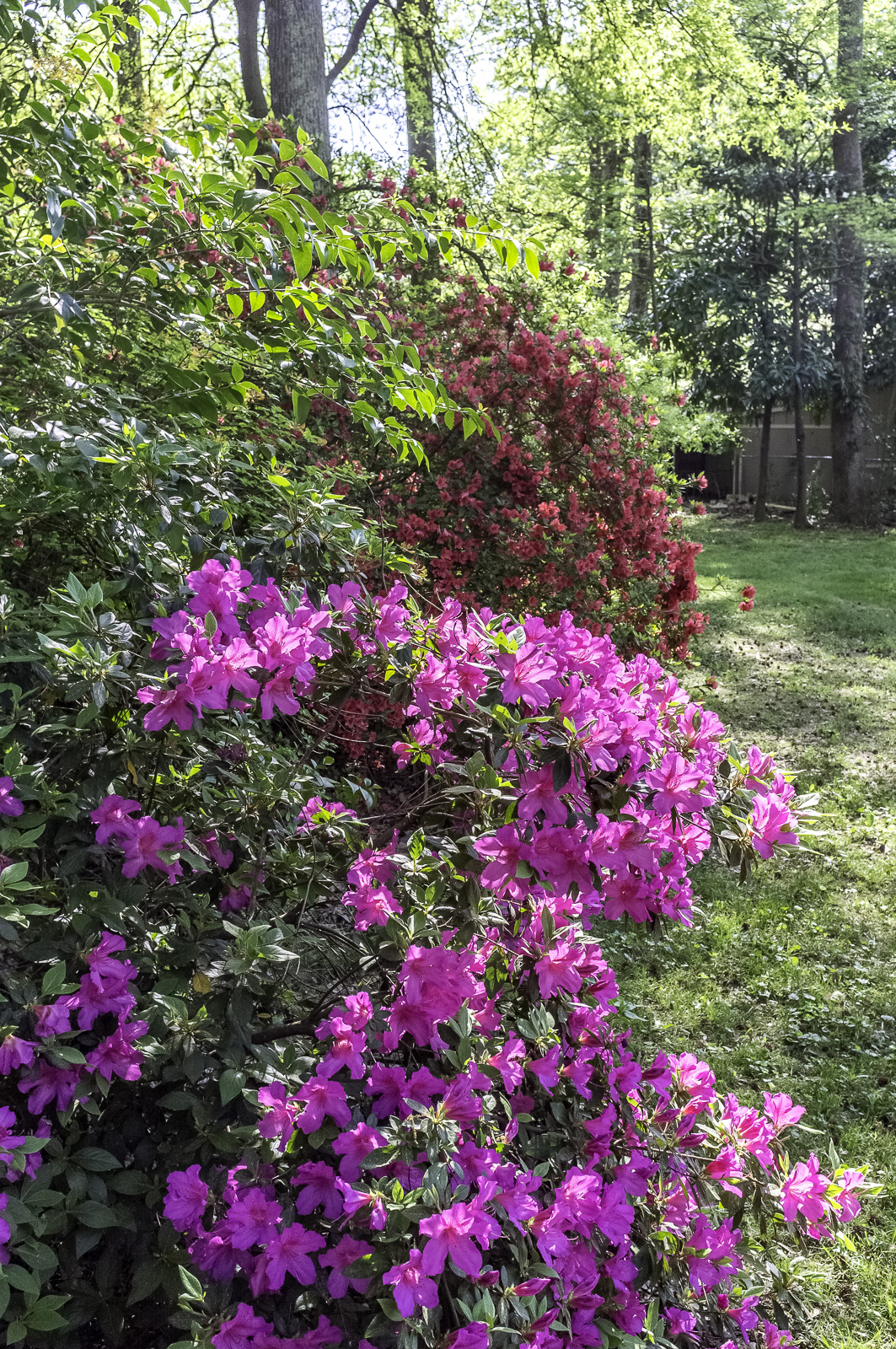
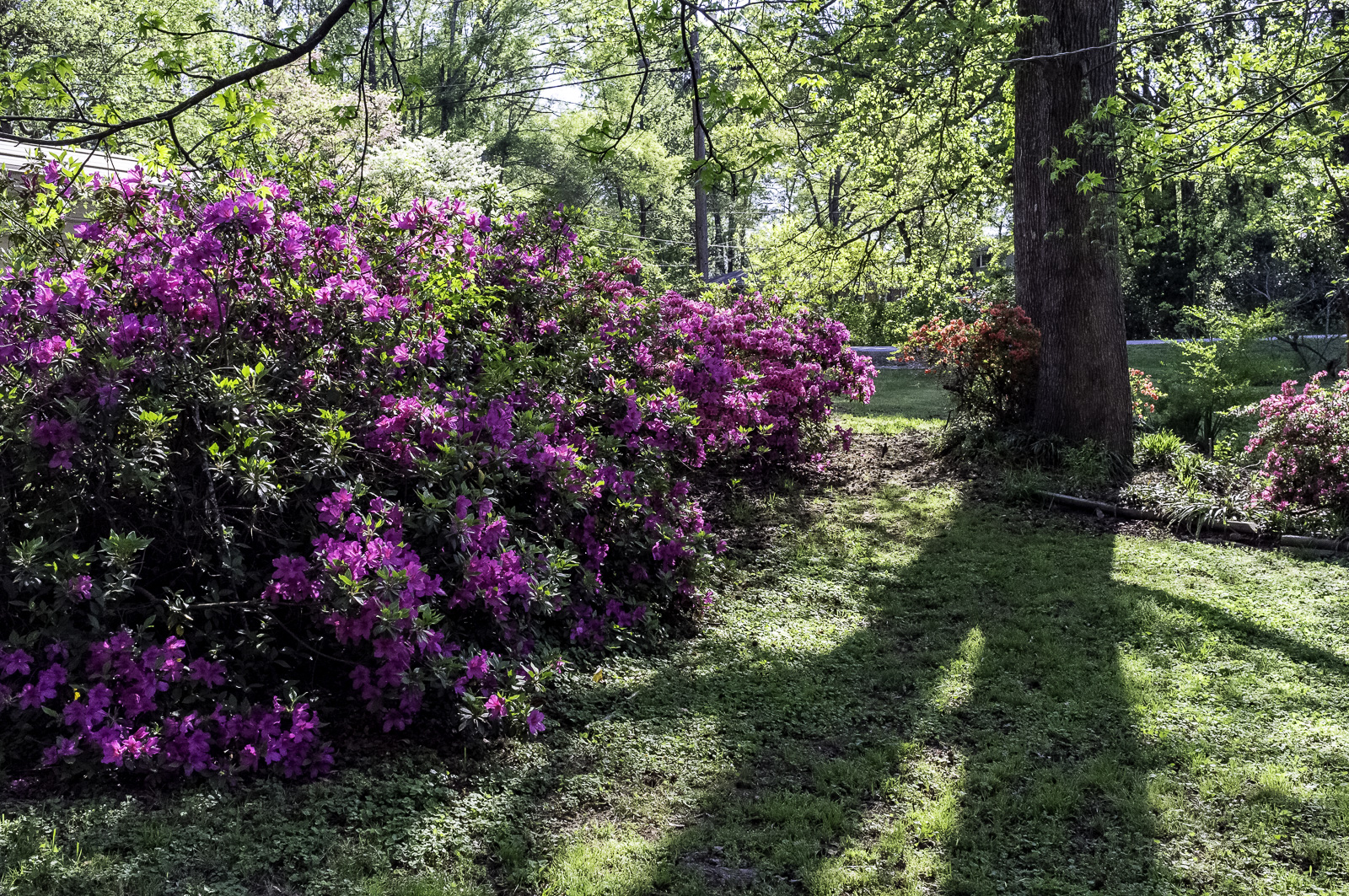
some blooms from the Azealia (same neighbor — surely they won’t mind), as well as a few treasures that grow by our creek.

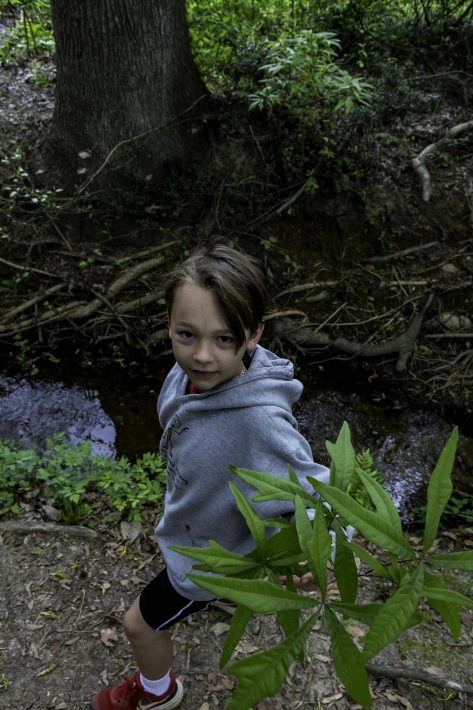
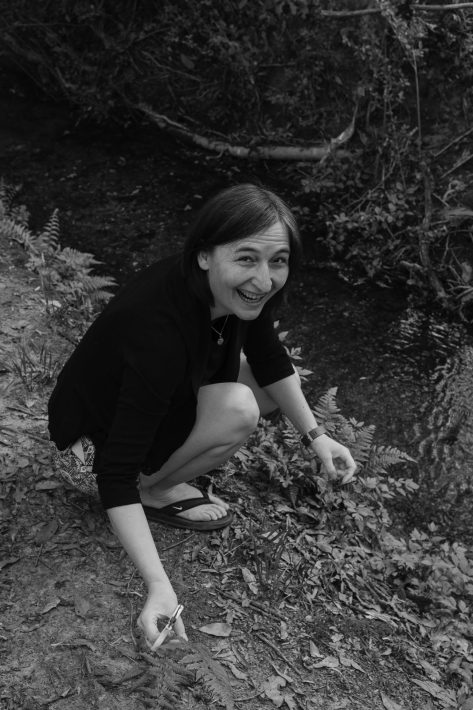
K picked some fern fronds, nearly falling into the creek in the process, and the Boy discovered a lovely bit of green that he gladly picked to help with the palm background/base.

K thought it was very sweet, his excitement and his willingness to help. Neither of us had the heart to tell him they were weeds. Besides, what are weeds? It’s an arbitrary determination — it’s simply a plant growing where someone doesn’t want it growing. In that sense, even roses can be weeds.

The last element: some of the flowers growing by the creek in our next-door neighbor’s property. K discovered them yesterday when she was going with L and E to see all the work they’d done cleaning the creek.

“Oh, such pretty flowers!” she said. “I shall come here in the early, dew-laden morning to pick some of these treasures.” (Well, that’s not quite what she said, but she’s been listening to the Anne of Green Gables series, and that has a decidedly Anne-esque feel to it, and I feel fairly certain K would have said it if she’d thought of it.)

After breakfast, K leads the kids and Papa through a Palm Sunday service, of sorts, following the directions our local priest sent out. It includes a long reading about Jesus’s trial and crucifixion, at the start of which Papa has to excuse himself temporarily and I head out for a quick walk. When I get back, the reading is still not done. It’s a very long reading.

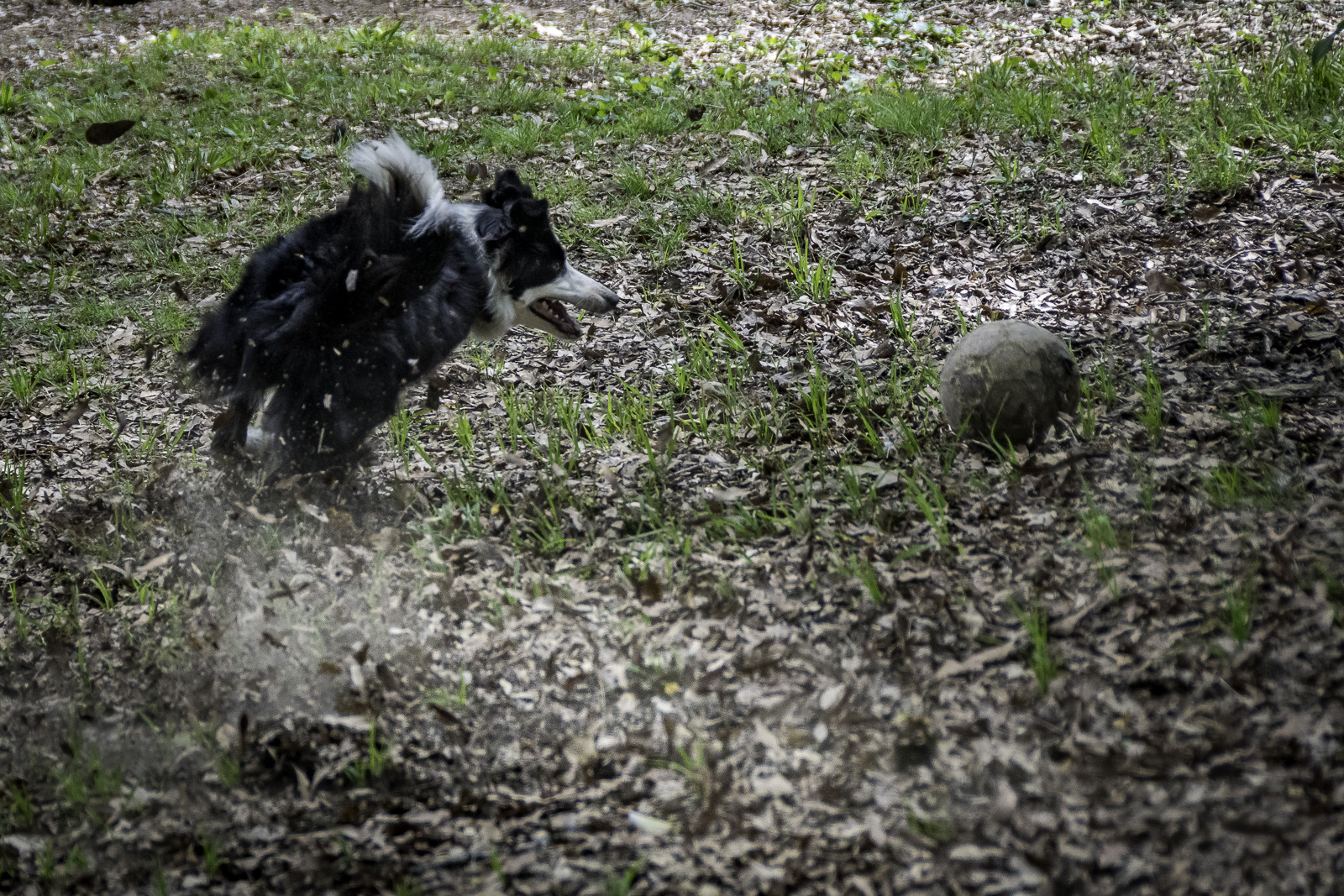
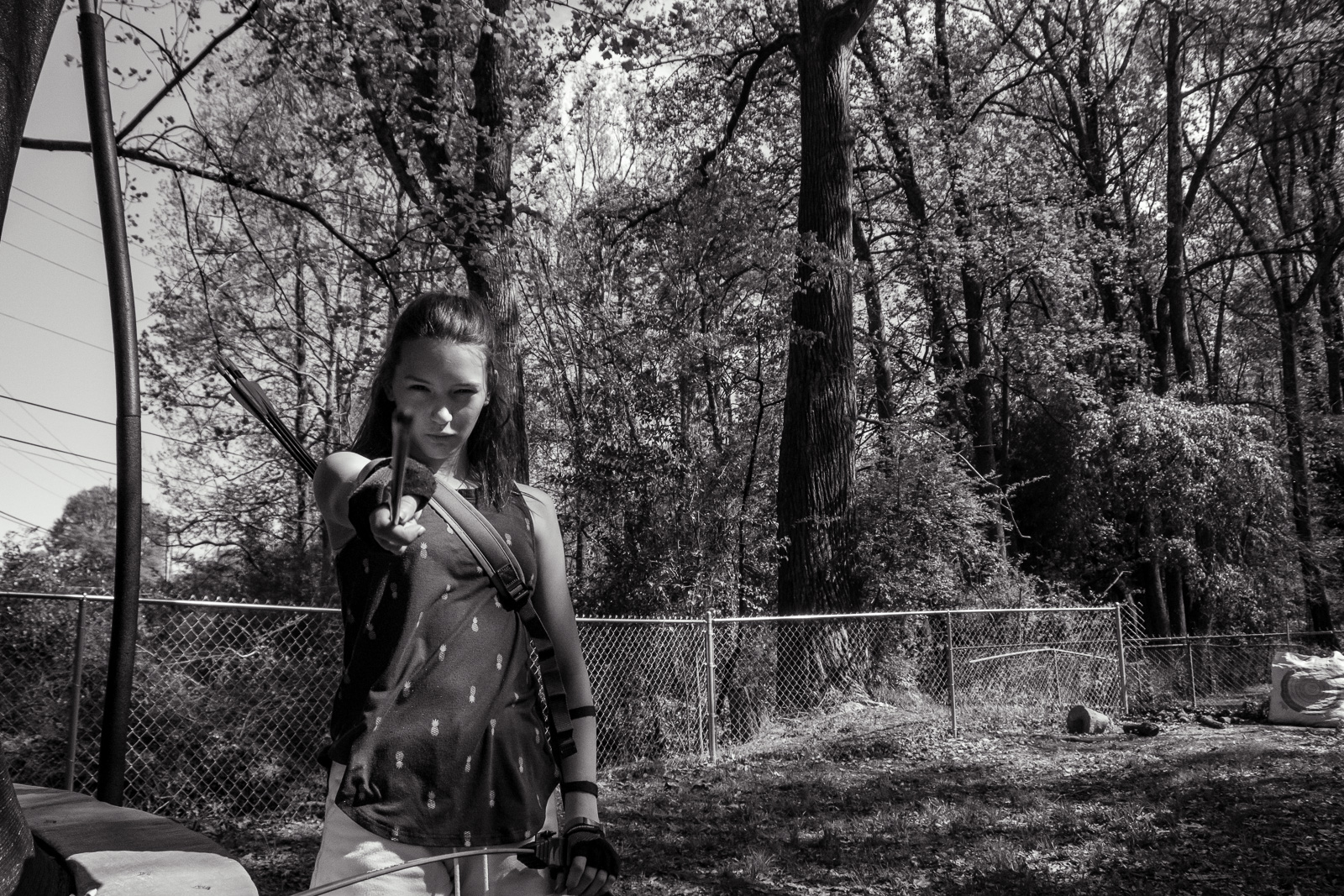
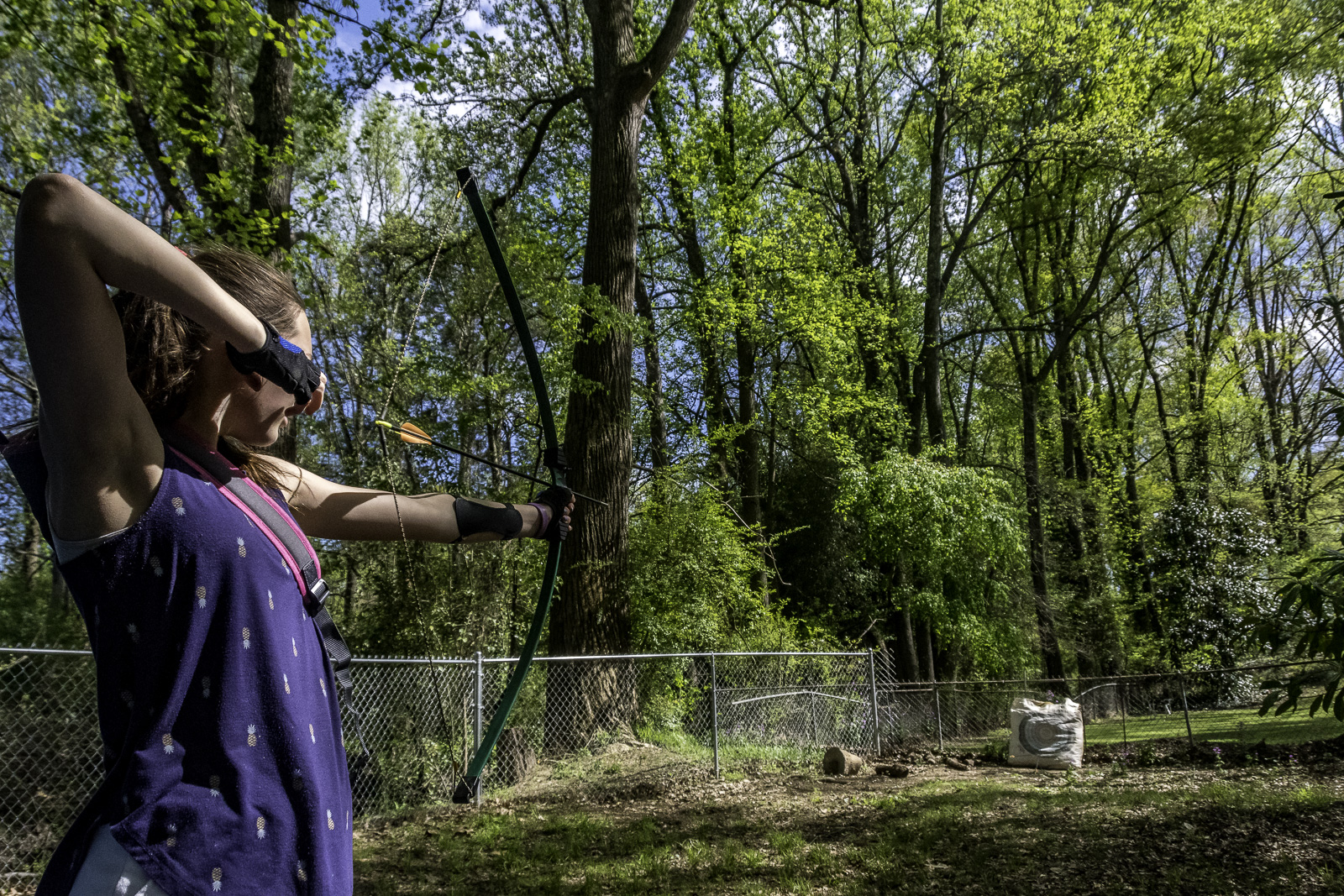
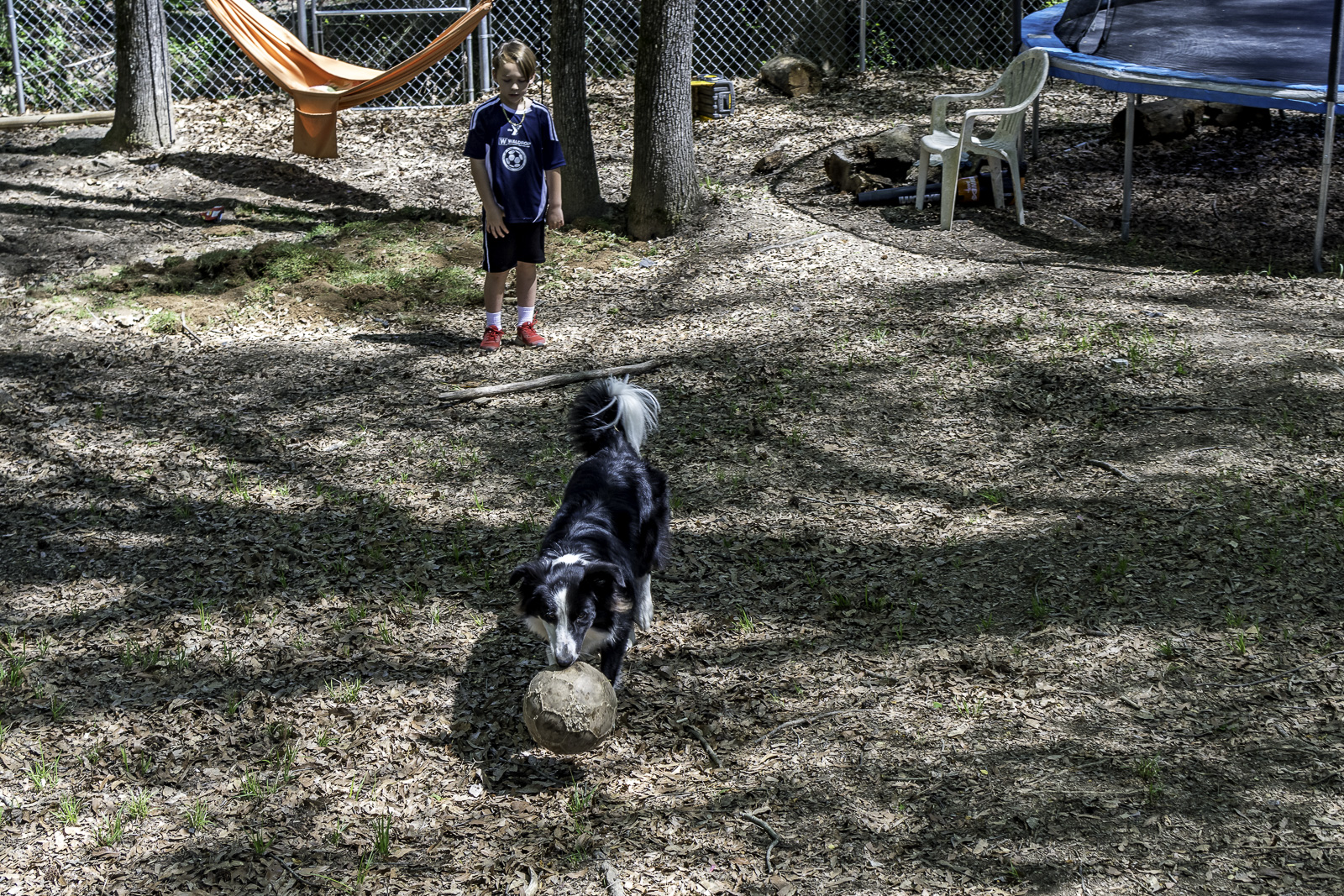
Lunch, which L and I cooked together, was followed by some outside time, kicking the ball for the dog, shooting arrows and bbs, jumping on the trampoline — the typical things we’ve been doing for years but have done with increased frequency (i.e., almost daily) several weeks now.

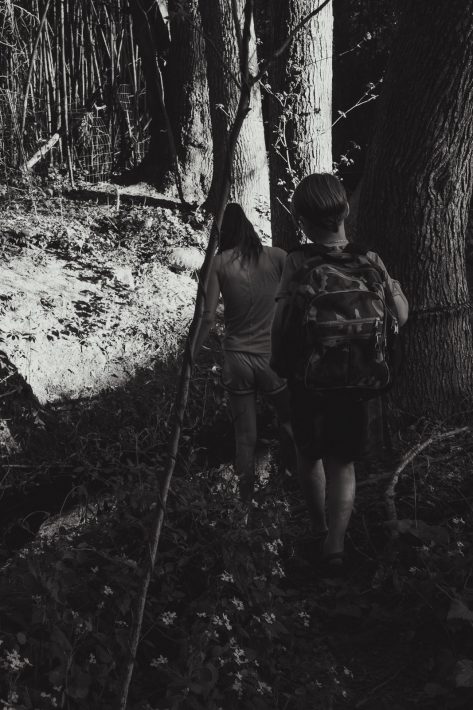
After dinner — homemade cinnamon buns — we took K out exploring. She hadn’t been quite the same distance (i.e., to the end of the little woods behind our house, where it drops into the next neighborhood), so we took her for a walk.

Overall, a lovely Sunday. A different Palm Sunday.

Previous Years

Palm Sunday 2019

Palm Sunday 2017

Palm Sunday 2015

Palm Sunday 2014

Palm Sunday 2012

Sixth Sunday of Lent 2013

Day 20 in Two Parts: A View of the Day and a Rant

Part 1: The Day

Our weed eater — I think that’s a brand name but I could be wrong — has been broken for some time. How long? Embarrassingly so. Today, we finally got a replacement, but we didn’t get as sturdy a model as might be expected. The reason? Turning things over to the Boy.

A battery-powered, small trimmer that E can handle. His reaction? “I love, love, love this!” He’s going to want to trim every day.

Part 2: Will This Change Anything?

K and I were talking a few nights ago about how this whole tragedy perhaps could have been significantly lessened if our inept president weren’t the egomaniacal narcissist that he is when our talk turned to how this might affect the country. K suggested that it would be a turning point, that the fact that America — the most powerful country in the world, the richest country in the world, the superlative-in-every-sense country in the world — was brought to its knees like this will necessitate some change, a whole new way of looking at things.
I disagree.

What I fear is that instead of turning this country’s populace into a science-first, technology-led country where politics and religion take a backseat to what science says (and if this were the case now, we might not be in the situation we’re in), it will only reinforce the same backward thinking that continues to threaten us now. Instead of seeing it as a science problem, they’ll see it as a religious problem. “God took his protection away from us because of X, Y, and Z” — fill in your favorite liberal boogieman.

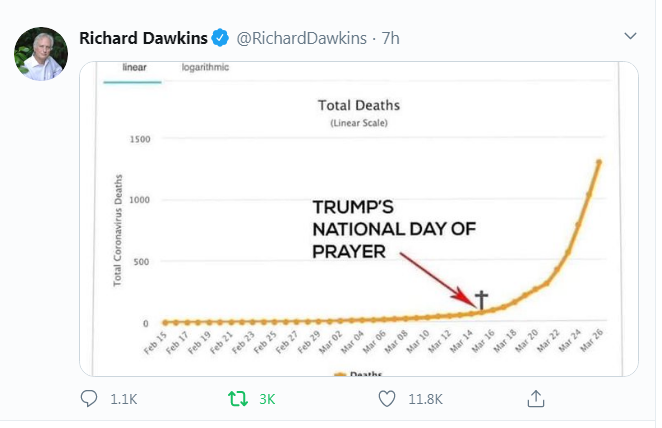
We really don’t have to wait for that — it’s already happening. The amount of religious stupidity coming out of this is just mindblowing. Stuff like this.

One would think that given the evidence, anti-vaxxers would be shutting up about now:

The person credited with saving the most lives ever is Edward Jenner, inventor of the smallpox vaccine. The disease had a much higher mortality rate than the novel coronavirus that is confining many people to their homes right now; about 80% of children and 60% of adults who contracted smallpox died of it. In the 20th century alone, it killed more than 300 million people before the vaccine eradicated it worldwide in 1979.

The polio vaccine is estimated to have saved 10 million people from paralysis just since 1988, and prevented 500,000 deaths, according to the World Health Organization. A global vaccination campaign for measles that began in 2000 prevented an estimated 23 million deaths by 2018, the organization reported. (LA Times)

One would think — but then again…

And this old nonsense about Bill Gates ushering in the apocalypse. (Money says he’s using a Windows computer here…)

And people trying to call judgment down on a virus as if it’s an incorrigible child.

And when you mix in bat-feces crazy like Alex Jones and people who take him seriously, well…

When you see everything — everything — as part of some conspiracy that was foretold in a book written by Bronze Age soothsayers,  no amount of science, logic, or critical thinking can penetrate your worldview.

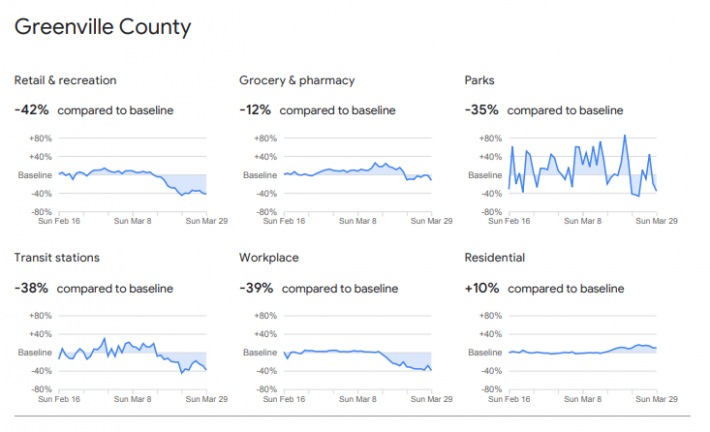
It’s not just a pessimistic sense that there’s a problem: there’s quantifiable data to show there’s a problem. Google has begun compiling reports on the changes in people’s mobility during this time.

As global communities respond to COVID-19, we’ve heard from public health officials that the same type of aggregated, anonymized insights we use in products such as Google Maps could be helpful as they make critical decisions to combat COVID-19.

These Community Mobility Reports aim to provide insights into what has changed in response to policies aimed at combating COVID-19. The reports chart movement trends over time by geography, across different categories of places such as retail and recreation, groceries and pharmacies, parks, transit stations, workplaces, and residential.

What do the data show? Well, as a disclaimer, Google warns about doing what I’m just about to do:

Location accuracy and the understanding of categorized places varies from region to region, so  we don’t recommend using this data to compare changes between countries, or between regions with different characteristics (e.g. rural versus urban areas).

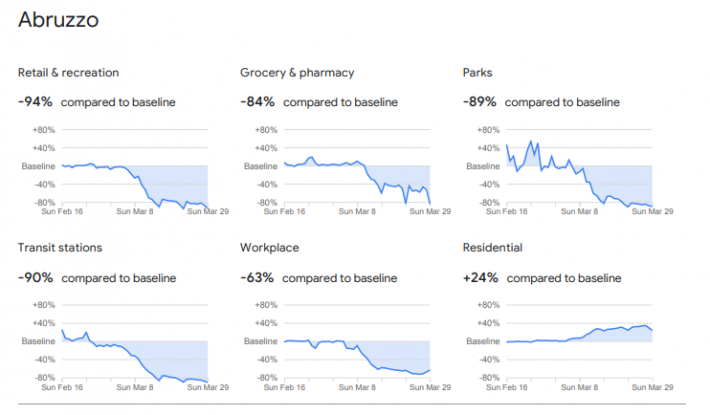
Still, data from three locations show the vast difference in national and local response.

Here’s the data from our county:

Now, we made the news recently as being the most mobile county in the nation during this time, so our stubborn little county is an outlier, but it’s where I live, so it’s the data I’ll use.

And here’s the data from the administrative district in Poland where K grew up, where Babcia still lives, and where I spent seven years:

A randomly selected district in Italy.

Are these two countries faring better than America? I suppose in raw numbers, they are. The long term picture looks better there. Why? Because they don’t have people going around saying, “I’m covered in the blood of Jesus — I’m saved and safe” like we do here.

Of course, in Poland, some bishops and priests are desperately trying to get churches reopened on some kind of limited basis, but even there, they understand the risk and want to have limited attendance. These bloody American Evangelicals — i.e., “covered in the blood of Jesus,” which is itself a disturbing image, but the second, British meaning of “bloody” works as well — want to have full, regular church services. The data makes their claims a little spurious, though:

And it’s not as if this virus is enough: we as a species can’t even go through this without some people turning it into a hell on Earth for those who are stuck with them:

In Hubei province, the heart of the initial coronavirus outbreak, domestic violence reports to police more than tripled in one county alone during the lockdown in February, from 47 last year to 162 this year, activists told local media.

“The epidemic has had a huge impact on domestic violence,” Wan Fei, a retired police officer who founded a charity campaigning against abuse, told Sixth Tone website. “According to our statistics, 90% of the causes of violence [in this period] are related to the Covid-19 epidemic.”

It is a pattern being repeated globally. In Brazil a state-run drop-in centre has already seen a surge in cases it attributes to coronavirus isolation, the Brazilian broadcaster Globo said.

“We think there has been a rise of 40% or 50%, and there was already really big demand,” said Adriana Mello, a Rio de Janeiro judge specialising in domestic violence. “We need to stay calm in order to tackle this difficulty we are now facing.” (Lockdowns around the world bring rise in domestic violence in the Guardian)

The virus is always teaching me something new:

The increased threat to women and children was a predictable side effect of the coronavirus lockdowns, said activists. Increased abuse is a pattern repeated in many emergencies, whether conflict, economic crisis or during disease outbreaks, although the quarantine rules pose a particularly grave challenge.

Predictable for some, that is. I hadn’t even thought of this — that’s how privileged I am.

So, no, I don’t think anything will change. At all.

Day 18: Without Subtitle

“I just want some attention!” The Boy was frustrated: K was gone; I was working on school matters; the Girl was being a typical thirteen-year-old. It struck me at that moment how this quarantine is affecting them.

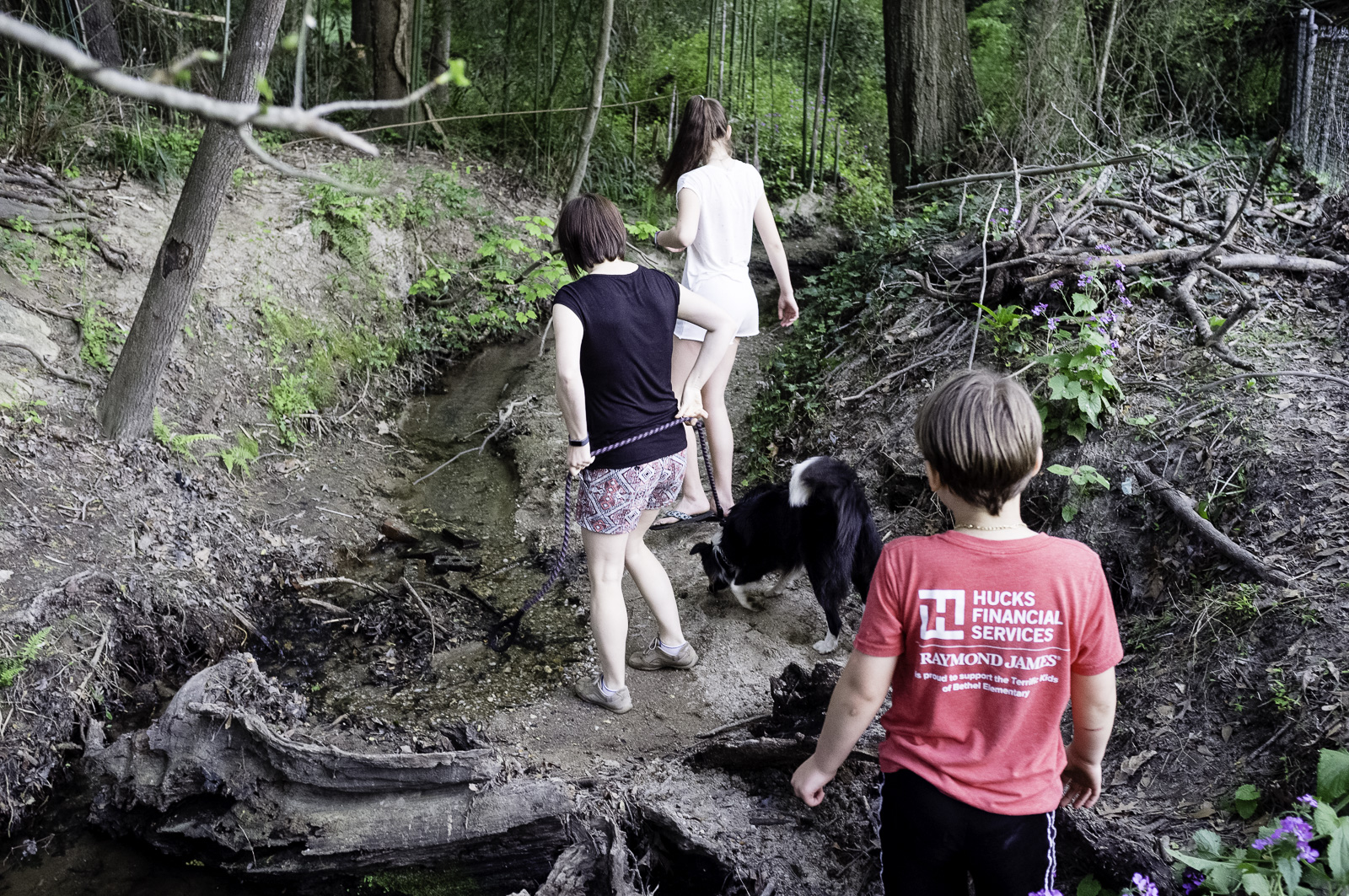
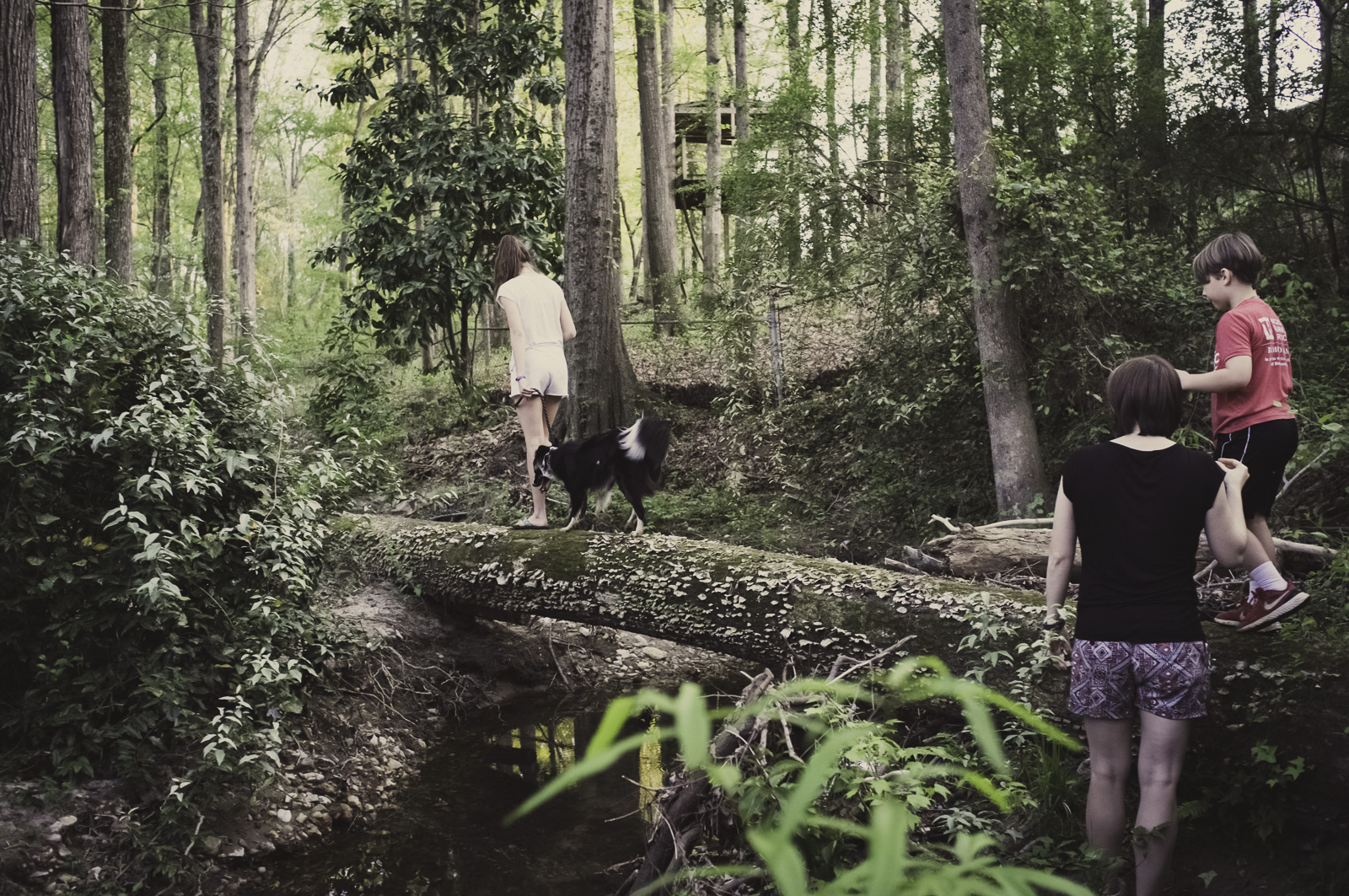
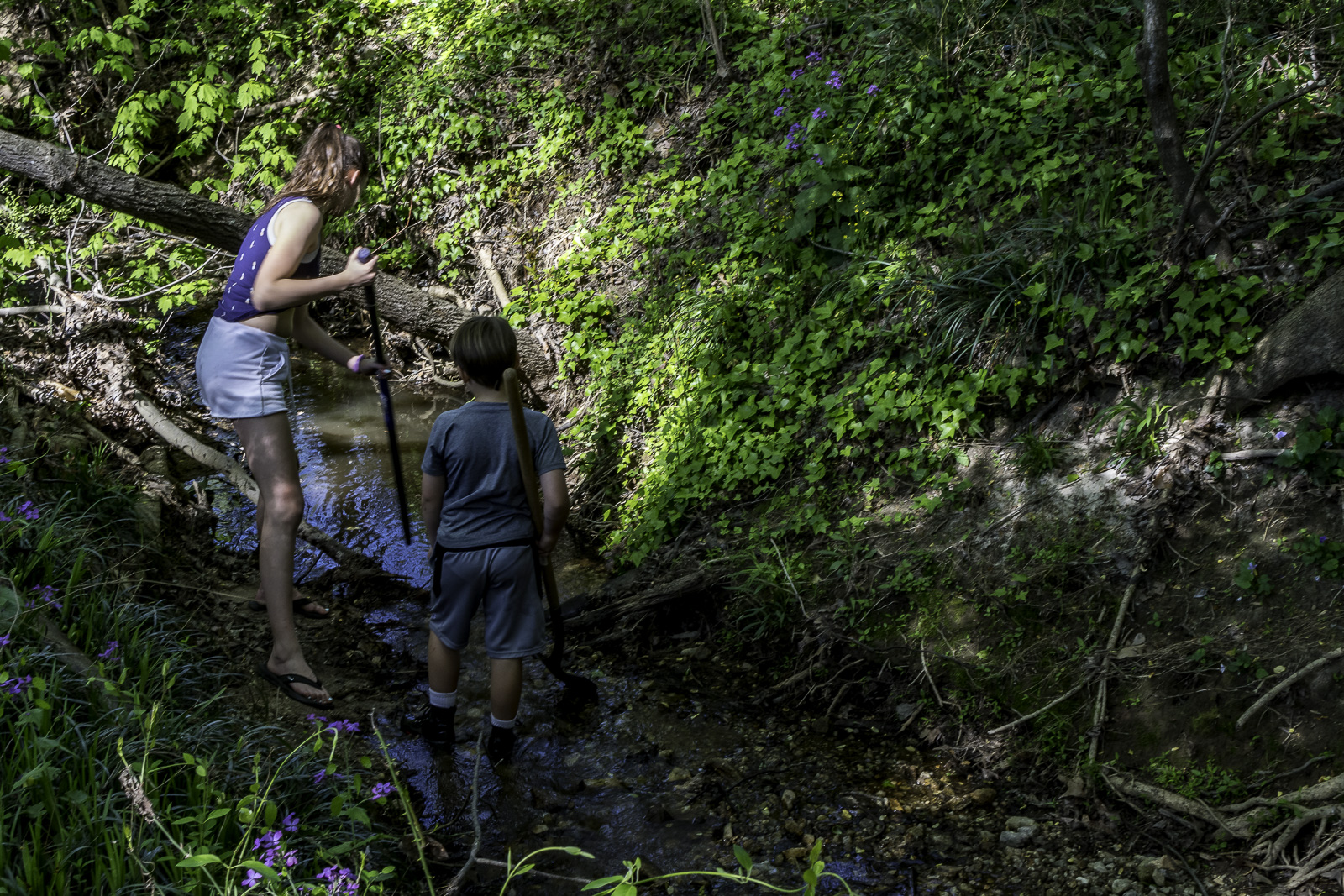
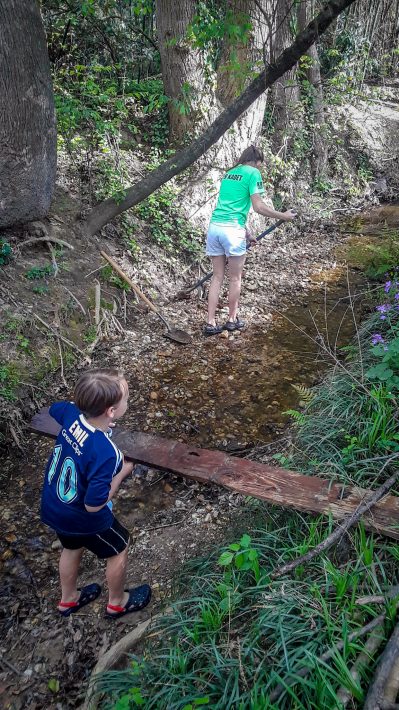
Cleaning out the creek behind the house

I’ve been using Flipgrid with some classes to take a wellness check. I recorded a video; kids record videos in response. The Boy has been watching the videos and responding with me, and a common thread in most videos is how much students miss seeing their friends. “I don’t really miss school that much, but I miss interacting with my friends,” one might say, and the Boy mutters, “Me, too.”

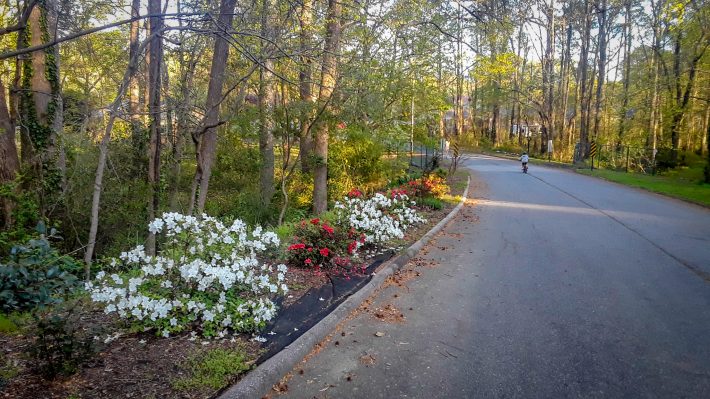
A lovely portion of our evening family walk

So when he asked specifically and directly for attention, I thought about those responses and the simple fact that he has been isolated — completely isolated — from all his friends for weeks now. It’s less annoying for the Girl because she Facetimes with her friends and texts them. We’ve set up a Facetime session with a few of his friends, and his teachers have done a great job using Zoom to get the class together at least once a week. (I’ve tried to do the same with my students, but with less stellar results.) But it’s not the same: he cannot just contact his friends whenever he wants to. He is much more dependent on us.

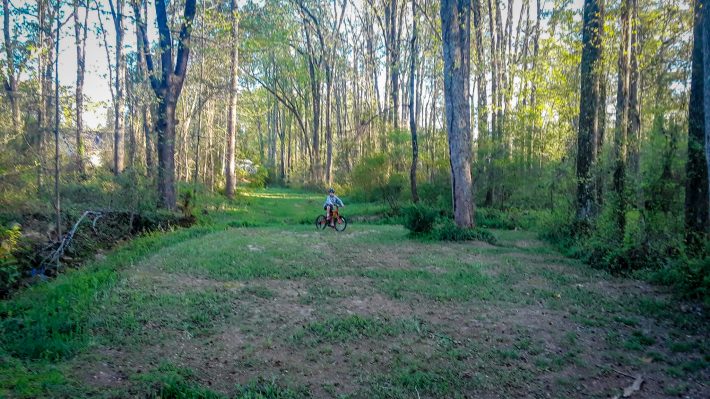
Exploring the easement

It’s one of those unexpected lessons we learn during this troubling period.

Day 17: Spiders and Compressed Script

We probably should have taken him seriously, but I think even he was joking. Papa’s handwriting has gotten more and more compressed over the last couple of years, becoming almost impossible to read.

“It’s probably a symptom of something,” he laughed. We laughed, too, because Papa likes to joke about growing old. We took it as a joke; he meant it was a joke. It wasn’t a joke — or it shouldn’t have been.

What would Papa have to write about now? Perhaps a description of the spider he was sure he saw in the corner of the room the other night. He called me in to take care of it.

“There, in the corner,” he said, pointing.

“What?”

“A spider.”

I looked closely — no spider. “It must have just been a shadow,” I said.

What is hallucinating spiders a symptom of? If you’d asked me before this afternoon, I would have suggested it was a symptom of listening to the Cure too much:

On candy stripe legs the Spiderman comes
Softly through the shadow of the evening sun
Stealing past the windows of the blissfully dead
Looking for the victim shivering in bed
Searching out fear in the gathering gloom and
Suddenly
A movement in the corner of the room
And there is nothing I can do
When I realize with fright
That the Spiderman is having me for dinner tonight

I listened to that song in high school more times than I care to mention — a favorite from a favorite album of 1989.

But that’s not what it was. Nothing so innocent.

Today, Papa went for a consultation with a neurologist. The unperceived symptoms combined with other issues (blood pressure jumps, moments of temporary near-paralysis as if someone hit a pause button, slight loss of balance, some tremors in the hands, memory issues — issues that have appeared in the last few weeks and sent us to the doctor for an answer) to give the doctor a diagnosis which, in his words, has a 95% probability of being accurate: Parkinson’s.

There is one other option, but we’re hoping for Parkinson’s, because option two has no treatment possibility at all. What an odd response: we’re crossing our fingers for Parkinson’s because Levodopa can make it manageable. The other possibility — well, I don’t even want to think about it. Luckily, the neurologist said most of the symptoms are more indicative of Parkinson’s. Especially the spiders. “The most common hallucination Parkinson’s patients have involve spiders,” he explained. Who knew? (Answer: a neurologist.)

Fortunately, we have caught it relatively early, and medications should be able to manage the symptoms and perhaps even slow things. Or not — PD is a different disease for every patient.

Papa is relieved to have a diagnosis. We all are. It’s no longer a mystery: these moments of paused movements, the balance difficulties, the memory issues are less depressing when they have a name and a treatment plan. We had a heartfelt “it could be worse” talk in the evening. It could be something truly devastating like Alzheimer’s (though I never feared it was). It could have all reached this point when Nana was still around, which would have absolutely broken her heart, filled her with guilt (“Why didn’t I see those things as symptoms?”), and wreaked her with anxiety and worry.

Not forever, though — when Papa was admitted for a surgery on his lung that ended up taking 2 lobes and leaving him in ICU for a week, she cried a lot at first but then went into full Nana mode and became a lioness protecting Papa, keeping track of treatments, medicines, shaving, and making sure the nurses were running a tight ship. That’s what Nana did: process her anxiety with tears and then become a fearless protector.

That’s our job now. I don’t know that we could do it as well as Nana, but we’ll do our best.