the girl

Eyes

When L was first born, she didn’t open her eyes in the light for many days. When it was dark, slits would appear in her never-used eyes sometimes, and occasionally, she would open her eyes almost fully. (You can see a little of this in “Pink Thing.”)

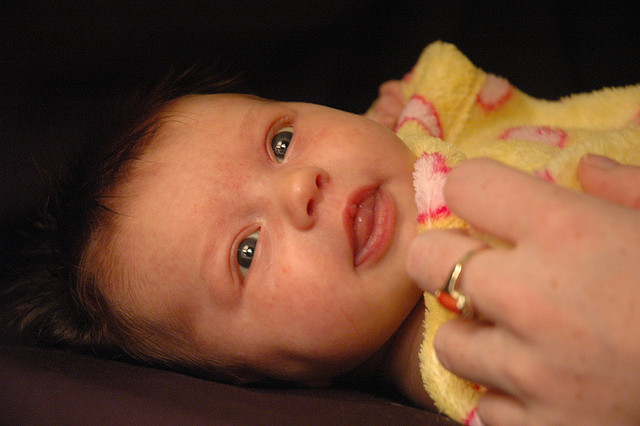
When she finally did open her eyes in lighted spaces, it was only for very short periods of time. And since the muscles in her eyes had not developed at all, she didn’t really look at much of anything. Nor would she have really seen much then except blurs.
Fascination

Now she opens her eyes and looks at things. When K or I is burping her, she often is looking here and there, fascinated by who knows what. Probably everything, since it’s all literally new to her.

K or I can get down and put our face about six inches from hers, and when she’s not already captivated by something in her field of vision, she’ll look directly at us as we talk to her. We move my head a few inches to the left — her eyes follow. We smile — she does nothing. Yet.

Step by step. Stimulus by stimulus.
This End Up

L has problems with reflux (or call it colic). That is to say, heartburn. That is to say, she can’t lie down for too long.

Which means we have to keep her upright most of the time.

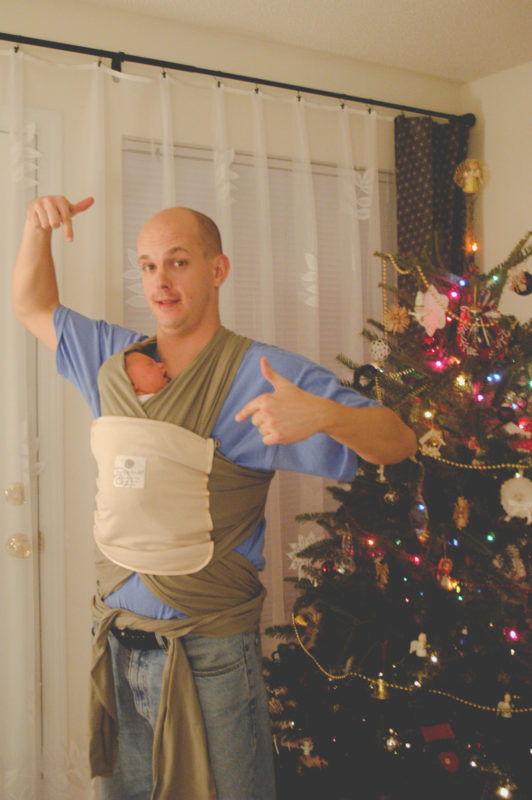
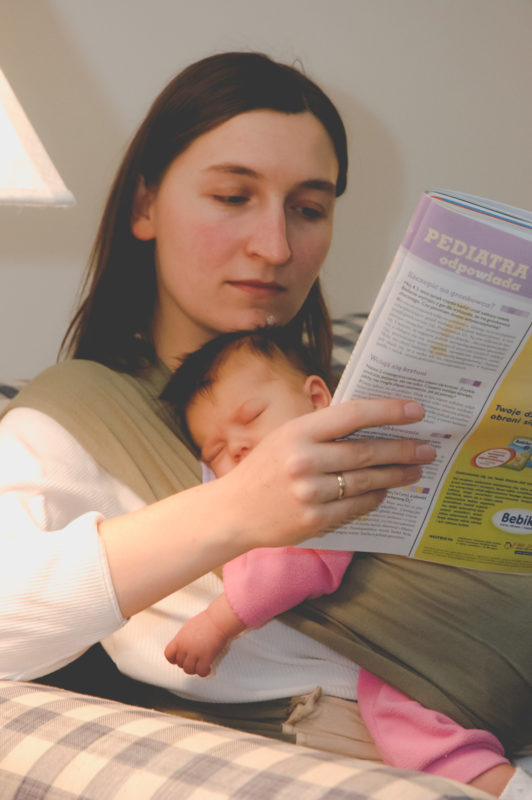
Which is why a baby wrap is essential for us.

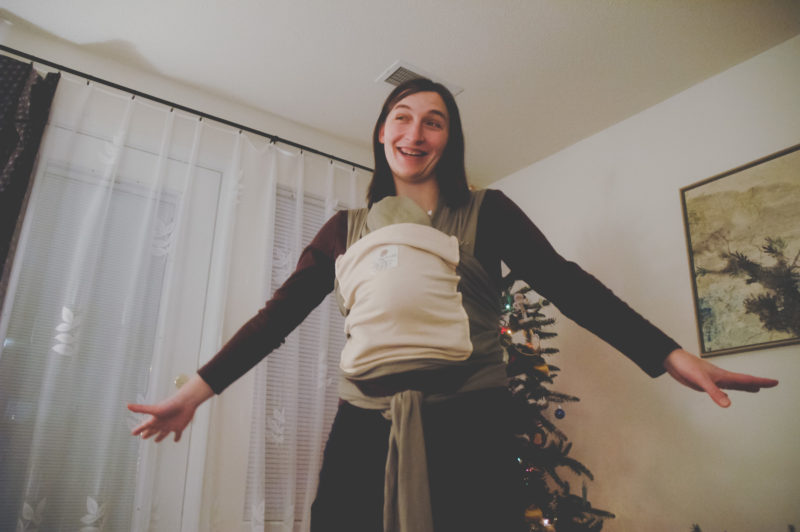
Basically, it’s a sling for your kid. It goes criss-cross (applesauce) across L’s back and between her legs, giving her whole body support. And freeing up both hands.

K uses it most of the time, since she’s still at home on maternity leave and, much as she loves our daughter, doesn’t want to spend all her time hovering over a reflux-y baby who requires constant soothing. This allows K to do all the wonderful things attached to having a newborn: laundry, laundry, and, from time to time, laundry.

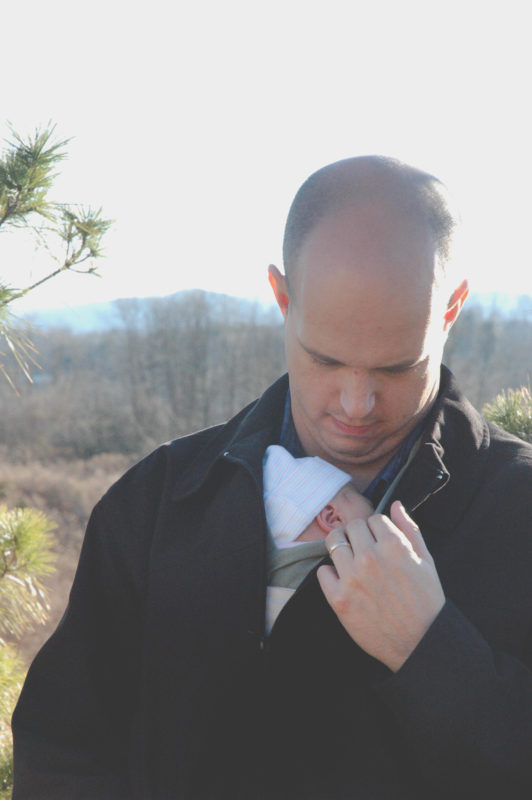
When going out on a cool-ish day, it has the added benefit of keeping L close to a source of warmth.

Lastly, when you’re dealing with a newborn, you don’t want to have a lot of people touching her. Keeping the infant wrapped keeps her in your own personal space, and while strangers will willingly and gleefully (and with the absolute best intentions) invade an infant’s personal space, they’re not so willing to do so if the infant is close to the parent.

For those interested/curious, the kind we got (Hug a Bub) can be on the expensive side if you’re not careful. Looking back on it, we overpaid. Still, it was worth it even at that price.

Our Sisyphus

Sisyphus

We don’t know how long it took Sisyphus to roll the stone up the hill only to have it tumble back down, but we can only hope that the gods were merciful enough to give him enough time to make it back down the hill and look for a moment upon his accomplishment.

Gods can be fickle, though, so there’s no telling.

K and I, however, know exactly how long our little Sisyphus takes to complete one cycle: three to four hours.

L eats almost in a panic at first. She doesn’t give a sign she’s hungry until she’s starving. Then it’s crying hysterics. When she gets the breast, she goes wild, as if she hadn’t eaten for days.

That starts with feeding. L is a gulper. When she’s nursing, she’s literally audible in the next room — which means she’s getting a lot of air with her milk. This requires a couple of burping sessions during the feeding session, and one long one after.

Burping L is an activity in and of itself. It can take anywhere from fifteen to ninety minutes.

What follows can be either an extended awake period (which requires constant monitoring, as L likes to have a bit of pacifier when she’s squirming about, and falls into hysterics when it falls from her mouth) or a sleep session.

Sleeping is shortly interrupted by pooping — apparently, an excruciating process for a number of infants, our pediatrician says. Much of it is just gas, which gets the girl squirming, straining, and turning red as she tries to get it out. As with burping, there’s a simple method to help get the offending gas out: pump the girl’s legs against her belly.

Once the natural gas exploration and extraction are accomplished, L may or may not go back to sleep. If she does, it’ll be for a very short spell, because it’ll soon be feeding time…

Saturday Morning with the Girl

Usually, when I rush out to work at 7:33 (and a minute later, else I’ll be late), the Girl and her mother are asleep. The early morning feeding is done and they’re both still pooped (and the girl probably still pooping), so I kiss them as the sleep and head out.

Saturday mornings are different. I take L while K sleeps for a while. We walk around the apartment, chatting about current events and what we might do that day. “Chatting” is still my monologue with her bright eyes looking at me; the day’s activities are still confined to whether or not to go for a walk. But it’s the principle: Saturdays are father/daughter time.

After the stroll through the apartment, L might start indicating that she’d be keen to suck on something. About the only thing I can offer her is my nose and a pacifier. The latter is much more hygienic, not to mention convenient. So I put her down for a bit of pacifier while I take a bit of coffee — at some point in the distant, perhaps we’ll share a Saturday morning coffee when she’s home for a visit, but for now, we don’t have much in common in the way of oral gratification.

If she’s in the mood for lying down with the pacifier (which is the most convenient position for a pacifier, given her apparent interest in the sport of distance pacifier spitting — if it were an Olympic sport…), I put her in the bassinet beside me at the computer and I read the latest headlines to her while she sucks contentedly.

Saturday Morning with the Girl

Last night, I was chatting with K with what Saturday morning with L might be like in a few months — perhaps early morning walks (and sooner than later, walks with L actually walking), playing together in the floor with whatever she’s interested in, reading to her. But for now, it’s good just to have a little father/daughter burping, pacifier, crying, gazing time.

Not to mention giving K a chance to rest some.

And what about Sundays? Pretty much the same..

Weight Gain

Wearing L in a wrap, under a jacket, creates the impression…

Weight Gain

well, that I’ve gained a fair amount of weight fairly quickly.

Tumble Calm

I have a friend who once put her cat in the drier — by accident, she claims. She just closed the drier door and it started up. From the inside came howls and screeches and the odd sound of scamper, scamper, scamper thud. My friend was laughing and crying so hard, she said later, that it took her just a moment to get the door opened. Off the cat bolted, disappearing for a good long time, emotionally scarred for life.

All that is just to point out that driers can be used for things other than drying clothes.

Take calming babies, for example.

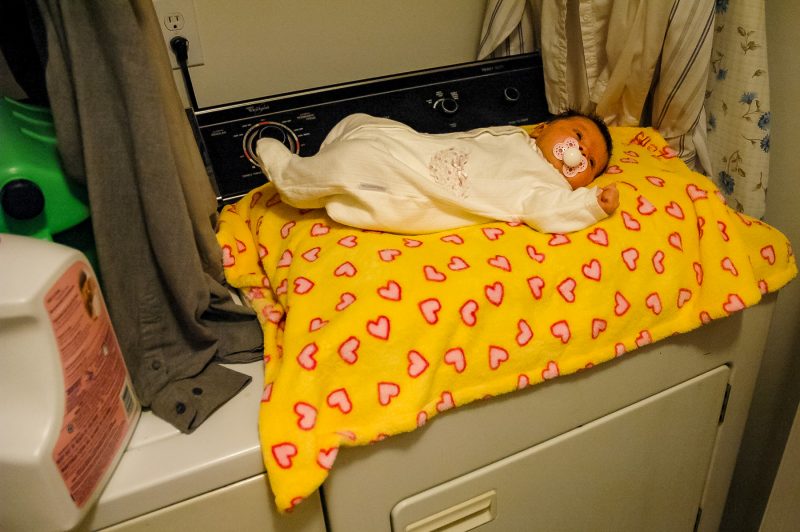
K and I had heard several couples say that the only thing that would calm their child was to put him on the drier and turn it on. Apparently the combination of motion, noise, and warmth was somehow soothing.

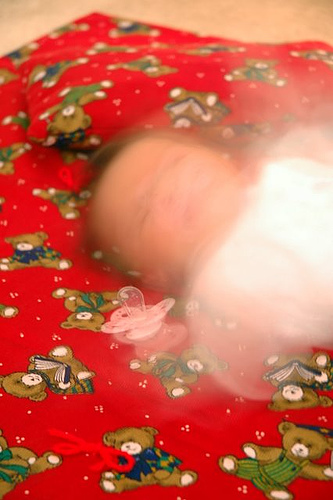
The other night, L in full panic mode, we decided to try it. And it worked. I put her on the pillow and blanket we’d set on the drier and she stopped instantly. It didn’t work for a long time, as evidenced by the picture: eventually she wanted her pacifier as well. But it’s good to know that, when all else fails, Maytag can save the day minute.

Who’s Bathing?

A new video, set to R.E.M.’s “We Walk.” Which is from Murmur — perhaps the most appropriately titled album in history, regarding the intelligibility of the lyrics anyway.

The song choice was inspired by the title alone. Michael Stipe has never been known for writing coherent lyrics, let alone good lyrics. This one, from R.E.M.’s debut album, is a prime example.

Sing365 has the lyrics as a repetition of the following:

Up the stairs to the landing, up the stairs into the hall, oh, oh, oh
Take oasis, Marat’s bathing
We walk through the wood, we walk

Marat? As in Jean-Paul Marat (Wikipedia)?

Discovered

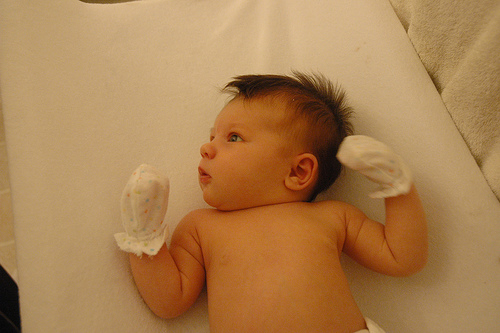
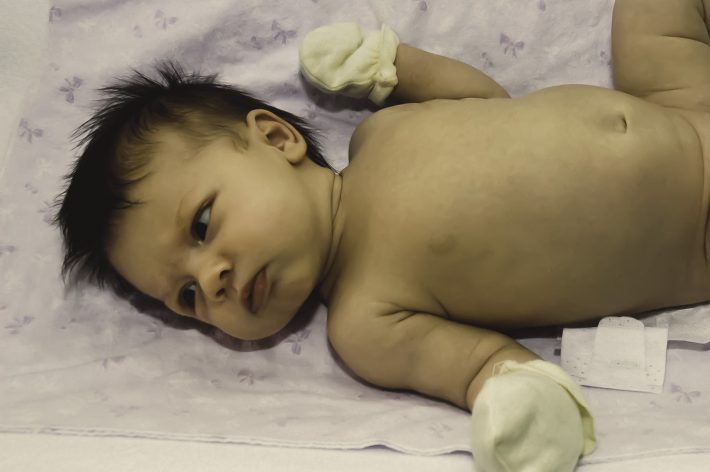
Newborns are completely covered for most of their first weeks, an L has been no exception. First, she was swaddled with a cap. Then we began dressing her in sleepers, but the cap remained, as did the mittens slipped over her dangerously sharp fingernails.

The Boxer

I got used to seeing only a round bit of olive skin, eyes closed, nostrils flaring, and the occasional gummy grimace as the crying begins. L was born with a head full of hair, but it was so rarely visible during her first couple of weeks that she might as well have been bald. But then the cap came off and we all got used to her beautiful dark hair, and how much it added to her features: her dark eyes seemed darker; her olive skin seemed more Mediterranean; her faint eyebrows were more visible. She looked less like the cheese-covered bundle of pink, wrinkled skin she’d been only weeks earlier and more like a little girl. It became possible to imagine what she might look like in a year, two years, five years.

Now, the mittens have finally come off, and the effects are equally dramatic. The eyes, some say, are a window to one’s inner thoughts. The fingers, it turns out, can do the same. What’s she touching? How’s she wiggling her fingers? How much control does she have over them? Mittened hands make mysteries of such questions.

Bare hands also highlight fragility. Fingers little larger than a matchstick could probably break with just as much ease.

It’s also now easier to see what she’s wrapping K and me around…

Cicho

“Cicho” would be spelled phonetically in English “chee-ho,” with the “o” being very short.

“Ciiiiiiiiii-cho, cicho, cicho, cicho. Ciiiiiiiiii-cho, cicho, cicho, cicho.” K leans over L — who is simultaneously howling, crying, screeching, and moaning — and whispers the most onomatopoeic word in Polish.

“Quiiiiiiiiiiiiiiet, quiet, quiet quiet.”

Calm

It’s a word conducive to whispering, made up entirely of long, soft, quiet sounds. It has all the sounds of the womb, all the peace of a whisper, and all a rhythm that softly strokes the ear. Hearing “cicho” whispered makes one’s eyes want to close.

DSC_4204

It’s probably the most pleasant sounding word in a language made up of harshness. W Szczebrzeszynie chrząszcz brzmi w trzcinie (Translation). These are the sounds of Polish: a phlegmatic language best spoken with spit flying everywhere.

What’s so remarkable about the word is that, when a mother whispers it, “cicho” contains the universal sound made for comforting a baby — it contains an inherent “shush.”

It is a candle being extinguished by damp fingers; the sound of walking through dry, light snow; the sound wind and leaves and trees.

If L chooses not to speak Polish to her own children many years in the future, I hope she chooses at the very least to calm them with a whispered “cicho.”

The Diaper

Call me bizarre, but I like changing L’s diaper. True, the contents don’t stink yet, so there’s no gag reflex to deal with. But I’ve a feeling that even when the Poopsmith does start incorporating fragrance into her artistic endeavors, I won’t mind it. I’ve come to realize that changing L’s diaper is the most loving, intimate thing I can do for her now.

I can’t feed her — that’s all K’s responsibility at this point — but I can clean up the mess.

Changing a diaper helps a father realize, I think, how completely dependent an infant is on on him and his, even for what in later life will be one of the most private of acts. Yes, that’s obvious, but hearing it and experiencing it are not the same.

For me, as I suppose for most men with the birth of their first child, changing a diaper was an entirely new activity, something requiring a bit of instruction, some patience, some practice, and a sense of humor when things go wrong.

Patience is key, for L poops in shifts. Hence, the first time I changed her, an almost scripted adventure: I get the new diaper on

Patience is key, for L poops in shifts. Hence, the first time I changed her, an almost scripted adventure: I get the new diaper on her only to hear the tell tale noises that say, “Time for a change.” I get that diaper on and it happens again. Lesson learned: give the little girl time to get it all out.

Patience is not enough, though. Practice combines with patience to create that mystery known as the quick diaper change, for it’s possible — in a rush, mind you — to put the diaper on wrong side out. This is not very effective, but fortunately the mistake makes itself readily manifest when you try to close up the diaper.

The need for a sense of humor is the most obvious — fountains of pee, squirts of poop, leaking diapers, heels planted firmly in dirty diapers all have their role in a diaper change.

Yet, changing a diaper is not for everyone, especially grandparents. When I asked my mother if she wanted to change L this weekend, she simply said, “No.” The great advantage of being a grandparent, I suppose: all the joy w

Burp

Burping L — a complicated process involving gymnastics, moan interpretation, patience, a sharp ear for slight gurgling, and a love of spit-up milk.

Burping

L has problems burping, which we’ve found we can solve by putting her horizontally for a few moments until all things gastrointestinal get good and worked up and enough pressure builds. By then, it’s no longer a bit of spit-up milk — it’s a fountain. Pick her up quickly, pat that back, and feel the warm ooze of undigested milk covering anything not covered with a burping cloth. (I think the milk gains sentience in the belly and then actively seeks any portion of the body not covered with the proper burping accessory.) Thump, thump, thump on the diaper (we’re using cloth diapers — they go halfway up her back at this point!) and then hold her still for a few minutes. Once she’s calm, repeat the process.

If we just hold her vertically and pat her belly, she’ll burp a time or two, fall asleep, and then squirm madly a few minutes later as the pressure builds up. Then L wakes with a start, crying, wiggling, and obviously in pain. And sometimes, to our terror, choking. So it’s best to do what works, even if the whole feeding process takes up to an hour and a half.

Proof, Pudding, and Other Glistening Things

Yet these are the fun things about being a parent — finding out the little quirks of your child, the little combinations of this and that in order to calm, soothe, burp, bathe, etc. effectively and quickly. Such things also speak to the coming quirks and wonders we’ll be discovering about her as she begins to smile, to speak, to walk, to run.

She also has problems sending it out other end, but perhaps another time…

Enter: LMS, Part V :: Birth

One two, one two — chop chop! There’s a sense of urgency to the arrival at the hospital that I’ve never experienced before. Yet, strangely calm urgency.

We get to the emergency room and the attendant grabs a wheelchair for K and I head back out to park the car. By the time I come virtually sprinting into the birthing room, K is on the bed, a nurse is getting a vast array of implements ready, and we’re all wondering when the midwife is going to arrive.

The nurse hooks up the two belts around K’s belly that measure the contractions and L’s heartbeat. She goes over some paperwork with K (“Would you refuse any particular type of medical intervention on religious grounds?” and the like) and then the midwife comes in. This is something like her 1,600th birth — she’s calm, calm, calm.

Contractions continue. Questions continue. More nurses come in and prepare a tray covered with various “sharps” — scissors, scalpels, needles, and a few things that look more Inquisitorial than medical.

Paperwork complete and sharps in place, it’s time to get K to the tub. I glance at my watch — it’s something like 6:40 am. We’ve only been there a little over forty minutes. Things are going so fast that it’s difficult for me to keep everything in perspective.

Once K’s in the, everything calms. K relaxes so much — and is so exhausted — that she actually begins falling asleep between contractions, which are coming with more frequency and lasting longer. I begin thinking, “Forget this hours in labor stuff — we’re having this baby within a few minutes.”

Close.

LMS

Through this all, K’s constant question: “When will I know to push?” The midwife, the nurses, everyone (except the only man in the room) respond with a reassuring laugh: “Oh, you’ll know.” One compared it to the feeling you get when you absolutely have to have a BM and there’s no toilet around. Nothing like a metaphor even the man can understand.

Sure enough, within a few minutes, K says, “I think I need to push.” And push she does, probably a total of less than ten times.

At 8:05, L makes her appearance, covered in cheesy Vernix caseosa, which the midwife advises K to use as lotion around her eyes. Her eyes, not L’s. “It’s the best moisturizer in nature,” she explained.

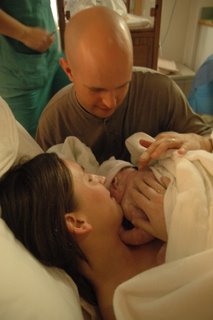
Within minutes, K’s in the bed, with L lying on her chest, and G standing around in a daze…

Latching

When she’s hungry, she’ll latch onto almost anything…

Kisses for Papa

When L’s upset, she starts rooting like mad.

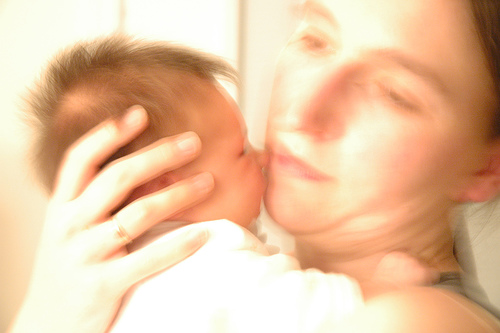
Occasionally, it looks like kisses.

Christmas Pictures

The other night we tried to take a picture of L in front of the Christmas tree. We figured that this would be the last night we’d have an opportunity. I took a few with the flash, and then I tried to get some without.

L in motion

And of course, she began moving. Like mad. (As always, click on the picture for more images at Flickr.)

Psie smutki

I dislike my translation very much. There’s no child’s voice in it, no simplicity. But it gives you the idea of what the poem’s about…

On the bank of a sky-blue river
live many small sorrows.
The first is sad because
he can’t play in the garden.
The second — that water doesn’t want to be dry.
The third — that a fly flew into his ear.
And what’s more, that cats scratch,
That he can’t catch the hen,
That he can’t bite the neighbor’s leg,
and that it never rains sausages,
And the last sorrow is that
People travel by cars, and a pup has to go on foot.
But just give him a little milk,
and bye bye sorrows.

Na brzegu błÄ™kitnej rzeczki
MieszkajÄ… małe smuteczki.
Ten pierwszy jest z tego powodu,
Że nie wolno wchodzić do ogrodu,
Drugi – że woda nie chce być sucha,
Trzeci – że mucha wleciała do ucha,
A jeszcze, że kot musi drapać,
Å»e kura nie daje siÄ™ złapać,
Że nie można gryźć w nogę sąsiada
I że z nieba kiełbasa nie spada,
A ostatni smuteczek jest o to,
Å»e człowiek jedzie, a piesek musi biec piechotÄ….
Lecz wystarczy pieskowi dać mleczko
I już nie ma smuteczków nad rzeczkÄ….

Bajka iskierki

I’ve put together a new video. For the music, I chose one of the most widely known Polish lullabies: “Bajka iskierka” (“An Ember’s Bedtime Story”). It’s a modern-ish version by Polish pop stars Grzegorz Turnau and Magda Umer.

An Ember’s Bedtime Story
Traditional Melody, Words by Janina Porazińska

From the fire’s ashes
an ember is winking at WojtuÅ›.
“Come! I’ll tell you a bedtime story,
A long fairy tale.

“There once was a princess
who fell in love with a minstrel
The king gave them a wedding,
And that’s the end of the story.

“Long ago lived Baba Jaga.
She lived in a hut made of butter.
And in this house all was enchantment.”
Psst! The ember’s died.

From the fire’s ashes
an ember is winking at WojtuÅ›.
“Come! I’ll tell you a bedtime story,
A long fairy tale.”

Hush! WojtuÅ› won’t believe you anymore,
little ember.
You flicker but for a moment,
then you die.

And that’s the whole fairy tale.

Z popielnika na Wojtusia
iskiereczka mruga:
Chod?, opowiem ci bajeczk?,
bajka b?dzie d?uga.

By?a sobie raz kr�lewna,
pokocha?a grajka,
Kr�l wyprawi? im wesele
i sko?czona bajka.

By?a sobie Baba Jaga
mia?a chatk? z mas?a,
a w tej chatce same dziwy!
Psst� Iskierka zgas?a.

Z popielnika na Wojtusia
iskiereczka mruga:
Chod?, opowiem ci bajeczk?,
bajka b?dzie d?uga.

Ju? ci Wojtu? nie uwierzy,
iskiereczko ma?a.
Chwilk? b?y?niesz,
potem zga?niesz.

Ot i bajka ca?a.

Enter: LMS, Part IV :: A Brief, Predictable Interlude

All my life, I’ve had an impossible, unlikely scenario in my head: driving my laboring wife to the hospital, I get pulled over by the police for speeding.

We’re about eight miles from the hospital. It’s early Saturday morning. There’ll be no traffic, so I decide we’ll forget the back routes (which are really a touch longer, but less traveled) and go the main way.

About a mile down the road, we realize K doesn’t have her wallet. We go back, get the wallet, and start again.

K is groaning and begging me to hurry; the road is deserted; I speed up and do between 65 and 70 mph on a quiet highway with a speed limit of 45 mph.

As I near the intersection with the main road in town, the highway curves gently to the right, slightly downhill.

On the left side of the street is an Ingles. In a small darkened access road to the left sits a car. I know what it is immediately.

We come to the stop light, and I look in the rear view mirror — there he sits, though his lights are not on. I decided I’ll go ahead and pull over preemptively, but when the light turns green, his lights turn on. I pull over.

Fortunately, the officer is reasonable and lets me go with a warning to drive carefully.

But no offer to escort me? Come on! That’s not how we all envision it!

Enter: LMS, Part III :: 4 a.m., Saturday

K awakens me with the news: “I think my water broke.”

Again, from birthing classes, we know that this is not a sign to rush to the hospital immediately. There are still no contractions, and the trick for knowing when to go to the hospital is 4-1-1 — contractions which are four minutes apart, last for one minute each, and continue like this for one hour.

“All this is part of early labor,” the birthing instructor informed us weeks ago. “This could last for hours, and it’s important for mothers to be as relaxed as possible. Go for a walk. Take a hot bath. Watch your favorite movie,” her advice continued.

We’d decided we’d watch My Big, Fat Greek Wedding — a movie about an amusing clash of cultures not entirely unlike what my family experienced at our own, Polish wedding.

But who wants to watch a movie at four in the morning?

K decides to call the midwife, just to make sure everything is fine. She learns that we need to meet at the hospital by eight if nothing has happened. “If contractions do not begin within four hours of water breaking, we’ll need to induce labor,” she explains.

We begin last minute preparations for our big adventure.

Once everything is packed, I come back to the computer and publish the pre-prepared post about going to the hospital. I set the time for eight, figuring that no matter what, we’d be on our way by then.

As I’m finishing up, K informs me that her first contraction has hit. It’s 4:15 a.m., and the contraction lasts about fifteen seconds, and about four minutes later, the second hits, also fifteen seconds.

Four minutes later, the third: about thirty-five seconds.

Four minutes later, the fourth: about forty-five seconds.

K tells me we’re going to the hospital within a few minutes. I’m still skeptical.

A little over an hour later, at 5:30, we leave for the hospital.