Occasionally, K and I are envious. Most often, we have too much to do at this time of day.
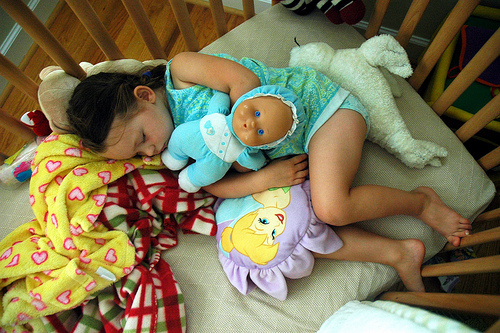
Occasionally, K and I are envious. Most often, we have too much to do at this time of day.
Nana’s birthday was Sunday. K prepared the requisite ritual (the cake); L helped decorate it.
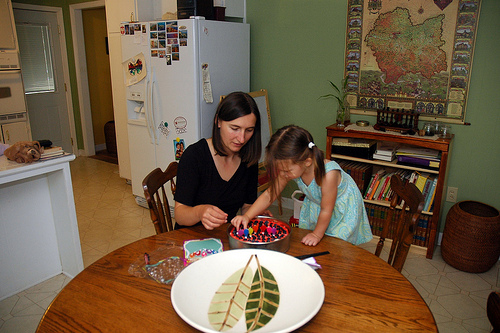
We took a novel approach to the birthday wishes. Or perhaps that should have been “took we an approach novel.” It’s a cake designed to be read while approaching it at very high speed in an appropriately-scaled vehicle.
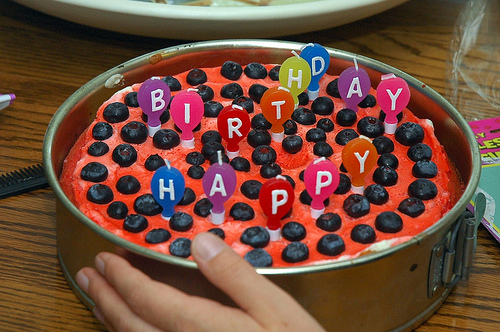
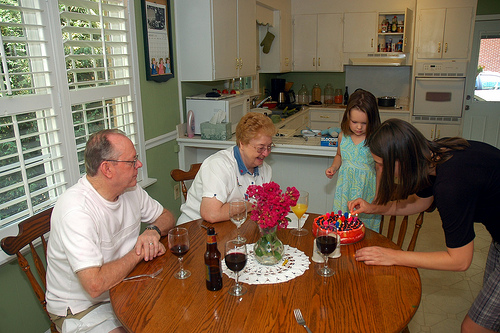
Nana made a wish,
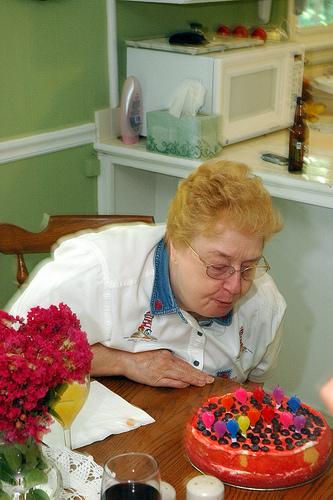
and Papa got his own wish fulfilled.
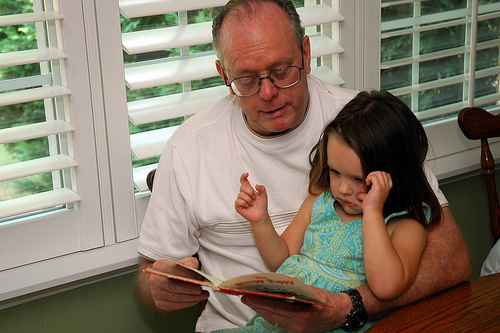
Reading The Sleepy Puppy to his granddaughter thirty-five years after he first read it to me, he didn’t laugh as hard but I’m certain the joy was as intense.
Checking a post’s formatting, I noticed a picture in the Flickr bar at right.
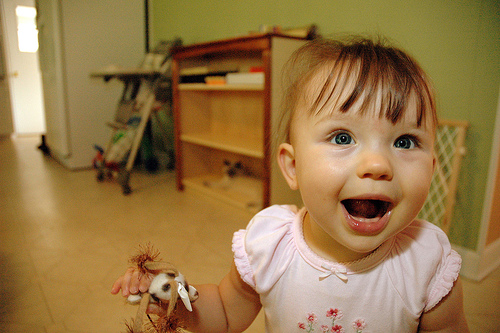
“Has she changed so much?” I gasped as I clicked on through. No teeth; short hair; such a very young face — she looks like a different child.
I click through the set — “LMS (First Year)” — and I see a terrifying picture.
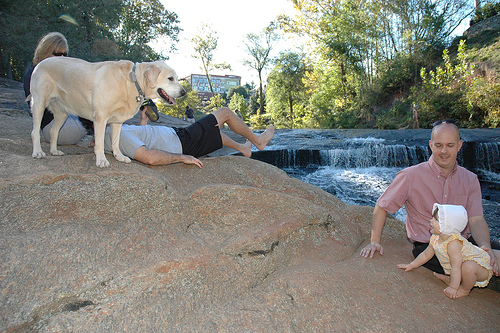
I would never put L in a setting like that now: she’s entirely too mobile and to hard-headed. She’d be tumbling down the rocks within moments.
Or would she? She’s a big girl; she has a fairly developed sense of balance. She might not. The old protectiveness clashes with the new, maturing reality.
A new class with a new teacher and a new building — recipe for stress for a 2.6 year old. All that in mind, we decided a lazy day at home was in order. Morning was for painting.
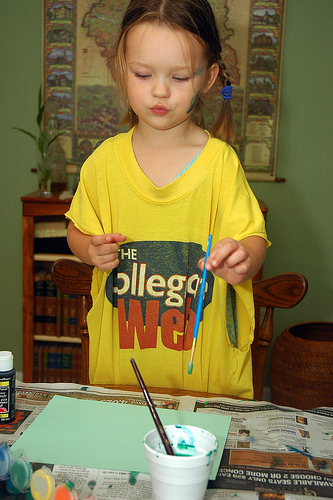
L is very interested in abstract design, and she has a strong sense of color, particularly blue. A successful painting has a significant amount of blue. And pink.
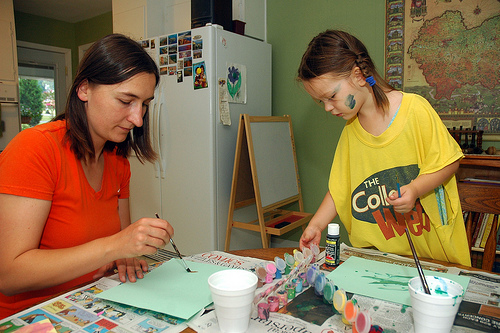
All great artists teach as well, directly or indirectly. L is no exception, offering advice to neighboring painters.
“But, but, you use blue paint, Mama, and I use blue paint. Okay?”
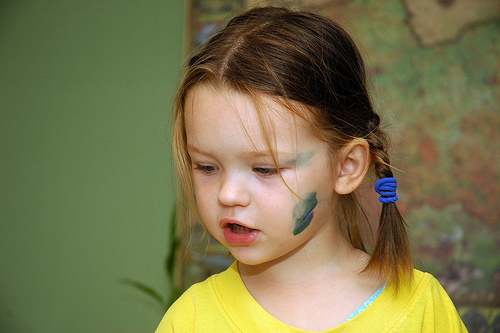
And a productive painting session requires the artist remain focused on her work, heedless of where else her paint might be landing.
We’re going on our first family camping trip over the Labor Day weekend. First, we have to check out the tent.
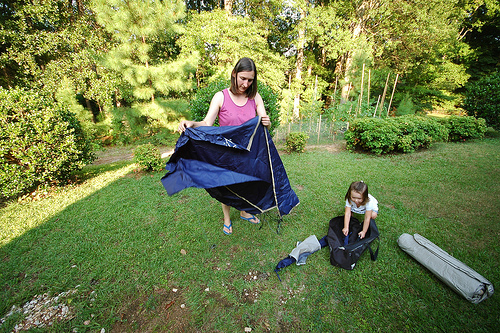
Of course, the Girl has to help. She loves helping, though until the last few months, her help has not been terribly helpful.
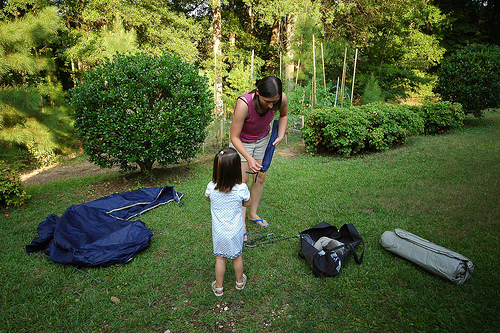
But she’s getting good at holding things for us.
“I can hold it?” she asks. She keeps a tight grip for a few moments, then asks, “You need this, Mama?” If Mama doesn’t need it, L quickly loses interest.
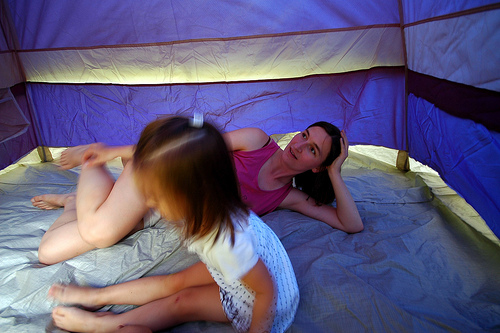
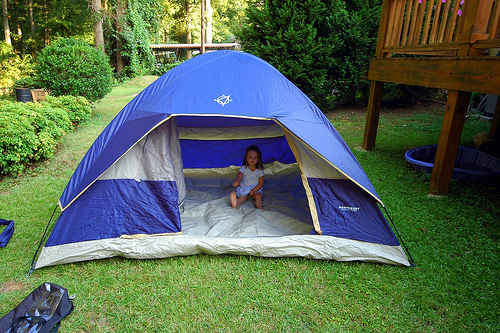
Once set up, the tent is a hit. It’s a palatial space for the Girl, and she makes good use of it, running about, jumping, being generally toddler-ish.
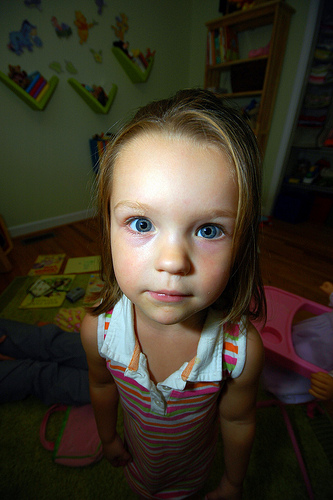
The Girl has begun padding about on her own…
 In the process of reorganizing the basement storage/work room, K and I have been tearing open boxes that have sat virtually untouched for years. Most of it consists of my own belongings, packed up while I lived in Poland in the late 1990s (eventually repacked into sturdy Rubber Maid storage bins). My parents moved, and instead of making the decisions for me, they left it to me, ten years later, to go through the stuff and toss out that which was once treasure but now trash. Granted, I could have done it earlier, but I lacked the serious motivation. Who wants to root around through old boxes of memories?
I had cracked the box that I knew contained my photographs. Eventually, when I moved back to Poland in the early 2000s and dumped on them all my earthly possessions collected in Boston and Polska, the box grew to contain pictures from close to thirty years of my life. It was a strong incentive, and I’d gone through that box several times.
The rest of the boxes remained packed, essentially for close to fifteen years. This was the week that I opened them.
The vast majority were books and toys from my own childhood that my mother had saved. Most of them were in remarkably good shape, especially the books. Not a spot of mold; not a hint of mildewy age.
I found a Harriet the Spy tour location tour on Flickr while writing this — well worth the time of any fans.
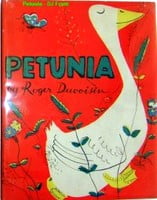
And so I took some time to go through books from my childhood, most of which I hadn’t held in my hands for at least twenty-five years. A look at the title and I remember almost everything: plot, illustration style with specific illustrations, and even my favorite parts. Petunia, the Sweet Pickles series, Benjamin Dilley’s Lavender Lion, stacks of Tell-A-Tale books–and so many other books I didn’t even remember having until I pulled them from the box. Near the bottom, late-childhood favorites hid: Harriet the Spy, a book on real, scary sea monsters, a book on tornadoes.
There were few specific memories about the books. Instead, it was general feelings, peaceful feelings. Calm.
I pulled several out to give to L.
 Her collection grows, and her eyes always light up when she gets a new book.
She takes books everywhere: she wants them by her as she plays; she wants them in the car with her; she wants one when on the potty. All of these are negotiable. The non-negotiable is the bedtime book. Usually her pick. That night, though, I chose: Petunia.
“Poor Petunia. Poor animals.” L mutters sympathetically when the firecrackers go off, scattering and injuring the animals.
I’m doing more than passing down books; I’m sharing memories in the most direct way, by recreating them.
 The evidence was everywhere: an empty wrapper; brown stains around the mouth; dark smears down the front of the dress; cocoa breath; the knick-knack box that stored chocolates sent from Babcia in Poland on the floor open.
“L, did you eat chocolate?” I ask.
She put her head down in shame — a new trick — and the looked up and said calmly, “No.”
I look at her quizzically and ask again. I get the same answers.
And suddenly, everything I’d learned about parenting during the last thirty-one months goes out the window. “How do you deal with someone lying who isn’t old enough to know what truth is?”
Some quick research shows that my assumption was right:
Your toddler lies because at this age he’s not yet able to differentiate between reality and fantasy. Until he’s 3 or 4, your toddler won’t fully grasp the concept of lying, because he doesn’t yet understand the idea of an objective truth based in fact. (S.Denham)
And yet, it didn’t seem like the the best idea simply to ignore it. Denham goes on to provide suggestions in her article, but standing there, looking at a chocolate smeared little girl who’d just told me ever so sweetly, “No, I didn’t eat chocolate,” I experienced something I hadn’t experienced at home for quite some time. At school, this happens quite frequently, but at home — not so much. In short, I stood there dumbfounded, wondering what in the world is the “right” way to handle the situation.
I told her that she’d lied, and I explained what that mean in concrete terms: “You told me you didn’t eat the chocolate, but you did eat it.”
And from there? Everything that came to mind just seemed so pedantic and ineffectual.
“Teach about the truth” is now on the parenting to-do-when-she’s-old-enough list.
Image: morguefile.com
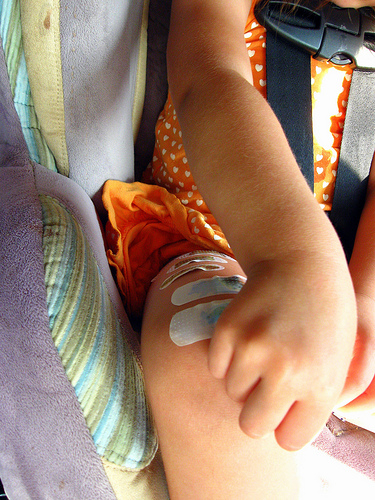
The Girl entertained herself with a box of bandages…

“They’re a bit rustic,” K’s colleague said about the cabins at Edisto Beach State Park. “They’re okay if you like ‘roughing it,'” he concluded.
“If this is ‘roughing it’,” K said as we walked in, “then I’d hate to see what his idea of luxury is.” We quickly determined that in between the two visits there must have been some extensive renovations.
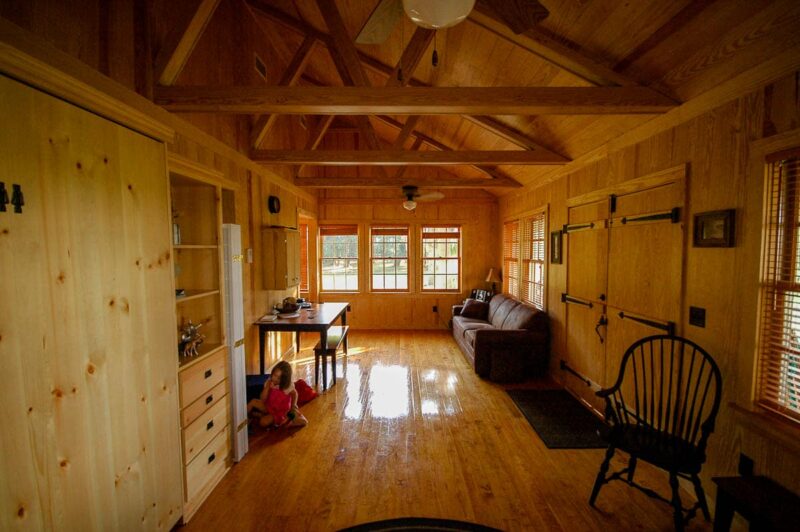
Surely no one could call this “roughing it.”
Hardwood floors and an interior done completely in unfinished pine — it is a welcoming space from the beginning. The living room has a Murphy Bed and an ample sitting area.
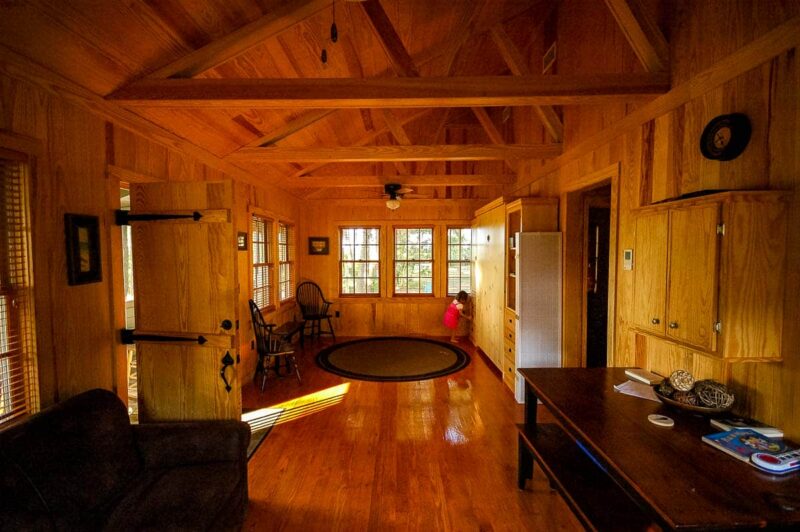
At the other end, a small television (hidden in the cabinet on the wall) and a leather couch.
There’s a small bedroom in one corner of the cabin — it’s L’s bedroom.
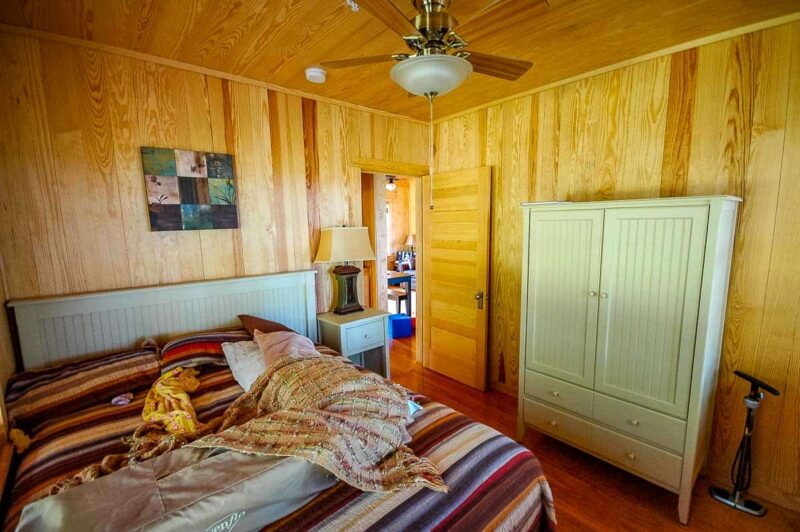
The kitchen is well light (in the day, anyway) and perfectly adequate for vacation.
The real treasure, though, is in the back.
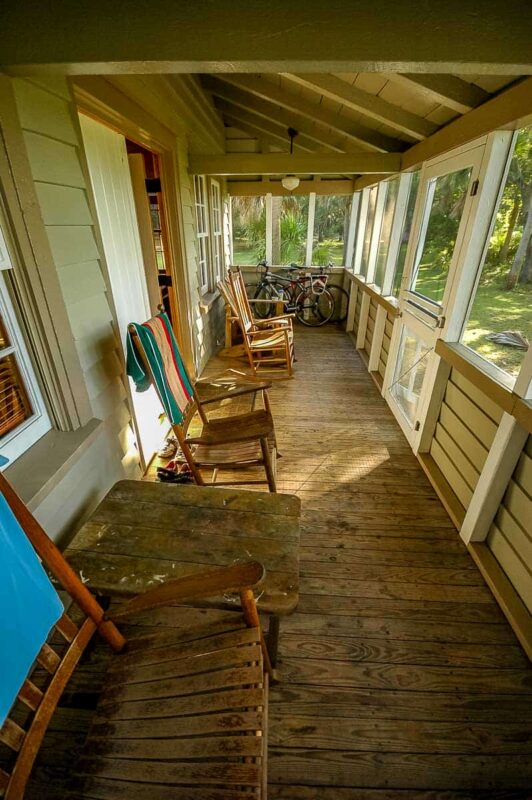
A restful night is a simple matter there, with the wind blowing through the palms and the crickets all around.
We wake the next morning to visitors: a family of four deer that almost managed to scamper away completely before I stumble back into the cabin for the camera.

Still, we didn’t come to Edisto for the wildlife. We came for the beaches, eager to give L her first beach experience.
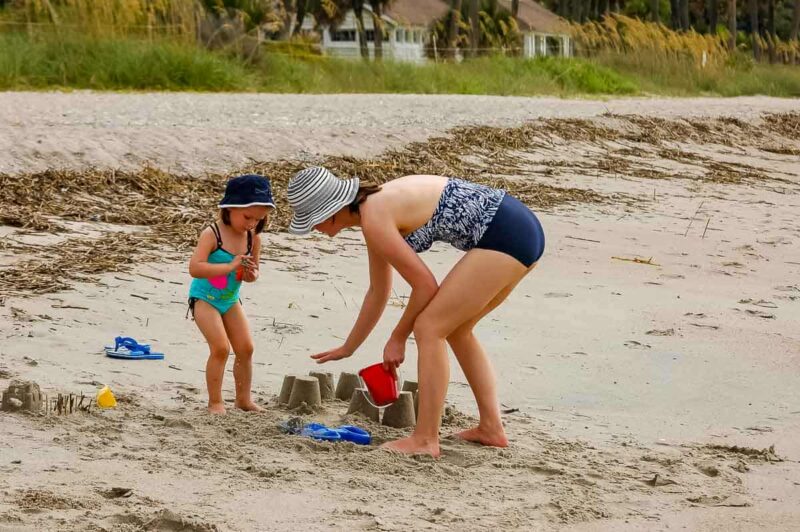
With the initial fear from the previous afternoon a distant memory, L is able to get down to some serious sand castle building. She carefully makes a ring of towers with an eventual moat. K, of course, only watches. Having grown up in southern Poland, she’s had enough beach time in her life!
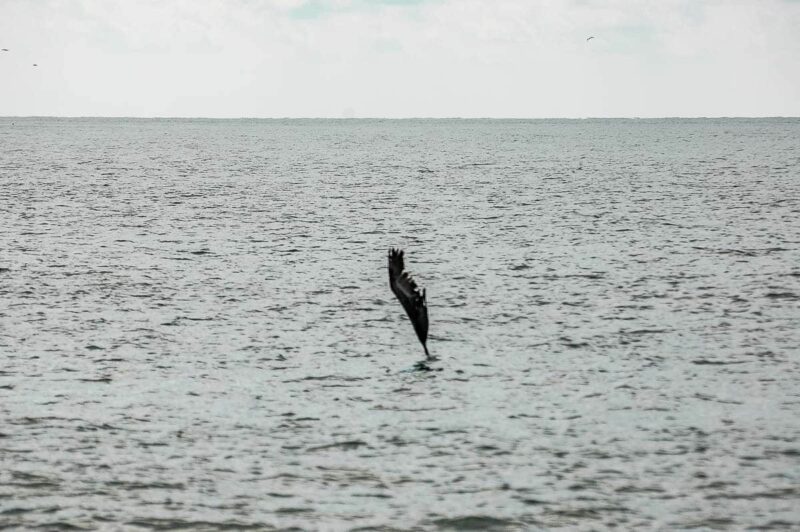
The pelicans off the coast have breakfast while the architectural wonders rise from the sand. They hit the water with shocking impact. We later find out that the repeated impact can so damage their eyes that they can eventually go blind.
The Girls, somewhat oblivious to the masochistic fishing exercise going on just behind them, continue to build.
Eventually, I try to convince L to approach the water and let the waves lightly wash over her toes. She’s not receptive, and when I press the issue, assuring her that I’ll hold her the entire time, that she has nothing to fear, that I’ll never let anything hurt her (A lie? No: some things are out of my control, but those things that I can control I will control. Or will I? There is learning in pain…), that it will be great fun — all for naught.
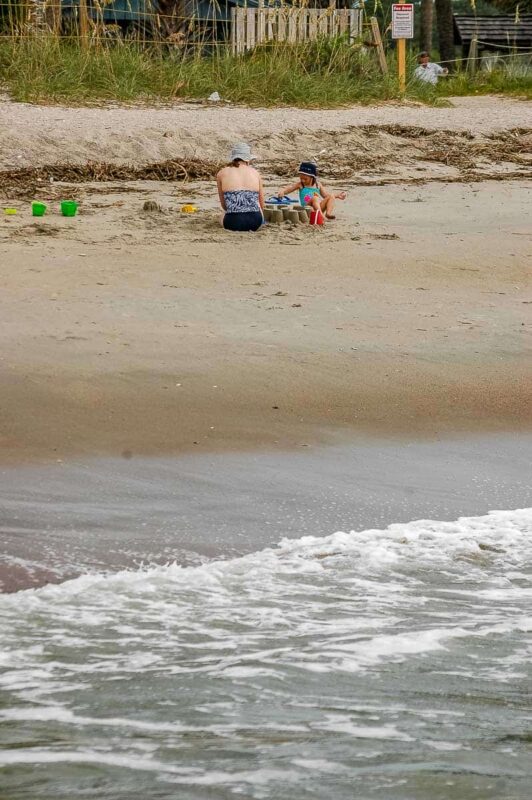
The more I reassure her, the more she panics. At last, I calm her down and assure her that I won’t make her go to the water.
It’s like with many foods: I know she’ll love it as soon as she overcomes her distrust.
She should be glad that she’s not a pelican, I decide. Then again, instinct is frightfully powerful, as is conditioning.
Being at a zoo can teach one many things.
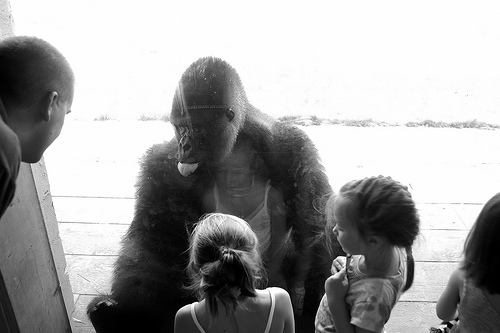
It can show you how close we are to the great apes. This great gorilla sat watching us as much as we watched him. His eyes darted from face to face, and occasionally he would furrow his brow. Proof of thought? Certainly not. It was humbling to look at him, though, thinking how closely related we are. Granted, we’re more closely related to chimps, genetically speaking, but I looked at the gorilla and saw shadows of us.
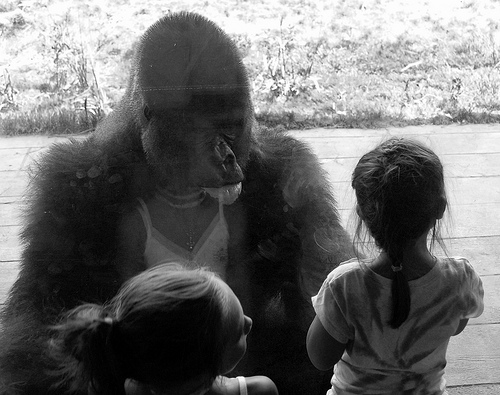
It was not so clear who was watching whom.
The elephants have better things to do. They’re more concerned with covering themselves with dust and looking old and wise.

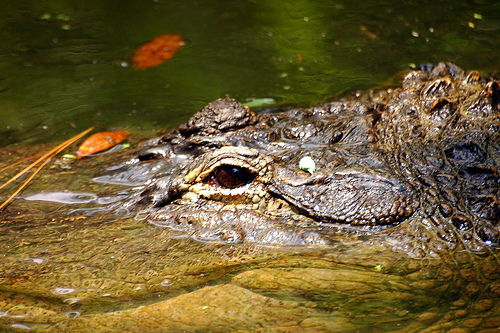
The alligators were looking sly, as if they knew how long they’d survived. “We walked with the dinosaurs,” they seem to say. “We’ll wait you out.”
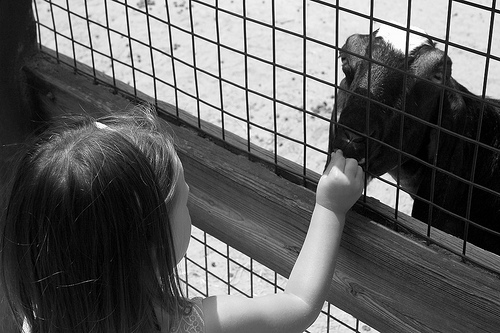
The goats, of course, were hungry. There’s not much to learn from goats, except how to deal with trolls under bridges.
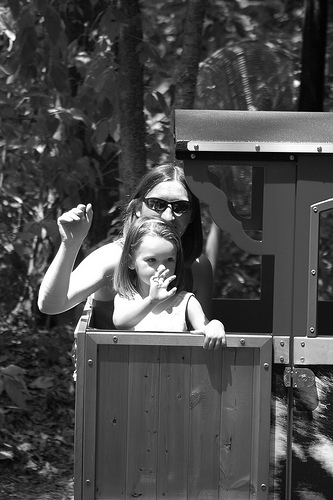
Trains come without tracks — the definition of “train” has become very flexible in the twenty-first century, but a ride on one is just as fun.
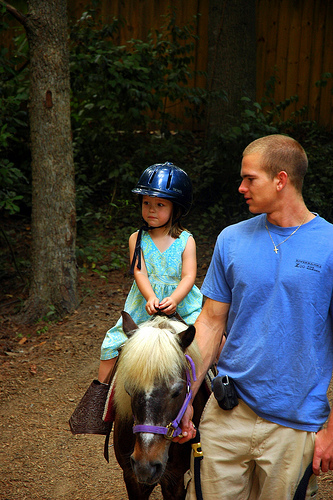
“Helmets are for bicycles,” declares the Girl.
“And for pony rides,” K explains patiently.
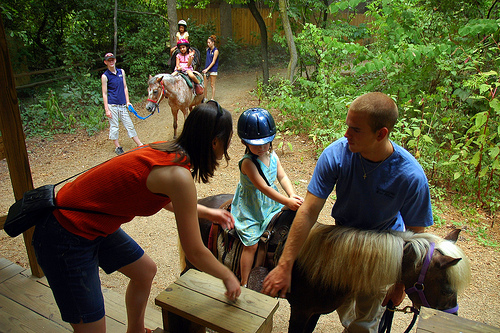
And pony rides are for those who are big enough to venture out on their own, sort of.
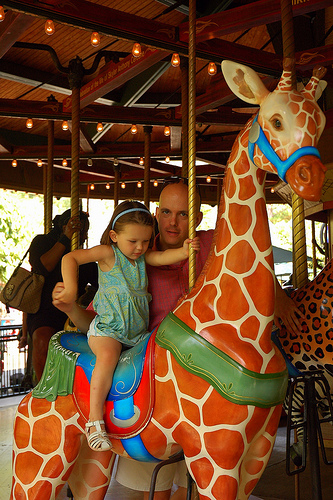
In many ways, giraffe rides are more fun: they last longer, anyway. And they do a more thorough job of getting one dizzy.
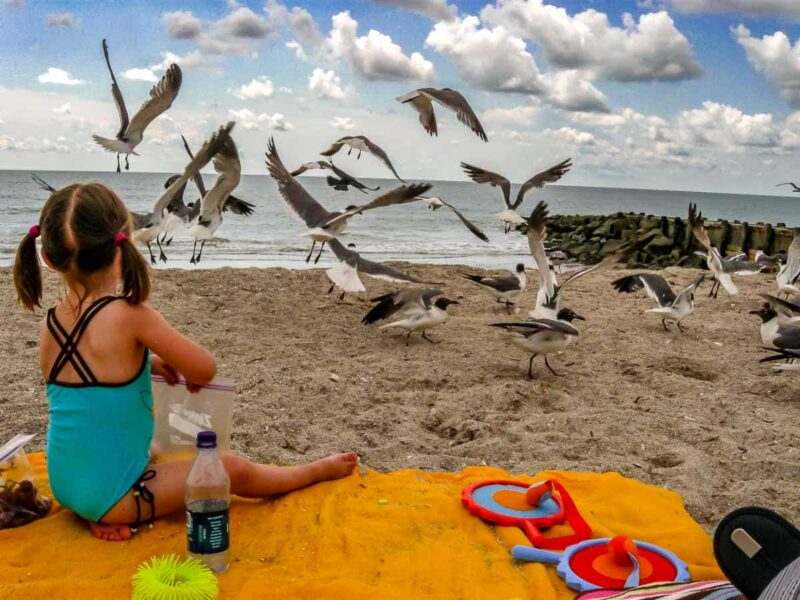
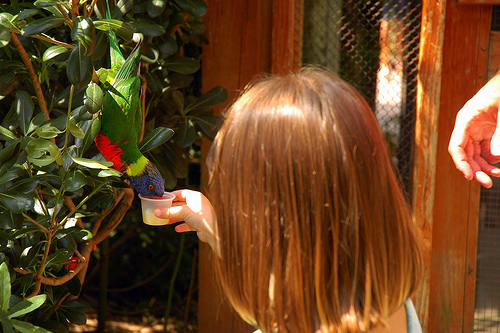
Some birds, growing so accustomed to regular feeding from visitors, take matters into their own claws.
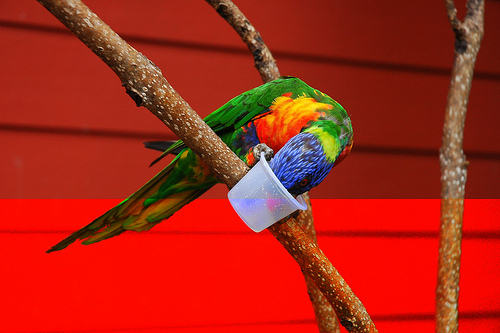
And it’s only with deliberate effort that visitors keep the greedy beasts from ripping the feeding cup out of one’s hand.

Feeding birds is a great way to make friends and giggle constantly.
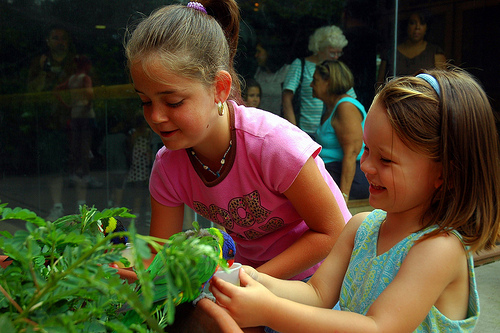
Birds will hang upside down to get food.
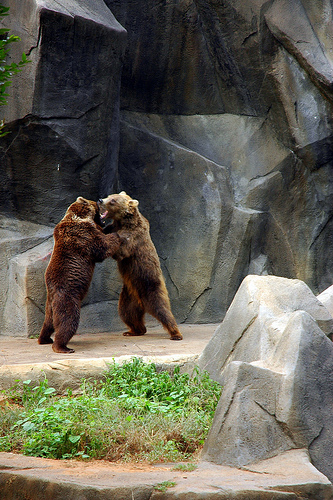
Zookeepers can take the grizzly out of the wild but, well, you know the rest of the cliche.
A quick swim when we got back to the hotel and everyone was ready for bed.
Tomorrow: a trip to Angel Oak, the oldest living thing this side of the Rockies (reportedly a 1,600 year old tree), then the final destination: Edisto Island.
From here on out, internet access is a big question mark. And that’s a good thing — we’re on vacation!
L and Bida, our cat, have an uneasy relationship. Or maybe it’s a love-hate relationship: L loves, Bida hates.
That might be taking it a bit too far. When Bida is in the mood, a scratch under the neck will bring a quiet purr no matter who’s doing the scratching. Yet sensing that mood is difficult for adults; it’s all but impossible for L. And so, in the name of love, L simply tortures the cat most of the time.
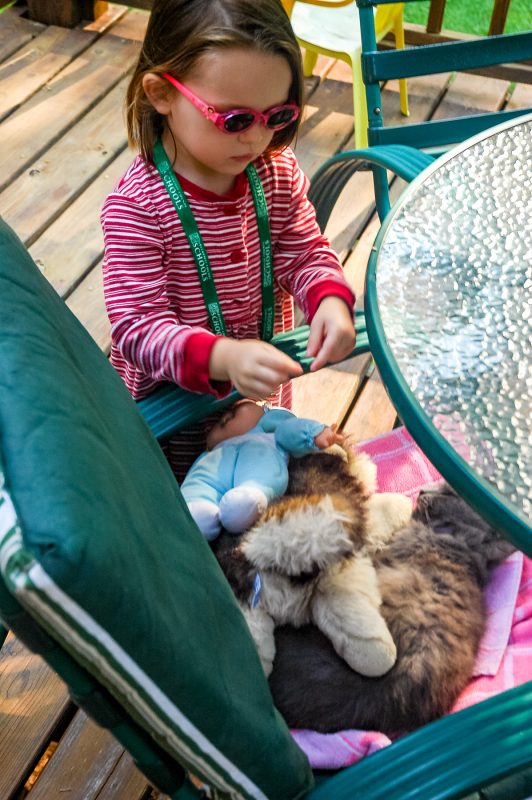
The trouble is, her “love” often is not affectionate; her “help” doesn’t assist in any way whatsoever. L’s simply trying out language and ideas she hears and sees all around her without fully understanding what it means (in the case of “help”) or how to show it (in the case of “love”). The result: a frustrated cat and a scratched little Girl.
At the same time, it’s incredible the patience Bida can sometimes show our budding veterinarian. She has figured out, I think, that if she waits just a moment, K or I will come and rescue her. And if push comes to shove (and L, in her rambunctiousness, can push and shove sometimes), Bida knows how to use her claws. And one would think that two or three painful, deep scratches would teach L to keep her distance, but to date, it hasn’t.
So K and I try to save the two smallest members of our household from each other on a regular basis.
Furman University, a private college just north of Greenville and home of the quasi-famous bell tower by the lake, has a summer concert series we’ve just discovered. It’s not Boston Pops on the Esplanade, but for a college of less than 3,000 undergrads, it’s an impressive schedule.

Last night, we went for the jazz program.
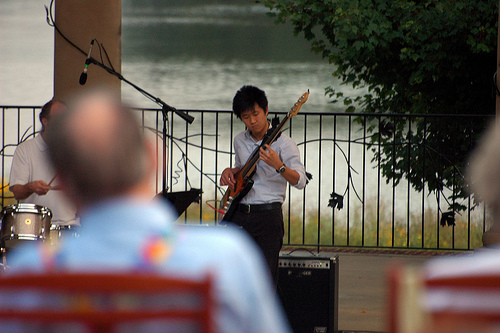
We’ve become increasingly fascinated with jazz over the last few years, so L hears quite a fair amount of it at home and in the car. It’s never among her requests — she’s particularly fascinated with Counting Crows’ music — but she does listen and bob her head about occasionally.

Last night, she simply danced. A little. Generally, she was having more fun throwing Baby down the little embankment where we’d spread our blanket, running to get it, and repeating.

She did calm down for the ballads.
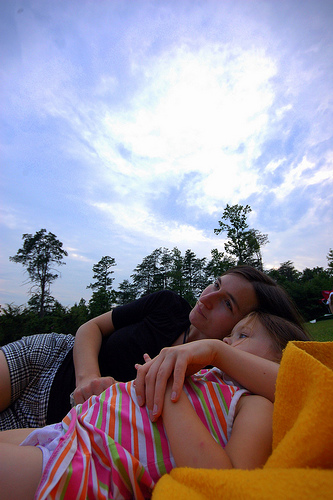
Igor Stravinsky said, “My music is best understood by children and animals.” L seems to understand music on some very primal level: it makes her want either to jump about or to sit calmly. It’s rarely merely “there.” It almost always provokes some kind of reaction.

In an informal atmosphere such as this, that’s just about perfect. Space to dance, an informal mood that doesn’t require silence, well-performed music — what could could a two-and-a-half year old want?
Six mornings in a row the Girl has had a completely dry diaper. We attribute this to four nights of waking up around midnight, hearing L crying out for the potty.
The new ritual is well established now. I stumble to the guest bathroom for the potty chair as quickly as I can while half asleep: I don’t want L to wake up any more than she has to. The real adventure begins in her room, for she’s often still partially or completely asleep. And she can fall back asleep at several points in the process. She has dozed off while
One night last week, she drifted off during four out of those five times.
“It’s time to start planning the final step of potty training,” I say to K over breakfast. There are the obvious things: a switch to training pants; a re-make of the crib; several nights of helping L get out of the bed and trundle off to the potty. There is an enormous potential pitfall, too, and a very literal one at that: our guest bathroom is just at the top of a short flight of stairs down to the kitchen.
Now that all the gates and barriers in the house are long gone, it’s time to start thinking about putting up new ones, which is sort of what parenting is all about: creating boundaries that (ideally) keep little hands safe but not restricted. Those gates will soon be much less literal, though.
An occasional selection for my nightly bedtime reading with L is One Fish, Two Fish, Red Fish, Blue Fish. She sits on my lap, commenting on pictures, asking with every pause, “Turn the page?” We make our way slowly through the book — it’s not one we read often and she can’t recite any passages from rote as I read, like she can with Fox in Socks or Green Eggs and Ham.
I’m always taken aback at the appropriateness of the ending:
Today is done.
Today was fun.
Tomorrow is another one. …
If we could only keep that in mind daily.
We took L for her first swimming lessons when she was six months old. She loved it. Then through some kind of osmosis, she began taking on the fear of the kids around her, I think, and by the end of the series of lessons, she wasn’t wild about swimming.
Last summer, she still clung to her anxieties: we really didn’t go often as a result.
This summer, it’s a different girl with us in the pool.

This makes for different parents in the water, as well.
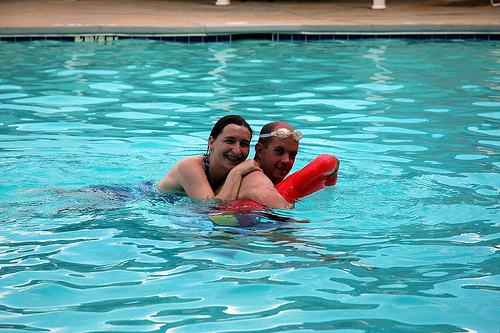
It has, in short, become a family affair. L floats; L slashes; L jumps — and we have to be there for it all. And that’s not just the parental pride; it’s L’s request.
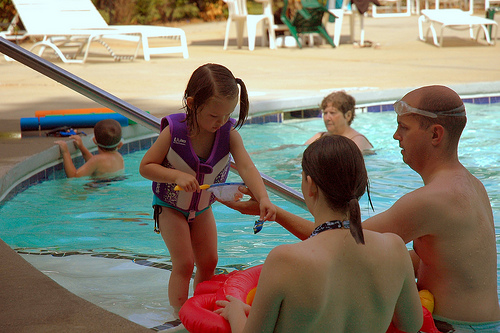
“Hey guys!” she likes to call out, “Watch me!”
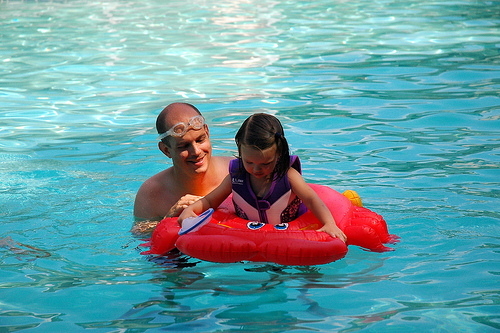
The clearest indicator of how her attitude toward the water has changed is her willingness to jump excitement about jumping.
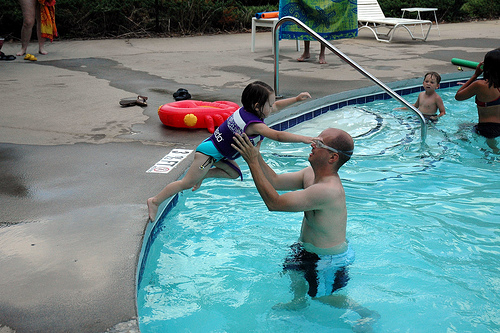
Again, and again, and again, only occasionally losing her nerve.
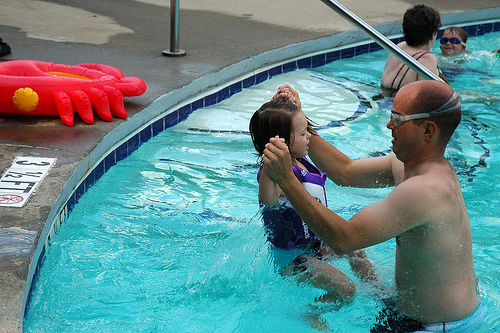
Nothing deters her, not even a face full of water. Not even a face entirely under water.
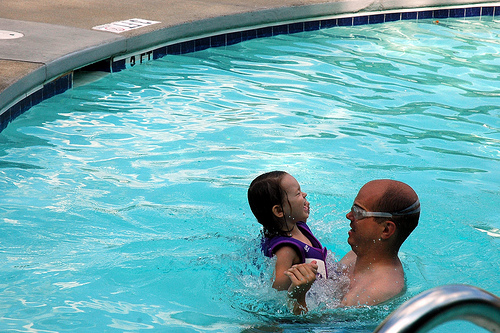
All of this is both gratifying (it’s great to see her overcoming her fear) and terrifying (it’s sometimes heart-stopping to watch her overcoming her fear). During a visit last week, she was being silly at the water’s edge and fell in. I was ten to fifteen feet away, so I swam there in a matter of moments. But those moments seemed eternal as she bobbed about in the water, unable to get her head out of the water, clearly terrified.
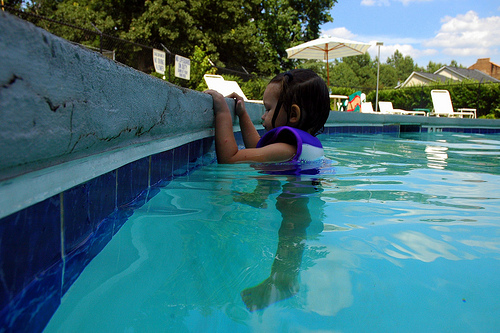
Another object lesson in the obvious: parenting isn’t about holding tight, but it is about being close by when those tight embraces are necessary.
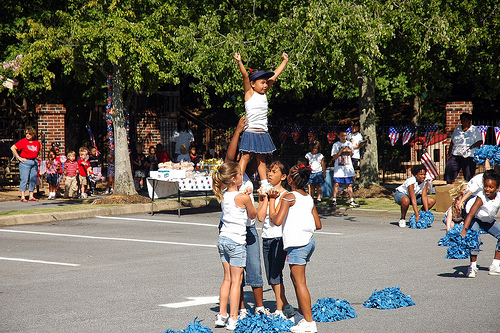
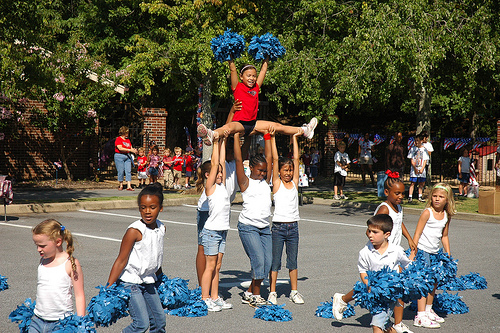
I don’t know if I’ve ever been in a parade. If I have, I don’t remember it. That might be the case with L thirty-plus years from now, but we’ll remember it, K and I: L’s school had a parade yesterday.
There was a pre-parade performance/cheer,
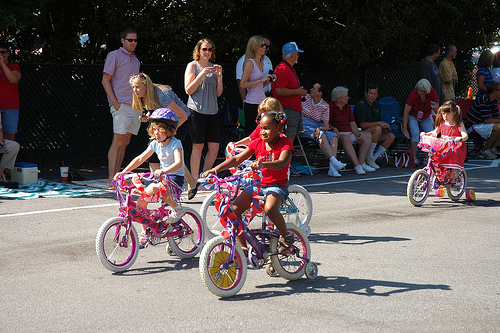
with a Cycling Corps actually leading the parade in (with one or two very wise little girls in helmets),
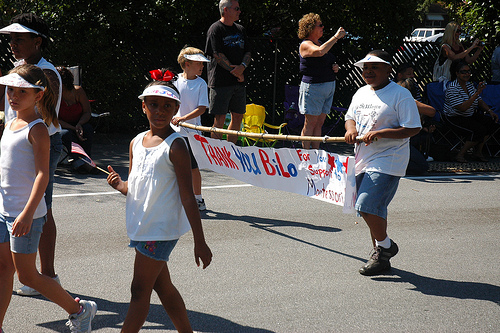
followed by some marchers complete with banners,
followed by the youngest toddlers’ escort.
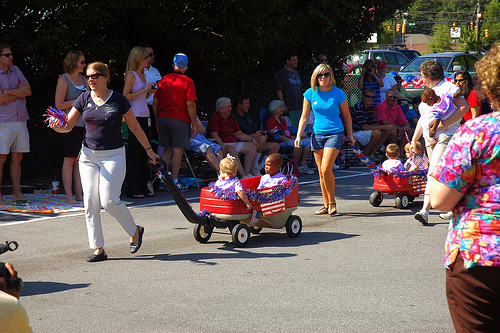
L’s group was the very last, with L marching as something of a walking Statue of Liberty.
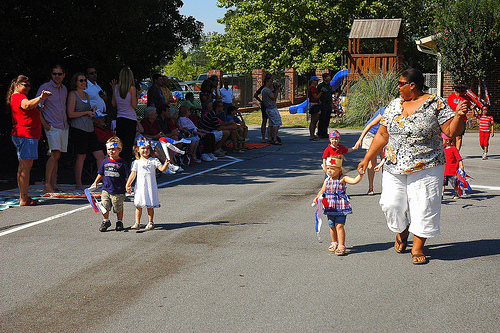
“Don’t let her see you,” K suggested before the parade began. “She’ll want to leave her group and come over to us.” Perhaps it was an unnecessary concern, for she marched past us with a big smile and obvious pride, and continued marching.
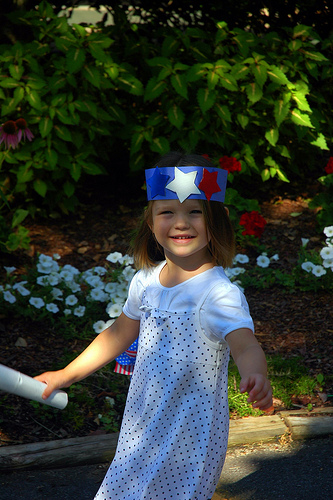
She was somewhat intrigued by her own shadow, though.
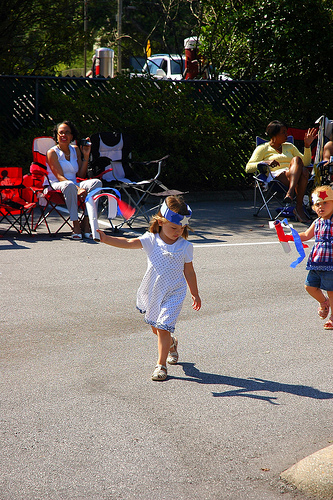
A photographer was there with a rather substantial collection of equipment, obviously a pro or a rich amateur: anyone with two Nikon D3 bodies…
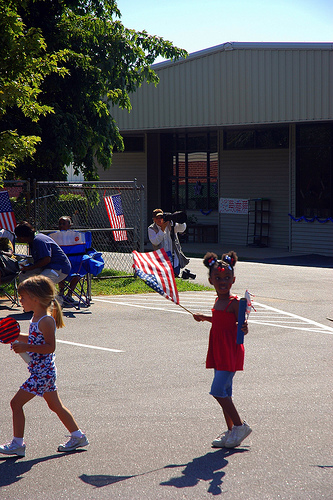
Finally, everyone gathered at the base of the flag to sing “You’re a Grand Old Flag,” I guess to the flag. It seemed strangely idolatrous and sweet at the same time.

A picnic followed, with L continuing her usual aversion to meat. No hot dog for her, thank you — just a bun.
I’m not sure how I got into the habit of referring to those closest to me by their initials: “L” for “Lena,” “K” for “Kinga.” Perhaps it was a sense of anonymity for those who don’t know us personally, but we don’t get many of those kind of visitors. Still, it’s a stylistic choice, one which I will continue.
Except for this post.
“Lena,” I also learned after naming our daughter, is a famous picture: “The Lenna (or Lena) picture is one of the most widely used standard test images used for compression algorithms.” (Source)
When Lena was still an unimaginably large bump in Kinga’s belly, we weren’t sure what to name her. We’d thought about naming her after her Polish grandmother, Janina. Yet, knowing the difference in pronunciation of “j” in Polish and English (It’s “y” as in “yeah” in Polish, for the uninitiated), we opted out due to the tendency everyone would have to mistakenly mispronounce her name. (The irony is, they still do it with “Lena,” for most want to pronounce it with a long “ee.”)
Our next choice was Amelia, but we were hesitated.
It was at this point, I believe, that Kinga suggested Lena, and I liked the name immediately. We settled on “Lena” fairly quickly once Kinga suggested it.
It had all the qualities we were looking for in a name:
The most uncommon name I’ve heard of is “La-a,” which is alternately spelled “Le’a.” It’s pronounced “Ladasha.” (The alternate spelling might also be pronounsed “Laapastrophea” or “Lainvertedcommaa.”) I’ve heard this is an urban legend, but Google “La-a” and you’ll get baby name site results for “La-a.”
Now, though, Lenas are popping up like mushrooms after a storm. Two of our friends have since named their daughters Lena; a friend who works in the hospital tells us that there are a lot of Lenas in the maternity ward.
And the same is true for Amelia. Very, very popular.
Part of me wants to say we were simply on the cutting edge of naming. By it also seems to hint at some kind of hidden current in societies that suggests things that bubble up slowly. After all, we only know two of the multitude of families who’ve opted for “Lena,” so the phenomenon can’t be attributed to our influence, as flattering as that might be.
K is frustrated. (The old habit returns…) “If we had another daughter, I’d want to name her ‘Amelia.'” And now we can’t.
Zdzislawa is looking better and better…
There’s also the LENA language system and a rock star in New York, not to mention the famous Polish/Czech Lenka pop star, and the Australian Lenka actress/pop singer.
A parallel thought to this is how children seem to grow into their names. Lena is a Lena. There’s no other name that seems to fit her, just like Madeline is Madeline. The name “Lena” is short and energetic, strong and joyful, single-minded; the girl Lena is short and energetic, strong and joyful, single-minded. “Amelia” would never fit Lena, and “Janina” is a worse match still.
When I was in college, I tried to go by my middle name, Lawrence. At the time, it somehow sounded more intellectual, more serious, than “Gary.” The trouble was, I could never remember that I was Lawrence. I gave up after one semester and took to heart how ingrained our names become.
Which makes me wonder about Bono, Eminem, Sting, Prince, Moby, Twiggy, Dido, Goldie, Cher, Lulu, Pink, and Seal. Do they so identify with their stage names that they prefer them to their real name? Do Sting’s closest friends call him “Sting” or “Gordon?” Does Bono go by “Paul” when the band is recording? And Prince — that’s a case all by itself.
So was Shakespeare right? Yes and no. Lena is not “Amelia,” though if we’d named her Amelia, I would be have reversed those names…