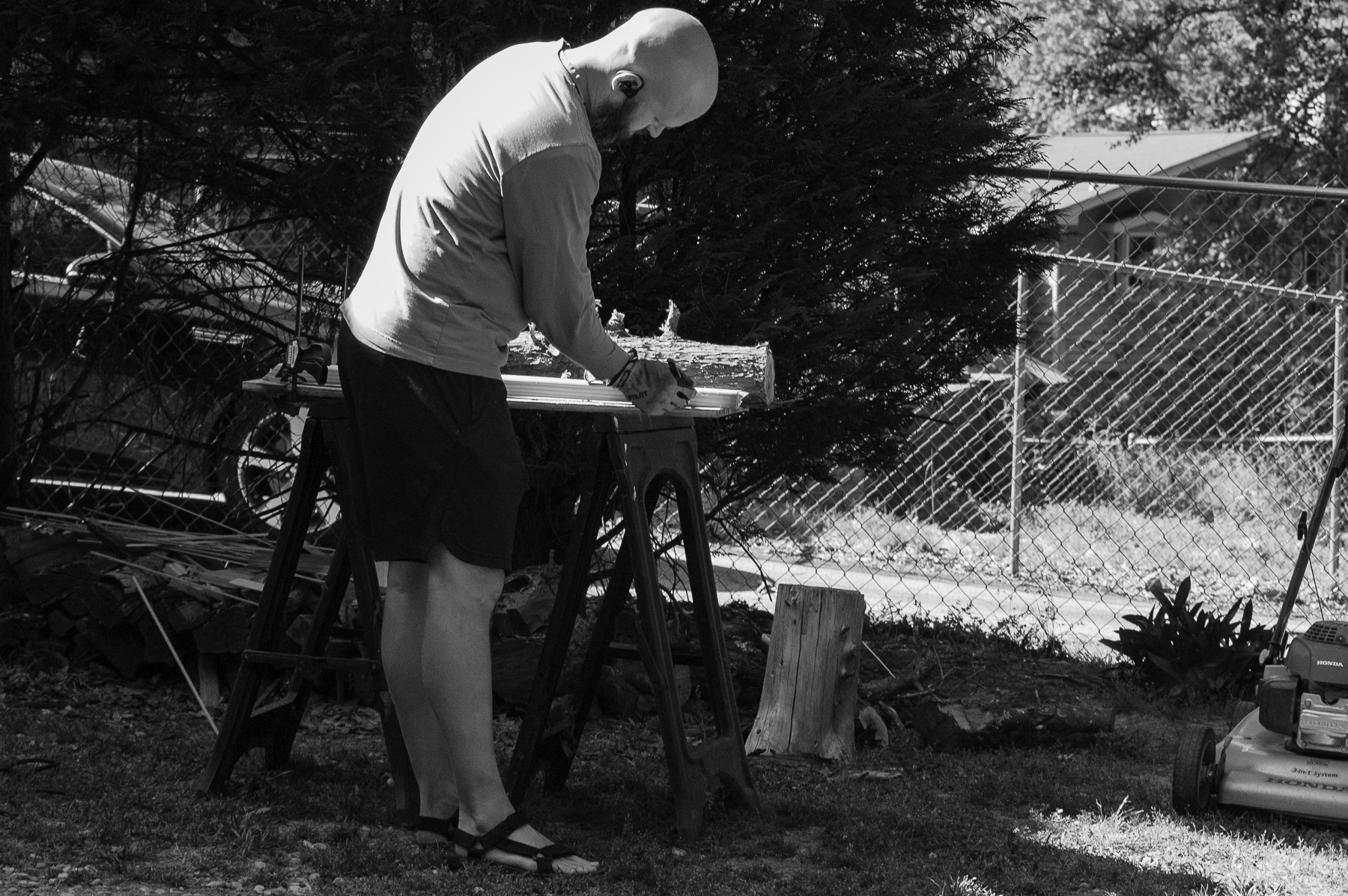
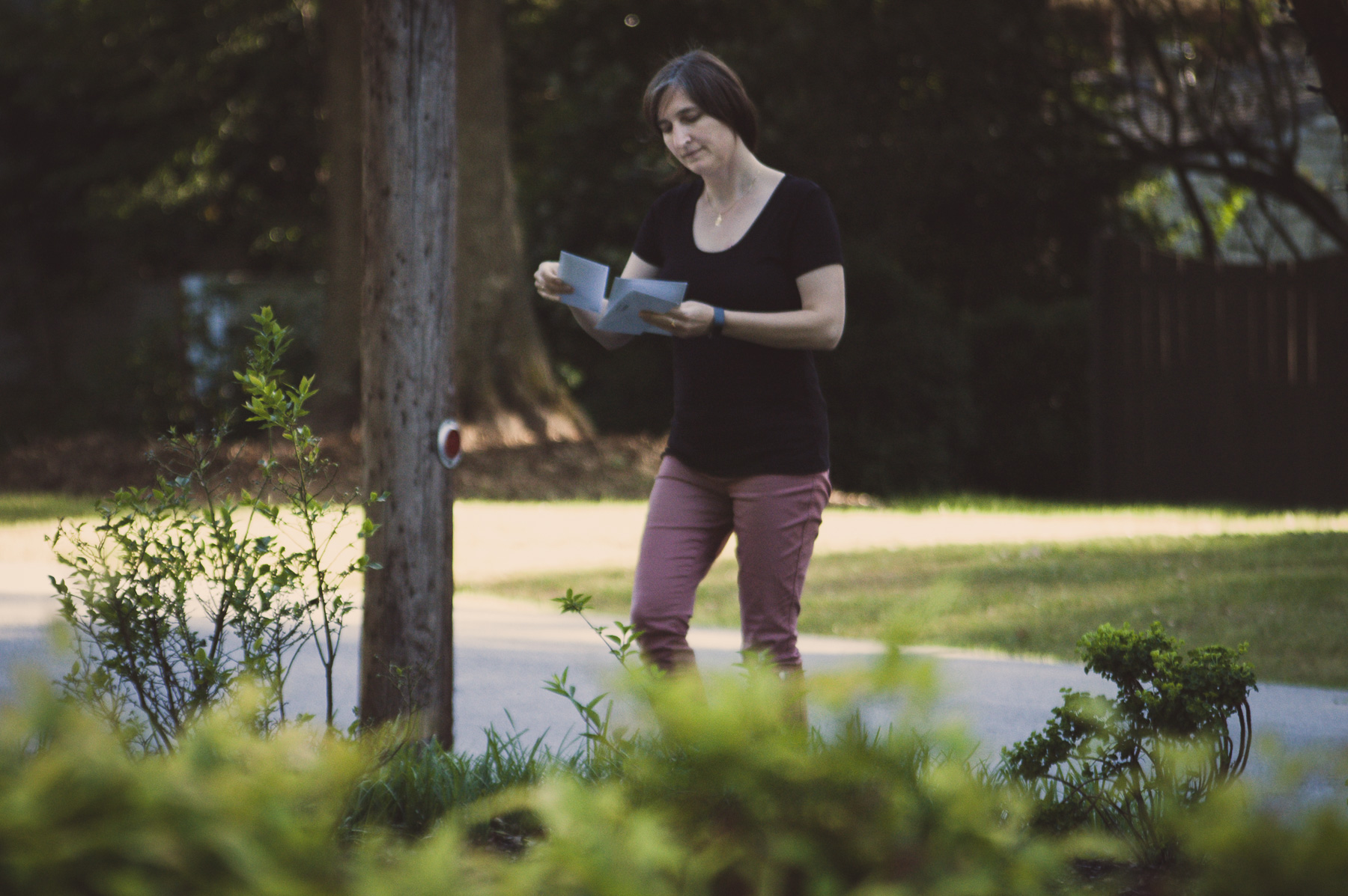

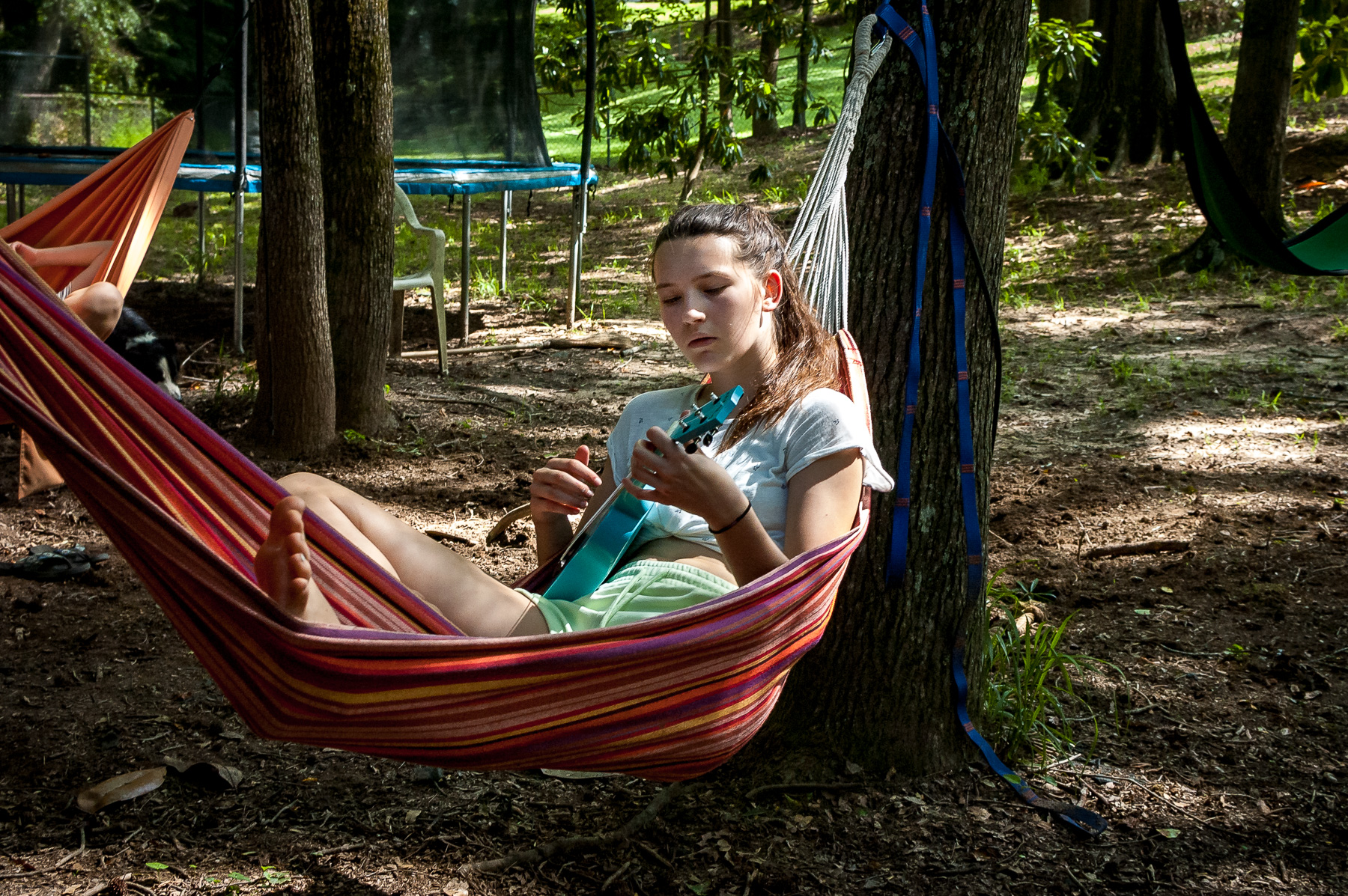
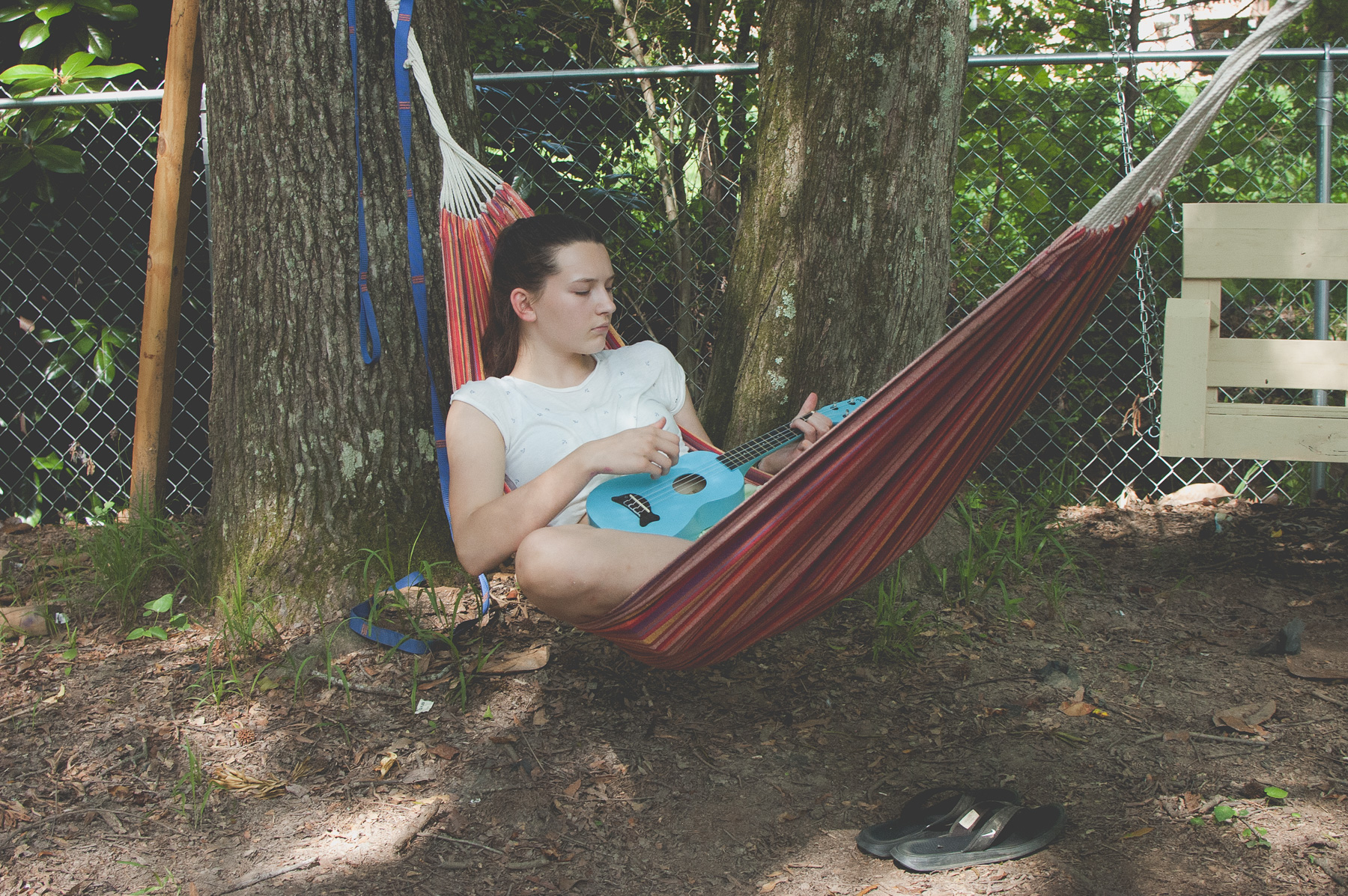

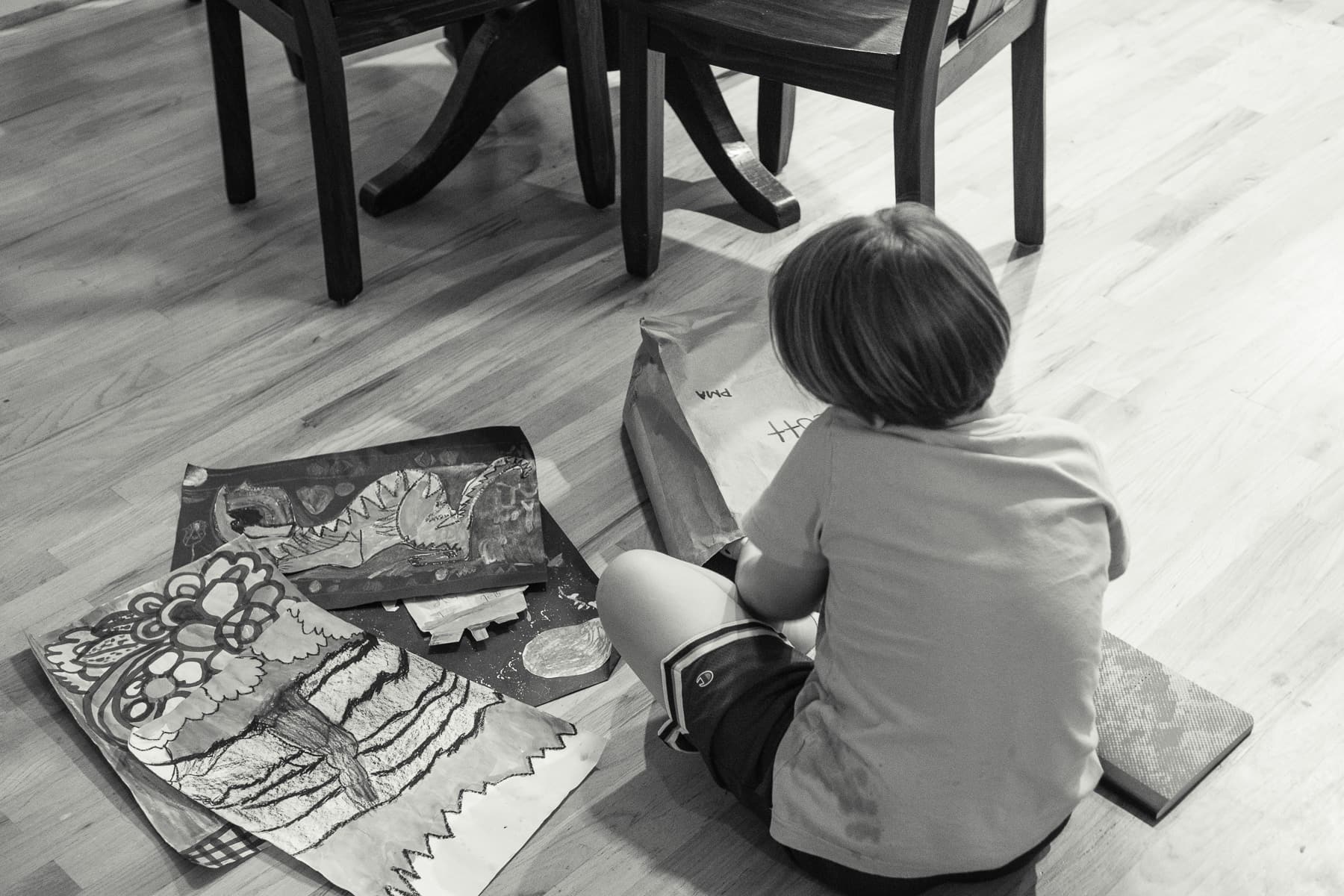
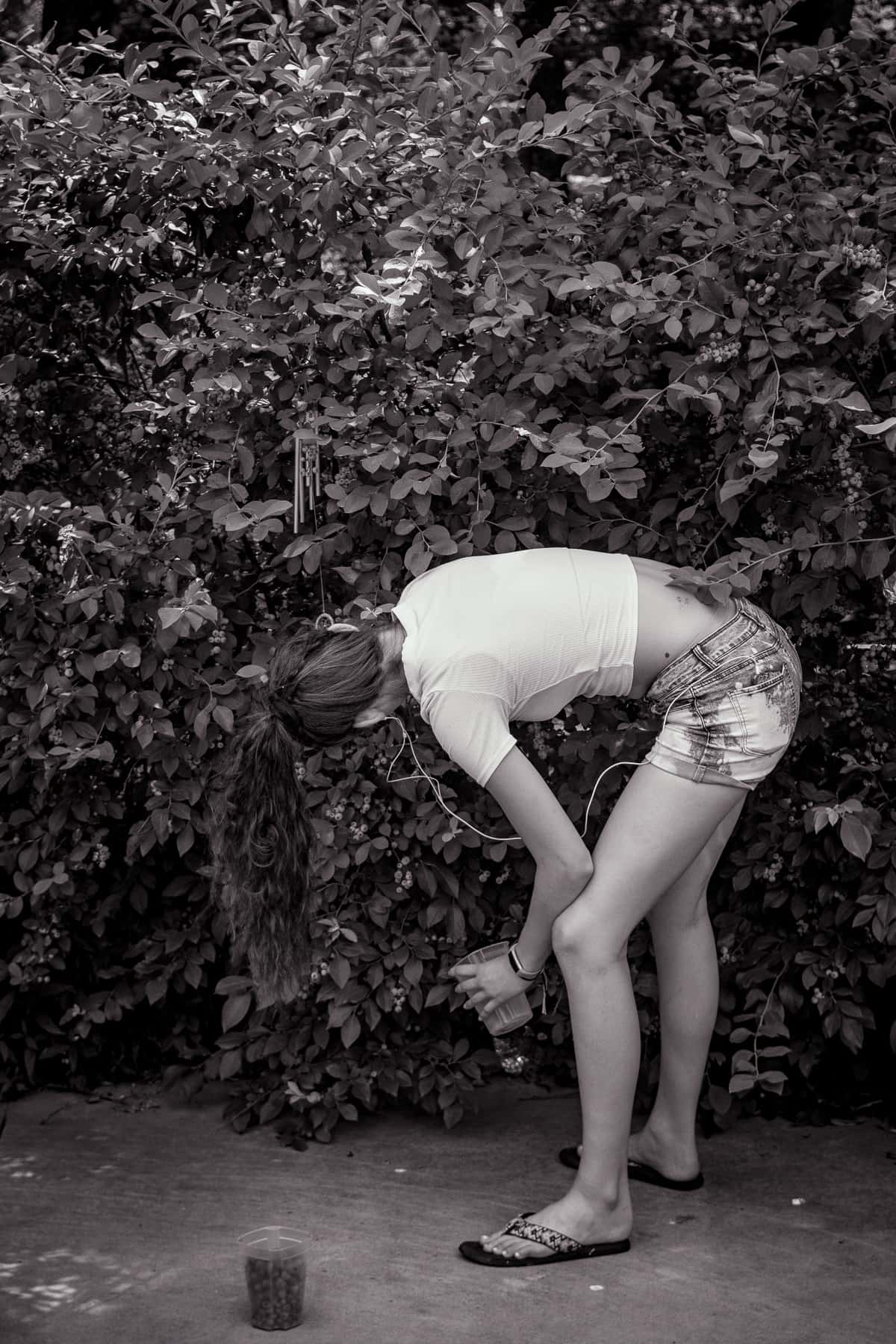
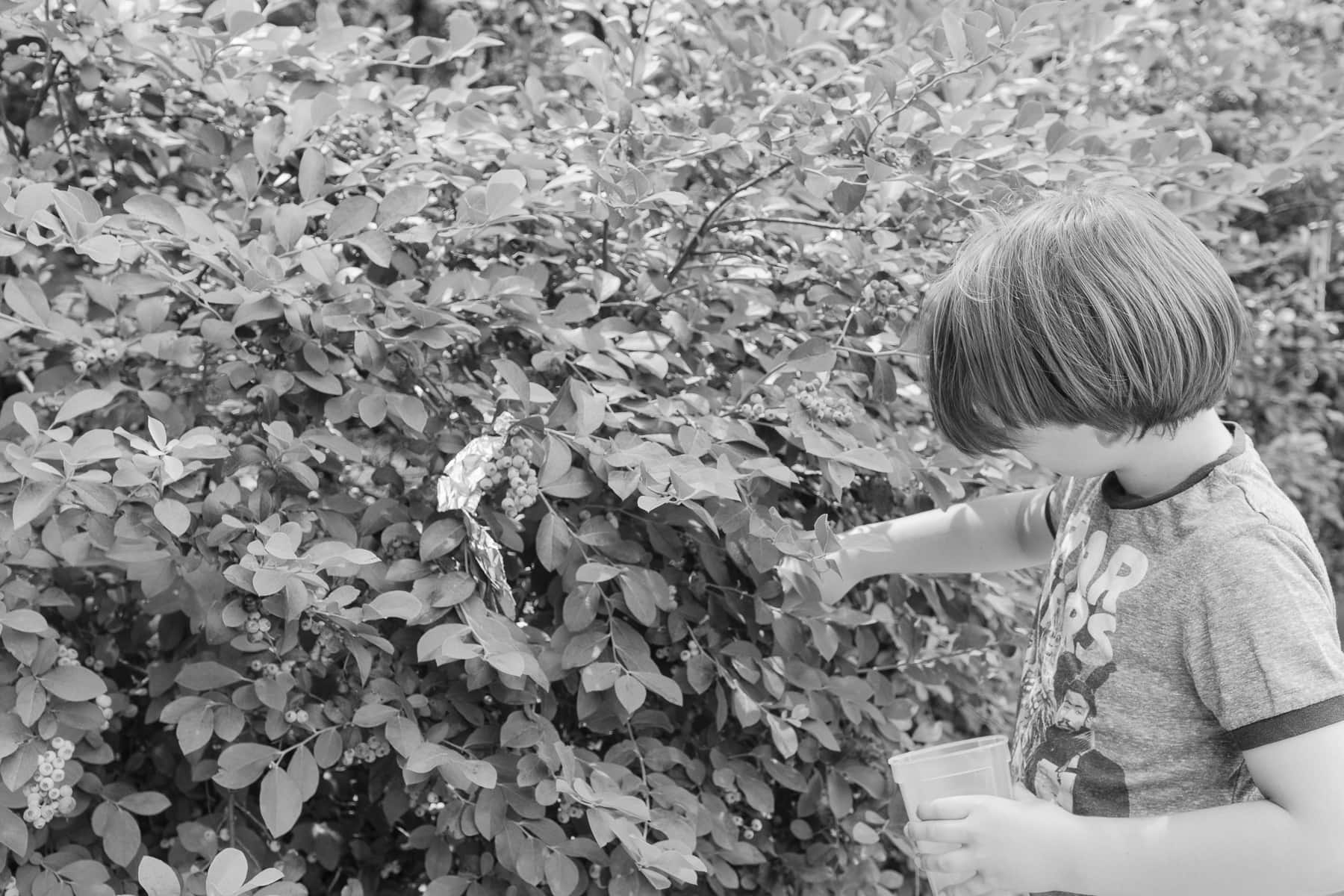




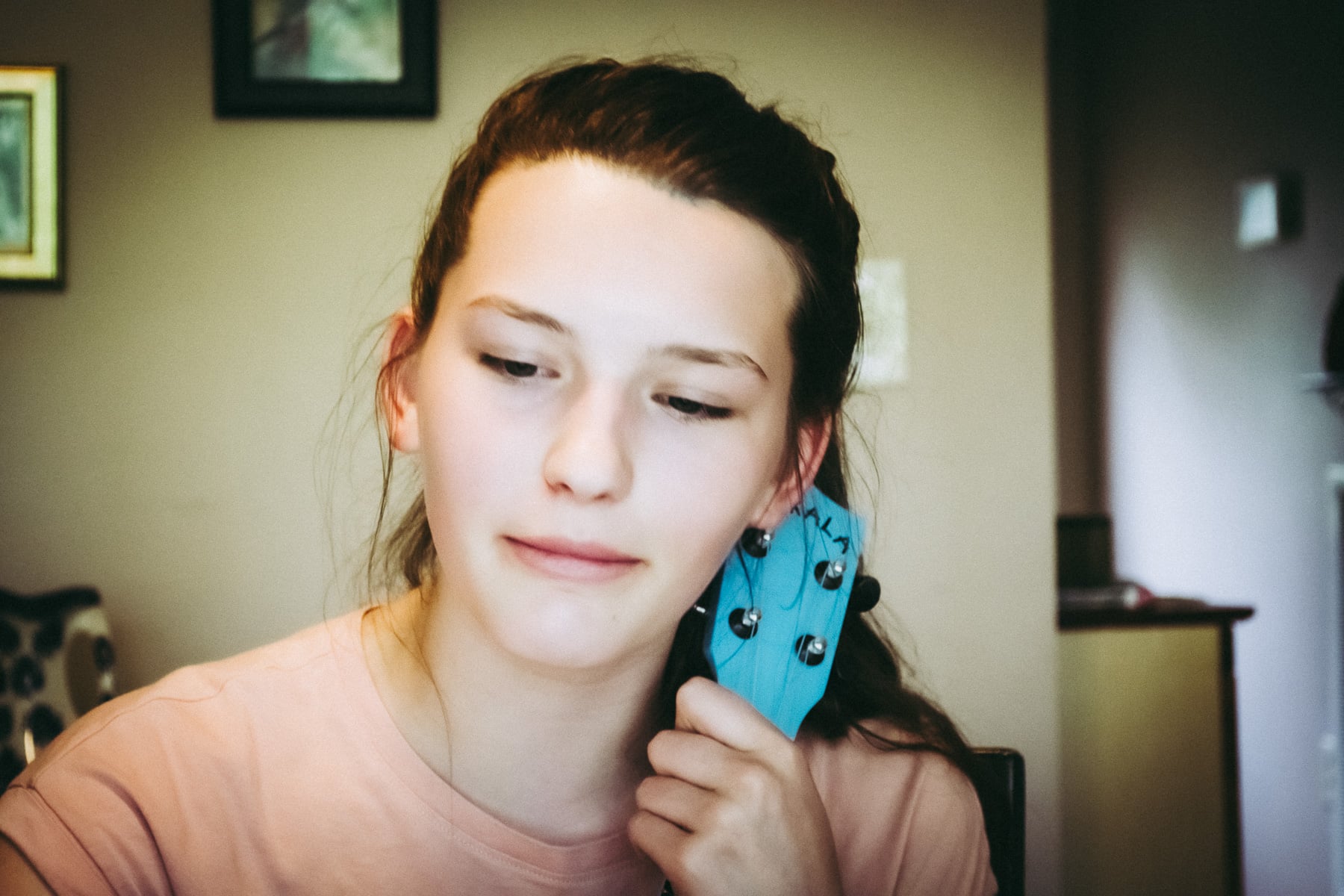

We’ve been waiting for our favorite park to open for weeks now. It seemed to us that going for a walk in the park should be something that lends itself rather naturally to social distancing. Certainly, you have to be aware of where everyone is and perhaps not go at the pace you would normally walk, but those are small concerns that mature people can keep in mind and in action relatively easily. But the city kept the parks closed.
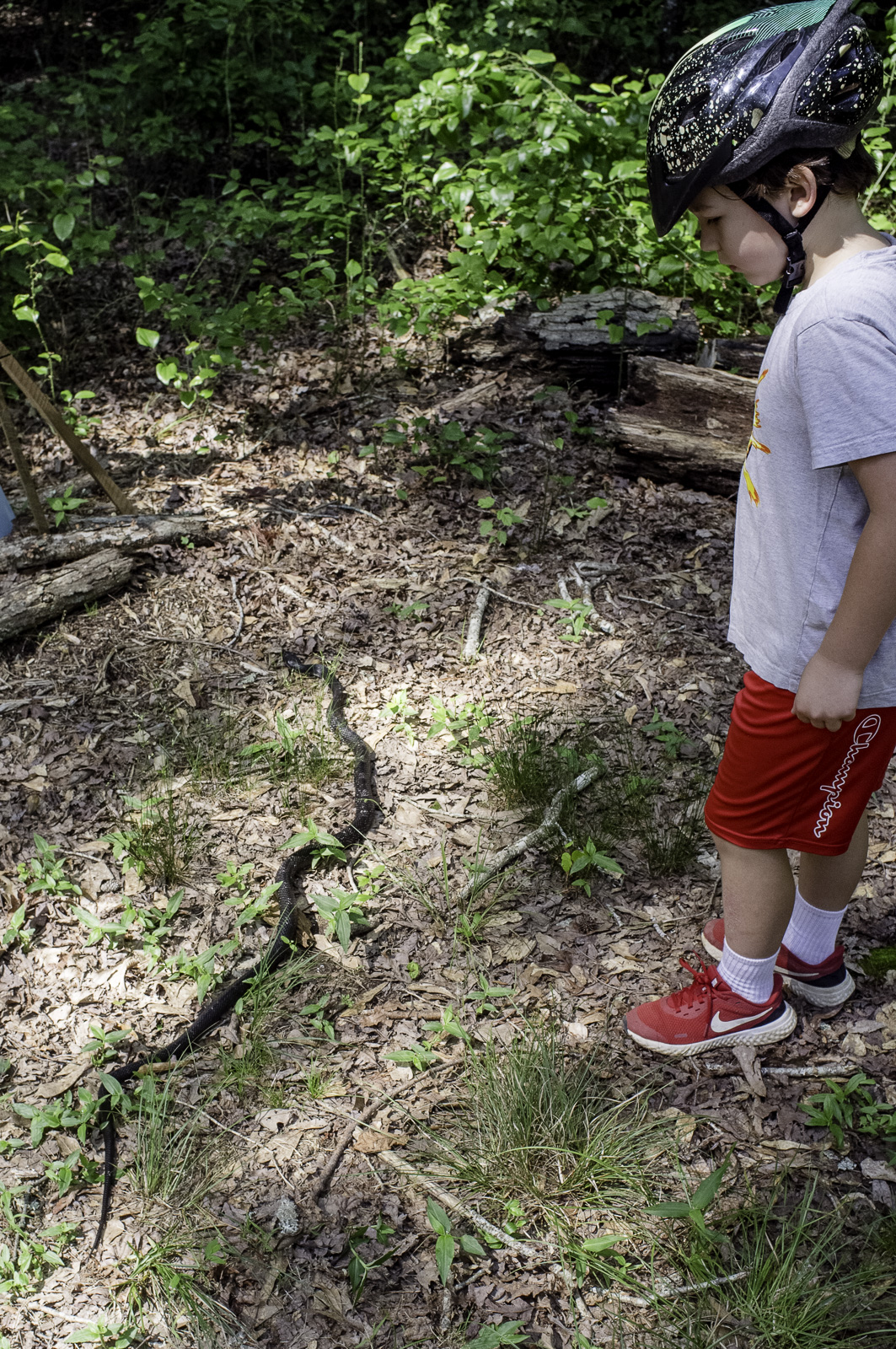
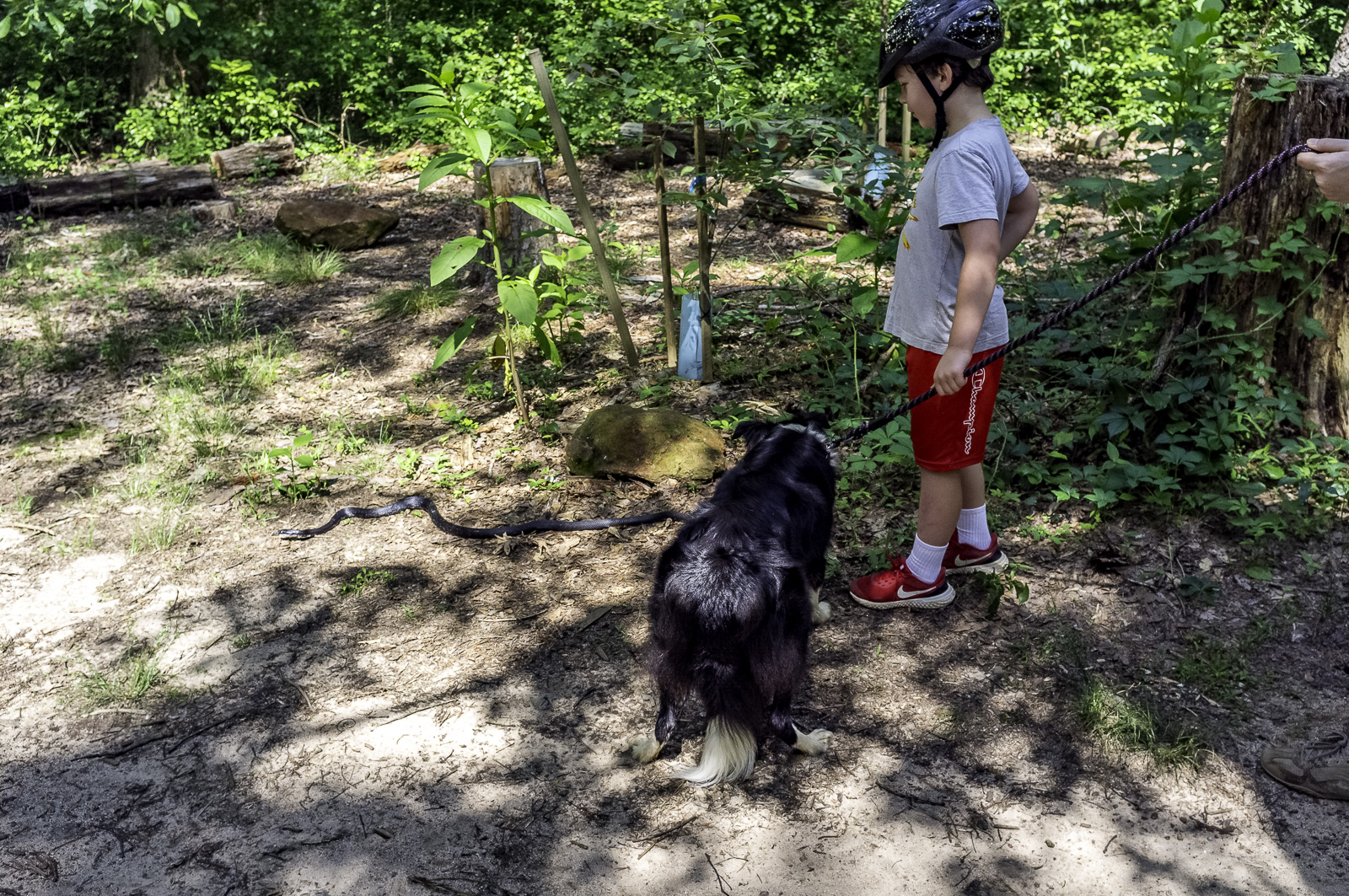
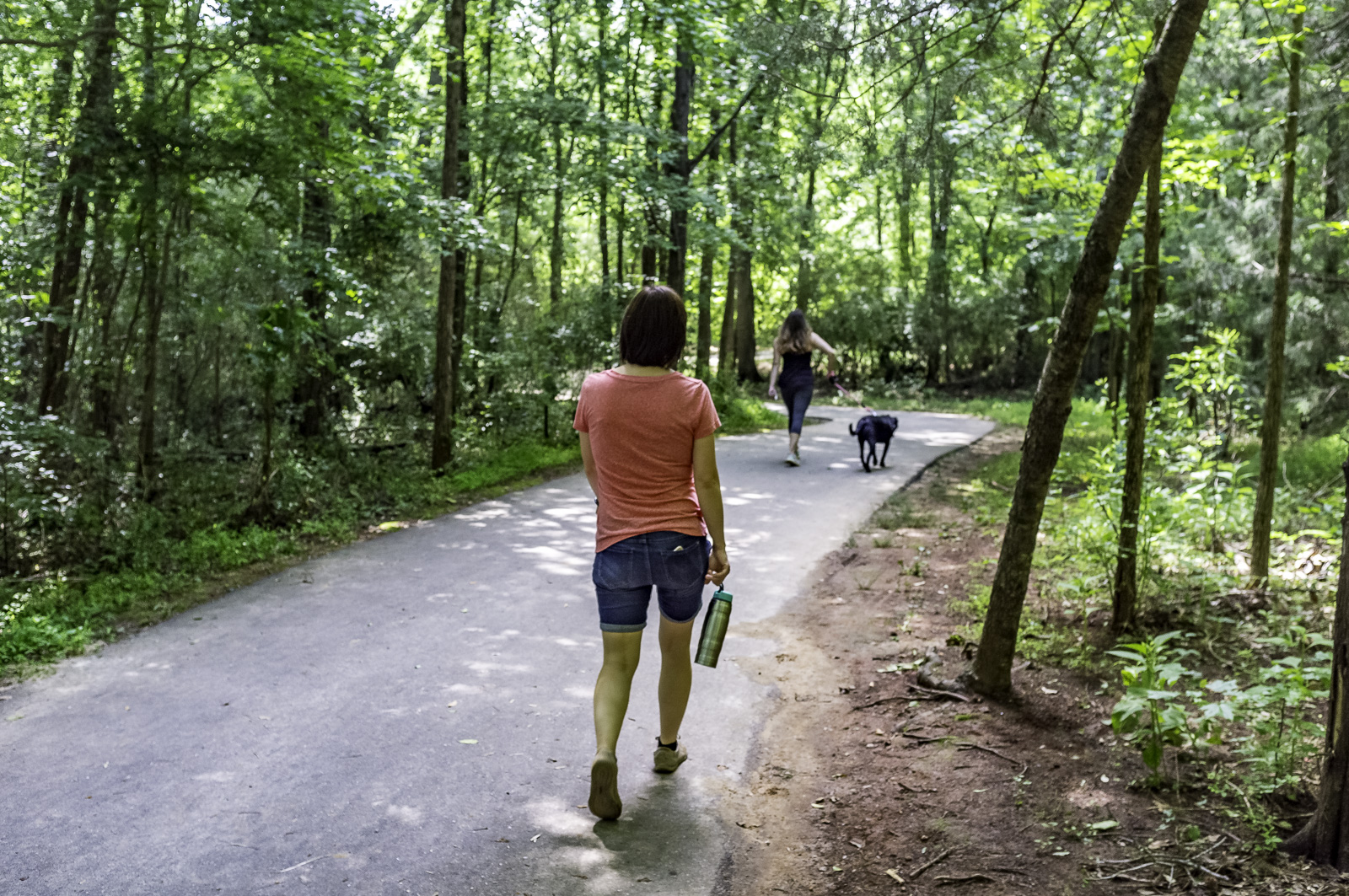
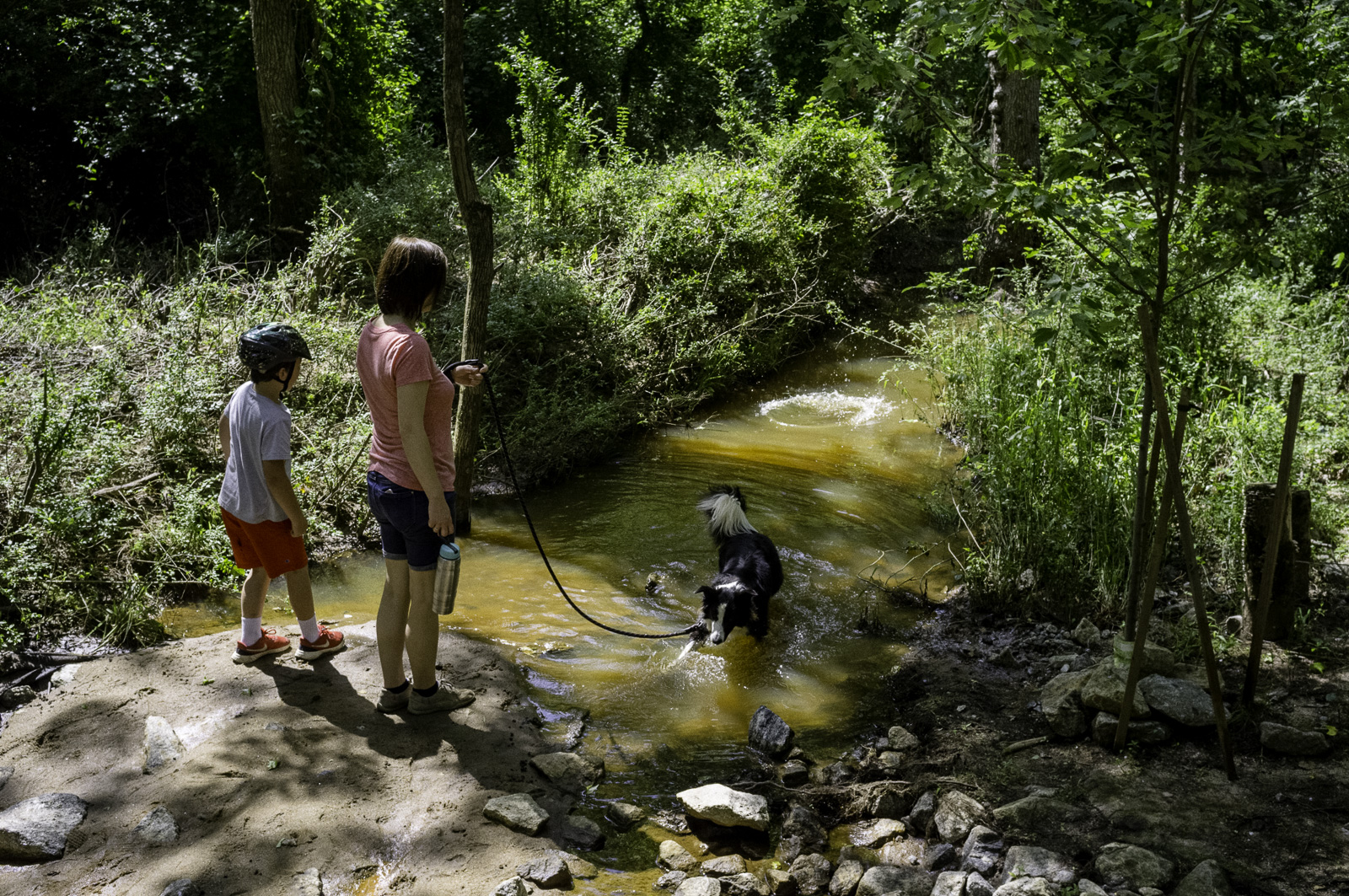
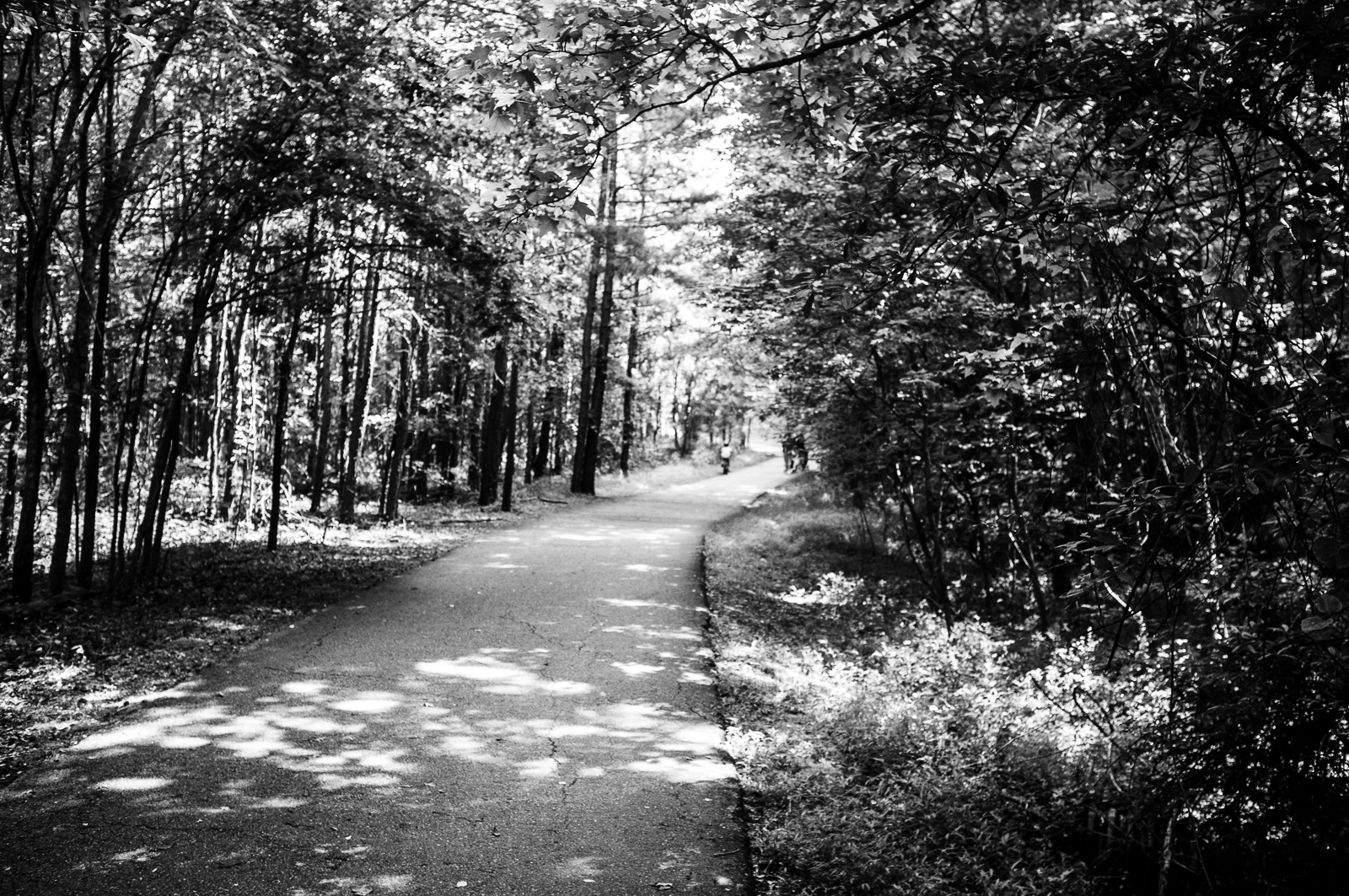
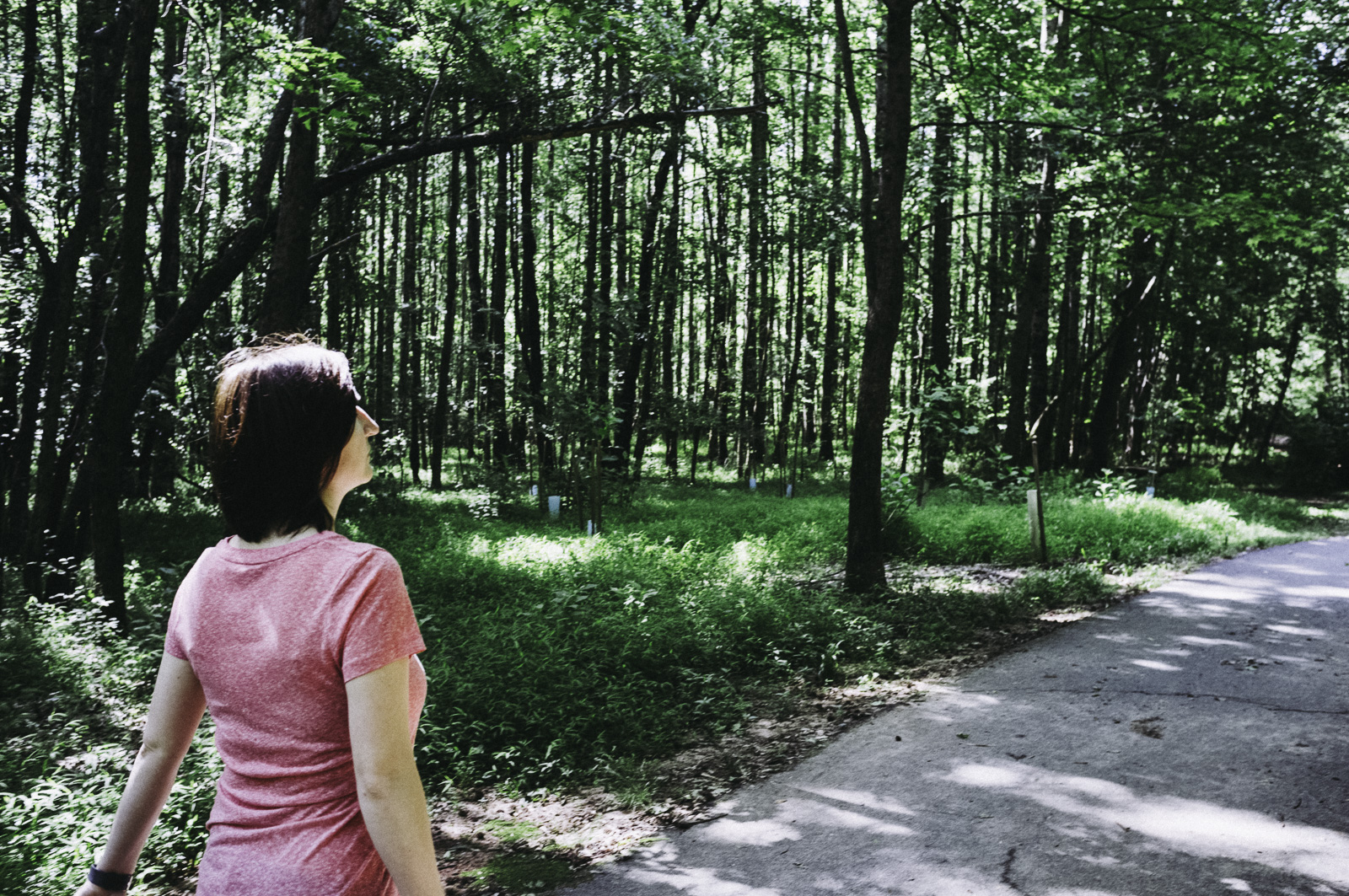
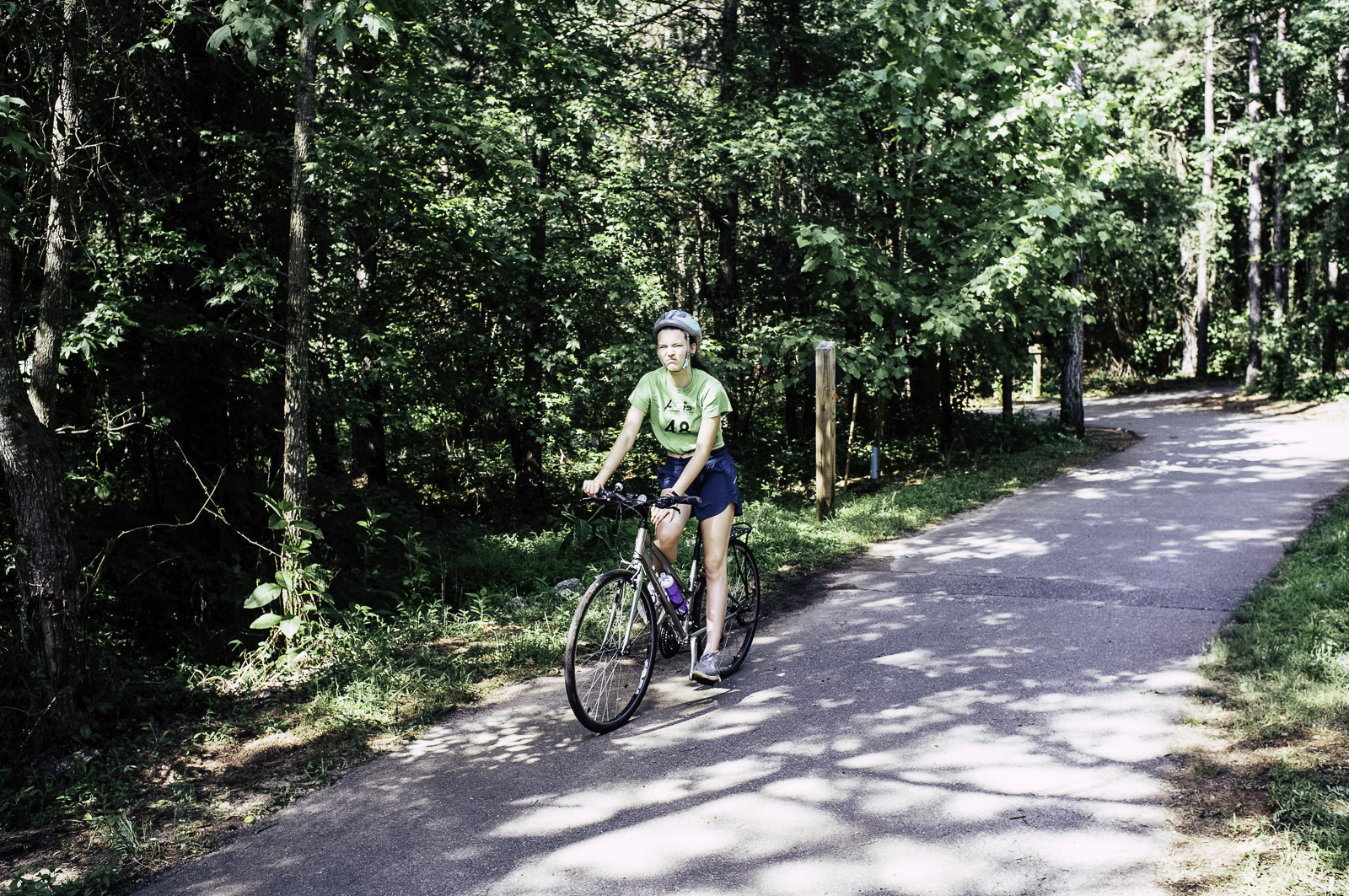
Today, they were open, so we went for a walk in the morning when it was likely to be less crowded. We kept our distance from everyone and behaved as model citizens.
The kids were just glad to get out and do something. Perhaps they were also glad to see other faces — I know I was.
But I’ve had concerns about this opening up of South Carolina. I don’t get the impression that everyone else is being as careful as we are. And the numbers prove it. Earlier this week, we had a day with 300+ new cases — the highest we’d ever had. Then we had a couple of more days in the 200s or high 100s range, then yesterday we saw that the number jumped up again. Today, there were 312, but there was also an addendum about yesterday’s count:
154 cases that should have been reported in yesterday’s positive case counts were not updated from suspected to confirmed cases in our database by the time yesterday’s news release was issued. An additional quality check of yesterday’s positive case numbers revealed the omission of these cases in the daily reporting total. The corrected total of positive cases for yesterday (May 30) has been updated to 420. (Source)
So we’ve gone from having no single day with more than about 280 to having a day with over 400. Just about two weeks after restrictions were eased. Which is to say that I’m afraid people’s stupidity (“This has all blown over — back to normal”) will cause a spike that will undo all we sacrificed over the last months.
When Noah and the survivors emerged from the ark after God had wiped out all of humanity except them, there would have likely been some consternation: what if God decides to do this again and this time, we don’t make the cut? It seems God wanted to assuage exactly those fears:
Then God said to Noah and to his sons with him: “I now establish my covenant with you and with your descendants after you and with every living creature that was with you—the birds, the livestock and all the wild animals, all those that came out of the ark with you—every living creature on earth. I establish my covenant with you: Never again will all life be destroyed by the waters of a flood; never again will there be a flood to destroy the earth.”
And God said, “This is the sign of the covenant I am making between me and you and every living creature with you, a covenant for all generations to come: I have set my rainbow in the clouds, and it will be the sign of the covenant between me and the earth. Whenever I bring clouds over the earth and the rainbow appears in the clouds, I will remember my covenant between me and you and all living creatures of every kind. Never again will the waters become a flood to destroy all life. Whenever the rainbow appears in the clouds, I will see it and remember the everlasting covenant between God and all living creatures of every kind on the earth.” (Genesis 9.8-16)
A skeptic like me has a lot of issues with this passage. Well, there are a lot of issues about the whole story of Noah and the ark, not the least of which is God deciding to wipe out all of humanity instead of, say, coming down and teaching them how they’re making bad choices, like a parent would do. Perhaps a spanking of some sort if we want to get Victorian. Then there’s the question of getting all the species in the boat, the inexperience of Noah as a shipwright — just problems all over the place.
But just these few verses offer a couple of big issues: first, why does God need reminding? “I will see it and remember the everlasting covenant” not “you will see it and remember the everlasting covenant,” though I guess that’s implied. But I suppose we could work out some literary way to get around that.
What we can’t get around is the simple fact that text here seems to suggest that there was never a rainbow before this event: “Whenever I bring clouds over the earth and the rainbow appears in the clouds” certainly hints at this. So you see the opening: “You mean to tell me that the lingering droplets of water in the sky that act as a prism and break the sunlight into its various colors — an act of physics — never happened before this?” Rainbows are not mysteries: we know exactly how they form, and I would imagine that meteorological sciences have gotten to the point that they can list several conditions that need to exist before a storm that will set in action a chain of events that will end in said rainbow.
Apologists who take the Bible literally have to deal with this. How to do so? I suppose they could suggest that, yes, God altered the laws of physics at that moment. But a more common explanation is a little more baffling: it had never rained before the deluge, apologist suggest. Mists and dew and the like were enough to water the flora of the Earth.
I mentioned this to K: she raised her eyebrows. “That’s the first time I ever heard of that.” I suspect it’s an Evangelical (i.e., American Christianity) attempt at explaining an obvious problem with the Biblical text in such a way that allows believers to continue interpreting it literally, word-for-word.
I first heard that argument when I was a kid. I want to say, “It struck me as strange even then,” but I don’t really recall. I remember hearing it, so it made some kind of impression on me, and it stuck in the back of my head as another example of some of the odd contortions literalists bend themselves into in order to continue interpreting the Bible literally.
I heard it again tonight. Or rather, overheard it. I wasn’t involved in the conversation, just listening from the fringes. “I mean, God created the world so perfectly that they didn’t even need rain — just a mist was enough,” the apologist explained.
It was one of those times that I really wanted to jump into a conversation but knew that there would be no point. Neither of us would budge from our view.
Today was the last day of the school year. Were it a normal year, we would have had three more half days. They’re useless for instruction: we’ve already completed grades, and what can you do with half days? Students clean out their lockers, sign each other’s yearbooks, have field day (or in eighth grade’s case, eighth-grade day, which differs from field day only insofar as the PTSA feeds the kids at the end of it all), and sundry end-of-the-year things. I use that time usually to pack up my room: I have lots of kids, empty boxes, and books — they make short work of what would take me a couple of hours. Were it a normal year — but it wasn’t, and three half-days of online instruction when a normal day of online instruction means thirty minutes of work per class — well, it just doesn’t make sense, and much to my surprise, the district realized that and basically thought like teachers for a change.
The Boy’s teachers had an awards day Google Meet — a very sweet thing for them to do. They recognized academic achievements like the A/B honor roll. When they began talking about it, I asked E if he thought he as on it.
“I don’t know.”
Indeed, I didn’t either. I knew he’d struggled mightily with a few things, and he was able to finish tests only because the teachers allowed him extra time. “I have to pay for it with less time on the playground, because that’s when I finish,” he once explained, “but that’s okay.”
But there was his name on the list, and there was a big smile on his face. High fives from everyone.
Is it a bad thing that I honestly had no idea whether or not he’d made the honor roll? I don’t think so: in second grade, grades appear for the first time. Everyone’s getting used to them. They’re not meaningless, but they’re not all that important, so I never really worried about his grades. I don’t quite think it was the same for K, but she never made a B (or 4 in the Polish system) even in her worst nightmares, so she put a little more weight on the grades. And to be fair, aiming high is always a good habit to develop. It’s not that I wanted him to settle. It’s just — well, it was second grade. I don’t remember a thing from second grade.
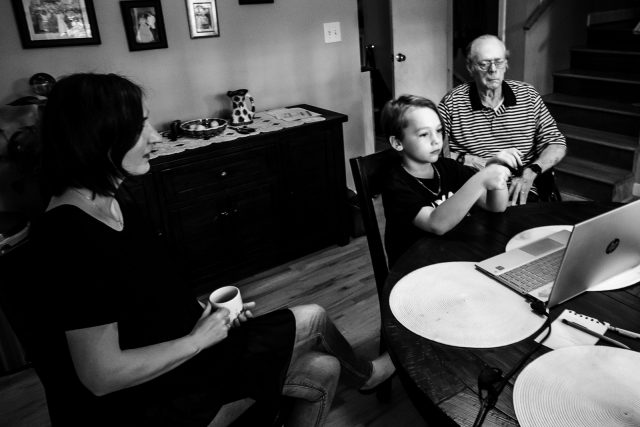
At the end of the program, they gave every single student a special award: most likely to — superlatives, in other words. E won “Most likely to win an episode of Survivor.” The other day during a Google Meet, E showed everyone his survival kit and told them a little about our adventures. That was what stuck in the teachers’ minds, and it was a cute award that just made E’s day.
What superlative would I give him? Sometimes, with his sensitive nature and keen sense of right and wrong, I think he’s most likely to have his heart broken in as many ways as one can imagine. He sometimes gets so frustrated with others’ unwillingness to follow basic rules. “That’s just not nice!” he concluded many stories about some tragedy that befell him in school. This is not to say that I assume he’s always an angel: many of our conversations involved me trying to help him see how he could have been nicer. Still, he’s a very by-the-book fellow, and it upsets him that others aren’t.
Maybe “Most likely to brighten someone’s day.” He can sure do that, but that requires a bit of familiarity. He’s not entirely comfortable approaching, say, a lonely kid on the playground that he doesn’t know but who might need someone to play with. The unknown — he’s not keen on that.
Maybe “Most likely to be an engineer.” He does love building things.
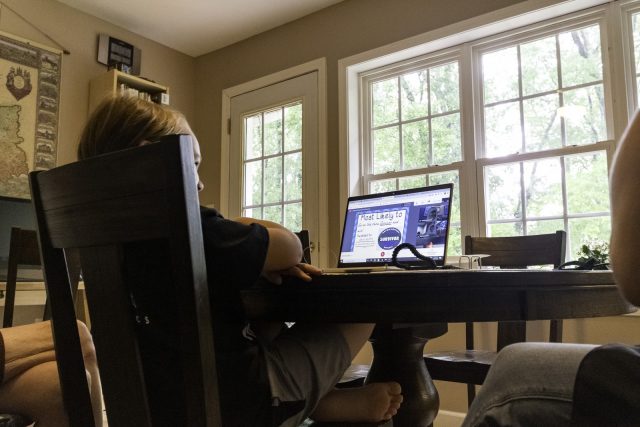
Or just “Most likely to make his family proud.”
As for the Girl, she got the good news that she definitely made it into geometry and English I Honors. That means she’ll be taking the course that I will teach exclusively next year. Were she a student at our school, that might cause problems: I wouldn’t want to stress of grading my own daughter.
For me, what’s more impressive is the geometry. I didn’t take geometry until tenth grade. She’s two years ahead of me.
She was worried about the possibility of not making one or both of those classes. Being a teacher and knowing how things often work behind the scenes, I knew it was unlikely. But I also knew that no “behind the scenes” would be necessary: she’s worked very hard this year, and she’s make sure that her grades are not just good grades but reflections of her actual understanding. She and K spent many an hour going over this or that algebra trick, and it all paid off.
So congratulations to both our kids!
This morning, E and I decided to play a game we hadn’t played in ages: Pentago. It’s a simple concept: Get five marbles of your color in a row. But the challenge is that each of the four nine-by-nine quadrants can be rotated. It’s a great game for the mental manipulate of objects because players have to turn those quadrants in their heads and make plans to try to surprise their opponent with an unseen 5-row connection.
At first, the Boy just tried to connect five in a row. I showed him quickly how easily stopped that could be, and how I could simply build on my efforts to stop him and create my own row with a twist here or there. Then he got it.
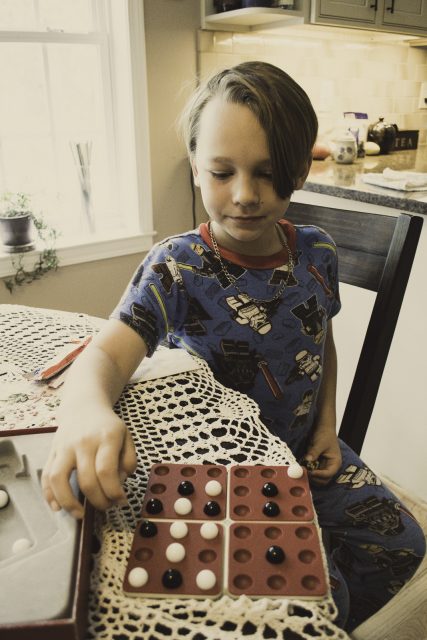
Did I “let him win”? Well, not so much. Once he figured out the importance of the twist, I played a while without really paying attention to anything other than his obvious efforts and he sneaked one or two by me.
After each game: “Can we play again?”
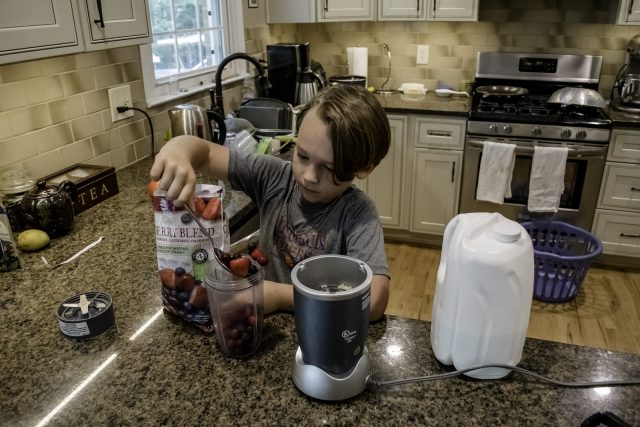
Snack
In the afternoon, the kids brought the old Rummikub satchel out: “Can you teach us how to play this?” they asked.
Indeed — I could barely remember myself. Something about runs and threes- and fours-of-a-kind. That was about all I could remember, and there were no instructions in the game.
It’s moments like that which make me really appreciate YouTube. A quick search, three minutes of watching the video, and off we went, playing a game I hadn’t played in decades.
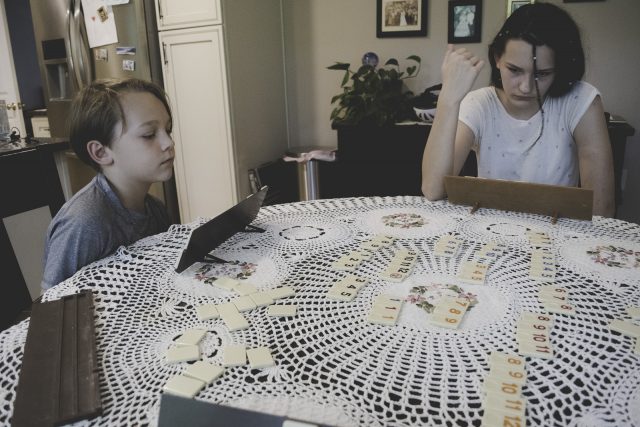
I last remember playing it in Nashville with Uncle N and Aunt L over the Thanksgiving weekend. We might have played it the last time we were there for Thanksgiving, which would have been 2005. Though we could have just played dominoes and Uno — that’s all I have photographic evidence for:
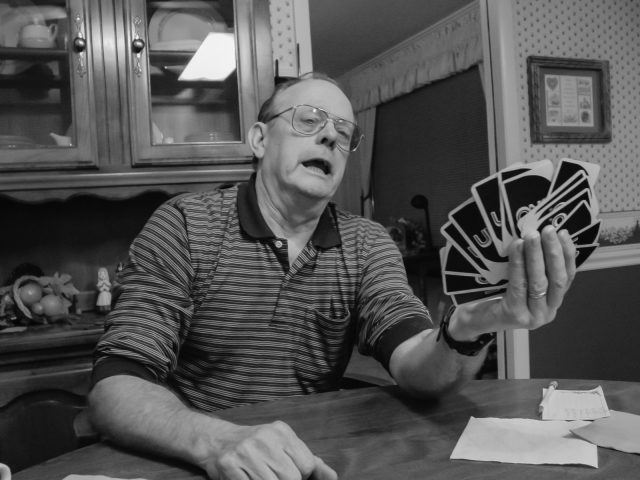
Uncle N passed away less than a year later from ALS, and we never went back there for Thanksgiving. So it might have been even longer since I played Rummikub. At any rate, the kids loved it. The Boy, less so because he couldn’t see all the combinations and such. L, however, fit into the game perfectly: that type of kombinowanie is just what she does best.
We watched last night the 2019 film Yesterday, in which a failing musician somehow enters an alternate reality in which only he knows anything about the Beatles. He subsequently recreates their catalog as his own. As expected, there are lots of Beatles songs in the film.
“Is that a Beatles song?” L asked as one started.
“Is that a Beatles song?” E asked with the next one.
“Yes, they’re almost all Beatles songs,” I explained.
“How many songs did they write?!” the Boy asked incredulously.
As a result, we listened to a lot of Beatles music this afternoon. They kind of liked it — we kind of encouraged them.
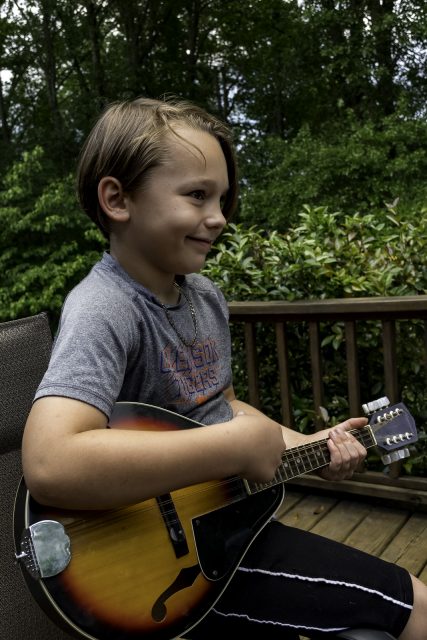
It did inspire some musicality from them. The Boy has a little guitar that he suddenly became interested in. However, it is missing strings, so I suggested he play my mandolin, which I bought in high school because R.E.M. had released Green, which featured the mandolin on a number of tunes. It’s a $100 plywood job that’s a perfect size for him.
Tonight, I worked with him on some basic ideas: pressing down strings just behind a fret to change the pitch. Chords? They’re a long way off. (Besides, I can only remember four or five chords on a mandolin.)
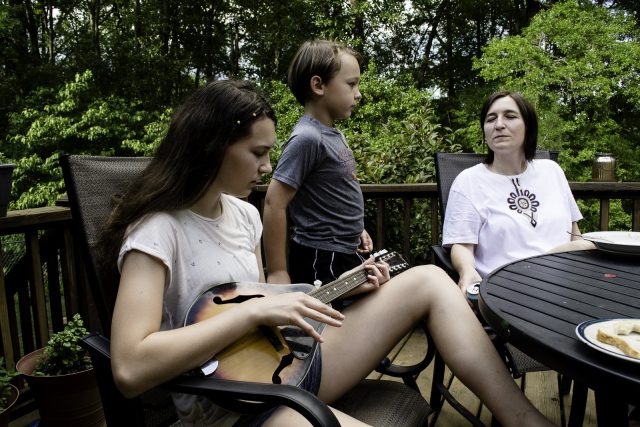
The Girl, who has been toying with a ukelele from time to time, gave it a try only to be shocked at how very different it was tuned from her uke. (When she first got the uke, I was surprised to find that, like a five-string banjo, the highest string is actually in the position where the lowest string is for most other instruments. They both just have that one out-of-place string that always gives me fits.)
We’ll see how this develops, but hopefully, the interest will remain.
When is this quarantine officially over? When do I stop prefacing every post with “Day X”? I started the first day we were supposed to go to school and yet didn’t — March 16.
Yet because we don’t have any coordinated national approach and since every state is easing restrictions step-by-step, there’s really no firm date for me to stop doing that. When we head back to school on a normal routine? (Will we do that in the fall?) I’ve decided that the most logical date to stop doing that is June 4, which would have been the last day of school were this a normal year.
On the other hand, I’m fairly certain that we will see an enormous uptick in cases after states have eased these restrictions. Just look at Cocoa Beach in Florida this weekend:
It’s concerning, to say the least:
On the Sunday talk shows, Dr. Deborah Birx, the coordinator of the White House coronavirus task force, said she was “very concerned” about scenes of people crowding together over the weekend.
“We really want to be clear all the time that social distancing is absolutely critical. And if you can’t social distance and you’re outside, you must wear a mask,” she said on ABC’s “This Week.” (Source)
If we have an explosion of cases, the very thing we were trying to avoid, then this entire 70+ lockdown will have been for nothing. Absolutely nothing.
Are we smarter than that as a species? Most days I have my doubts.
I’m on a run: I’ve never posted so many consecutive days on this site. Not even close. I’ve posted daily since December 21, 2019. Counting roughly, that’s 130+ consecutive days. Why? Why not?
Not only that, but for the month of May, I’ve written an average of 1,047 words a day. That’s like my journal writing when I first arrived in Poland and everything — everything — fascinated me endlessly.
Of course, I have cheated a few times: I included long quotes from books I’m reading, in part because I was honestly interested in writing a little something about them, in part (at least once) because I just wanted to reach that arbitrary number (like I just did in this paragraph). One thousand words. At least. Every day.
I can’t possibly keep that up. The quarantine is helping with that. But daily posts? Could I make it a full year? Probably. Will I? No idea.
It started raining around two this afternoon, first sporadic rain with fat, lazy drops, then steady rain, then torrential rain.
In the past, such rain worried me because of flooding in our basement. With the leak in our roof, I now have different concerns. As the storm grew and the wind blew harder, I wonder whether or not I’d secured the two tarps protecting our roof well enough to keep them in place with such a storm. There was really nothing I could do about it at the time, of course: it would not have been remotely safe to head onto the roof in a storm to put down additional weight to keep the tarps from flying off.
In the end, my worries were for nothing: the tarps stayed in place; the sump basin didn’t even have much water in it, so the basement wasn’t even close to being threatened.
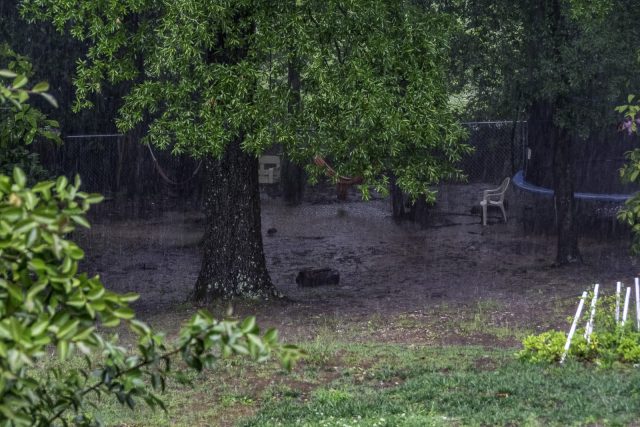
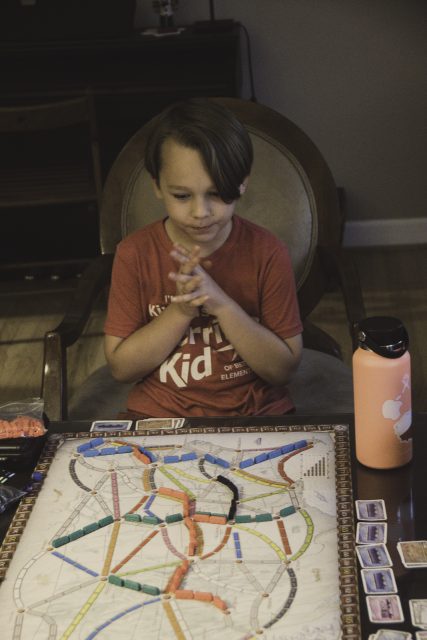
Yet we still had a lake in our backyard: the creek didn’t crest but we had essentially one big puddle in the lowest part of our yard, so after we finished playing a game (“Ticket to Ride” — I never play to win; I play to block other players — you can’t lose if you’re not trying to win!), E and I struck out to see what was going on in the neighborhood.
We weren’t prepared for what we found:
To begin with, there is a house basically in a hole that has an enormous backyard — I thought it was a park when we first moved here.
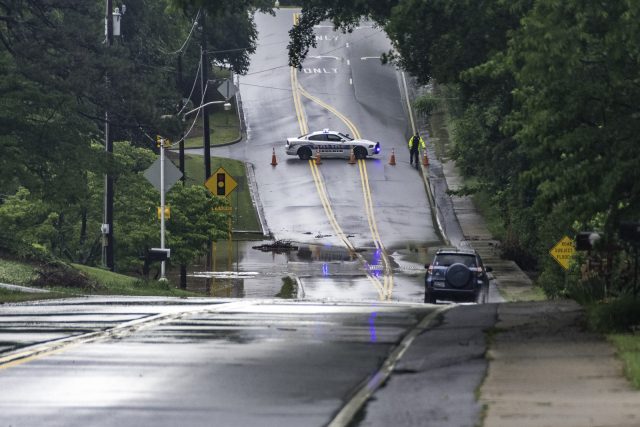
The road that goes by it was closed because their yard, which is in reality just a drainage basin for the surrounding community, was completely flooded.
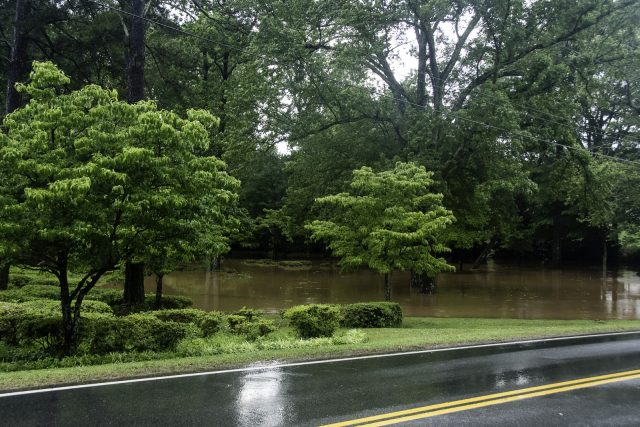
Completely.
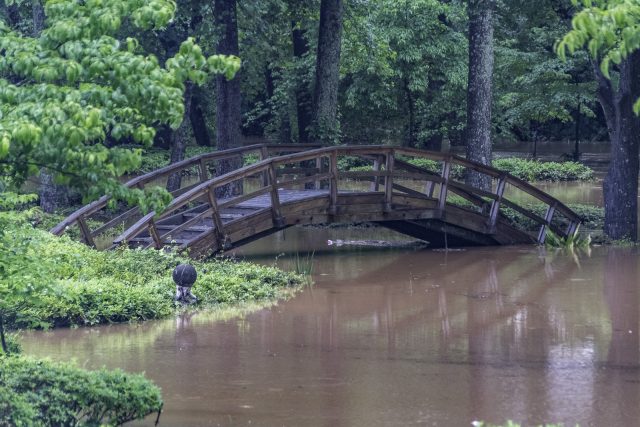
So much so that the culvert under the road was completely submerged, creating a whirlpool as the water tried to drain.
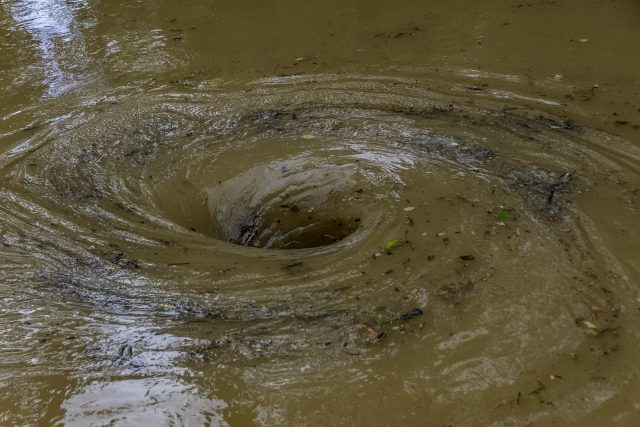
We stood in the road looking at the whirlpool, right at the edge of the water. We’re past the time of E asking questions like, “Daddy, what would happen if I fell in that water?” He knows. He likes to show he knows. “Boy, Daddy, if I fell in that…” and his voice trailed off for effect.
It gave me a little shudder, the shudder of a parent having nightmarish visions of the worst possible outcome. Once such thoughts enter my mind, it’s hard to shake them. The Boy seemed to realize that. “Come on, Daddy, let’s go back to the other side.
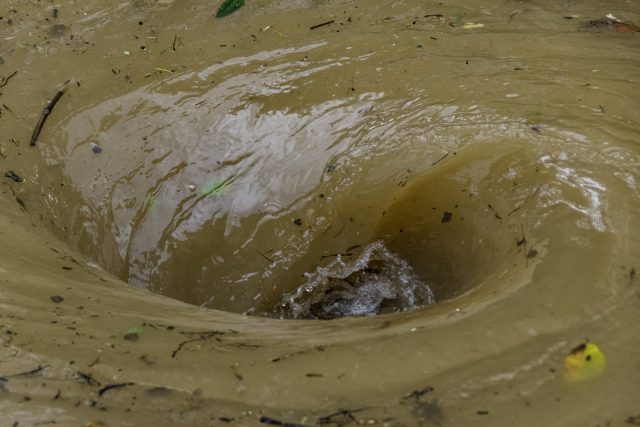
All that water — undoubtedly the worst flooding we’ve seen there. It was still nothing compared to what we saw later, downstream. We walk by here almost every night — it’s K’s favorite walk.
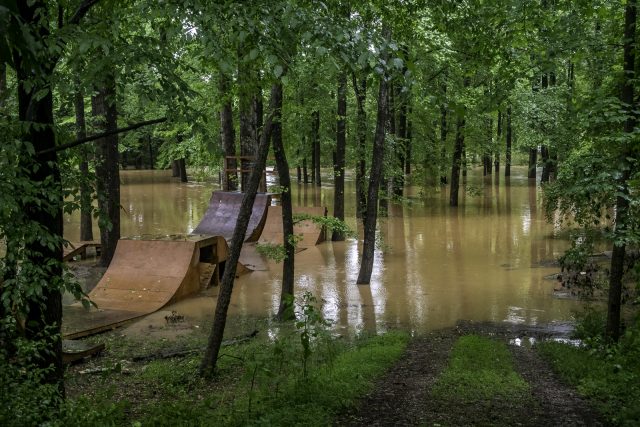
The creek that was forming the whirlpool earlier joins with another creek at this point, and the two completely covered the flat land around it.
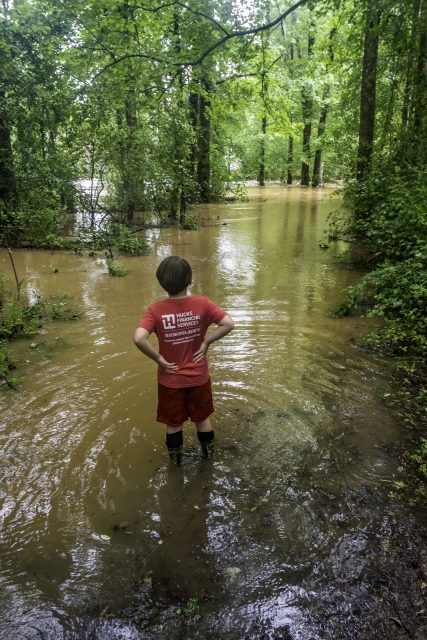
We headed back home, still having fun on the way.
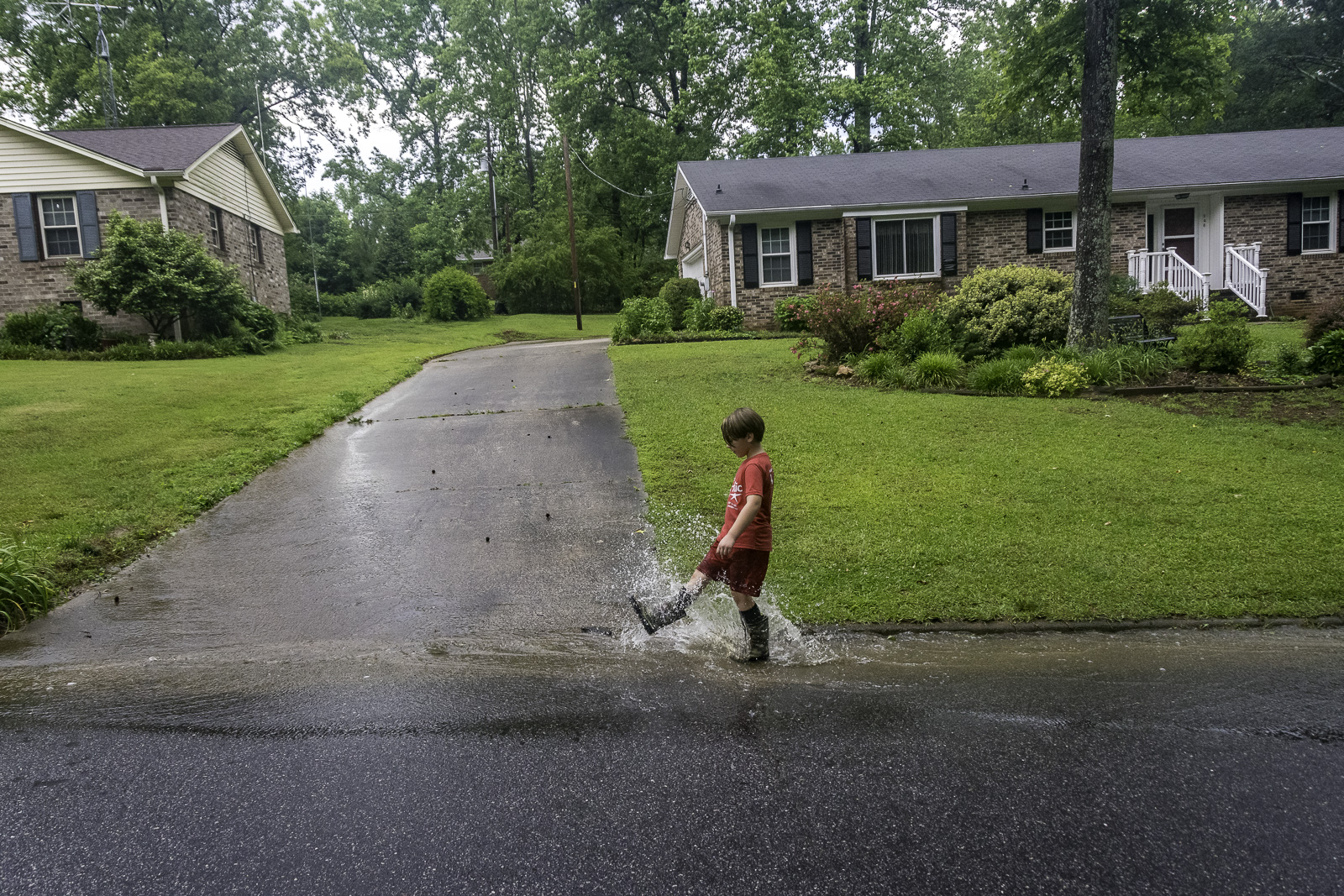
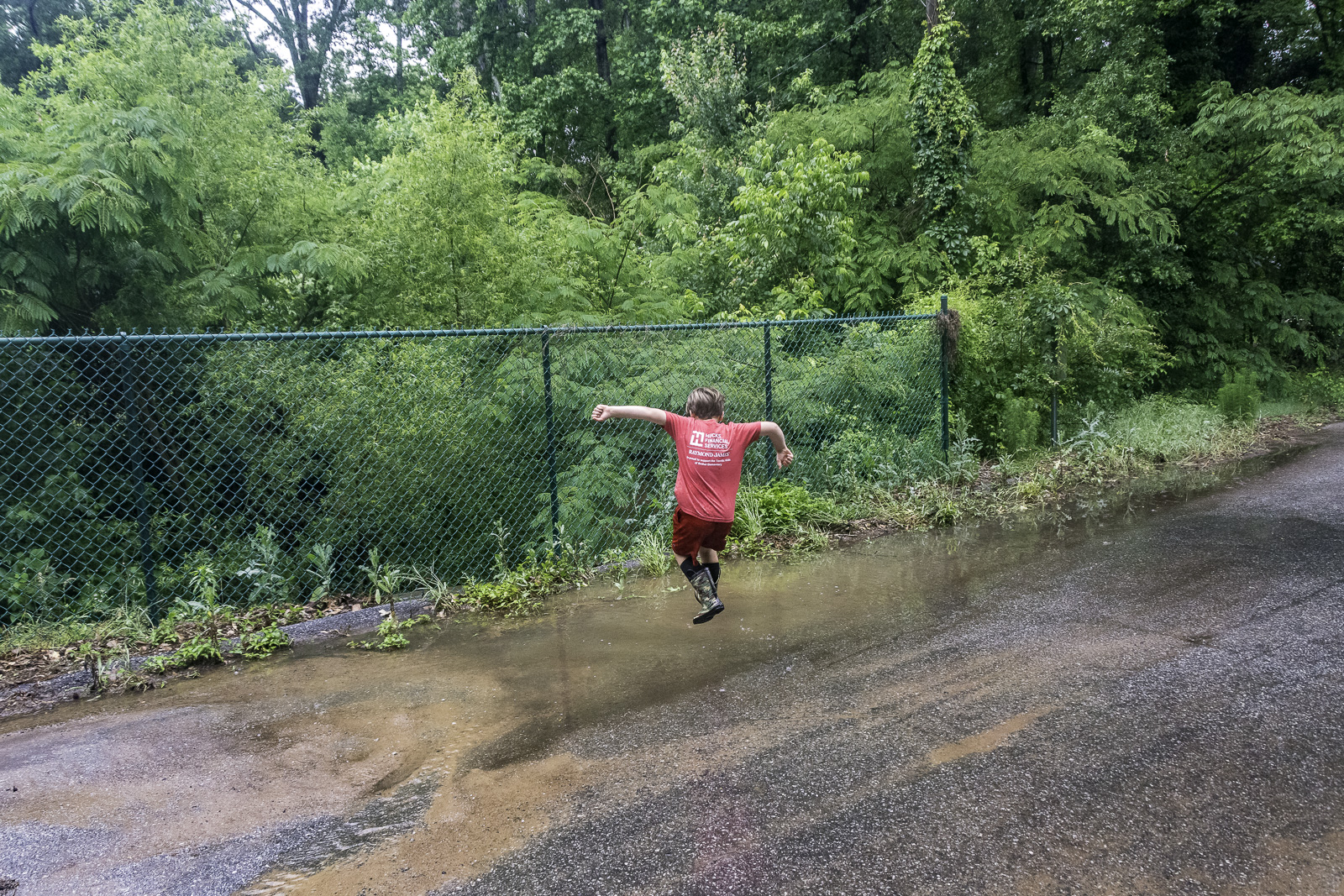
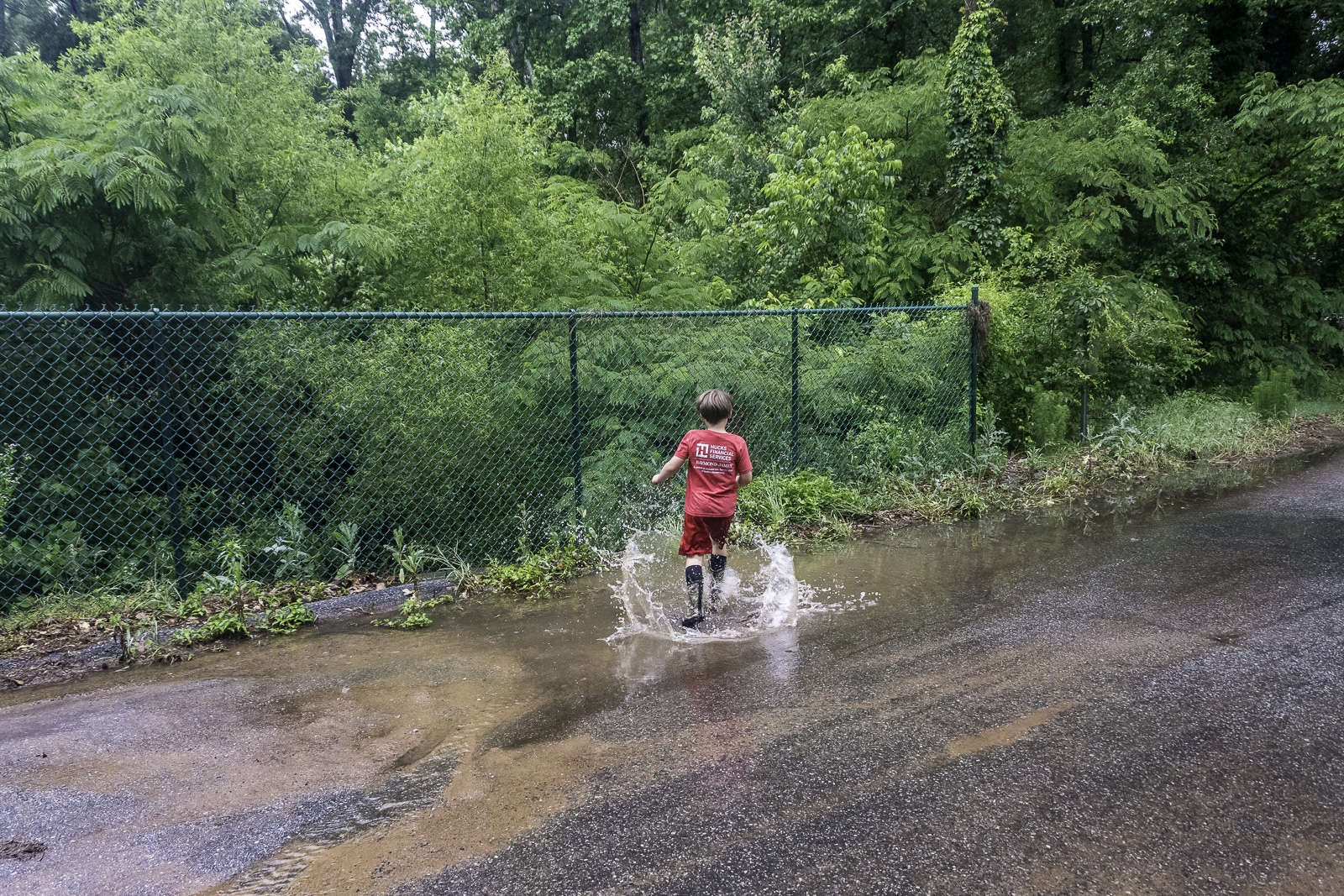
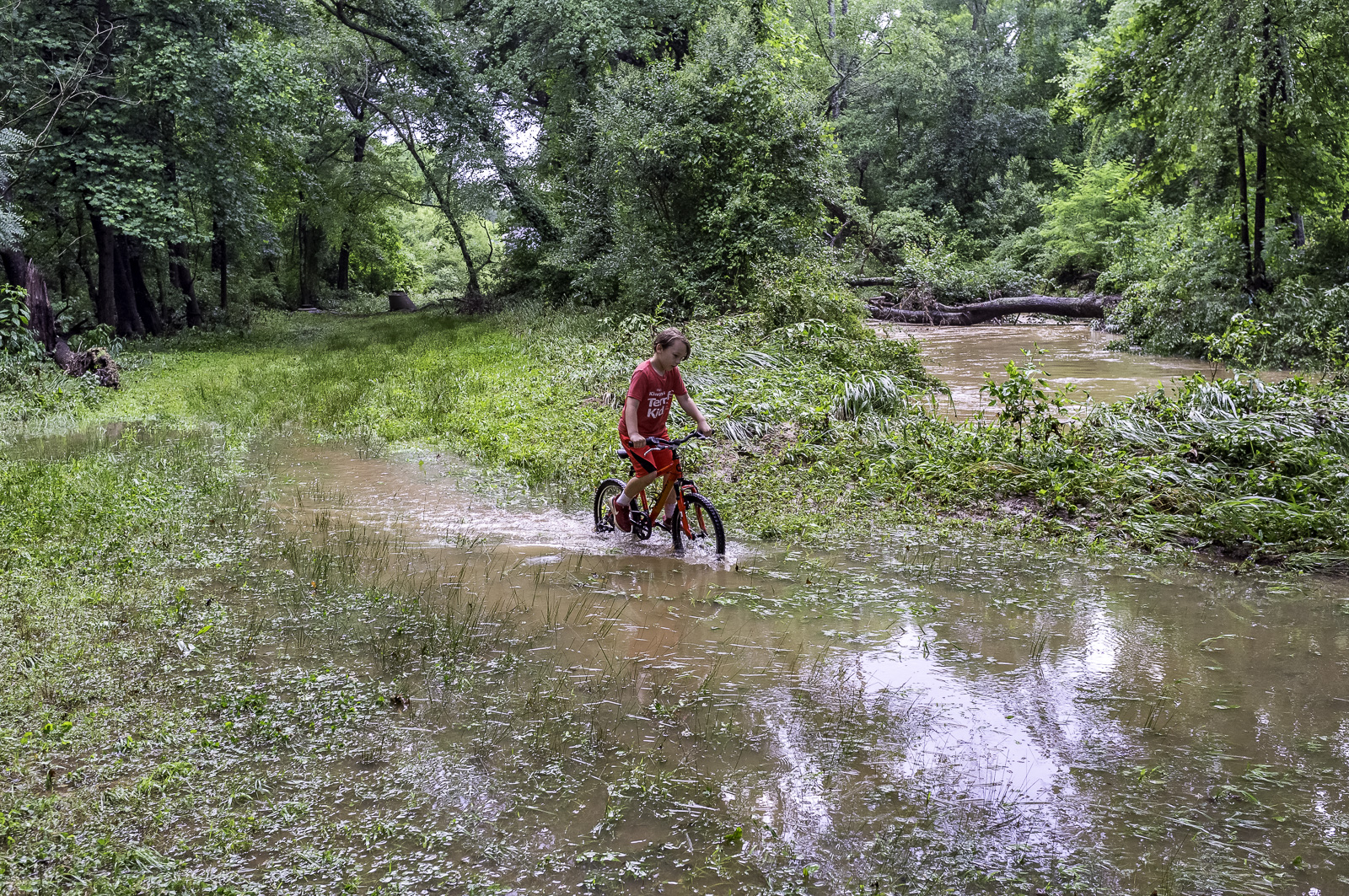
In the evening, we went for a walk to show the girls what it looked like. Of course, most of the water had subsided, but there was still enough to be impressive, and just enough to enjoy safely.
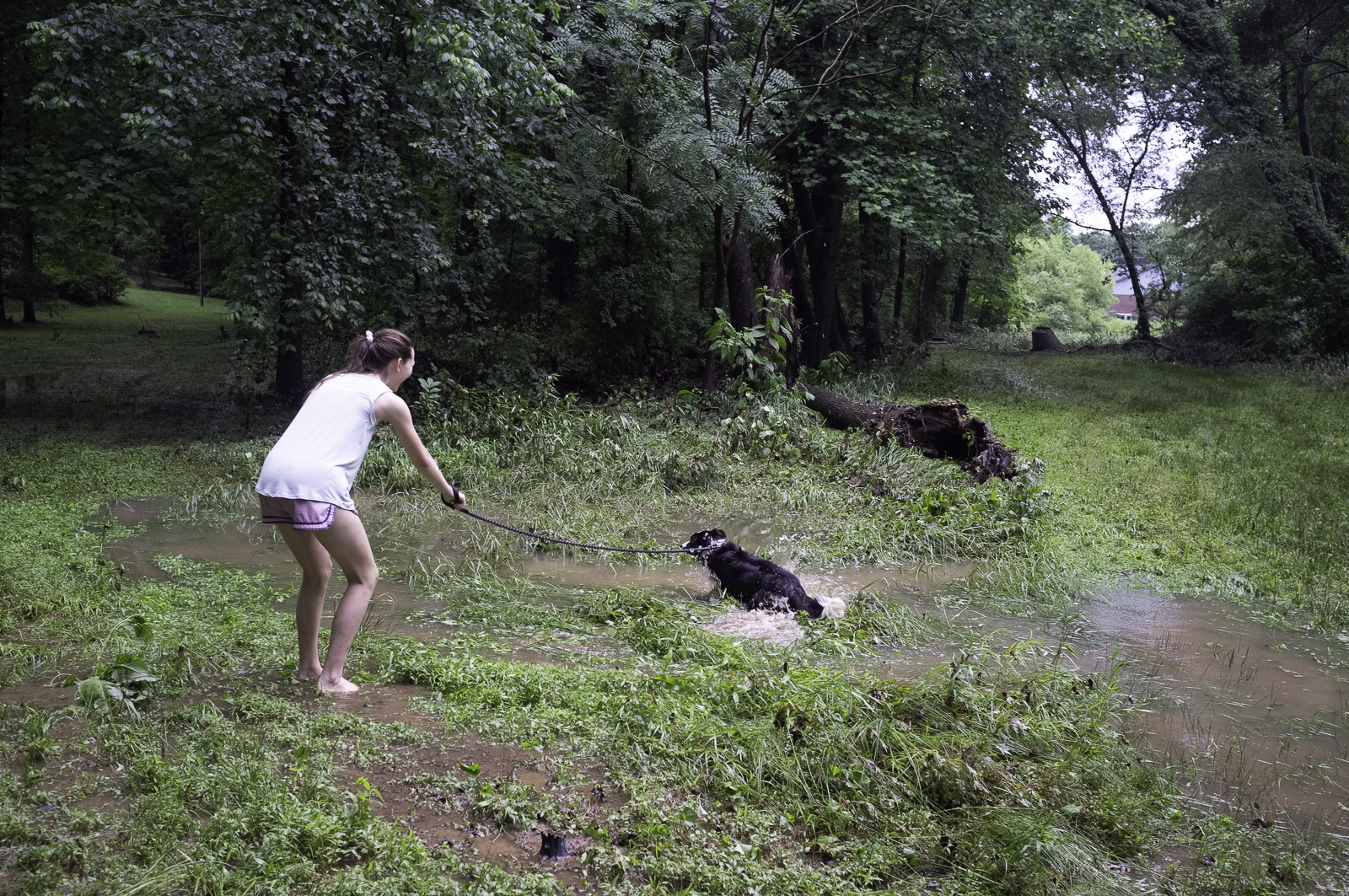
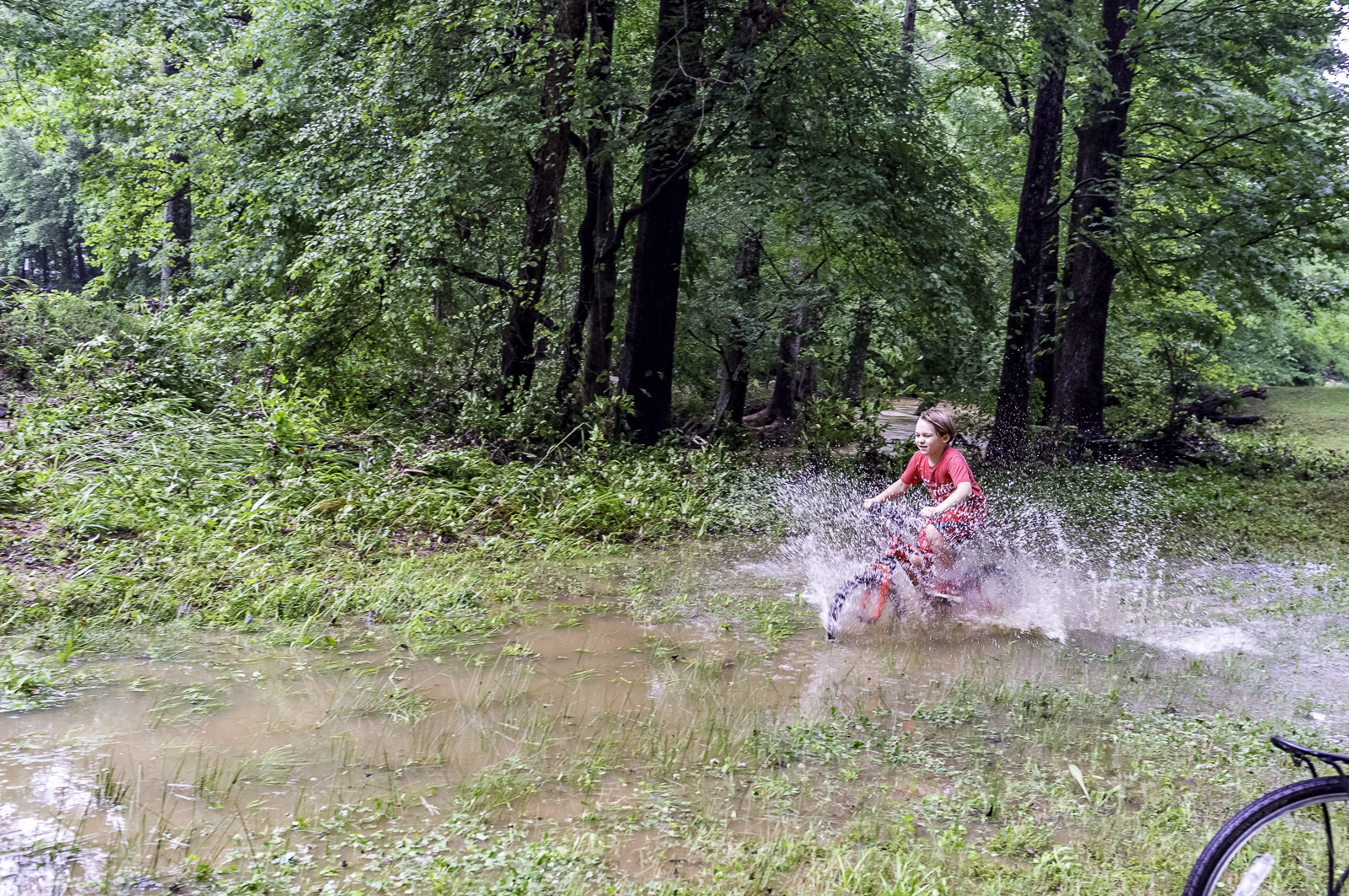
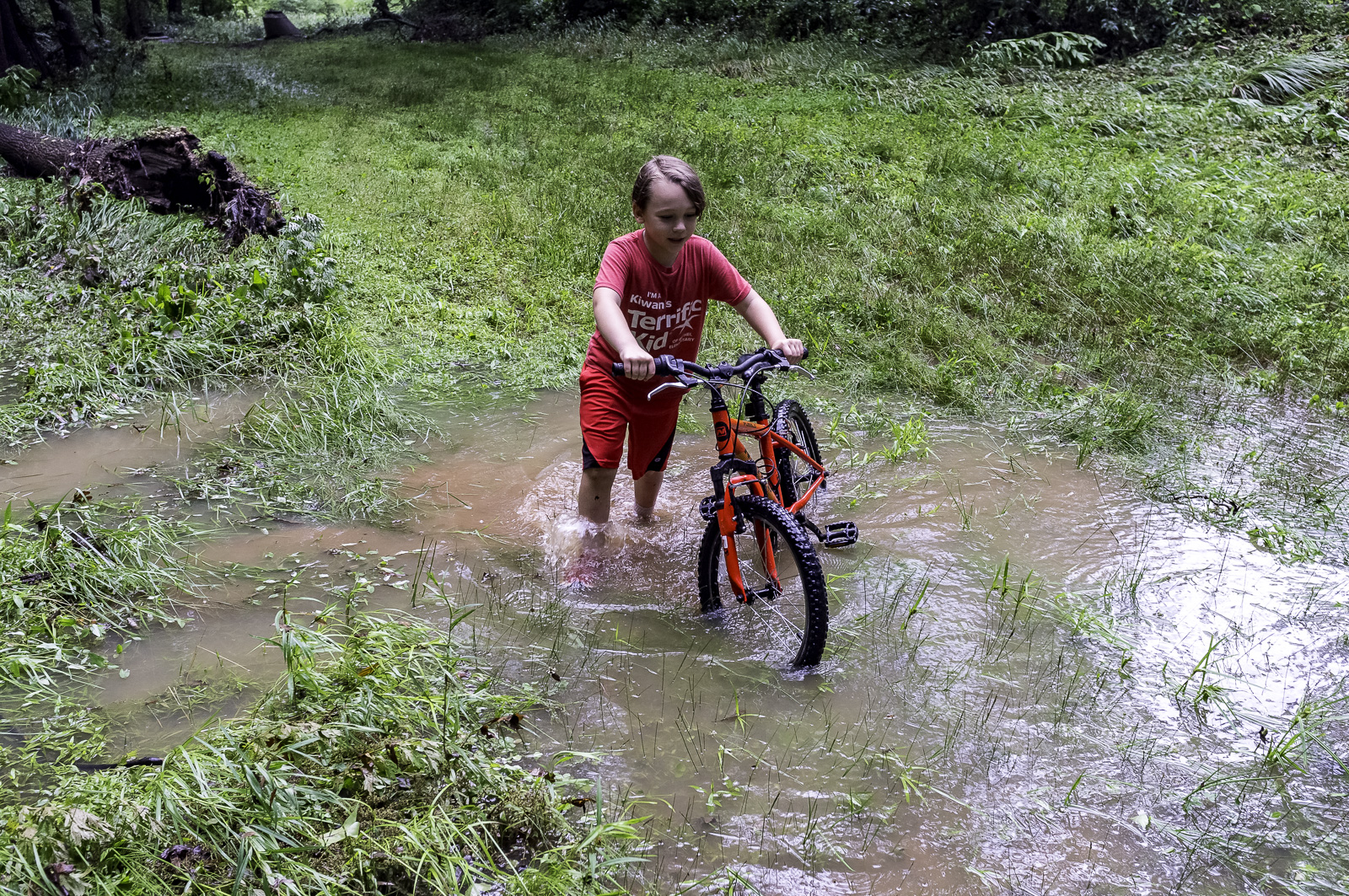
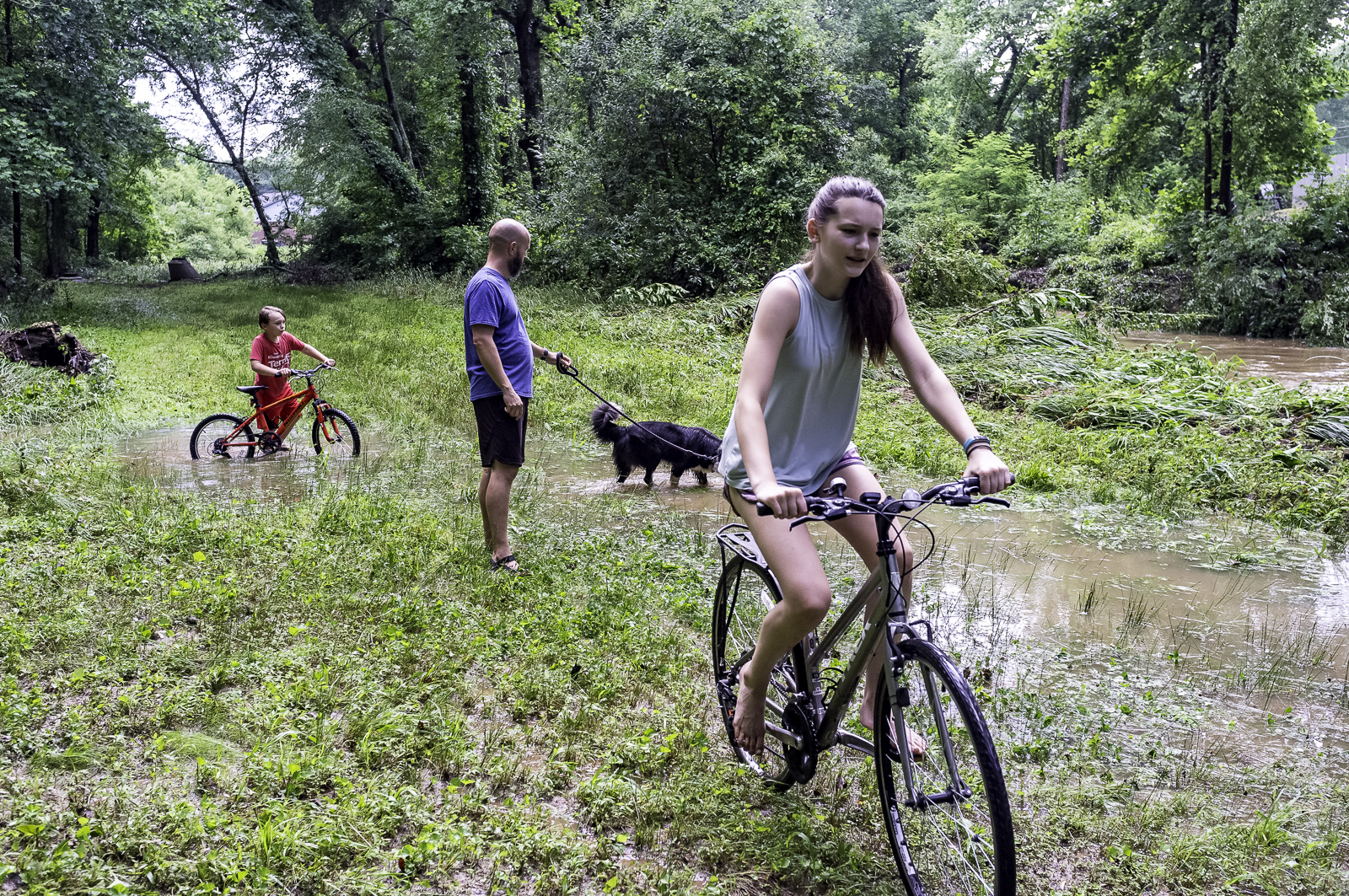
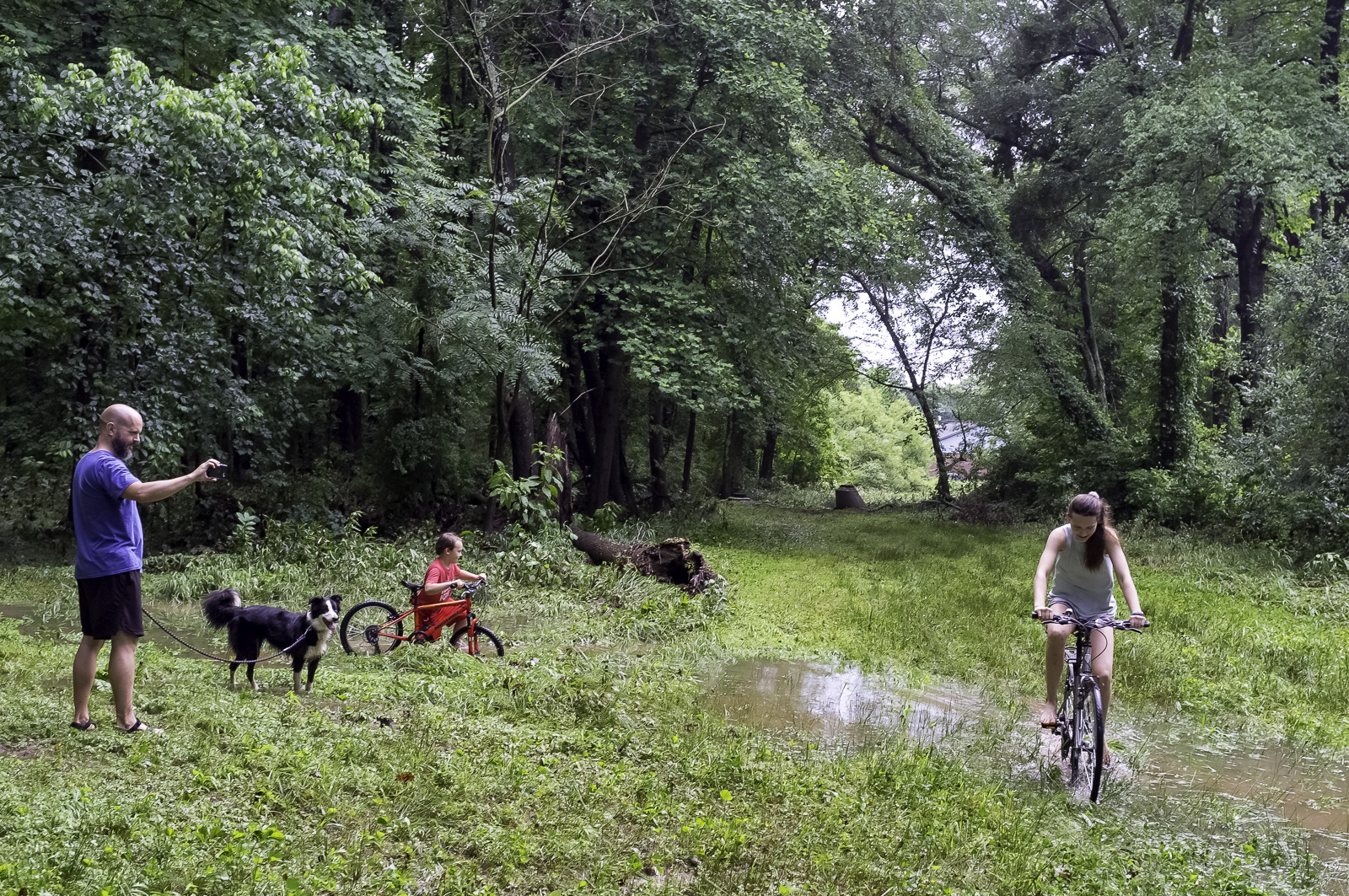
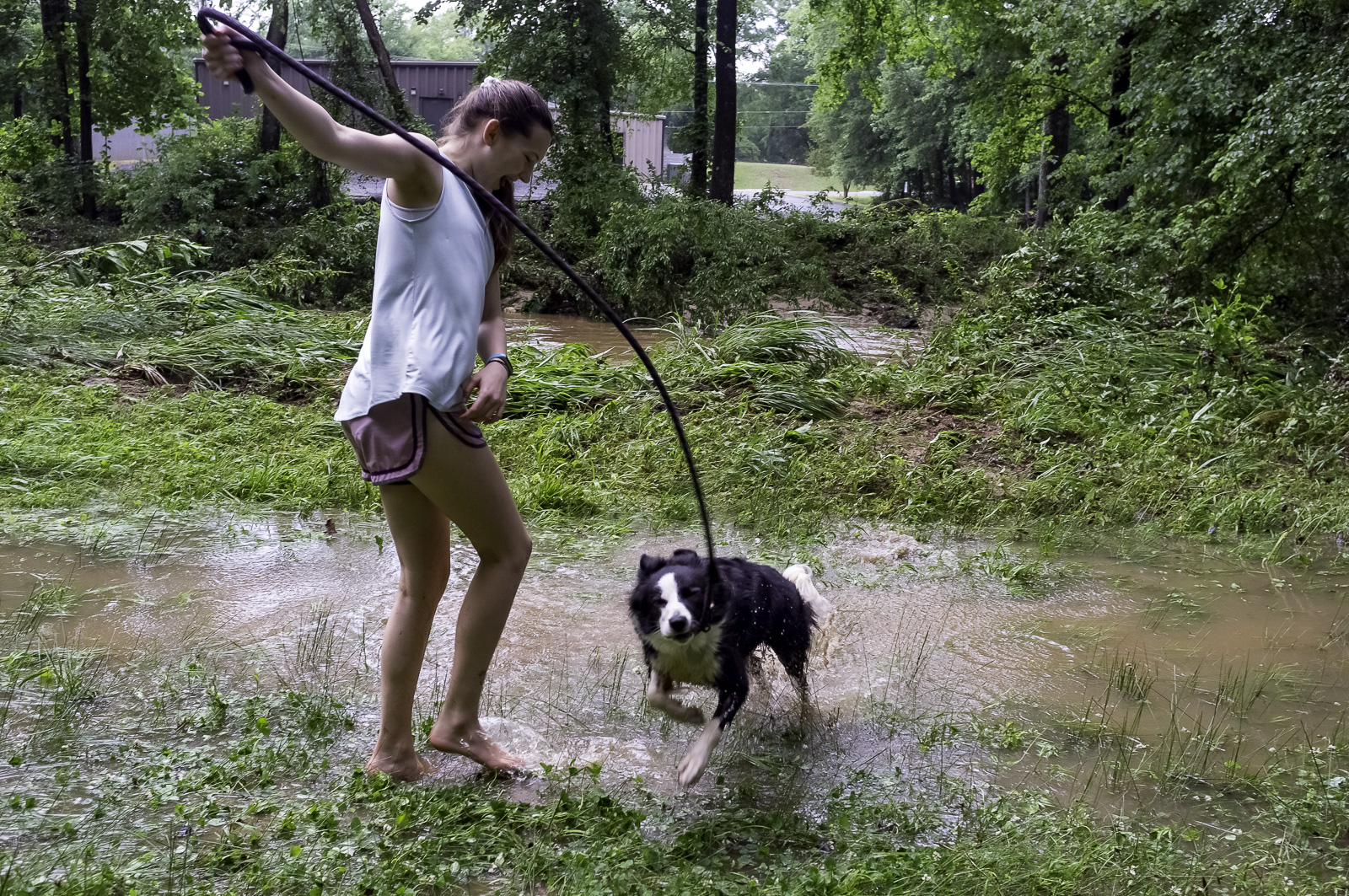
Our pup has come a very long way. I thought, when we got her, that since she’s a border collie (smartest breed on the planet, right?), things would be easy. She’d be easy to train, easy to control (after all, you can get those dogs to do the most amazing tricks herding sheep), easy to house-break — just easy. But it turns out that BCs are too smart for their own good: it makes them a little stubborn at times. And that describes our Clover perfectly: stubborn, stubborn, stubborn. But we didn’t give up on her: we took her for some obedience training, we left her a couple of times for one-on-one days with a trainer, and for the last year, things have been going great.
Now, we have a few tricks with her.
For her birthday, though, we got her an agility course. The Girl began training her yesterday. It was fairly simple: she figured out that she had to jump over the bar, had to jump through the hoop. Easy-peasy. She looked up at L like she looks up at me when we go for a run: “Was that supposed to be a challenge or something?”
Today, the Boy got in on the fun. He had a little difficulty getting her to jump without a leash on her to guide her, but soon enough, he’d worked out his own way of bribing her with a little treat.
I finished reading My Ántonia today — or rather, listening to it on Spotify. I first read that book in college, and it astounded me, particularly one quote: “Some memories are realities, and are better than anything that can ever happen to one again.” More than O, Pioneers! (the only other Cather book I’ve read), I really connected with the sense of nostalgia that pervades My Ántonia. That’s why I remember that quote almost a quarter of a century later: I read it shortly after some emotionally traumatic losses (not deaths, just losses) in my life, and I was wallowing in nostalgia about those lost relationships.
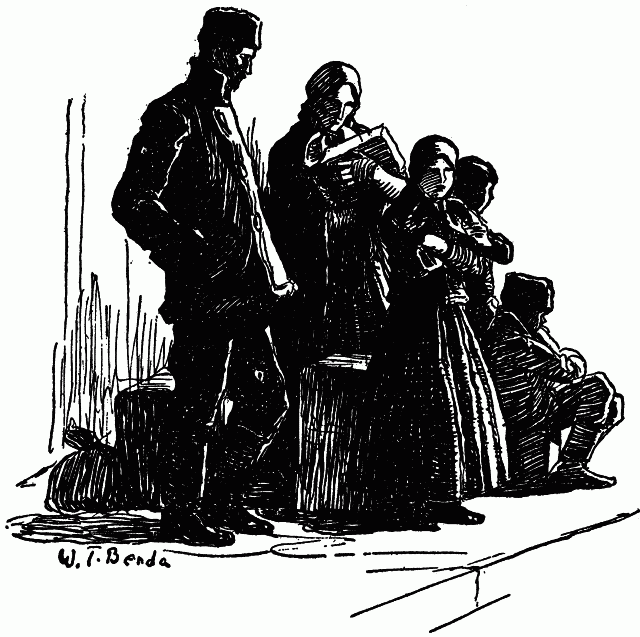
I had forgotten, though, about the ending:
This was the road over which Ántonia and I came on that night when we got off the train at Black Hawk and were bedded down in the straw, wondering children, being taken we knew not whither. I had only to close my eyes to hear the rumbling of the wagons in the dark, and to be again overcome by that obliterating strangeness. The feelings of that night were so near that I could reach out and touch them with my hand. I had the sense of coming home to myself, and of having found out what a little circle man’s experience is. For Ántonia and for me, this had been the road of Destiny; had taken us to those early accidents of fortune which predetermined for us all that we can ever be. Now I understood that the same road was to bring us together again. Whatever we had missed, we possessed together the precious, the incommunicable past.
“What a little circle man’s experience is.” What a lovely notion, what a great truth.
“What to listen to now?” I thought, as I finished the Cather novel early in the day and still had plenty of outside work to keep me occupied. Much of the morning I spent cleaning rocks. Yes, cleaning rocks. The drainage trough (for lack of a better term) I made at the base of our driveway has, over the years, become more and more clogged with dirt. Now instead of wicking water away from the drive, it just serves as a barrier and makes it puddle water. What’s more, with all that dirt, weeds had a great place to grow. So I pulled out all the rocks down to the landscaping fabric, washed the dirt off the rocks, and put them back. (Coronavirus quarantine has lent itself to long-ignored, not-necessarily-critical projects.) Anyway, I was still working on the rocks and the book finished.
Spotify is sort of hit-or-miss with audiobooks: there’s very little (that I’ve found) that’s relatively recent, and a lot of the older books are actually in translation — lots and lots of German audiobooks I’ve found.
When I lived in Poland, I had some difficulty finding affordable English-language books. Penguin Classis, though, were plentiful and relatively cheap. That’s how I read almost every Dickens book in the space of three years. There are a few that I never found, though, and I thought today might be a good day to return to Dickens.
I hadn’t really read him in almost twenty years. I teach Great Expectations some years to my English I Honors students, but that doesn’t really count: the last year I taught it (two years ago, I think), I didn’t even read it with the students.
So today I began Dombey and Son. I’d forgotten how clever and witty Dickens can be, and how gifted he can be at beginning a novel. Think of his most famous, A Tale of Two Cities:
It was the best of times, it was the worst of times, it was the age of wisdom, it was the age of foolishness, it was the epoch of belief, it was the epoch of incredulity, it was the season of Light, it was the season of Darkness, it was the spring of hope, it was the winter of despair, we had everything before us, we had nothing before us, we were all going direct to Heaven, we were all going direct the other way— in short, the period was so far like the present period, that some of its noisiest authorities insisted on its being received, for good or for evil, in the superlative degree of comparison only.
Or my personal favorite Dickens beginning, which I’ve mentioned here before, Bleak House:
London. Michaelmas term lately over, and the Lord Chancellor sitting in Lincoln’s Inn Hall. Implacable November weather. As much mud in the streets as if the waters had but newly retired from the face of the earth, and it would not be wonderful to meet a Megalosaurus, forty feet long or so, waddling like an elephantine lizard up Holborn Hill. Smoke lowering down from chimney-pots, making a soft black drizzle, with flakes of soot in it as big as full-grown snowflakes—gone into mourning, one might imagine, for the death of the sun. Dogs, undistinguishable in mire. Horses, scarcely better; splashed to their very blinkers. Foot passengers, jostling one another’s umbrellas in a general infection of ill temper, and losing their foot-hold at street-corners, where tens of thousands of other foot passengers have been slipping and sliding since the day broke (if this day ever broke), adding new deposits to the crust upon crust of mud, sticking at those points tenaciously to the pavement, and accumulating at compound interest.
Fog everywhere. Fog up the river, where it flows among green aits and meadows; fog down the river, where it rolls defiled among the tiers of shipping and the waterside pollutions of a great (and dirty) city. Fog on the Essex marshes, fog on the Kentish heights. Fog creeping into the cabooses of collier-brigs; fog lying out on the yards and hovering in the rigging of great ships; fog drooping on the gunwales of barges and small boats. Fog in the eyes and throats of ancient Greenwich pensioners, wheezing by the firesides of their wards; fog in the stem and bowl of the afternoon pipe of the wrathful skipper, down in his close cabin; fog cruelly pinching the toes and fingers of his shivering little ‘prentice boy on deck. Chance people on the bridges peeping over the parapets into a nether sky of fog, with fog all round them, as if they were up in a balloon and hanging in the misty clouds.
Dombey, though, has a clever opening:
Dombey sat in the corner of the darkened room in the great arm-chair by the bedside, and Son lay tucked up warm in a little basket bedstead, carefully disposed on a low settee immediately in front of the fire and close to it, as if his constitution were analogous to that of a muffin, and it was essential to toast him brown while he was very new.
Dombey was about eight-and-forty years of age. Son about eight-and-forty minutes. Dombey was rather bald, rather red, and though a handsome well-made man, too stern and pompous in appearance, to be prepossessing. Son was very bald, and very red, and though (of course) an undeniably fine infant, somewhat crushed and spotty in his general effect, as yet. On the brow of Dombey, Time and his brother Care had set some marks, as on a tree that was to come down in good time—remorseless twins they are for striding through their human forests, notching as they go—while the countenance of Son was crossed with a thousand little creases, which the same deceitful Time would take delight in smoothing out and wearing away with the flat part of his scythe, as a preparation of the surface for his deeper operations.
Of course, Dickens can be tiring with all his subplots and sub-subplots (after all, the longer he stretched novels, which were always published in syndication in magazines, the more money he could make from a given book), but I’m thinking he’ll be a lot easier to listen to than read.
My friend M grew up on a farm with his grandparents. His father passed away; I never really knew what happened to his mother. But from the time I met M, he lived with Ma and Pa as he called them, and as I came to call them.
Their farm was just outside the city limits, a place in the county that felt so different and distant from my suburban, cookie-cutter neighborhood that I felt I might be in a different state. In a different country.
We spent a fair amount of our time there shooting .22s and shotguns. We’d shot at birds and usually miss. We’d shoot at squirrels with the .22s and miss; we’d shoot at them with the shotguns and, well, it wasn’t pretty. We were stupid — what can I say?
One Sunday afternoon in 1990, just before I started my senior year of high school, Pa gave us a task. “There are raccoons that are just givin’ the garden a hard time. How about sittin’ up on the hill above the garden and seein’ if you boys can take care of the problem?” He needed to say no more. We took a bottle of Mountain Dew, Pa’s double-barrel 16-gauge shotgun and Papa’s bolt action 20-gauge (a bolt-action shotgun? really?) and took positions on the slope just behind the garden.
About an hour before sundown, the raccoons made their way into the garden. We waited until they were among the cornstalks, reasoning that they would sustain the least damage from stray pellets, then fired away. Papa’s shotgun had a two-shell clip and held one in the barrel. I discharged those in short order then reloaded as quickly as I could. M fired one then the other barrel, broke the gun over his knee, tossed out the spent shells, and was firing again before I knew it. I think we reloaded twice. M might have reloaded thrice.
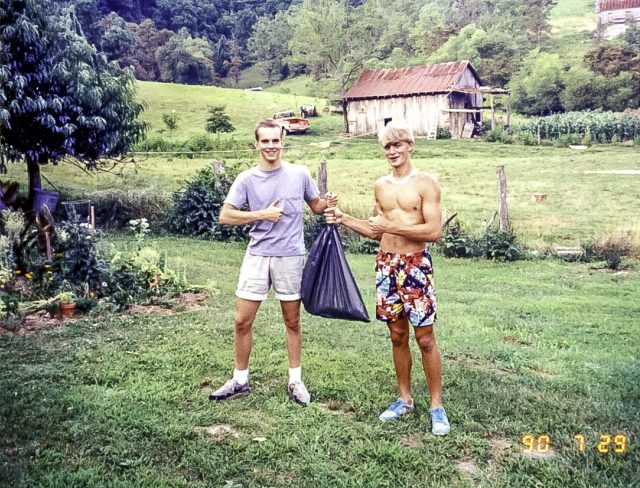
All told, we killed three raccoons that afternoon and earned the gratitude of both Ma and Pa. And we had a hell of a good time.
I’ve long ago lost touch with M. I last saw him in 1998 during the summer I came home after two years in Poland and one more year waiting. He’d made some bad decisions, and the place of our meeting was something out of an O. Henry short story. After that, we corresponded a few times, but the last we communicated was in late 1999.
That was almost thirty years ago now, and I still think back on that day fondly. Not because of the death we dealt but because of the innocent friendship lost. I don’t feel guilty for killing those ‘coons, though: they were doing real damage to the garden, and we took care of the problem in the country-folk way. Sure, we probably could have trapped them and released them somewhere else, but Pa was not a sentimental man, and he would have regarded that as a waste of time.
Years later, I thought of this day when I read the poem “The Early Purges” by Seamus Heaney:
The Early Purges
I was six when I first saw kittens drown.
Dan Taggart pitched them, ‘the scraggy wee shits’,
Into a bucket; a frail metal sound,Soft paws scraping like mad. But their tiny din
Was soon soused. They were slung on the snout
Of the pump and the water pumped in.‘Sure, isn’t it better for them now?’ Dan said.
Like wet gloves they bobbed and shone till he sluiced
Them out on the dunghill, glossy and dead.Suddenly frightened, for days I sadly hung
Round the yard, watching the three sogged remains
Turn mealy and crisp as old summer dungUntil I forgot them. But the fear came back
When Dan trapped big rats, snared rabbits, shot crows
Or, with a sickening tug, pulled old hens’ necks.Still, living displaces false sentiments
And now, when shrill pups are prodded to drown
I just shrug, ‘Bloody pups’. It makes sense:‘Prevention of cruelty’ talk cuts ice in town
Where they consider death unnatural
But on well-run farms pests have to be kept down.
Today, the Boy made his first kill. Birds were in our blueberry bushes, and the Boy had his bb gun. Somehow, he was close enough that one shot dropped a robin that was making an evening snack of our still-unripe berries.
The Girl was furious about it. She was literally in tears, shouting at him that he had no right to kill an innocent bird that had done nothing to us.
“In this time of the pandemic, we have to share,” she muttered as we ate dinner — fish our neighbor caught a couple of weeks ago when the governor let boat ramps open again before reclosing them due to a general failure to follow the newly-established guidelines.
I didn’t point out the obvious irony, nor did I point it out when she popped chicken nuggets into the toaster oven for her evening snack.
The other day was Clover’s birthday. I think it was her birthday. L insists — positively and passionately insists — that it is the 21st of May. Or the 20th. Or maybe it was the 19th. I’m not sure. I’m not sure about her certainty. But we celebrated Clover’s third birthday this week nonetheless by getting her an agility course.
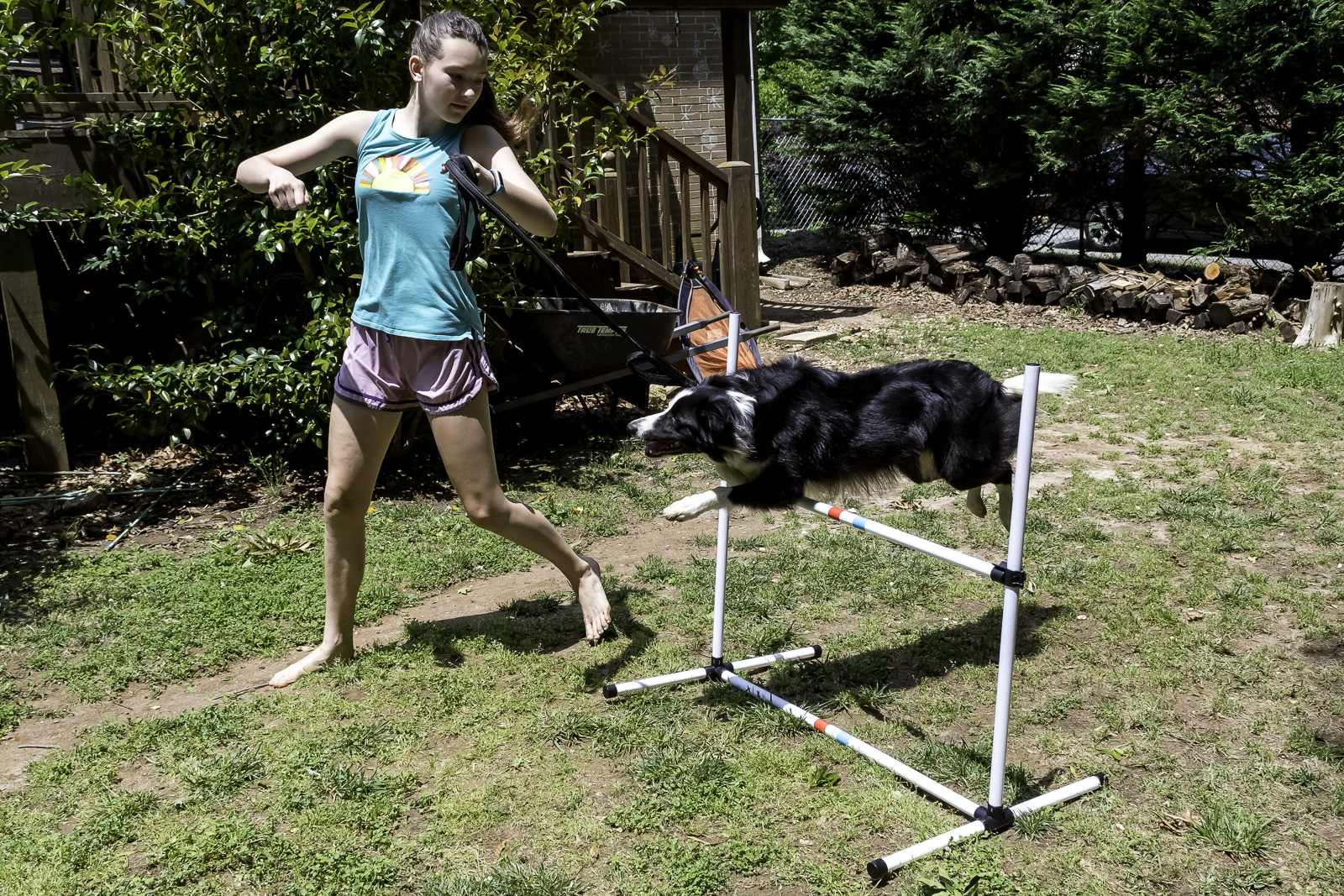
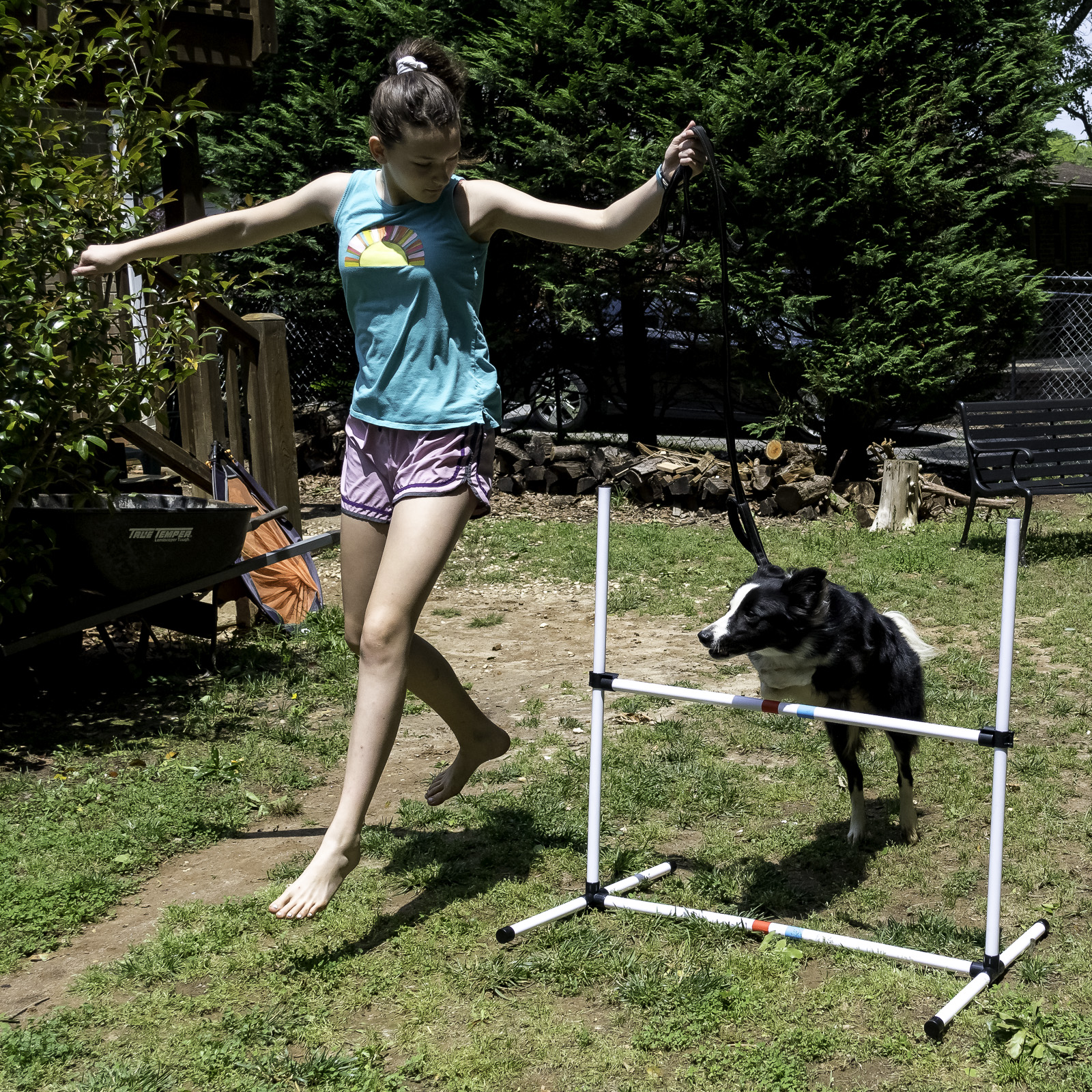
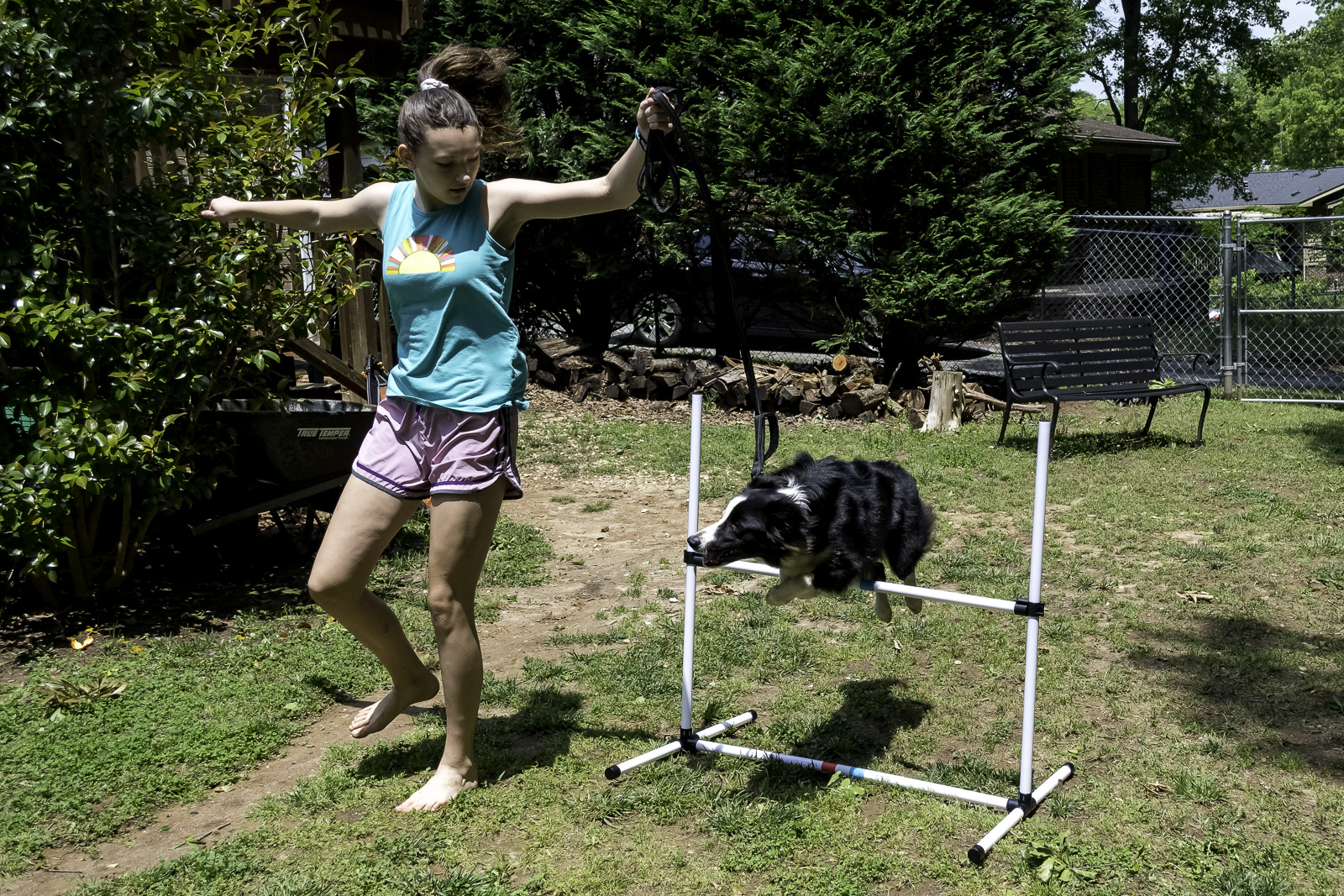
She’s already got a few new tricks up her, well, I guess tangled in the long hair on her hindquarters. (Cliches sometimes break down, I suppose.)
E talked K into doing a little exploring after dinner. While K was still in her good clothes.
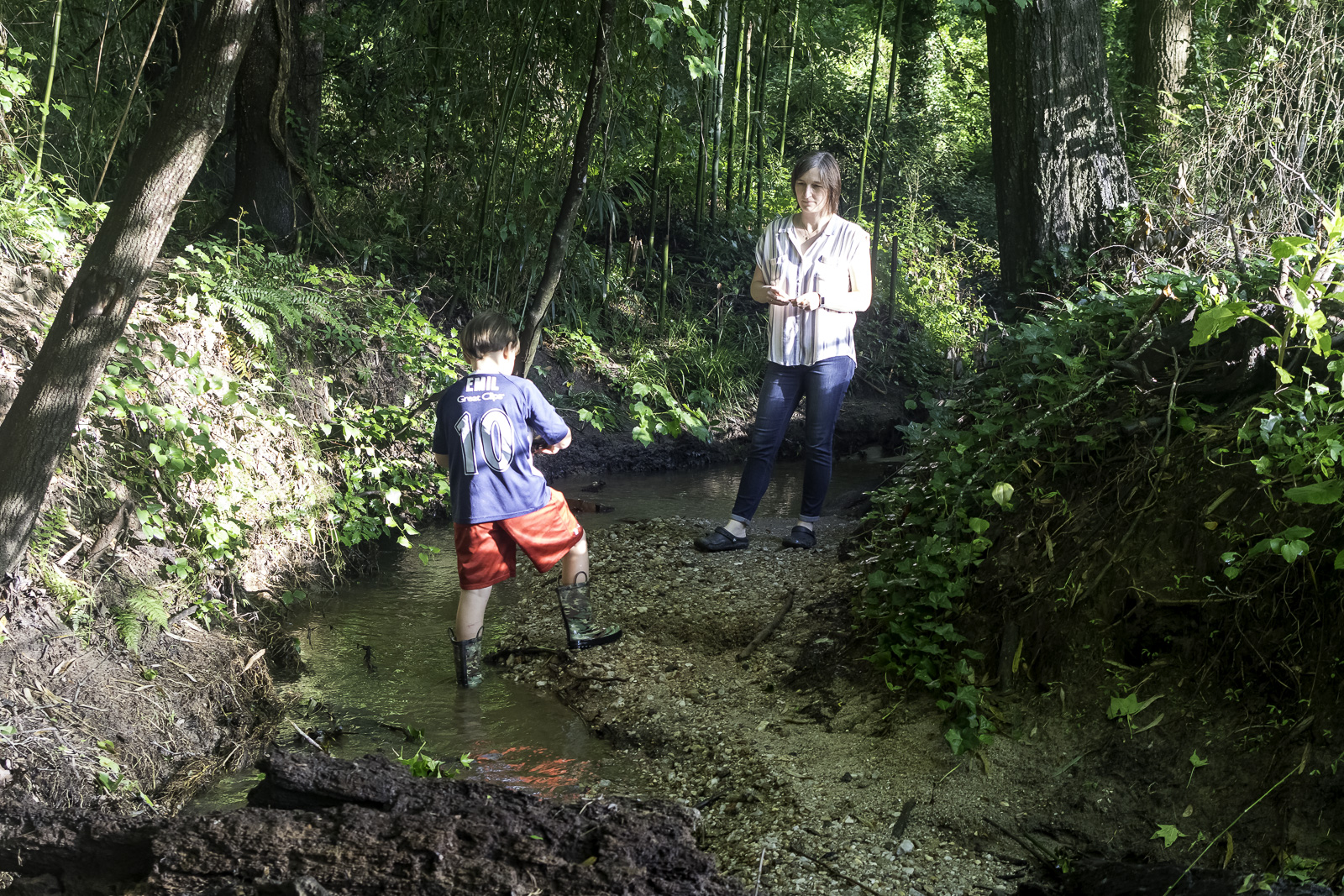
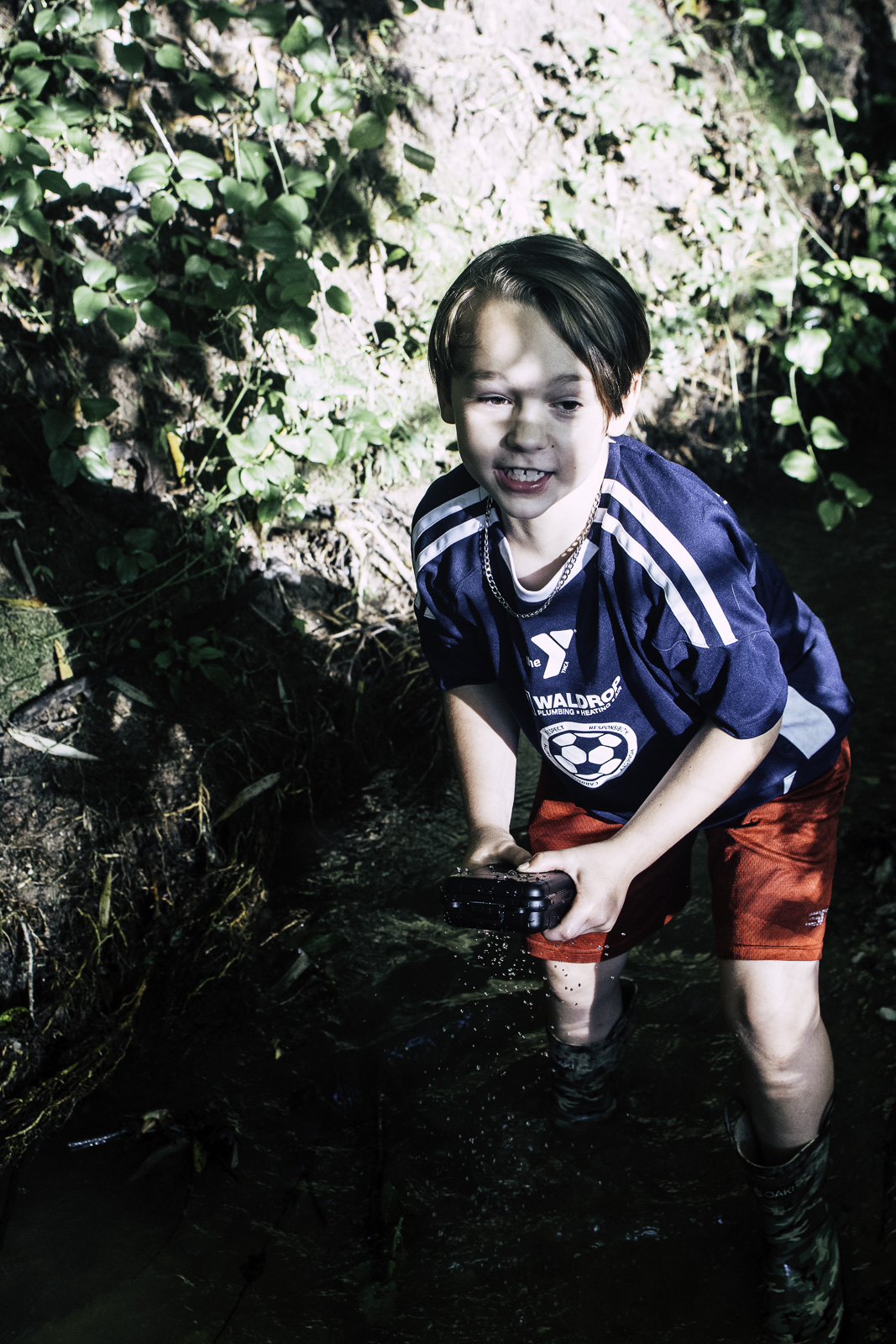
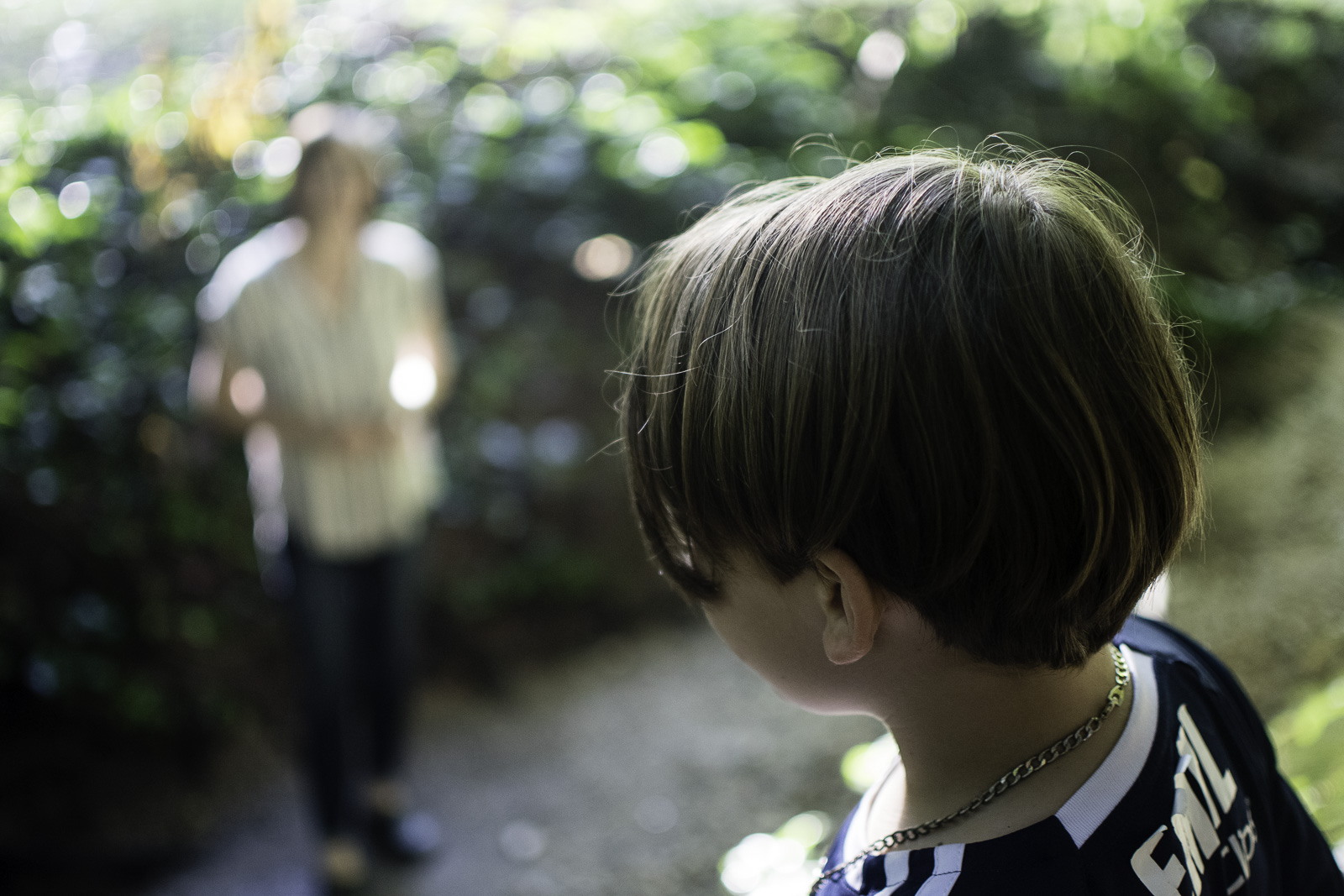
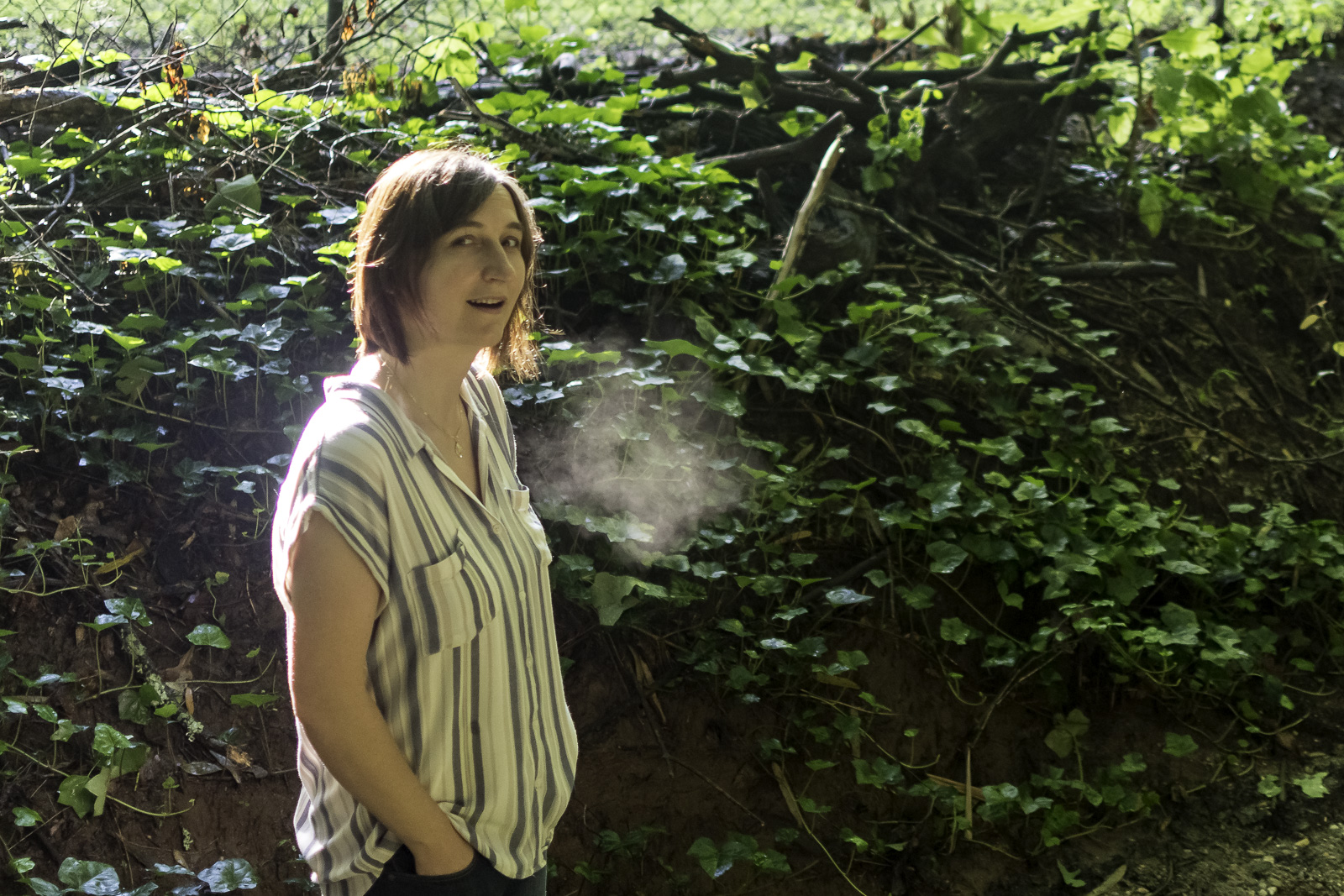
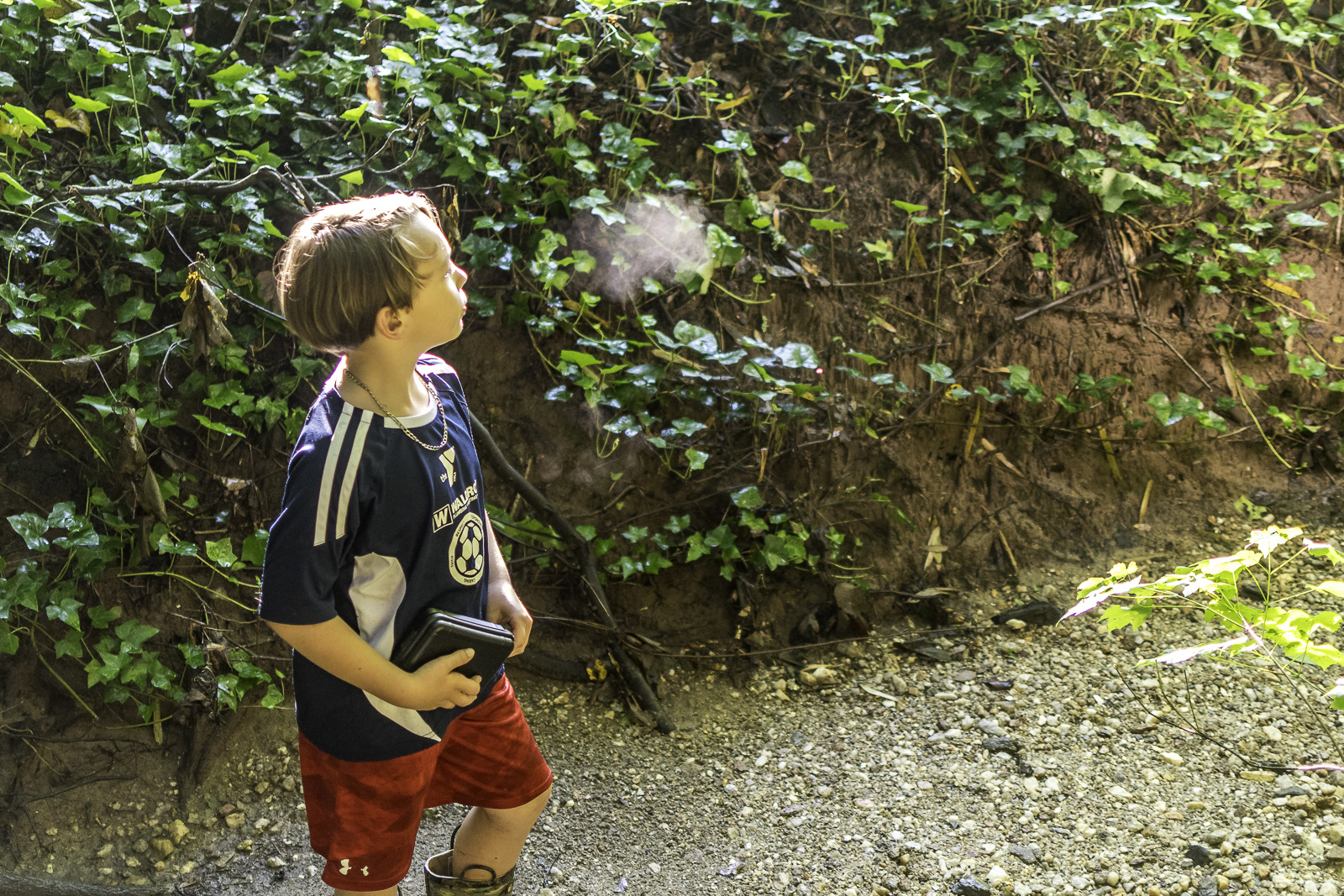
He was keen to show her how the plastic box his survival gear came in is, in fact, watertight.
The morning, post-breakfast ritual during this time of lockdown and isolation:
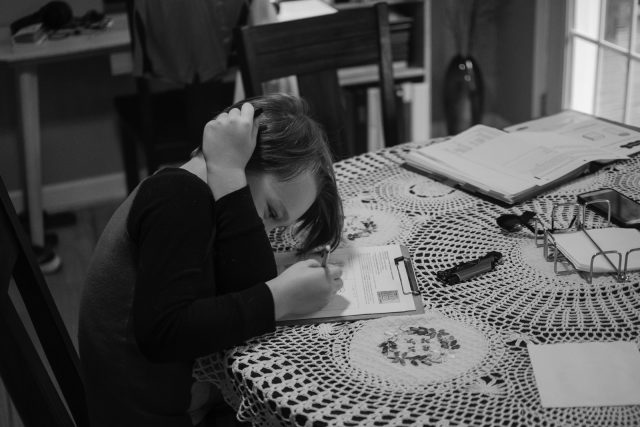
The Boy works on his schoolwork. We try to pace it: whatever’s going to be more challenging for the day we tackle first. Lately, things have been fairly balanced: everything has been much easier, in short. Still, old habits persist, and he’ll start fussing if he gets the slightest bit frustrated some mornings.
Today, we made it through everything fairly quickly with minimal fussing.
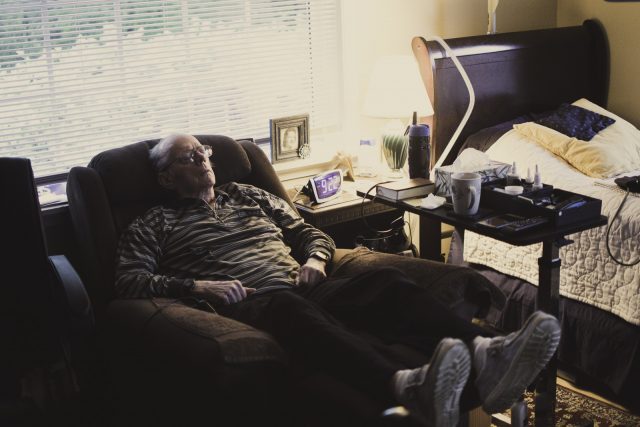
Papa often takes a nap. He doesn’t necessarily intend to take a nap — he’s just comfortable, full, content, watching television or listening to a book, and what else is there to do?
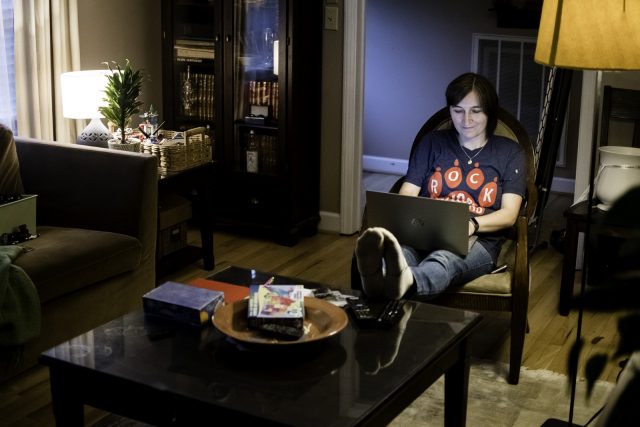
K works on emails for her real estate clients. She’s trying to work two jobs now. We all tell her that she needs to focus on one or the other. We know which one she’d like to focus on. We also know that that job doesn’t have a set pay schedule.
I am usually either helping the Boy or working on my own school work downstairs. Or as in this case, taking pictures.

The Girl — well, she does what a teenager does best.
Ever since we had our first flood in the basement several years ago, a heavy rainfall makes me just a bit nervous. I look at the puddles forming in the backyard. I check the weather. I duck into the crawl space to look in the sump pump basin. I repeat the cycle. I worry, worry, worry. Until our big flood in February, I’d gotten to the point, though, that I really fretted very little. It had gotten a little wet but it hadn’t flooded flooded. Still, I’m always probably going to be a little worried about water coming up from below, the hydrostatic pressure building to the point that it forces water through the smallest of cracks and starts filling our basement again. It will happen. And though I have taken steps to remediate the situation, there are no more steps I can take that don’t involve massive work and a sizeable fiscal commitment.
Our neighbor up the street had a drainage system put in his basement recently: around the entire parameter of the basement, workers busted up the concrete and the applied perforated drain pipes that lead to a central sump pump. It was a five-figure job.
That might be the next step if the basement continues flooding. It’s the type of job that, having the summer off every year, I’d be keen on tackling myself. At the very least, I could rent a jackhammer and bust up the concrete and dig down to the footer, cutting the cost significantly, I would think. Or at least hope.
The other option: when we pull out the landscaping front of the kids’ bedrooms, I could dig down to the footer there and re-seal the foundation, perhaps installing a French drain system there while everything is dug up.
I was playing pool with a friend in the basement probably almost decade ago when water started pouring onto the pool table. It turned out that the shower pan in the master bathroom had failed.
We ended up renovating the whole bathroom as a result.
There was one other time when the water came from above instead of below: somehow, the water came in between the upstairs deck and the door sill and started dripping from the top of the door in the basement. I never figured out what caused that, but I caulked well around the door and it never happened again.
But most of our experience with water entering the house comes from below.
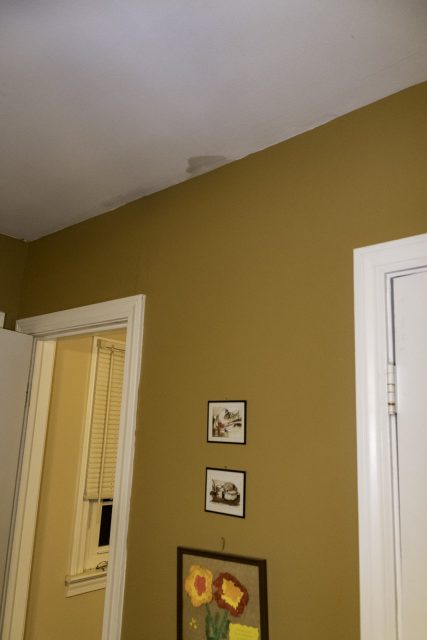
But tonight, the Boy was getting ready for his bath when he looked up and asked, “Daddy, is that a leak?”
Shit.
I went to get a chair so I could reach up and feel the dampness I knew would be there. Still, as I walked to the Boy’s room and returned with the chair, I found myself thinking, “Please, oh please just be a dark spot on the ceiling that I’ve never noticed though we’ve lived here almost thirteen years.”
I looked carefully at where the stain was and realized quickly what had likely happened: the roof vent flashing had somehow failed. Perhaps it had gotten cracked. Perhaps it was torn. Perhaps, perhaps, perhaps.
“Maybe it’s just running down the sewer vent,” I thought.
I climbed on the roof to see if anything was amiss. “Perhaps the hail we had a few days ago damaged something and insurance will pay for an entire re-roofing job,” I thought both hopefully and sickeningly. Examining the flashing, I couldn’t see any sign of compromise. We covered it with some plastic and hoped for the best.
Still, I needed to check in the attic to see just how bad the problem was.
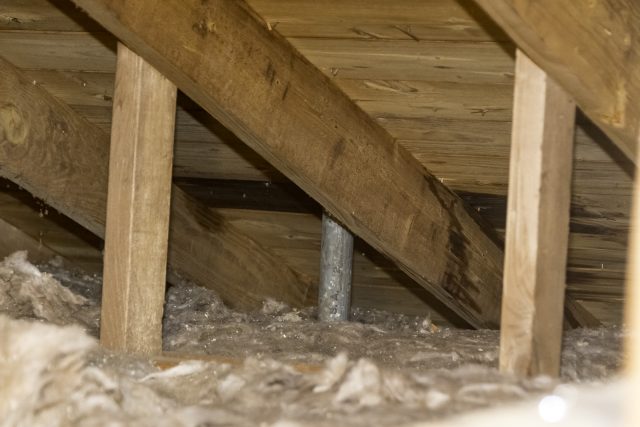
I don’t really know if that’s bad or not. Part of me says, “That’s horrible: it’s bad enough that it’s saturated the ceiling sheetrock enough to make a stain.” And yet, I really don’t know.
So tomorrow we’ll call the insurance adjuster and a roofer to see what they say.
When I got back down and talked to K about what I found, the Boy discovered my boots and couldn’t resist.
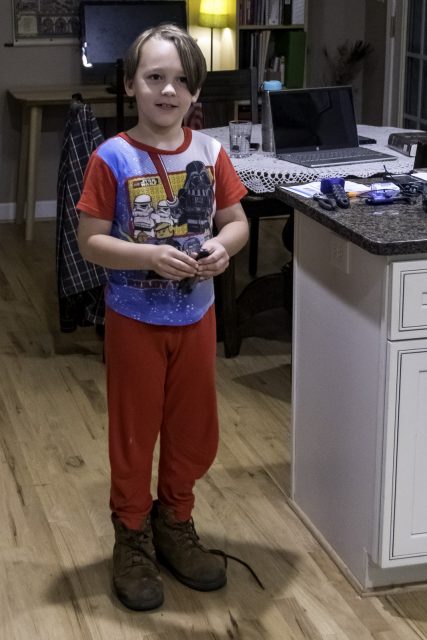
Later in the evening, K thought the spot is damper than it was earlier. We decided to go all out: we brought out the two tarps we use for camping, overlapping one with the other so that water can run under the tarp, weighing the whole thing down with bricks and cinder blocks. And doing all this in a light rain. At 10:30.
In August 2003, K and I rode our bikes south through Slovakia to Hungary to spend a week in Budapest. When we returned, we rode to Sturovo, a town in southern Slovakia, where we caught a train to Zilina, where we waited for another train to Trstena, just across the border from where we lived in southern Poland. We had to wait in the Zilina train station for most of the night to catch the 5:00 a.m. train to Trstena. This guy was waiting for a train, too.
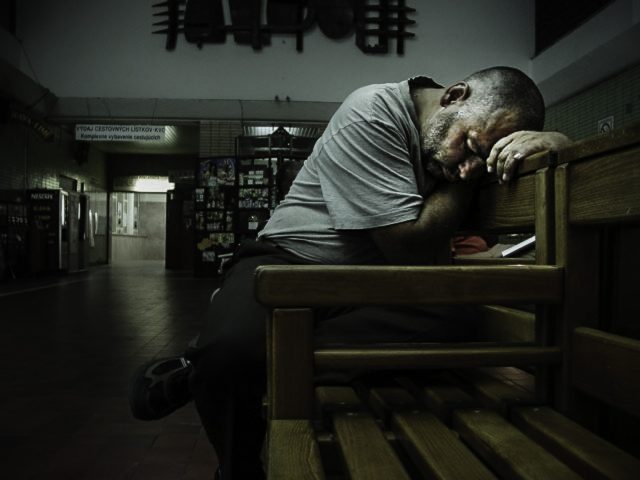
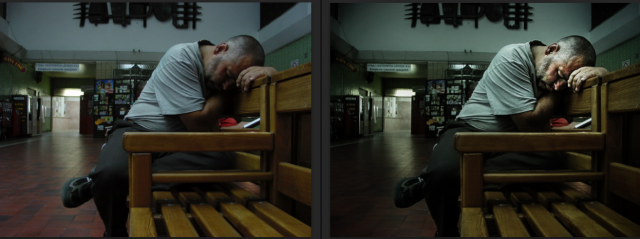
This is one I’m particularly pleased with the Lightroom reworking. The before-and-after shows how much of a difference it makes to do selective editing:
We’ve gone camping as a family quite a few times: Stone Mountain, Deep Creek, Lake Jocassee, and Huntington Beach come immediately to mind. Memorial Day was always a great weekend to go camping, and we went most often to the beach. But then life got complicated, family got sick, schedules changed, and responsibilities grew so that now, even if there weren’t a pandemic to worry about, we would not be able to go camping as a family for quite some time. For how long? We really don’t know.
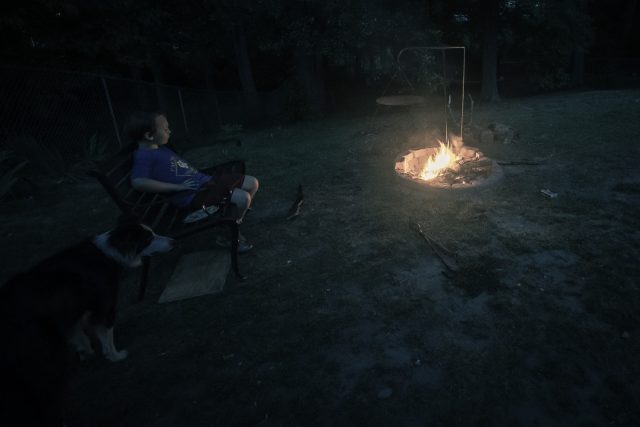
The Boy, though, wanted to go camping. So we did the obvious thing last night: we pitched a tent in our backyard and spent the night in it. There — camping.
Well, not quite. We took our pillows down with us. Somehow, we never remember to bring our pillows — or any pillows really — when we go camping.
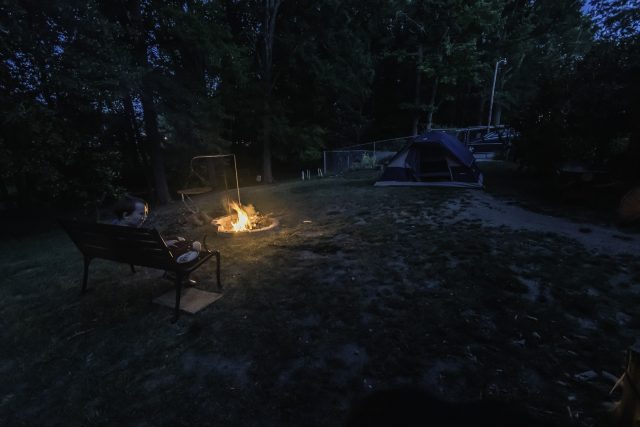
Also, I went in to get E’s blanket in the middle of the night when I woke to find him only barely covered with the sleeping bag because he was sleeping under it instead of in it.
And we didn’t have to strike camp this morning. We just left it up, thinking we might go camping again.
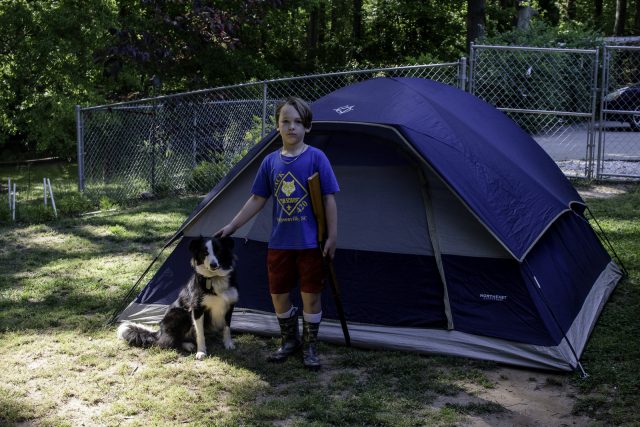
Finally, and most significantly for me, I took a shower without flipflops this morning.
Yesterday afternoon, we also put up K’s new swing. It’s hanging a little wonky now, and I didn’t have a chance to figure out today why, but it’s there. And the dog even likes it.
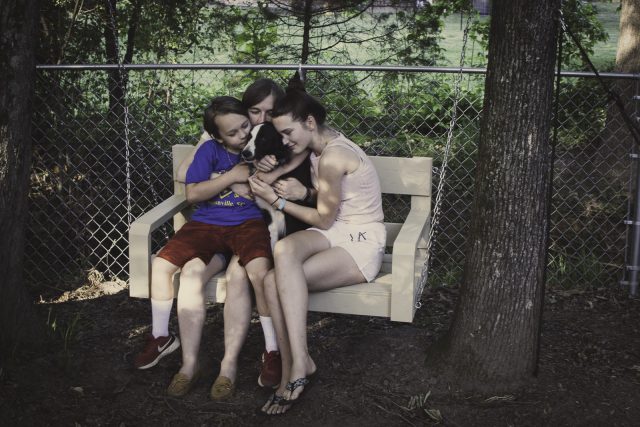
As for today, other than the single picture from this morning, I never had occasion to take out the camera. Who wants to see pictures of bathrooms in the midst of weekly cleaning or the crawl space as I examine the water pipes to try to figure out why they’re banging and knocking?

A proper birthday has to start with a proper birthday breakfast and a phone call from Babcia. For E, this meant an omelette for breakfast. Never mind that this was only the second time he’s ever had an omelet, a proper omelette, but he fell in love with it earlier this week, on Mother’s Day, and decided that it was his favorite breakfast of all time. Making omelets though is a time-consuming task, so although I layered the sauteed onions, sauteed peppers, and bacon bits very carefully for the Boy, the rest of us got it all mixed up in scrambled eggs.
“I could have it that way, I guess,” he confessed. “It’s the same thing, just all mixed up.”
The phone call from Babcia was a little less fluid. E is reticent to speak Polish, so although he understands everything Babcia says, he usually responds in English then turns to K, expecting a translation. Today Babcia tried to help him out, tried to ease his anxiety. She asked him simple questions like, “Are the flowers blooming?” or “What color are the flowers?” Yet he was still reluctant to speak Polish.
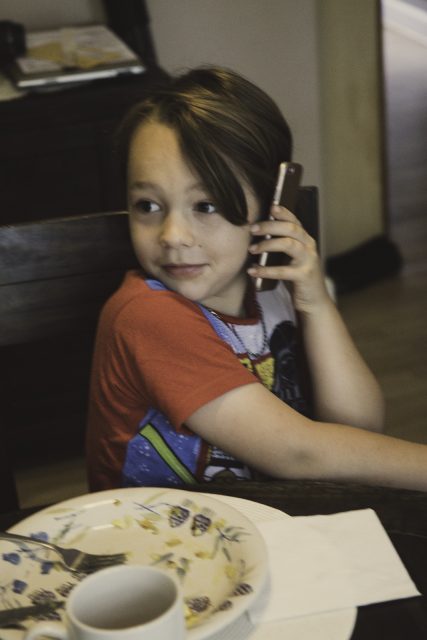
School today for him was relatively simple. At first, he wanted yesterday to complete as much of today’s work in addition to yesterday’s work as possible. But yesterday in the afternoon he decided that was not the best plan after all. He was ready for some free time. This meant of course that he had all the work for today to complete.
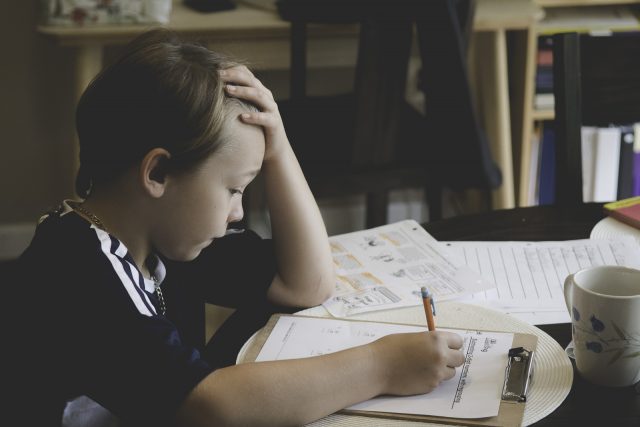
At the beginning of this quarantine, a day’s worth of work was just that: a day’s worth of work. The amount was greater than it is now, to be sure, but he fussed incessantly how about the frustrations he was feeling, about the difficulty of the math problems, about the length of the readings. We are half expecting such antics today, interspersed with cries of, “But it’s my birthday. Why do I have to work on my birthday?” However, he plowed through his work with relative ease, making it through math, which was subtracting three-digit numbers from three-digit numbers, each problem requiring regrouping and then word problems, in less than fifteen minutes. He wrote two more chapters of his frog/toad book and was done.
In the afternoon, we headed back down to the spot where we’d caught and inadvertently killed a minnow yesterday. I thought perhaps we might have a repeat, feared it in some ways — who wants to just go around killing little fish? Yet E was keen to try again. We did try again, and caught three fish. Two of them made it back to the water fine.
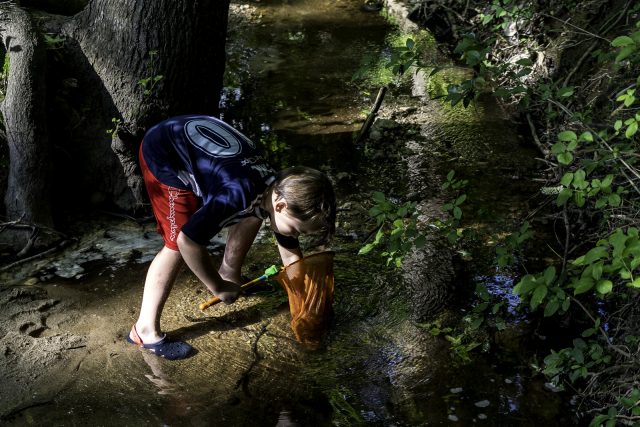
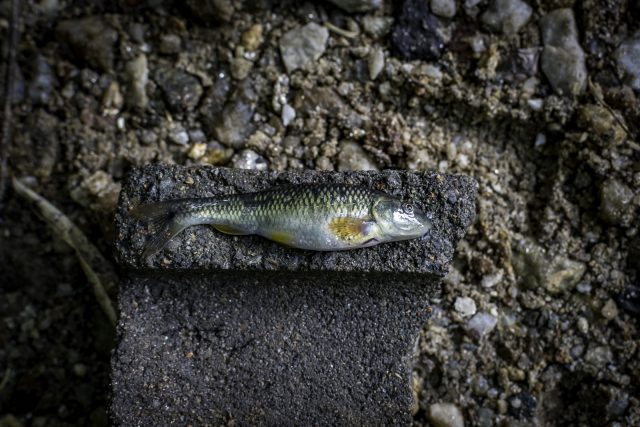
One of them — well, we didn’t quite hook him in the mouth but somehow hooked him through his body. He was already bleeding when we pulled him out of the water.
While we were down there, L came to the balcony and yelled across the yard, “You guys need to come back! Now!” At first, I was afraid that something had happened to Papa. Of late he’s been spending afternoons on the deck wallowing in nostalgia by exploring songs he hasn’t heard in decades, all thanks to Spotify.

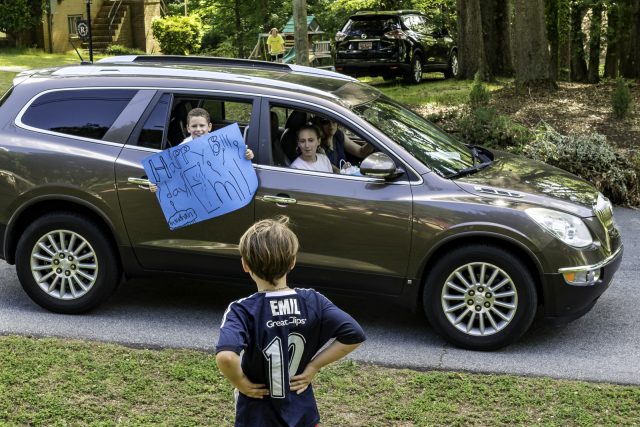
Instead, we all got a pleasant surprise:

E’s best friend’s mother drove him by our house to wish the Boy happy birthday.
As for our celebration, we played a trick on him that Nana and Papa played on me a couple of times: give him something that’s relatively worthless without the other item. Like a cable to hook up a laptop to something suggesting that it might work with an old laptop, then giving a new one as a surprise (a la Nana and Papa).
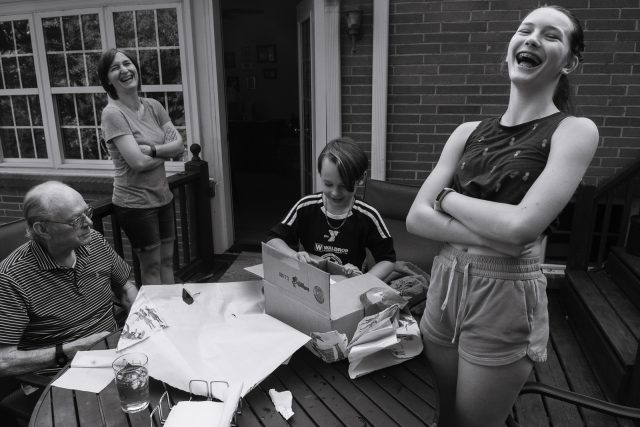
We gave him a tablet case and screen protector. He’d been asking for a tablet for some time, and we thought we’d see what would happen if he got only the empty shell. “You can keep and maybe you’ll get a tablet next year,” I suggested. “Oh, that’s great,” he said very calmly — not really upset, not really thrilled.
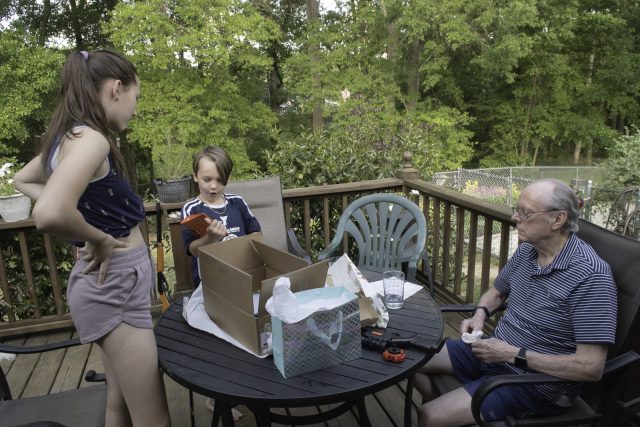
Then, when he opened Papa’s present, lo and behold — an Amazon Fire, just for him.
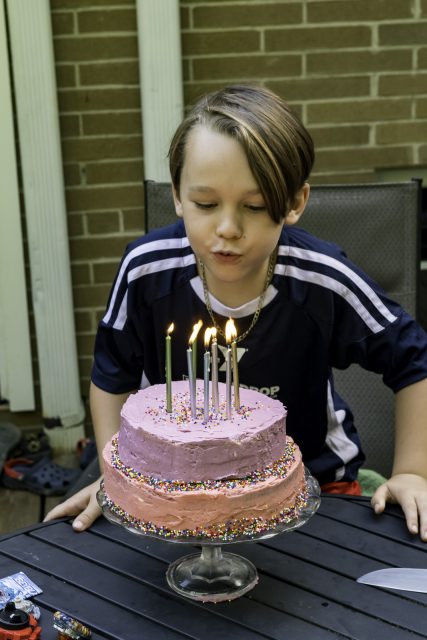
Finally, there was the cake. L began working on the cake yesterday and decided to add to it today. A two-tiered cake, each with two layers.
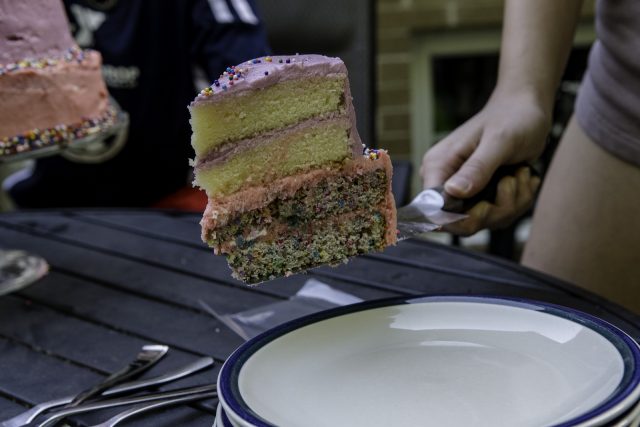
The slices were impressive to say the least. K and I split one: she took the top tier, and I worked on the bottom one. The Girl is getting the flavors down — she’s still not thrilled with the presentation, though.
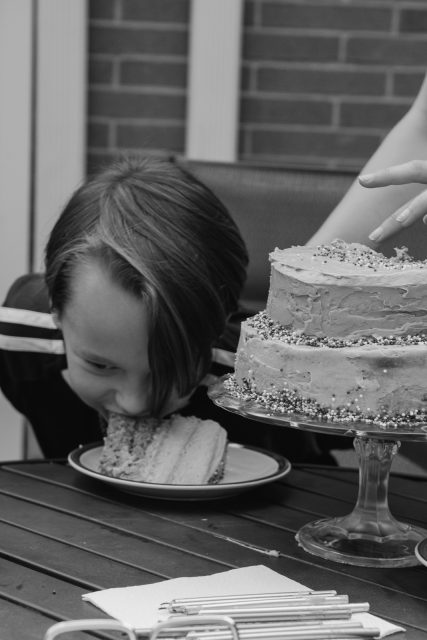
“Patience and practice,” K said to her. Though perhaps not quite so much practice while we’re all locked down.
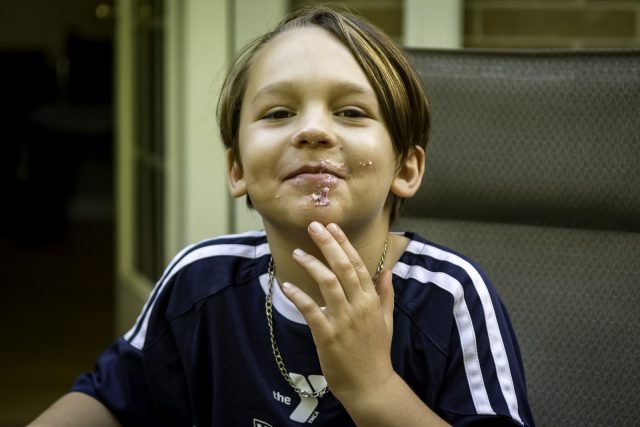
Since I didn’t have much to do for school this morning, I took over the first part of E’s homeschooling adventure. Our first task: to write the first chapter or two of his book about frogs and toads. Six chapters will constitute the final product:
As we read, I saw the difficulties and frustrations lying ahead: when it would come time to write the book, he might fuss, “Now we’ll have to go back through the text again. We have to read it again!!” So I taught him a little trick as we read that I use with my students.
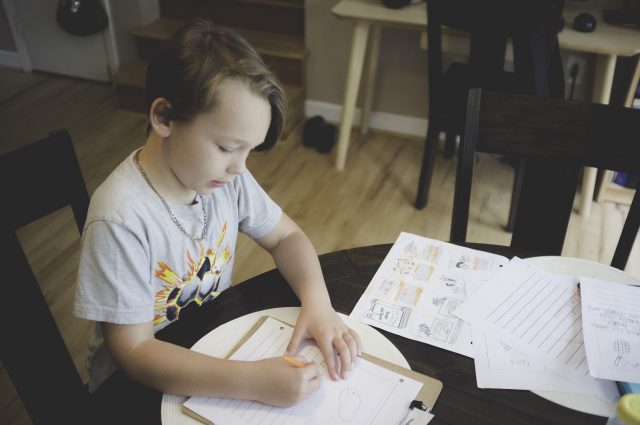
“As you’re re-reading, highlight facts you might want to rewrite in your own writing. Then put a number beside it to indicate which chapter you’ll use it in. When it comes time to write, then, you’ll just have to look at all the numbers for the chapter you happen to be working on.”
There are two reasons for this: first, it will help him with his writing later. That’s the most obvious way it assists him. Less obvious but more importantly, it helps him develop skills as a critical, analytic reader. My own students often have difficulty reading because they’re not reading for a particular reason. Giving kids a purpose as they read gives them a goal and a metric to measure comprehension and success.
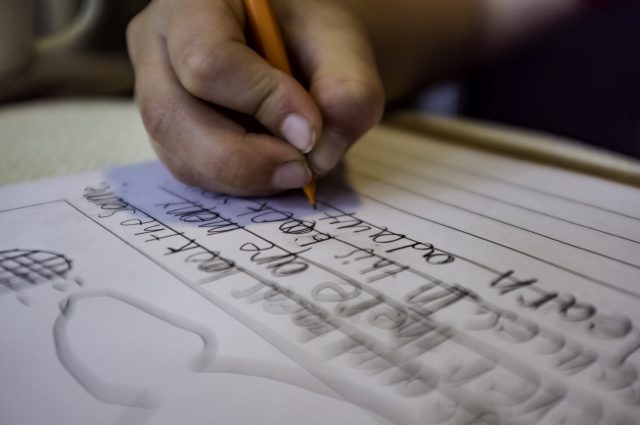
As we read, E grew more confident about the whole process; as he began writing the first chapters, he realized the sense behind it all. That might lead to a little less fussing as he continues to work on the piece.
Mr. F, our neighbor, is a keen fisherman. He’s got a boat, countless rods and reels, and multiple tackle boxes filled with endless lures and hooks. Heading out to the lake regularly, he often comes home with enough fish for his family and some neighbors: he’s given us many, many pounds of fish over the year. He’s the type of fisherman that, as regards fishing equipment, if he doesn’t have it, it probably doesn’t exist.
The Boy often goes over to help Mr. F. He’s something of a third grandfather to E, which makes him really like a second grandfather since Dziadek passed before E was a year old and E knows him only from pictures.
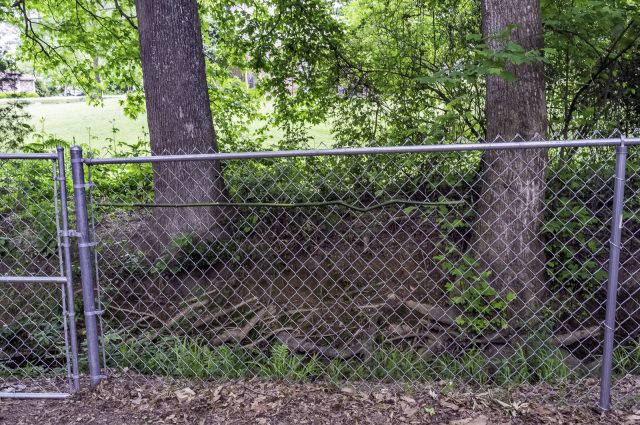
When E and I discovered in the creek that runs behind our house a couple of pools that are deep enough for larger minnows — some looking to be three or more inches long, maybe even four inches long — I commented that they’re almost big enough actually to use a hook and bait. Recalling the little minnows we caught in Lake Jocassee with just a line, a hook, and some bread, I suggested that we could use a bamboo cane and make a real, old-fashioned playin’-hooky-to-go-fishin’ cane fishing pole.
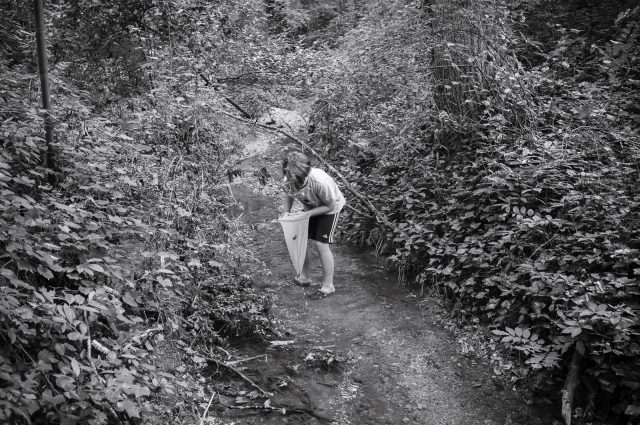
After we were both done with school, we headed down, saw and net in hand. “I still want to try to net some minnow,” he explained. We found an adequately small cane and cut it after a bit of unsuccessfully netting attempts.
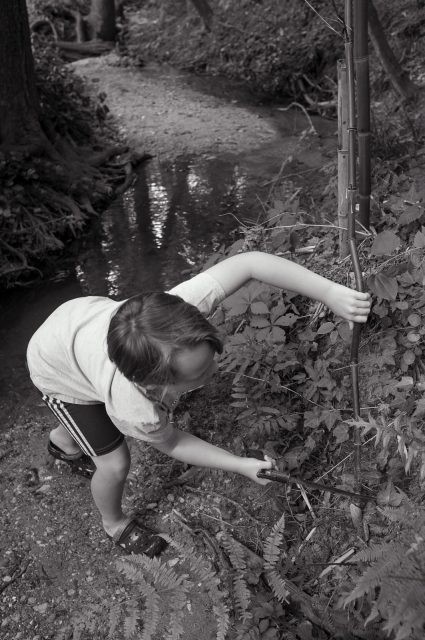
“Now we just need the line and a hook,” the Boy said as we headed back, adding as a sad afterthought, “but we don’t have any.”
“Why not ask Mr. F?” I suggested.
“Oh yeah!”
Then the real question as far as I was concerned: with Mr. F not out, he would have to go knock on the neighbors’ door, and I decided it was something he was going to have to do by himself. Would he do it?
“Just go knock on their door,” I said after he protested that Mr. F wasn’t outside at that moment.
“What if Mrs. P answers the door?”
“Just tell her that you have a favor to ask of Mr. F.”
He paused in thought. “Okay.”
When he came back, the Girl had joined us and was snooping about to figure out what was up. I explained. “Oh.” No protests about how awfully cruel it would be to catch a minnow with a hook. “With a hook!? Jabbed in its mouth?!” I could just hear her indignantly and incredulously asking.
When the Boy headed down for some fishing, I suggested that L might want to go with him. “Don’t let her talk you into letting her have the first turn because she will try to bamboozle you,” I warned.
He headed down by himself, though. I thought for a while that I should go with him at least to memorialize the moment photographically. Then I thought better of it: he needs some independence, and since he didn’t even ask me (with the explanation of being scared or worried about this or that) to go with him, I stayed behind.
He came back up a few minutes later, a scowl on his face as he stomped up the hill.
“Guess what?” he began, not waiting for a response. “I had one or two good tries and then the hook got stuck. When I tried to pull it out, the hook came off!” He plopped in a chair. “Now I can’t fish at all today!”
“Sounds like we might need to go get our own hooks,” I suggested.
More incredulity: “At the store?!” E is the most worried about cornavirus in our family. I think he’s convinced, despite our efforts to explain everything, that one can just get it, that it just lurks in the air waiting for unsuspecting victims.
In the end, we didn’t have to go get more hooks: the Boy remembered he had one small hook still on his fishing pole, so we cut it off and tied it onto the cane pole. We took some bread from a dinner roll we had, rolled it back into dough, and put it on the hook.
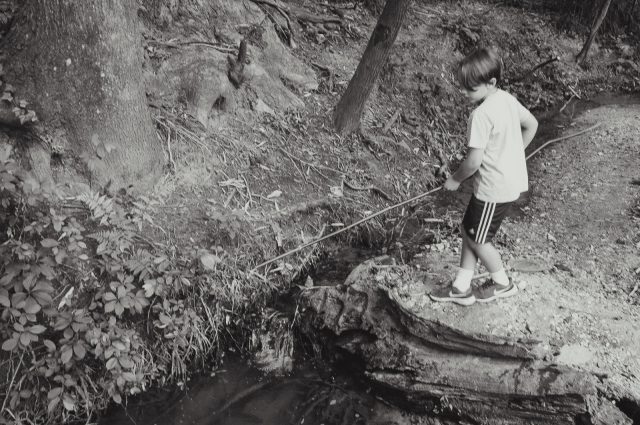
Soon enough, we had a minnow.
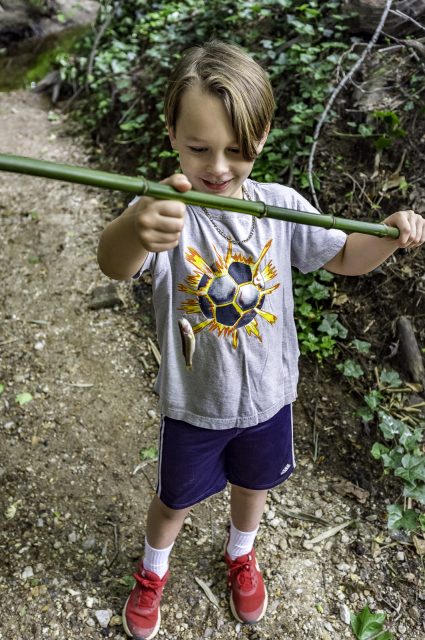
But our catch-and-release plan was thwarted by the difficulty of removing a hook from such a small fish. In the end, something terribly traumatic happened to the poor fish as we were removing the hook, and it went belly up immediately upon release.
Clover has become a companion dog. She doesn’t wander around, looking to find what she can get into. She doesn’t sneak off to try to get on the couch. She doesn’t (always) go off searching for a toy. She plops down next to someone and just relaxes. When we’re outside and L is, for instance, in our fort reading and Papa is on the deck listening to music (he’s become a real Spotify fiend), the pup moves from person to person, spending a little time by my side, a little time by Papa’s side, and a little time with L.
Another sign that she’s no longer a puppy.
Then she goes over to the fence just to antagonize the neighbors’ dog, so many not so much…
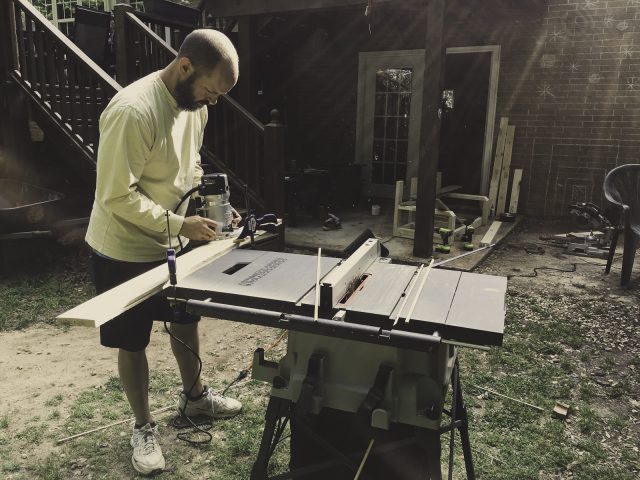
I don’t know how it inevitably happens, but projects with me just seem to swell completely out of proportion from my original estimates. Sometimes it’s simply that my estimates are wrong. No, that’s most of the time. I tend to underestimate the time required because I tend to overestimate my skills. Today, though, my estimation of the time required to make K’s Mother’s Day present was just about dead on. True, it took me longer in the end, but that’s because I decided to pull out the router and round over every edge. Why? Because I have a router and quite honestly don’t have that many opportunities to use it.
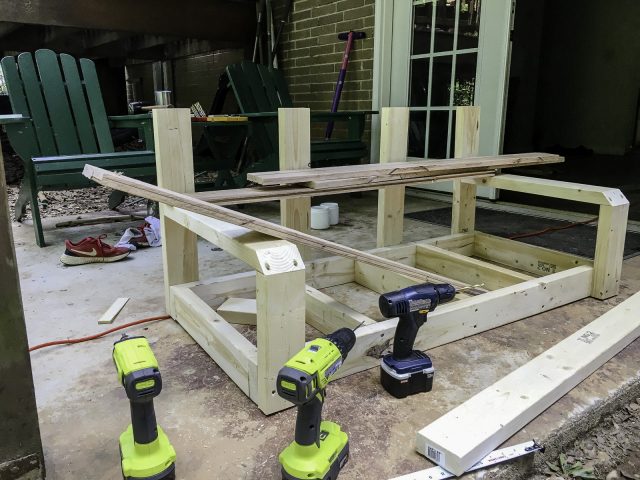
I also decided as I was working to countersink all the screws and go back with wood filler and hide them all. That added a bit of additional time. But the raw building itself took just about as long as I anticipated.
What got me off track was not the time it took to make the bench but rather the time it took to gather the needed materials. The wood was the real trick.
I went to Lowe’s expecting to be back fairly quickly. All I needed was a bit of additional chain for the swing, a few hooks to connect the swing to the chain, and some 2x4s for the framing of the swing. The chain took quite some time — probably more than twenty minutes — because I pressed the “Press here for assistance” button and no one came for what seemed like an eternity.
Finally, I was ready to pick up the lumber and haul it back to the in-store sawing station to have them cut the 96″ studs down to 48″ pieces that would fit in K’s Rogue. The first trick was to find a lumber cart. I finally gave up looking for one, went to the cashier, paid for the hardware, took it out to the car, and returned with a lumber cart from the parking lot. I loaded my six 2x4s and headed to the cut station. Where I found a sign that read, “Saw not functioning.”
I felt like I was in the film Nie Lubię Poniedzialku except that I was in Greenville not Warsaw and it was Saturday not Sunday.
I just left the cart there with the lumber on it. It was a somewhat crummy thing to do — I could have at least taken the lumber back.
After dropping off the hardware at the house (because it was on the way), I headed to Home Depot. The saw there was completely functional. The studs I picked out, though, were not 96″ but only 93″. So when I told the shop assistant to cut them at 48″, adding “I just need them in half-size pieces,” he did just that: he put one end of the board on 48″ and cut. And the resulting pieces were of a significantly different length. That’s when I measured and saw they weren’t 96″. I could have checked. I didn’t. I just sighed.
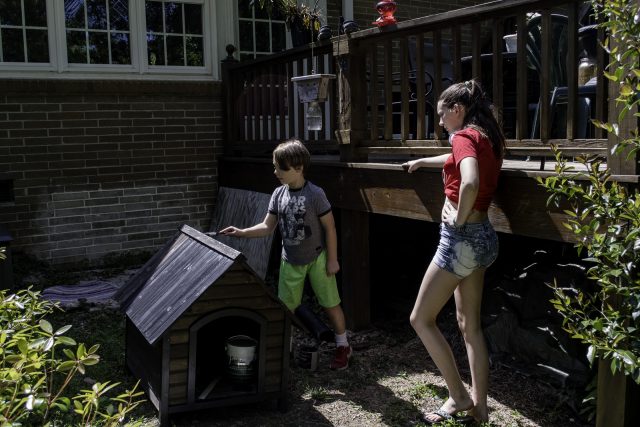
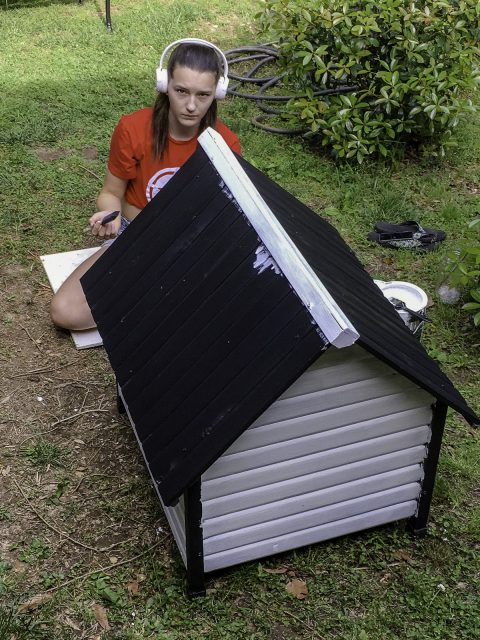
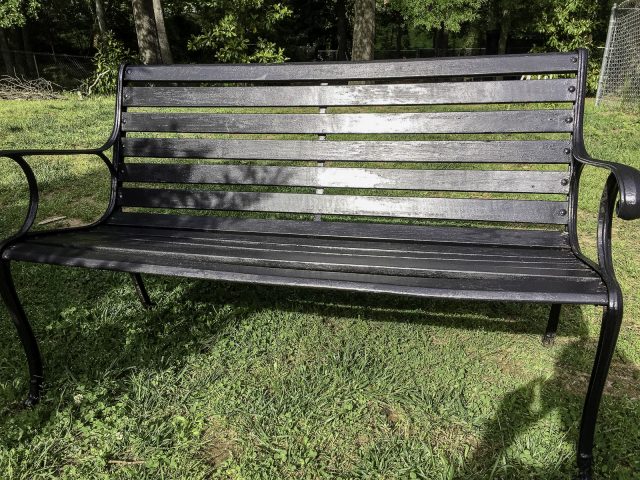
While all of this was going on, the Boy alternated between helping me and helping the Girl, who was painting the dog house and the bench.
In the evening, we watched Nie Lubię Poniedzialku. We’ve been trying to expose the kids to some of the classics, and we decided it was time for Poniedzialku. I love that film. It’s probably my second-favorite Polish film, right behind Miś. The story, such as it is, is charming: we all laugh at the horrid Monday everyone is having even though none of their trials rise above irritation. There’s no shadow of any real tragedy — just the annoyance of plans going awry.
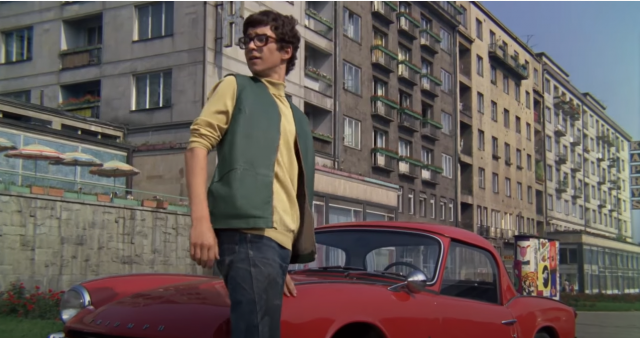
What I really love about the film, though, is the views of the Warsaw of the early 1970s. Just a quarter of a century after the Second World War, much of the city is still under construction, and what has been completed has the look of 60s communist architecture that was still prevalent in Warsaw when I arrived in 1996.
Papa decided he’d watch the film with us. “There are no subtitles,” we warned him, but he wasn’t fazed. We explained critical dialogue, but most of it really didn’t require a whole lot of explaining.
The Boy disagreed. “I don’t get any of the funny parts, even when you explain them,” he fussed.
Perhaps he’ll find the next one we’ve planned a little more enjoyable: the classic Sami Swoi. We found it on Netflix DVDs, which means it will have subtitles. “Kargul, podejdź no do płota!”
A couple of weeks ago, I got an email from my principal. It read, in part,
We are working on the schedule for next year, and I wanted to run something by you. In an effort to simplify people’s assignments and avoid teachers having 3 preps, we are looking at the possibility of you teaching all of the English 1 sections. […] My one hesitation is that 4 sections of E1H is a lot for one person. A lot to grade and be responsible for.
English I Honors is indeed a handful. Each class is about 30 students usually, and whereas 60-65% of students in English 8 turn in a given assignment, it’s something like 90% in English I. Many English 8 students often have issues with time management and apathy, so it’s rare for a student in those classes to turn in all assignments in a given quarter. English I is exactly the opposite thought: it’s rare to have more than two or three students in a given class not turn in a given assignment.
Another element adding to the E1 workload is the simple fact that, compared to English 8, it’s two classes combined into one: reading and writing are separated into two classes for English 8, and I have always taught the reading/literature portion. English I isn’t, so I have to teach both, which means a lot of writing to assess.
So I was hesitant to accept such an offer. At the same time the idea of working with students who have almost no serious behavior problems, who are all working hard most of the time, who all see the value of education, is pretty hard to resist.
My other concern was regarding the fact that having all the English 1 classes would mean Mrs. H, the other English I teacher, would have none. I knew how she enjoyed teaching that class, and if the tables were turned, I would not want to give up English 1 even for the tempting offer of having only one prep. I expressed my concerns to the principal, and he, in turn, discussed those concerns with Mrs. H. It turned out that for her, the thought of having only one prep was indeed enticing enough to give up English I. In fact, she was somewhat worried about the workload that I would be facing, and she emailed me about those concerns. Receiving this email and having assurances from my principal that Mrs. H would not feel as if I were somehow taking these classes away from her (because that’s how I felt: if I to take these classes, that means she loses them, and I can always say no), I agreed to take the 4 English I classes.
Yesterday the official master schedule for the 2020-2021 school year was released.
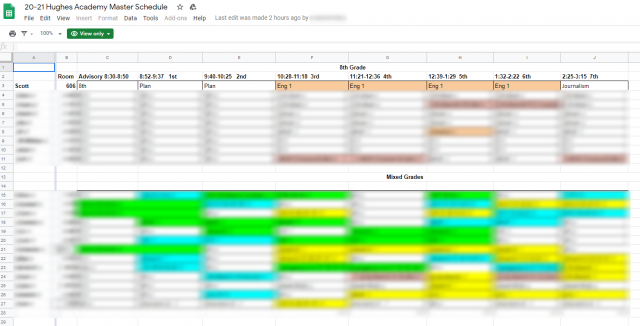
And there I am back-to-back-to-back-to-back English 1 classes.
I’m happy about this for a number of reasons, not the least of which that I will have very few behavior issues to deal with. It’s also a great joy to work with students of actually do want to learn and you actually do put forth their best effort on a consistent basis.
On the other hand, working with a class that includes a significant number of at-risk students has its own rewards. I often feel I have the opportunity to teach them even more important skills like anger management, delayed gratification, empathy, impulse control, and appropriate self-efficacy.
The change will be significant. The increased workload will be noticeable. The rewards? Well, it is indeed a trade-off.
L decided today that she wanted to get involved in the fort.
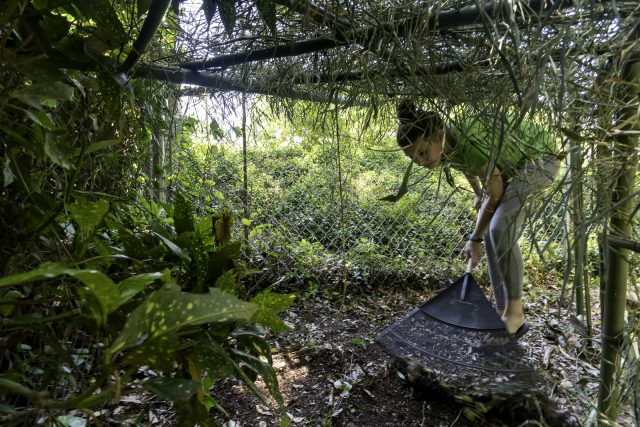
“You guys did the hardest part,” she said, “But still — I want to help.”
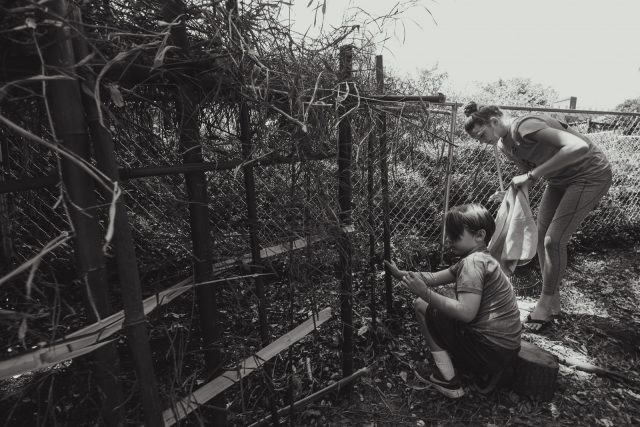
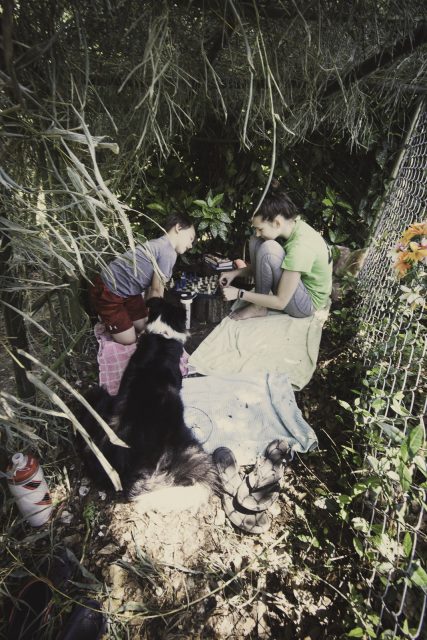
She brought an interior design eye to the project, bringing ground covering (old towels), decorations (old silk flowers), entertainment (books, a chess board, and more), and snacks.
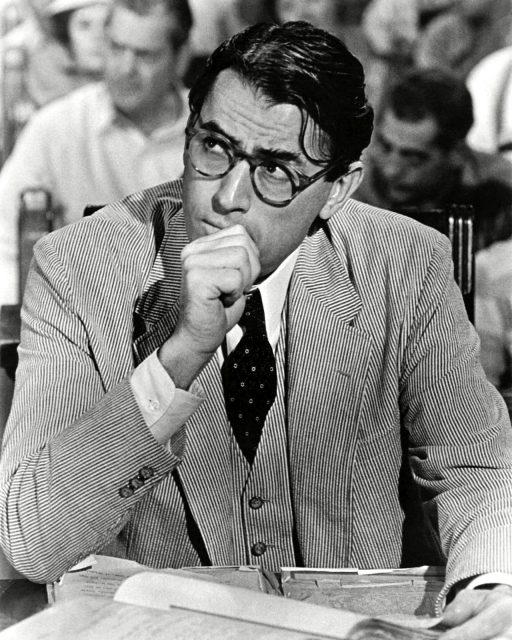
Atticus Finch — what a hero. What a fantastic lawyer. That’s what we all walk away thinking the first time we read To Kill a Mockingbird. We read his cross-examination of Bob and Mayella Ewell and think, “He did a really good job establishing Tom’s innocence,” and can’t understand how Tom could be found guilty– though we can understand it because it’s Depression-era Alabama.
The state has not produced one iota of medical evidence to the effect that the crime Tom Robinson is charged with ever took place. It has relied instead upon the testimony of two witnesses whose evidence has not only been called into serious question on cross-examination, but has been flatly contradicted by the defendant.
Nailed it — keep hammering on the fact that no doctor was called, Atticus.
She was white, and she tempted a Negro. She did something that in our society is unspeakable: she kissed a black man. Not an old Uncle, but a strong young Negro man. No code mattered to her before she broke it, but it came crashing down on her afterwards.
Her father saw it, and the defendant has testified as to his remarks. What did her father do? We don’t know, but there is circumstantial evidence to indicate that Mayella Ewell was beaten savagely by someone who led almost exclusively with his left. We do know in part what Mr. Ewell did: he did what any God-fearing, persevering, respectable white man would do under the circumstances—he swore out a warrant, no doubt signing it with his left hand, and Tom Robinson now sits before you, having taken the oath with the only good hand he possesses—his right hand.
There it is — that brilliant evidence that someone lefthanded inflicted the bruises on the right side of Mayella’s face. Tom’s left arm was mangled in a cotton gin when he was young — he couldn’t have done it. Case closed.
And then that impassioned closing:
Thomas Jefferson once said that all men are created equal, a phrase that the Yankees and the distaff side of the Executive branch in Washington are fond of hurling at us. There is a tendency in this year of grace, 1935, for certain people to use this phrase out of context, to satisfy all conditions. The most ridiculous example I can think of is that the people who run public education promote the stupid and idle along with the industrious—because all men are created equal, educators will gravely tell you, the children left behind suffer terrible feelings of inferiority. We know all men are not created equal in the sense some people would have us believe—some people are smarter than others, some people have more opportunity because they’re born with it, some men make more money than others, some ladies make better cakes than others—some people are born gifted beyond the normal scope of most men.
But there is one way in this country in which all men are created equal—there is one human institution that makes a pauper the equal of a Rockefeller, the stupid man the equal of an Einstein, and the ignorant man the equal of any college president. That institution, gentlemen, is a court. It can be the Supreme Court of the United States or the humblest J.P. court in the land, or this honorable court which you serve. Our courts have their faults, as does any human institution, but in this country our courts are the great levelers, and in our courts all men are created equal.
I’m no idealist to believe firmly in the integrity of our courts and in the jury system—that is no ideal to me, it is a living, working reality. Gentlemen, a court is no better than each man of you sitting before me on this jury. A court is only as sound as its jury, and a jury is only as sound as the men who make it up. I am confident that you gentlemen will review without passion the evidence you have heard, come to a decision, and restore this defendant to his family. In the name of God, do your duty.
What a perfect defense! What insight! What an amazing job defending a man in a hopeless situation!
That’s what we think when we’re not lawyers, though. But what about a trial lawyer who’s had twenty years’ experience in the courtroom? Someone who’s represented defendants against charges of rape and murder?
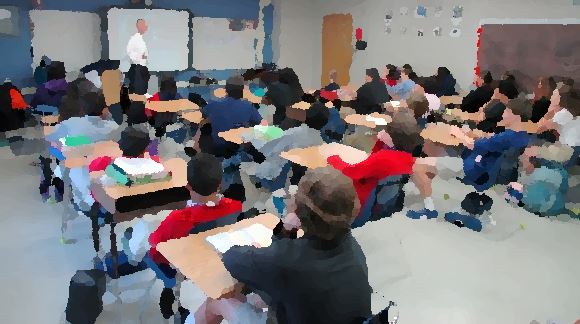
Every year, as the kids finish up Mockingbird, I have Jim Bannister, a local defense attorney, come in and walk the kids through the details of the trial and evidence. He’s been doing this presentation for some years, ever since a friend’s daughter read the book. The friend asked him what he thought of Atticus’s defense and, not having read the book since middle school, Bannister reread the chapters dealing with the trial.
“I would have handled things a little differently,” he remarked. “To be fair,” he’s always added when talking to the kids, “Atticus seems to be a tax and/or estate lawyer, so he was not in his area of specialization at all.” Still, he helps the kids see the mountains of evidence that Atticus could have brought into the trial that doesn’t even get a mention.
The most damning evidence does appear in the book, but Atticus doesn’t push it hard enough: no doctor was ever called. This means there’s no evidence that the crime even took place. But there’s so much more than that.
What about clothing the accused and supposed victim were wearing? How could Tom, who’s left arm is all but useless, hold down Mayella as she claimed, take off his clothes, take off her clothes, and rape her while using only one arm? It doesn’t make sense — it’s physically impossible.
What about defensive wounds on Tom? Mayella said she fought him “tooth and nail.” There should have been scratches all over Tom’s face.
What about the window through which Bob says he saw the rape in progress? Earlier in the book, the Ewell house is described and we discover that there’s cheesecloth over the windows instead of glass panes. How clean was that cheesecloth? How much could Bob actually see?
And if his daughter was being raped and all that stood between him and the rapist was a bit of cheesecloth over a window no more than three feet above the ground, why didn’t he dive through the window and attack Tom? Instead, he claims he witnesses the rape in the front room and runs around the entire shotgun house and enters through the back door.
All these were failures on the part of Heck Tate, the sheriff, who did absolutely no investigation at all. “I would tear him apart on the stand,” Bannister laughs.
For me, though, the most jaw-dropping piece of evidence was a little gem hidden in Tom’s account of the event.
“Mr. Finch, I was wonderin’ why it was so quiet like, an‘ it come to me that there weren’t a chile on the place, not a one of ’em, and I said Miss Mayella, where the chillun?”
Tom’s black velvet skin had begun to shine, and he ran his hand over his face.
“I say where the chillun?” he continued, “an‘ she says—she was laughin’, sort of—she says they all gone to town to get ice creams. She says, ‘took me a slap year to save seb’m nickels, but I done it. They all gone to town.’”
Tom’s discomfort was not from the humidity. “What did you say then, Tom?” asked Atticus.
“I said somethin‘ like, why Miss Mayella, that’s right smart o’you to treat ’em. An‘ she said, ’You think so?‘ I don’t think she understood what I was thinkin’—I meant it was smart of her to save like that, an‘ nice of her to treat em.”
Why in the world didn’t Atticus call to the stand that ice cream salesman?! Everybody in the town knows the Ewells; everyone knows how poor they are. To see all seven of them come traipsing up with nickels in hand to buy ice cream would have been a once-in-a-lifetime, always-remember-it moment.
So he comes every year to lead students through these pieces of evidence, suggesting at the outset that they pretend like he’s the lead attorney and they are his paralegals, investigators, and co-attorneys. “Let’s see if we can’t put together a better defense for Tom Robinson.”
Except he couldn’t come this year for all the obvious reasons. Yet when I asked him if he’d be willing to give it a shot on Google Meet, he didn’t hesitate: “What dates are we looking at?”
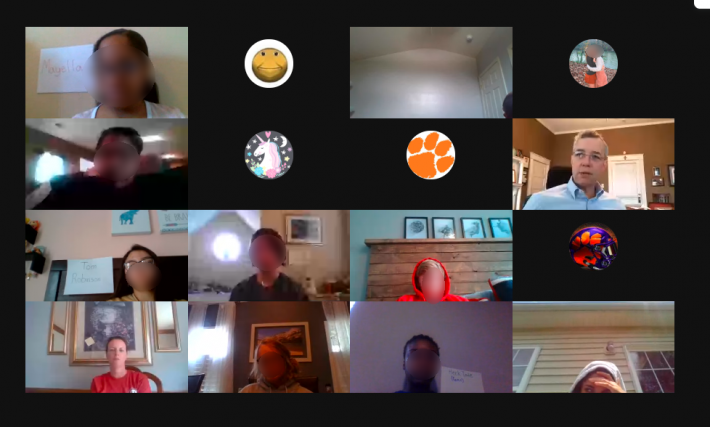
And so he sat in his study and led several of my students through a discussion via Google Meet, and my eighth-grade vice principal (well, she will be next year after our current, much-loved vice principal retires) popped in eagerly when I told her what we were planning.
Despite the frustration of the lockdown, it was a good day to be a teacher.
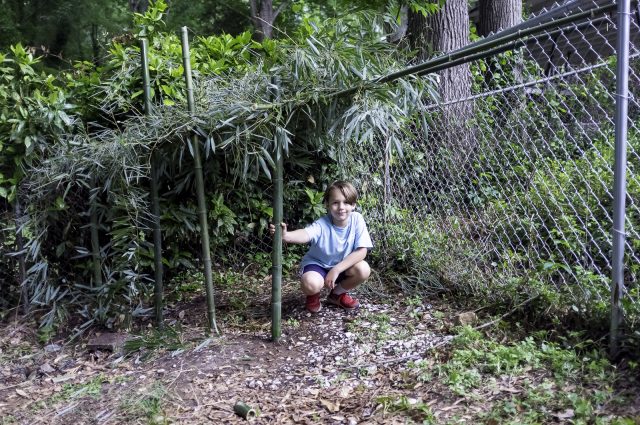
The Boy has wanted to build a bamboo structure of some sort for some time now. He had in his mind a large and grand structure, perhaps with a swimming pool beside it and a diving platform coming out of the second story.
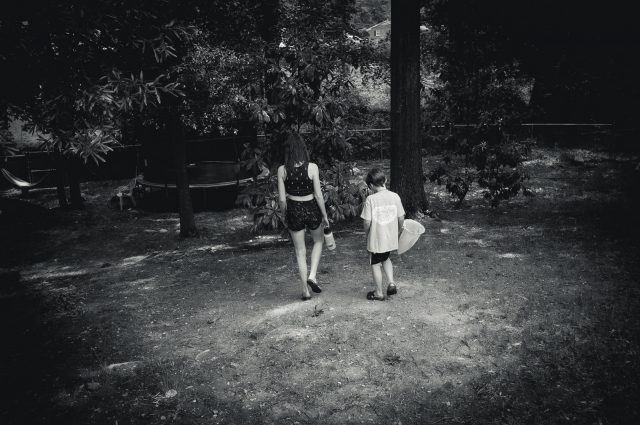
Today, I suggested a little more modest structure: “We could simply use the corner of our fence and Mr. F’s fence and build it there.
And so we went out into the stand of bamboo growing in Mr. F’s back yard (more or less — not really sure of property lines there) and took a few canes.
We stripped off the small branches on which grow the leaves, cut them to length,
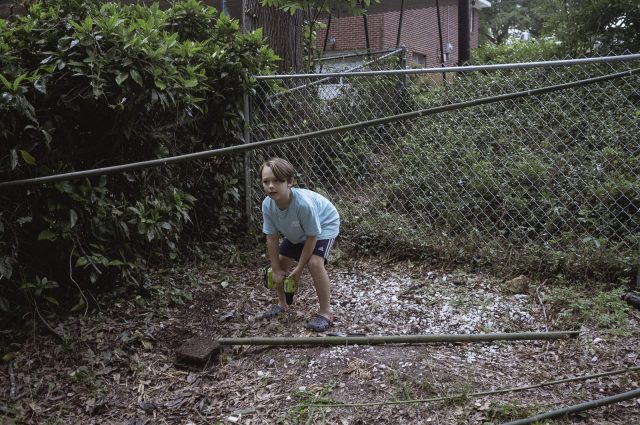
dug a few holes, and we had our basic frame. A little more work and we had a functional structure.
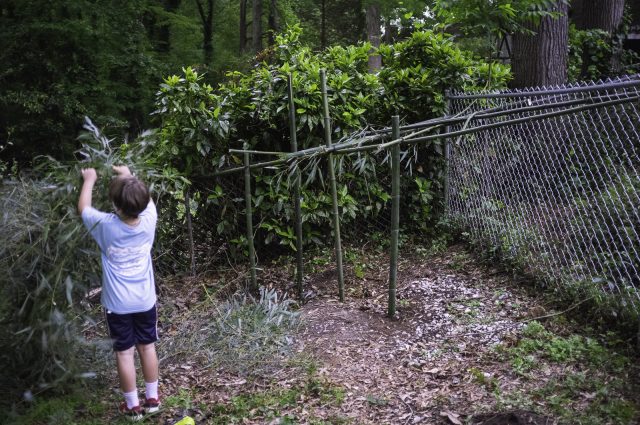
A good day to be a dad.
During the warmer months, the creek that runs through the backyards of our street becomes a frequent destination for us. Of late, this has been because of the minnows that flourish in the small stream.
I find myself wondering how in the world the little fish survive. What do they eat? According to one site, “Bluntnose minnows eat algae, aquatic insect larvae, diatoms, and small crustaceans called entomostracans.” I don’t know if these are bluntnose minnows, but that was the first thing Google turned up when I asked, “what do minnows in streams eat.” That makes sense.
Their presence also solves another mystery: what do the snapping turtles in the creek eat? That and frogs, I guess.
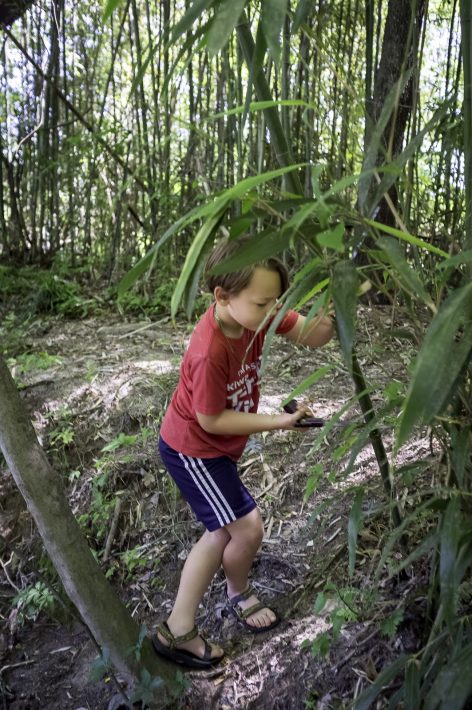
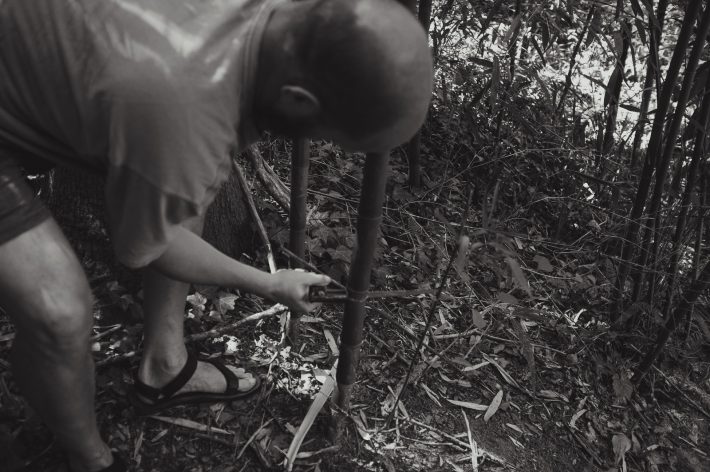
We were in the creek three times today. The first was in the morning, a session that included a bit of minnow netting and some bamboo harvesting.
The Boy has been watching videos on YouTube showing young men in some south Asian country (Malaysia? Indonesia?) who dig vast underground spaces or build impressive bamboo houses using only the most primitive of tools and resources. He has decided that he wants to do the same. This morning, then, we cut down a couple of bamboo canes for this project. The Boy wanted to get more, but I put him off, hoping his obsession with this project would wane a bit when he realized it’s impossibility for a seven-year-old boy. Still, I want to encourage him to try, hence today’s harvest.
After we took down the canes, it was time for a little minnowing. The Boy as a curious and amusing approach that seems counterintuitive but works: he sneaks up to where the minnows are gathering, then leaps into the water, thrusting the net in before him and waving it about violently in the water.
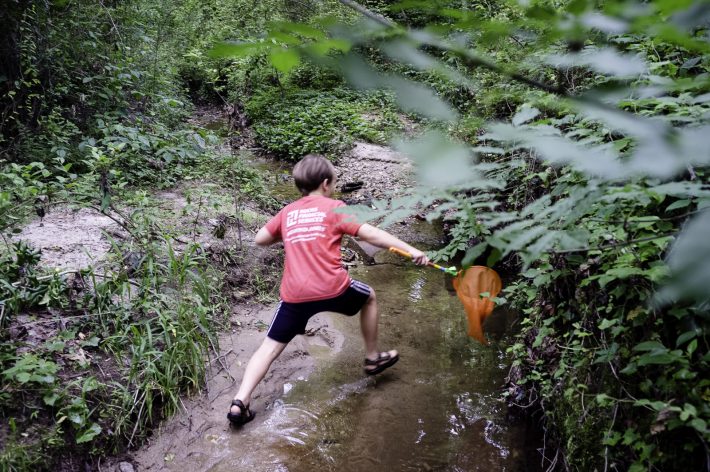
It seems like it would never work, but it does.
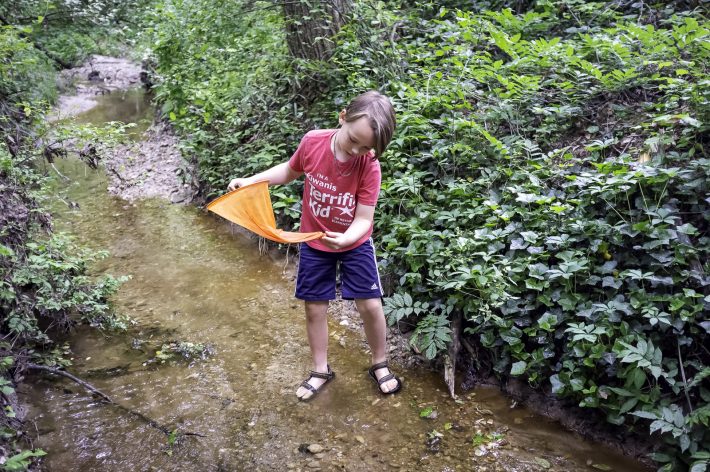
Occasionally, the minnows have caused a bit of consternation in the house. The first minnows he caught spent the night in a Mason jar on the kitchen counter. When K went down in the morning, one of the two minnows was floating on the surface of the water. Not wanting to risk the other’s life, K took the jar and sprinted down to the creek to release the survivor.
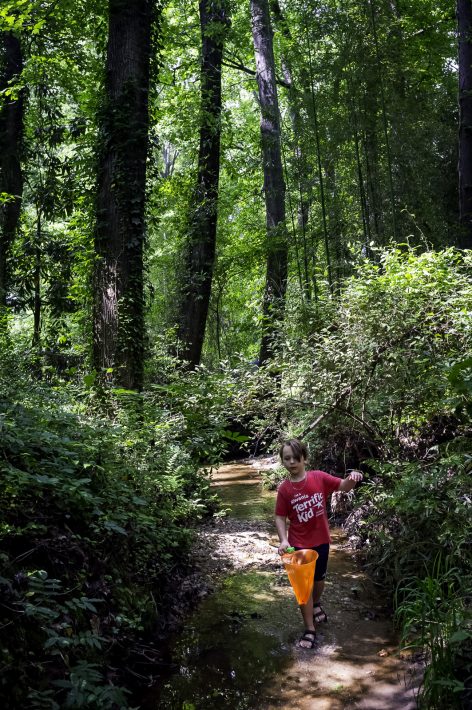
This prompted a new rule: minnows can be held in captivity until bedtime. When the Boy comes up for his bedtime ritual, the minnows need to be back in their own habitat. That worked for a couple of days until yesterday, when one of the minnows leaped out of the jar as it sat on the deck, flopped about on the deck board, then slipped in between two boards to its death in the leaves and chaos that exists under our deck.
“Minnow murderer!” the Girl exclaimed.
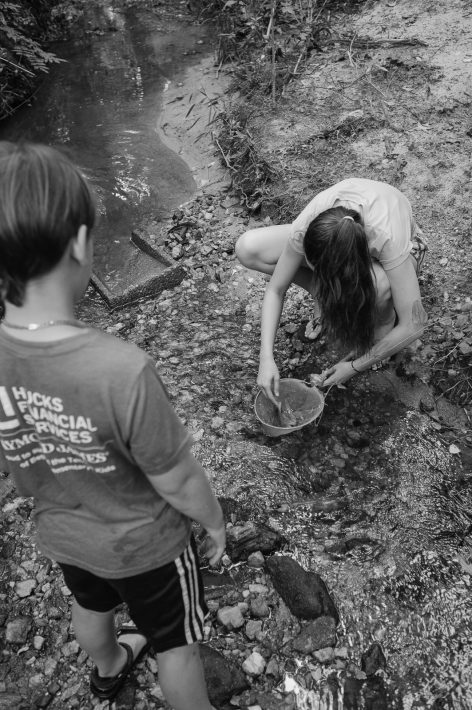
So now the jar stays in the house and minnows are released only moments after they’re caught.
Today, though, we discovered much more than minnows. During our afternoon session, we decided to head to the waterfall that’s just upstream. This means a short jaunt through the woods, approaching the stream from above. E started out toward the rocks and then suddenly started yelling.
“Daddy! Daddy! Come quick! It’s a snake! A snake! And it’s eating!” There was excitement and fear in his voice: he loves snakes, but he’s terrified of the thought of encountering a venomous one. He seems to think they’re conscious of their deadly venom and somewhat maleficent to boot. “What if they just chase me down and attack me?”
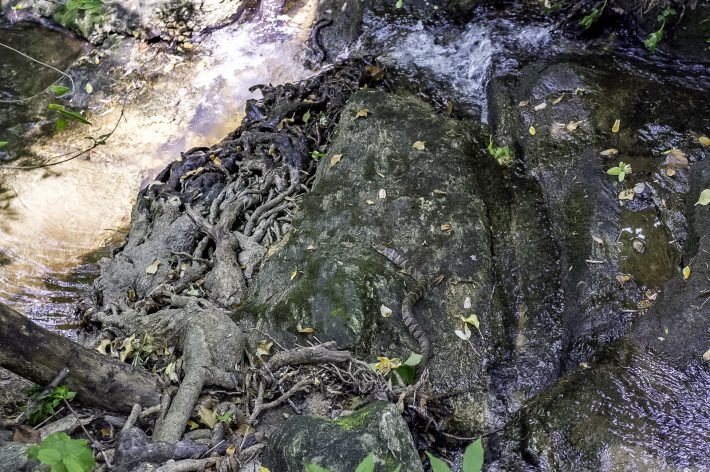
I try to reassure him when he says things like that, and today was no different: “Buddy, to him, you’re a huge, terrifying monster!”
“But how? They’re packed with venom.”
“They don’t know that.”
“They don’t?!” The Boy was having trouble comprehending that. How can a snake be so deadly and yet not realize its power?
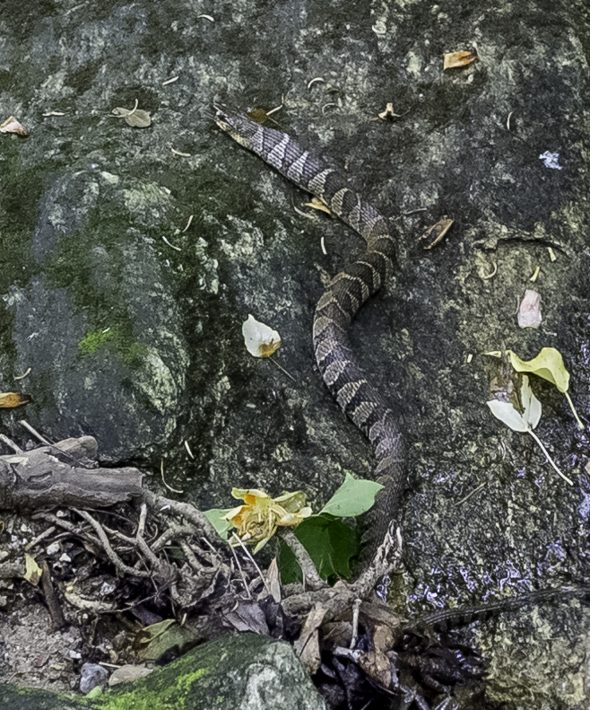
I’m no snake expert to say the least, but I was fairly sure it wasn’t a venomous snake. The eyes, the shape of the head, its markings. But what about those markings? They’re awfully close to a cottonmouth’s markings except the dark triangles rest fat side on the belly of the snake — the whole pattern of this snake inverted.
Still, no need to take chances. We left the snake to its dinner and headed home.
I did a little research when we got home and came to the tentative conclusion that it might be a plain-bellied water snake, which is not venomous. Still, it got me thinking: what if it had been a cottonmouth and the Boy was bitten? Cottonmouths don’t have venom that kills humans, but it can make one very sick. But what about a little boy? We’ve tromped about those rocks where the snake was eating dinner countless times.
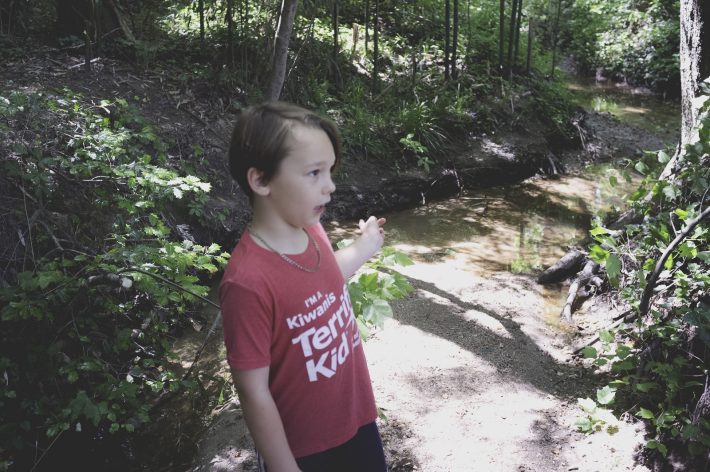
It was another one of those realizations that threats lurk around us constantly and we’re mostly unaware of them. Our current global reality is a reminder that we are far from the top dogs on the planet in a number of ways, and yet we’re the only species that could burn the whole thing to a radioactive cinder.
While I was cooking dinner over an open flame in our new fire pit, I listened to The Scarlet Letter again, and once again, an echo of the day:
Much of the marble coldness of Hester’s impression was to be attributed to the circumstance, that her life had turned, in a great measure, from passion and feeling, to thought. Standing alone in the world,—alone, as to any dependence on society, and with little Pearl to be guided and protected,—alone, and hopeless of retrieving her position, even had she not scorned to consider it desirable,—she cast away the fragments of a broken chain. The world’s law was no law for her mind. It was an age in which the human intellect, newly emancipated, had taken a more active and a wider range than for many centuries before. Men of the sword had overthrown nobles and kings. Men bolder than these had overthrown and rearranged—not actually, but within the sphere of theory, which was their most real abode—the whole system of ancient prejudice, wherewith was linked much of ancient principle. Hester Prynne imbibed this spirit. She assumed a freedom of speculation, then common enough on the other side of the Atlantic, but which our forefathers, had they known it, would have held to be a deadlier crime than that stigmatized by the scarlet letter. In her lonesome cottage, by the sea-shore, thoughts visited her, such as dared to enter no other dwelling in New England; shadowy guests, that would have been as perilous as demons to their entertainer, could they have been seen so much as knocking at her door.
Two hundred years had passed from the events of the book to the narration of the book, and in the meantime, the country had grown a little less Puritanical and a little more tolerant. Hawthorne seems to see some hope in this. Perhaps we all should
Today was a somewhat low-key day. We went for a walk or two; we did a little work around the house; K led an in-house Mass substitute for the kids. But overall, it was a very lazy day.
In the morning, I took E on a walk with the dog. Well, I was planning on going alone, but he tagged along anyway. I was glad to have him.
“I want to hear the car honking!” he proclaimed, so we went back to the neighborhood where I’d heard it last week.
“Why do they do that?” he asked.
Why indeed. What’s the point of all those “amens” and “hallelujahs”? I think it has to do with social bonding. It’s like Catholics kneeling and standing and praying together, like Miloszcz said. I wanted to say, “It makes them feel good,” but I didn’t. And it probably isn’t all that simple, either.

Clover’s new ball
After the walk, I took care of a couple of little tasks left over from yesterday. I use construction adhesive to connect the landscaping timbers on which I mounted the composter to solid concrete blocks to give it a bit more weight. I wanted to make sure that, if when another flood washes through the backyard, the composter will stay put. (I also set it behind two trees, which will help break the flow of the water.) I used the rest of the adhesives on the fire pit, gluing pairs of bricks together to make it a little more solid but not completely permanent. (To be sure, I have no idea how long the adhesive can handle the heat in the fire pit before failing, so it might have been a waste of time. Still, I didn’t have anything else to do with the remaining adhesive.
There was witchcraft in little Pearl’s eyes, and her face, as she glanced upward at the minister, wore that naughty smile which made its expression frequently so elvish. She withdrew her hand from Mr. Dimmesdale’s, and pointed across the street. But he clasped both his hands over his breast, and cast his eyes towards the zenith.
He looks up toward the heavens, and we know what will happen: he will see something; he will hear something; he will have some revelation. What’s startling is the narrator’s take on this:
Nothing was more common, in those days, than to interpret all meteoric appearances, and other natural phenomena, that occurred with less regularity than the rise and set of sun and moon, as so many revelations from a supernatural source. Thus, a blazing spear, a sword of flame, a bow, or a sheaf of arrows, seen in the midnight sky, prefigured Indian warfare. Pestilence was known to have been foreboded by a shower of crimson light. We doubt whether any marked event, for good or evil, ever befell New England, from its settlement down to Revolutionary times, of which the inhabitants had not been previously warned by some spectacle of this nature.
From a modern perspective, what’s most interesting is the little side comment in the opening lines: “in those days.” Were the people of Hawthorne’s day any different? Are we any different? After all, it was the appearance of the Hale-Bopp comet that led 39 people to take their own lives.
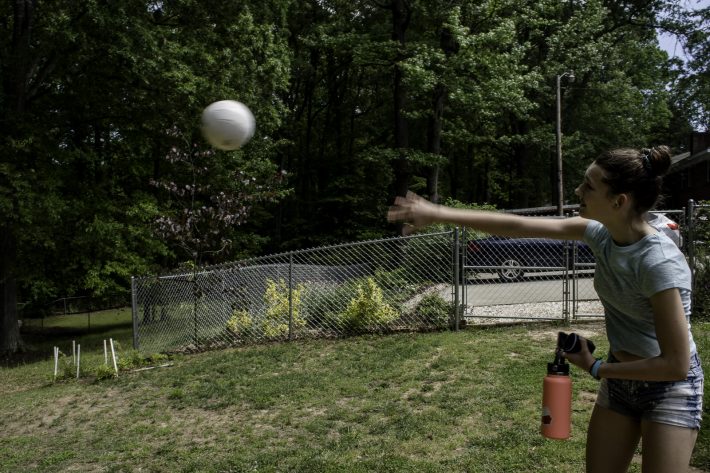
Which is a volleyball, much to L’s delight
It’s really one of the many God-of-the-gaps situations: we don’t understand this, therefore God. At some point, earthquakes or comets were the antecedents, the “this” which we don’t understand. Science comes along, explains it, closes one gap, and believers searching for evidence of God’s existence move on to other gaps. The complexity of DNA and the seeming impossibility of cosmology are the biggest gaps now, and they will not likely be closed for some time. Will science ever unravel those mysteries? I don’t know. I’m not worried about it. As someone put it, I would rather have questions I can’t answer than answers I can’t question.
Not seldom, it had been seen by multitudes. Oftener, however, its credibility rested on the faith of some lonely eye-witness, who beheld the wonder through the colored, magnifying, and distorting medium of his imagination, and shaped it more distinctly in his after-thought. It was, indeed, a majestic idea, that the destiny of nations should be revealed, in these awful hieroglyphics, on the cope of heaven. A scroll so wide might not be deemed too expansive for Providence to write a people’s doom upon. The belief was a favorite one with our forefathers, as betokening that their infant commonwealth was under a celestial guardianship of peculiar intimacy and strictness.
This problem is at the heart of all religious revelation: Joseph Smith discovered the plates that he translated into the Book of Mormon all by himself; Muhammed received his revelation alone, in a cave; Moses saw the burning bush all by himself; Mary was all by herself when the angel appeared. These revelations that started large religions later developed ways to deal with the problem that Hawthorne mentions (there were individuals who signed affidavits that they had seen Smith’s golden plates in person, for example). The smaller revelations, which lead to smaller followings, don’t: David Koresh alone heard God’s voice. At that point, short of working miracles, how do such people convince followers?
But what shall we say, when an individual discovers a revelation addressed to himself alone, on the same vast sheet of record! In such a case, it could only be the symptom of a highly disordered mental state, when a man, rendered morbidly self-contemplative by long, intense, and secret pain, had extended his egotism over the whole expanse of nature, until the firmament itself should appear no more than a fitting page for his soul’s history and fate!
Some people go further than this: David Pack, leader of a little sect of a few hundred to a couple of thousand followers, literally sees himself prophesied in the Bible. As such, he says things like “I have to be the most hated man on the planet,” which he claims in one of his sermons.
We impute it, therefore, solely to the disease in his own eye and heart, that the minister, looking upward to the zenith, beheld there the appearance of an immense letter,—the letter A,—marked out in lines of dull red light. Not but the meteor may have shown itself at that point, burning duskily through a veil of cloud; but with no such shape as his guilty imagination gave it; or, at least, with so little definiteness, that another’s guilt might have seen another symbol in it.
So it’s remarkable to me that Nathaniel Hawthrone, writing The Scarlet Letter 170 years ago, created such commentary. And I wonder what he would have to say about contemporary Evangelical worship, with its rock-concert feels and amen-ing. And what he would have thought about nearly-sequestered worshippers replacing it with claxons.
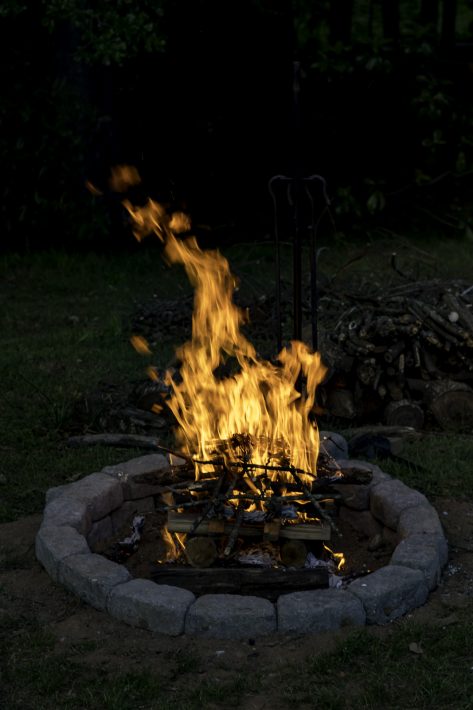
First fire in new firepit
This morning I had a little epiphany that I should have had months ago: “I’ll bet there are lots of audiobooks on Spotify.” I know — an obvious thought I should have had long ago, but I am sometimes a little slow on the up-take. I did a quick search and discovered that almost any classic one could imagine is there. Shouldn’t have been a surprise.
A month or so ago, I’d pulled from the bookshelf a novel I’ve been wanting on and off to re-read since college, The Scarlet Letter. I hadn’t really liked it a lot then, and I liked it even less in high school, but I reasoned that, being twenty-five years older than when I’d last read it, I might see something more in it.
For one thing, it’s been a different read because I finally made it through the opening section, “The Custom House.” When we read it in college, we were supposed to read that seemingly disconnected introduction but I didn’t. Today, I listened to it while I worked on our broken smoke, cleaning off the base blocks before screwing down the barrel that serves as the body of the smoker and then covering all the base in concrete. The job took about an hour and a half because I spent some time trying to pry off the leaking quick-connector on the hose before mixing the concrete, to no avail; the intro itself took considerably longer to complete.
And what of “The Custom House”? It’s a fictionalized attempt at making the story seem authentic by making it something of a found-footage type novel (mixing media there, I know). Was that novel (no pun in intended)? I really don’t know.
When the novel began, I was back in familiar territory. I’d initially forgotten about that opening, with the rose outside the jail door, but once that portion began, it was like hearing a long-forgotten-but-once-loved song again after twenty years:
[O]n one side of the portal, and rooted almost at the threshold, was a wild rose-bush, covered, in this month of June, with its delicate gems, which might be imagined to offer their fragrance and fragile beauty to the prisoner as he went in, and to the condemned criminal as he came forth to his doom, in token that the deep heart of Nature could pity and be kind to him.
This rose-bush, by a strange chance, has been kept alive in history; but whether it had merely survived out of the stern old wilderness, so long after the fall of the gigantic pines and oaks that originally overshadowed it,—or whether, as there is fair authority for believing, it had sprung up under the footsteps of the sainted Ann Hutchinson, as she entered the prison-door,—we shall not take upon us to determine. Finding it so directly on the threshold of our narrative, which is now about to[53] issue from that inauspicious portal, we could hardly do otherwise than pluck one of its flowers, and present it to the reader. It may serve, let us hope, to symbolize some sweet moral blossom, that may be found along the track, or relieve the darkening close of a tale of human frailty and sorrow.
While I was working on the smoker, the Boy was working to remove the last bit of flaking paint from the bench we brought from Nana’s and Papa’s to use by our firepit.
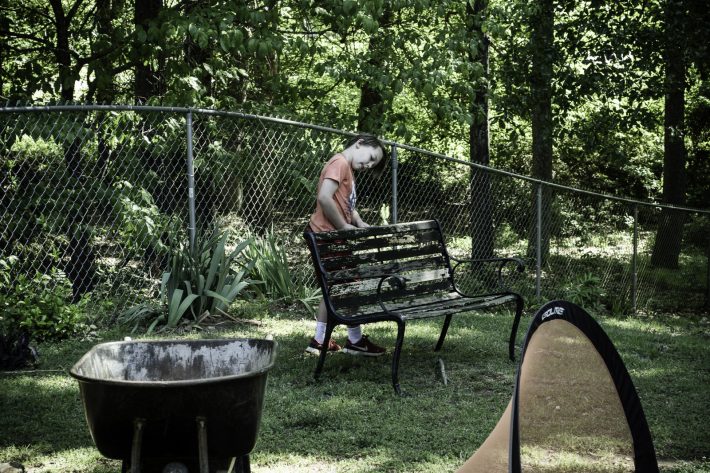
I went inside to get the drill and impact driver and by the time I came back out, he’d disappeared.
“It’s too hard!” he exclaimed. I think he understood that I expected him to get all the paint off.
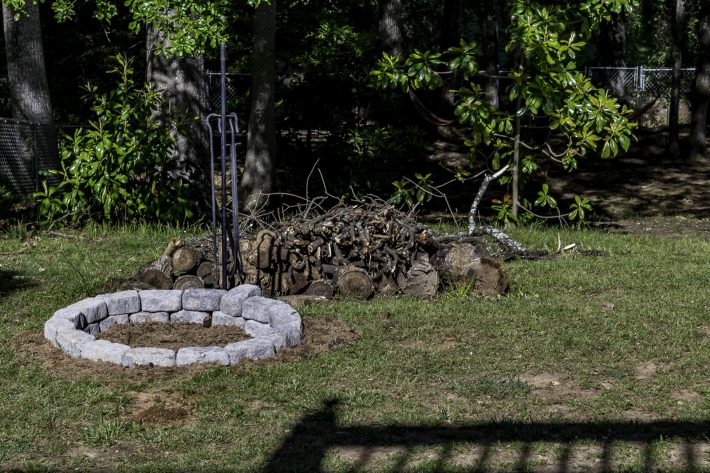
By the time I was ready to work on the next project of the day, the novel was introducing its heroine, Hester Prynne.
The young woman was tall, with a figure of perfect elegance on a large scale. She had dark and abundant hair, so glossy that it threw off the sunshine with a gleam, and a face which, besides being beautiful from regularity of feature and richness of complexion, had the impressiveness belonging to a marked brow and deep black eyes. She was lady-like, too, after the manner of the feminine gentility of those days; characterized by a certain state and dignity, rather than by the delicate, evanescent, and indescribable grace, which is now recognized as its indication. And never had Hester Prynne appeared more lady-like, in the antique interpretation of the term, than as she issued from the prison. Those who had before known her, and had expected to behold her dimmed and obscured by a disastrous cloud, were astonished, and even startled, to perceive how her beauty shone out, and made a halo of the misfortune and ignominy in which she was enveloped. It may be true, that, to a sensitive observer, there was something exquisitely painful in it. Her attire, which, indeed, she had wrought for the occasion, in prison, and had modelled much after her own fancy, seemed to express the attitude of her spirit, the desperate recklessness of her mood, by its wild and picturesque peculiarity. But the point which drew all eyes, and, as it were, transfigured the wearer,—so that both men and women, who had been familiarly acquainted with Hester Prynne, were now impressed as if they beheld her for the first time,—was that Scarlet Letter, so fantastically embroidered and illuminated upon her bosom. It had the effect of a spell, taking her out of the ordinary relations with humanity, and enclosing her in a sphere by herself.
The scarlet letter is a double symbol: it is a symbol to the characters in the novel of Hester’s sin and depravity as well as a symbol for Hester herself of her resistance. For readers, it’s both these things, but it also represents the hypocrisy of Puritans, among other things.
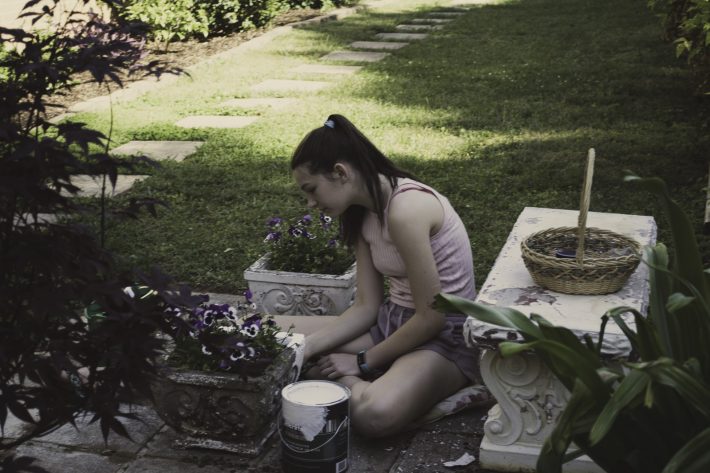
At this point, I’m about halfway through the novel, though completely through the day’s projects (as is L). More thoughts coming later, I’m sure.
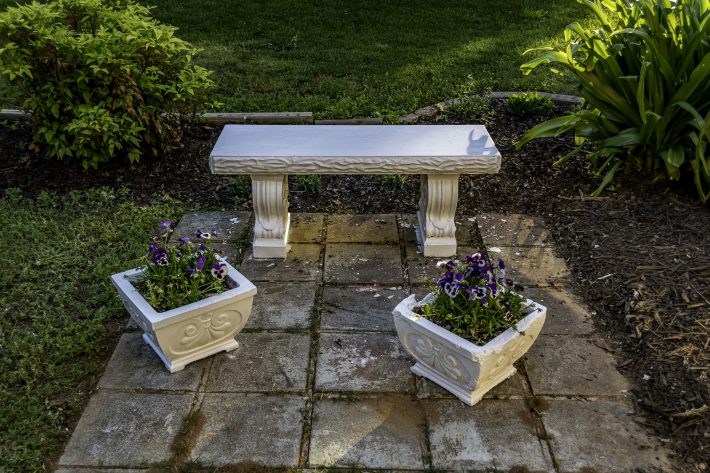
Some years ago, there was a little flu epidemic here in the upstate. I’d forgotten all about it until I read the entry from the “Time Machine” widget at the bottom of the page.
I wrote,
Students come running into the classroom, desperate not to touch anything but the bottles of hand sanitizer that they’re most eagerly sharing amongst themselves. They sit down and put their hands in the air as if they’re being held up at gun point. They open doors with their feet and they laughingly refuse to touch the copies of Much Ado About Nothing we’ve been using in class.
A quick look around the room confirms my suspicions: I won’t be able to accomplish anything without dealing with this first.
That was 11 years ago now, and it seems so insignificant compared to what we’re living now. Our flu outbreak affected a small part of the state; this viral reality is affecting the entire world. Magnify something and its significance seems often to increase exponentially like the curve of new cases in many places. That curve seems to have reached its summit in some areas. Everyone seems eager for that to be the reality, though. Do we have the maturity and self-control needed to keep the curve from turning back upwards again? I don’t know.
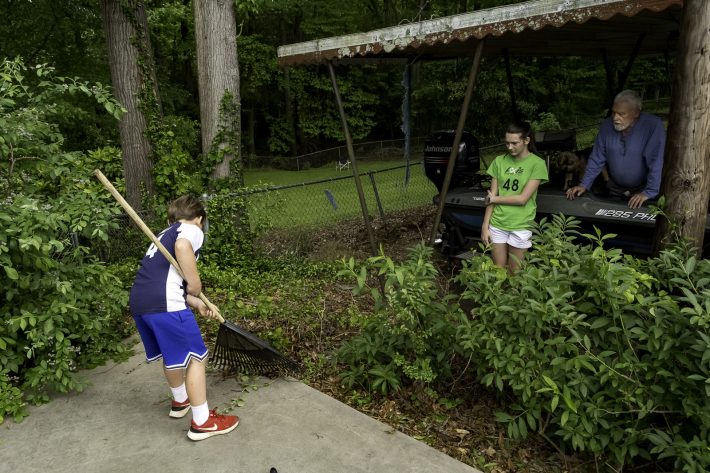
I know the kids have simply settled into the new rhythm and joke about it. The Girl is having an easier time than the Boy in some ways because she’s in more constant contact with her friends through Facetime — they sometimes just leave it on while they’re doing other things, as if to have a companion near.
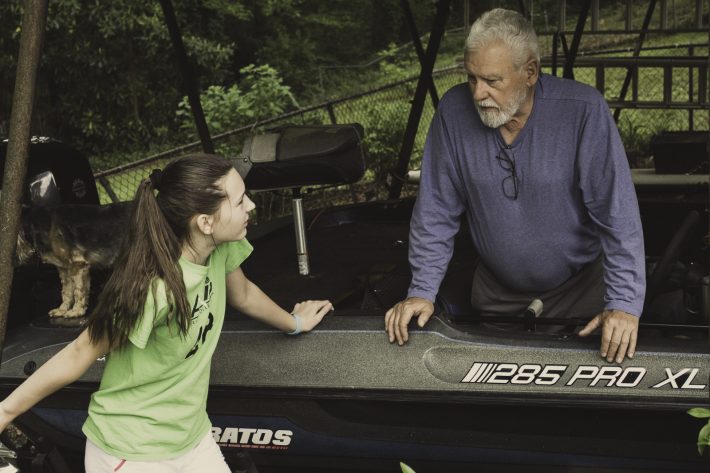
The Boy gets to see his friends daily with their whole-class Google Meet. (An aside: It’s amazing the difference between elementary students and middle school students when it comes to these online meetings. When E’s class meets, almost everyone is there; when my classes meet, almost no one is there. I suppose there’s more parental involvement in the younger children’s lives.) Still, that’s hardly a substitute for their usual day together, which includes a bit of down-time to talk and of course recess.
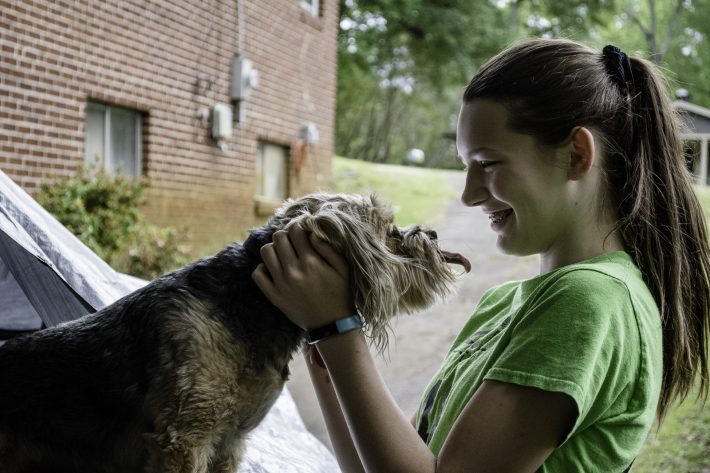
Another entry from the nostalgia widget:
I wrote,
My reaction over the years has changed. In the past, I was just trying to survive at this point in the year. Perhaps that was because of a lack of clear and clear-headed goals for students; maybe that was a result of my inexperience and ineffectiveness; possibly that was because I had some exceptionally challenging students. Or perhaps it was all that and more. At any rate, I find myself eager, after a short break, to begin again. A sufficient “short break” in this case would be about three weeks or so, but I’m fortunate that we get about four times that.
That short break I was referring to was a hypothetical three-week summer break before getting back to school. I was suggesting that perhaps the whole summer is necessary. Indeed, it’s a luxury. But now — we’ll have a break from mid-March until mid-August, and even then, I doubt we’ll get back to normal.
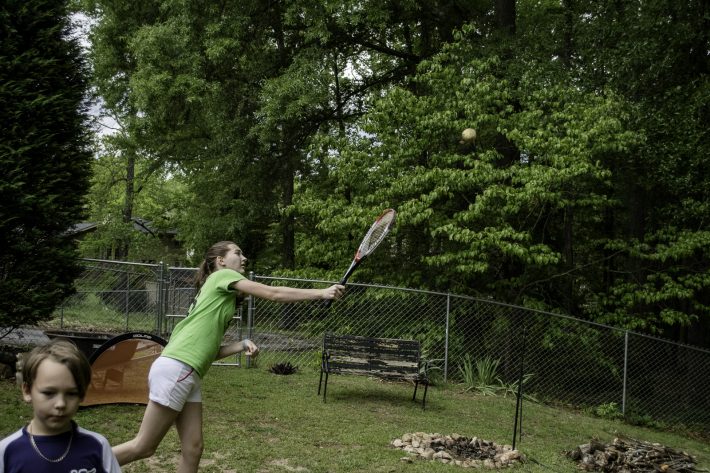
In the end, “normal” will have to shift. Our state superintendent is already talking about possibly going to school in shifts to maintain an appropriate distance. I’m assuming that would mean dividing the eighth-grade student body in half: group A goes Monday and Wednesday and group B goes Tuesday and Thursday. Friday? Who knows. Who knows anything at this point. It’s odd that the longer this stretches out, the more the uncertainty in some sense.
“Daddy, let’s play chess!” Normally, I wouldn’t say no to this. I enjoy sharing chess with the kids, so when the Girl suggested we play this afternoon, I was more than willing. She went out on the deck, where Papa was taking his afternoon fresh air, and began setting up the board. And then I had the idea.
“Why don’t you ask Papa if he‘d like to play?” I suggested.
Papa used to be obsessed with chess. He taught me how to move the pieces and then nothing more. This was because, by the time I came along, he’d given up chess. It was taking over his life, he said. He was lying in bed thinking of lost games. I know that feeling. So I wasn’t sure if he would play a game with her. But of course, I knew he would — he’s not going to turn down his granddaughter.
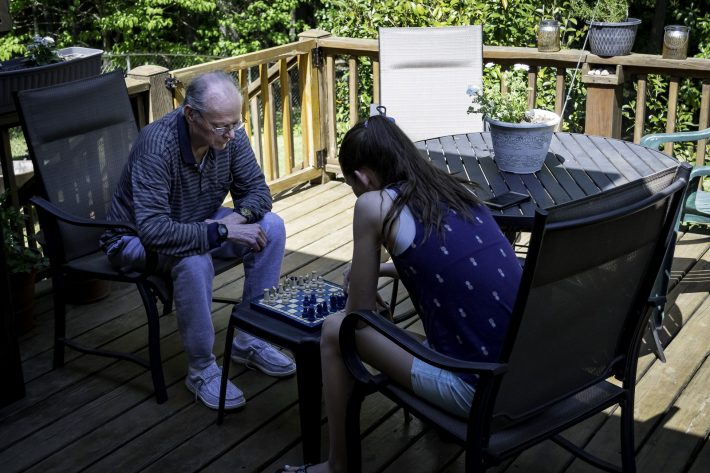
It was an up and down game. I sat by them, reading Paul Auster’s The Locked Room, looking over every now and then to see how things were going. Papa was up; L was up; Papa was up; L was up. It was a very uneven game until the end, when L just fell apart.
During all this, E was Facetiming his best friend from school. They were talking about Pokemon, baseball cards, favorite cartoons — second-grader stuff. He’d suggested it to his friend while the whole class was having a Google Meet in the morning.
“E, do you have a question?”
“Yes! I want to ask N when he can Facetime because it’s been ridiculously long since the last time.” And so we set it up for this afternoon.
Once he came outside and saw the chess game, though, he wanted to play Papa.
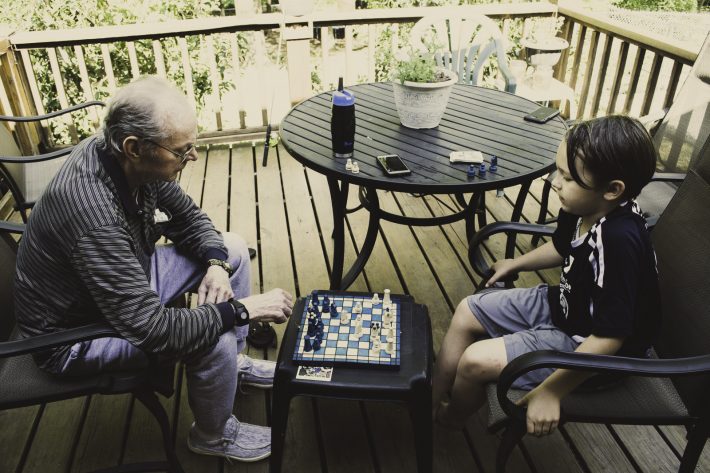
Things didn’t go much better for him — Papa went undefeated today. Which was good for Papa.
In the evening, L decided she wanted to bake cookies and try a formula for homemade Playdough. One might think this is something that would thrill parents, but K and I have learned: the Girl is not the best cleaner. She talks fast, walks fast, and cleans fast, which means she cleans poorly. It’s a thirteen-year-old thing, I’m certain. Tonight was no different. So I called her back down to the kitchen and pointed out the little things she’d missed.
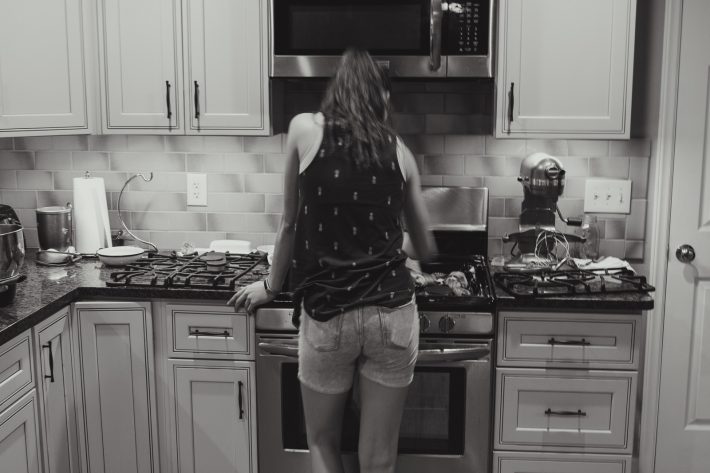
She fussed; she argued; she pouted. But in the end, she did it.