learning

Symmetry

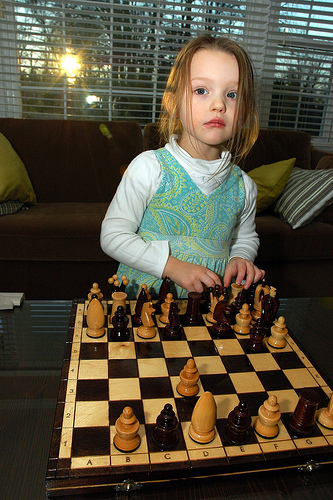
The Girl enjoys playing with the chess set I brought back from Poland. (If I remember correctly, a gift from Nana and Papa, when they came for our wedding.) She has invented her own little version that involves us using single pieces to push our opponent’s single piece around the board for a few moments. She loves the game, but I’ve yet to discern the sublime objective.
DSC_0875

Occasionally she just gets all the pieces out and puts them on the board. There’s usually a pattern: black pieces on black squares; white pieces on white squares.
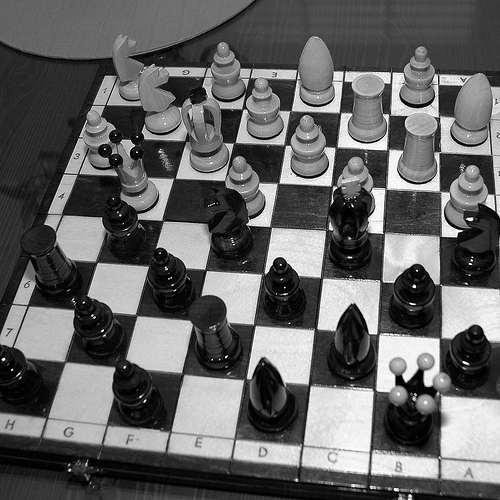
DSC_0878
A perfectly impossible position, but notice: the white king is in check, forking the queen.

It’s another example of the similarities between toddlers and older children with autism: pattern, pattern, pattern. Everything has its place, and to disturb that order is to invite chaos, in more ways that one.

We’re more like that than we’d like to admit. A colleague once commented that we’re all on the autism spectrum; it’s just that some of us have very mild cases. Mine manifests itself in my obsession with seeing patterns in floor tiles and then feeling a compulsion to walk in accordance with said patterns.

That’s probably why I looked at L’s work, smiled, and said proudly, “Very symmetrical. Well done.”
New Games

I never really liked card games as a kid. I guess Uno was alright once in a while, but that doesn’t really count as a real card game. Since Windows hadn’t yet come out when I was a kid, I never learned to play Hearts. Spades was popular among some friends, as was — oddly enough — euchre, but I just didn’t get it. What was the point? (Bridge, of course, was out of the question then; now, it’s the only card game I truly enjoy.)

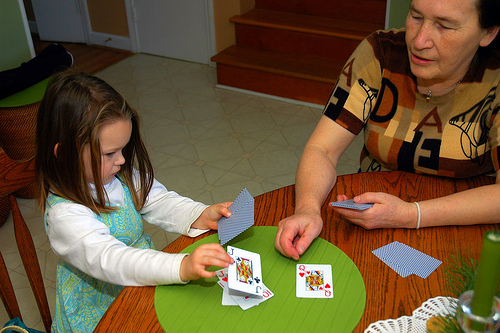
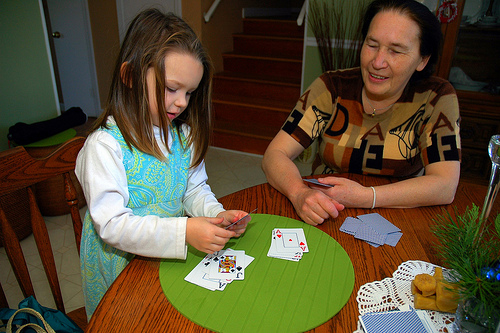
L learned a new game today — “learn” being used in a most generous way. She didn’t quite get the point; she couldn’t quite understand why Babcia took the upturned cards for herself sometimes and sometimes gave them to her.

DSC_9909

I can’t remember what this particular game is called in English. In Polish, it’s “wojna” — war. Perhaps it’s the same in English. I can’t really recall. (Another one of those odd circumstances in which I know the Polish but am unsure of the English.)

DSC_9914

Most importantly: the Girl enjoyed it (for a few minutes).

“Let’s play it again!” she chimed again and again.

Still in English, though…

Balance

“Shhh! There’s a monster in there!” says L as we walk toward her room. She’s at that age where she sees monsters, tigers, and bears everywhere. A “smoky, smoky dragon” is a common visitor at night, and right after a bath, an alligator — simply named Alligator — comes looking for her as she hides under her big bath towel. Saturday mornings she likes to jump in our bed (even if it’s made up — she’ll willingly unmake it) and hide under the covers.

“Shhh, shhh, shhh!” she’ll proclaim. “Monster’s coming!”

I play along sometimes, but it creates a problem: she gets genuinely scared sometimes, and it’s because there’s an alligator under her bed or a dragon right over there, in the corner. I reassure here that there’s no such thing is monsters, but it’s difficult to do if I’ve just been playing along with her imagination earlier in the evening.

It’s difficult to balance her developing imagination with her developing fear.

Will she learn there’s no such thing as dragons before she learns Santa doesn’t exist? I’m helping create both illusions, feeling slight pangs of guilt about it, and wondering if it’s all avoidable.

Memorex

L has an absolutely astounding memory. She can “read” many, many books — at least fifteen, I would say — from memory. She turns the page and quotes almost verbatim the text on the page.

And she corrects me.

“‘That’s what you said yesterday,’ shouted elephant,” I read from one of L’s favorite books, Goose Goofs Off.

“No, Tata! Elephant snorted!” comes the reply.

The Bad Hat

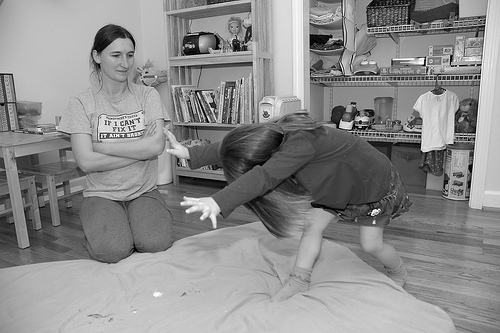
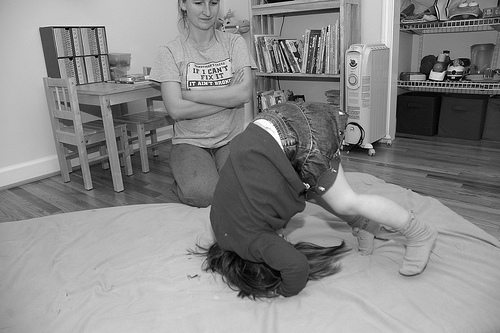
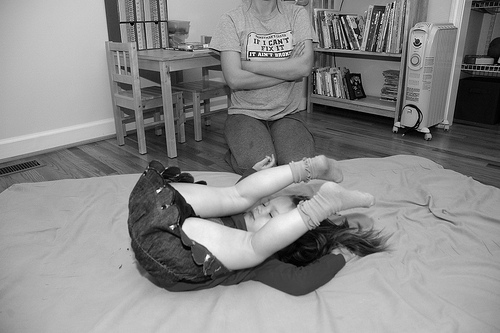
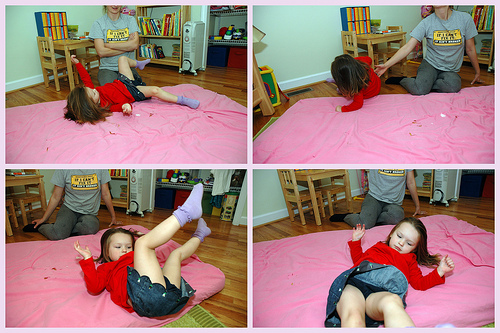
That Brooke — she’s a bad influence. At school, she teaches L to disregard all safety, to live on the edge, to do somersaults.

DSC_8355

DSC_8356

DSC_8357

There were a handful of less-than-perfect landings for each perfect one.

091015_flips

Outsourcing

For the first several months of L’s life, K and I could be fairly sure that everything she knew was something we’d taught her, directly or indirectly. Sometimes she would imitate us with prompting, sometimes without. There were few moments that prompted comments of “Where’d she get that?” and the like.

When she started spending time with other kids and adults at daycare, the gradual shift began. Slowly she picked up as much at daycare as at home; then, daycare overtook us.

Now she comes home with songs we’ve never heard:

Twinkle, twinkle traffic light…
Red means stop
Green means go
Yellow means very, very slow

She comes home with skills we haven’t touched on: tracing numbers and letters is the most recent.

These things come from the teacher, who told K this morning during the first of many parent-teacher conferences, that L is a “good old-fashioned girl” with good manners and a strong sense of right and wrong.

DSC_8285

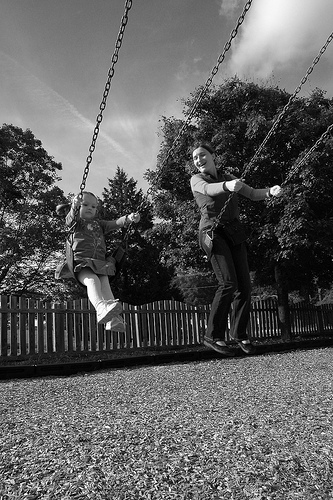
Other things come from friends. Brooke taught her how to swing by herself.

DSC_8289

She’s growing more and more independent.

DSC_8298

Now, she knows she can get her information from other sources, that she’s not dependent on us mentally any more than she is physically.

DSC_8303

Which, in reality, is still quite comforting: still many years to go. It comes in mercifully slow steps.

Learning

He came up to me in the hallway between classes, somewhat visibly upset. We’d just had a meeting with the principal in which he explained his very high expectations for everyone, especially including dress code. This young man was soon thereafter working on tucking his shirt in when the charge of “sagging pants” was made.

“I got a referral for that,” he said. “Can you believe that?”

It was one of those moments that I hide my true opinion.

“Bad luck, I guess.” Probably not terribly fair, I thought. He seemed to handle it like an adult, though. He was irritated, but not furious, and his demeanor told me that he’d managed to keep his cool during the encounter.

“So what did you learn from that?” I asked.

“Nothin’. There’s nothing I can learn.”

It’s the challenge I face with so many of my students. See the world around you as the Ubiquitous Classroom. Understand that the mindful person can learn something — about herself, about the world, about her influence on others — from just about every action and interaction.

I really shouldn’t be surprised if they haven’t learned this: they’re thirteen and I, almost three times their age, still forget to be on the lookout for the hidden lesson.

Hit or Miss Language

At school, everyone is “Miss.” Miss Karen. Miss Cathy. Miss Deborah. Miss Brenda.

Miss Cathy — L’s favorite — works in Toddler I. L no longer sees her on a daily basis, but her eyes light up when she sees Miss Cathy coming.

Miss Karen, Miss Deborah, and Miss Brenda work in Toddler II, where L spends her days now.

I wondered whether L thinks “Miss” is just part of their name, but it’s become obvious that L has separated the “Miss” from the name. She understands it as a prefix, but she still doesn’t understand its significance. It’s a term she uses with individuals she really likes.

Hence, I am often “Miss Tata” now. K is “Miss Mama.” Our cat, “Miss Bida.”

Fore!

The Girl is learning to golf.

School's In
1/60, f/5, 10 mm, flash off ceiling

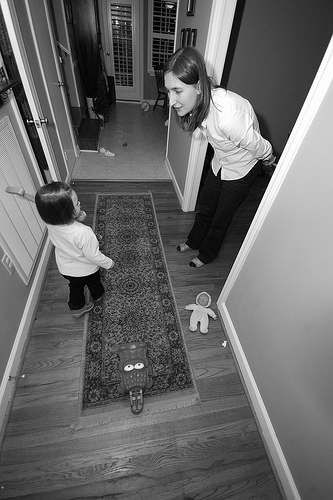
The crocadile sits at the end of the rug, patiently awaiting its feeding, but the Girl is more interested in directing everyone else to shoot. And of course Baby gets pointers, too.

Attention Span

At an in-service a couple of weeks ago, we received the little research tidbit that middle-school-aged students have a maximum attention span of some eleven minutes or so. The implication — made very explicit by the presenter — was that our lessons should have activity changes every fifteen minutes or so. You know, in order to keep students engaged and focused.

No mention was made about trying to expand and stretch students’ attention span and ability to stay on task for more than a relative nanosecond. And the notion that we could just say, “Look — today you’re just going to have to focus on this for more than a few minutes” was implicitly ruled out.

Which is good, because in high school, college, and beyond, all you really need is an ability to focus for about fifteen minutes in order to be successful.

Turning Heads

I’m constantly amazed at all the things L has to learn, and how quickly she learns them. She learned those things waving around in front of her face were hers, and then she learned to control them. She’s figured out that those growths from her lower body are hers, too, and she’s learning to control them too.

Both those examples are very concrete.

Lately she’s been getting into the abstract.

We noticed last night, for instance, that she’s figured out a major fact about the world around her: it generally stays in the same place, and it’s she that moves. She was watching K load the dishwasher, and I turn around 180 degrees. She quickly turned her head and continued watching. And it took me just a couple of seconds to realize the significance of what she’d done. I turned back around again; she turned her head again, and giggled when K kissed her cheek.

Learning to say “Okay”

For many of the young people in the program where I work, one of the formal goals that forms part of the forest of paperwork about them is “Learn to say “Okay.'” What that means in practical terms is fairly simple: many of them are unable to accept criticism — broadly defined as anything even apparently critical of them or their actions — of any kind from adults.

A scenario from not so long ago illustrates how many things are going on that can make it difficult for someone just to say, “Okay.”

Two boys, in class, are doing something disruptive. Fidgeting with something, throwing it back and forth (maybe a jacket?) or something. I couldn’t see clearly what it was, but it caught my attention and I deemed it a distraction.

“Hey, guys, stop doing that, please.”

“Doing what?” one asks simultaneously with the other’s plea of innocence: “I wasn’t doin’ nothin’!”

Now it really doesn’t matter what they were doing. It really doesn’t matter if they were doing anything at all. The best response to bring the whole exchange to an end, to prevent it from escalating into something more serious, to ensure not getting into trouble, is to say, “Okay.”

“If you have a problem with that,” we tell them, “you can talk to the teacher afterward. If you don’t know exactly what the teacher is asking you to do, you can ask for clarification after saying “Okay.’ But getting defensive, taking it personally, exaggerating it into a personal affront will only make the situation worse.”

And so going back to the above scenario, I reminding the boys that one of the skills they’re working on is simply saying “Okay” and moving on.

“I ain’t sayin’ “Okay’ to something I didn’t do!” one replied indignantly.

“Why not?” I asked. “In saying “okay’ you’re not admitting to guilt. You’re not doing anything other than acknowledging that you heard and understood what the person in authority — be it a teacher or not — is saying.”

“But I didn’t do nothin’!” he protested.

“But that doesn’t matter.” I responded. “In protesting it, particularly in the manner you’re doing now, you’re not doing anything to help your situation.”

“Are you telling me that if someone accused you of doing something…”

“Whoa, wait — I’m not accusing you of doing anything. I simply asked you both to stop. If you weren’t doing anything, then clearly I wasn’t talking to you. Even if I was addressing you alone and said “Stop doing that” and you were behaving perfectly, the best response is to say, “Okay’ and move on.”

“Move on?! You’re the one making an issue of this” he said, voice pitching upward into a virtual screech, eyebrows raised just enough to say — inadvertently or purposely — “You’re an idiot for saying that.”

“No, I’m using this moment to remind you of a skill you’re working on and to try to get you to practice it.”

The boy couldn’t accept that saying “Okay” even if you’re completely innocent is anything more than an admission of guilt. And to prove his point, he brings up a most fascinating example: “So you’re sayin’ that if you walking down a street and cops come up to you and say, “You look like this guy who just robbed a bank,’ and arrested you, that you’d just say, “‘Okay.'”

The discussion is starting to get less and less productive as we range farther and farther off topic. Or are we off topic? Is this how the boy equates all these things? I decide to play along.

“Yes, I would. Or at least I hope I’d have a cool enough head to say that.”

“But you didn’t do it. Are you saying that if they said, “You robbed this bank,’ that you’d just say nothing, that you wouldn’t tell them you’re innocent? They’ll take you to jail and what — you’ll end up spending ten years in jail for something you didn’t do?!”

Right here, though I suspected it moments earlier, I realize the young man didn’t have a firm grasp on the workings of our criminal justice system. And another thing begins dawning — we’re really getting off track. Does this help the young man understand the situation? Is he just trying, like so many of the boys do, to get me so wrapped up in a discussion argument exchange that it’s just a matter of whoosh! blink! and the whole class is over? I decide, somewhat against my better judgment, to continue.

“Just because they arrest me doesn’t mean I’ll be spending ten years in jail. There’s a trial first, and in the meantime, I can be released on bail. But think of what they say, what you hear on TV, every time they arrest someone.” Almost together we recite the Miranda warning. Then I continue, “Now if I’m an idiot, I’ll start blathering on about how I’m innocent and how I didn’t do anything and then, in court, that will be used against me, because the irony is, it makes me look guilty. If I’m smart, I’ll shut my trap completely until I can get a lawyer.”

“But if you didn’t do nothin'””

Especially if I hadn’t done anything,” I replied.

Finally things are winding down, and a boy enters from the other group.

“Hey, Mr. S, let’s ask him if he’d just say “okay.’ ‘Eric, if someone framed you.'”

And now everything is mixed up. Nothing is as it started. We’re no longer talking about whether or not saying “okay” helps you in a situation even if the request is relatively arbitrary; we’re no longer talking about whether or not saying “okay” is an admission of guilt — we’ve moved off into the netherworlds of arbitrary, six-sixty-degrees-of-separation tangents that suck up time and accomplish nothing.

Or is it simply that he doesn’t understand what I mean? Are all these scenarios that we’ve been bouncing off of each other identical to him?

In the end, he simply says, “Well, if that’s a skill, I guess it’s a skill I won’t use.”

And I think, “Okay — we’ll try again tomorrow.”

Politely Declining (Or “Why Polish is really a nightmare”)

I recently wrote about Polish plurals and the strange fact that there are two forms.

That was only the tip of the iceberg. The easy part of the language. Today — how to make a Polish sentence meaningful. Or “how to make sure you say ‘The dog bit John’ rather than ‘John bit the dog.'”

In English, word order is an essential grammatical element. We know in the sentence “The dog bit John” that the dog did the biting, and not John, from the position of “The dog” in the sentence.

Polish, however, is an inflected language and that means that word order has no effect on the meaning of the sentence. In Polish, you could just as easily order the words, “John bit the dog” without any change in meaning. For that matter, “Bit John the dog” and “The dog John bit” are possible as well.

So how are they differentiated? By their ending. In Polish (in all highly inflected languages) you indicate a word as a direct object, an indirect object, a subject, or whatever by adding a suffix according to a given pattern.

An example may help. Imagine in English that subjects ended in “-doj” and direct objects ended in “-aldi.” Our sentence would then look like this: “The dogdoj bit Johnaldi.” In that case, “Bit Johnaldi the dogdoj” would have the same meaning, as would the following:

  • “Johnaldi bit the dogdoj.”
  • “Johnaldi the dogdoj bit.”
  • “The dogdoj Johnaldi bit.”

English does indeed have a bit of declension. Some examples:

  • “-ed” to a verb to make it past tense
  • “-s” to make a noun plural
  • “-ing” to make a verb a gerund (i.e., “Swimming is a healthy activity.”)
  • “-er” and “-est” in the comparative and superlative forms
  • “-‘s” to denote possession (i.e., “Samantha’s mother left for Switzerland.”)

By and large, though, English is not an inflected language. “The dog bit John” and “John bit the dog” are very different sentences as a result.

Thanks to Oliver for the correction. Originally I’d mistakenly claimed that German has five cases.

An inflected language uses cases to differentiate functions and forms. Greek and German have four cases.

Polish has seven:

  • Nominative case — The subject of a sentence
  • Accusative case — The direct object of a positive sentence
  • Genitive case — To denote possession (i.e., “That’s George’s bag.”)
    • The direct object of a positive sentence for some verbs
    • The direct object of a negative sentence
    • For quantities of five and above.
  • Locative case — To specify location after certain prepositions
  • Instrumental case — To denote the method or tool used to do something
  • Dative case — The indirect object of a sentence
  • Vocative case — Used in addressing people (i.e., Did you take it, George?)

These changes even occur to names, providing a clear example of the complexities of Polish grammar. We’ll use “Bill Clinton” as a direct object, indirect object, object of a preposition, etc, and see just how insane Polish is:

CaseExample
Nominative caseTo jest Bill Clinton. (This is Bill Clinton.)
Accusative caseLubię Billa Clintona. (I like Bill Clinton.)
Genitive caseSzukam Billa Clintona. (I’m looking for Bill Clinton.)
Locative caseMyślę o Billu Clintonie. (I’m thinking about Bill Clinton.)
Instrumental caseRozmawiam z Billem Clintonem. (I’m talking with Bill Clinton.)
Dative caseDałem Billowi Clintonowi. (I gave Bill Clinton… s’thing.)
Vocative caseWzia…łes›, Billu? (Did you take it, Bill?)

Because of declension, the word order doesn’t make any difference. For example, if you want to stress that you gave it to Bill as opposed to George, you could say, with the proper vocal inflection to stress it, “Billowi dałem.”

But learning Polish grammar is not simply a matter of remembering some endings, for all nouns in Polish have a gender (as in German, French, Spanish, etc.), so you have to learn a hell of a lot of endings.

  • Three genders
  • Seven cases
  • Singular and plural

So when you utter a Polish noun, there are forty-two possible endings, depending on whether it’s singular or plural, masculine, feminine or neuter, and whichever case is necessary.

And the exceptions, for some forms are exactly the same except in given cases.

  • The accusative plural and the nominative plural of neuter nouns are identical, but feminine and masculine nouns are different.
  • The female genitive and locative cases are the same for singular nouns but not for plural nouns.

Aside from that nonsense, there are various considerations for exceptions. Is it a masculine alive noun? Does it end in “a”?

Good Morning!

While hurrying to the store across from the church I encountered one of my students, pulling/leading two cows up the road, presumably taking them into the barn for the evening. I waved at him, smiling. He grinned and waved back. As I neared the shop I noticed another student riding toward me on her small bike. I could tell that she was getting ready to greet me. A smile shot across her face and she said, “Good morning!” at 5:55 p.m. “Hello!” I said in response. If these two encounters are indicative of what these two years will be like, then I can only say that I look forward to them with great anticipation.

I had six lessons. I was so very tired when the last one finally rolled by. I think things went rather well, but that didn’t change the fact that I was hardly able to stand at the end of the day. I hope things at least maintain for the next two years. Deterioration of class morale could be quite a blow to me, but I think things will only get better.

Realities

We had a staff meeting today. Of course, I understood next to nothing that was said, but Danuta gave me the scoop after it was all said and done. Basically, nothing has changed. We might have a schedule by Thursday. This is all truly amazing. We still don’t know if the Ministry of Education will let the school add German to the curriculum! We have less than a week before school starts: Where are we going to get a German teacher on short notice? In addition, we still don’t know exactly how many English teachers we will have. I cannot believe how unorganized (rather, how unfinalized) everything is at this, the last moment! One of the classes hasn’t even been divided into language classes yet. Does anyone know what’s going on? It certainly doesn’t seem that way.

Now, on to the adventures in Polish banking. Danuta and I went to Jabłonka this afternoon after the conference only to learn that I don’t have the proper kind of documentation to get a savings account. When can I get that documentation? As soon as the Ministry of Education (and/or Labor) provides us with the proper work permit. And only they know (and I doubt they do) when that stuff will be ready.

I am beginning to become frustrated with the ways of this country. The bank problems, the scheduling problems, and the fact that several stores close at three in the afternoon combine to make me just a little annoyed. I am at my site and still, I know nothing! How is this possible?

Additionally, I am scheming about how I can get a bike, for this place is too long to walk it and the buses are much too infrequent. I’ve two methods in mind but I don’t know which would be best. Also, I don’t know what (if any) PC channels I would have to go through. Whom would I have to inform, if anyone? “Local solutions to local problems,” said E. Timothy Carroll – I shall take that to heart. Of course, one small problem at this point is how to get the money I will need for this small “project.”

One last thing: I accidentally bought an enormous block of cheese today. I could only imagine what the poor clerk thought. And then there’s the whole old/new złoty issue . . .

Training Woes

Another tech session, another endurance test. I cannot understand why we do such things. It is such an incredible waste of time – it could be used in so much more effective ways. But of course I really shouldn’t complain. Still, time spent working on lesson plans and/or our syllabi would be much better. This is especially true now that we’re both teacher and learner – we have so much stuff to do that ends up being done at home. So we end up being at school nine hours a day and then we go home and do homework and lesson planning.

One interesting thing about Polish students of English and the future tense: One way to form the future tense is “will” (future tense of by ) plus past tense. So a literal translation will produce “I will went.” They are simply applying a Polish grammatical structure on English, just as we must often do the same in reverse.

An obvious observation: There is not an action which cannot be described in words. The writer’s job is to find those elusive words.

I must teach two lessons tomorrow and though I am hesitant to do it, I am doing a final lesson on past progressive and simple past. I will be using a modified textbook activity which I think will really help to clear up any lingering misunderstandings. I’ll also be doing a lesson on modals.

We had TEFL session today on teaching with music and the final two pieces were Carmina Burana and the second movement to Górecki’s Symphony No. 3. The presenter seemed somewhat impressed that I recognized the pieces and floored when I mentioned that I have four Górecki CDs (I have five but I forgot about one). It was a triumphal moment to name those tunes in class . . .

Perfectly Imperfect

Just when I thought I was getting the hang of this Polish thing, BOOM!! We begin perfective/imperfective [verb forms]. So that means in many cases we have to learn a second verb for the same damn thing. Not only that, but the conjugation patter of many of the past tense perfective verbs are incredibly irregular. Not only is there an ending change from masculine to feminine – the stem sometimes changes! Oh joy.

Sitting in class I experienced total overload. Everything the poor woman was saying simply bounced off of me. I might as well have walked out of the room.

For the first four weeks I’ve been asking for verb conjugation information. “No, not now,” everyone told me, “It’s not time.” So now, in three days, (a week, rather) we’re getting everything. I kept telling people “This is not the first time I’ve tried to learn a foreign language. I know how things work, at least a little.”

One more thing about perfective: Most perfective verbs are simply the imperfective verb with a syllable added. The problem is that because of the next-to-last syllable stressing, adding the extra syllable makes an entirely new pronunciation.

General Notes

plums photoEvery day there is a woman who balances on the edge of the first seat of the bus, getting off around two or three stops after I get on. She has short hair which is frayed and silvery. Her body is more round than the average Pole, and she always wears a skirt with a gray sweater, and her veins stand out clearly on her pale legs. A couple of days ago the bus driver applied a bit too much force [on the brake pedal] a bit too quickly. She tumbled out of her seat with a thud and cracked her head against the door of the glass enclosure around the driver. No one offered to help; no one asked her if she was okay. We PCVs stood watching, remembering that Chrissy told us that it is often better not to get involved. A bit ironic, for it is too late for us not to get involved . . .
Immersion

I survived another day of immersion with only one day left. That is actually thrilling. Those final sessions are hell, truly. By that time my mind has completely shut down, no questions asked. To try to jump-start it would be a great waste of time. Fortunately, the teachers realize how tired we are (and they are certainly more exhausted) and the final lesson is some sort of game. Of course we don’t have the luxury of completely shutting our minds off. They’re “educational” games.