learning

Open Letter

Dear Typical Parents:

I think it’s about time that we all sit down and have a little chat. While we don’t have a great deal in common, we should have in common one important thing, and that is the interest in the well-being of our children.

DSC_5535

In the old days, parents’ job consisted mainly of protecting physically their children. They made sure their children were warm and fed. They protected them from the dangers of invading armies as best they could. They protected their children in a thousand and one ways, great and small, but almost always physical.

Those days are long gone, but our responsibility to protect our children remains. Only now, the dangers from which we are shielding our children are much more insidious because they are not readily, physically apparent. These dangers are all the more deadly because they threaten not the physical, but the spiritual. They threaten not the destruction of the body but the destruction of the soul. I’m speaking, of course, of our children’s mindset, their worldview, the lens through which they see the world and the matrix by which they interpret reality.

The pervasive worldview of our culture is carnal. It’s physical. It’s driven by a pathological inability to forego a momentary pleasure in the interests of a longer-lasting good. It ridicules self-denial and worships at the altar of immediate and total gratification, usually physical.

My wife and I are trying to raise our children in such a way that they understand that the “now” is often not as important as what’s to come, that the physical is never as important as the spiritual, that the mental always outweighs any pleasures that come through our senses. This is difficult because it runs counter to everything our culture — through advertising, through music, through casual conversation — everything our culture promotes. In other words, my wife and I are trying to raise freaks. Not freaks of nature, but freaks of society, freaks of culture. We’re trying to raise kids that understand that sex is not everything, and that it comes with some pretty important responsibilities, that it’s pleasure is secondary and subordinate to its ultimate purpose, which is procreation.

I wish I could say that our concerns with society deal with a number of other issues, that it isn’t only the sex, but unfortunately our society has made it so that it is only about the sex. One only need look at the recent Lena Dunham advertisement for the Obama campaign, which draws direct correlations between voting and sex — let’s be frank: when you watch the ad, she’s simply talking about the first of many sexual experiences a woman is expected to have in the guise of “serial monogamy — to see how deeply embedded in our culture this obsession with sex really is. One only has to read Kristin Iversen’s mocking commentary on the critics of the ad to see how obsessed our culture is with pushing sexuality on younger and younger children:

Does Dunham say how important it is that the first time be special? Yes. Does Dunham comment that her first time voting was what made her a woman? Sure. Is all of this amusing and charming and only blush-inducing if you are a 10-year-old girl, in which case, why are you watching this, you can’t vote anyway? Also, yes. (Source)

Our whole culture seems obsessed with it, willing to do anything for it, and increasingly expecting others to pay for the responsibility of it. It seems willing to trade of any good in a Faustian bargain for short-term ecstasy.

That is not the priority I want my daughter and son to have. And I hope it’s not the priority you want your children to have.

Unfortunately, the things my daughter comes home from kindergarten saying, drawing, and doing make me think that, if that is your priority, if you are consciously trying to raise children who put the spiritual (and you’re almost free to interpret that as liberally as you wish at this point) over the physical, then sadly, my friends, you are doing a very poor job of it.

How do I know?

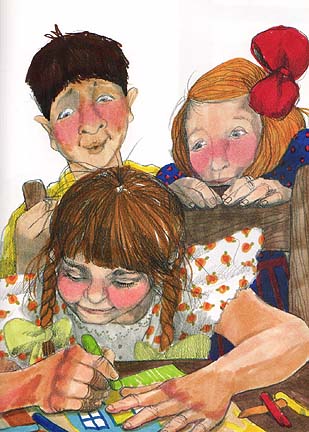
When my daughter comes home with a picture she drew in school that she later explains is the plan by which Friend A wants to conspire to break up the “relationship” of Friend B with her boyfriend (these are all three kindergarteners, mind you) so that Friend A can have the young man for herself (again, these are kindergarteners); when my daughter comes home explaining this in great, illustrated detail, explaining all the steps necessary, using the terminology “break up”, “boyfriend”, “fall in love with”, and “twist”; when my daughter comes home with these images and ideas and norms, I am afraid you and I are at the very least with how conscientiously we are trying to raise our children. And at the very worse, that you are consciously raising your children to have goals and plans diametrically opposed to mine and my wife’s.

I am having to explain things that, quite frankly, I don’t want to have to explain. At five years old, she’s too young to know what a boyfriend is in any real, experiential sense, whether her experience or vicariously through the experiences of those she calls her friends.

You might not be doing this consciously, and indeed, I hope and even doubt that you are. However, the fact remains that you are teaching my daughter that I really do not want my daughter to learn. You are teaching my daughter through the example of your children, who throw up their hands and say, “I don’t care” with such derision that it even disturbs my daughter, though she has begun doing it herself. You are teaching my daughter by allowing your children to listen to the sex-infused popular music of today without even explaining, it seems, that “sexy” is not a word that needs to come out of a five-year-old’s mouth. Through your children, you are teaching my daughter so many things at five years of age that I thought she would not encounter for at least, in the very worst case scenario, another year or two.

Still, I should be grateful. You have made me more thankful than ever that, through some odd, unlikely grace, I found myself married to a Catholic woman and eventually baptized into the Catholic church myself. You have made me exponentially more vigilant about the crap — sorry, but there’s no other word for it — that today’s culture is trying to shovel on her. You have taught me that it’s never too early to be on guard. You have reminded me that my promise to my daughter and son, of which I remind my daughter almost daily when she’s frightened by this or that by simply asking “What’s my responsibility” and knowing that the response is always “To protect me”, is my primary responsibility on Earth today and that every other Earthly responsibility is secondary or tertiary at best. I don’t mean to sound bellicose, but you’ve reminded me that I am in a war for my own soul and, until they can defend themselves, my children’s souls.

All the same, it would be so much easier if I knew we were all on the same side. Sadly, I’m not sure we are. Still, it’s good to know where we stand. You and your children will be in my prayers, but my own children’s spiritual well-being will be in my prayers and my conscientious, purposeful deeds.

Regards,
The Girl’s Dad
Homework

The bane of most students and many teachers, too, homework seems in some ways to speak to the inadequacies of our educational system. Alfie Kohn and others certainly argue that, but they’re certainly in the minority among educators. Most of us educators see homework as practice: just as a world-class gymnast or swimmer puts in extra time beyond formal coaching to improve his or her skills, so too young learners put in the extra time to master new skills.

DSC_3398

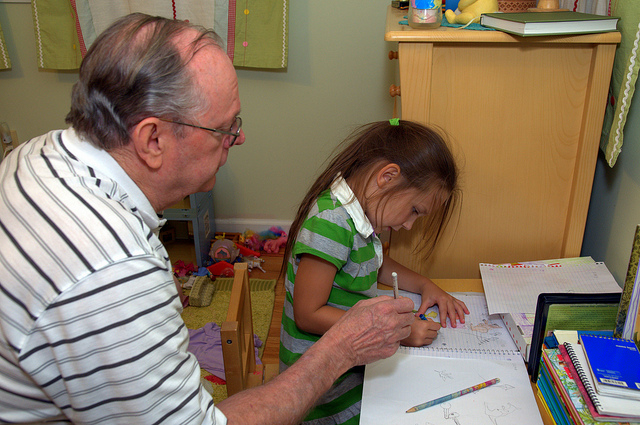
For the Girl, it’s turned into something of a rite of passage. “When will I have homework?” she used to moan when she found me going over student work. Now that she has homework — of a sort — she’s thrilled. “Tata!” she squealed as she ran into the room the other day, “I love homework!”

And what’s not to love about it if it’s done right? It can be a moment of bonding between a parent (or grandparent) and a child, an intense social and intellectual engagement where the two engage in a task with a specific and common goal.

Our Own Trisha

Every year, as we begin a unit on the Gary Paulsen novel Nightjohn, I read Patricia Polacco’s Thank You, Mr. Falker. The story of a young dyslexic girl who was suffering the taunts of peers and the seeming neglect of teachers, the book emphasizes the life-changing nature of literacy. Trisha, the protagonist, spends the first four grades of school hiding her inability to read, feeling dumb for not being able to keep up with peers, and taking solace in her one skill, her exceptional artistic ability. It’s such a touching story that even a room of rowdy eighth-graders ends up sitting in silence, visibly moved. Every now and then, a girl — always a girl, for a boy will never show such a “vulnerability” — sniffles in the back or wipes her eye occasionally as the story nears its conclusion.

“We have Trishas in this room, guaranteed,” I tell the class this afternoon. “Someone here has felt stupid about something, been taunted for something out of her control, taken refuge in solitude and some seemingly non-academic talent that doesn’t fit today’s educational mold.”

“We’ve probably all experienced it,” says a boy who has never struck me as being particularly attuned to the pains and sufferings of others. I nod solemnly in agreement. And I think back to the quiet girl a couple of years ago who, leaving the classroom after that particular lesson, murmured, “I have a lot in common with Trisha.”

Errors and Mistakes

In the midst of the process, it becomes obvious to me that the road these students are on will not lead to the results they want. They’re working hard learning a new framework for planning and writing formal essays, but there are so many larger and smaller steps — I couldn’t have covered them all the first time through. Yet I sit and wonder whether or not I’ve made a mistake. Instead of essays, many of them are going to wind up with three body paragraphs that seem to have nothing to do with each other.

I’m left wondering what to do. Do I stop everyone and make a group course correction? That’s likely only to confuse some. And besides, it’s the process I’m teaching. I’m not worried as much about the finished product at this point as I am the steps the kids are taking to create that final product.

Then it occurs to me: sometimes the teachable moment is not in the moment. Sometimes it’s best to let them stumble — knowingly, even anticipating it — so that their misstep will show them rather than tell them where they were on the wrong track.

“Mr. Scott,” I envision one young lady beginning quizzically, “This essay we wrote — it don’t make sense.”

“How so? What doesn’t make sense?” I will reply, hoping that she will see then what I already clearly see  now.

“I don’t know. It’s just,” she might continue, pausing to look for the right way to express herself. “These paragraphs. They just don’t go together somehow.”

And I will smile and say, “I know, and I’m so very glad you’ve noticed that.”

Floating on More than Survival

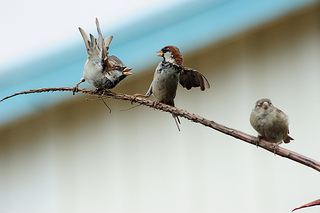
male sparrows putting on a show.

male sparrows putting on a show. by Will at Morro

The students sit during the Silent Sustained Reading with which we now conclude each day in our new schedule. We’ve begun the year reading the same book, a Pearl Buck short novella called The Big Wave, keeping a reader’s journal as we read. We’re all almost literally on the same page, which simplifies some of the logistics of the year-long project.

“Once you finish this book,” I tell the kids, “You can read whatever you want.” And so when I finish the book, I pick up a poetry collection and encounter R. T. Smith’s amazing poem (source):

Hardware Sparrows

Out for a deadbolt, light bulbs
and two-by-fours, I find a flock
of sparrows safe from hawks

and weather under the roof
of Lowe’s amazing discount
store. They skitter from the racks

of stockpiled posts and hoses
to a spill of winter birdseed
on the concrete floor. How

they know to forage here,
I can’t guess, but the automatic
door is close enough,

and we’ve had a week
of storms. They are, after all,
ubiquitous, though poor,

their only song an irritating
noise, and yet they soar
to offer, amid hardware, rope

and handyman brochures,
some relief, as if a flurry
of notes from Mozart swirled

from seed to ceiling, entreating
us to set aside our evening
chores and take grace where

we find it, saying it is possible,
even in this month of flood,
blackout and frustration,

to float once more on sheer
survival and the shadowy
bliss we exist to explore.

I think of all the linguistic hoops most of my students would have to jump through even to understand the poem let alone to find themselves floating themselves when they reach the final line. Then there is all the cultural knowledge they would need — chiefly, at least a rudimentary knowledge of the and familiarity with the music of Mozart. And the general motivation.

It’s at times like that that I understand just what it means to teach literature and writing in 2012 to fourteen-year-olds.

Hands

Hide

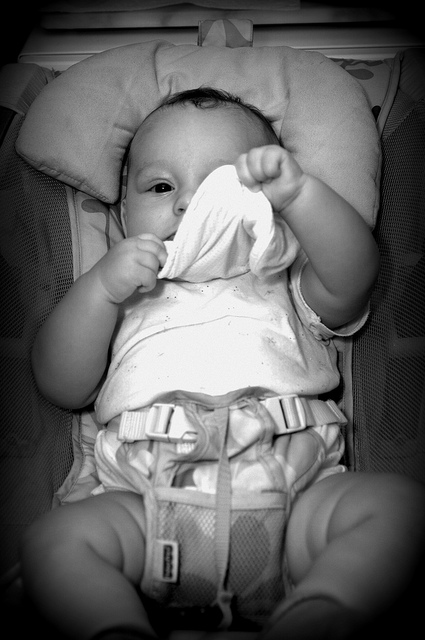
The Boy has been discovering his hands, discovering that he has them, discovering that he can control them.

Trails

This summer vacation provides me with the first real opportunity in a long time to spend a great deal of daily time with the Girl. As such, I try to do something out of the ordinary with her every chance I get. It’s a good reminder for her of her continued importance in our family despite our shift in attention during the last eight weeks.

VIV_0902

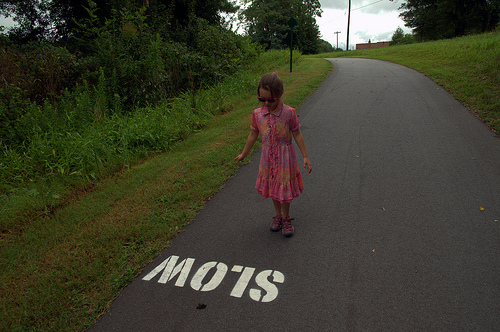
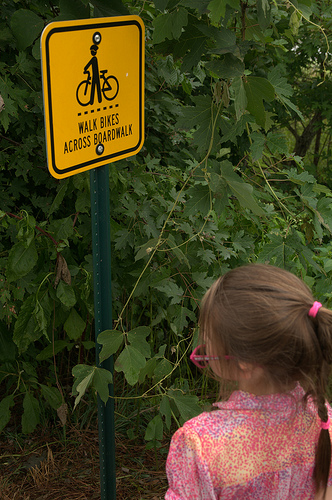
Today, we try a new path at a park fairly new to us. We’d explored the north side of the park’s trails; today, we hit the south side, sounding out signs as we marched.

VIV_0904

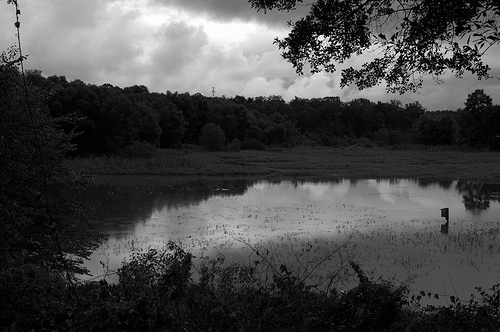
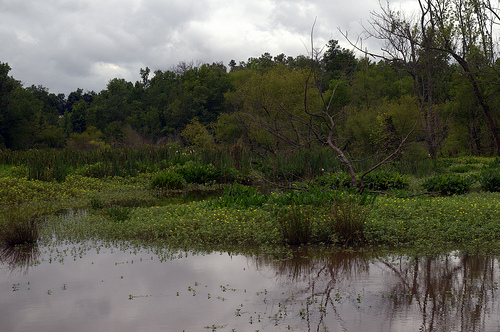
It’s an odd trail. To the right we see a lake and accompanying wetlands — a vision of nature’s riches.

VIV_0908

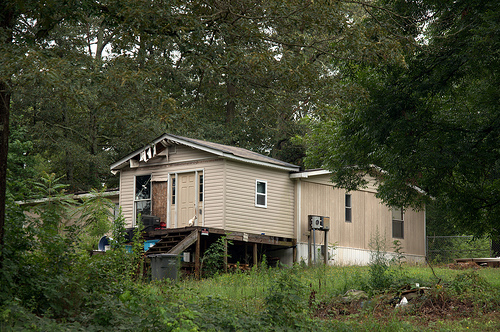
To the left, a view of humanity’s poverty: trailers and virtual shanties. It’s an odd combination, made even stranger by the fact that one of the old homes has a BMW in the driveway. Perhaps a question of priorities: one’s peers don’t have to see one’s house, but one’s car is always on show.

VIV_0914

At the end of our walk, an observation point that juts out into the wetland area made even wetter by the copious rainfall of the last few days.

VIV_0930

We sit for a while, sharing a pack of crackers and sipping on water, careful not to litter (“The wind could blow the plastic away!” someone explains) and commenting on the various blooms reeds.

DSC_0925

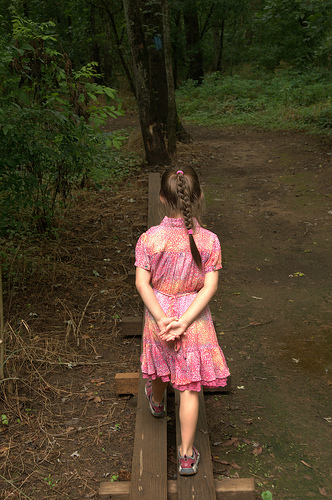
During our hike out, with the Girl clasping her hands behind her back, there’s only one thing to do: let her lead.

Knight Study

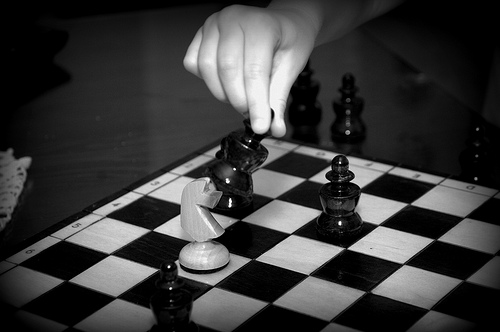
“Daddy, can we play chess?” the Girl asks almost daily now. She’s learning — slow steps — but her enjoyment of the game is most gratifying. Today: knight study.

“Put a pawn at each square this knight is attacking,” I say. She forms the circular pattern around the knight.

Knight Study

“Notice,” I continue, “that the knight is on a white square but is attacking all black squares.” I hope this will help her complete the exercise, but we end up getting pawns on random black squares in a few moments.

I suppose the next lesson — moving the knight to the edge of the board to show how its power is effectively halved in doing so, proving the old adage, “A knight on the rim is grim” — will have to wait.

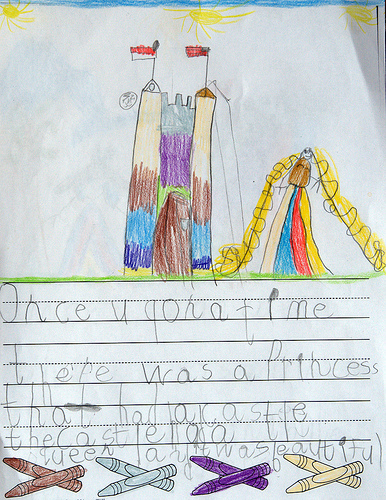
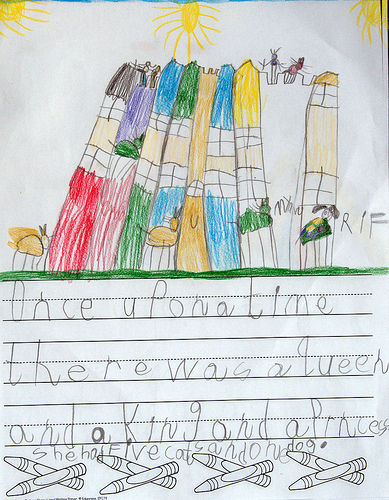
Story Four

Fairy Tale 4

Once upon a time there was a princess that had a castle. The castle had a queen. She was beautiful.

Story Three

Fairy Tale 3

Once upon a time there was a queen and a king and a princess. She had five cats and one dog.

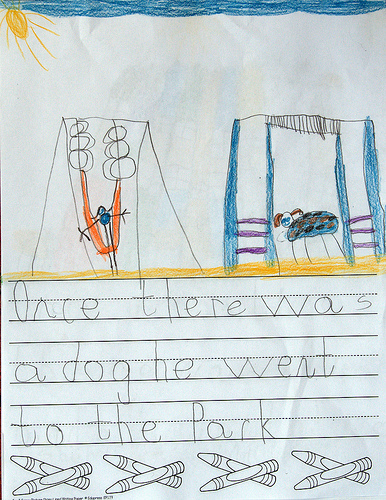
Story Two

Fairy Tale 2

Once there was a dog. he went to the park.

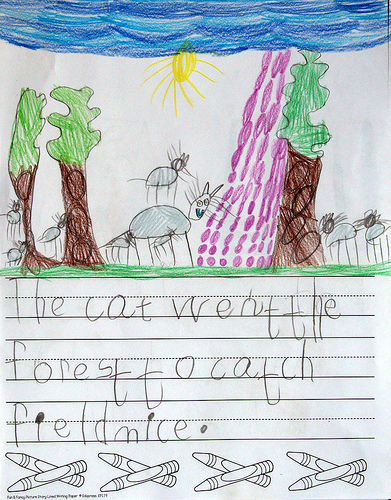
Story One

Fairy Tale 1

The cat went the forest to catch field mice.

Peer Review

It’s nearing the end of the school year, which means my English I students are tackling the year’s final project: an analysis of some facet Victorian England that is clearly evident in Great Expectations. Social class, adoption, education, and gender roles are popular motifs.

This year, having access to seemingly endless articles on JSTOR, I’ve decided to make the project a bit more challenging. After printing out twenty-five or so articles from peer-reviewed journals, I inform the students that we’re going to do this one “old-school.”

“No web pages as research sources.”

The groans are audible throughout the school.

I flop five inches of journal articles down on a chair in the front of the room and explain that this is going to be one of their primary sources of information. We review how to skim a text effectively; we practice with a text projected on the board; we talk about the difficulty of the language; and I turn them loose.

1-img_3979

Soon, kids are getting excited about titles like Alastair Owens’s “Property, Gender and the Life Course: Inheritance and Family Welfare Provision in Early Nineteenth-Century England,” struggling with passages like this: “Among families, property rights shifted according to changing circumstances and as individuals moved through their lives. Inheritance was obviously a unique phase in this life course, characterized by social and proprietorial upheaval.” Fairly straightforward for adults; a struggle for young readers. But these are not kids who give up quickly, so they constantly call me over with the same request: “Can you read this passage, then listen to what I think it says, and tell me if I’m right?”

Others are combing through F. M. L. Thompson’s “Social Control in Victorian Britain” in the hopes of finding something about the effects of the sense of genteel society on social behavior. Or, as they put it, how society and popularity in the upper class are related. Or something like that. I’m not quite sure I understand some of their topics, and I’m not sure some of them do either. But no worries. That’s part of the point.

“What if we don’t find anything for our topic?” becomes a common cry.

“Then I guess you’ll change topics,” I say, and sit with the frustrated student to help him find a way to narrow, broaden, or slightly shift his topic.

Their frustration seems overwhelming.

4-img_3982

“How can we get all this research and writing done in just a couple of weeks?” is another common concern.

What they don’t realize — what I don’t tell them — is that the paper itself is of little importance at this point. Like so many things in life, it’s the process. The struggle.

“I want them to have the experience of digging through a journal article only to determine that it’s not of any use to them for their topic,” I discuss with a colleague later. “I want them to struggle defining and redefining their research question as they find materials that shift their thinking.”

By the third day of research, kids are taking copious notes (and I frustrate them by saying, “There’s a good chance that twenty to thirty percent of these notes won’t end up in your final paper”), sharing resources (“Allie, I know you’re working on education, and this article on social class actually has something on education, too. Want it when I’m done?”), and actually smiling from time to time.

Changes

It was sometime during second or third grade, I believe, that I first realized I wasn’t seeing the same things my classmates were seeing. I’d somehow discovered that if I pulled on the corners of my eyes, I could see better. The teachers noticed, said something to my parents, and shortly after that, I had my first pair of glasses.

DSC_8636

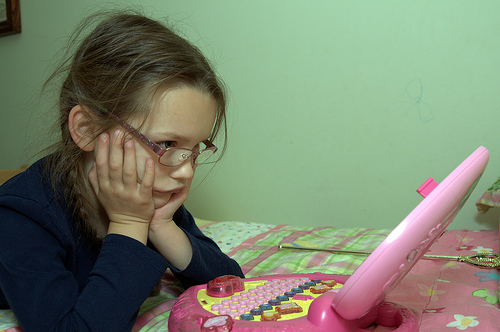
The Girl, it turns out, has the opposite problem: she’s far-sighted.

DSC_8639

The optometrist tells us it’s something she could outgrow in a few years.

DSC_8640

There are some things, however, she’s likely to retrain for several years to come.

Hypothetical Exchange

Cell Phone
Photo by Mike Fisher

Girl 1: Did you lose your phone?

Girl 2: Yeah.

Girl 1: What for? For cussin’ out your mama?

Girl 2: My mama don’t care if I cuss her out.

Girl 1: Then what’d you lose the phone for?

Girl 2: I don’t know.

Bike

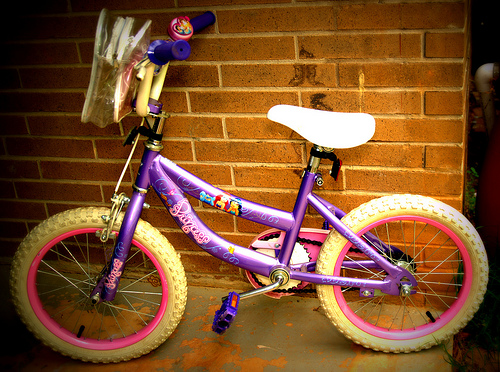
DSC_8535

We’ve been working on it for some time now: riding a bike. It’s something K and I take for granted, one of the shared interests that helped in its own little way to solidify our relationship years ago.

The Girl didn’t take to it immediately. She was scared of everything: going up hill; going down hill; turning; going straight; starting; stopping. It all scared her. “I was beginning to think she’d be like Babcia,” K remarked today.

It’s been a long time coming…

http://www.flickr.com/apps/video/stewart.swf?v=109786

Greater Expectations

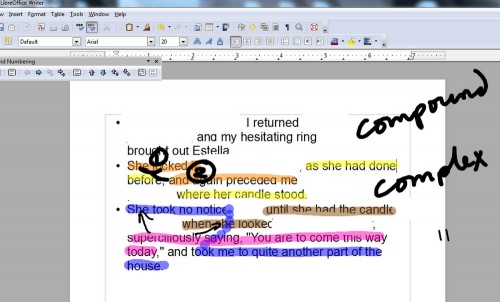
It’s the end of the year, which means the English I students are tackling Great Expectations, having just finished a brief overview/review of clauses and sentence types. “To understand Dickens,” I explained a couple of weeks ago, “you have to break apart some of his incredibly complex sentences into manageable chunks.” So we practice: every day, students entering class are greeted by a few sentences of from the previous evening’s readings. The bell-ringer, starter, whatever you want to call it:

At the appointed time I returned to Miss Havisham’s, and my hesitating ring at the gate brought out Estella. She locked it after admitting me, as she had done before, and again preceded me into the dark passage where her candle stood. She took no notice of me until she had the candle in her hand, when she looked over her shoulder, superciliously saying, “You are to come this way today,” and took me to quite another part of the house.

Students cross out unnecessary phrases — prepositional, gerund, participial — and try to find the gold: a single subordinate clause. “If you find a subordinate clause,” I explain, “you know it’s either a complex or compound-complex sentence; if you don’t, you know it’s a simple or compound sentence.”

The results are improving daily.

Keeping and Surrendering

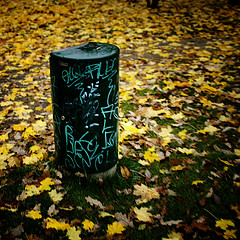
Trash can
Photo by Lauri Rantala

“Hey L, come help me take out the trash and recycling,” I call as we finish up playing tag in the front yard, our new daily tradition. I pull into the laundry room the wicker basket we put our paper recycling in during the week and have her help me transfer the paper from it to the tub we’ll take out to the street. And then she sees it: one of her drawings. There. In the recycling.

She gasps.

“What’s this doing here?!” she asks, confused. “Are you throwing this away?”

I think fast and answer truthfully: “Well, we went through everything, and we’re saving the best.”

She looks at one of her crayon drawings and asks incredulously: “And this?!?”

Truthfully, it is quite good.

“Well, we can take that,” I admit. “It’s a good drawing.”

“And this?!” she exclaims, pulling out another. “And my subtraction work?!”

Soon she’s pulled out every single item of hers, each time accompanying the delicate removal with a gasp of shock and horror.

I explain to her that we can’t keep everything, making a mental note to check with K before having the Girl help sort recycling again. Still, it’s not a lesson she’ll learn quickly: most of us tend to hold onto things more than we should.

Work

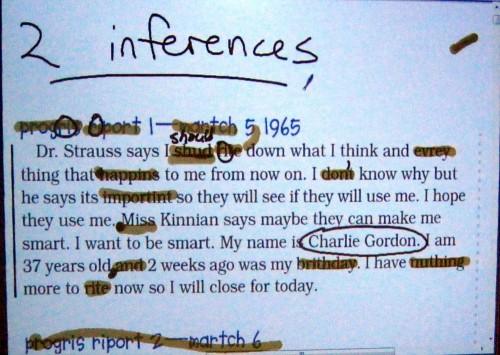
One class began working on Flowers for Algernon.

Another class continued with Great Expectations.

Still another class began looking at the notion of voice in writing.

Busy day back.