learning

Last Day of Break

“Daddy, I don’t understand. On Sid the Science Kid, the teacher calls all of the children scientists.” The Boy paused for a moment: he’s learned how to pause to heighten the moment just a bit. “That can’t be right! They can’t be scientists!”

We were on our way home from shopping, leaving the girls at home this last day of break. K stayed home because of a lingering illness, so we were together for the morning, but the Boy and I headed out after lunch to do the week’s grocery shopping.

“Why can’t they be scientists?” I asked, wondering what he had in mind.

“They’re just kids!”

“So?”

“To be a scientist, you have to have a job. That’s your job. A scientist,” he explained still frustrated, though sometimes with him it’s hard to tell if the frustration is real or just pretend, as if he’s trying it on for size.

I thought about his definition and reasoning for a few moments, thought about why the teacher would be calling children scientists — obvious for an adult, not so much for a child.

“Well, E, it’s a question of scientific thinking. She’s calling them scientists because they’re behaving like scientists. They’re thinking like scientists.” This satisfied him for a few moments, but it didn’t satisfy me. I was wondering if he would ask what it means to think scientifically, hoping he would ask. He didn’t, so I prompted him. “Do you know what that means, to think like a scientist?”

“No.”

“It’s a process. You observe. You think about why things happen. You make predictions about why things happen; you check those predictions…”
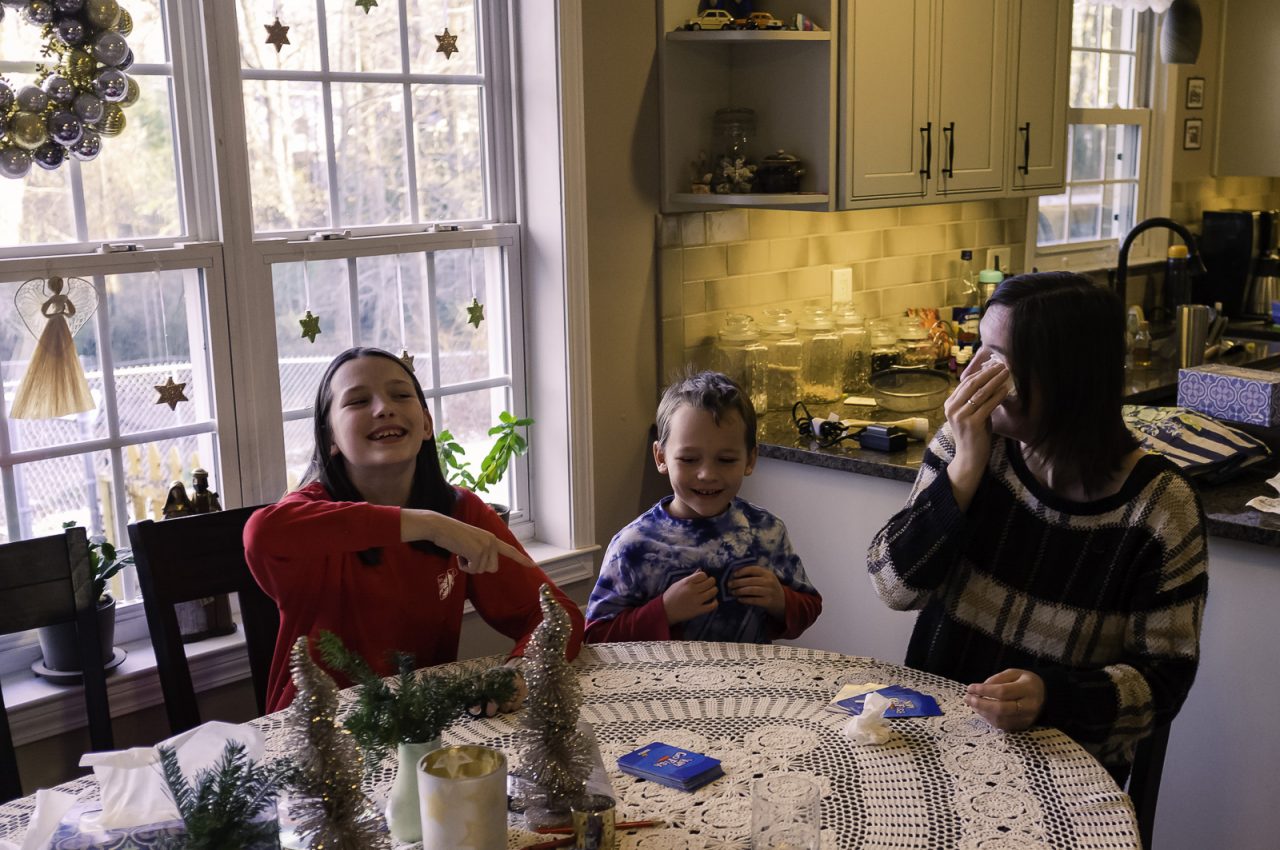
I fear a lot of Americans really have no clue what it means to think like a scientist.

The other night, while on a walk, I was listening to an old sermon by a religious leader, and he was railing against “intellectualism.” He never really defined it. He never really explained why it was so bad other than to say it was vanity. He was upset about how some Biblical scholars will spend so much time picking at the smallest little detail, and as he said that it occurred to me that he really didn’t have a firm grasp of what those scholars were doing, how they were examining the text, their methodology and the justification for it.

I think this is a common thread in America, this anti-intellectual position, and it’s directed at all sciences. People dismiss all sorts of things they, were they taught like Sid the Science Kid to think scientifically, they likely wouldn’t dismiss, and they accept things that, were they taught like Sid the Science Kid to think scientifically, they would dismiss out of hand.

So I was very pleased when E later spoke of thinking scientifically. And as he played Go Fish with the girls, it occurred to me that here is a perfect opportunity for some basic critical thinking: observe (listen to what others are asking for); test (ask for a few things in a systematic way); repeat.
Lost Stars

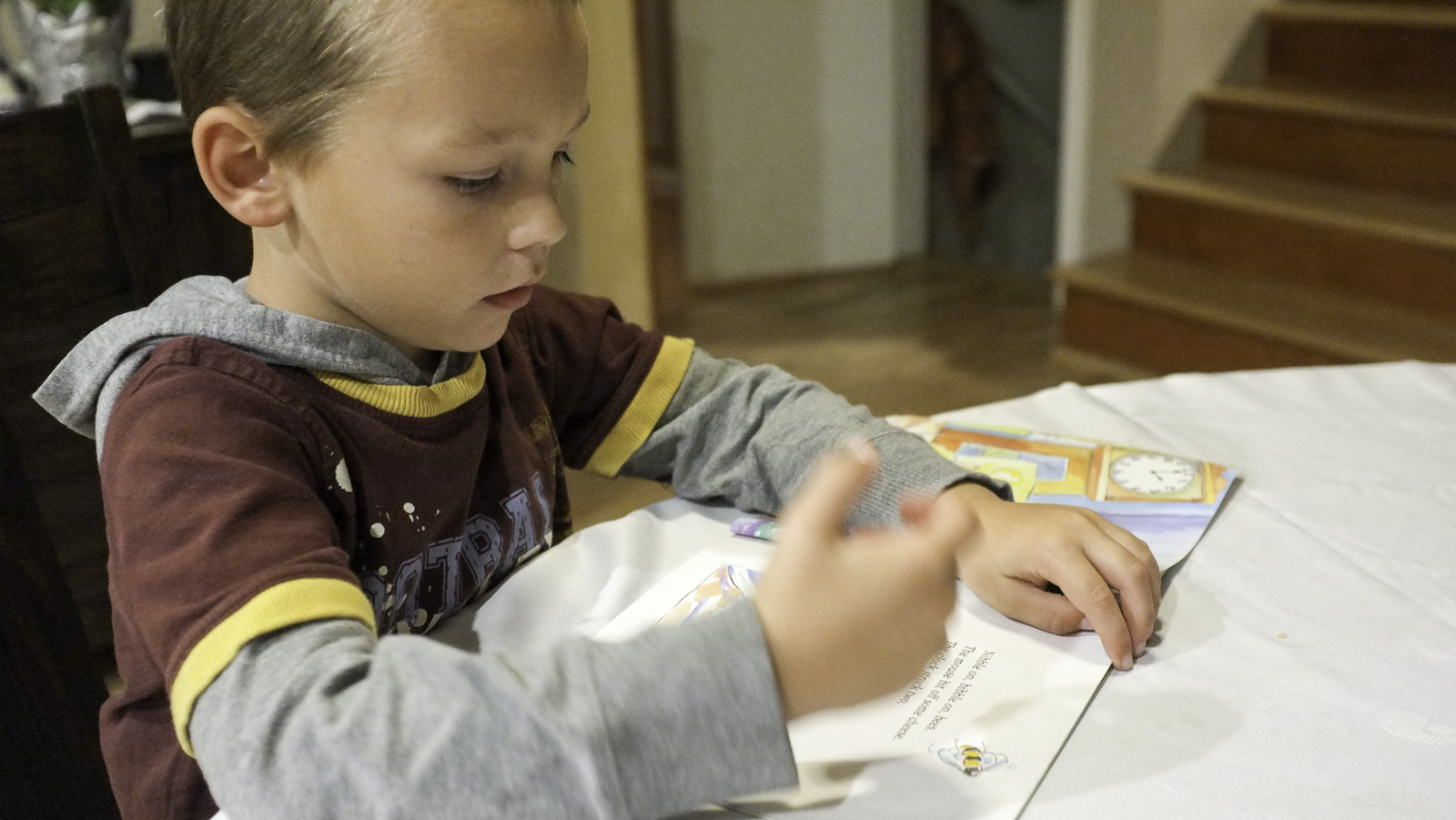
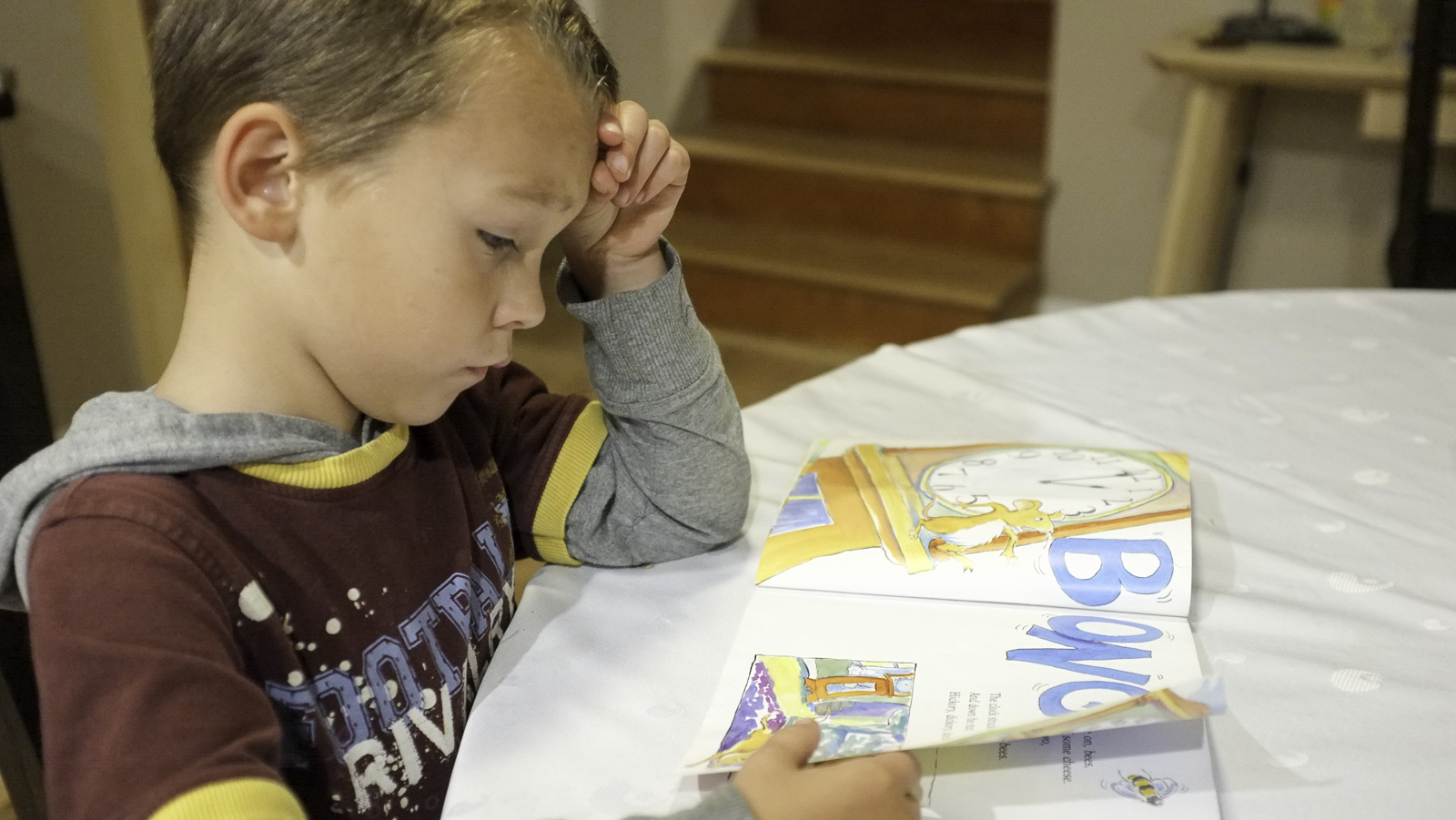
E and I were lying on the bed in the master bedroom, reading. He always gets a book from school for his daily reading log, and often the book is leveled just right for reading with a parent: a few words he knows, enough short words that he can sound out, and a few words that he needs a lot of help with. Always a refrain of sorts, something easily remembered that he can just repeat.
Today’s book: My Dad and I.

We made it through the book, which was about all the things the narrator’s dad teaches him to do and all the things he teaches his dad to do, and E began teaching me about his star behavior system in school. Of course I knew all about it: I just had a conference with his teacher a few weeks ago, and we get a daily report about how many stars he ended the day with. But of course I let him explain it.

“We start with three stars, and if we do something wrong, we lose a star.” He paused, then added, “I haven’t lost a star yet this year.”

What will he do when he loses a star?

What I Learned

Today, at E’s first soccer game of the season, a certain little boy managed to break from the pack of children that attempt to herd the ball in one direction or another, and he dribbled the ball down half the field and blasted a devastating shot at the opposing team’s unprepared goalie. A few moments late, in a move reminiscent of German’s complete destruction of Brazil in the 2014 World Cup semi-finals, broke away again and scored a second time in as many minutes. That little boy was a hero all around. That little boy was not the Boy. He spent most of his time lingering around at the edges of the hive of children always swirling around the ball, never charging in and begin aggressive as he does here. He almost shot a goal, but truth be told, it was because he just happened to be where a deflected ball just happened to land. Yet he was so very proud of that.
“I’m going to tell Mommy I almost got a goal,” he told me several times on the way home, as if to make sure I understood that he was going to tell her. I wouldn’t have had it any other way.

I’ve mentioned before that the Boy is not overly aggressive, and I even mentioned it in the context of soccer.

I don’t have a problem with that. I don’t have a problem with him shooting an own-goal (as he did last year) or only barely missing a goal because an ironic combination of luck and misfortune. I don’t have a problem with him wandering around the edges of anything, looking in, unsure and unwilling to commit himself until he is. I don’t have a problem with him giving up on any and all sports.
That is what I learned about myself and my son today.

What I learned about my daughter will have to wait until I have to fix what I learned about myself at the same time.

Infinity

Driving home from Mass today, the Boy and I somehow got into a discussion about infinity. I can’t remember how it came up or even who brought it up, but there we were, discussing one of the great paradoxes of life and math.

To try to explain it to him, I talked about numbers: “You can count on and on and on and on,” I said. But this didn’t seem to support what I said earlier, about infinity having no beginning or ending.

“But it does have a beginning,” he protested from the back. “When I count, I say, ‘1, 2, 3, 4, 5.’ You start at one.”

I tried dipping into the topic of negative numbers to show him that we really could start anywhere.

“Negative numbers? Like 5, 4, 3, 2, 1?”

Life at Babcia’s

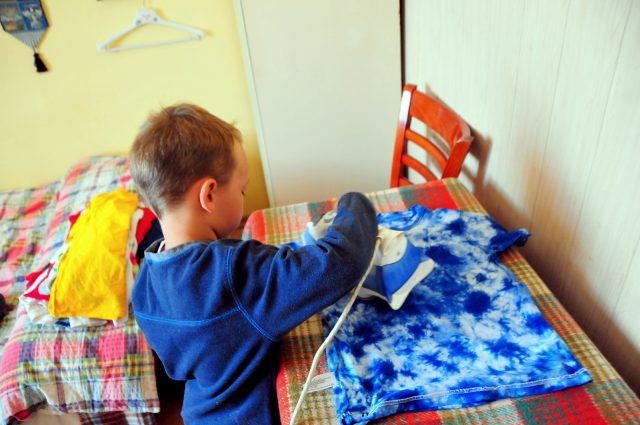
A clothes drier is a standard item in the States. I don’t know anyone who, having a washing machine, doesn’t have a drier. That’s simple enough to understand: electricity and gas are both cheap in the States, and driers are almost always packaged with washers. In Poland, though, it’s a different story.

In much of rural Poland, gas lines simple don’t exist: all gas products use propane tanks. And as far as electricity goes — forget it. It’s ridiculously expensive compared to what we pay in the States. Bottom line: Babcia doesn’t has a drier, and that means one thing — there’s a lot more ironing going on in Babcia’s house than in our house. Everything — jeans, tee-shirts, underwear (and I’m not joking here; some people do iron their underwear), bed clothes, everything — gets ironed.

With all the additional clothes, that would be a ridiculous amount if work, so we try to iron as much as we can. (I say “try” because Babcia is liable sometimes to pull everything off the lines and iron it all while we’re out hiking or some similar silliness.)

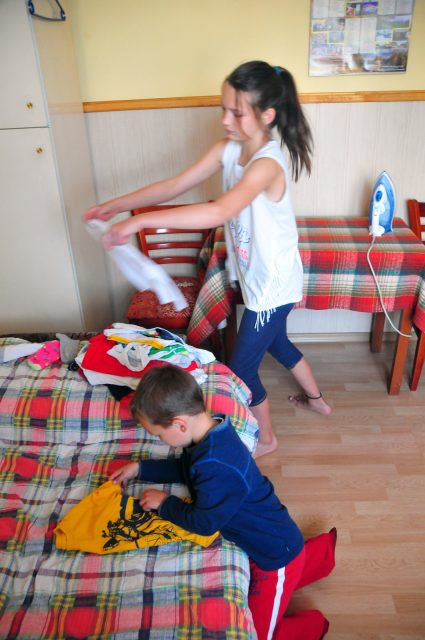
Today, E learned to iron. L insisted that she knew how to already, and when she began ironing her own clothes, it seemed that she did indeed know how to. The Boy, though, needed lots of instruction. They both need a lot of work with folding, though.

The outcome: after a few minutes, they were fussing and arguing over who got to iron.

Lucanus elaphus

I found it floating in a bucket out back that had a couple of inches of water from the last storm. It was still squirming, trying to escape, doomed to drown. I pulled it out and took it to the Boy to show him. He put on gloves and was eager to hold it.

Lucanus elaphus

Fear of such animals I supposed is learned, or more importantly taught. Tell a kid constantly that such creatures are out to get him, and he’ll likely believe it. Tell a girl that the only good snake is a dead snake, and she’s likely to hold that opinion for decades. But kids are naturally curious — it’s what gets the hurt. With the Boy and the Girl, we’ve tried to strike a happy medium: such insects might, like roaches, carry certain bacteria on their bodies that are not particularly helpful, but in and of themselves, they’re harmless. Certain snakes are deadly, so we should never approach a snake and try to make a plaything out of it, but an enormous black snake slithering through the grass (as happened here five years ago) does much more good than harm.

Atypical Saturday (Lent 2012: Day 32)

With people, there’s the whole additional possibility of deceptiveness. If only it were so simple with humans.

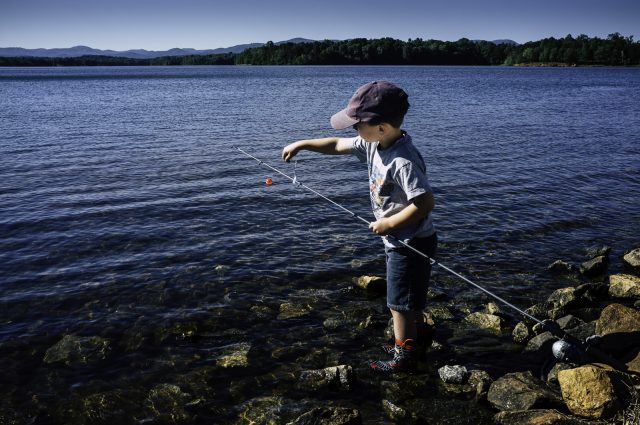
Fishing

“Do you think I’ll catch a Clownfish?”

We were eating breakfast when this question came up. A typical Sunday morning: breakfast around half-past eight. The Girl off to choir practice at quarter past nine. The boys off to Mass about an hour later. That morning promised to be our normal, comfortable ritual. The afternoon, though, promised adventure.

“No, son. Clownfish live in the ocean. They’re salt water fish.”

“Plus,” added L, “they live in reefs.”

It only took him a few minutes to get the hang of it, and for a while, he was casting beside the Girl as she practiced with her new archery set.

A few bites later, he had another thought. “What if I catch a shark? I’ll have to be strong if I catch a shark.”

“I don’t think you’ll catch a shark.”

“Oh, right. It lives in the ocean.” He thought about things for a few more moments, then added, “All the fish I know are salt water fish.”

Playing in the water

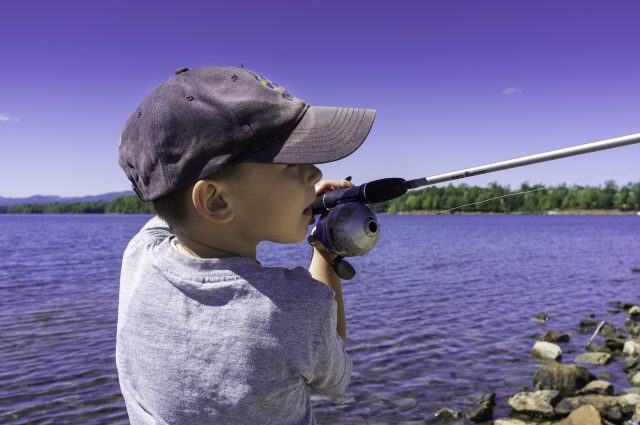
Planning for the afternoon fishing trip really began on Christmas Eve, when our children following Polish tradition were opening their presents. Our neighbor, who goes fishing often, had bought the Boy a beginner’s rod and reel set, complete with a small tackle box. He was thrilled, and he was even more excited when I found a casting weight in my old tackle box downstairs and explained that he’d be able to practice casting in the backyard.

A few days ago, when our neighbor was packing up his gear and hitching his boat to the truck for a morning fishing trip, the Boy informed K that his rod and reel were, in fact, for nothing. “They’re not for decoration,” he explained. And so she told me when I got back home that afternoon, “You must take him fishing this weekend.”

I haven’t been fishing in probably close to thirty years. I can’t remember ever going fishing with my father — not because I asked and he refused. Fishing was simply not something we did in my family. My mother’s brother was very much a fisherman, and during one visit, he gave me a handmade graphite rod with a very sturdy reel with a tackle box filled with every imaginable worm-like, grub-like, and fish-like lure one could imagine. I was twelve, I think. I probably used it no more than half a dozen times, if that many.

Learning to untangle

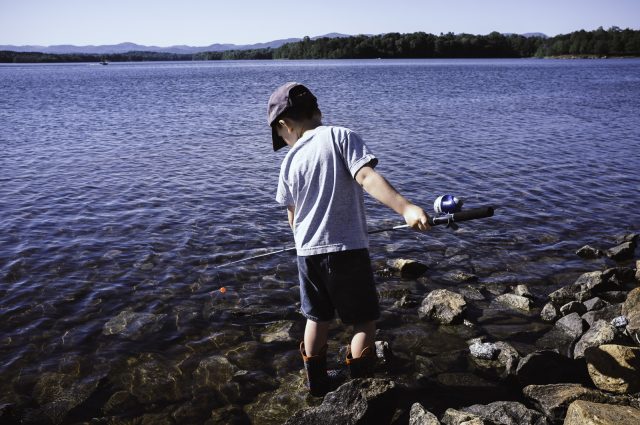
In thinking about taking my own son fishing, I had a whole list of concerns. Some were reasonable: what’s the best type of bait to use at this lake when fishing from the shore. Some weren’t: what if I can’t remember how to tie a hook? But with muscle memory, that latter worry disappeared. But the bait? When I saw the lake, I realized that it really didn’t matter: we weren’t going to go onto one of the fishing piers because the Boy, having no practice casting with an actual hook, might cause disaster. (In fact, he caught my shirt once, but fortunately only my shirt.) Since the lake was so shallow with a gentle slope out to the deeper water, I knew he’d never cast far enough from the short to catch anything, so we tried a number of lures.

He caught nothing but my shirt. But he begged to go back tomorrow after school.

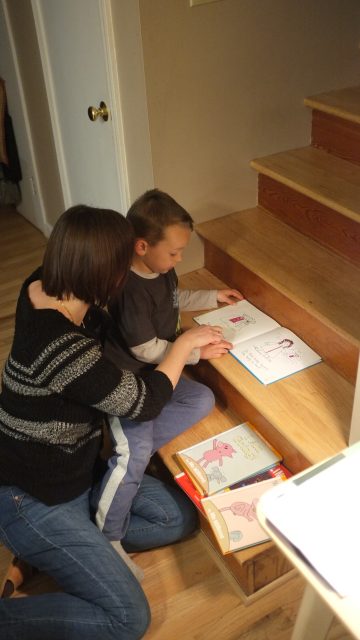
Lessons on the Stairs

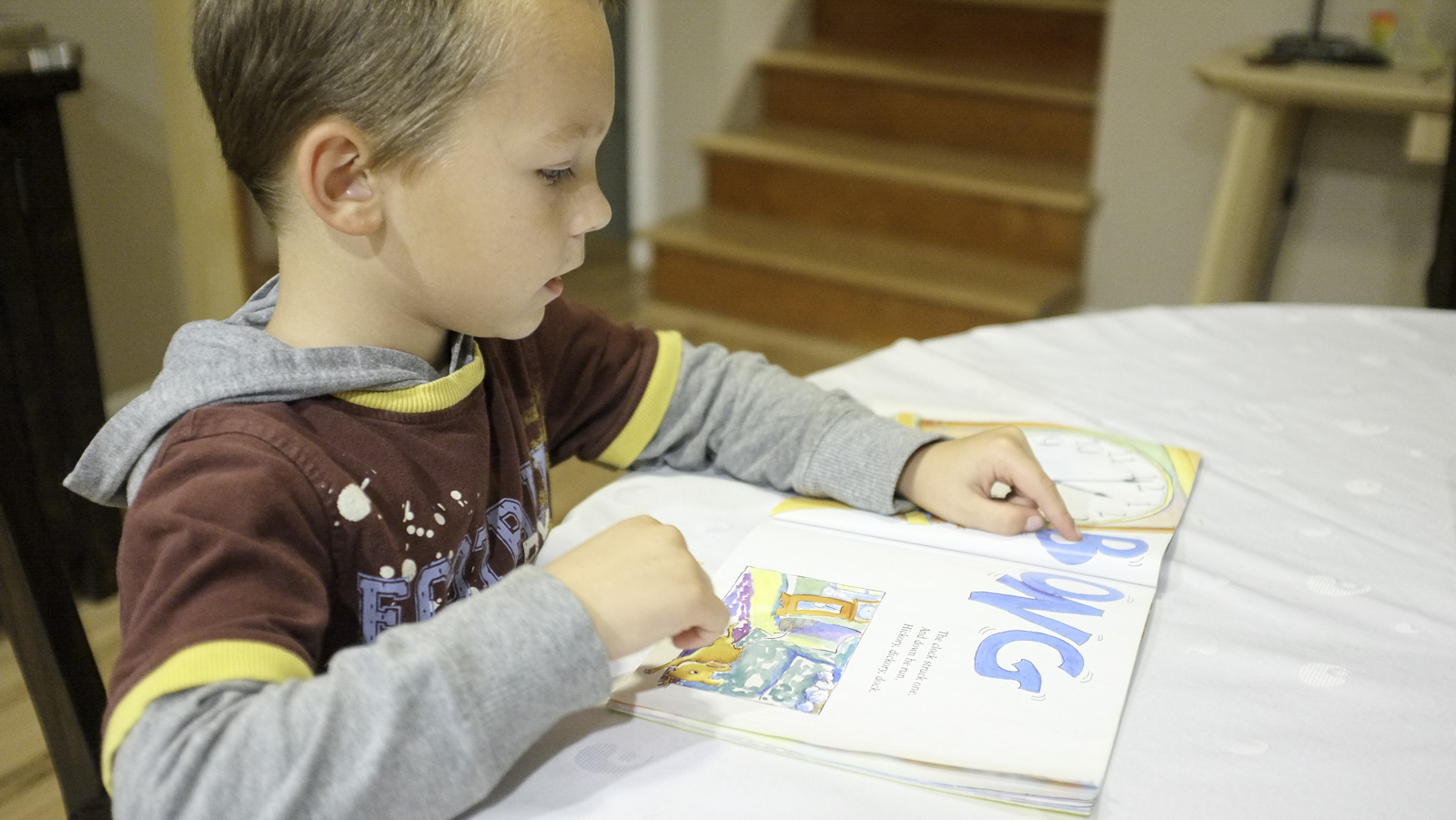
When the Boy, who sometimes expresses such a frustration with his inability to read that he resigns himself to never knowing how to read, takes a book and tries reading on his own, you go along with it, no matter where it happens. This was last night.

Falling Down

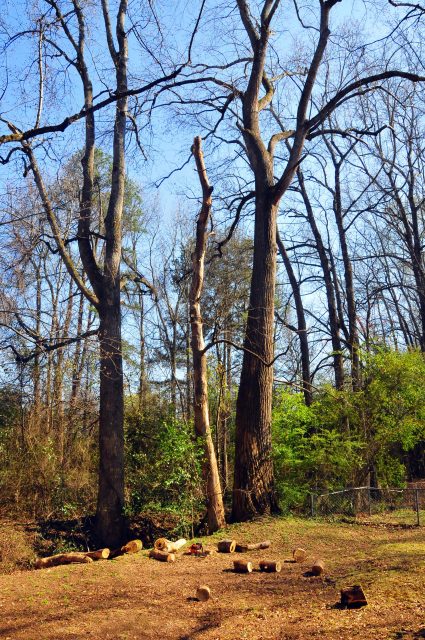
There are two trees in the back corner of our lot that worry me. One worries me as a cause of a potential problem; the other is the potential problem. They’re both tulip poplars, with one having a diameter of at least five feet. The smaller of the two has succumbed to some kind of disease or infestation or both. It’s been dying for a couple of years. The bark has just about completely fallen off, and the base of it is beginning to rot. It will fall of its own accord within another year or so, but I’m worried that the enormous tulip poplar next to it — the biggest tree by far that we have in our hard — will develop the same problem. If the sick tree falls, it won’t be a big problem, especially now that the top third of it fell this week, leading to a change of Saturday plans and extensive use of the chain saw. Falling of its own accord is not always an option, though: the large tree if it were to fall, would cause some major damage. It might take out a power line that runs behind the house, and it’s tall enough that it could even damage a house behind us.

Besides the fact that I’m not really what the financial ramifications might be for a tree falling on someone else’s property (from my rough research, we might be held responsible if it was a question of negligence, which would be more of what we’re doing about it now: nothing), there’s the simple fact that I love that tree. It must be at least two hundred years old, possible older, and so it’s a history lesson right in our own backyard. It was around when Lee surrendered at the Appomattox Court House. It was a large tree when Somme Offensive became the largest killing field in history to that point. In a country of new things, I value the old.

But falling down is a part of life.

As a Catholic, falling down has a spiritual, metaphysical sense to it: it requires a visit to the confessional. Like with the tree, there can be collateral damage when I fall down. A lie might tell someone could have far-reaching repercussions. The angry word spoken in spite might damage more than the moment. That’s what this Lenten season is all about — thinking about that collateral damage that accompanies sin no matter how we try to compartmentalize it. Our parish priest began a Lenten homily series on the nature of sin, and the communal nature of sin is a key Catholic teaching. We are responsible for our own actions, of course, but we always seem to rise and fall together.

As a parent, falling down is something my kids just have to do. They have to learn how to fall, how to absorb the impact without breaking bones or, later, hearts. More importantly, they have to learn how to get back up. That’s a lesson many of us never learn, I’m afraid. L has learned how to take a tumble and hop back up, or perhaps even laugh about it.

The Boy is slowly learning the same. Sometimes he’ll fall with a thump and hesitate for a moment before hopping up and proclaiming, “I’m okay!”

With L finishing up fourth grade, though, K and I have begun thinking about the simple fact that we’ll soon have to start thinking about considering middle school. (We’re masters of procrastinating at times.) That will begin a whole new cycle of learning: the broken heart. I don’t necessarily mean crushes that turn sour, though that too is in the back of the mind. I simply mean the cruelty with which teenagers can treat each other: the cutting comments, the fair-weather friends, the peer pressure, and all the sundry stresses of teen life.

But for now, sometimes it’s probably best not to fall down but just let yourself down, gently, and enjoy a lazy Sunday afternoon. Those worries will wait. For a while.

Gone

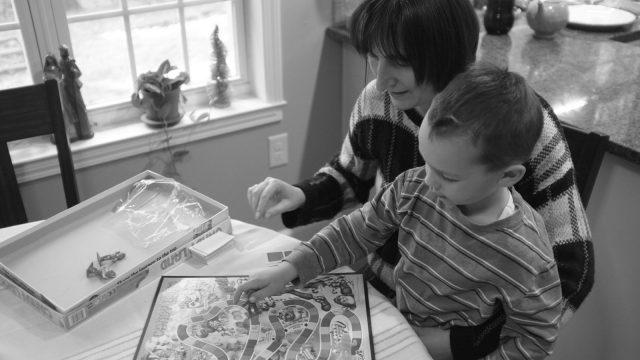
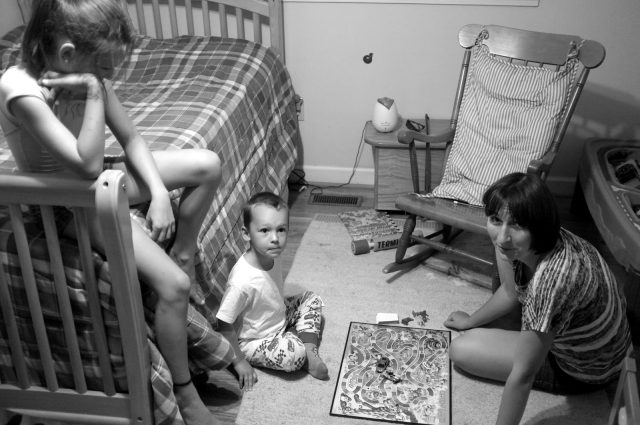
The Boy was playing CandyLand with K, and after he’d won the first game, he was eager to play another.

“I’m going to win again!” he proclaimed, and for a moment, it looked as if he were going to do just that. He shot ahead with double color after double color. Then K drew the gum drop and zoomed ahead.

“Oh, I’ll never win!” he proclaimed, frustrated.

“Yes, but you might draw another candy piece and move ahead, or Mama might draw the candy cane when you’re way past it and have to go back many, many spaces,” I reasoned. But as I often remind The Girl, there’s no reasoning with a four-year-old. He continued playing a bit halfheartedly. He drew a candy piece eventually, but K had shot so far ahead by then that his chances of winning really and truly were gone.

And with that loss, his desire to play was gone as well.

I remembered the whole time they played the new buzzword in education: grit. It’s really nothing more than perseverance in the face of difficulty and setback, but educators and researchers in education like new jargon. (I suspect it’s mainly from the latter.) And so “grit” is thrown around in education blogs and educator gatherings quite often these days. It was rewarding to see The Boy showing some of this perseverance. It took a good bit of encouragement, but he finished the game, learned the lesson (?), and we had a nice close to the afternoon.

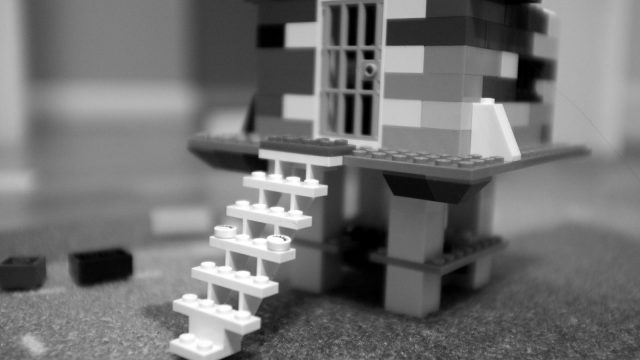
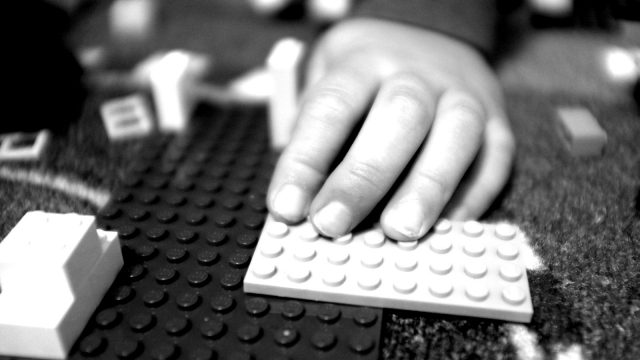
The next night, The Boy and I are working with Legos. I was building a jail for him, and he was building a mystery. Not having a plan, he found the process a little slow-going and frustrating.

“I just can’t get it,” he fussed as he couldn’t get two pieces joined. He threw them down, and for just a moment, I thought the chances of a relaxing evening of Lego-ing were gone. But just for a moment. Seeing everything as a teaching opportunity — or at least trying to — I showed him how to get the pieces together, then pulled them apart and had him try again.

“I got it!”

Two opportunities to teach that could have disappeared but didn’t. The trick for me, though, is to transfer that to my students. Everything can be a moment to teach, a learning opportunity, for the at-risk kids in my charge. They lack social skills, patience, anger management methods, volume control, grit (there it is again), a growth mindset (another edu-speak jargon term that’s hot now). Every teaching moment can’t bloom — I’d never get to the curriculum some days. The balance must be there, but there’s so much they need before they’re gone off to high school…

Inspired by the Daily Post’s prompt of the day: Gone.

Teaching Tasting

The Boy really wants to learn how to cook, so we’ve begun, somewhat unplanned, to recognize spices.

When I gave him cinnamon, he wrinkled his nose a bit, took another sniff, then asked, “Did we put that in the sauce for Thanksgiving?” I nodded my head. “Oh, it’s crunched up cinnamon sticks!”

Monday Chills

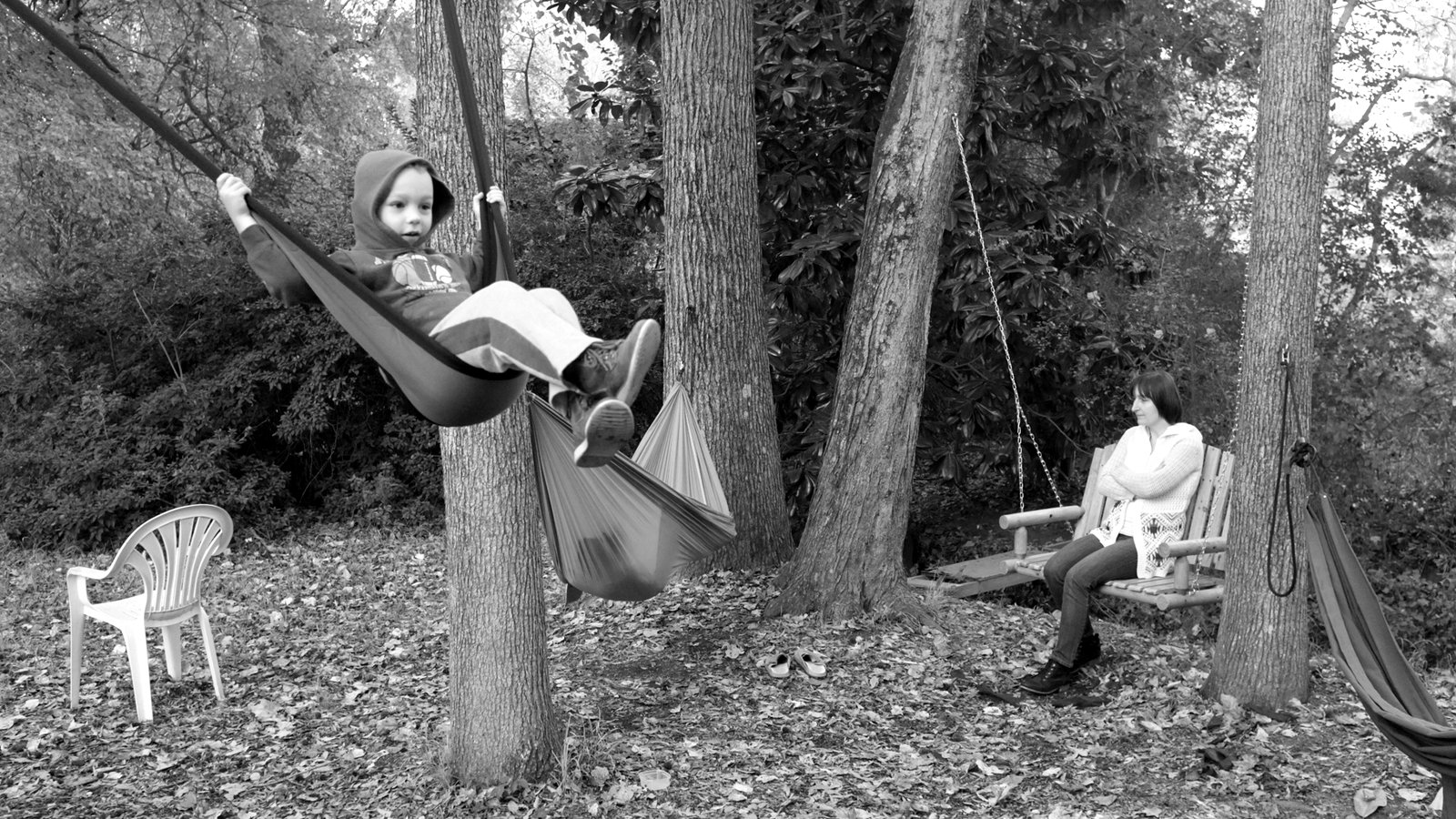
When I got home today, everyone was in the back yard. The Boy was swinging, the Girl, wrestling with Polish lessons.

Tadpole

1-dscf0650

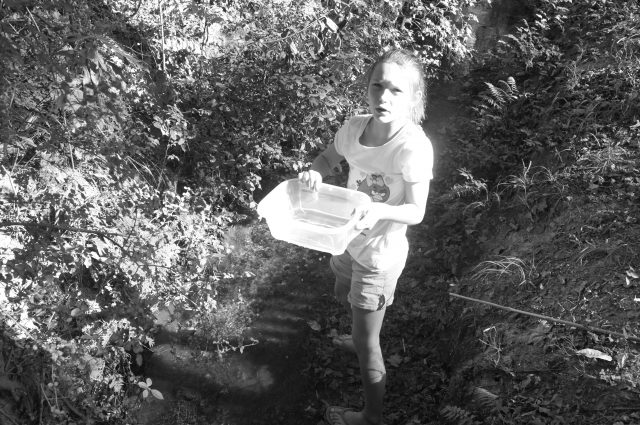
The recently-caught tadpole needs more room to grow. L did some research about what they might eat and how to best provide an authentic environment for development, and she’s determined to see it through to frog-hood.

Candyland

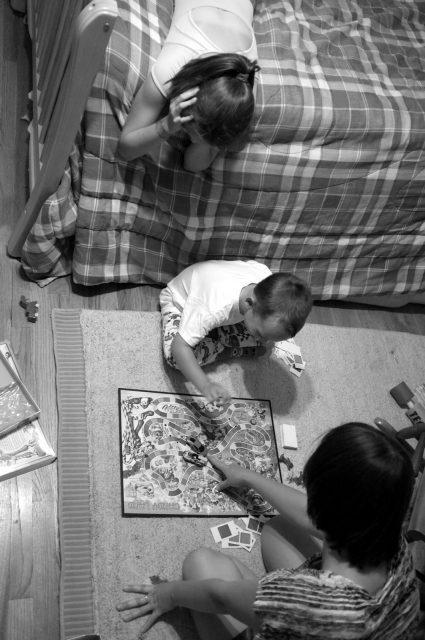
Candyland is a good first game for the Boy. It’s as boring as can be for the adult playing with him, but that’s often what parenting is all about: getting over the selfishness of boredom and relishing the interaction with the child. At the same time, I remember stacking the deck when playing with L, rationalizing it to myself by saying that I was teaching her to lose gracefully or win humbly. Perhaps I was just not savoring the moment and rushing to get to the end.

1-dscf0556

Candyland teaches turn-taking and acceptance of the luck. And while I’d like not to be one to suggest that luck has much to do with one’s fate because I’m a tough-minded, right-leaning moderate, I know that’s just bullocks. It’s luck where you’re born; it’s luck what your parents are like; it’s luck whether or not you have a handicap, physical or otherwise. Still, we right-leaning types like to think of bootstraps and such in the land of the free and home of the brave.

2-dscf0560

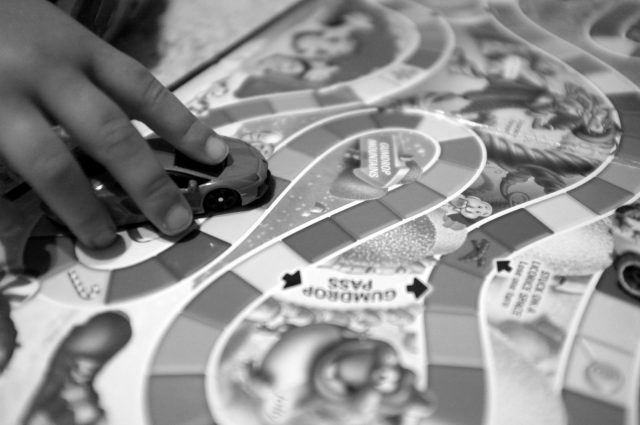
The Boy, though, had to add his little touch: the use of cars. If it’s not cars, he’s really not all that interested. Colors are difficult to remember because, well, colors, but vehicles — he can recognize Lamborghinis and campers, excavators and hot rods. But other things — not so much.

K the other night was working with him on Polish prayers, and she recited the traditional guardian angel prayer. After listening to it, he looked at K and said, “You must be kidding! I can’t remember that!”

3-dscf0593

Perhaps K needs to update it, include a Bugatti or something similar.

Exploring

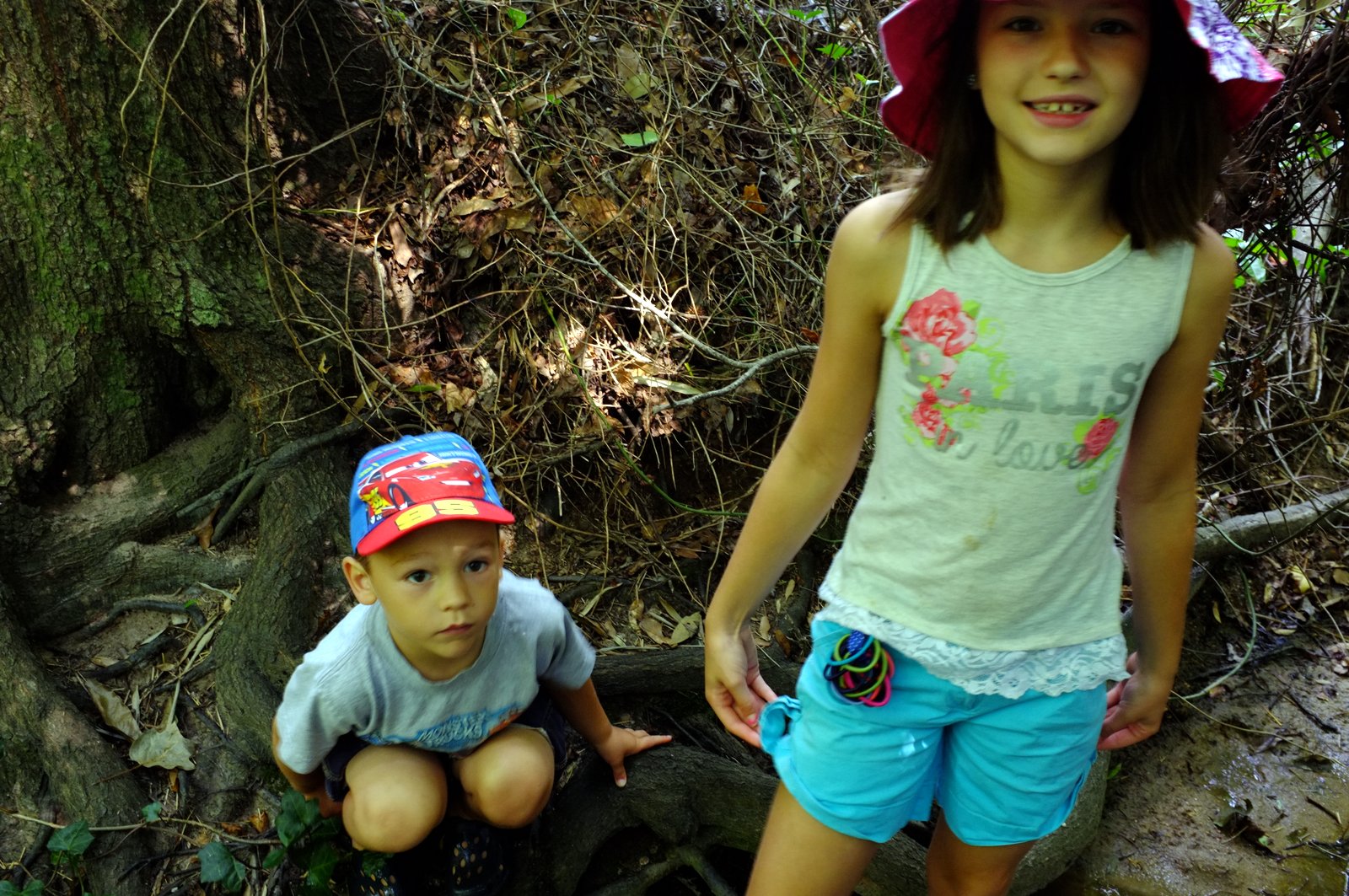
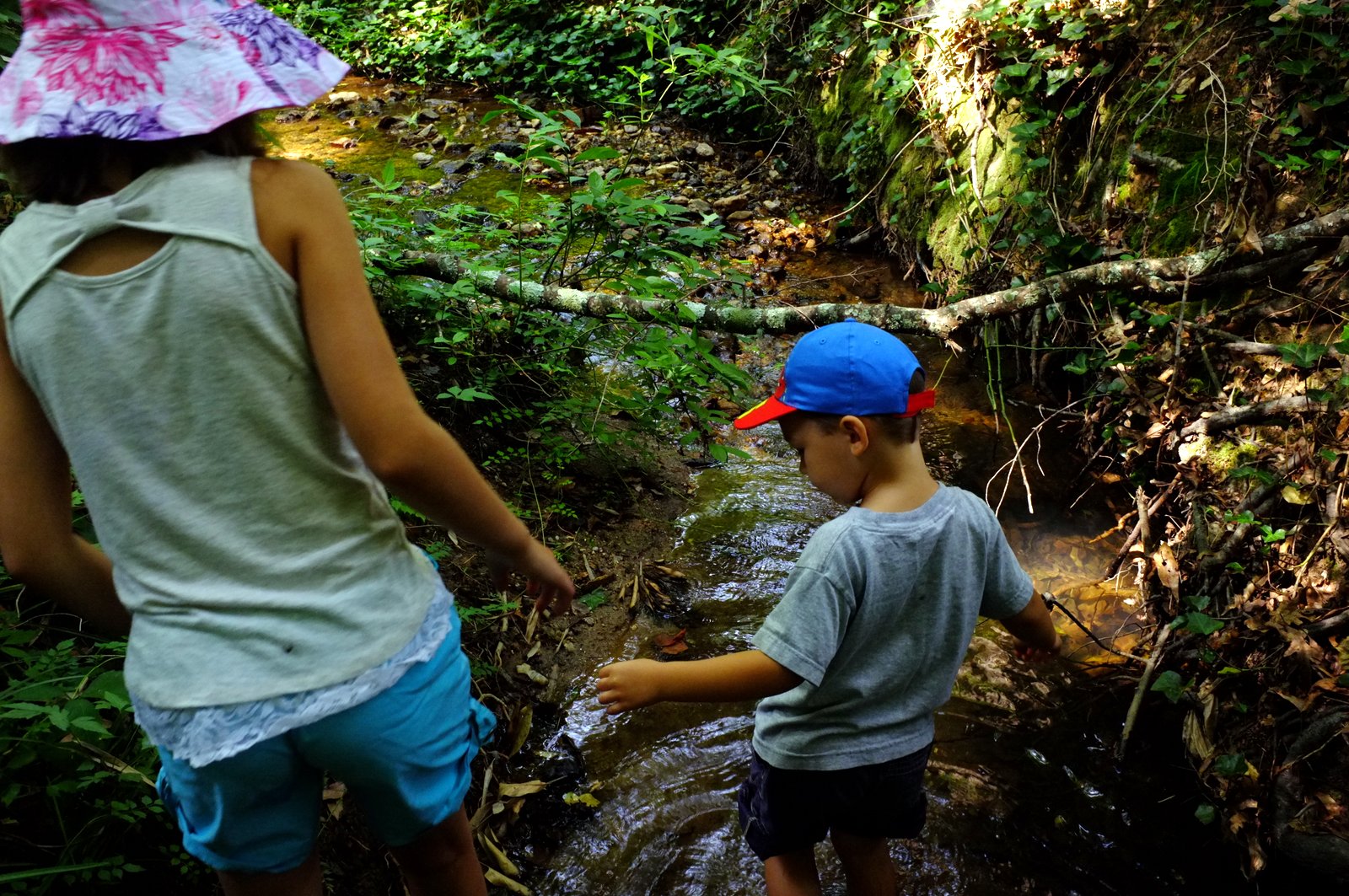
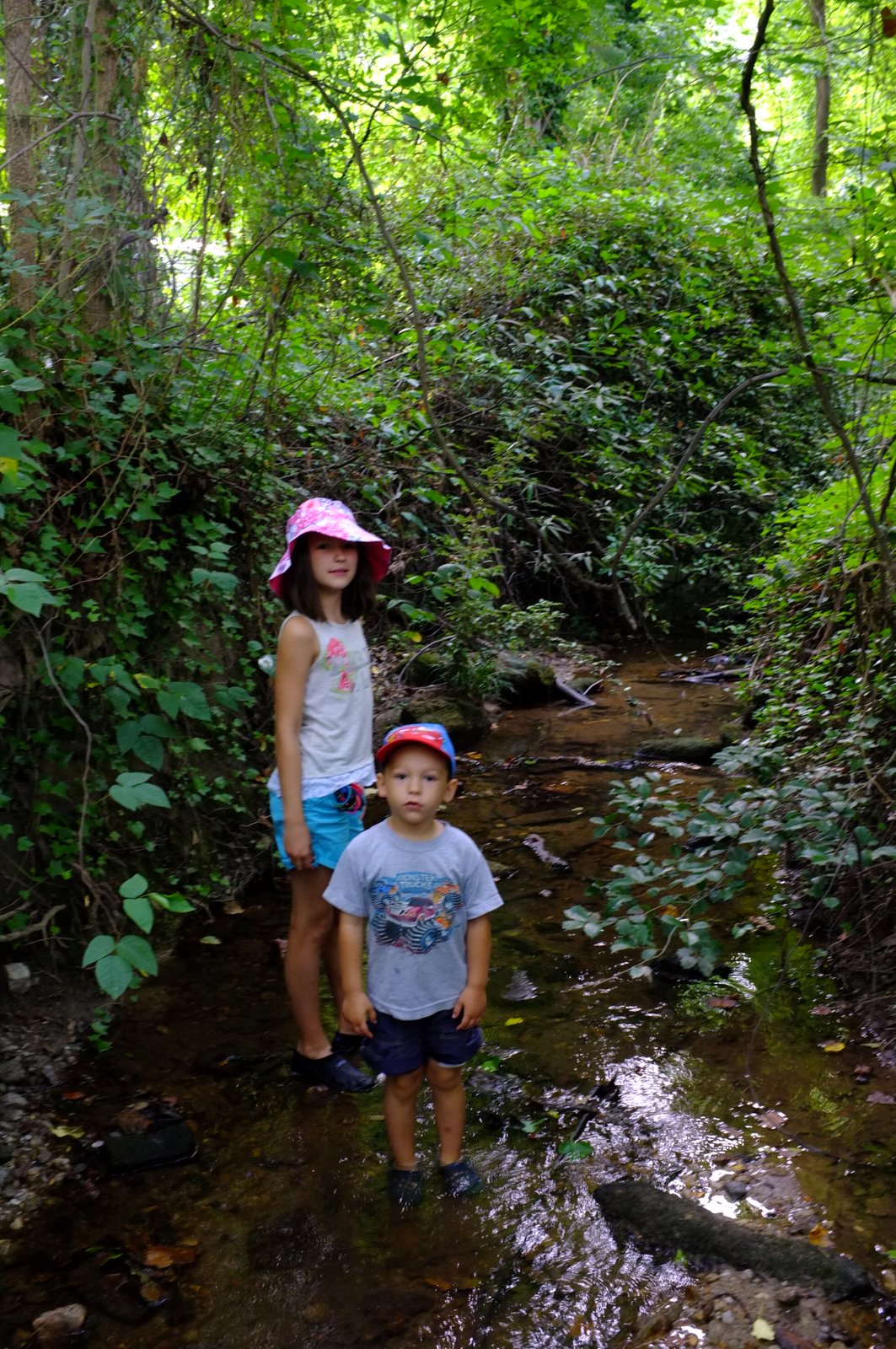
We finally put water shoes, Crocs, and sandals on and went exploring in the creek behind our house.

Earnings

The Boy has become aware of money and all the things it can bring. While he’s not quite dreaming of cameras, he has his own toys he thinks about.

“Daddy, I’m going to save some money and buy that set,” he might say when we discovers some new car set that he simply must have. So he’s set about finding ways to get money. It turns out, our neighbor will give him some spare change when E comes over hand helps him wash his truck.

“He scrubs the tires a bit,” the neighbor explains, “and I help him out in his savings.” Last week, he came back with thirty-five cents.

“Now I can buy my car!”

“Not so fast,” we all want to explain, but it’s difficult to explain to an almost-four-year-old what money really is, what value actually consists of.

1-DSCF8919

Value is something, I guess, you have to learn yourself. Like when you drop some of your coins into the recycling bin that’s half again as tall as you, when you realize that there’s no way at all you can get that money back out without someone’s dedicated assistance.

2-DSCF8928

Cameras

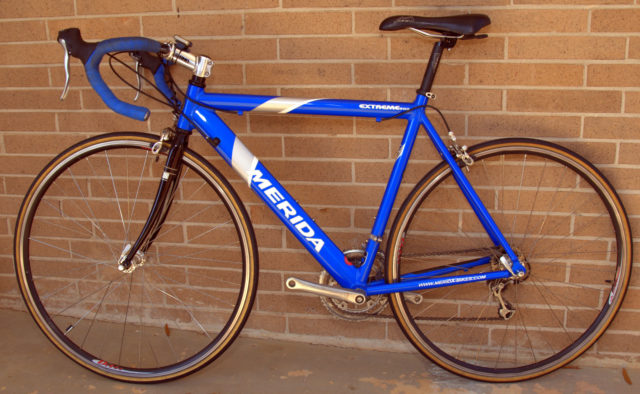
So many things started for me in Poland. Of course the most obvious is my family. I met K soon after my arrival, and now close to twenty years later, I can’t imagine life without her. I also fell in love with cycling while in Poland, eventually buying a road bike that I rode many, many kilometers.

I sold that a few years ago to raise money for my other Polish-born love: photography.

1-DSCF8895

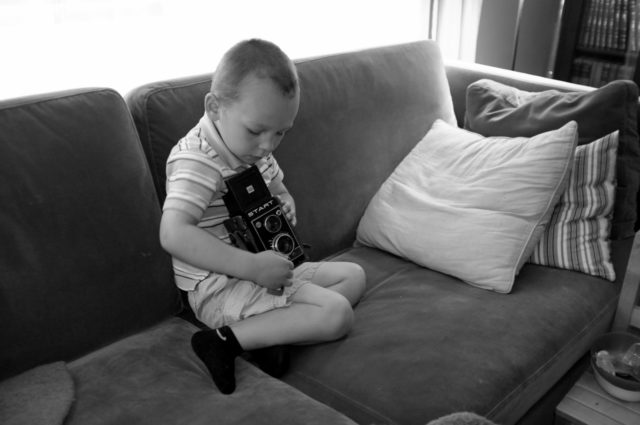
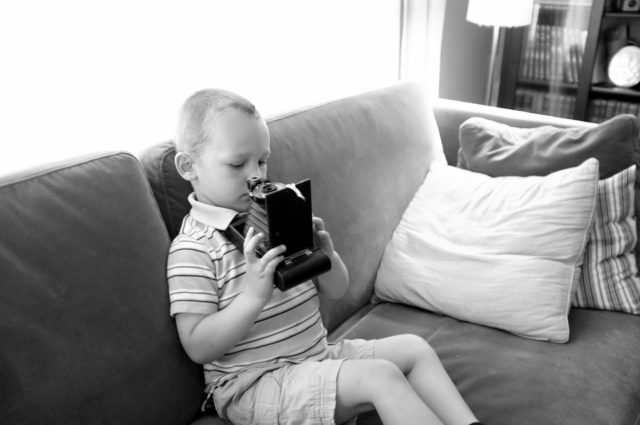
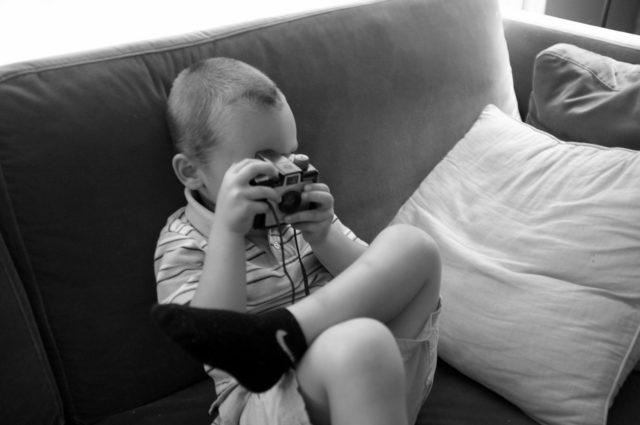
In between the time I first decided I needed a better camera — which was about two or three weeks after arriving in Lipnica — and the images I made today, I’ve amassed a small collection of various cameras, including several Russian models I bought in Poland or K brought to the marriage.

2-DSCF8897

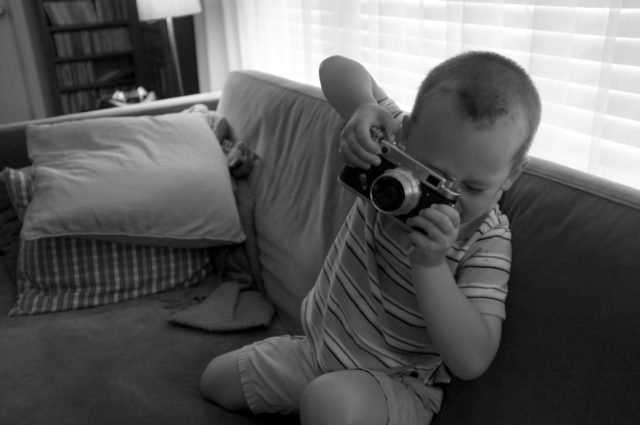
Today, the Boy discovered them and absolutely had to look at them all. The Russian range finders were a favorite as they were small and fit his hands. The twin-lens reflex camera was a mystery: I couldn’t explain to him that you hold it waist level and look down into the view finder.

3-DSCF8898

But he was a quick learner: it was only the second camera that the questions from the first experience appeared: “Daddy, how do you take the picture?” which is to say, “Where is the shutter release?” “Daddy, how do you move the picture?” which is to ask, “Where is the film advance?”

4-DSCF8904

The irony of the situation was on the other side of the lens. I spent so much time lusting after bigger and “better” cameras over the years. The Nikon D2X captivated me until the release of the D3. The D4 of course replaced that, and then came the D5. And it would be pointless to mention that, at around $6,000 for the body alone, these professional cameras are and always will be out of our price range. So I contented myself with the so-called prosummer D300, which is now of course ancient history.

5-DSCF8905

And then there are the lenses. The real magic of the camera is the glass, and my dream lens to go with my dream camera is about $2,000. Again, out of my price range.

The irony? My favorite camera now is our little Fuji digital range finder.

No zoom. No bells. About as plain a camera as one could wish for.

6-DSCF8910

So now I’m dreaming of a $6,000 Leica M9 digital range finder…

Silly boys and their toys.