education and teaching

Pattern of Mate

Chess, from beginning to end, is a game of patterns. Steven Pinker, in The Blank Slate, writes that chess grandmasters are no better than non-players at remembering randomly arranged chess pieces. They rather remember the patterns of threats, attacks, defenses.

Patterns are the stock and trade of autism. Arranging, rearranging, obsessing with shapes.

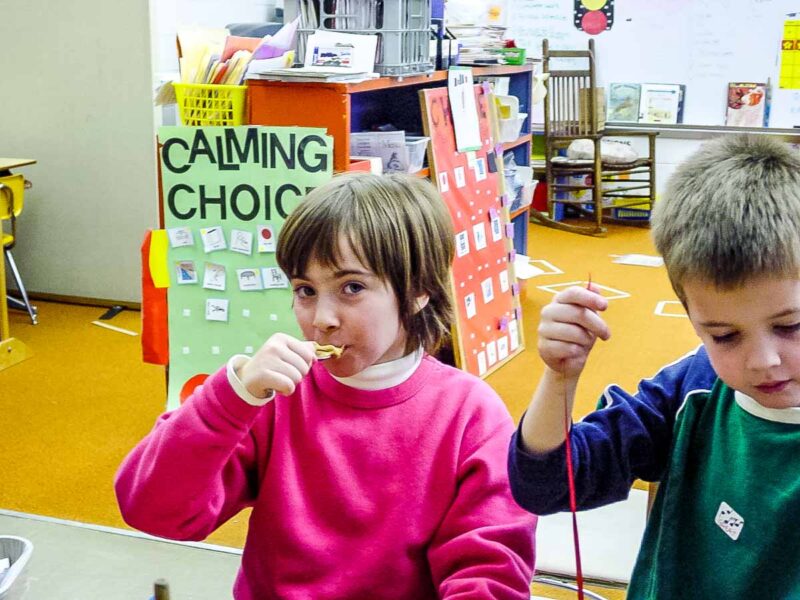
At school I’ve been finding that chess is in fact an excellent activity for children the higher functioning spectrum of autism. During their choice time, several kids have taken to playing chess, taught primarily by yours truly. Elementary chess; chess without much “strategy”; with some kids, chess without all the pieces (minimizing input and thereby confusion) — still, chess all the same.

Today, much to my surprise, one of the children with more intrusive autism (read: closer to low-functioning than most of the other children) decided he wanted play with the chess pieces during his choice time. He knew that they go one to a square, and he’d even picked up from watching the other kids play during the last few weeks that all the pawns go in front of all the major pieces. Once he’d got them all situated, I asked him if he’d like me to show him how the back pieces were to be arranged. He readily agreed, and I showed him: castles (using “rook,” “knight,” etc. was a level of abstraction that I decided was unnecessary) go on the outside; the horses go next, because they’re riding out of the castles; next we have these tall, funny, pointy looking pieces; and then the king and queen. I tried to get him to turn the board around and set up the white pieces, using the black pieces as a model. Nothing going there, and I simply backed off. I returned in a few minutes to find that he’d done it himself.

Impressive.

But more was to come.

Another young lad decided to join in the fun, and the two were soon having a blast simply moving the pieces around randomly, taking with rooks by jumping three pieces at a diagonal, but still obviously grasping the object of the game.

And then the real shock – the first boy put all the pieces back perfectly and they played again.

Once choice was over, I used the chess pieces and board with the first boy to segue into math, working on which numbers are bigger. Instead of using the workbook and coloring in blocks of a chart to give a visual for the young lad, we used the chess board. Once he’d arranged the correct number of pieces on the board, he then colored in the squares in his workbook, and we had a short little quiz.

“Which number is bigger: six or eight?” A quick to the chess board or the workbook gave him the necessary help when he wasn’t sure. By the time we got to ten (I added two squares on a piece of paper, since a chess board is only eight by eight), he was carefully arranging the pieces by alternating color and size.

And we continued working, without a glitch, even when the rest of the class left for the library.
Random Memory

Seven years ago almost to the day, I took the GRE. Living in rural Poland, I had to get up at five in the morning to take a bus to Krakow in order to take the blasted test. Arriving, I had to wait about two hours to take the test.

Not the best start.

I scored decently — over 1800 — but found my analytical score to be about 100 points below what I’d been making in practice tests at home.

One of those silly dress rehearsals I had a perfect score in the analytical section. With a catch: I ignored the time limit and simply worked the problem.

I’ve never understood the point of putting a time limit on a test like the GRE. It means that the exam measures how well you do on silly riddles, geometry problems, and the like under severe time pressure.

And given all the courses and books designed to “help performance,” the whole test is a ridiculous joke.

The Scream

If you’ve never heard the scream of an autistic child, count your blessings. It’s inconceivable how a single, shrill sound could convey so much pain, confusion, and anger. The scream comes from so deep inside them it sounds more animal than human. And yet, it’s so shrill and hollow that it’s ethereal.

Often words are woven into the scream — “I hate you!” or “Get away from me!” — to produce a genderless voice. Add the repetitive nature of what they’re screaming and it’s not difficult to see how this could have once been labeled “demon possession.”

Autism, in the time of a rage, wipes away all differences between afflicted children — gender, intelligence, everything — and replaces it with a screech. The rage contorts the face, flails the limbs, and lashes out at anything in the vicinity. The scream fills whatever space you’re in, seeming at times almost like another entity, hovering around the child as you try to isolate her so that so can calm herself.
If it happens around children who are not accustomed to it, the bewilderment and pity in their eyes is striking. And it’s impossible to deny the spark of fear as well.

Often the screaming subsides as quickly as it comes on. A raging child might notice there’s an echo in the room where he is, and that will be enough to derail the rage and pacify the child.

Good morning

I’m shocked at how many times I’ve said “Good morning” to students coming into class where I’m subbing, and been ignored.

Completely ignored.

What happened to politeness? What happened to basic social skills?

First Impressions II

Back straight, chest out, shoulders square, hands folded behind the back. Greetings, warm but firm, as everyone comes in.

The Speech, highlights:

I will treat you as an adult, which means that I will respect you and speak respectfully to you. When I speak to you, I will not simply bark an order, but I will speak politely. I use “please” and “thank you.” Most importantly, it means when you speak to me, I give you my full attention. I expect the same. Is that clear? Does everyone understand?

A quick survey shows that some indeed are not listening. Time for the sergeant act.

“Ladies and gentlemen, I asked you a question, and when I ask you a question, you will answer it. When I speak to you, you will listen.”

It’s the best drill sergeant voice I can muster, and I deliver the words in a loud and firm voice.

Silence.

“Do you understand?”

Heads nod, a few “Yes sirs.” A hand up. “Were you in the military, sir?”

Sometimes it’s amazing how well I can act the role.

Français sans filet

Je ne parle pas bien français. Je me souviens très peu de ce que j’ai appris à l’université. En fait, j’ai écrit cela en anglais et je l’ai traduit à Babel Fish. Cela explique la bêtise de ce texte.

I don’t speak French well. I remember very little of what I learned in college. In fact, I wrote that in English and I translated it at Babel Fish. That explains the silliness of this text.

Not speaking French didn’t stop me from being a French teacher for the day today. Fortunately, I had two bocks of first-year French and only one block of third-year. Even more fortunately, the planning period fell between the third year and first year blocks, so I had plenty of time to do a bit of cramming.

Oh, for a real Babel Fish, though. Think of the problems that might solve — instant intelligibility. Think of all the translators and comparative literature scholars out of work.

Teaching something while not being entirely sure that you’re teaching it correctly is a little like the Engine that Could — I think this is right, I think this is right.

A few tips for those embarking on teaching a foreign language you barely remember:

  • When in doubt about translation, be honest: “I don’t know.”
  • When in doubt about grammar, be honest: “I don’t know.”
  • When in doubt about spelling, be honest: “I don’t know.”
  • When in doubt about pronunciation, mumble.

And thank the maker for an assembly that cuts half an hour off your last lesson.

ESubL

Being bilingual can really be a troublesome affair when trying to teach English – if your student’s L1 is different than your L2.
Today, while subbing, I worked with a student of Latin origins who spoke very limited English. I speak even more limited Spanish, though I’ve decided I must learn that language. At any rate, I found that while working with her it was a constant and very conscious struggle not to lapse into Polish. “She doesn’t understand what you’re saying,” a voice was screaming in my head, “So use another language.”

Unfortunately, Polish was not terribly helpful.

The world of ESL is frightful in some ways. The responsibility is enormous.

As an EFL teacher, I was teaching a foreign language, which means it’s not going to be used that often. It’s not often going to be the basis of all other learning. And teaching English as a foreign language also affects the skills stressed. My primary goal for my students was verbal communication. Writing is important, but not nearly as important as speaking.

I confess, then, that I probably didn’t spend enough time with my students working on writing, until the national testing standards changed and forced my hand.

ESL is an entirely different animal. The goal is simple: get students’ English up to a level where they use it as their primary language for instruction. Think about it: it’s re-wiring a house, re-pouring a foundation. No, wrong analogy. It’s adding a second set of wires to a house, putting a foundation within a foundation.

And what do students do in the meantime? If they have limited English, how do they learn science? The idea solution is bilingual education, with L1 gradually being phased out. But the ideal is often just that.

In Your Face

What do you say to a student when he says to you aggressively, “You don’t have to get up in my face like that!”? How do you respond when in fact all you were doing was trying to be “reasonable” and explain why you were calling him down in the first place, and doing it by squatting down to be at eye-level with him, talking to him like a man? Is this blatant disrespect, or something else?

I’m not even sure I know what it means to be “in someone’s face about something.” I’m assuming that it means the chest to chest, strutting peacock type of testosterone-laden behavior I saw myself as a student many times. Of course I wasn’t doing that when students said those lovely words to me, so what’s going on?

An invasion of someone’s personal space is the only explanation I can come up with. In trying to be respectful — and I do believe teachers should be as respectful to their students as they expect their students to be to them — it seems I crossed an unknown, unseen boundary and caused offense. Or perhaps he was just testing me, seeing what he could get by with?

Support from Your Principal

Erin O’Connor at Critical Mass has a fascinating and yet disturbing post about a way of dealing with student profanity…by allowing it.

An English high school has decided to cope with the problem of student profanity by tolerating it. Beginning this fall, students will be allowed to curse at their teachers, just so long as they don’t say “f — k” more than five times during a lesson. Part of the new policy involves keeping a running tally on the blackboard of how many times the word “f — k” has been uttered during a given lesson–a practice that promises to distract students.

I for one would feel this as a complete abandonment on the part of the principal of any acknowledgment even of my authority as teacher.

The post is here.

Are you our sub?

A first-time experience and I keep quiet — that can’t have happened too very often. But the details about the events of yesterday, fascinating though they were, will remain distanced from any comments I might make here about it. The experience: I was a sub. First time.

In an effort to gain a face in the local school system, I am trying substitute teaching, and I got my first call yesterday morning.

“Substitute teaching.” That in itself seems to be an oxymoron. Teaching is a profession requiring such intimate knowledge — not the least of which, the kids’ names — that “substitute teacher” has all the ring of “substitute shrink.”

“Yes, I know you’d rather be talking to Dr. White, but he’s away on urgent business and his office asked me to come down and fill in for him. Now then, what seems to be the problem?”

It just doesn’t seem like it would work.

Yet at an orientation session for new substitute teachers last week, I and other new subs learned that “subbing isn’t the glorified babysitting it used to be” and that subs are expected to continue on instruction. In other words, be a substitute teacher and not just a substitute authority figure. I’m not sure it was ever anything else, but I do think that there was less expectation of what subs would accomplish in the classroom, say, twenty years ago.

The Day

Seven years of teaching has taught me one invaluable thing about the profession — take nothing they do personally. Any silly, probing, “let’s-see-what- he-does-now” behavior is directed at my role, not my person. That realization will be key to being an effective sub.

I survived. Not only that, but I enjoyed it. It felt good to be in a classroom again. With the beginning of the school year here (and approaching in Poland — 1 September), it was difficult to keep from feeling a tinge of sadness at the thought of not teaching this year. The call Friday morning helped alleviate that.

I spent the afternoon with a group of seventh graders, the first time I’ve worked with that age group in many years.

Six weeks of my student teaching was in a seventh grade classroom, and those kids, according to my reckoning, have just finished college, so it’s been a while.

Seventh grade — an interesting age group, for they’re right on that border between “child” and “young adult,” beginning to realize that they’re not kids anymore but not quite sure how to handle that.

Survival Mode

And out of the blue yesterday, a tolerable lesson with The Class. What makes them tick? I have no idea. Such a strange group of kids. Monday was living hell; yesterday was survivable, even decent. But still, the same old folks were up to the same old game – gap speaking activity turned into a copy-your-partner’s-worksheet activity. And of course the usual suspects didn’t come to class with anymaterials whatsoever, then use that as an excuse to sit and draw all lesson.

I’ve finally realized with that class that I simply can’t make them learn, and so I concentrate now on the five to seven students (depending on their moods) who want to learn, with the four hardest-working students (and therefore, best behaved) at the front of the room. I talk to them, and glance at the others from time to time, in case someone there gives a crap. Most of them don’t, it seems.

The other day, I all but told them this. I said that I really didn’t care whether they care anymore, and that I’m going to put all my attention on those who in turn pay attention. “Tak jest,” said the best student – a young man who has, I believe, one B (a 4 in the Polish system) this semester.

I worry this might be self-defeating in the long run, and not a very good classroom management method. Still, I’ve got about three weeks of school left, and I’m just in survival mode with them now.

-ation

I did a lesson on word formation with a group of juniors today. We worked on turning nouns to adjectives (i.e., beauty to beautify) verbs to nouns (i.e., improve to improvement), and then I stunned them with the news that they were going to learn more than a thousand new words during the lesson.

It’s an easy lingustic trick, really. Words that end in “-ation” in English usually are virtually identical in Polish, only with an “-acja” (pronounced “aat-see-ya”) suffix, or a variation.

  • “revolution” is “rewolucja”
  • “inflation” is “inflacja”
  • “distribution” is “dystrybucja”

I don’t think I need to elaborate on what word young Rafał blurted out in class…

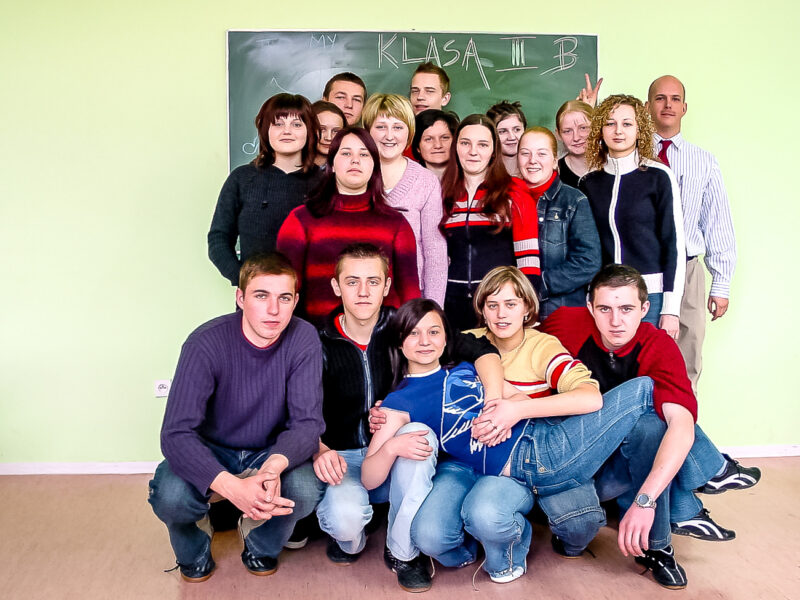
Class 2d

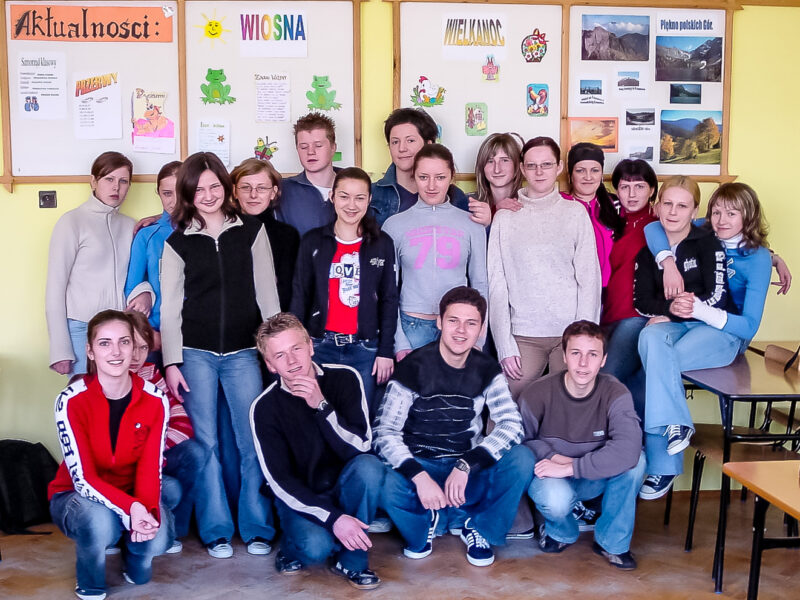
Not supposed to have favorites, but I’m not going to lie — this was one of my favorite classes.

Matura

Here in Poland, the bane of high school students’ existence has just begun: the matura. This year is exceptional because it’s the first time in many years that the matura has been significantly revised.

The old matura was hell. The new matura — well, we’ll see.

This year the order is reversed: first the oral exams (in both Polish and a foreign language), then written exams (in Polish, a foreign language, and a third, student-chosen subject).

It is also, in my opinion, much easier. The foreign language exams, at least the basic level exam (there’s also a possibility to take an “extended” exam), depends more on students’ ability to communicate than on grammatical knowledge.

The English Matura

The English exam has four parts: three situations/dialogues, and a picture. The situations have three sub-points that students have to complete in order to get the full credit. Usually the situations are something like, “You are on vacation in England and you read an advertisement about excursions to Scotland. Call the given number and find out,” with the three sub-points being something like:

  • cost of the trip;
  • what’s included in the price;
  • when and where the departure will be.

Pretty basic stuff, and most of the kids who’d put forth any effort whatsoever during the last three years will have no problem with it at all.

The picture is always of one or more people, doing some obvious, clear activity. Students have to describe the picture, than answer two questions about it.

Again, pretty basic stuff.

Still, a lot of the students are scared silly. Many of them have no cause to be frightened — they’ll pass despite their jitters. But a few have reason to be nervous.

I too am a little worried about it. It’s at least a partial reflection of my teaching ability. It shows, I think, students’ communicative skills (or lack thereof) much more so than my teaching, but still…

Teaching

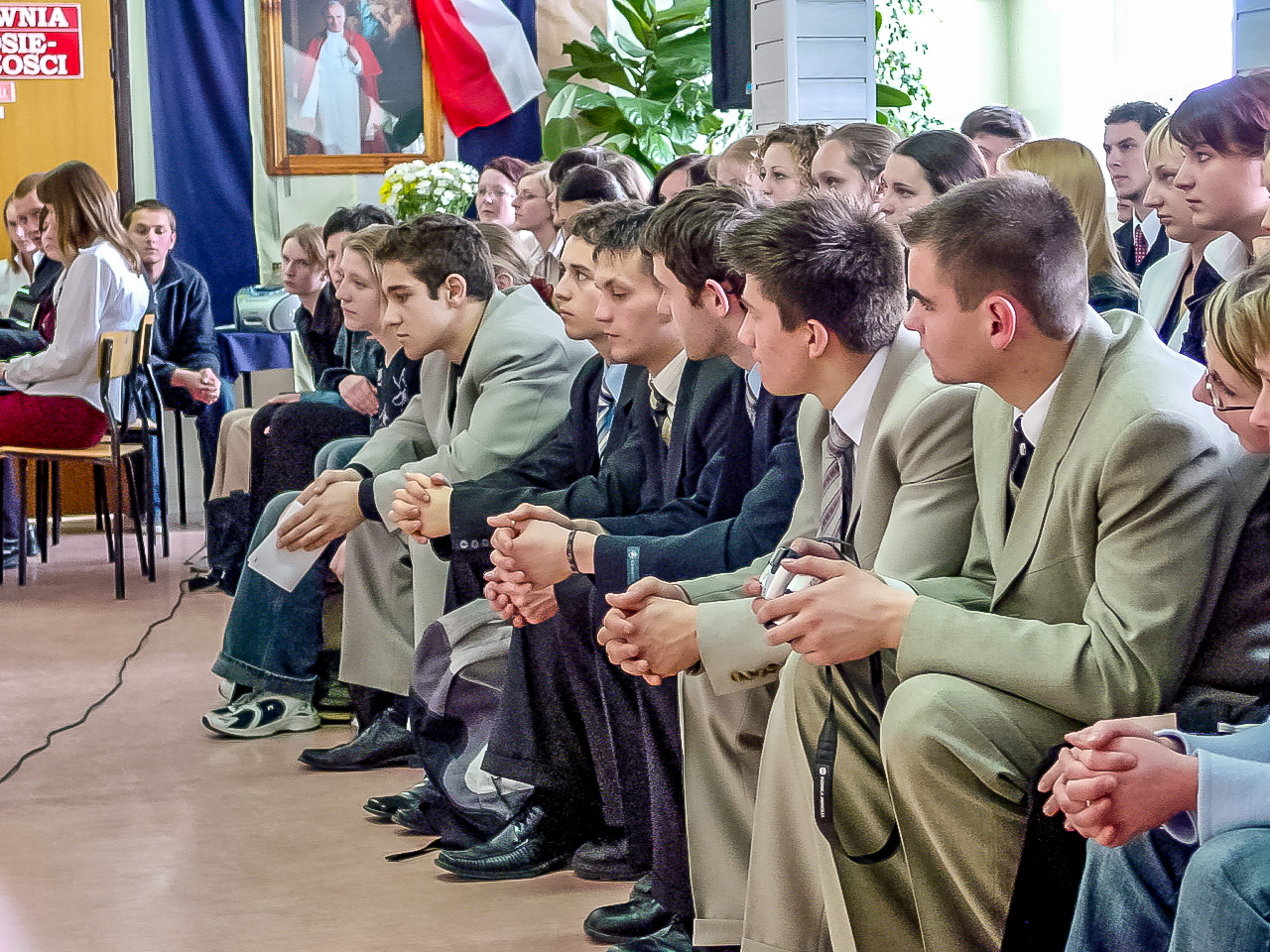
The end of the school year for seniors – today was the last time they’ll all be together, and as of this afternoon, they are officially graduates, with only the matura (exit exam) awaiting them. There was of course something like a graduation ceremony, complete with a series of skits and songs performed by juniors, as per tradition. Naturally, among the songs was that school classic, “Ale to już było / I nie wróci więcej”

(“But that has already been, and won’t return again”).

I sat there, facing the seniors, watching some of the girls get teary-eyed and sing along, and I couldn’t help but smile. I wasn’t happy because of their obvious sadness, but because of the privilege I was experiencing – to be that close to so many young people that are of no relation to me at all. I see their joys and troubles, and sometimes have to put up with their troubles jointly when they come pouting to class. When I’m extremely fortunate, I’m even part of the cause some of their joy; and unfortunately, I’m certainly the cause of their troubles too often. But young skin, hearts, and bones mend quickly, I tell myself.

I’ve taught these seniors for three years – their entire high school career. I’ve seen some of them go from being complete beginners to relatively eloquent English speakers.

I’ve seen some of them come in and leave with the same level. Most have improved, as evidenced by letters that I had them write to themselves at the end of their first year in high school and then gave back this week. What a feeling, watching them read and hearing them laugh at their own silly mistakes, and what a sense of accomplishment for them that they can now see those mistakes.

But it’s not only been their English that has improved. Girls have become young ladies, in appearance and behavior. Little boys in teenagers’ bodies have become responsible young men. Nerdy outcasts have improved their social skills and have even become semi-popular. Boys learned how to comb their hair and became young men, and awkward young girls became attractive young women.

That’s the best thing about having taught in the same place for a while – you see the kids grow up. It’s like parenting, without as many of the worries.