education and teaching

It’s a Beautiful Day

It’s rare that we wake up with a sense that today something truly fortuitous will occur. I guess that has to do with the etymology of the word:

1653, from L. fortuitus, from forte “by chance,” abl. of fors “chance.” It means “accidental, undesigned” not “fortunate.” (Online Etymology Dictionary)

We can’t foresee luck — it would be the ultimate oxymoron.

All of that notwithstanding, I woke up this morning feeling positively positive. I arrived home in a bit of shock.

For some time, K and I have known we will be moving out of the Asheville area — the real estate market is ridiculously overpriced. Yet where to go? We needed a place that’s developing so K can get a job; we needed a place with good schools and lots of them. Greenville, just across the border in South Carolina, seemed the ideal locale.

Spring comes, and the school systems across the countries publish their anticipated and actual staffing needs for the next year. As such, for the past few weeks, I’ve been checking the Greenville County Schools website almost daily, applying for almost every English/LA position that appears.

Last Sunday evening I got a call.

“Have you accepted a teaching position yet?”

I think: “Are you kidding? I haven’t even heard much of a ‘we received your resume thank you very much.'” I say: “No, not yet.”

“Would you be able to come this Wednesday for an interview?”

I think: “Try keeping me way.” I say: “Certainly.”

How fortuitous. I have an interview, and I can drop by a few schools as well.

I wake up this morning feeling that something good is going to happen. Something better than good — something beyond unexpected.

First school: principal is there, but not available. We’ll take your resume and be in touch.

Such has been my experience. It’s understandable — principals are busy, to say the least, and they don’t have the time to see every single applicant who drops it to try to get a head-start on the rest of the pack.

I drive to the second school. The receptionist doesn’t know where the principal is, but gets on the now-standard walkie-talkie and asks the principal if he’s able to come meet me. He’s in his office, and within a few moments, I’m sitting across from him as he looks over my resume and asks a few questions. Then: “Okay — you’ve got five minutes. Sell me.”

I’m not dressed for an interview; I’m not expecting an interview; I’m certainly not prepared for an interview at this moment — but apparently I’m having an interview.

What do I say? Long story, and perhaps I’ll share it here. Probably not. Suffice it to say that I do fairly well. How do I know?

“Well, I don’t want to make a decision right now,” the principal says, “But let me get in touch with your references and I’ll be in touch.”

There are moments when you’re fairly sure your ears are compacted with wax, or have been blown like Pete Townsend’s, or are submerged in water — certainly he didn’t say by implication, “You’re almost hired.”

At any rate, I walk out to my car in a bit of a daze. “I knew something good was going to happen.”

Lunch with a friend, then I change into my Superman suit and head across town to the interview. The actual interview. The scheduled interview.

Questions about

  • the integration of technology and instruction;
  • how I keep up with developments in my field;
  • my comfort level of teaching to rigid standards (i.e., NCLB);
  • how I might go about creating an atmosphere that is conducive to learning;
  • what sorts of professional development programs might help me feel more comfortable teaching;
  • how I might bring my life experiences into the classroom; and,
  • how I dealt with the cultural and linguistic differences while teaching in Poland.

More questions, more answers — I am hot. I speak with a fluidity that I’ve never experienced in an interview. I’m enthusiastic. I’m succinct yet not wooden.

In the past, I’ve had absolutely awful interviews. I walk out to the car fighting the temptation to go back and say, “Look, let’s not play games. I know I blew it. Thank you for your time.”

During a pause in the interview, I think, “I might have a chance at this job!”

After that pause, I hear “And how would you respond if I offered you the position right now?”

Count to ten. Slowly.

I sat stunned for at least that long.

I think: “What would I do?!? Fight the urge to dance on the table! Swallow the ‘barbaric yawp’ that’s muscling it’s way up my throat!” I say, hoarsely: “Are you offering me the position?”

“Yes.”

Count to ten again. In the meantime, I look at all the other faces in the room. I remind myself that it’s May, not April. I slap myself mentally and shout, “You’re just sitting there like a zit, you dolt!”

What to say?

I go with the subjunctive voice:”I would ask when you would want a decision.”

“Now,” she says, with a warm and polite smile.

Red flags! Flashing lights! “Danger, Will Robinson!” Our Kia adventure made me hyper-sensitive to any kind of “decide now” situation. What’s going on? Do they have so few applicants? As Julie Andrews asks in Sound of Music, “What’s wrong the the children?”

As delicately as possible, I ask why the rush.

“Because we simply don’t want anyone else to snatch you up.”

I did wake up morning, didn’t I? I remember having my morning tea, followed by a now-rare morning coffee. No, I’m out of bed, showered, dressed, sitting in a conference room being offered a job, being told that my interview was “exemplary.”

After a tour of the school, meeting faculty and staff along the way, I go with my gut feeling. Back in the administrative offices, the principal says/asks, “So I’ll call you tomorrow?”

“No, I don’t think that will be necessary.”

The last person I meet on my way out is the secretary. “She’ll be sending your paperwork to the district office today,” says the principal.

And so, come August, I’ll be the new eighth-grade Language Arts teacher at Hughes Academy of Science and Technology.
Chinese Math

America, in general, is lagging far behind a lot of the world regarding education, and this is particularly true with science and math.

Who’s ahead of us? It might be easier to ask who isn’t ahead of us.

Not surprisingly, the Chinese, in their quest for world domination (Mwa-ha-ha!), not only have cheap labor on their side; they also have a higher level of mathematics achievement, I’d venture.

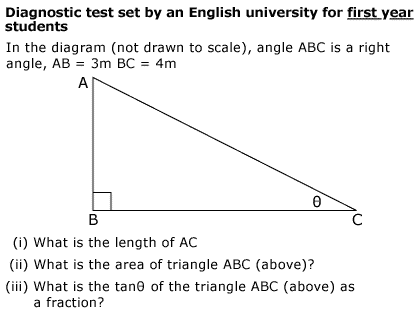
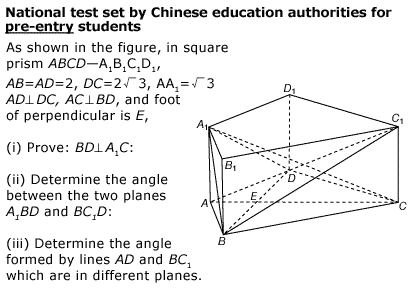
The BBC recently put up two questions from two tests: one, a test intended for first-year university students in English schools; the other, a question from a Chinese pre-entrance exam.

Here’s the English problem:

English Math

That’s pretty simple. Even I, having used no geometry for close to twenty years now, can do that with no problems.

Here’s the Chinese problem:

Chinese Math

From BBC.co.uk

Limitations

The other day, I got a comment at another website that meant more to me most other comments I’ve received put together:

Hello! I want to say thanks, because you was (no, are still) very good english teacher… you’s lessons helps me very much, now I’m live in Ireland, and I m still learn… If you want to write me: [email and name redacted]: 1,2e ”zarzadzanie inf, terrorysci…”bye

In a class of “difficult” students (who, in retrospect, were angels), this young lady was one of the few students I could count on consistently. She caused any disruption; she rarely came to class unprepared; she rarely wasn’t smiling and happy.

Naturally, I wrote back. And of course I got this in return:

A message that you sent could not be delivered to one or more of its recipients. This is a permanent error. t the moment you cannot send a message to [reacted], try again later 1: retry timeout exceeded

I tried again, knowing it was a futile effort. Still, the thought that it might not go through, and she’ll think my response to her invitation to contact her was, “Um, no thanks,” irritates to no end, so I tried. And yet again.

And so, I. Z., if you are reading this, please know: I wrote you back, but onet.pl is cranky and often does not take email from my account.

Which leads me to a question for all tech folks who read this (both of you): What could be causing a consistent problem with delivering email to Polish servers from a given account here in the States? I’ve asked tech support for my web host — they think I’m crazy. But consistently email sent from any address that uses the server this site is hosted on gets bounced back, or simply disappears. As in, “Did you get that email?” “What email?”

What I wouldn’t give, sometimes, for a return to consistent use of regular mail for correspondence…

  1. -1

Learning to say “Okay”

For many of the young people in the program where I work, one of the formal goals that forms part of the forest of paperwork about them is “Learn to say “Okay.'” What that means in practical terms is fairly simple: many of them are unable to accept criticism — broadly defined as anything even apparently critical of them or their actions — of any kind from adults.

A scenario from not so long ago illustrates how many things are going on that can make it difficult for someone just to say, “Okay.”

Two boys, in class, are doing something disruptive. Fidgeting with something, throwing it back and forth (maybe a jacket?) or something. I couldn’t see clearly what it was, but it caught my attention and I deemed it a distraction.

“Hey, guys, stop doing that, please.”

“Doing what?” one asks simultaneously with the other’s plea of innocence: “I wasn’t doin’ nothin’!”

Now it really doesn’t matter what they were doing. It really doesn’t matter if they were doing anything at all. The best response to bring the whole exchange to an end, to prevent it from escalating into something more serious, to ensure not getting into trouble, is to say, “Okay.”

“If you have a problem with that,” we tell them, “you can talk to the teacher afterward. If you don’t know exactly what the teacher is asking you to do, you can ask for clarification after saying “Okay.’ But getting defensive, taking it personally, exaggerating it into a personal affront will only make the situation worse.”

And so going back to the above scenario, I reminding the boys that one of the skills they’re working on is simply saying “Okay” and moving on.

“I ain’t sayin’ “Okay’ to something I didn’t do!” one replied indignantly.

“Why not?” I asked. “In saying “okay’ you’re not admitting to guilt. You’re not doing anything other than acknowledging that you heard and understood what the person in authority — be it a teacher or not — is saying.”

“But I didn’t do nothin’!” he protested.

“But that doesn’t matter.” I responded. “In protesting it, particularly in the manner you’re doing now, you’re not doing anything to help your situation.”

“Are you telling me that if someone accused you of doing something…”

“Whoa, wait — I’m not accusing you of doing anything. I simply asked you both to stop. If you weren’t doing anything, then clearly I wasn’t talking to you. Even if I was addressing you alone and said “Stop doing that” and you were behaving perfectly, the best response is to say, “Okay’ and move on.”

“Move on?! You’re the one making an issue of this” he said, voice pitching upward into a virtual screech, eyebrows raised just enough to say — inadvertently or purposely — “You’re an idiot for saying that.”

“No, I’m using this moment to remind you of a skill you’re working on and to try to get you to practice it.”

The boy couldn’t accept that saying “Okay” even if you’re completely innocent is anything more than an admission of guilt. And to prove his point, he brings up a most fascinating example: “So you’re sayin’ that if you walking down a street and cops come up to you and say, “You look like this guy who just robbed a bank,’ and arrested you, that you’d just say, “‘Okay.'”

The discussion is starting to get less and less productive as we range farther and farther off topic. Or are we off topic? Is this how the boy equates all these things? I decide to play along.

“Yes, I would. Or at least I hope I’d have a cool enough head to say that.”

“But you didn’t do it. Are you saying that if they said, “You robbed this bank,’ that you’d just say nothing, that you wouldn’t tell them you’re innocent? They’ll take you to jail and what — you’ll end up spending ten years in jail for something you didn’t do?!”

Right here, though I suspected it moments earlier, I realize the young man didn’t have a firm grasp on the workings of our criminal justice system. And another thing begins dawning — we’re really getting off track. Does this help the young man understand the situation? Is he just trying, like so many of the boys do, to get me so wrapped up in a discussion argument exchange that it’s just a matter of whoosh! blink! and the whole class is over? I decide, somewhat against my better judgment, to continue.

“Just because they arrest me doesn’t mean I’ll be spending ten years in jail. There’s a trial first, and in the meantime, I can be released on bail. But think of what they say, what you hear on TV, every time they arrest someone.” Almost together we recite the Miranda warning. Then I continue, “Now if I’m an idiot, I’ll start blathering on about how I’m innocent and how I didn’t do anything and then, in court, that will be used against me, because the irony is, it makes me look guilty. If I’m smart, I’ll shut my trap completely until I can get a lawyer.”

“But if you didn’t do nothin'””

Especially if I hadn’t done anything,” I replied.

Finally things are winding down, and a boy enters from the other group.

“Hey, Mr. S, let’s ask him if he’d just say “okay.’ ‘Eric, if someone framed you.'”

And now everything is mixed up. Nothing is as it started. We’re no longer talking about whether or not saying “okay” helps you in a situation even if the request is relatively arbitrary; we’re no longer talking about whether or not saying “okay” is an admission of guilt — we’ve moved off into the netherworlds of arbitrary, six-sixty-degrees-of-separation tangents that suck up time and accomplish nothing.

Or is it simply that he doesn’t understand what I mean? Are all these scenarios that we’ve been bouncing off of each other identical to him?

In the end, he simply says, “Well, if that’s a skill, I guess it’s a skill I won’t use.”

And I think, “Okay — we’ll try again tomorrow.”

Stating the Obvious

“You’ve got kind of a big nose, huh?”

The words fell like grenades as the three of us bobbed about the shallow end of the pool. My best friend was talking to my new girlfriend my first girlfriend, truth be told who’d been the axis of my existence for the previous week of band camp.

The words hit her fairly hard, too, for her eyes teared up and she swam away.

I said something icy and hateful to my friend and swam off to comfort my lady.

Truth be told, she did have a nose that was a bit on the large size, though of course I was not foolish enough to admit it when my friend protested later, “But she does have kind of a big nose.”

“You didn’t have to say anything,” I thought. I said, “No, she doesn’t!”

She herself admitted it sometime later, with a laugh, even.

We were all twelve, and yet somehow my friend had not yet learned that you don’t have to say everything you’re thinking.

Many of the boys I work with daily, at age fifteen, even sixteen, still have not learned that either. If I go into work with a bit of razor burn, I get comments. Endlessly. If they think my clothes are somehow unfashionable, they let me know, then stand around in a circle and laugh about it as I stand there.

It’s funny — when I was their age, I did the same thing. But my friends and I talked about teachers’ razor burn or mismatched wardrobe in hushed tones, and we would never be presumptuous enough to think that we could mock the teacher as if he were a peer. But that is exactly what many of the boys at the center do.

The worst was the first time I cycled to school. When they saw me in typical cycling clothes everything spandex, basically they howled with laughter. “Oh my God!” one literally screamed. “Look what a faggot Mr. S looks like!”

Part of what I try to do on a daily basis, then, is to encourage them to whisper among themselves instead of talking among themselves. And this is particularly frustrating, because it seems to them that I’m simply annoyed by their behavior and trying to punish them in some way or other. Quite frankly, it’s easy to ignore such immaturity (and that’s really all it is), but that’s not my job — and therein lies the frustration.

Snow Day

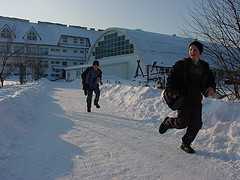
Snow Day? You must be kidding? I woke up this morning to a fiery throat, thinking immediately, “Maybe I’ll come home early — as in, shortly after arrival — if we’re not terribly short-staffed.” Much to my delight, I looked outside and saw a powered sugar dusting on everything and thought, “No school, I’m sure.” And sure enough, no school. There’s less than an inch of snow on the ground, but no school.Returning home from school

I think back to the years I spent in Poland, buried in snow from December (sometimes November) to March. I believe we missed one day because of weather. If I recall correctly, students are not legally obliged to come to school if it’s colder than minus 18 Celsius (0 Fahrenheit), but many come anyway.

K laughs at the reaction here to the slightest bit of snow. There are two reasons, I explained to K. First, most places don’t have the equipment to remove snow city-wide. And given the fact that so few people have experience driving in snow, the slightest bit makes them nervous.

dsc00048A colleague at work provided the second explanation: that there’s a certain phobia with local school boards about lawsuits, and so they cancel school at the slightest hint of bad weather.

Both reasons are completely foreign to K.

Many roads in Poland are literally packed with ice through most of the winter, so the thought of being spooked by a couple of centimeters of snow is absurd to her.

And the fear of lawsuits?

Only in America, she smiles.

Update

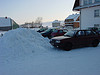
I went out for a walk at about eight. Suddenly, it was fairly clear why school was closed.

Slip Slidin' Away

Just a few feet apart, three cars that slid off the road.

For the Want of Punctuation, Calm Was Lost

We’ll call him Doug. He’s one of the young men I work with — a young man who’s made a lot of progress in the last few weeks. An exchange with him a few weeks ago taught me — again — the importance of speaking judiciously, and it suggested something of this young man’s past.

We were writing up reports from a short experiment we’d done, and I thought I’d use the chance to teach the boys something about spreadsheet software. We were beginning to enter all the data into a spreadsheet, and I suggested to Doug that he add a title.

“What do I call it?” he asked, his voice a bit edgy.

With Doug, I’ve noticed that confusion leads quickly to frustration, and frustration can lead to crisis. When I hear the edge in his voice that suggests all is not well, I slow down, and I also mention to Doug that I’ve noticed he’s getting frustrated, and I encourage him to keep his cool “like I know you can.”

To answer his question, I suggested he think back to the topic we’d been learning about in the previous lesson (namely: friction). He couldn’t remember, and he was clearly not entering a “teachable moment.”

I continued trying to jar his memory, asking him some fairly basic questions that were similar to ones we’d worked on in class. One of them, I recall, was, “Well, Doug, what happens when you try to walk on ice?”

He looked at me as if I were a complete idiot. When he didn’t answer, I asked him to hazard a guess.

He exploded.

Man, you know what happens when you try to walk on ice! I know what happens when you try to walk on ice! Everybody knows what happens when you walk on ice! Why are you asking me that?! What are you talking about. I just want to get some help and you go off asking me stupid questions!

His voice had gone from being merely edgy to being positively aggressive. Everything in his body language screamed, “You’re an idiot!”

Since instruction in social skills trumps academics, I stepped out of my role as science teacher and explained what had just happened.

When you say those things in that tone, with that facial expression, your words are telling me one thing, but your body is saying something else. It’s saying to me, “You’re stupid.”

It’s just a small step from, “It’s saying to me, ‘You’re stupid.'” to “You’re saying to me [that] you’re stupid.”

Doug heard the latter; I intended the former.

Instant crisis.

“Man, don’t you fucking call me stupid!” — and several variations of that same sentiment before I could calm him down.

At first, I was completely taken aback. I had foreseen the misunderstanding and thought I’d chosen my words with sufficient care. My gut instinct was something I’m a little ashamed to admit now: “You just hear what you want to hear! You’re just looking for an excuse to act out!”

Writing about it in my journal that night, I realized my error. You can’t verbally indicate those quotation marks (or inverted commas, if you prefer) with perfect clarity. When I wrote the sentence, I saw how easily it could have been misconstrued.

Better would have been, “It’s like you’re telling me that I’m stupid.”

All that aside, I can’t help but wonder if there was much more going on. Most of the kids I work with come from environments that are so far from the norm — let alone the ideal — that it’s shocking. For all I know, almost every time Doug has heard the word “stupid” coming from an adult’s mouth, it was directed at him.

Once I calmed Doug down and explained what I really meant, I realized I did have a teachable moment then.

See, Doug, when you thought I called you stupid, you really didn’t like it, right? And you really didn’t want to be in my presence, let alone have me help you. When you let your body language accidentally tell people that they’re stupid, they don’t like it, and they’ll be less inclined to help you. Understand?

Doug screwed up his mouth while he thought about it, then mumbled “Yeah.” And though I might be imagining things, I could have sworn that for the rest of the lesson, Doug was doing his best to stay aware of his body language.

As often happens in jobs like mine, its those little moments that make all the less-than-ideal on-job experiences worthwhile.

The Process of Education?

Via Autism Vox, I found this post: “The Process of Education.” In part, it reads,

shouldn’t the people who fail school be kicked out? I mean, if someone fails a class and makes no effort to regain good grades, that person is assuredly not going to contribute to society. It really would save a lot of money and time if those people were just simply expelled; they obviously do not care about their well-being and education. it’s a waste of money for us all, and morons like that tend to annoy me, anyways. And the same goes for mentally challenged children. Just let them die. We, in this world, cannot waste any more money educating these worthless brats. And I’m not talking about ADD or ADHD. Those things can be channeled by a person and used for their advantage. What I’m talking about are the more serious illness. Autism, for one. People with autism shouldn’t even be educated, and if I was a parent of an autistic child, I would really be ashamed. We don’t need to waste any more precious money educating people who won’t learn (Process of Education)

Dr. Chew deals with the uneducated absurdity of this comment here, but I wanted to touch on something a commenter said in reply:

It’s high school, it’s more a social experience than anything. High school builds character and knowledge where you manage to grasp it.

A lot of fluff was in my high school days and I’d like to think (I say like because someone has to pay for that shit to keep going) that whatever class you’re going into has a small impact on your overall character and in some way you’ll expand yourself. I was in all sorts of fine arts classes from art itself to woodworking, computers, ceramics, to auto body, and from my standpoint right now I’m glad I went through those classes so I at least have some knowledge in a different area of life. I understand that I may never again have the need to wedge an aerated piece of clay air tight again but at least I know what it is. (Source)

High school is a social experience? Sadly, I agree. And this individual (one “shaharazhad”) even touches on part of the problem: a completely fracture curriculum. In the name of diversity, we’ve spread our education so broadly that it’s almost paper thin.

Now, thanks to No Child Left Behind (NCLB in all in-school communications), we’re reaching over to the opposite extreme, at least in primary school. We’re focusing so much on math and reading that we’re neglecting a lot of other subjects that might be called “fundamental.” NCLB tries to solve the problem of low achievement through testing and conditional funding. What about lengthening the school day and increasing the number of days children spend in school?

Suspension

The typical suspension length at my high school was three days. I’d heard of year-long, but I never actually heard of anyone getting it. It was always out-of-school suspension as well. To my recollection, there was no such thing as in-school suspension at my high school.

There is certainly a move away from out-of-school suspension, for a variety of reasons.

The unappealing idea of students serving out-of-school suspensions roaming their communities during the day, possibly getting into more trouble, prompted some schools to create or expand their in-school suspension programs. In Louisiana, state officials became so concerned about suspended students missing instructional time that the legislature began funding in-school suspension programs.

The Kentucky Department of Education encourages school districts to develop policies that include well-rounded academic offerings for those students who stay in school during suspension. (Education World)

But it still exists. If it didn’t, I wouldn’t have a job, for a majority of the clients in our program are there because of year-long, out-of-school suspension.

Out-of-school suspension (for simplicity, just “suspension” hereafter) is the lazy way out, though. It puts the burden of educating the most troubled students on someone else. In our organization’s case, that “someone else” receives most of funding through “professional begging” — that’s what the organization’s director likes to call his continual grant writing.

Suspension addresses only the behavior; it does nothing to correct the causes of the behavior. To be sure, those causes are myriad and most of them out of the effective reach of a public school system. If a child has been suspended for the remainder of a school year, the situation has reached a point at which therapists are probably necessary. Short of dealing with the causes, school systems are simply putting off the inevitable: a sense of failure so deeply ingrained and reinforced that the child gives up on doing anything other than fulfilling everyone’s expectations.

An old saying comes to mind: “If you think you’re going to succeed, you’re probably right; if you think you’re going to fail, you’re still probably right.” School systems that kick the tough kids out of school are feeding into the latter. Then organizations like ours have one more shell to break through before we can start reinforcing the former.

Perspective

In the switch from science to social studies at the day treatment program with teach in, I’ve gone from trying to follow the appropriate grade-level curriculum in science to allowing the kids (and myself) a bit of freedom in what we’re covering now in social studies. (We switch subjects every six-week grading period.) On talking to the lead teacher, I realized that it’s not as critical that we follow the curriculum because there’s such a mix of kids.

M-Jezzy, of science fame, has been asking about slavery. How did it begin? Who started it? How’d they get the slaves?

In explaining that we’d be looking at slavery next week, I got a response I’d been thinking I might hear, but had hoped to avoid nonetheless. Basically, a young man asked, “What can a white guy teach black people about slavery?” Now, to his credit, it was very polite — surprisingly maturely and subtly phrased, in fact. It was more like, “I don’t mean any offense or anything, but, you know, I’d rather hear about slavery from someone who’s experienced it, someone whose people experienced it.”

“That’s a very good point,” I said, thinking, “Am I glad I did some research before mentioning this,” for that’s exactly what I found:

In the 1930s, the Works Progress Administration (WPA) sponsored a federal project dedicated to chronicling the experience of slavery as remembered by former slaves and their descendants. Their stories were recorded and transcribed, and this site presents dozens of select sound recordings and hundreds of transcriptions from the interviews. Beyond the content of the interviews, little to no biographical information is available on the individuals whose interviews appear here.

These interviews are available at PBS’s site for their series Slavery and the Making of America.

An Agenda

Yesterday, one of the boys in our program asked if he could use the computer for a little while. “No problem,” I said. He’s had a great week, and it was a slow morning.

The week was much improved over the past. We were both frustrated about how things were going in my class — he much more than I. At the end of the last six weeks, when we were working on science (now we’ve switched to social studies for the second six weeks), M-Jezzy (his nom de plume at our program’s blog) was trying to make up some missed work, and getting very frustrated about it.

“Man, I just hate science,” he exclaimed.

“That’s fine,” I said. “Not everyone likes science. What we can do, though, is use that as a way to make up some of your work.” I instructed him to log into our blog, akacoolpeople.com, and write about science and why he hates it. “Explain three reasons you don’t like it, and we’ll count that as one of your missed assignments.”

He wrote,

I do not like science at all. And i,ve got three reasons why. One reason is because it is so confusing. likewhe gives the homework out. I dont know what he is talking about beause. They would be so many things that he is talking about. An the other reason iswhen he gives the i want know what to do because. It will be so many things that you would have to look for an you would have to do so much research. And the last reason is the things that he teaches in class i dont know wat in the world that hebe talking about. Likewe was talking about an atom an what i have to study about it is so hard because. The atom has so many things in it. And you will get mixed up with all the parts of an atom. Beceause you will not know how to put them in oder. An if you get this and you are really feeling wat i am saying to you then mail me back M-JEZZY out. I hate science so bad i wish i did not have it at all. (science)

I read it and thought, “What an indictment of me. I obviously don’t explain things for him, and I can’t even make myself clear when assigning homework.”

Depressing.

But fixable.

I talked to the head teacher about it; I talked to the program director about it; I talked to the head counselor about it. The consensus: M-Jezzy does not deal with ambiguity well (as if anyone really does). Like most people, he wants to know where he’s going and what he’s going to have to do to get there.

Starting this week, I began something new. Something obvious. Something basic. Something I should have been doing all along. I blocked off a portion of the white-board and wrote an outline of what we’d be doing, including information about what kind of activity it would be.

Next class, M-Jeezy was like a different young man — much more attentive, much more focused, much more involved. He asked penetrating questions, and he didn’t giggle too much.

A success, I thought.

Back to yesterday morning. M-Jezzy sits down at the computer and logs into “aka cool people,” and starts typing. This is what he writes:

now sence my teacher was started to put the agenda on the board i am starting to learn more in class and i know no wat to do.And i am not getting confused write me (Agenda)

I can’t remember the last time I felt so good.

Yet it was not what M-Jezzy wrote that made my day — it was that he did it spontaneously.

Fighting Back the Smile

Sometimes, the kids say things that are humorous, but not necessarily because they’re trying.

Yesterday, I was talking to a young man about an altercation we’d had. I was trying to get him to see that he was arguing with me.

“I wasn’t arguing with you!” he exclaimed, offended.

“Well, be that as it may, you’re arguing with me now.”

His eyes got really big — wide with disbelief. “I am not arguing with you,” he exclaimed as if he were shocked that I’d even suggest such a thing.

Please Don’t Give Us Homework!

There’s a “movement” to abolish homework, according to the San Francisco Chronicle.

Vigorous scrutiny of the research, they argue, fails to demonstrate tangible benefits of homework, particularly for elementary students. What it does instead, they contend, is rob children of childhood, play havoc with family life and asphyxiate their natural curiosity. Learning becomes a mind-numbing grind rather than an engaging adventure.

Who said all homework was mind-numbing? Perhaps these teachers should be thinking of more original alternatives than photocopied worksheets and such.

Who said homework has to impact family life? Here’s an idea — the parents become more involved in their children’s education and work with them.

Is this more of the no-wrong-answer-fuzzy-math theory of education?

In an era of more rigorous academic standards and vertebrae-straining backpacks, most American schools seem to be assigning more homework in earlier grades. For two decades, experts have propelled this trend with dire warnings that students in nations such as Japan are besting Americans because they diligently do more homework.

The problem is not the amount of homework we are or aren’t giving our students. It’s the time spent in actual instruction, particularly at the high school level.

  • The Japanese school year starts in April and consists of three terms, separated by short holidays in spring and winter, and a one month long summer break. (Source)
  • Japanese students spend 240 days a year at school, 60 days more then their American counterparts. Although many of those days are spent preparing for annual school festivals and events such as Culture Day, Sports Day, and school excursions, Japanese students still spend considerably more time in class than American students. (Source)

So it’s not just the amount of homework. Imagine that…

Take Five

With Take Five, the Dave Brubeck Quartet proved you could play jazz in 5/4 time | JAZZ.FM91

One of my favorite albums is Dave Brubeck’s 1959 classic Time Out, with probably his most famous piece, “Take Five.” The quintuple time signature (5/4) could give it a somewhat jerky feel, but Dave’s light touch smooths the piece and provides minimalistic base for Paul Desmond’s now-timeless melody.

Playing in 5/4, I would imagine, is all about self-awareness. It’s such an odd time signature and so rarely played that I would think it takes a conscious effort to stay in time.

It’s almost as if Brubeck and Desmond were writing a soundtrack for events forty-seven years in the future, a commentary on some of the difficulties the kids I work with have, and how they deal with it.

“Why don’t you just take five?” A question that comes from my lips almost daily. “Take five” means, in our program, getting up and walking to the front foyer and taking a break from a situation that is in some way upsetting. Staff can tell the kids to take five if the staff member feels things are getting out of control, and the kids can simply say, “I need to take five.”

I imagine that the circumstances leading up to those “take-five” moments feel a bit like the 5/4 time signature played badly: jerky, unpredictable, out of control.

From the outside, it often seems like the smallest thing has set a kid off.

  • Sometimes, I have to ask a kid to stop talking so I can finish explaining something, and boom. “Why are you always on my back?!”
  • Occasionally, a couple of kids are talking, so I stop talking and just wait for them to finish. And then wait for there to be silence so I can continue. “Man, why you just standin’ there?! I wanna get this class over with.” Usually, the one who says this is one who was talking.
  • Every now and then, insisting that a kid correct his work — providing negative feedback, in other words — upsets him to the point of distraction, even if I’m sitting there working with him. Indeed, this can make it worse.

In all these situations, and many others, I find myself thinking, “What’s going on here? Why is this simple request to be quiet or to correct a wrong answer so upsetting?”

Such moments are harsh reminders of the simple fact that I see only a small portion of their lives — almost incalculably small. These behaviors didn’t appear instantaneously, and they were reinforced by events that I’ll never know about and could do nothing about even if I did.

Bottom line, the reaction doesn’t make sense, and the reason why they’re occasionally reacting in such ways is the same reason they’re in our program and not still in school.

Curriculum Concerns

In planning my lessons and the general shape of my course, there are a few things I have to take into consideration.

  1. The state curriculum
    Since most of the students are in eighth grade, I generally follow the eighth grade curriculum.
  2. The standards the program director wants implemented
    Hands-on is what he suggests, and I try to make as much of my teaching “hands on” as possible.
  3. The materials and facilities at my disposal
    Our program is relatively new, and while there are plenty of teaching materials available to me, the facilities are somewhat lacking. To everyone’s relief, this is due to change within the year.
  4. The worldview and experiences students bring into the classroom
    Most of the young people in the program don’t necessarily see the importance of education. Further, because they’ve been thrown out of school, they do not have a lot of trust in the educational establishment, which I obviously represent to them.

For these first six weeks, I taught basic chemistry. It’s part of the state curriculum; it’s very hands-on; at the level I’m teaching it, the course doesn’t require a lot of materials.

Beginning tomorrow, I’ll be switching to social studies. If I follow the state guidelines, I’ll be teaching North Carolina history.

In both cases, I wonder I am (or will be) teaching anything useful to these kids. Who cares if they can tell how many protons a given element’s going to have in its nucleus? Who cares if they have a vague understanding of North Carolina history? How’s that going to help them in a future that likely doesn’t include college and might not even include a high school diploma?

Even more troubling is the thought that I’m not their permanent teacher. I — like the rest of the staff — want them all out of the program as fast as possible. That being said, shouldn’t I be teaching them things that will help them succeed better once they do return to “regular” school?

The frustration mounts when I consider the academic level of many of our “consumers” (as the kids have to be referred to in Medicaid reports). Sadly, not one is on grade level; tragically, several are two, three, even four years behind. And I could add perhaps “predictably” to those sentences: if they’re having problems coping with anger and frustration, problems with showing respect toward others, they’re certainly not learning very much.

Of course, the first obvious answer is to throw out the state curriculum, to some degree. Going strictly by the book is not going to reach these kids — the fact that they’re in our program to begin with is ample evidence of that.

Second, meet the kids where they are in their academic achievement and — most critical — interests. At the moment, I have groups of four students when everyone is present and accounted for. Sometimes, I have two students. That means I taylor something specifically designed for each student and monitor them all as they work.

There’s not much I can do about changing their worldview except by giving them an example of a different one. And so I try to be enthusiastic even when — indeed, especially when — they’re dead in their chairs.

Sometimes I feel that being an example is about all I can do — and that’s not meant as a comment about their inability, but mine.

akacoolpeople.com

I work at a day treatment facility for troubled youth. They wind up in our program either through long-term suspension or via adjudication.

It can be a tough bunch of kids.

Recently, I set up a blog for the whole program with the aim of using it as a way for students to write for an actual audience, instead of just writing for the teacher, as is often the case.

But for that, we need an audience.

That’s obvious enough.

Since I’m just trying to get the kids excited about the idea of writing on a regular basis, I’m not having them do much of any correction. Small steps”

Read it with a smile. So I’m asking any willing readers to pop over to akacoolpeople.com and read what the kids have written so far, make a few comments (even if it’s “Hey, that sounds really great!”) and – most importantly – to keep checking back from time to time to make comments. It’ll be slow for a while (right now, there are only a few posts – two of them mine), but I’m hoping that as kids get comments, it will encourage them to write more. (And obviously enough, I’m looking for comments to the kids’ posts, not my own!)

Additionally, if you yourself have a blog or web site and would be willing, give “aka cool people” a mention and see if you can steer some more traffic our way.

Thanks in advance for your help.

Resistance

Some days, working with troubled youth means everything is an encounter. Everything is an issue. Everything offends. Everything upsets. Hairs are split, then split again, and yet again.

2k

One of the young men I work with was doing afternoon chores today, and he asked me to show him how to tie up a garbage bag. When I finished, I asked, “Would you like me to help and take the trash out for you?”

“If you would, please.”

Such a simple response — something most of us might not pay much attention to. But when working with kids who sometimes demonstrate that, through no fault of their own, they have somewhat limited social skills, I notice.

Indeed, it’s my job, among other things, to notice.

I pointed out that I felt he’d earned 2,000 points for that interaction. He pulled out his point card and jotted them down, and after I signed it, I asked, “Do you know what you did to earn those points?”

He explained that he’d been polite.

“Correct.” I asked, “Do you know why it’s important to accept help politely like that?”

“Not really.”

Indeed, why? I paused for a moment, thinking about it. Why is it better to say, “If you would, please” than respond, “Yeah,” or “If you want to,” or any number of less-than-perfect formulations. It’s one of those things many of us parse without thinking, a response we expect to hear.

I thought for a moment, but not long. To be honest, I’m beginning to develop a skill for this explaining of social conventions.

“Because the next time you need help, I’ll be more likely to offer it. If you’d just said, ‘Yeah, if you want,’ I probably wouldn’t have felt that you really appreciated my help. But saying it like you did showed me that you really appreciated it, and so I’ll be more likely to offer to help you the next time I see you working on something.” Not a bad reason.
He accepted it and moved on.

The question is, will he remember it next time?

I’m starting to be optimistic enough about my job to think it’s quite possible. Dare I say, likely?

A’s

In science class, we’re learning about the atomic world and what makes different elements different. To their surprise, it’s just the number of protons. Some are somewhat interested, but we’re not yet to the interest level that produces questions like, “You mean mercury could turn into into gold if we just took away one proton and one electron.”

What I wouldn’t give for a question like that. But we’re getting there.

One thing I’ve done to try to keep interest levels up is to make as many lessons hands-on as possible. Thus, last Friday we put all our new knowledge to work by making clay models of atoms. Each student chose an element (from a list I provided — I didn’t want anyone coming up with protactinium, for example) and then devised a way to make a model. Forgetting about the number of neutrons, we made semi-anatomically-correct models of sodium, oxygen, neon, and others. And at the end of the lesson, I announced there would be a quiz Monday.

The young men I work with probably have made very few A’s in their lives. This is not because of a lack of ability or intelligence, but the fact that their behavior problems get in the way of learning. And so, to this point, the grades have been relatively low as I learn how to tweak my lessons and quizzes and homework assignments just so — they must be instructive, vaguely interesting, challenging, yet not defeatingly so.

The quiz was simple: I put each clay model on a piece of paper that had a number in the corner, gave the students a periodic chart and sheet of paper, and told them to identify the elements. I let them take the time they needed, because when I saw some counting protons, others counting electrons, I thought, “This could be it — the quiz everyone passes.”

Not only that, but everyone got an “A.”

There was some bravado, as showing pleasure at having aced a quiz would have been a sign of weakness to some of these kids. But their eyes told me that they were pleased.

With that positive start, it was difficult not to have a productive lesson