education and teaching

Outsourcing

For the first several months of L’s life, K and I could be fairly sure that everything she knew was something we’d taught her, directly or indirectly. Sometimes she would imitate us with prompting, sometimes without. There were few moments that prompted comments of “Where’d she get that?” and the like.

When she started spending time with other kids and adults at daycare, the gradual shift began. Slowly she picked up as much at daycare as at home; then, daycare overtook us.

Now she comes home with songs we’ve never heard:

Twinkle, twinkle traffic light…
Red means stop
Green means go
Yellow means very, very slow

She comes home with skills we haven’t touched on: tracing numbers and letters is the most recent.

These things come from the teacher, who told K this morning during the first of many parent-teacher conferences, that L is a “good old-fashioned girl” with good manners and a strong sense of right and wrong.
DSC_8285

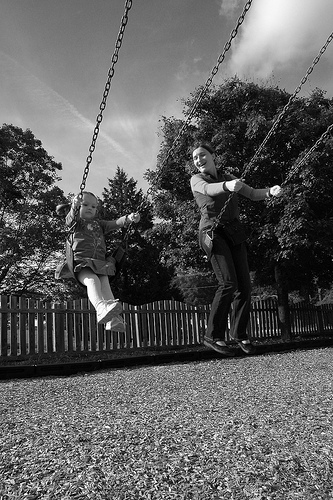
Other things come from friends. Brooke taught her how to swing by herself.
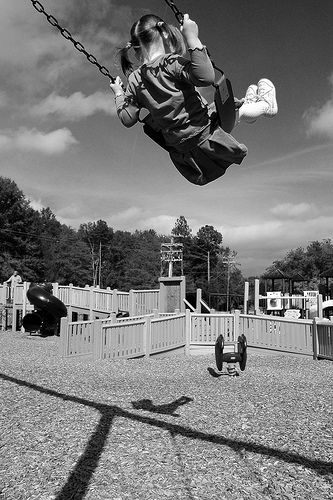
DSC_8289

She’s growing more and more independent.

DSC_8298

Now, she knows she can get her information from other sources, that she’s not dependent on us mentally any more than she is physically.
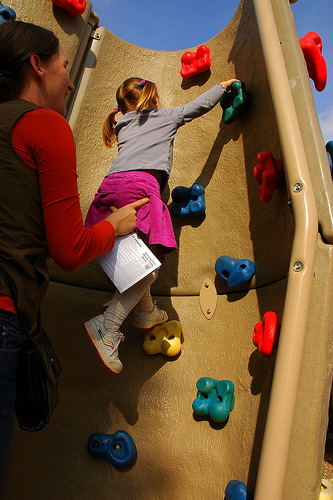
DSC_8303

Which, in reality, is still quite comforting: still many years to go. It comes in mercifully slow steps.


Shock and Disbelief

In preparing to read the dramatization of Anne Frank’s diary, I spent some time going over the Holocaust with students. I was taken aback at how little they seemed to know about it. “A bunch of people — I think they were Jews — got killed” seemed to be the general view. They do know something about it now, but their questions revealed both how complicated and unfathomable such an act is.

Most common was, “Why did they hate Jews?” Why indeed? Many answers, none of them short and simple. I offered a few: notions of Jewish conspiracies; Jews as “Christ killers” and the old blood libel; the fact that there are a substantial number of Jews in banking (which is directly traceable to early Christians’ reluctance to engage in usury) as proof of some international Jewish conspiracy. All those explanations in turn (which is why I was silent about The Protocols of the Elders of Zion).

As I spoke, though, and showed pictures and short clips of survivors, it was almost eerie how closely they paid attention. Any noise brought immediate shushing, and the look of shock on everyone’s face told me that there is at least one thing they’ll remember from their time with me.

This Is a Test

I gave three of my four classes a test a few days ago. It’s worthy of comment because I so rarely give tests. In fact, I despise giving tests. It’s true that they’re a relatively quick way to assess student understanding, but our school district has such a regimen of standardized tests and tests from other teachers that I seem always inclined to find alternative methods of assessment.

Recently, our state mandated yet another standardized test for eighth graders. We now take the MAP (Measure of Academic Progress), ITBS (Iowa Test of Basic Skills), Explore, and PASS (Palmetto Assessment of State Standards) tests. Additionally, students who elect to pay the fee can take the PSAT test. Each of these tests require multiple days to complete, and so we have thirteen testing days built into the 180-day calendar (not including the day it takes for the PSAT).

When teachers complain that their students are drowning in an acronymic sea of standardized testing, this is precisely what they mean. When states complain that their schools are underfunded, these tests represent a significant expenditure.

What are these tests for? What is taxpayers’ money buying?

The PASS test is the assessment used for NCLB (No Child Left Behind) compliance. It’s a new test, replacing the PACT (Palmetto Something-or-other Challenge Test or something like that) at the start of the 2008/9 school year.

Because it’s a new test, there are additional costs as the first year’s results are audited to determine cut-off points for the achievement standards. This in itself is problematic for me, because it underscores the arbitrary nature of any standardized test. Once the results were in, test administrators began analyzing the scores to determine what score should be the thresholds for the Exemplary/Met/Not-Met standards. And what standard did they use to determine those standards? Did they perform basic statistical analysis that showed X% scored within some range, Y% scored within another range, and Z% within yet another and then used those numbers as the thresholds? If so, that would only measure future test takers against the first year’s results. Surely there must be an objective standard, right?

The MAP test is administered twice, at the beginning and end of the school year. It is just what the name implies: a measure of the progress of individual students in the school year. It’s useful for teachers to see how much progress individual students have made; it’s useful for administrators to determine how much progress the teacher has made. Of all the tests, this has the most practical application.

The ITBS is a measure of basic skills. I’m not sure its purpose. We get attractive printouts that we send home. That’s about all I use it for.

The Explore test is the newest addition. It is, as far as I can determine, a pre-ACT test. Useful, I suppose. For all students in eighth grade? I’m not so sure.

We began taking the Explore test today; we’ll finish up during the first half of tomorrow. The one heartening aspect of the test: at least one student wondered aloud about the impact so much testing was having on his education.

Getting to Know Them

Donald Graves, in A Fresh Look at Writing, suggests a deceptively easy pen-and-paper method to gauge one’s familiarity with students. After creating a three-column table for a given class, begin writing students’ names in the left-hand column and including information about interests (especially academic) and not-quite-obvious personality traits in the middle. The third column is to indicate whether that has been specifically confirmed by the student.

Doing it all from memory should show how well a teacher knows his students. It also shows the students a teacher enjoys and worries about most (the first listed) and the students who are not immediately noticeable in the classroom (those listed last and/or forgotten).

I tried it mentally immediately after reading Graves. There is only one excuse for how insufficiency and insignificance of my list: it’s still very early in the year. It looked something like this (names changed, of course):

Samuel Enjoys talking with friends; plays The Godfather like a master but has never seen the film √
Justine Plays violin; switched piano violin . √
Andrew Likes eating hot food √
Susan Shy; admittedly tends to think of herself as inferior to many others in her class √
Janet Likes dancing

It continued on like this for another five or six students.

I learned that I still know nothing terribly significant about anyone in that class. I have given myself a mandate: learn more about these students by the month’s end.

Yet how? The opportunities to have a genuine conversation with students are few. Certainly one could simply spend class time talking to some of them, during student conferences and such, but that’s not always the most efficient method, not to mention it being a particularly ineffective use of class time.

A few of the ideas I have begun implementing:

  • In the hallway between classes. Because our school uses the team-teaching model, students stay in the same area of the hall throughout most of the day. They have the time to chat with each other, so they have the time to chat with me.
  • In lunch lines. There’s always a long line of students waiting to get their lunch. They chat with each other, and it’s a good, non-academic environment for conversation.
  • In the hallway, on the way to the library/lunchroom/computer lab/etc. While I require my students to remain silent as we walk along, I break my own rule and chat with one or two of them quietly. Perhaps it’s unfair, but as a colleague tells students, “I earned a college degree to get this privilege.”
  • During fire drills. Once we get the students outside and counted, there’s always a few minutes before we’re called back into the building.

The single best way to get to know students, though, is through a journal assignment. I have one class writing a thrice-weekly journal, and I learn more about the students in ten minutes of reading than I could ever learn in 180 days of teaching. This girl runs cross country; that boy enjoys using Google’s Sketch Up; she has a talkative father; he has a talkative mother. I walk into class the next day and see a whole person rather than a 50-minute sliver.

Teaching Writing

Teaching writing means reading things like this

  • The crowd looks like a box of crayons with their colorful shirts on to support their favorite school.
  • The most magnificent and wonderful part of day is the night that takes us within. It gives you your dreams and time to think about the day that trailed behind you.
  • I ask my mom. “I’m too busy at the moment. How about later?” Knowing that later will be near 7 PM, I slither back to my room.

How can you not smile when gems like this are scattered through student writing? Evaluating each assignment becomes a treasure hunt.

Pushing Buttons

"Buttons, Arduino & unsped shield" by musicalgeometry on Flickr

Many of my students expose their emotional buttons and switches freely and openly. Within a few minutes of meeting some of them, I can tell what their sensitivities are.

“How many administrative referrals did you get last year?” I ask some of them, with a smile that I hope says, “I’m not trying to size you up — I’m just curious.”

“A lot,” a girl — call her Ann — responds.

“Did you notice my question?” I query. “I didn’t ask, ‘Did you receive any referrals?’ but rather ‘How many did you get?’ I’ll bet you got several of those referrals because you simply walked away from a teacher who was saying something you didn’t want to hear.”

I have her attention: she’s curious, and that’s always a good thing.

“How could you tell?” Ann asks.

With their posture, gait, tone and volume of voice, many of these kids speak loads without saying a word. Yet they’re totally unaware of it. Of more concern is that they’re unaware that others are aware of it and can use it against them.

“When you advertise what ‘makes’ you lose control,” I explain, “You provide others with ammunition. The teacher who doesn’t like you at that moment knows: ‘All I have to do is push a little harder and she’ll definitely give me something to write up.’ You let others know your weakness and they might use them against you.” I pause for a moment, deciding to use a bit of vernacular: “Then who got played? Who got owned?”

“Me,” she says meekly.

I have these little conversations after class with the kids that would be labeled “at risk” because they are at risk: they’re in danger of becoming slaves to their own impulses and the people who can pick up on those signals and use them.

Occasionally, there are moments that illustrate that they are indeed beginning to pick up on the signals they give off. They are aware that others can only “make them” mad if they allow it by advertising their sensitivities and reacting predictably.

This afternoon, while students were waiting for their buses, I was joking with a young man that I could probably get him in a state that would end in a disciplinary referral for him. We’d been joking with each other all class about such things, and he stridently denied that I could “push his buttons.”

“How about you,” I ask the boy’s neighbor. “Do you think you have advertised what gets you hot? Do you think I could push your buttons and get you furious in just a few moments in class” He shrugs his shoulders.

I turn to Ann, always one of the last students waiting for her bus. “I’ll bet I could get you.” I know I can: I already have, inadvertently. The question — the hope — appears in my mind: “Will she own up to it?”

“You already have, Mr. S.” Her grin is an odd combination of devilish delight and sheepish vulnerability.

I smile. “Do you think I could do it again if I tried? I won’t ever try, but if I were to try, what do you think?”

She shrugs her shoulders and looks away. For just a moment, though, her eyes say, “I don’t think so. At least I hope not.” A first step — an admission of ownership and of personal responsibility.

“One small step for man…” I think, as the students leave for the bus. I glance down at the roll book and see four more names that need to have such a brief moment of self-confidence in their ability to control their lives.

“I’ll start on him next week,” I mumble.

It’s all part of the growing realization I’m having about working with these “tough” kids. The cliche is spot on: they don’t care what I know until they know that I care. And they’re beginning to know that I care because with me, it’s not business as usual in the discipline department. The etymology of “discipline” includes notions of teaching, not notions of punishing, and I try to put that into practice in the classroom.

Confusion

Some weeks seem intent on confusing the sense out me. Students say things that literally leave me speechless, wondering whether or not the kid is joking. Parents and pundits around the land fall into spasms of paranoia about a presidential speech intended to encourage students to take their studies seriously. An odd, high-pitched whistle begins drifting into the house through the back windows at various times during the week leaving everyone wondering what the devil that sound could be.

A long weekend away from all the confusion and nonsense hopefully will help. At the very least, L will experience and hopefully enjoy her first camping trip.

Journals

How does one keep a journal? It’s something I’ve done for so long that I no longer even think about it. And yet when you’re starting out, doing it on command–and for a grade, no less–then it might seem a little intimidating.

“Three hundred words, three times a week,” I said. “About anything.”

“Anything?” the students ask incredulously.

“Yes, anything.”

“Anything” is an awfully big topic. So big it could be overwhelming. I understand their concerns.

One thing I mentioned was writing about school work and projects. I need to tell them, “You should think of a journal as a place where you simply think aloud.” Perhaps that will help. “It’s a place where you can think through the Lord of the Flies project or tease out all the reasons you don’t really like So-and-so, or where you can simply play with language.

“Here language, fetch.”

Students tend to question the value of it, especially when I tell them that I won’t be reading each journal in its entirety. “Then why write it?”

“Writing is just like any other activity: the more you do it, the better you get.”
Some buy it, some don’t.

Fork

Image by

Image by i_yudai (Flickr)

It’s a famous riddle: You stand at a fork in the road. One road leads to happiness; the other leads to sorrow. You don’t know which is which. At the fork stand two men. One always tells the truth; the other always lies. You don’t know which is which. You’re allowed one question to determine which road to choose. What do you ask?

The intricacies of the riddle concern me less than the general theme: a life-changing moment, with two, diametrically opposite outcomes.

As a middle school teacher, I often encounter kids standing at just such an intersection. Generally, they don’t realize this, and the ones who do will probably ask the right questions in life.

Of the ones who haven’t yet realized that every moment offers decisions that can change the outcome of the rest of their lives, there are three varieties.

The first give every indication that all will be well with them. This is not to say they’re all studious and hard working. Indeed, many are not–as many of us were at thirteen. Still, there’s something about how they carry themselves that speaks to their future success.

The second group is a mystery. Truth be told, they usually turn out alright too, but they’re just not giving the clear signs yet. They’re not giving any signs yet, and that’s fine. They’re thirteen.

The third group is the group that haunts me. I see them and it’s difficult for me to imagine them making many good choices in life because it’s hard to see them making choices, period.

And not to choose in this case is a choice.

It’s not that they lack intelligence or even vigor. They simply don’t see the choice. They don’t see choice at all in their lives.

They are victims, eternally, and of everything. Adults don’t seem like them and they don’t know why–and they think there’s nothing they can do about it. They speak with loud voices that echo through the hallways and it’s just the way they are: “I’m a loud talker–it’s just the way I am.” They get referrals because teachers are picking on them and out to get them. Only with great difficulty can the make eye contact with anyone at all. They are subject to the whims and silliness of others: people are constantly “making” them do something. They react violently when they feel they’ve been disrespected, and often no disrespect was meant. They consistently show self-destructive views that make it all but certain that the cycles of dysfunction that they have obviously experienced in their lives will continue to haunt them, and their children, and their grandchildren.

Working with them is like working with a blind girl who’s always been blind and who doesn’t even realize she’s blind. Talking to them, trying to present any view that differs from the calcified reality of their first thirteen years is like speaking Finish to an Egyptian.

There are those that wake up and make the changes they have to, that realize they’re actually in control of a great deal of their lives. I know several such people. But the odds are against them, and the fact that I can do very little to change those odds is sometimes the most depressing aspect of teaching.

Learning

He came up to me in the hallway between classes, somewhat visibly upset. We’d just had a meeting with the principal in which he explained his very high expectations for everyone, especially including dress code. This young man was soon thereafter working on tucking his shirt in when the charge of “sagging pants” was made.

“I got a referral for that,” he said. “Can you believe that?”

It was one of those moments that I hide my true opinion.

“Bad luck, I guess.” Probably not terribly fair, I thought. He seemed to handle it like an adult, though. He was irritated, but not furious, and his demeanor told me that he’d managed to keep his cool during the encounter.

“So what did you learn from that?” I asked.

“Nothin’. There’s nothing I can learn.”

It’s the challenge I face with so many of my students. See the world around you as the Ubiquitous Classroom. Understand that the mindful person can learn something — about herself, about the world, about her influence on others — from just about every action and interaction.

I really shouldn’t be surprised if they haven’t learned this: they’re thirteen and I, almost three times their age, still forget to be on the lookout for the hidden lesson.

Finding Our Space

“I don’t know what to write about” is a common complaint among eighth graders, often regardless of whether or not a topic has been provided. To alleviate that, we began an extended lesson: “How do I find topics for my writing?”

It seems abundantly clear to me: just look around and there are things to write about everywhere: the jostling silliness and/or frustration of a class change; the way five minutes can just drag by even in the best classes; the dress code to which students are required to adhere; the difficulty of coming up with a topic for writing–topics are simply everywhere.

To give students a starting place, we worked on creating Expert Inventories today. “Imagine a teacher told you to write a paper on the topic of ‘blank.’ What topic would make you make you think, “Oh, that’s easy. I can do that I no time!” All the kids dutifully began creating the same lists. The boys wrote “basketball, football, Madden 09.” Many of the girls included shopping, texting, boys.

There were some surprises. One girl enjoys making bricks with her dad. “We like to experiment with how things used to be done,” she explains. Another is good at making mortar. “Mortar?” I asked, wondering if I heard her correctly.

Next step: branching out some of the general terms to more specific ideas. “What do you mean when you say you’re an expert at basketball?” I asked. “Playing it? Watching it? Commentating on it?”

“Shopping–shopping for what? Shoes? Music? Clothes?”

The kids expanded their list, some of them writing endlessly. “Can we use the back of the page?” one girl asked. A good sign.

What I’m trying to do is fairly simple, not to mention fairly obvious: before kids can get serious about improving their writing, they have to enjoy it, or at least tolerate it. Having them to “analyze the author’s craft” (as one of the required “artifacts” is to do) in a short story will not bring “Ooohs!” and “Ahhs!” of excitement. For it to be enjoyable, it has to be meaningful; for it to be meaningful for many eighth graders, it needs to have a personal connection. And so I’m taking the whole idea of required this and required that and tossing it in the recycling bin for a moment. We’ll return to these ideas soon enough.

Focus

Some teachers, it seems, want peace, quiet, and calm in the classroom for their own sakes. I’ve tried something new, something that seems to legitimize my authority as well as the unfortunate, occasional necessity of “cracking down.” During the first class period, I simply told them — and tried to show them — that I’m there to help them, to educate them, to increase their chances for success later in life. “And if one of you tries to take that opportunity from another member of this class by being disruptive in any way and refuses to work with me as I try to bring things back in line, I will make sure that disruption stops. It’s not for me: I will simply not allow you,” and here I point randomly at a student, “interfere with your,” and here I point randomly at another student, “education.” Pause for dramatic effect, then I add, “And vice versa.”

This year, I am trying desperately to show that everything that happens in that classroom has only one intention: helping.

So far, they seem to be buying it.

Magnetism

To love one’s job truly and deeply, so much so that one can hardly wait to return as one is walking out the door at the end of the day, is a great and wondrous gift.

I sat in my room, doing paperwork during a planning period, and I was excited by the fact that class began in ten minutes; I walked out of school this afternoon eager to return the next day.

Only two days have passed and I know I have the kids. I see in their eyes, “This year is going to be different.” One hundred minutes with students (two fifty-minute classes) and I already have a better relationship with them than I’ve probably ever had with students, definitely the best relationship with students in America. I have their complete attention, and they enjoy being there. There’s eye contact; there’s smiling; there’s thoughtfulness — and we’ve just been talking as a class about how this year will be.

In short, I finally have the classroom I always knew I could: mutual respect with a common sense of purpose and an excitement about the year.

What’s different this year? It seems so obvious now, but I’ve simply rejected the common “wisdom” about creating a first impression in the classroom. That so-called wisdom is based on a Hobbesian view that humans are inherently bad and respond only to coercion. “Scare them.” “Make them know who’s boss.” “Don’t smile before Christmas.” That’s fine if you want a seemingly well-behaved class that jumps when you require it. It doesn’t do much for relationships, though. Students tend to think the teacher is simply flexing his district-given power. No one responds well when being “put in their place.” No one works well in an environment based ultimately on fear.

Instead, I’ve taken Rousseauian approach. I don’t believe everyone is inherently good — I believe we’re inherently rather neutral — but I do believe that people treat us the way we treat them: if we treat people well, they will respond well. If we establish from the beginning, unquestionably, that we respect people, they will return that respect.

This is critical when working with middle schoolers, and even more important with working with middle schoolers who might have grown up in an environment almost completely lacking in adults who behave in a way that inspires respect.

The upshot of all of this is that I simply can’t wait to get into the classroom tomorrow, which makes it infinitely easier to plan lessons tonight.

Back to the Dream

DSC02059

I end the year dusting and I start it with a rag in my hand as well. Before we can check out for the summer, we teachers have a myriad of duties and responsibilities, not the least of which is preparing our room for the summer cleaning. This involves taking everything not attached to the floor out into the hall way, refinishing the floor, then putting everything back. At both ends of the summer, then, there is a thin layer of dust on many things.

There is usually something similar clouding students’ minds in the early weeks. They act as if we’ve awakened them from a deep sleep and not given them the time to clear the haze from their thinking. In short, they forget some of what they learned the year before.

It’s to be expected. After all, who wants to rehearse subject/verb agreement and the quadratic equation when everyone else is at the pool or on a trip?

So I spent the day dusting and arranging, preparing to dust and arrange.

On Fire, In More Ways Than Intended

I’ve been buying and reading books on pedagogy this summer, and one I bought was Rafe Esquith’s Teach Like Your Hair’s on Fire: The Methods and Madness Inside Room 56. Esquith is all the rage: after all, how many fifth grade teachers do Shakespeare with students after class?

There are some good ideas in there, and initially I was hopeful that it would be a useful book. His discussion of the importance of trust in the classroom and some ideas of how to integrate that into a classroom management plan excited me, as this was something I was hoping to focus on this year.

Soon, though, some things started to feel off. Discussing the fact that educators are role models, Esquith writes,

Some of my students laugh bitterly at a teacher they once had. They discuss her in the most unflattering of terms. She often comes to school late. [… She] talks on her cell phone constantly. Even when the kids are being taken somewhere, their fearless leader walks in front of them gabbing on the phone. […] The same teacher thinks she is “secretly” shopping online while the kids do their science assignments. She believes the kids do not know what she is doing. She is very much mistaken. (10)

My initial reaction: what an awful teacher. My second, more thoughtful reaction: how in the world does Esquith know this? Certainly, a teacher can overhear students talking in class about a teacher they had, but if the conversation continues long enough for the teacher to garner this much information, one of two things is happening:

  1. These kids aren’t working but sitting in class having free time, which they’re using to gossip about another teacher; or,
  2. Esquith discusses other teachers with his classes.

Neither one of these is terribly flattering. The passage in the book is terribly unprofessional.

One passages deserves to be quoted at length:

You see, the children at our school do not read well. They do not like to read. As of this writing, 78 percent of the Latino children on our campus are not proficient in reading, according to our state’s standardized tests. This means one of two things: Either we have the stupidest kids on the planet , or we are failing these children. Please believe me when I tell you that the vast majority of our students are perfectly capable of learning to read. No one wants to admit it, but a systemic conspiracy of mediocrity keeps these children on the treadmill of illiteracy.

To fight the problem, we now have “literacy coaches” at schools. Most of these “experts” are former classroom teachers who never accomplished much with their own students. […]

Teaching our children to read well and helping them develop a love of reading should be our top priorities. People seem to understand this. Millions are spent on books and other reading material, celebrities make public service announcements, and thousands of hours are spent training teachers. The spin doctors at various publish companies tell us that our students are doing better, but honest people know this is simply not the case. Concerned teachers have learned not to bother raising their voices, because powerful textbook companies have carefully prepared answers to anyone who points out that the emperor has no clothes. Young teachers are afraid of being crushed by bureaucrats whose only real mission is to keep selling their product. As testing services compete to rake in millions of dollars, nervous school districts anxiously await the latest test results. And year after year, most children do not become passionate lifelong readers.

It’s complicated. There is a lot of finger-pointing. But to borrow a phrase from another big, fat book that won a Pulitzer Prize, our children are victims of a sort of “confederacy of dunces.” Powerful forces of mediocrity have combined to prevent perfectly competent children from learning to love reading. These forces include television, video games, poor teaching, poverty, the breakup of the family, and a general lack of adult guidance. (29-31)

There is a lot of truth in the statement, Testing services do make a lot of money from the increasing number of standardized tests students have to take. There can be pressure to use state-funded textbooks regardless of a teacher’s preference. But the bottom line is this passage is highly insulting by presumptively marginalizing literacy coaches.

This book has some good ideas, but most of the time, I found myself thinking, “I’m glad I’m not this guy’s colleague!”

Still, listening to him on NPR, I sense a humility that just doesn’t come across in his writing, which is too bad.

No Child Left Behind: The Football Version

Many educators are not fond of the No Child Left Behind (NCLB) legislation, which Obama doesn’t seem intent on scraping. I suppose education is never the priority politicians claim it is, though to be fair, neither candidate made much of education in 2008.

Some outside of education are confused as to why a teacher would oppose NCLB. They see it as an unwillingness to be held accountable for what happens in the classroom. Or even a fear of accountability. This is deeply inaccurate, at least in my case.  I (and many others) oppose NCLB because of how it (claims) to hold teachers accountable.

One effective way of illustrating some of the absurdities of NCLB is to apply it to sports. I’d seen this online a time or two, but a professor posted this for us in class the other day and it made me realize anew how skewed some people’s perception of NCLB actually is. So here’s the scenario: football is run according to guidelines similar to NCLB:

The regulations:

  1. All teams must make the state playoffs, and all will win the championship.
  2. If a team does not win the championship, they will be on probation until they are the champions, and coaches will be held accountable.
  3. All kids will be expected to have the same football skills at the same time and in the same conditions. No exceptions will be made for interest in football, a desire to perform athletically, or genetic abilities or disabilities.
  4. All kids will play football at a proficient level.
  5. Talented players will be asked to work out on their own without instruction.
  6. Coaches will use all their instructional time with the athletes who aren’t interested in football, have limited athletic ability or whose parents don’t like football.
  7. All coaches will be proficient in all aspects of football, or they will be released.
  8. Games will be played year round, but statistics will only be kept in the 4th, 8th and 11th games.

This will create a New Age of sports where every school is expected to have the same level of talent and all teams will reach the same minimal goals.

The fact is, children in the same grade start at different places intellectually, emotionally, and socially.

What’s worse, NCLB is a moving target. Every school must achieve “Adequate Yearly Progress.” If you fail to make that progress, you have to make up all that ground and then some for the next year. Another sports analogy (this time, my own) might make it clearer:

Let’s say to make the football team, you have to run the 40 yard dash in 5.5 seconds. You fail to make it by one tenth of a second. You work out. Finally, you reach 5.5 seconds and come back to try again. The coach now tells you that now you have to run the 40 yard dash in 5.4 seconds. You can’t do it, so you go back and work out some more. When you can sprint it in 5.4 seconds, you go back to the coach, who informs you that now the bar has been moved to 5.25 seconds.

Or, as someone else put it:

The annual measurement bar is a moving target and once missed it is like chasing after a train pulling out of the depot year after year. Of course then it becomes the fault of the instructors, and not the curriculum , or the administration, or heaven forbid the students themselves. (Source)

Accountability is good; poorly-thought-out accountability can only be harmful.

Strangers in the Classroom

In the Hall, Final Day

They enter the classroom in August and they’re strangers. I struggle for a couple of weeks to learn everyone’s name; the energetic talkative ones I get down by the end of the first day. Slowly, I learn their personalities: their passions, their quirks, their fears. By mid-October, I know a group of 80-100 thirteen-year-olds fairly well; by mid-May, I can almost predict their every move.

This is what keeps me hooked on teaching: the relationships. A picture of a group of students is a fairly meaningless thing to anyone but the students’ teacher, but to that teacher, it’s a thousand stories about 180 days spent working, laughing, and sometimes arguing together.

And this is why I consider it a privilege to teach. Between 160 and 200 parents trust me with their children for almost an entire year. In some ways, I know their children better than they do. This can be problematic — “Oh no! My child would never do that!” — but only rarely.

Yesterday, I said goodbye to the kids I spent 180 days with. In a few, short weeks, I’ll begin again, with a new group of strangers in my room.

dsc_5614
At the Lockers

It is a testimony to how well the year went that I am as excited about starting next year as I’ve ever been. Last year was a tough year, with a tough group of kids. Many teachers on the eighth grade hall said it was the most challenging group they’ve ever taught. “Baptism by fire,” one laughed when I commented it had been my first year teaching there. Last year, the goodbyes were a formality, and I was relieved to have the year behind me; this year, the goodbyes were touchingly sincere, and I was a bit saddened to see the year come to a close.

One young man was terribly upset. I saw him and smiled; he thought I was mocking him. “Mr. S, don’t laugh!” he begged. I went quickly to him, trying my best to smile warmly. “I’m not laughing,” I reassured him, telling him-probably vainly-that the sadness of this ending will transform itself into joy at a new beginning. I didn’t tell him how difficult it was for me to go through endings, how it’s still difficult. Perhaps I should have, but I was afraid I would upset him more. On his own, he will learn to recognize the sweet in the seemingly bitter moments.

If I’m fortunate, he’ll come back to tell me about it.

xtranormal in Action

I mentioned earlier my efforts to use xtranormal.com — the free animation site — in school. Here are a couple of examples from students who used the site to animate research done on selected topics about Victorian England.

Education in Victorian England

xtranormal Shakespeare

I’ve been playing with xtranormal.com, the site that allows you to create a movie merely from text. I’m thinking I might use it somehow next year with my English I Honors class when we work on Shakespeare.

Something like this:

The pronunciation is a bit off at times, but otherwise, a potentially useful tool.

I’m just not quite sure how to use it…

Eighth Grade Shakespeare

Shakespeare is a challenge to our modern ears, no doubt about it. Even the most knowledgeable experts halter a line or two of a performance before they settle in to the poetry. In my experience, it takes me about a few minutes before the language on stage sounds completely natural and non-foreign.

I’ve been teaching Shakespeare to eighth graders of various academic levels for the past week: an enlightening, frustrating, ultimately rewarding experience. We’re reading an abridged version of Much Ado About Nothing. It is, in fact, part of the required eighth grade curriculum here in Greenville County, and I’m thrilled that those who designed the curriculum had the wisdom of chosing a comedy rather than, say, Julius Caesar. (A perfectly fine play in its own rights, it’s an absolute bore to teenagers.) Much Ado has all the elements adolescents can relate to: unrequited love; jealousy; the twittery, jittery joy of new love.

Yet it’s still been difficult enough for them that it’s been, at times, a chore. And so to remedy that, I changed my unit plan and decided to show the Branaugh Much Ado concurrently with our own reading. We’ve completed the first two acts in class; we watched the first two acts today.

What a joy to watch the kids watch Shakespeare and enjoy it. What was most rewarding for me was to hear them laugh at lines that had been omitted from our abridged version. “They’re really getting it,” I almost said aloud.