education and teaching

Cat Gut

“Mr. Scott, is it true that chewing gum is made out of cat guts?”

The question floated up in the midst of a quiet, productive moment. It was, in a word, a gift.

“Of course,” I answered, deadpan. “What else would it be made out of?” I was wondering how long I could keep the straight face.

“Really?” She wasn’t buying it, and quite frankly, she shouldn’t have: I’m a bad liar.

“Seriously.”

A pause as she searched my face for some sign of deceit.

“Would I lie to you?” I asked, still holding the straight face.

“Yes!” she laughed.

At that moment, a young man seated behind me stood up, marched to the garbage can, and violently spat out his gum.

That question was a gift, I tell you.
January Reads

I have decided to complete the “52 Books in 52 Weeks” challenge. I shouldn’t be much of a challenge at all, given the amount I read for the classes I teach and the fact I’ll be starting grad school (again) shortly. Still, I thought for a year I’d keep track of everything I’d read, regardless of the reason or, for that matter, the “quality.”

January’s list was varied, to say the least:

AuthorBook
Dean HamerThe God Gene: How Faith Is Hardwired into Our Genes
Bart EhrmanGod’s Problem: How the Bible Fails to Answer Our Most Important Question–Why We Suffer
Robert BaerThe Devil We Know: Dealing with the New Iranian Superpower
Bel KaufmanUp the Down Staircase1
Paul LanganShattered 2, 3
Paul Langan and D. M. BlackwelBlood is Thicker2, 3
Anne SchraffSomeone to Love Me2, 3
Anne SchraffUntil We Meet Again2, 3

The Bluford books really shouldn’t count, I tell myself. They were something I read because some students were reading them. At the same time, I learned a great deal from them.

The series is aimed at African American students, and many of my black students say they can truly relate to the characters and situations.

In the case of Someone to Love Me, that is truly tragic. It tells the story of Cindy, a high school freshman who has only a distant relationship with her mother, who is constantly going out with her boyfriend Rafe (I believe that was his name — some shortened form of “Raphael”). She is constantly leaving her daughter at home with a couple of cats and a freezer filled TV dinners while she goes out on the town, eating out, buying new clothes, and generally acting selfishly irresponsible. When an elderly neighbor invites Cindy over for a hot dinner, she relish it: “It had been years since Cindy had eaten such wonderful homemade food.” Perhaps the most damning passage in the book. The girl goes on to get involved with an abusive older boy and has to face her mother’s anger — and physical abuse — when she tries to convince her that Rafe is a dealer. It is an emotional, sordid affair from page one.

If this is in any way the reality of any of my students, it’s little wonder they have difficulty focusing on school work.

1. Re-read
2. For school
3. Bluford series (for school)

Adolescent Dhammapada

In “The Childish Person” from the Dhammapada we read:

Childish, unthinking people
go through life as enemies of themselves,
committing detrimental actions
that bear bitter fruit.

Glenn Wallis, in his notes about his translation of the Dhammapada, explains that “childish” in this context as several meanings: “childlike” is certainly relevant, but the Buddha also meant a “person who ambitiously pursues material fortune, being pushed along by an ever-strengthening current of “I, me, mine.” (125) (Other translations render “Bāla-vaggo” simply as “the fool”, but I prefer Wallis’ less vitriolic “the childish person.”)

Later, in “The Practitioner”, we find a similar notion:

Do not carelessly swallow a copper ball and,
burning, cry out, “This is pain!”

All too often, we cause ourselves the pain we’re certain has exterior source. And nowhere is this more evident than the middle school. In that setting, it might sound like this:

Teacher: You display your buttons for anyone to see. You don’t hide anything, and so if teachers wanted to pick on you, you make it easy for them. I know exactly what I could say to get you upset, and so I virtually control you.

Student (in a very disrespectful tone): Oh no! No! Let me just tell one thing. You don’t control me. You don’t. Ain’t nobody in the world controls me. I control me.

Teacher: I just did it. I got you angry. I just got you to mouth off. A teacher would be justified for writing you up for the tone you used with me. If you were really in complete control of yourself, you would have sat quietly, thinking, “Right. Let me show this joker who’s in charge of me.”

Smile

Walking down the hallway, I try to smile and acknowledge students as we pass each other.

They say it takes more muscles to frown than to smile, but I’m not convinced. Smiling is not always easy: sometimes I want to scowl because of some frustration; sometimes I want to have a blank expression due to exhaustion; occasionally, I don’t want to hide my anger. In spite of all of these competing emotions, though, I still try to smile.

I know I must be doing something right when students smile back at me. It means that we have, at the very least, a pleasant working relationship (though frowns don’t always mean the opposite). And a good relationship is an important part of the foundation for learning.

Oh, whom am I kidding? I’m a mean ogre…

Breaks

The thing about breaks is that they are the epitome of entropy:

Turning and turning in the widening gyre
The falcon cannot hear the falconer;
Things fall apart; the centre cannot hold;

Breaks encourage cessation.

As a teacher, I experience this every single Christmas break and summer vacation. “As soon as I rest for a short while, I’ll accomplish so much.” It never happens, for breaks — in my experience — encourage mere anarchy to be loosed upon my world. At least for a brief moment.

With a blog, it’s the same. For two weeks, I’ve done virtually nothing here, and the break has been almost unnoticeable: with the end of the semester, I’ve been so busy that grading and more grading has filled any break I might have convinced myself I was taking.

Through the break, though, there have been pictures:

DSC_0107

DSC_0109

DSC_0113

Quotes from Yeats’ “The Second Coming”

Ladies and Gentleman, May I Introduce William Shakespeare

I have the privilege of introducing a group of twenty eighth graders to the unabridged, unadulterated Shakespeare. We began Romeo and Juliet this week, and it is the highlight of my year.

I began preparing a foundation earlier in the year by having the kids write sonnets and wrestle with iambic pentameter. I mentioned that Romeo and Juliet is, for the most part, in metered verse. “You mean he wrote the WHOLE play in iambic pentameter?” they asked incredulously. I got my Riverside Shakespeare, large enough to use in the gym as a free weight. “Not only that — most everything he wrote was in iambic pentameter.”

They were, in a word, terrified.

That’s understandable: the Bard does have quiet the reputation for being inaccessible to many casual modern readers: long sentences that sometime contain clauses with convoluted, inverted structure, and vocabulary that can make one’s toe nails curl.

We took it slowly.

In fact, we took a whole lesson on the prologue:

Two households, both alike in dignity,
In fair Verona, where we lay our scene,
From ancient grudge break to new mutiny,
Where civil blood makes civil hands unclean.
From forth the fatal loins of these two foes
A pair of star-cross’d lovers take their life;
Whole misadventured piteous overthrows
Do with their death bury their parents’ strife.
The fearful passage of their death-mark’d love,
And the continuance of their parents’ rage,
Which, but their children’s end, nought could remove,
Is now the two hours’ traffic of our stage;
The which if you with patient ears attend,
What here shall miss, our toil shall strive to mend.

The next day we spent an entire lesson on the opening fight scene. With some group work, class discussion, and multiple readings, they actually began to find Gregory and Sampson to be, amusingly, “losers.” Laughter in the classroom while reading Shakespeare is musical.

The result: comments like this on our online forum:

  • The language isn’t as hard as I anticipated.
  • Now that we have taken the time in class to discuss the play in normal language, I find it rather challenging but yet understandable.
  • I was scared at the beginning because i didn’t think i would get any of it. Now that we have started i actually understand most of it.
  • At first i figured the language would be extremely difficult to understand and read like words such as “tis” or “thy” or “ay,” but if you read the words you can figure them out over time.

The most enjoyable will be observing their reaction as they watch Romeo + Juliet, the Luhrmann version of 1996. Not the best version in cinematic history, but I show it to illustrate the timelessness of the story.

It’s going to be a fun month.Photo by shizhao

New Games

I never really liked card games as a kid. I guess Uno was alright once in a while, but that doesn’t really count as a real card game. Since Windows hadn’t yet come out when I was a kid, I never learned to play Hearts. Spades was popular among some friends, as was — oddly enough — euchre, but I just didn’t get it. What was the point? (Bridge, of course, was out of the question then; now, it’s the only card game I truly enjoy.)

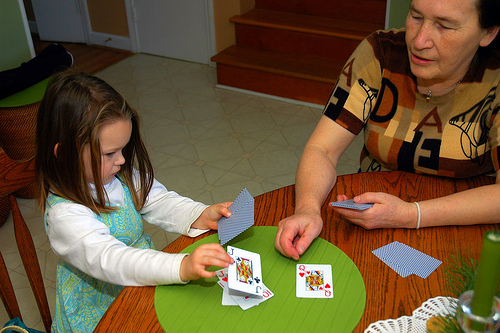
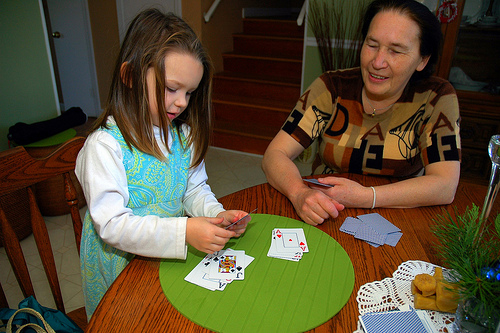
L learned a new game today — “learn” being used in a most generous way. She didn’t quite get the point; she couldn’t quite understand why Babcia took the upturned cards for herself sometimes and sometimes gave them to her.

DSC_9909

I can’t remember what this particular game is called in English. In Polish, it’s “wojna” — war. Perhaps it’s the same in English. I can’t really recall. (Another one of those odd circumstances in which I know the Polish but am unsure of the English.)

DSC_9914

Most importantly: the Girl enjoyed it (for a few minutes).

“Let’s play it again!” she chimed again and again.

Still in English, though…

Balance

“Shhh! There’s a monster in there!” says L as we walk toward her room. She’s at that age where she sees monsters, tigers, and bears everywhere. A “smoky, smoky dragon” is a common visitor at night, and right after a bath, an alligator — simply named Alligator — comes looking for her as she hides under her big bath towel. Saturday mornings she likes to jump in our bed (even if it’s made up — she’ll willingly unmake it) and hide under the covers.

“Shhh, shhh, shhh!” she’ll proclaim. “Monster’s coming!”

I play along sometimes, but it creates a problem: she gets genuinely scared sometimes, and it’s because there’s an alligator under her bed or a dragon right over there, in the corner. I reassure here that there’s no such thing is monsters, but it’s difficult to do if I’ve just been playing along with her imagination earlier in the evening.

It’s difficult to balance her developing imagination with her developing fear.

Will she learn there’s no such thing as dragons before she learns Santa doesn’t exist? I’m helping create both illusions, feeling slight pangs of guilt about it, and wondering if it’s all avoidable.

14-year-old Poetry

People write about what they know. One of the prime motivations of confessional poetry was that we theoretically know more about ourselves than about anything else.

When you ask a group of thirteen- and fourteen-year-olds to write poetry, there is one guarantee: the boys will write about video games. In one portfolio of ten poems, one young man wrote two poems about games (including a haiku about “Call of Duty 5”), two poems about sports (one about playing, the other about watching), and one about hunting.

I mentioned this to a colleague this afternoon. She thought for a moment, then made a suggestion: “Next year you could tell them that each poem had to be about a different topic.”

“Then they’d simply say, ‘Well, they’re two different games, so that’s technically two different topics.'”

Memorex

L has an absolutely astounding memory. She can “read” many, many books — at least fifteen, I would say — from memory. She turns the page and quotes almost verbatim the text on the page.

And she corrects me.

“‘That’s what you said yesterday,’ shouted elephant,” I read from one of L’s favorite books, Goose Goofs Off.

“No, Tata! Elephant snorted!” comes the reply.

Stacking the Deck

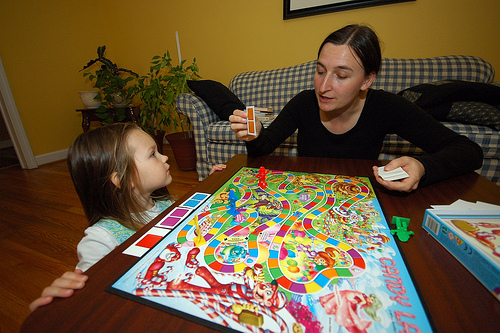
A daily game of Candy Land has wiggled its way into our routine. L has mastered the concepts: she knows what the cards are for and she generally knows which direction her piece needs to move.

DSC_8921

The problem is that Candy Land is unimaginably dull: draw a card, move your piece, wait. Repeat. While L was learning, it was a pleasant game: actually playing the game was not the objective, and as I love teaching, any educational activity is enjoyable.

Now that she knows how to play the game, though, it can drag.

I feel a little guilty about that. I should adore every single moment with her, but let’s face it: there are only so many times you can feign surprise at having to go back to the Gingerbread House.

When I was working with autistic children, Candy Land was a popular free time choice. I got so utterly sick of it that I — and I am somewhat ashamed to admit it — stacked the deck to make sure the kid I was sitting opposite got all the good cards.

“What!? Another double-purple? Well, you’re well on your way, aren’t you?”

I haven’t done that with L yet. In the truest sense of “stacking the deck.” I might have switched the top two cards after a quick peek at my own, making sure she got another double-purple, but that’s not really stacking the deck. That’s helping.

Time Machine

I work in a time machine. Each and every day, I’m transported to my middle school days as I see bits and pieces of my eighth grade year reflected by my students. Times have changed — there’s certainly a lot more hugging going on these days, for one — but the gravity-bending, end-of-the-world trials of thirteen- and fourteen-year-olds remain. Students charge up and down the hall, furious about this or that, certain it’s the end of the world. Love blooms and the infatuation they’re now experiencing is the one to see the young lovers through the rest of their natural days.

I see myself in this or that student. I see peers in his peers. I watch experiences that I had, and I wonder if they will shape the young people in the same way the events shaped me. Broken hearts, unjust accusations, careless comments — I look back on these things with calmness now, though I felt nothing but anguish then.

Occasionally this gets me to wondering about how I would handle middle school differently were I suddenly to return. Would I have been calmer? Would I have realized that this or that disaster was nothing of the sort? Certainly, but then, twenty-some years later, I’d be wondering the same thing again. “Knowing what I know now, after two times through, would I…”

Part of growing up is growing out of this kind of thinking. Yet spending seven hours a day with thirteen- and fourteen-year-olds makes it easy to wallow in the nostalgia. For about three seconds.

Policing the Waistline

Our school has a dress code that in effect creates a school uniform. It is, in short, relatively strict. Regarding shirts, it reads, in part:

  • Navy, red, black, or white (solids only)
  • All shirts must have a collar and sleeves
  • No shirts made of 100% Lycra or Spandex
  • Shirts may not have stripes on the collar or armband
  • All shirt tails MUST be long enough to be tucked in at all times while on campus or field trips

The county dress code is somewhat more lenient, and on occasion, students are able to come dressed in the less restrictive, county dress code.

For all involved, it usually turns into more of a nightmare. Such esoteric concerns as “Should this shirt be tucked in?” and “Is this accessory permissible?” take up much of the first minutes of the day.

A few weeks ago, we had such a “county dress code day” and there was much emotion and worry about whether the fashionable, down-to-the-bottom-of-the-crotch tee-shirts had to be tucked in or not. County dress code states that shirts that are designed to be tucked in should be tucked in, so it was a reasonable assumption that this particular style shirt didn’t have to be tucked in. Other styles caused problems, and a general rule was implemented just before first period: if it’s a rounded seem, tuck it in.

It occurred to me that a clothing designer could create a dress shirt (i.e., with the rounded shirt tail) with the intention of it not being tucked in. And walking back to the classroom, I shook my head and laughed aloud at the amount of energy we expend on such trivial things as whether or not to tuck in a shirt.

And the experience made me quite thankful for our strict dress code. The kids complain about it and about my enforcement, but I can simply respond, “The dress code is out of my control, and I will get reprimanded if I don’t enforce it. So if you have a problem with it, you should talk to the principal.” In short, it allows me to pass the buck.

Stage Fright

Ron sits in the front row and raps. Sometimes it’s an audible mumble, but it’s often just a whisper.

Harvey likes to turn his desk into a drum set. He’ll beat, thump, scratch — he’ll get more sound out of a school desk than one would think possible.

Keeping them quiet is a recurring task. It’s not a constant battle, but I do have to ask them a few times a week to stop the disruption.

Working on poetry and teaching meter, I was having students gradually move from dryly reciting the poem (“Cat!”, from yesterday) to rapping it. The idea was to get them to create a rap and “a beat” and point out that it all depends on the pattern of stressed syllables in the poem. I asked Ron to rap; with a nervous laugh, he eventually begged off. When a student finally volunteered, I turned to Harvey to supply the beat. He too said he’d rather not.

Another ironic moment in the classroom.

Choral Cats

Photo by Hannibal Poenaru

Photo by Hannibal Poenaru

We’ve started a poetry unit; as I always do, I began by asking students to do some free writing to answer a simple question: “What is poetry?” Inevitably, the first or second response mentions “feelings.” If I’m lucky — as I was today — they make broader connections, such as “music” or “enlightenment.”

Teaching poetry to adolescents is a trick. Boys don’t like it because, at this age, “feelings” are not something they generally care to delve into. Poetry has to seem alive and less academic. Today I rediscovered that a poem that is strongly rhythmic and filled with fun sound devices (onomatopoeia, alliteration, a bit of assonance) combined with some choral reading makes for a great start to a poetry unit.

“Cat!” by Eleanor Farjeon fit the bill perfectly.

Cat!
Scat!
After her, after her,
Sleeky flatterer,
Spitfire chatterer,
Scatter her, scatter her
Off her mat!
Wuff!
Wuff!

Treat her rough!
Git her, git her,
Whiskery spitter!
Catch her, catch her,
Green-eyed scratcher!
Slathery
Slithery
Hisser,
Don’t miss her!
Run till you’re dithery,
Hithery
Thithery
Pftts! pftts!
How she spits!
Spitch! Spatch!
Can’t she scratch!
Scritching the bark
Of the sycamore tree,
She’s reached her ark
And’s hissing at me
Pftts! pftts!
Wuff! wuff!
Scat,
Cat!
That’s
That!

Starting with an animated reading, we moved to a semi-choral reading, with students reading the italicized portions. Then a few students took a try at reading this verbally challenging poem. By then, it was easy slide into a discussion of onomatopoeia and verbal rhythm.

A successful lesson that leaves me eager to return tomorrow.

Photo by Hannibal Poenaru

Scat Cat

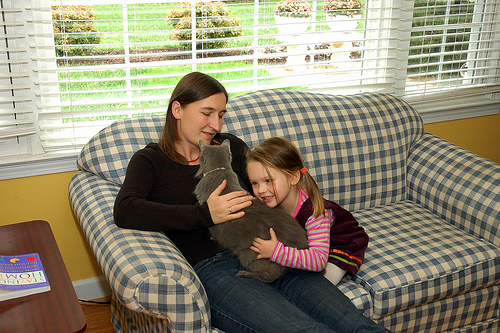
It’s still a cliche love-hate relationship: L still loves, the cat still hates. Or perhaps “the cat fears” would be more accurate.

In my pre-parenthood thoughts of what fatherhood would be like, I never realized that literally everything must be taught — even how to show love. It’s a given when we look at the dysfunctional relationships that are everywhere (most commonly on the covers of magazines in the checkout line). Still, I thought that if we taught by example, L would learn how to express affection.

DSC_8763

We teach by example; we illustrate by experience (“See? We’re gentle with the cat and she comes to us.”); we instruct directly (“Hitting the cat is not a good way to show affection.”). Sometimes it works. Generally, Bida continues to head the other way whenever L enters the room.

Measured Words

Lesson Planning

Robert Frost reportedly said, “Writing poetry without rhyme is like playing tennis without a net.” The same could be said of meter-free poetry.

We’ve been working on poetic meter in English I Honors, and yesterday I sent them packing with deceptively simple homework: write a sonnet.

“What’s a sonnet?” they thought. Fourteen lines of iambic pentameter — da-Dum times five.

One by one they filed in today, and one by one they declared, “That homework was a nightmare!”

We took some individual lines and examined them, adding words and massaging the lines until they were roughly iambic pentameter. The homework for tonight: rework the first four lines so that they are all the proper meter. Just before the bell, I reminded them of the next hurdle in sonnets: “Remember, we’re working on English sonnets, so ultimately we’ll be having an a-b-a-b rhyme scheme for this first quatrain.”

The moans were overwhelming, but at the very least, they have a newly found respect for Shakespeare: “He wrote 154 sonnets.”

“Did he not have any friends?” one young man asked.

Manic Depressive

The problem with teaching is that it leads to manic-depressive thinking. When things are up, they’re really up. Confidence soars; it’s easy to get out of bed; grading and planning are a snap. When things are down, it can make one lose confidence in the entire national competency and grind one down into a pessimism that is almost palpable.

Trust but Verify

When Gorbachev and Reagan signed the Intermediate-Range Nuclear Forces Treaty, Reagan used one of his most loved slogans:

The President: […] We have listened to the wisdom in an old Russian maxim. And I’m sure you’re familiar with it, Mr. General Secretary, though my pronunciation may give you difficulty. The maxim is: Dovorey no provorey — trust, but verify.

The General Secretary: You repeat that at every meeting. [Laughter]

The President: I like it. [Laughter] (Source)

It was in that spirit that I approached an administrator to verify a student’s explanation of her absence.

“No she did not come talk to me” came the reply, and my own words to the students, from the beginning of the year, echoed: “You have my trust now. Once it’s gone, it will take a long time to rebuild it.” This young lady, sadly, has lost my trust.

I’m not sure she’ll care. I can see her brushing it off as if it’s no big deal, and it might very well not be a big deal. Someone who hasn’t spent much time in an environment that fosters trust might not know what it’s worth, and in that case, it’s difficult not to try to care for her.

Busted

Reading over student work, I find a sentence that troubles me: it has a maturity that belies its author. I continue reading, and within a few moments, I’m pulling out the laptop and Googling the suspect sentence: it’s lifted directly from Wikipedia. With a sigh, I write “See me” at the top of the paper, underlining it emphatically.

Dealing with plagiarism is one of my absolute least favorite duties as a teacher; it’s especially tough when it’s a student I really like, a student who is sensible and gives every impression of being a conscientious student.

Plagiarism is a sin that is hard to treat evenly. Is unintentional plagiarism as bad as intentional? Is malicious plagiarism (“He’ll never catch on, the old doddering fool.”) worse plagiarism motivated by laziness or procrastination?

As I’m reading, and I begin to grow concerned about the authenticity of a particular essay or poem, I find myself tensing up. A brier patch of issues awaits, and it’s seldom a pleasant experience.

Celuacy for non-Poles, is a grade above an “A”. It signifies mastery of a subject accompanied by superior extra-curricular work.

On one occasion, though, a young lady of supreme character managed not only to avoid losing respect but managed to increase it. She was a student in Poland, and she worked hard to have celuacy (“excellent”) in as many classes as she could. She turned in a journal that was clearly plagiarized. (With English learners, it’s easier to discover copied work, for obvious reasons.) I spoke to her about it, asking her why she’d done it.

“I just didn’t understand that we weren’t supposed to copy.”

A lame excuse, but she had so endeared herself to me (to all teachers) with her hard work and dedication that I put off the inevitable. “Well, I’ll think about how we can handle this; my standard policy, though, has always been to give a failing grade for plagiarism.” She said nothing, but she was clearly upset.

The next day, she approached me. “I’ve been thinking about it,” she began, impressing me with her correct use of the present perfect continuous tense. “I should have known better. I want you to give me a zero.”

I did, but I made sure she had plenty of opportunity to offset that zero and maintain her high average.

She did.

Every time I’ve had to deal with plagiarism since then, I’ve hoped for such a response. So far, no luck.

Maybe tomorrow.