education and teaching

R&J

It’s that time of the year, the highlight of my teaching year in many ways: I go over Romeo and Juliet with my English I class. I know I’ve mentioned this before, even at roughly the same time of the year. (The start of the second semester is just such a perfect time to begin the most challenging read of the year.) I suspect I’ll be writing about it every January, because I get such a thrill out of introducing a new group of kids to arguably the greatest writer in English.

It’s such a time of uncertainty for the students. Shakespeare has held such a vaunted place in their imaginations for so long that they’re certain it will be the most stilted, boring bunch of aristocratic nonsense they’ve ever encountered.

And then they hear the nurse making one sexual innuendo after innuendo: “I am the drudge and toil in your delight, / But you shall bear the burden soon at night.” They notice that Juliet is prone to making them, too:

‘Tis but thy name that is my enemy;
Thou art thyself, though not a Montague.
What’s Montague? it is nor hand, nor foot,
Nor arm, nor face, nor any other part
Belonging to a man.

They see Mercutio being a positively provocative smartaleck: “And but one word with one of us? couple it with / something; make it a word and a blow.” They find themselves not liking characters: “Mr. Scott, Romeo is kind of creepy in a way.” And out of the seeming blue, they find themselves able to follow three scenes (2.4-2.6) in a recorded performance without the aid of the text before them.

Every day, I ask the same question: “On a scale of one to five, how difficult are you finding Shakespeare now?” I ask students to hold up the number of fingers to express their difficulty with the text. After the first reading of the prologue, it was all fives. Now, after two acts, it’s a mixture of fours, threes, and twos.

I have the privilege of watching 100+ eighth graders grow and develop over the course of nine months. I see them developing self-control, self-confidence, and occasionally even calm humility, but these are part of the natural course of growing up. Seeing them gradually make their peace with an author they feared only months before (and I can claim all 100 for this, for everyone in my classroom comes to terms with the Bard at some point and some level) is something I can claim at least partial credit for, and it’s one of the many thousands of reasons I can’t imagine doing anything else.

Photo by -JvL-

One Semester in One Month

I just finished up a course on diagnosing and correcting reading deficiencies in middle and high school students. One of the most useful courses I’ve ever taken — especially the book: Kylene Beers’ When Kids Can’t Read: What Teachers Can Do. It’s my new classroom Bible.

The course was a one-semester course crammed into one month, what my school calls, appropriately enough, “January term.”

Which is finally over. And which explains how we could take the Girl ice skating for the first time and it receive nary a mention here…

Maybe over the weekend…

Letters, Part One

Teachers have a dream letter. It’s the letter that says simply, “Thanks. You helped me.” Sure, it’s an ego boost, but more than that, it’s confirmation that a teacher is doing his job effectively from the only source that matters: the student.

I received one such letter after my student teaching. A young lady in the honors course I was teaching was frustrated with the amount of reading I’d assigned. She came to me after class and explained that she has great difficulty comprehending what she’s read. “I have to have my mother help me. She reads it and explains it,” she said quietly, wiping her tears and glancing about to see if any other students were in the room.

The next day, I gave her a list of techniques I’d created the night before while pouring over all my notes and books from college. I explained how each technique worked, modeling a couple. She used them at home and said they were helpful.

When my cooperating teacher had the students write letter to me before I completed the assignment (one thing you liked, one thing you didn’t, and advice for the future), she wrote a sentence that, though I have long since lost the letter, I remember clearly: “You’ve helped me more than you realize.”

Fifteen years later, I receive another letter.

To be continued

Journals

Frustration Bliss
Image via Wikipedia

Reading eighth-graders’ journals is like jumping in a time machine: all the angst, all the broken hearts, all the frustration with school. I see myself a thousand times over. Bored with this. Frustrated about that. Irritated with him. In love with her.

“Nothing new under the sun.”

They’ll find this out for themselves. But when I leave comments in their journal, how can I say this without being dismissive? It’s a fine line.

First Day Back

Returning to school as a student was always something of a mix. There was a little relief because, let’s face it: free time can get a little boring when you’re a teen. At the same time, there was the return to dreaded classes and dreaded teachers. There were classes we didn’t feel were worth our time (sometimes rightly, often not), but this was not the real problem.

The true problem was in the personnel: the teachers.

Though they were few, there were teachers gifted at turning interesting subject matter into drudgery because of their inability to share their enthusiasm or (probably more likely) their complete lack of enthusiasm. Such teachers often complained about the end of break, relied heavily on sarcasm in their interactions with students, and generally made no effort to hide the fact that they really didn’t want to be there, that they really didn’t enjoy working with us, and that, given any other options, they would choose just about any job over being a teacher. (This is certainly not to say that any teacher who complains about the end of a break or uses sarcasm is such a teacher.)

Those were the classes we endured when going back to school after a break. Was it best to have such a teacher first period, fourth period, or seventh? That was the only question. First period meant getting the dreaded class over with from the beginning. Seventh period meant capping a potentially great day with a sure disaster. Fourth was always good for me: not early enough to put me in a sour mood for the rest of the day and not late enough to leave a bad taste in my mouth before heading home.

I know there are still teachers like that. I suspect that if I snooped around a bit, I’d find one or two in my own school. Most teachers would say the same of their schools, I’m sure.

For such teachers, being in class is just as much drudgery as it is for the students. Neither wants to be there; all are counting the minutes to the end of the class. Such teachers drag themselves out of bed every morning and breathe a sigh of relief when the day is done. And so the first day back for them is sheer torture. It’s a return to work.

Along the lines of the old adage, I’ve never worked a day in my life as long as I’ve been employed in education. Going back to school today was a pleasure. Indeed, I couldn’t get to sleep for the excitement last night of trying some new lessons in old units. I walked down the hall this morning with an enormous smile on my face, and I greeted everyone — students, teachers, administrators — with a genuinely goofy cheerfulness. I told students that I’d missed them, that I’d been looking forward to returning, that I was a little bored without working with them.

Perhaps this helps explain why I have no behavior issues in my classroom beyond the talkative nature of thirteen-year-olds.

Potential

My English 1 Honors class is about to start the Odyssey. For their weekly short essay assignment, I asked about heroes and heroism. Commenting on the usual association of “hero” with super powers, one student wrote the following:

In fact in the real world having superpowers would make you a villain sooner than it would a hero because though the idea of superheroes saving the world on a regular basis is nice and all, name one superpower and there are probably more than ten different ways to exploit it for personal gain and in a world where “look out for number one” is a personal motto for most of the world it is no long shot that with real superpowers there would be more villains than heroes in the world.

Getting these kinds of results is a real boost: such potential in this kid’s writing. The problems are purely cosmetic: nothing a few mini-lessons on sentence variation, punctuation, and voice can’t buff out.

Expectations and Challenges

"Teacher Appreciation" featured phot...
Image via Wikipedia

Bonnie Davis writes in How to Teach Students Who Don’t Look Like You,

In searching for the causes of the achievement gap, [Haycock] and her research colleagues ask adults why there is a gap. They hear comments from educators that the children are too poor, the parents don’t care, and they come to school hungry. The reasons, she adds, are always about the children and their families. Yet, when she talks to the students, she hears different reasons. Students talk about teachers who do not know their subject matter, counselors who underestimate their potential and misplace them, administrators who dismiss their concerns, and a curriculum and expectations that are so low level that students are bored.

I’m curious about the methods of this study. Were teachers simply asked to share their assumptions, with researchers later collating and categorizing them? Or was there a questionnaire? Either way, there is an element of interpretation necessitated by such research that might make it far from objective.

I’m particularly curious about the claim that students find the curriculum so low-level that they’re bored. I don’t doubt their claim to be bored, but I’m skeptical about the cause of that boredom.

In my own classroom experience, I’ve found the state-mandated curriculum to be too challenging for many of the students placed in on-level classes (students who, generally, actually read two to three grade levels lower than their actual grade). I often feel my expectations are too high.

But is this why children are bored in the classroom? Is there a societal element? I believe there is. Contemporary entertainment media — games, television, the Internet — have taught students to expect short, entertaining bites of information.

The question is obvious: are we competing with the new media?

We might be in competition for students’ attention, but to that I’m tempted to say, “Well, that’s at least equally the students’, parents’ and teachers’ fault.” I agree that teachers should be interesting and engaging, but the point of the classroom is not entertainment, and the defining criterion of an effective twenty-first century teacher should not be their ability to entertain students.

Literacy, On the Fly

We began a new unit on Nightjohn and literacy in the English Studies class today. Just as the students were starting the kick-off, which was to answer the essential question, “How does literacy change lives?”, I had remembered William Meredith’s “The Illiterate.” It’s always been one of my favorites, a sonnet that takes all the rules about sonnets and bends them slightly. Cursing (internally only), I was frustrated that I hadn’t thought of it earlier. It was one of those moments where the teaching-as-an-art kicked in. I thought about it for a moment, Googled the title, and, finding it available online, decided to improvise.

I thought I’d try a technique I’d learned at the South Carolina Middle School conference at Myrtle Beach last year, but not having printed copies, I had to improvise.

I projected the poem on the whiteboard and read it aloud to the students.

The Illiterate

By William Meredith

Touching your goodness, I am like a man
Who turns a letter over in his hand
And you might think that this was because the hand
Was unfamiliar but, truth is, the man
Has never had a letter from anyone;
And now he is both afraid of what it means
And ashamed because he has no other means
To find out what it says than to ask someone.

His uncle could have left the farm to him,
Or his parents died before he sent them word,
Or the dark girl changed and want him for beloved.
Afraid and letter-proud, he keeps it with him.
What would you call his feeling for the words
that keep him rich and orphaned and beloved?

“Turn to a partner,” I said when I finished, “and select the five to eight most important words in the poem.” As they finished up, we went though the poem line by line, and I circled important words students called out from behind me. In the end, with a few suggestions from me, it looked something like this:

Touching your goodness, I am like a man
Who turns a letter over in his hand
And you might think that this was because the hand
Was unfamiliar but, truth is, the man
Has never had a letter from anyone;
And now he is both afraid of what it means
And ashamed because he has no other means
To find out what it says than to ask someone.

His uncle could have left the farm to him,
Or his parents died before he sent them word,
Or the dark girl changed and want him for beloved.
Afraid and letter-proud, he keeps it with him.
What would you call his feeling for the words
that keep him rich and orphaned and beloved?

“That’s more than five to eight words,” one student pointed out.

“True, but this was what I was aiming for in the long run, so it worked out well.”

I read the poem again, and then we talked about its meaning based on the highlighted words. They quickly saw that the letter contains three options: riches, sadness, and love. We jumped to the last line and reread it.

“Turn back to your partner and come up with three words that might describe his “feeling for the words that keep him rich and orphaned and beloved.” The responses were varied, as I’d hoped:

  • concerned
  • worried
  • mysterious
  • curious

We went back to the poem once more, and I led them to see that the  majority of the poem is an extended simile to explain the poets feeling when touching the unnamed subject’s goodness.

Turning it back to the essential question, I had students write in their journal how literacy would change the narrator’s life. We shared a few, then moved on to the next portion of the anticipatory lesson for Nightjohn.

As I write this, though, it occurs to me that I missed a significant portion of the potential power of the improvised activity. The narrator is not illiterate in the literal sense of the word (pun not intended). He is, however, illiterate. It might have been worthwhile to see if the kids could pick up on the emotional illiteracy that the poem is expressing.

Still, not bad for ninety seconds of planning and another sixty seconds of preparation.

Other Side of the Desk

I sit quietly, looking at the long list of assignments upon which the professor will be basing our grade. Thinking of all my other obligations, I find myself wondering if I’ll survive the next few months.

And I am pleased with that.

Being a teacher without being a student on a regular basis is about like being a mechanic who never drives. It’s one thing to “dish it out.” It’s another to take it.

To see the classroom from both sides of the desk is to ensure reasonable expectations from one’s own students.

First Things

The first week of school is behind us. A hectic week of bureaucracy and smiles. The former comes from all the forms and materials we distribute to students and then take back up almost immediately. “Bring this back before the end of the first week!” The latter comes from my yearly effort to be genuinely friendly.

Betonwerksteinskulptur
Image via Wikipedia

There’s an old saying — advice to new teachers, really — that a teacher should never smile before Christmas. By the end of every school year, I’m so frustrated with my failures in dealing with this or that disruptive or disrespectful (somewhat synonymous in many ways) student that I promise myself that next year I will be a rock until Christmas. I will lay down the law and accept no compromise. I will be a drill instructor. I will pound them into submission and then convince them I’m a decent and nice guy.

Yet summer wanes, my planning progresses, and I inevitably turn my thoughts to what I want to do during the first days of school. And it occurs to me that I would most definitely not like to be beaten into submission as an initial experience with anyone. It would be hard to overcome the negative feelings such a first impression would create.

So when the first day of school arrives, I begin again to walk the ever-wiggling line between being a kind authoritative and devolving into a kind permissive teacher. Students might find the first overbearing at times but have a general faith — now and in the future — that all was done for their best; students find the second to be a favorite teacher while in middle school, only to look back on the teacher as one who was “nice but didn’t teach us much.”

Last week — the first week back — was the honeymoon period. The real test now begins. The sad thing is, I already have my eye on one or two that I believe will be major problems before the end of the first quarter. If I can work effectively with students and keep it only to one or two, it will be a great success.

Endings and Beginnings

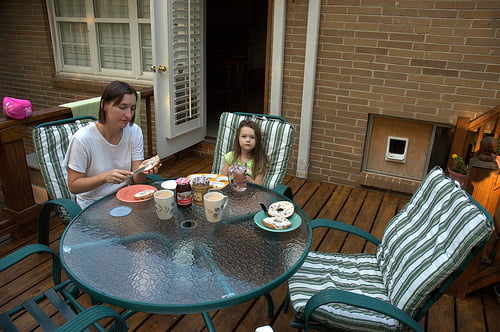
The summer’s end nears. Morning temperatures are back in the lower seventies, and we return to eating breakfast on the deck occasionally. Bagels for us all, but the Girl prefers to dip hers in maple syrup. In a sense, it’s hard to argue with that kind of logic.

DSC_5703

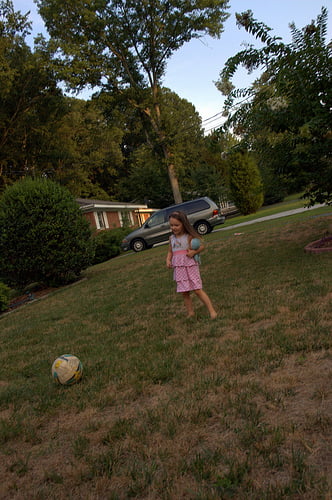
Here in the south, the end of summer is about the only time we can go outside and play comfortably. In July, it’s still 90 degrees as the sun sets. We try to head out sometimes for a little outdoor time, but no one wants to melt.

DSC_5708

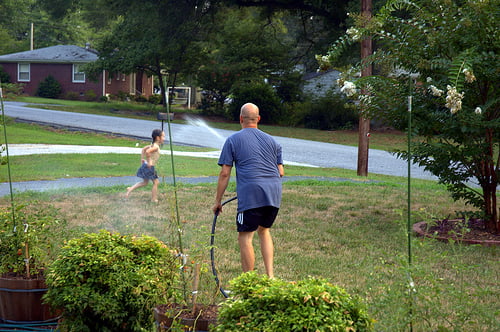
Still, there are options. And does it ever bring back memories: a few minutes of running through misted water on a hot summer afternoon was my idea of paradise when I was a kid. A few overlapping garbage bags fastened to the ground with whatever one could find would sometimes serve as a slide, though never for too long. Since we don’t have a sprinkler (they’ve all broken), L has somewhat limited options. It’s more fun for me, though.

DSC_5685

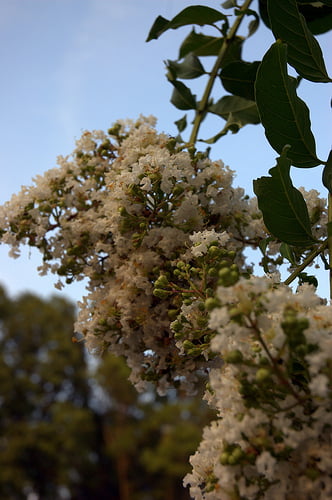
The last of the crape myrtle blossoms begin falling.

DSC_5719

And in this end is my beginning: a new school year both sparkles and looms.

Learning Space

Do much course work in education and you’ll soon find yourself covering some of the same names in various classes: Piaget, Vygotsky, Erikson, Binet, Skinner, Kohlberg, and the list goes on.

It’s frustrating to cover the same material in course after course, but the advantage is that it sits solidly in your head, and you find yourself thinking about it at the oddest times.

DSC_5228

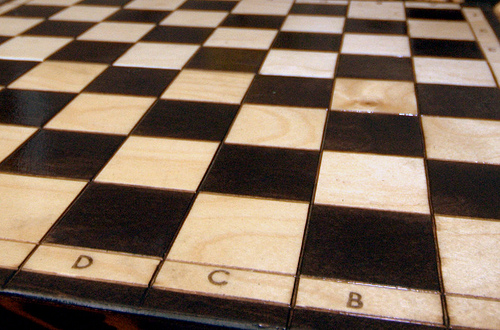
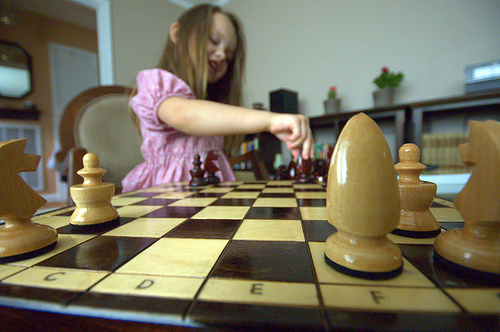
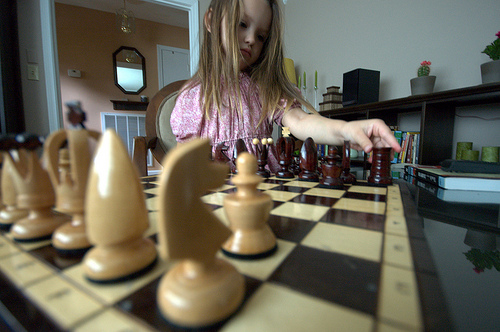
For example, L and I sit down to play chess. Our chess is usually random motions of random pieces, but instructive all the same: she learns that we take turns, and that the object of the game is to defeat your opponent by taking pieces. It’s fun, but her attention span usually only last a few minutes before it’s time to have “tea” or feed her baby or any number of other priorities.

DSC_5220

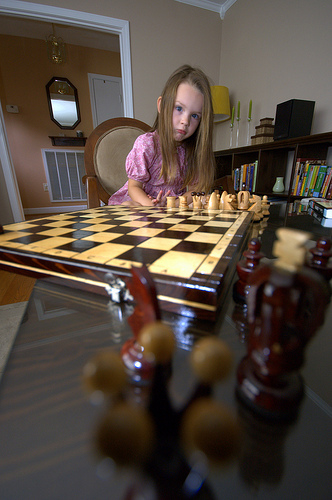
Today, we try something new. I tell her I’m going to set up pieces on my end of the board, and she needs to try to copy them on her end. A real challenge, to be sure. It is quite taxing on her spacial intelligence, for I am asking her to create a mirror image, which requires quite a bit of mental spacial manipulation.

I think of Piaget and Erikson — does she have the mental development for the task at hand. Technically, those gentlemen would probably say, “No.”

“She’s still at the very beginning of the preoperational state,” Piaget says.

Forget ed psych — let’s have some challenging fun.

DSC_5236

The beginning is slow, and it takes her a good ten minutes to figure out that she’s supposed to be mirroring my pieces. But she puts everything together slowly, and it’s obvious she can do it.

More importantly,  she loves it. And I figure it must be in her “zone of proximal development,” for she’s having great difficulty, but slowly she’s mastering it.

“Let’s do it again!”

And so we do it many times. Each time, I alter the order in which I put the pieces on the board. First one pawn, then the other, then a knight and bishop beside each other before moving to the other side. Sometimes a mix of major pieces and pawns.

DSC_5225

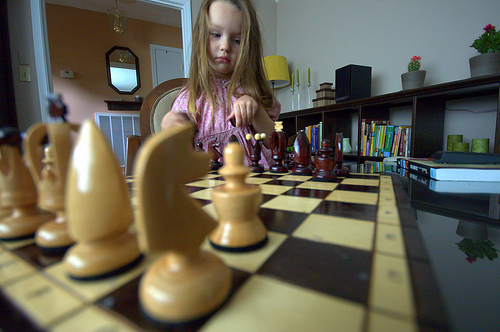
Toward the end, I give her the real challenge: most of the major pieces and some of the pawns are on the board when I tell her, “Figure it out.”

DSC_5226

She looks at my pieces, looks at her own, back at mine, and suddenly, in a flash, her side of the board is perfect.

Once we get the piece positioning down, we’ll start learning how the pawns move.

Once, Upon A Time

I first arrived in Poland in June 1996. I stayed until June 1998, when I went home for the summer before returning for a third year. In 2000, I went back to Poland for a week. In 2001, I moved back to Poland to teach English, returning to the States for the summer of 2002. K and I left for American in 2005 and made our first return visit in 2008. Now it’s 2010, and I’m back in Poland for the fourth, maybe fifth time. Each time I arrive, one of the highlights has always been the unexpected encounter with former students.

Even when I lived here, I would bump into kids I hadn’t seen in a couple of years (by then, adults), and we would chat a bit. It’s great to see what your efforts have led to. Not all of them use English on a regular basis, but some do. Several of my students became English teachers (four that I can think of). A couple of them used English to communicate with the individual who would eventually become his/her spouse. Several of them worked abroad and used English with their employers.

During our return of 2008, I met at least ten former students. I bumped into four or five at a folk festival. One or two worked in shops that I visited. One married the son of a neighbor of my in-law’s. I met a few at the Wednesday market in Jablonka. Each time, it was the same conversation: what they’re doing; what I’m doing; plans for the future. Maybe a word or two about this or that amusing incident that happened in class years ago.

This year, I’ve met one, and only in passing, literally: he was in a car, I was on foot with the family. And that stands to reason: the kids I taught during my first three years are now in their late-twenties or early thirties. They have families of their own, and most likely they have achieved their wish of moving out of the village. I’ve heard as much about a few. The kids that I taught during my second stint in Poland are now in their early- to mid-twenties. They’re done with college, possibly married, with new worries and new passions.

I walk down the street now and see young, new faces. I search the features for a similarity — perhaps he or she is a younger sibling of this or that student. Very unlikely, I realize, but I only recently realized why it’s so unlikely. The kids who are now in high school, whom I would now be teaching, were only newborns when I first arrived. At most, they were two or three years old.

It’s a different world.

K has noted the same thing. “I go into the shops,” she told a friend, “And every single face behind the counter is new.” The teenagers have grown up, moved on, and miraculously, others have filled their spots.

It’s really the curse of being a teacher: I stand still in time. I remain with one of the twelve milestones of one’s life, and I get older while the kids get relatively younger.

Heraclitus, by Johannes Moreelse

It’s also the surprise of the passing of time. Once, we all thought we were ageless, possessors of infinite youth and endless energy. As adults, we go back to a spot where we felt that invincibility, and though we shouldn’t be, we’re surprised that nothing is the same, either with ourselves or with the environment itself.

Naturally, in noting all of this, I’m saying nothing new. Heraclitus discussed it 2,500 years ago, using his famous “never see the same river twice” metaphor to illustrate the centrality of change in the universe. Perhaps part of the nature of change is its sensitiveness. We don’t even realize it’s happened until we return to one of the poles of our lives that serve to solidify and give meaning to our lives, and then we see how much the world — including us — has grown.

Big Hand, Little Hand

I’ve been in education long enough to realize that most of the fixes that have been floating around only treat this or that symptom; what’s at the heart of the condition remains untouched.

Whatever is at the core usually appears to me as a nebulous confluence of technology complacence, with perhaps a bit of torpescence mixed in for thoroughness. I’m no Neo-Luddite, but I’m beginning to wonder if technology, combined with good old fashioned oppression, is not at work in our society, pushing our relative education level down, down, steadily down.

I had an eighth grade student ask me turn on the television so she could find out what time it was. I leave my television on channel fifteen, which is the channel for school announcements and such. When no announcements are posted, a digital clock appears.

I pointed to the analog clock on the wall.

“Why don’t you just look at that?” I asked.

“I can’t read that!” came the response, as if I’d suggested she translate the Odyssey for kicks.

Mildly shocked, I mentioned it to other teachers at lunch. They all agreed: a shocking number of students don’t know how to tell time with an analog clock.

Now a reasonable case can be made that analog clocks are on the way out, that it’s not that critical a skill because such clocks will almost certainly disappear in the near future. Point taken. However, what disturbed me more than anything was the girl’s reaction: there was no hint of even trying to figure out what time it was. She just gave up.

Math teachers tell me this is rampant in their classrooms these days. “They want instant answers,” one told me. “They’re not willing to take the time to work through something, step by step.” She conjectured that this was due to the ease of information availability on the internet.

I mentioned all this to K, and she sympathized, then added, “On the other hand, our grandparents knew how to do things we have no idea how to do, simply because they’re not necessary anymore. Could you guide a horse and buggy?” she asked.

“No,” I replied, adding, “But I would at least try to figure out how.”

Granted, I’m talking about fourteen-year-olds, and they’re a special breed in and of themselves. Still, taking my personal, anecdotal evidence with the fact that America is sliding steadily downward in international academic rankings, and it’s obvious that something is terribly, terribly wrong. The anecdotal evidence further indicates it’s not just a problem with the education system; it’s a problem with the culture, with the Facebook, iPhone zeitgeist.

I find myself asking, “Don’t politicians and high-level educators realize what’s going on?” Don’t they realize that it’s a problem so much deeper than making sure teachers know how to “incorporate student test data into their planning”?

If they don’t, they’re seriously out of touch. There is a breakdown in communication of catastrophic proportions.

Lately, though, I’ve been thinking that perhaps they do know. And the state of the US education system is just what they — and the real people running this country — really want.

An educated public is capable of critical thinking. An educated public stops to think, “Do I really need a BMW when I won’t be saving anything for my retirement as a result of my payments?” A public capable of critical thinking would wonder whether the cable news station they watch is giving them the whole story and seek out other points of view, thinking, “There might be something more to this.” A public that is knowledgeable about chemistry and biology will look at the labels of most of the “food” that’s for sale and demand something real. They’ll wonder whether their weekends are best spent in front of the television watching sports and amassing football trivia. An educated public questions, and that’s not what corporate America wants.

An uneducated population that, by and large, lacks critical thinking skills is easy to rule. They don’t stop to think, “Wait — those special interest groups and lobbying agencies are spending billions to circumvent my vote.”

But what are the options? We have elections every two years for Congress, every four years for the President, and every six years for the Senate, and nothing ever changes. We throw out the Republicans and put the Democrats in; nothing changes. We throw the Democrats back out and put in the Republicans; nothing changes.

The only way this can happen is through the “pressure” of interest groups and lobbying agencies, hired by the corporations that are run by an insignificant percent of our population, people who only want more. They give the Senators, Representatives, and the President the money to get elected and reelected; what do we give them? A meaningless vote.

Maybe this is why the education system is not improving. Perhaps the corporations don’t want it to improve. As George Carlin said, the corporations want citizens bright enough to run the machines and do the accounting, but stupefied enough to be content buying meaningless trinkets and ignorant enough not to realize all of this.

Trust and Teaching

Christmas break has disappeared behind a pile of compare/contrast essays, journals, and persuasive essays. The school year has resumed, and the consequence of my inability to keep on schedule means I have in one weekend a pile of grading that I was intending to spend two weekends and the intervening week plowing through.

Plowing through — as if this were a drudgery. It’s the amount, not the work.

This week has forced me to reevaluate my career choice. Most would expect a paragraph that begins like that to end bemoaning the decision to go into education. My thoughts led to quite the opposite conclusion. Every now and then it occurs to me how fortunate I am to be doing what I love most: working with kids. Teaching is a privilege, an honor.

Most significantly, it is a position built around trust. Perhaps it’s not voluntary trust, and maybe it’s not trust in me personally, but public education is built on trust. One parent said told me, “You’re raising my child; you see him more than I do,” Parents hand their children over to me daily, believing that I will do my best to help their children grow — intellectually and even emotionally. I feel a surge of pride and honor every time I think of the role these parents trust me to play in their children’s life, and that’s why the piles of paperwork this weekend don’t phase me.

Ideally, there should be another relationship of trust in education: between teacher and student. If there is mutual trust, there must be mutual respect: it’s hard to trust someone you don’t respect, and vice versa.

I must have faith that, all variables being made equal, my students all want to learn. Some days it’s more difficult than others: those variables — parental support, presence of adult role models, family educational history (i.e., socioeconomic status) — have a resiliency that can be frustrating. But if I didn’t believe all students wanted to learn (not necessarily what I’m teaching, but simply learn), how could I go to work in the morning? It would be the ultimate Sisyphean task.

The trust my students must have in me is much more multi-faceted. If they’ve had several bad experiences with adults, I start already behind. If they’ve had less-than-effective teachers in the past, I start even further behind. So many ways to gain and lose their trust.

When working with thirteen- and fourteen-year-olds, it’s a thin line of trust. They can have such a heightened sense of “fair,” and they often confuse fairness and equality.

How many of my students would say they trust me? Certainly not one hundred percent: it’s not a perfect world, and I’m not a perfect teacher. I can honestly say, though, that a good number trust me to keep their best interests in the forefront of all we do. Even in moments of classroom management crisis (e.g., acting out),

The End

The school year ended today. It was as I predicted: lots of joy, fair amounts of crying. I told one tearful girl, “It gets less painful every time you reach the end of something like this.” Did I lie? She seemed to think, at the very least, that I didn’t know what I was talking about.

Why is it nostalgia is so much more potent when we’re young? Perhaps it’s simply our general lack of experience, and we’re often thinking, “It can’t get any better than this was,” and so we’re melancholy. Maybe it’s part of the naivete of youth, but this too is a result of being inexperienced in the cycles of contemporary life.

Of course, there were as many not tearful as there were with glistening cheeks. Perhaps they’re not as sentimental as the rest of us. Perhaps they have more experience in their fourteen years that has taught them the transience of most things. Sadly, it might be that they learned about temporariness from the love, attention, and affection they’ve received.

I have at least one such student every year. I always feel like I let him down. I always look back at the year and see countless opportunities to do more, to be more, for such students.

It leaves me wondering, once again, about the marks of a successful year. Testing-wise, I was very successful: I met my MAP score goals, and my E1H EOC grades average was just where I thought it should be. Yet what use are acronyms in determining a successful year? It seems a relatively shallow metric.

The truth is, I became a teacher because I simply love working with kids. Perhaps a selfish reason: I do get a certain high when I connect with a kid and feel I’ve somehow helped him. It’s hardly altruism, especially considering the times I’m doing the opposite: the moments when the urge to take a ridiculous behavior personally and become viscous becomes overwhelming. So maybe it’s not surprising that I have the depressive phases to go along with the manic moments.

This is all to explain why I’m feeling down even though it’s the end of the year.

Another kid left today that I find myself thinking, “I’d like to have another shot with him.” I’d like to have him in my classroom another year and manage to get myself out of the way and see what he needs and give it to him. His needs were not to be met by following the curriculum or making him play by all the admittedly arbitrary rules of the classroom. There was more going on in his life than iPods and texting friends, and I’ve a suspicion a large amount of it was negative. My class might have been one of the few bright spots in his day, but looking back over the year, I doubt it. I communicated to him all the things I swore I never would express through body language and tone to a student.

I finally caught on at the end of the year. (Why did it take so damn long? I knew — I had a similar student last year, and I swore I wouldn’t do what I did this year.) While other students were working on a final project, I realized the project might easily turn into yet another zero for him, and so I differentiated: I had him write an essay on three things he could do next year to meet with more success in the classroom. I gave him a pencil and a legal pad (he seldom had materials), and he always replaced the items on my desk at the end of the class.

What I read when he was done was a stinging condemnation, though he was polite in his tone and word choice. He didn’t even mean to condemn me. He just shared some feelings. Feelings of inadequacy that I fear I only heightened. Feelings of hopelessness that I worry I did nothing to assuage. Feelings of being trapped and only vaguely realizing it.

Real success in the classroom is not measured in completed assignments and MAP/ITBS/PASS scores. Success in the classroom is measured with a metric that, like black holes and dark matter, is hypothetical at best. We can infer it from a student’s smile, or a boy’s pride at walking into class having pencil and paper, or a girl’s wide eyes at getting a C on a test.

I forget this too often.

The school year ended today. It was as I predicted: lots of joy, fair amounts of crying. One girl said, “It’s not going to hit me until tonight. Then I’ll be sad.” And another student added, “And happy, cause we’re in high school.”

I know just how they feel. If only I can keep all this in mind until next August, when I’ll surely another Denny.

Final Days

The school year is nearing completion: just under two more weeks remain. Everyone — teachers, students, administrators, custodial staff — everyone in the building is counting the days.

Such an odd thing: we’ve spent 170+ days working together, and we’re all sick of each other, rather like a family on a long vacation. A bit of time apart and all would be well. Yet “a bit of time apart” is impossible: the students move on, and we teachers remain, waiting for the next group.

It’s as if we’re on a cosmic treadmill. We take a few steps with the kids, and though we all (teachers, students, parents, administrators) keep walking, the students slowly move on ahead of us teachers, occasionally looking back with a smile of thanks, occasionally staring straight ahead, occasionally — tragically — looking down.

“I’m so sick of all this,” we all mutter, but come what may, there will be tears on the final day, and I’ll probably be accused of laughing at someone’s tears as I was last year. “No, no, I’m not laughing at you,” I’ll insist. “I’m just smiling because it’s all rather sweet.”

It’s this time of year that I start making resolutions for the next year. Knee deep in all the mistakes I’ve made this year, I resolve not to do this or that, promise myself to be more systematic about some thing or other, commit myself publicly to more of this, less of that. I’ve a six-page, detailed outline of changes I’ll be making in one course next year, and I’ve only just begun recording my thoughts and plans. (A lesson learned from last year: all the brilliant ideas one has about changes to this or that unit tend to disappear the day school is out.)

And in the midst of all this planning for next year while making sure this year ends positively and productively comes a call from a parent. The long conversation includes a story about how her son came into my class apprehensive. Now he admits that the class is “alright” because I’m a “cool” teacher.

And another student sends me an email: “Thank you for helping me get through this year maintaining my grades.”

Bittersweet moments, indeed.

The Promise of the Future

We took our students on a field trip to a district vocational school where students can learn everything from cosmetology to aircraft repair.  We weaved in and out of the classrooms, learning a little about the requirements and salaries of the jobs the students were preparing for, as well as the expectations of the class. Students asked questions and occasionally listened with wide eyes at salary possibilities.

Though they’re only fourteen, they’re already thinking about their future and their careers. It’s an exciting and uncertain time.

At age fourteen, I was sure I was going to be architect. I was thrilled at the prospect of taking drafting in high school, and though the thrill was gone by the end of the second year, I stayed on for a third year of drafting. In a sense, I regret it: I never directly use those skills now. Auto shop would have been of much more practical value.

I thought about telling the students all this as we walked from room to room, but we almost always learn — truly learn — such lessons firsthand.

MAP Testing

When I walk up behind her, she’s already read the question:

Read these two sentences:

  • The odor of the blossoms drifted across the field.
  • The fragrance of the blossoms drifted across the field.

What is the primary difference between these two statements:

  1. connection
  2. connotation
  3. context
  4. conceptualization1

She’s selected “connotation,” but she’s not sure. She clicks “context” and then “connotation” again. She clicks back and forth, several times.

I linger to see what decision she makes. I cross my fingers, hold my breath, hope that she’s going to select the right answer. Glancing away for a brief moment, I’m disappointed to see that she’s made her selection while my attention was diverted. Being forbidden to discuss the test, I’ll never know if she got it right.

There’s a lot pedagogically wrong with that simple fact. 2

  1. Not the actual question, nor realistic choices.
  2. This is not to disparage the MAP test. It’s actually a fairly useful tool.

Teaching to Share

We’ve been teaching the Girl to share. With no siblings, she’s fairly accustomed to having all her toys all to herself. Yet sharing is not something you can force or even teach like tying a shoe. It’s something in which she needs to see the intrinsic value herself. And the only way to convey that — the joy of sharing, you could call it — is to model it.

“Here, Mama. Would you like some of my cake?” I ask K. She has a slice herself, but she gladly accepts. We smile, but they’re genuine smiles: it’s amusing, the whole process, and it’s difficult to do it with a straight face.

L is beginning to catch on. The other day, she brought me a bit of candy she’d tried, saying, “Tata, I’m sharing this with you. I don’t like it.”