education and teaching

Lent 2012: Day 17

A kind interpretation of actions is such a far-removed idea for me at times, but perhaps the most challenging times are when I’m in a heated situation with a student and when I’m driving in Greenville.

We must come to esteem very lightly our sharp eye for evil, on which perhaps we once prided ourselves as cleverness.

The latter is the most consistent challenge. While I don’t necessarily see other drivers’ motivation as being a result of evil, I constantly pride myself on the cleverness of my own driving as compared that of my fellow pilgrims on the road. This idiot doesn’t know how to turn left at a traffic light. That dolt waits until the car in front of him is twenty car lengths ahead before pulling starting from a green stop light. This moron pulls so far into the intersection that it’s difficult to make a left turn around her. That dork is so busy texting that he misses at least five seconds of the light. This one is a matter of merely reminding myself that I’ve no idea what these people drive the way they drive and that perhaps they have very good reasons. Perhaps the person hesitant to make a left turn recently had a terrible accident doing so. Maybe the person who is waiting for the care in front of him to be a seemingly ridiculous distance from him before starting is having car problems and the car doesn’t respond as well as he wishes. Possibly person pulling too far in to the intersection is on the way to a critical meeting — perhaps a family member is ill in the hospital — and made a last-minute decision not to push the yellow light. And perhaps the person texting is texting about the death of a loved one.

Calmness while driving — offering what Faber calls “kind interpretations” — is fairly simple: there’s very little at stake. A few moments lost here or there is hardly something to get enraged about, and whether or not the kind interpretations are justified, it all seems a relatively moot point when we consider who brief and insignificant the interaction.

The former example of heated situations with students is of much greater import. These are not brief, insignificant interactions. Like it or not, the student and I will meet again tomorrow — and the day after and the day after that — and will have to work together productively. So when a student begins the day with a smart comment to me, simply wants to come in and sleep, simmers with anger at a mild request from me, or any number of things that I would normally be tempted to take personally as an assault on my classroom authority and my personal dignity, I really have two choices in how I deal with the situation, and the decision I make depends on whether or not I create for myself a kind interpretation of the individual’s motives. Students come to class with any number of significant and insignificant emotional weight pulling them down, and the simple truth is I have no idea when someone has placed more mass on her shoulders. Perhaps this young man comes from an abusive home and he just faced down a violently angry parent to deflect injury from a younger sibling. Maybe this young lady is responsible for a eight-week-old sibling during the night because their mother works the night shift. This young man might not have eaten breakfast this morning and had very little dinner the night before. Any one of these situations would be enough to set a day off on a crooked trail. And while I know more about these kids than the average stranger, most of them are still virtual strangers to me when it comes to the clockworks of their lives.

A kind interpretation of their anger, apathy, exhaustion, and frustration results in a kind answer, and we all know what that does.

The quoted excerpt is from Father Frederick Faber’s Spiritual Conferences, excerpted here.

Lent 2012: Day 8

Thus does kindness propagate itself on all sides. Perhaps an act of kindness never dies, but extends the invisible undulations of its influence over the breadth of centuries.

“We can only plant the seeds. We never know how they will grow” It’s a common refrain in teaching, and I always kind of thought it was a cop-out. At times I feel like, quite frankly, such a failure as a teacher. Kids spend 180 days with me, and some of them seem none the better for it. It’s perhaps a useful guilt: it might spur teachers to become better at their job, to seek training and experiences that will increase their effectiveness.

Perhaps an act of kindness never dies

But saying, “We can only plant the seeds” seems somehow to alleviate that guilt. We plant the seeds; it’s up to the kids to tend the resulting crop.

Faber suggests otherwise: it’s not a cop-out. We can sow kindness and know, with some certainty, that it will grow into more kindness. We can know that we’ve had a positive impact on someone’s life. Perhaps it’s a good sign that we’re more willing to admit the opposite, or maybe it’s just another sign of our condition.

The quoted excerpt is from Father Frederick Faber’s Spiritual Conferences, excerpted here.
Lent 2012: Day 5

the immense power of kindness in bringing out the good points of the characters of others

When I can lift myself above my wounded ego — “What?! How dare you be cruel or disrespectful to me, who is only trying to help you get an education!” — and respond thoughtfully and kindly, a change sometimes occurs, a softening, a reflective moment of calm.

A kind word or tone can transform conflicts into positive experiences. A simple kindness of offering to help a kid by holding books while he rummages through his locker can bring a smile where once there was anger.

Even if all is well in the student’s life at the moment, an act of kindness can echo into the future. Relationships are like bank accounts: we can make deposits through kindness that will give us a buffer against emotionally stressful withdrawals.

The quoted excerpt is from Father Frederick Faber’s Spiritual Conferences, excerpted here.
Lent 2012: Day 4

Probably the majority of repentances have begun in the reception of acts of kindness, which, if not unexpected, touched men by the sense of their being so undeserved.

Reading Faber, I keep returning to thoughts of school and interactions with students. And I can’t deny that there are times, based on behavior of various students, that I find myself thinking that this or that student doesn’t deserve kindness. When someone is disrupting others, making it difficult to focus on the task at hand, focusing all her energies on getting everyone’s attention, she is attempting to take opportunities away from others. It’s a myth to think that students today aren’t interested in learning — the vast majority are, keenly so. But it only takes two or three in a classroom to derail the whole process, and an incorrigible student soon draws the ire of other students and the teacher.

It is precisely at those moments that I most decidedly don’t feel like being kind. It is in those situations that the temptation to cruelty is most acute. Responses come to mind that are so ineffably and cruelly inappropriate but at the same time seem so perfect. Yet a kind word can sometimes calm the whole situation, while cruelty will only debase everyone in the room. It’s the easy way out, which is why kindness can be so difficult.

The quoted excerpt is from Father Frederick Faber’s Spiritual Conferences, excerpted here.
Teachable Moments

DSC_6782

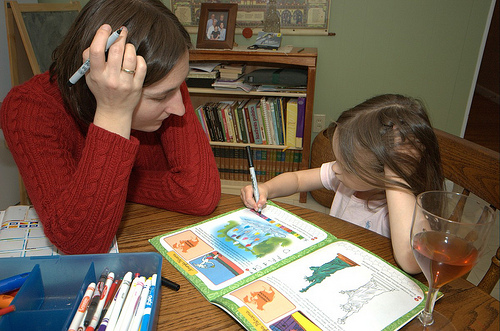
It often astonishes me how few social skills some students have. Among other tendencies, they exhibit an inability to accept criticism, to delay gratification, to express frustrations in a positive manner, or to know when it’s best to keep a particular thought to themselves. “How is this possible?” I sometimes wondered in the past; having a child whose verbal abilities and cognitive skills increase daily has taught me: these students simply haven’t had sufficient direct instruction.

There are so many things that kids pick up on without being taught directly — chief among them, the most unique characteristic of humans: language — that it’s easy to forget that some things we take for granted actually have to be taught. We think that correction is teaching.

Tonight, I came home with a bit of spare change in my pocket, and as the Girl is saving for a Barbie camper, I give her a bit of my loose change when I have it. I gave her a quarter; she smiled and asked, “Can I have more?”

The easy response — the response I suspect a few of my students got as children — would be, “Can you what?! Don’t you go asking me for more when I’ve already given you something!” And that would be the end.

Tonight, I took the quarter back and explained calmly that, when someone gives you something, it’s really not very polite at all to ask for more. “Let’s try it again,” I said, directing the Girl to return to the spot where she was standing.

“I have something for you,” I smiled again.

“What!?” she asked in almost genuine excitement — she’s a good play-actor.

I gave her the quarter, raised my eyebrows ever so slightly, and she replied, “Thank you!” and put it in the piggy bank.

Explicit teaching followed by directed practice. Sounds like I what I do eight hours a day…

Map Work

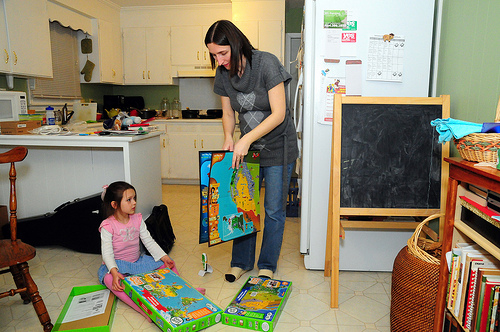
The Girl has been working on puzzle maps at school, learning, continent by content, states and countries — Europe, North America, and South America down, currently working on Africa.

DSC_6618

Almost every day since then, we’ve gone over countries and states, an effort to remember what’s learned and add new states so she can finish a continent and bring home her hand-colored map.

In Poland this autumn, she drove everyone crazy showing all the maps she knew. Only Dziadek, a former geography teacher, could sit down and listen to her, time after time, catalogue the shifting geography of an ever-changing world. “Many of those countries didn’t exist when I was born,” I think as she names them for me; as for Dzaidek, even Poland was a different country when he was born. Those nuances are lost on L as she points and names, proud of her memory.

DSC_6625

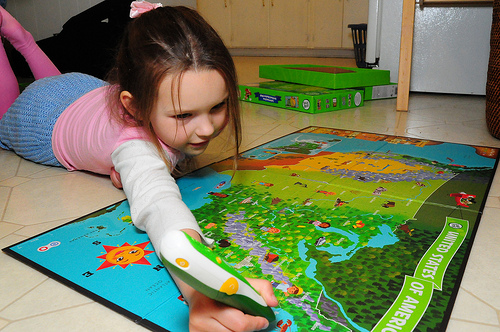
As a reward, though, we agreed to buy the Leap Frog interactive maps for her when she completed Europe, and they arrived today.

DSC_6630

Endless fun on the horizon.

The Games We Play

DSC_6585

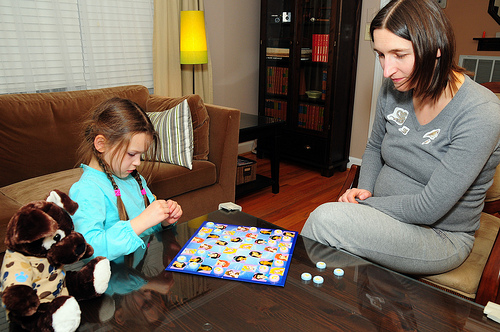
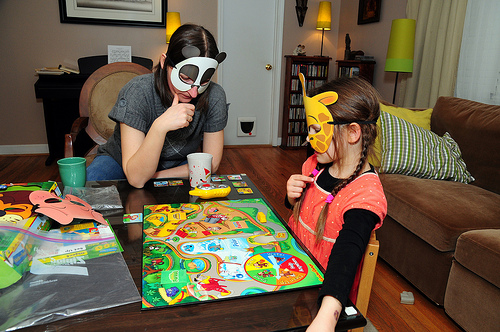
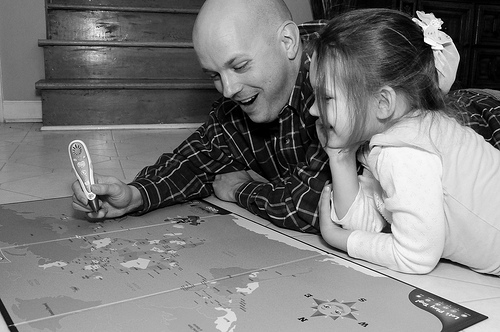
The Girl simply loves playing games: Candy Land, checkers, Go Fish, “the memory game” (Never just “memory” for her), Curious George — you name it, she’ll play it.

DSC_6583

The long-standing challenge for us as parents has always been teaching her to win with humility and lose with dignity. It’s tough to teach a child something you yourself are not good at, for it must be said that I don’t always lose with dignity myself. Chess is about the only game I play, and while I don’t pitch a fit, my pulse quickens at a loss, and I’m soon berating myself for my obvious mistakes.

DSC_6596

Yet by their very nature, these games make excellent benchmarks for social skills development. There are countless metrics:

  • How far into the game does the first fuss appear?
  • How long does the first fuss last?
  • Once it subsides, does the first frustration return immediately?
  • Is the Girl capable of finishing the game or has she worked herself into an irreversible tizzy?
  • When it begins to look like a loss is inevitable, does she give up or continue playing?

Recent gaming adventures have shown that L is developing a tolerance for the inevitable eventual loss, an ability to recover quickly from initial frustrations, and the poise to win and lose well. It was, in short, truly a phase.

Thoughts on the Balcony

We all go into the classics of literature with certain preconceptions and assumptions. We grow up hearing about Romeo and Juliet, and knowing that it is considered a classic love story, we expect to find a valiant and noble Romeo. What we find, as the play develops, is a character that is entirely more human than we expected. In fact, early impressions of the young man sour quickly.

These are some of the impressions from my eighth graders after a two-day look at 2.2, the famous balcony scene.

  • I think Romeo is a little obsessive. Like when he was in love with Rosaline, he fell deeply in love, but he quickly moved on to Juliet. He didn’t even know who she was and he was already making out with her! I think nowadays he would be considered a player.
  • He’s a major creeper and totally a player. I would never date him.
  • I think Romeo has good logistics but when it comes to love, he’s a bit tipsy! He is a star-crossed stalker.
  • I can’t believe he went to her balcony. That is mega-weird.
  • Romeo is a psycho-creepy stalker!
  • Romeo is very spontaneous. He lacks a lot of common sense that Juliet has.
  • Romeo is someone I would trust but would not fully trust.
  • I can see why Rosaline left [Romeo].
  • Even though he is a creeper, he seems romantic and sweet.
  • Boy is he a CREEPER! Come on now! You just met her!
  • Romeo is brave yet incredibly stupid.
  • I hope as we read on he will get back to the person I thought he might’ve been before, like charming and funny and bold.
  • [Romeo] is annoying and very stalkerish, but I don’t see him as mean.
  • I wish Romeo was more of a perfect gentleman, funny, daring.
  • Romeo is a creepy, weird person. I thought he was cool at first, but not anymore.
  • I feel like Romeo is being shallow.
  • Romeo is a creep.
  • [Juliet] seems like she would make smart decisions like not to smoke or drink.
  • I think Juliet would be a cool person (without the old English).
  • You’re telling me you wouldn’t risk life and limb for your belovèd? That’s not very gentlemanly. (In response to another student.)
  • I probably wouldn’t be friends with Romeo because he confuses me a lot of times.
  • [Juliet] has good views on love and is an independent girl. We will soon be BFFs :)
  • Romeo is a professional psycho. ‘Nuff said.
  • [Juliet is] NOT creepy, like Romeo!
  • The crazy part of it is that Juliet ends up killing herself for the psycho! See, she’s the one that needs to be checked into a mental institution for liking him!
  • Romeo is a stalking creep. Nope, we wouldn’t be friends. We’d be best friends. We’d go stalking together.
  • Romeo goes with his heart and blacks out his mind, which is not good at all!
  • Romeo falls in love a lot.
  • Romeo would be the kind of person that would be overprotective and call or text you every day, say “I love you” a lot. (Clingy.)
  • I’m not being friends with some mushy guy!
  • I’d be [Romeo’s] friend as long as he stays away from my window!
  • I wouldn’t want to listen to [Romeo] sob about love and girls all the time.
  • Romeo is a dreamer and a gal-pal and would be annoying.
  • Romeo is starting to turn out a little weird.
  • I think it’s pretty hardcore that Romeo lives in the present.
  • I’d keep a fair distance [from Romeo].
  • If Romeo says you can only love one person, then why does he love two?

The Return to Reality

The return after a long break is both nerve-wracking and refreshing. The former comes from the unpredictability of fourteen-year-olds. The latter is a simple function of having a long period away from each other. As much as I like my students, it’s good to be away from them from time to time — to be around adults more than kids. (Well, having a five-year-old daughter, I’m not sure how much that’s really possible.)

For everyone today — teachers and students — it seemed the “refreshing” won out. Far from being reluctant to return to studies, many students seemed positively eager to come back — at least that was the feeling I got in my classes.

It was a good Monday, and often can one say that, especially after a long break?

Meter

I try to show the kids the simple fact that much of what we write can feel iambic even when we’re speaking normally.

In the hush of the classroom we read all the lines of the ages, and marvel that “anapest” is a dactyl and that “trochee” is one while “iambic” isn’t. We scan the lines, apply the labels, and admire the Bard for all he did for the iamb.

Tops

Few things are as beautiful to me as an English teacher as the tops of my students’ heads. Like thirty suns rising over the horizon of their desks, the sight of students’ crowns is a sure promise, an hint that today might be better than yesterday.

With pencils skating and tapping across their page, my students reveal the treasure in their heads through flawed but ever-charming drafts. They create maps of ideas that are perfect in their heads but somehow get a little muddled as they travel down their arms to their fingertips. But oh, the treasure they often share. What a strange and electrifying privilege to learn things about people that seem to be revealed only to the most trusted. What an honor to be the confidant of so many bright minds.

Yet it’s not just the content that brings joy. The process itself is almost sacramental. Some write with furrowed brow; others look like they’re smiling; still others seem both amused and confused; a few even seem ambivalent. There are exasperated sighs and frustrated moans, and the crisp echo of someone wading paper occasionally punctuates the grey-black scratching of graphite.

I’m always torn during such in-class writing engagements. I try to set the example and write alongside my students, sharing my own drafts and troubles so they can see that all writers have problems with writing. Still, part of me wants to sit and just watch as they wrestle with themselves. “I have trouble writing when I don’t like the topic,” they almost universally write in their first assigned topic, “I, the Writer,” an exploration of writing in their lives. To remedy this, I try to allow as much freedom as I can, and the fact that I can get thirty-plus thirteen-year-olds to sit quietly and write is a testament to the effectiveness of freedom. And so I work toward a successful medium: write a little, glance up and feel proud for them, then write a little more. My writing during these sessions often turns to the joy of watching students work.

It is most clearly in these moments that I see my vocation: I am a teacher. I will always be a teacher. I cannot imagine doing anything else, for I am addicted to the warmth and trust of my students.

First Day

It’s all smiles the first moments of the first day. There is optimism and perhaps hint of hope. New teachers. New year. A fresh start.

“I’ve heard she’s a little odd,” one says to another.

“But she’s really tough. That’s what Eric said,” another chimes in.

Next door, it’s the same story. The worries are identical. Will this be a cool teacher? Will I get along with her better than I did my last first period teacher?

“I’ve heard he’s really hard.”

“I’ve heard he’s really easy.”

Down the hall, the thoughts are the same. What will we read? What experiments will we do? Where will we go for field trips?

“I’ve heard he’s a jerk.”

“I’ve heard she’s really sweet.”

Everyone bumps around, unsure of themselves, unsure of their standing in the class, unsure of more things than they will care to admit. No one knows what to expect; no one knows whether to hope for the best or prepare for the worst.

“I’ve heard the cafeteria food is going to be better this year.”

“I’ve heard the dress code will change.”

Everything is in flux, sliding and slipping about like a ballerina on a well-greased floor. The only thing anyone has to go on is rumors and the Pop-Tart gobbled on the way to the bus stop.

And it’s all visible in the eyes, in the body language. The teacher clears her voice, signaling the beginning of the class, and everyone looks the same: shields up; defenses activated; look like a stone.

Who’s to blame them, for who is this person, this unknown, who will be an integral part of their lives for the next nine months? It’s a great poker game: no one knows if the teacher is the jackpot or three lemons. Everyone knows from experience that a great teacher can turn into a horrible ogre in a matter of days, and so everyone is afraid that it’s a front. The smile might not last; the attempts at jokes might not continue; the proposed classroom atmosphere of ease might be only an illusion.

It’s all rather like a blind date. The doorbell rings and there stands a bloke with a bouquet and a smile. The girl has her guard up and is analyzing every single thing the guy does: the jokes he cracks; the car he drives; the conversation he makes; the clothes he wears. Everything is a coded, hidden message, and the girl wants to know as soon as possible whether or not to text her friend who agreed to call her and speak in a loud, frantic voice about the impending emergency that she must, simply must, come and help with.

“I’m so sorry. I have to go. My friend’s cat is stuck in the dryer.”

If only it were that simple, for this date will last nine months. It’s a first date, a blind date, that’s the length of a pregnancy. And as with a pregnancy, there is nothing a friend can wildly scream over a cell phone, no emergency so great that it can end the date. And yet, the girl ponders, perhaps it won’t be so bad. After all, her cousin ended up marrying a guy she met on a blind date.

So the girl eases into the car and the students ease into the desks with a bit of worry and a touch of hope. This could all turn out well. The young man might be a perfect gentleman; the teacher might be a perfect instructor and mentor. Everyone decides for a moment, for a few days, to give the guy, to give the teacher, the benefit of the doubt.

Even those who are sure the whole school is involved in a vast conspiracy to trouble and torment them through their whole education entertain the thought that this year might be different. It’s sure to turn into disaster sooner or later, they think, but maybe it won’t be that bad. Maybe it won’t even be a disaster; maybe it will just be an inconvenience.

Everyone thinks, “Let’s wait and see.”

The teacher stands in front of the classroom, sees the sea of new faces, ponders the coming nine months, and thinks exactly the same thing.

“By the end of the first quarter, this girl might end up driving me nuts,” she thinks, looking at a face in the front row. “By the end of next week,” she shutters, “That guy in the back row might make me question my dedication to teaching.” The teacher looks, and explains, and waits. Waits for the first sign.

“We will have a test on every chapter,” she begins, and she sees the troublemaker in the back row yawn and prop his head on a casually balanced fist. “Oh, it’s already started,” she thinks. “I can’t make this any more interesting than this, and he doesn’t even have the decency to…”

In truth, it’s always like this. We are individual universes, carried around by clumsy bodies that often belie our doubts and fears. We assume, judge, and act on our initial prejudices, and then wonder why everyone else does the same. But sometimes, those judgments and quick characterizations set the scene for something more significant than a blind date. We are constantly moving into and out of each others’ universes, but we very rarely have any idea when we’ve bumped into someone who will have a major impact on our lives. But such moments do exist.

The first day of class is one. Students and teachers wake up on the first day of the new school year with the same thought: “I hope this year will be better than last year.” It doesn’t matter whether the previous year was a total disaster or an unqualified success. We always want it to be better. And we all hope, students and teachers alike, that it will be better.

Then the old routines return, and the students and teachers alike find themselves wondering, “What’s going on? How did it all go wrong?”

The dilemma is much more complicated than that, because we all have different ideas of what “wrong” means. Because we’re these universes — monads, as Spinoza called them — jostling around, unable ever to understand fully the physics of each other, we’re doomed to make mistakes that we don’t even know are mistakes. We offend where no offense was meant; we anger when we’re trying to amuse; we harm when we’re trying to help.

And nowhere is this more evident, more clear, than in the classroom.

What are we to do? We don’t have instruction manuals that we can read about each other. We don’t know what each others fears and dreams are. Sometimes we don’t know what words hurt, what actions destroy. Unless we tell each other.

That’s unrealistic. No one spills her guts walking to the car on a blind date. “Listen, I had a really bad relationship with a guy who always brought me roses. I associate roses with pain, so you might not want to bring them. They only call back bad memories.” No one says, “Listen, I am very insecure with my reading, and if you ask me to read something aloud, I will do anything and everything to avoid it–even if I have to cause a scene to get thrown out of class.” No one says, “I really want to help you guys, and sometimes I get really frustrated when people don’t seem to be paying attention. Then I make sarcastic remarks because I think it should be obvious.” No one says these things, but maybe they should.

So I will say these things to you. I am here to help you. I am on your side. I wake up in the morning with the hope of somehow making your life a little better. But I am human. I get frustrated; I get tired; I get irritable. I sometimes assume you should realize things that you might not necessarily realize. I occasionally assume that you didn’t this or that because you’re lazy. I catch myself, but sometimes the damage is done. Yet that doesn’t change the fact that I’m still on your side. I still am here for you.

Twenty

We jostle about in our adolescence, bumping against others and ourselves, usually questioning where we stand with others, often unsure of where we stand with ourselves. Such tumultuous times of identity formation, questioning, and reformation. We make and remake ourselves year after year, month after month, even day after day, and we’re all nagged by the same question: is the me I see in myself what others see? Or more to the point, is the me I see in myself the real me?

Sociologists and psychologists tell us that adolescence is a relatively recent cultural phenomenon, a product of the same innovations that created the leisure class and free time. In the past, one’s position in life was fairly well determined generations before one was born. Once born to generations of farmers, always a farmer; once born to a family of wealth and position, always an aristocrat. These days we wake up and find ourselves in possession of a driver’s license and a handful of friends, unsure what to do with either, and we struggle to make decisions that weren’t even available ten decades ago.

Every year, as an eighth grade teacher, I see my own students going through this, yet with seemingly infinitely more choices that I had. Their thumbs can move at over a phone’s small keypad at the speed of gossip, and last week is ancient history. They come to class sometimes with tears in their eyes, and I think, “Someone broke someone’s heart, and they’re both sure they’ll never survive it,” and I smile to know they will, because I did, and a hundred and twenty kids in my cohort did as well. “Love is blindness” I mutter under my breath.

I want to say, “Twenty years from now, you won’t worry so much about this. Like precipitates in a Chem II experiment, love and your personalities will seem somehow to have settled and congealed.” I want to tell them, “You’ll quote the Beatles: ‘I am he as you are he as you are me and we are all together,'” until I realize that U2 is their Beatles. (A student mentioned to me that he likes U2: “My friends think I’m crazy for listening to that old music,” he confided. Thanks.) I want to confide, “You’ll think to yourself, ‘Love is blindness,’ go to your twenty-year reunion, and find that you had more in common with everyone in your class than you ever realized.” But I know the words will do no more for their shattered hearts (egos?) than such words would have done for mine, and I’ll hope that some day, perhaps they’ll invite me to a reunion.

Heading Home

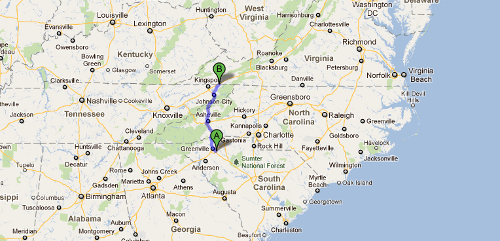
I grew up in a border town — half in Virginia, half in Tennessee — about three hours north of where we presently live.

In the last fifteen years, I’ve only gone back a handful of times. Today, K and I are making the trip to meet with people I haven’t seen in twenty years, most of whom I knew only in passing, and many of whom I probably won’t recognize, and if I do, I likely won’t remember their names immediately. Yet there are a few, and to see them again will be worth it.

I wonder, in the age of social networking, will future generations have twenty-year reunions?

In Their Lives

In a world of spin and deception, to be trusted with someone’s greatest victories and deepest tragedies is rare indeed. For one hundred and some adolescents to trust someone that way can only happen in one, obvious environment: the classroom. The level of trust some students show (and hopefully, I earn) reminds me daily the privilege I have of teaching thirteen- and fourteen-year-olds.

Students write in essays and journals about things I sometimes worry few other adults in their lives know about: anxieties about the future; frustrations with current situations; sorrows over tragedies large and small. They come to me excitedly when they’ve done well, looking for a high five and a smile; they come to me dejectedly when something’s gone wrong, hoping for a sympathetic ear. They tell me when they’ve fallen in love and when someone’s broken their heart.

With some, I need to show only a little attention, ask a few questions genuinely from curiosity, and a smile blooms that makes my day and causes me to wonder why people would want to do anything else with their lives.

Letters, Part Three

We were writing about writing — an odd thing to my class of 25 eighth-graders, but they complied. Heads down, they scribbled for half an hour, turning out some of the best writing they’d done all year.

One young lady, Tina, after fifteen or twenty minutes of writing, declared, “I’m done!” I told her she should continue writing and that she could write about anything she chose.

“Even you?” she asked.

“Sure,” I replied, wondering what I might get. After all, Tina had a reputation, and I could tell from the first few moments of the first class that it might be a challenge to keep her quiet and focused.

In short, Tina said whatever came into her thoughts. If a comment was “stupid,” she let the poor bloke know it. If she realized she was hungry, sleepy, bored, thirsty, excited, amused, or anything else, she shared it with the whole class the instant she realized she was hungry, sleepy, bored, etc.

I’d spoken to her about it a few times. It was easy to lose my cool and simply react to her provocations, but I knew such reactions would serve little purpose. I also knew that, were I to leave her alone, she would quickly burn through all the steps in the school discipline policy; it would be easy then to get her out of class on a regular basis simply by writing administrative referral after referral.

By the end of the first quarter, she’d calmed down significantly. Her outbursts were increasingly rare, and she responded to my mild reminders to stay on task with a smile rather than an argument.

All of that went through my thoughts as I walked away from her desk. Immediately after all students were on their way to the final period of the day, I went through the papers and dug hers out.

She wrote,

Now I’m going to speak upon the Great Gary Scott. Mr. Scott, the best, is my favorite teacher. He may be boring, but he believes everybody can do it if they try. He has helped me so much and I thank him greatly and I have to say he is a great father figure. His daughter has a good daddy at home.

“She probably has no idea how great this makes me feel,” I muttered to myself, so I thanked her as she walked to the bus. “Those were very kind words, and I appreciate you sharing with me.”

She smiled and said “You’re welcome” quickly, bolting away from me as she suddenly saw a friend.

Another Door Closes, Opens

Thursday I said my goodbyes to the fourth group of eighth graders I’ve taught here in Greenville. I shook countless hands, gave numerous hugs, and reassured many crying students, all the while thinking how blessed I am to have such an honorable job.

I understood their pain. Endings are so painful when we’re young. Each transition is filled with such uncertainty, and like everyone, I’ve been through my share of painful transitions. In 1999, I was on the verge of tears as a friend drove me through the Polish village I’d called home for four years on the way to catch the train that would take me to Warsaw to catch a flight home. That longing all my students felt only briefly Thursday afternoon was so intense twelve years ago that it eventually led me back to Poland, back to the same village, back to the same students whom I’d left as freshman and returned to as seniors. It was the best decision I’ve ever made.

But I know the secret: we start again. Every ending is a beginning. Every chapter is followed by another, and if we do it right, the next chapter is always better. I tried to tell my students that Thursday. I’m not sure I was successful: no one can ease a pain that’s almost voluntary. Adolescence loves misery in small doses, especially the pain of loss.

I like to think I’m still an adolescent at heart, so now I sit, smiling, looking through pictures I snapped the final day, feeling honored that I had the privileged of working with such incredible kids, wondering what the future holds for those fourteen-year-olds that I grew to love. What do we know when we’re fourteen?

I know many of my students, due to the tragedies and misfortunes they had no part in, know more about pain than I know though I’m twenty-five years older than them. I tried to make the daily fifty minutes I spent with them a pleasant experience, but I know I let them down. It haunts me, and it’s the bitter part of the bittersweetness of the end of a school year.

Thursday evening I met a former student — I’ll call him Ed — who gave me utter hell when he sat in my sixth period class. “I gave everyone hell,” he would say if he read this. “I was just making bad decisions. I just wanted to be bad,” Ed explained Thursday night as he explained the path his life has taken in the intervening three years. I finished that year thinking I’d let him down, swearing I’d never do it again, and now I know I have done it again. And I’ll do it yet again — probably next year.

So I sit, scrolling through pictures, wondering where the lines of these kids’ lives will lead them, eager to get to know next year’s batch, wondering if I’ll ever lose this sadness I feel at the end of school years, and hoping I never will.

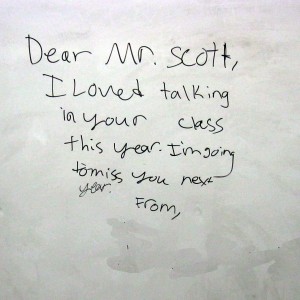
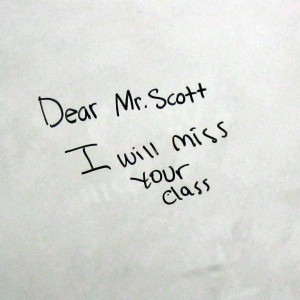
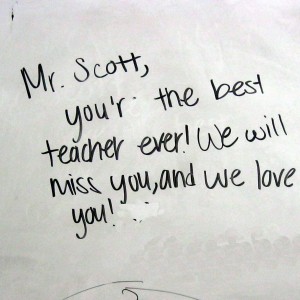
How could I, when students leave notes like this on my board?

Transfer

I sit in class with fourteen other adults, and we go through essays that students have submitted for group review. We share what we like and what works for us as well as what we think could be improved. We’re courteous but sufficiently critical. We take initiative, ask and answer questions, volunteer observations. The author jots notes about this or that comment, sitting silently yet respectfully listening.

Why can’t I get this to happen in my own classroom? I have a list of excuses:

  • Students don’t come prepared.
  • Students don’t have the necessary background knowledge.
  • Students don’t have the sufficient motivation.
  • Students don’t have the necessary skills, social or subject.
  • Students don’t care.

For any given student, one or more of these end-of-the-day excuses might be true. Or none. Or all. Some are in my control; many are not. The common element, though, is probably the problem: “Students don’t.”

I make an effort to incorporate workshops into my teaching. Things don’t go as well as I’d hoped, so I refocus — “Stop thinking ‘students can’t’ and ‘students don’t’!” — and re-plan and try again. Somewhere, the right balance of innumerable factors exists, and someday, I’ll be leading a class like the one I participate in every Tuesday evening.

Studying

I’m taking two classes this semester, still working toward a Master’s; I have to study.

K is taking a class this semester, beginning her course work toward an eventual professional license; K studies.

Language Work

L, seeing the two of us, has decided she needs to study.

Letters, Part Two

Over the summer, a former student tracked me down on Facebook and sent me a note. I’d had an interesting relationship with the young man: at times, I felt he was very frustrated with the class. Indeed, he said as much. And he also said that very often, when he’d asked for help, I didn’t really help him. I thought about this for a moment, then realized that he wasn’t yet recognizing what I was trying to do. It’s something along the lines of the saying about giving people fish versus teaching them to fish.

The young man’s note included one of those compliments that feels a little like a backhanded insult. He wrote, “I want to thank you for being such a great teacher and making the class not extremely boring.” Apparently I was boring, just not extremely so. Yet the next few sentences simply set me to smiling:

You would help me sometimes and most of the time you didn’t, and I am glad you did that. I realized that I can’t be helped all the time and that I need to learn to do things on my own more often.

He closed by saying that I “made the class and literature enjoyable” for him, but that’s really of little significance compared to helping him develop self-reliance.

One of the things I love most about teaching eighth grade is the simple fact that I teach more than my subject content. I came to realize this fully the other day, when I received the third letter.

To be continued, again…