education and teaching

Boosterthon

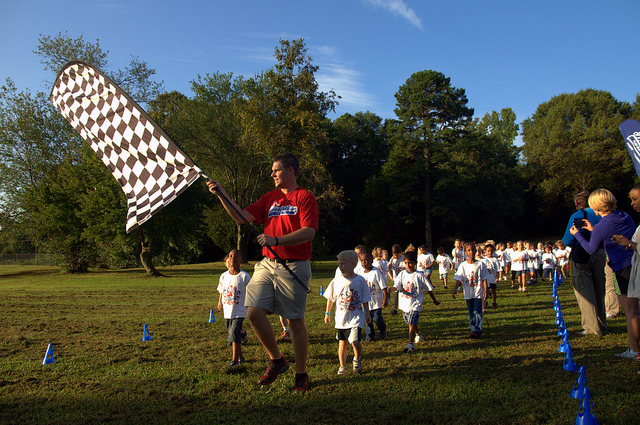
It’s half bet, half bribe. It’s a fundraiser, an exercise event, and certainly for some, a bit of a pain.
DSC_3870

I suppose one might argue that it’s an exercise in school spirit and self-confidence. Elementary school activities, we’re finding, tend to combine several elements like that. Show, exercise, fundraising, dance party — I suppose it covers several state educational standards.
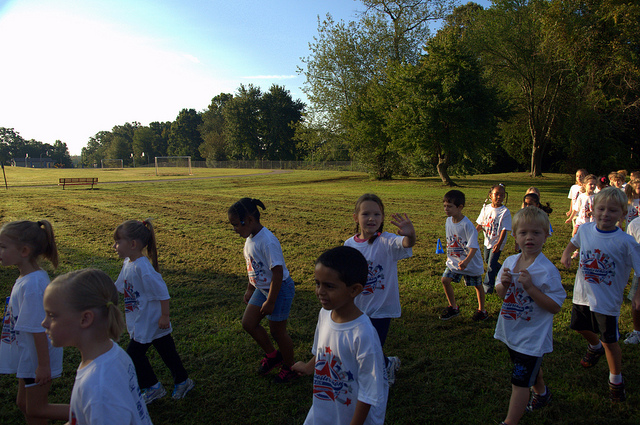
DSC_3874

For “the biggest fundraiser for the year” at her school — so it was explained at a recent PTA meeting — L had to gather pledges for a run around a small, 1/16th of a mile route set up in the field behind the school. Nana and Papa pledged a significant amount per lap, adding a cap as assurance of not having to mortgage the house to pay their commitment.
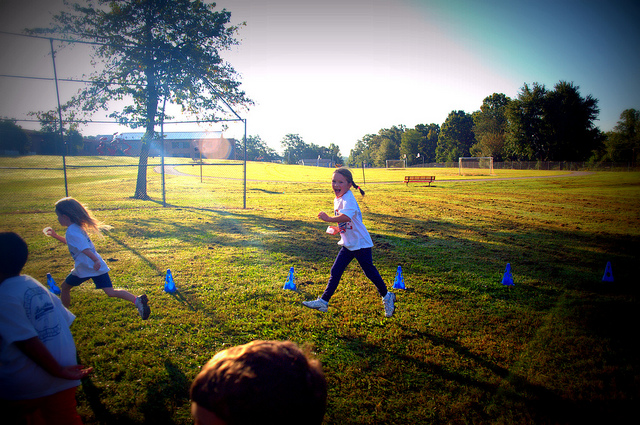
DSC_3886

Sure enough, when it came time to run — and hop, skip, walk, dance — through the boosterthon, the Girl did the maximum 35 laps.
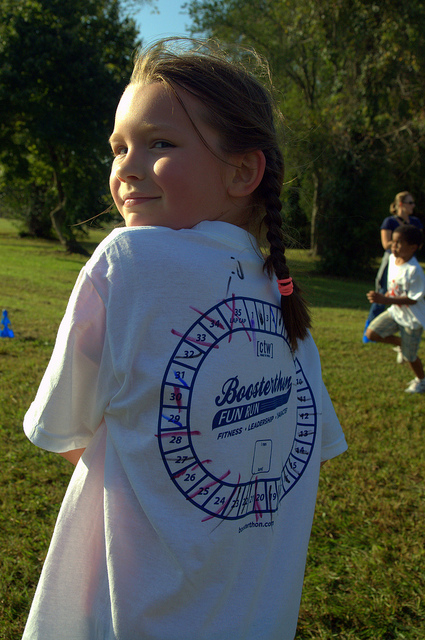
DSC_3903

Which amounts to just over two miles, which is fairly impressive for a five-year-old.
Homework

The bane of most students and many teachers, too, homework seems in some ways to speak to the inadequacies of our educational system. Alfie Kohn and others certainly argue that, but they’re certainly in the minority among educators. Most of us educators see homework as practice: just as a world-class gymnast or swimmer puts in extra time beyond formal coaching to improve his or her skills, so too young learners put in the extra time to master new skills.

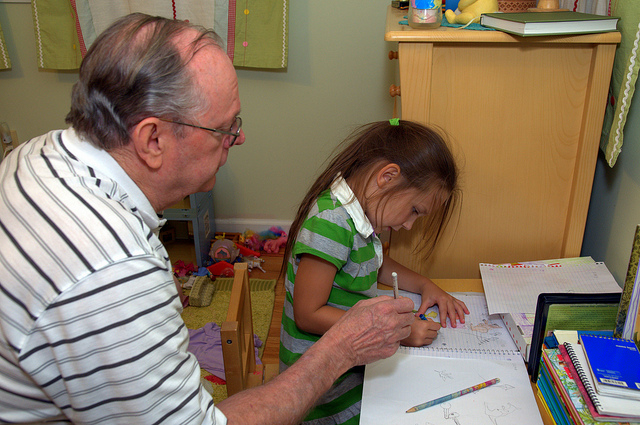
DSC_3398

For the Girl, it’s turned into something of a rite of passage. “When will I have homework?” she used to moan when she found me going over student work. Now that she has homework — of a sort — she’s thrilled. “Tata!” she squealed as she ran into the room the other day, “I love homework!”

And what’s not to love about it if it’s done right? It can be a moment of bonding between a parent (or grandparent) and a child, an intense social and intellectual engagement where the two engage in a task with a specific and common goal.

Our Own Trisha

Every year, as we begin a unit on the Gary Paulsen novel Nightjohn, I read Patricia Polacco’s Thank You, Mr. Falker. The story of a young dyslexic girl who was suffering the taunts of peers and the seeming neglect of teachers, the book emphasizes the life-changing nature of literacy. Trisha, the protagonist, spends the first four grades of school hiding her inability to read, feeling dumb for not being able to keep up with peers, and taking solace in her one skill, her exceptional artistic ability. It’s such a touching story that even a room of rowdy eighth-graders ends up sitting in silence, visibly moved. Every now and then, a girl — always a girl, for a boy will never show such a “vulnerability” — sniffles in the back or wipes her eye occasionally as the story nears its conclusion.

“We have Trishas in this room, guaranteed,” I tell the class this afternoon. “Someone here has felt stupid about something, been taunted for something out of her control, taken refuge in solitude and some seemingly non-academic talent that doesn’t fit today’s educational mold.”

“We’ve probably all experienced it,” says a boy who has never struck me as being particularly attuned to the pains and sufferings of others. I nod solemnly in agreement. And I think back to the quiet girl a couple of years ago who, leaving the classroom after that particular lesson, murmured, “I have a lot in common with Trisha.”

Errors and Mistakes

In the midst of the process, it becomes obvious to me that the road these students are on will not lead to the results they want. They’re working hard learning a new framework for planning and writing formal essays, but there are so many larger and smaller steps — I couldn’t have covered them all the first time through. Yet I sit and wonder whether or not I’ve made a mistake. Instead of essays, many of them are going to wind up with three body paragraphs that seem to have nothing to do with each other.

I’m left wondering what to do. Do I stop everyone and make a group course correction? That’s likely only to confuse some. And besides, it’s the process I’m teaching. I’m not worried as much about the finished product at this point as I am the steps the kids are taking to create that final product.

Then it occurs to me: sometimes the teachable moment is not in the moment. Sometimes it’s best to let them stumble — knowingly, even anticipating it — so that their misstep will show them rather than tell them where they were on the wrong track.

“Mr. Scott,” I envision one young lady beginning quizzically, “This essay we wrote — it don’t make sense.”

“How so? What doesn’t make sense?” I will reply, hoping that she will see then what I already clearly see  now.

“I don’t know. It’s just,” she might continue, pausing to look for the right way to express herself. “These paragraphs. They just don’t go together somehow.”

And I will smile and say, “I know, and I’m so very glad you’ve noticed that.”

Advice

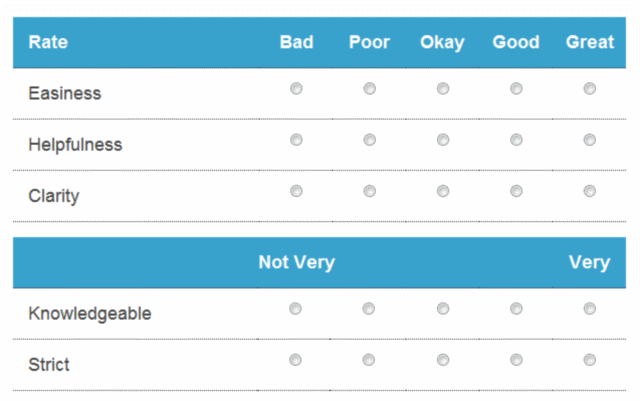
Though it seems to be largely ignored regarding our particular school, the web site ratemyteachers.com offers a method for evaluating teachers that includes a somewhat-disturbing metric: easiness. I’m not quite sure what they mean by this, for the other metrics seem fairly acceptable. One would hope teachers would be helpful, clear, and knowledgeable, and the notion of strictness might be initially off-putting for some teachers, but I take that to be an evaluation of whether the teacher is authoritarian, authoritative, or permissive. (I try to be the second of those three options.)

But easiness? Do we really want easy teachers? Do we really learn anything by doing easy work? Do athletes improve by completing easy workouts?

I would professionally take this as an insult if I were rated “Great” in the easiness category. I want to be challenging; I want to hear students complain, “Mr. S., this is hard.” Indeed, if I could write my own dream end-of-the-year evaluation, it would read, “This is an extremely hard class, but it’s worth the effort because I learned a lot.”

Every year I get a view of how close I’ve come to this goal when I have students write letters to the next year’s students. Some highlights from what my current students read last week from the class of 2012:

  • English one honors in the eighth grade with Mr. Scott is the hardest class I personally have taken so far. Mr. Scott will set expectations so high that you don’t feel like you can actually reach them but don’t worry to much, Mr. Scott will never leave you out high and dry.
  • By the end of this [first] class you will be scared out of your bananas!
  • With Mr. Scott as your teacher, I am positive that this year in this class will not be any easy one. What he has you do, is only for your benefit. By the end of the year, you will see much improvement in you English work. You will eventually thank him for all the hard assignments he had given you, well most likely you will.
  • This class will be about one of the hardest classes you have taken from kindergarten through seventh grade.  […] This year you will have to work your butt off and you can’t procrastinate if you want a decent grade.
  • This was by far the hardest class I completed all year. You will have homework every night so I hope you enjoyed last night. Don’t stress too much because Mr. Scott is a great teacher and he will prepare you for all the challenges that are yet to come.
  • Mr. Scott’s class is a fun yet serious class.
  • English I Honors, more technically known as Genre Analysis, is the most abhorred, despicable, positively terrifying course you will take yet, with gigantic papers over 1500 words (3+ pages, if you’re wondering), your thoughts of writing completely overturned, colossal, complicated tales, and most of all, a dash of creativity and thinking outside the box. Are you sure you’re ready?
  • This year will be a great one because you are on top of the middle school food chain and you will have at least one class that you will look forward too. Mr. Scott is a nice guy and is very funny.
  • You will learn many critical things in this class that you need to take with you after you leave Hughes.
  • At first the class seems intimidating, but when you get to the end of the year you feel like you have made a lot of progress.
  • You know that extremely nervous feeling you’re having right now? Yeah, you’ll get used to it in about three months… Maybe.
  • You’re not going to be able to just walk in and expect it to be an easy A, because it’ll probably be the hardest class you’ve ever taken. Although it may be demanding at times, if you pay attention, listen, and take my advice, you should do just fine.
  • I hope you are ready for one of the toughest classes of you life. You will be learning a lot of new things that are very difficult to understand. It will be very helpful but also very hard. […]  If you thought you had a hard class before, just wait until this year.
  • Mr. Scott’s class is a very difficult class with many challenges. Â He is a wonderful teacher. He always keeps you entertained while you are in class. Â I have learned so many things this year that were very challenging, but I learned that he will always help you if you need it.
  • You are about to enter the hardest class of your life. Good luck. Do you have a social life? Well, not anymore. Be prepared for late nights of studying, long reading assignments, and well, you might lose some of your hair, but don’t worry… throughout the year it won’t get any easier.
  • Mr. Scott is a very demanding and rigorous teacher that loves to watch his students suffer as they struggle to meet his requirements.
  • You are about to have one of the most challenging years of your life. It will be difficult but it will help you tremendously. […] Mr. Scott is the hardest teacher I have ever had, but he is also one of the best.
  • This class requires time and energy, more than you have I suppose. One way to avoid the 100 lashes earned from a late assignment is to stop procrastinating.
  • I hope you’re ready for a really great year. This year, you will learn tons of new things, from improved writing skills to reading plays. Prepare yourself for hard work, because this class is definitely not easy. Don’t expect to breeze through the year, but as long as you study, pay attention, and try your hardest, you should be fine. This year definitely won’t be easy, but it won’t be unmanageable. Mr. Scott isn’t that bad!
  • English 1 Honors is one of the hardest classes that I’ve taken in the years that I’ve been in school.
  • You may get mad at him for giving you so much work, but think first.  The assignments you have to do are sometimes nothing compared to how much he as to read and grade.  So multiple your work by fifty six and you will know how he feels.
  • If you’re nervous about taking this class you shouldn’t be. If you do your work and you complete all assignments then it should be fun!
  • Mr. Scotts English One class will be very challenging.
  • Welcome to the hardest class of your life! Be prepared to study like never before, work harder than you ever have, and be ready to learn a lot. All my life English has been a class I’ve never had to try in. But this year I have worked more for this class than all my other classes combined. Mr. Scott has taught me so many things and I feel ready for high school and at the end of this year, you will too.
  • This will potentially be one of the most difficult classes you will take this year.

It’s an affirmative moment to read things like that about you. Then again, there’s always the question of kissing up…

Floating on More than Survival

male sparrows putting on a show.

male sparrows putting on a show. by Will at Morro

The students sit during the Silent Sustained Reading with which we now conclude each day in our new schedule. We’ve begun the year reading the same book, a Pearl Buck short novella called The Big Wave, keeping a reader’s journal as we read. We’re all almost literally on the same page, which simplifies some of the logistics of the year-long project.

“Once you finish this book,” I tell the kids, “You can read whatever you want.” And so when I finish the book, I pick up a poetry collection and encounter R. T. Smith’s amazing poem (source):

Hardware Sparrows

Out for a deadbolt, light bulbs
and two-by-fours, I find a flock
of sparrows safe from hawks

and weather under the roof
of Lowe’s amazing discount
store. They skitter from the racks

of stockpiled posts and hoses
to a spill of winter birdseed
on the concrete floor. How

they know to forage here,
I can’t guess, but the automatic
door is close enough,

and we’ve had a week
of storms. They are, after all,
ubiquitous, though poor,

their only song an irritating
noise, and yet they soar
to offer, amid hardware, rope

and handyman brochures,
some relief, as if a flurry
of notes from Mozart swirled

from seed to ceiling, entreating
us to set aside our evening
chores and take grace where

we find it, saying it is possible,
even in this month of flood,
blackout and frustration,

to float once more on sheer
survival and the shadowy
bliss we exist to explore.

I think of all the linguistic hoops most of my students would have to jump through even to understand the poem let alone to find themselves floating themselves when they reach the final line. Then there is all the cultural knowledge they would need — chiefly, at least a rudimentary knowledge of the and familiarity with the music of Mozart. And the general motivation.

It’s at times like that that I understand just what it means to teach literature and writing in 2012 to fourteen-year-olds.

The Letter

It’s been a little tough for the Girl to begin school. Going from the small environment and relative freedom of Montessori to the highly organized reality of public school kindergarten would have been enough, but the color-coded “positive behavior incentive program” has added an entirely new stress. All students begin on green, it was explained to us during orientation, and students update their color as their behavior changes. Blue and purple indicate great and superior behavior; yellow and red indicate problematic and bad behavior. “Finishing on green or higher is considered a successful day,” said the principal.

DSC_2298

L’s goal from the beginning: straight purple. Her first day, she came home with purple; her second day, blue. A few days later, the unthinkable: green.

“I hate those colors,” K admitted shortly afterward. “Why do they even need that system?”

I understand the reasoning, though. Public school lumps together children from a variety of backgrounds, with parents who have more or less effective parenting skills. In short, there arrive at kindergarten children who aren’t very well behaved. They must learn the social skills necessary to make it through school successfully, and such a system is an attempt to foster a certain (edu-speak alert!) behavioral metacognition.

But for children who already have those skills? And for children like the Girl, who already have those skills plus a healthy dose of OCD perfectionism? It’s stress.

And then the email arrives from L’s teacher, Ms. B:

Good Afternoon! I just wanted to take a moment and let you know what a joy L is to have in class. She has such a sweet personality and is so much fun to teach. I can’t wait to get to know her better and let her show me how smart she is. Thank you for sharing her with me.

Thank you, Ms. B.

The Blind and the Blind

They sit in their desks, which chance has placed side by side, and quibble. Snipe. Insult. Complain. One barges in on another’s conversation with an inane response meant only to provoke, then grows angry about the provocation. An act? The other talks about her nemesis as if she’s not there when in fact she’s within ten feet. Deliberate cruelty?

I intervene, and soon one or the other is saying words that could have easily come out of either’s mouth

“She’s so irritating!”

“I can’t stand her!”

“She does that stuff just to annoy me!”

“She won’t quit!”

And I find myself saying, “If.” If you’re so annoyed by her, why provoke her by cutting into her conversation? If you think she’s purposely irritating you, why encourage her by acknowledged her success? If she won’t quit, why don’t you?

The obvious answer isn’t always so obvious to adults; to expect a flash of mature intuition from thirteen-year-olds might be just looking for the miraculous. Still, I hope that eventually, once the blinders begin to fall off, they’ll recognize futility.

First Day 2012

Who knows how many times I’ve done it. If I had to count, I probably could count how many “first days” at school I’ve experienced. With time on both sides of the desk, I suppose I’d have to be now nearing thirty first days.

But I still remember my first first day. Some degree of nervousness, some level of excitement, some small amount of disappointment mixed with a great deal of joy.

DSC_2298

I would like to think the Girl will remember her first first day. That she will remember how the night before her worries and fears melted in the morning to a smile and a paradoxically calm excitement.

DSC_2303

That she will remember her idea to have a desert picnic after dinner. That she will recall her planning and packing for the picnic.

DSC_2319

That she will linger over the memory of cuddling up to her mother, snuggling with her baby brother.

DSC_2326

And that she’ll think of that first day every time she sees an ice cream truck.

DSC_2333

DSC_2339

Another End

How many ends can we face? The end of elementary school; the end of a fable; the end of a friendship; the end of a marriage; the end of a book; the end of an evening; the end of a song; the end of a project; the end of a journey; the end of a sunrise; the end of a bike ride; the end of a cigar; the end of a sunset; the end of a relationship; the end of a concert; the end of a line; the end of a story; the end of a caress; the end of a smile; the end of a blog post; the end of a bottle of ginger ale; the end of middle school.

Weren’t we all so broke by endings when we were young? Weren’t we so unable to discern the difference between “the end” and a conclusion?

Today, two hundred and fifty — if not more — eighth graders met another in countless endings. For some who’d lost a parent or a sibling, it paled in comparison. For others, it was a tearful afternoon. Those who don’t know will all learn soon enough.

Peer Review

It’s nearing the end of the school year, which means my English I students are tackling the year’s final project: an analysis of some facet Victorian England that is clearly evident in Great Expectations. Social class, adoption, education, and gender roles are popular motifs.

This year, having access to seemingly endless articles on JSTOR, I’ve decided to make the project a bit more challenging. After printing out twenty-five or so articles from peer-reviewed journals, I inform the students that we’re going to do this one “old-school.”

“No web pages as research sources.”

The groans are audible throughout the school.

I flop five inches of journal articles down on a chair in the front of the room and explain that this is going to be one of their primary sources of information. We review how to skim a text effectively; we practice with a text projected on the board; we talk about the difficulty of the language; and I turn them loose.

1-img_3979

Soon, kids are getting excited about titles like Alastair Owens’s “Property, Gender and the Life Course: Inheritance and Family Welfare Provision in Early Nineteenth-Century England,” struggling with passages like this: “Among families, property rights shifted according to changing circumstances and as individuals moved through their lives. Inheritance was obviously a unique phase in this life course, characterized by social and proprietorial upheaval.” Fairly straightforward for adults; a struggle for young readers. But these are not kids who give up quickly, so they constantly call me over with the same request: “Can you read this passage, then listen to what I think it says, and tell me if I’m right?”

Others are combing through F. M. L. Thompson’s “Social Control in Victorian Britain” in the hopes of finding something about the effects of the sense of genteel society on social behavior. Or, as they put it, how society and popularity in the upper class are related. Or something like that. I’m not quite sure I understand some of their topics, and I’m not sure some of them do either. But no worries. That’s part of the point.

“What if we don’t find anything for our topic?” becomes a common cry.

“Then I guess you’ll change topics,” I say, and sit with the frustrated student to help him find a way to narrow, broaden, or slightly shift his topic.

Their frustration seems overwhelming.

4-img_3982

“How can we get all this research and writing done in just a couple of weeks?” is another common concern.

What they don’t realize — what I don’t tell them — is that the paper itself is of little importance at this point. Like so many things in life, it’s the process. The struggle.

“I want them to have the experience of digging through a journal article only to determine that it’s not of any use to them for their topic,” I discuss with a colleague later. “I want them to struggle defining and redefining their research question as they find materials that shift their thinking.”

By the third day of research, kids are taking copious notes (and I frustrate them by saying, “There’s a good chance that twenty to thirty percent of these notes won’t end up in your final paper”), sharing resources (“Allie, I know you’re working on education, and this article on social class actually has something on education, too. Want it when I’m done?”), and actually smiling from time to time.

Hypothetical Exchange

Cell Phone
Photo by Mike Fisher

Girl 1: Did you lose your phone?

Girl 2: Yeah.

Girl 1: What for? For cussin’ out your mama?

Girl 2: My mama don’t care if I cuss her out.

Girl 1: Then what’d you lose the phone for?

Girl 2: I don’t know.

Greater Expectations

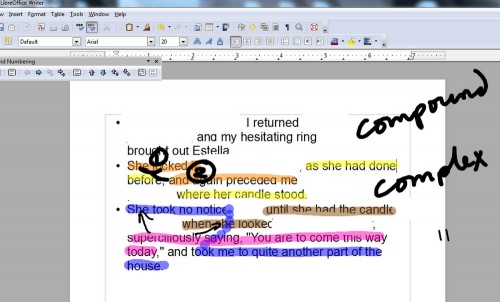
It’s the end of the year, which means the English I students are tackling Great Expectations, having just finished a brief overview/review of clauses and sentence types. “To understand Dickens,” I explained a couple of weeks ago, “you have to break apart some of his incredibly complex sentences into manageable chunks.” So we practice: every day, students entering class are greeted by a few sentences of from the previous evening’s readings. The bell-ringer, starter, whatever you want to call it:

At the appointed time I returned to Miss Havisham’s, and my hesitating ring at the gate brought out Estella. She locked it after admitting me, as she had done before, and again preceded me into the dark passage where her candle stood. She took no notice of me until she had the candle in her hand, when she looked over her shoulder, superciliously saying, “You are to come this way today,” and took me to quite another part of the house.

Students cross out unnecessary phrases — prepositional, gerund, participial — and try to find the gold: a single subordinate clause. “If you find a subordinate clause,” I explain, “you know it’s either a complex or compound-complex sentence; if you don’t, you know it’s a simple or compound sentence.”

The results are improving daily.

Work

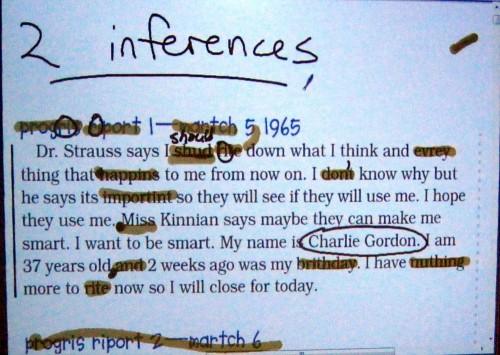
One class began working on Flowers for Algernon.

Another class continued with Great Expectations.

Still another class began looking at the notion of voice in writing.

Busy day back.

Preparing

Bibliography
Photo by Alexandre Duret-Lutz

The day before school starts again, I always get a bit nervous. What’s the return going to be like? Is it going to be like pulling teeth to get them to work? What will their attitudes be like? What will my attitude be like?

Spring Break?

The first day of spring break 2012 proper, and it starts like any spring day should: sun, warmth, clear light. Freshly emerged leaves offset the patch of Azalea blue (or is that purple? I’ve never checked, i.e., asked K) in the back corner. It would be great to be out in the warmth, to do some work on our small raised-bed garden, to work up the first sweat of the year. The grass needs mowing; autumn’s leaves need raking; the raspberries need netting shortly — yet none of these are options.

April Morning

With a major paper due in a week, I’m sequestered, reading through articles, planning an attack, drowning in coffee and tea.

I spend the day filling a folder with articles from JSTOR, Gale, and seemingly countless other online resources that make it possible to research most anything from home. Then I write, write, write.

“In calling these stories ‘parabolic,’ we encounter an critical etymological parallel with geometry.”

Did I really just write that?

Still, I take my own advice, the mantra to my students that I seem to chant daily: “It’s a first draft. Don’t worry about making everything perfect — or even close to it — in a first draft.”

Evening approaches and with it, new tasks. I help the Girl get ready for bed; I trim tenderloin and prepare the brine for smoking later this week. K reads the Girl stories and prepares a salad for tomorrow’s lunch. Having to go to work tomorrow, she trundles off to bed; I sit down once more at the computer.

Others I’m sure are enjoying a first evening at the beach or the sounds of crickets at a mountain retreat. Me, I’m just ready to turn out the lights and head to bed.

At Work

At times I want to strangle them. Sometimes, five minute later, I want to hug them.

Lent 2012: Day 30

There is always one bright thought in our minds, when all the rest are dark. There is one thought out of which a moderately cheerful man can always make some satisfactory sunshine, if not a sufficiency of it.

Sometimes, I wonder. Some of the students I work with on a daily basis seem to have few bright images in their minds. Life is a constant crisis for them: everything from someone bumping them in the hallway to a perceived injustice from a teacher sets them off. They wear a scowl on their faces most of the time, and life seems to be one big trial for them.

Faber, in the quote above, is speaking of the belief in a joyous afterlife, but sometimes I wonder about the usefulness of that hope for someone who’s already lost all hope for a happy life here and now, and all by the age of fourteen.

The quoted excerpt is from Father Frederick Faber’s Spiritual Conferences, excerpted here.

Lent 2012: Day 27

There is also a grace of kind listening, as well as a grace of kind speaking. Some men listen with an abstracted air, which shows that their thoughts are elsewhere. Or they seem to listen, but by wide answers and irrelevant questions show that they have been occupied with their own thoughts, as being more interesting, at least in their own estimation, than what you have been saying. Some listen with a kind of importunate ferocity, which makes you feel, that you are being put upon your trial, and that your auditor expects beforehand that you are going to tell him a lie, or to be inaccurate, or to say something which he will disapprove, and that you must mind your expressions. Some interrupt, and will not hear you to the end. Some hear you to the end, and then forthwith begin to talk to you about a similar experience which has be fallen themselves, making your case only an illustration of their own. Some, meaning to be kind, listen with such a determined, lively, violent attention, that you are at once made uncomfortable, and the charm of conversation is at an end. Many persons, whose manners will stand the test of speaking, break down under the trial of listening. But all these things should be brought under the sweet influences of religion. Kind listening is often an act of the most delicate interior mortification, and is a great assistance towards kind speaking.

One of the curses of teaching middle school is multi-tasking one must do during certain times when a student is trying hard to clarify something that happened in class — homework, a proofreading trick, a comprehension check, or any number of little things that might require some additional explanation. And these moments come, often enough, as I’m standing at the door, supervising students as they change classes. Hardly the time to be able to listen kindly.

I once had a young lady terribly upset — unbeknownst to me — because of this. She felt I was never listening to her, that I never had time for her questions. She was a most studious, hardworking girl. It took a while to work out, but I learned, again, the value of kind listening.

The quoted excerpt is from Father Frederick Faber’s Spiritual Conferences, excerpted here.

Lent 2012: Day 22

Kind words will set right things which have got most intricately wrong. In reality an unforgiving heart is a rare monster. Most men get tired of the justest quarrels.

If I could teach my students one extra-curricular lesson, it would be this. I have calmed furious students (sometimes furious at me, most often furious about something some peer has done) with a few kind words so often that it has become almost instinctive: “Get the kid away from the situation and say something kind.” A smile helps as well.

Yet they re-enter the same quarrel, sometimes only hours later (occasionally, even more quickly), and I can see a certain Sisyphean fatigue in them as they fuss. “A calm answer…” I mutter to myself, wondering if I can teach that by example alone.

The quoted excerpt is from Father Frederick Faber’s Spiritual Conferences, excerpted here.