education and teaching

Because They Asked

Simple instructions — the starter — great them when they enter the classroom.

Complete: “Poetry is…”. Write at least five facts about poetry. Then complete “Poetry isn’t…” and write five more things poetry isn’t.

They get started scribbling a list, a list we will share and debrief once I’m done checking roll and making sure I have all my materials for the day’s work in order.
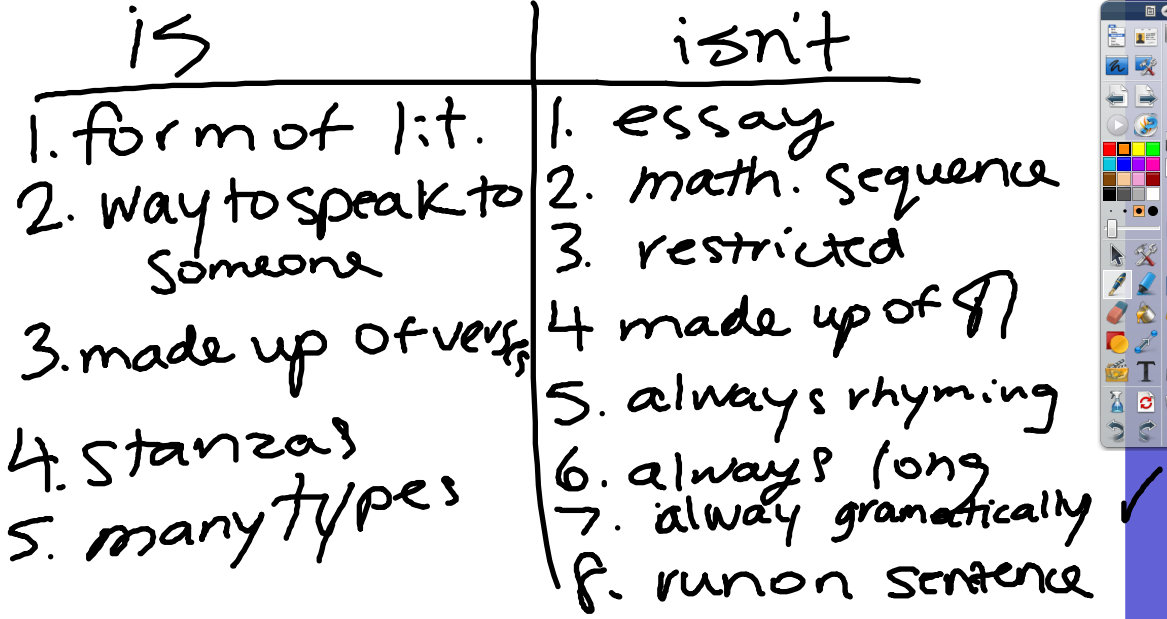
1-Fullscreen capture 10222013 20504 PM

Then the poem: “Because You Asked about the Line Between Prose and Poetry” by Howard Nemerov.

Sparrows were feeding in a freezing drizzle
That while you watched turned to pieces of snow
Riding a gradient invisible
From silver aslant to random, white, and slow.

There came a moment that you couldn’t tell.
And then they clearly flew instead of fell.

After reading a couple of informational texts about how to read a poem, students try their hand at Nemerov’s analogy:

prose : poetry :: sleet : snow

It’s slow going at first, for it’s such a strange poem for eighth graders. “It claims it’s going to be talking about poetry and prose in the title,” one student complains, “and then it’s all this stuff about birds and rain and snow.”

Tomorrow I will model the steps of interpretation, relying heavily on the questions and steps in the two texts about reading poetry they went over today, with the hope that they’ll be able to do it for themselves, at some point.

Natural Consequences

A kid shoots a paper wad at the trash can and misses I sit and look at him, at the wad of paper on the floor, back to him — what’s a logical, natural consequence? There really isn’t a natural consequence, I guess, but a logical one? A negative reinforcer? Or even a punishment?

I hate moments like this. I find myself being far more analytical in situations than I really need to be.

M-Jezzy

Dear Terrence,

Seven years ago, on 13 October 2006, I wrote this, I worked at a day treatment facility for kids who had been unable to find a path to success in school.


Yesterday, one of the boys in our program asked if he could use the computer for a little while. “No problem,” I said. He’s had a great week, and it was a slow morning.

The week was much improved over the past. We were both frustrated about how things were going in my class – he much more than I. At the end of the last six weeks, when we were working on science (now we’ve switched to social studies for the second six weeks), M-Jezzy (his nom de plume at our program’s blog) was trying to make up some missed work, and getting very frustrated about it.

“Man, I just hate science,” he exclaimed.

“That’s fine,” I said. “Not everyone likes science. What we can do, though, is use that as a way to make up some of your work.” I instructed him to log into our blog, akacoolpeople.com, and write about science and why he hates it. “Explain three reasons you don’t like it, and we’ll count that as one of your missed assignments.”

He wrote,

I do not like science at all. And i,ve got three reasons why. One reason is because it is so confusing. likewhe gives the homework out. I dont know what he is talking about beause. They would be so many things that he is talking about. An the other reason iswhen he gives the i want know what to do because. It will be so many things that you would have to look for an you would have to do so much research. And the last reason is the things that he teaches in class i dont know wat in the world that hebe talking about. Likewe was talking about an atom an what i have to study about it is so hard because. The atom has so many things in it. And you will get mixed up with all the parts of an atom. Beceause you will not know how to put them in oder. An if you get this and you are really feeling wat i am saying to you then mail me back M-JEZZY out. I hate science so bad i wish i did not have it at all. (science)

I read it and thought, “What an indictment of me. I obviously don’t explain things for him, and I can’t even make myself clear when assigning homework.”

Depressing.

But fixable.

I talked to the head teacher about it; I talked to the program director about it; I talked to the head counselor about it. The consensus: M-Jezzy does not deal with ambiguity well (as if anyone really does). Like most people, he wants to know where he’s going and what he’s going to have to do to get there.

Starting this week, I began something new. Something obvious. Something basic. Something I should have been doing all along. I blocked off a portion of the white-board and wrote an outline of what we’d be doing, including information about what kind of activity it would be.

Next class, M-Jeezy was like a different young man – much more attentive, much more focused, much more involved. He asked penetrating questions, and he didn’t giggle too much.

A success, I thought.

Back to yesterday morning. M-Jezzy sits down at the computer and logs into “aka cool people,” and starts typing. This is what he writes:

now sence my teacher was started to put the agenda on the board i am starting to learn more in class and i know no wat to do.And i am not getting confused write me

I can’t remember the last time I felt so good.

Yet it was not what M-Jezzy wrote that made my day – it was that he did it spontaneously.


M-Jezzy was fifteen when I wrote this, theoretically a tenth-grader but he was still in eighth grade because of behavior. He’d been tossed out of regular school because of his behavior — basically an unwillingness to regulate his impulses in any way whatsoever — and then tossed out of alternative school for the same reason. All of this left him with few alternatives, which is how he landed in our day treatment facility — a last ditch effort to teach him the social and personal skills he so clearly lacked and so desperately needed.

In the end, it’s clear that we didn’t get through to M-Jezzy, for later this week, he’ll be going to trial facing six charges: misdemeanors and two felonies. The former: trespass charges and assault on a female; the latter: first degree murder and intentional child abuse with serious physical injury. He stands accused of beating to death his girlfriend’s four-year-old son.

From the accounts I’ve read in newspapers, it seems a reasonable assumption that he’s guilty. Knowing him personally and seeing his temper in action, I find it tragically plausible that he did indeed beat a toddler to death.

The vindictive (read: human) side of me thinks his punishment should be based on a simple mathematical equation. A proportion, really. Take the pounds per square inch of his punch over the weight of the child he beat to death. The other side of the proportion you can probably figure out: x over his weight. Solve for X. Then he should be beaten regularly by someone who can hit with that much force. Beaten for weeks on end. Months on end. The end will come — eventually, he’ll be beaten to death in one, long session. But he’ll never know which one it will be. So each time he sees his executioner, he’ll have to ask himself the same question his victim asked himself: how will it end this time?

Fortunately, I’m not in charge of sentencing. The compassionate side of me realizes that such punishment is cruel, but again, the vindictive side says, “Who is he to deserve mercy?” It’s a conundrum.

I write this to you because I want to be perfectly clear with you: I don’t know how M-Jezzy got from where he was merely a disruptive kid in an under-funded day treatment facility to a young man facing serious prison time (if he survives: my aunt, who worked in the prison system for twenty years, assures me that as soon as inmates find out what M-Jezzy got convicted of, if he’s convicted, they’ll take care of the problem). I don’t know the road he took, but I do know this: you remind me of him so much sometimes it’s terrifying. And now, it should be terrifying for you.

With concern,
Your Teacher

Positive and Negative

Dear Teresa,

When I asked you today to keep track of your positive comments and negative comments throughout the day, I didn’t really realize you might not be able to tell the difference. I realized this when I saw in the positive column, “Please get out of my face.”

Despite what you’ve been told, “please” doesn’t always make all the difference in the world.

With a smile,
Your Teacher

Common Core

Common-CoreThe rumbling in the district probably started long before I first started hearing about coming “new standards.” We’d just revised the state standards a few years earlier, but I’d begun teaching in the state the year the new standards went into effect, so I never had to go back and revamp plans to correspond with new standards.

“Well, I guess I’ll see what that’s like now,” was my only real concern. But I was confused: I knew little about what these “new standards” might be or whence they might come. I assumed it was the state again, fiddling eternally with the numbered guidelines that are my daily metric of effectiveness.

Last year, though, we began going through the process of shifting from old state standards to the Common Core. This meant, it turned out, decidedly more than changing standard numbers on our lesson plans. The head of English instruction in our district, in a series of workshops preparing teachers for the change, constant told us (and more importantly, showed us) how these standards would necessitate a change not only in what we teach but also in how we teach.

I did have some initial concerns over the standards, though. The English standards place high importance on what in Common Core nomenclature is known as “informational texts.” We used just to call it “nonfiction,” but somehow that’s not descriptive enough, I suppose. This is not nonfiction as in essays and biographies, though. By one definition,

informational text is:

  • text whose primary purpose is to convey information about the natural and social world.
  • text that typically has characteristic features such as addressing whole classes of things in a timeless way.
  • text that comes in many different formats, including books, magazines, handouts, brochures, CD-ROMs, and the Internet

This includes, then, things like textbooks, pamphlets, forms, and myriad other textual forms. I’m certainly not going to suggest these things have no place in a classroom; indeed, they’re critical in the classroom. But what proportion? The Common Core suggests that by high school, students should be reading seventy percent informational texts. This means, in short, the classics are essentially gone. Only thirty percent of high school students’ reading should be fiction, and I’ve heard from a friend who is also a teacher that her principal has informed the librarian that she will receive absolutely no funding for the purchase of fiction this year.

What’s the thinking behind this? The earlier-quoted article continues by providing four reasons why these texts are so important:

we feel children should encounter more informational text in the primary grades for the reasons explained below:

  • Informational text is key to success in later schooling.
  • Informational text is ubiquitous in society.
  • Informational text is preferred reading material for some children.
  • Informational text often addresses children’s interests and questions.

It’s all a question of supposedly getting kids ready for “the real world,” where most of the texts they read are informational texts. Indeed, the first point echoes things I’ve heard in my own district about informational texts: students get to college and have difficulty reading college textbooks. They’re used to reading primarily fiction, goes the argument. This is simply ridiculous, most conspicuously for the stunningly obvious fact that high schools use textbooks, which ironically is a function of the second point about the ubiquity of informational texts.

Beyond that, though, it belies the my experience and that of everyone else I know who successfully completed college: we all made the shift from (supposedly) primarily fiction reading to mostly nonfictional texts without much difficulty. There is some truth to the claim that much of informational text in the world is argument, written to persuade, but all middle and high school curricula covered that without Common Core’s insistence on seventy-percent informational text coverage.

Yet other portions of the Common Core struck me as reasonable, even necessary. For instance, the CCS places a much higher premium on writing than other standards, and the proposed shift in assessment (via Smarter Balanced Assessment Consortium) seemed more like things people do in “real life” rather than simply choosing A, B, C, or D. It involves reading resources with the aim of synthesizing something from them (often an argument). People do that all the time in their jobs, and it’s a critical skill.

I’m ashamed to admit that I never stopped to think about what political forces might have lined up behind these new standards. Somewhat like Milgram’s thirty-seven, I just did what I was told. I heard the hoopla, went to the meetings, studied the new standards, and went along with it, changing my unit plans, ditching this and that, adding that and this. Yet the more I learn about it, the more concerned I am.

The major concern right-leaning people have about the Common Core has to do with the apparent increased control it gives the federal government over education. Yet that seems to be a misplaced concern. Yet I am worried about the loss of state control over education, not to the federal government but to the private corporations that make the tests that will assess students’ and teachers’ performance with the new standards. It is, as one commentator called it, “Education without Representation.” 

Another worry: we’re going headlong into these new standards and tests with very little empirical testing. All these states just seem to be jumping on the bandwagon and saying, “Hey, great idea — let’s do it!” But will these standards actually accomplish what they’re touted to accomplish? In modern education, it’s all a question of data, data, data — except in this case.

A final worry is the one that likely rolled around in the thoughts of all teachers who have spent more than a couple of years in the classroom. Educational fads come and go. Standards change and then disappear, reappear, and are reshaped. My fear is that this too will only turn out to be a fad, something that everyone gets excited palpitations about now but only appears in the footnotes of Intro to Ed books. If that is the case, a final, more politically conservative concern: think of all the tax dollars wasted in that case in this clamoring toward these new supposedly salvific standards. We could likely do some real good in the classroom for all that money.

Uncommon Core

Imagine forty-some states all adopt new standards that involve drastic realignment of what and how all English teachers runs their classes. Imagine that the standards have such a different focus on instruction that most existing state standardized testing would have to be radically changed. Imagine that the standards are in fact so different that you suspect that early and fairly complete implementation of the standards in anticipation of the changes but before the new tests are put into place (i.e., old tests taken by students taught to new standards) would result in a noticeable decrease in overall test scores. And then imagine that perhaps there are rumors swirling that it is all for naught, that it will all be rescinded. If that’s true, think of the time wasted, the tax dollars wasted, the work wasted.

Only rumors? Does it really matter?

255, 223, and 186

Though I am not a mathematician, physicist, or astronomer, and though I teach words, words, words, my professional life is an orbit of numbers. Some of the numbers are relatively innocuous: attendance, school picture orders, class periods. Yet every fall I get a series of numbers that guides instructional decisions for the next months and serves as the first half of what, to some degree, is largely regarded as a metric of my effectiveness as a teacher. In the spring, students trudge back into the computer lab as they did today to take the second MAP test, and I sit at my computer, entering the various scores, hoping that each student will score higher than she did in the fall.

The fall testing regime tells me what I have to work with. There are rarely any surprises: I can often guess within three or four points what a given student will make. By the time they’ve taken the test, the students have been in my class for a month, plenty of time to figure out their strengths and weaknesses. Add to it the fact that English and math classes are grouped by ability in our county and it’s a relatively easy exercise, this “Guess My Score.”

But there are always surprises. Today, for example, student after student in one class just seemed to be scoring higher and higher. Given the fact that an average MAP reading score for an eighth grader is 220, seeing student after student score above 240 is astounding. “It’s no wonder these kids are in English I Honors, effectively skipping eight-grade English and going straight to a ninth-grade, rigorous honors course,” I thought as I punched in the numbers. I knew they would be high, but this high? Unheard of. The highest fall class average I’ve ever encountered. And then one student finished with a score of 255, just four points lower than the highest spring score I’d ever seen!

It’s much more dramatic when one knows the grade level norms for the MAP reading test.

Grade Fall Spring Growth
1 160 173 13
2 179 190 11
3 192 200 8
4 201 207 6
5 208 212 4
6 213 216 3
7 217 219 2
8 220 223 3
9 222 224 2

So the reading level of the student who scored a 255 is at least a college freshman, if not higher.

“What am I going to do with these kids?” I joked with a colleague. “They’re already scoring higher than they should at the end of ninth grade!”

“Make them your assistant teachers,” she replied.

Yet it’s not a serious problem: I just have to push them harder than usual. It would be a problem if they were mixed in with some students from other classes, because their reading level is significantly below grade level.

Later in the day, I had the opposite situation: student after student was scoring significantly below grade level. By significant, I mean a class average that, for the first twelve or thirteen students, didn’t rise above 197. Several students were scoring in the 180’s. Scroll back up and check the chart: that’s a second- or third-grade reading level. Though several students were absent from that class, I was still hopeful that by the time I entered the final scores, the average would rise above 200. But there were no scores high enough to pull the mean up, until the 223. The highest score in the class, and technically a score above average. The mean soared, rising to almost 201. I sighed in relief: it’s low, but having a sub-200 score seemed impossible. Unheard of. Then the next student finished: 186. The averaged dipped below 200 again, and stayed there until the end of testing, just two tenths of a point away from 200.

At the end of the day, I looked at the summary I’d created. Two classes drastically below average; two classes radically above. The lowest score put one student at a second-grade reading level; the highest score put another student at a college freshman or sophomore level.

“Thank goodness I don’t have them in the same class,” I thought. What could a teacher possibly do with students literally ten to twelve grade levels apart in reading? It’s essentially a return to the one-room school concept. Fortunately, I don’t have to figure out a way to solve that problem in my class, and the math teachers are equally fortunate. But social studies and science? There’s no leveling there, and so one’s class is likely to be an incredible mix of ability, motivation, and preparedness. I know there are ways to compensate for this (I have a Master’s in education, for heaven’s sake), but those techniques and tricks seem hardly up to such a challenge: they seem like they work only in theory. In practice, someone is always going to be bored, and thus someone is always going to be disruptive.

I wish I could end this with some sort of optimistic, pithy observation about the nature of education, about the malleability of the brain, about the strength of the human spirit, or some such cliche. I have answers I’ve found in books, but I don’t know how effective they are in dealing with such issues, especially when a significant portion of the challenge lies in challenging others to change their habits and behaviors.

It leaves me feeling pessimistic.

But I’ll get over it by Monday.

The Smile

I saw her walking down the hall and as I always do, I shot her a smile.

She seems to need it: there’s always apathy just at the edges of her eyes, sadness just at the corners of her mouth. When she smiles, her dark cheeks set off the whites of her wide eyes and glistening teeth. She is transformed.

“You need to smile more often,” I tell her.  It’s not just honey and vinegar and all that. The ability to create a positive affect is a basic skill that everyone needs to master, and when one is as gifted with physical beauty as she is, something as simple as a pleasant smile puts everyone in the room at ease. She has that advantage, and she rarely uses it. In fact, most of her peers and teachers, I believe, think she’s ambivalent to the world, lazy at best, perpetually angry at worst.

Every time I smile at her, she smiles at me. That’s progress.

So I shot her the smile, and she smiled back.

“Who else do you smile at?” I asked.

“No one,” she replied, the smile disappearing.

Heartbreaking and heartening at the same time.

Literary Argument

I’m working with my students on how to construct an argument in general and a literary argument in particular. We’re working with single paragraphs now, slowly building to whole papers. Here’s one effort:

The character Montresor from “The Cask of Amontillado” is an untrustworthy narrator. He tries to improve his image to the reader by telling how he’d endured the “thousand injuries of Fortunato”. This is meant to give the reader the idea that Montresor has good reason for wanting to murder Fortunato. However, Montresor does not describe the injuries Fortunato apparently gave him; in fact, because the story is in first person, we don’t know if Fortunato ever even hurt him. Not only that, he lies in the actual context of the story as well; for instance, when he tells Fortunato that he “receive[s] a pipe of what passes for amontillado”. Even if he did get the amontillado, Fortunato wasn’t fortunate enough to see it. He probably lied about being a mason, too. You can see from these quotes and facts that you cannot trust Montresor.

I love teaching writing because we all see the improvement in short order.

Music Ed.

Currently reading When Giants Walked the Earth: A Biography of Led Zeppelin. It’s obviously influencing my listening habits as well: haven’t listened to this much Zeppelin in at least twenty years. I mentioned it to a class in a “what are you reading” conversation to fill the last few minutes of class. I was shocked at the number who’d never heard of them. Needless to say, I remedied that the next day during their bell ringer with “Dazed and Confused.” The next day, a petite, preppy blond asked, “Mr. Scott, can we listen to that song again?” Small victories…

Inference

Observation and inference — two totally different skills, so linked in some ways, so very different in most ways. To observe means to use one’s senses and only one’s senses. In observing, it’s what we see, what we smell, what we hear, what we taste, what we feel — and nothing else. To infer means to take those sensory stimuli and combine them then somehow go beyond them, drawing a logical conclusion based on evidence.

I don’t really recall any lessons in school about how to infer, about how to discern inferring from observing. Perhaps we had some lessons on those skills and differentiating between them, but I don’t really recall. (As if that’s any kind of proof…) Still, I teach my eighth grade students every year how the difference between inferring and observing, and one of the continuing ways I do it is to show a photograph with some statements below it, some inferences, some observations.

It might look something like this:

infer

Are the following a) observations or b) inferences?

  1. He slipped.
  2. The floor is wet.
  3. There are papers on the floor.
  4. He is a lawyer.
  5. He was in a hurry.
  6. He is on the floor.

Students often insist that the first statement is clearly an observation. With a little prodding they realize, though, that they didn’t actually see the gentleman slip, so it’s only an inference.

“Why do you think that?” I ask.

“Because he’s on the floor, with his papers spread about in front of him, and the floor’s wet.”

“But how do you know the floor is wet?” I push further.

“Because there’s a sign about the floor being wet,” the students press incredulously.

I sketch a “Wet Floor” sign on a piece of paper and put it on the floor.

“Is this floor wet?”

“No!” comes the chorus.

“But how do you know? I mean, there’s a sign here and everything,” I continue. “Prove to me it’s not wet.” Finally one student gets up and touches the floor.

“See?” she says, showing me her dry hand, “It’s dry.”

Inferences that look like observations — how often do we confuse the two? How many disagreements do we have simply because one party thinks she’s observing and instead is inferring? I suspect most, if not all, political disagreement arises from this. One side feels it is only observing the simple facts while insisting that the other side is inferring — and inferring wrongly — from the facts, or worse, inferring based on previous inferences based on previous inferences, ad infinitum. In fact, probably most political positions are built on a long string of inferences. Understanding this might be a good first step to less acrimonious political discussions. Indeed, it might be a good first step to better relationships in general.


Your Letter

Dear Terrence,

I read your letter and felt it really needed a reply: you touch on a lot of issues that got me thinking, gave me hope, and honestly caused me to worry a bit.

You wrote that you “feel like people criticize [you] because of [your] past,” something which “hurts [you] to even try to change.”I don’t know what you thought I might have known about your past, but I knew nothing. I’m fairly sure the other teachers on the team knew nothing about you, either. Yet we can all accurately guess about your past because of your present. I don’t mean to be offensive or blunt, but despite your desire to change, you still exhibit a lot of behaviors that draw negative attention to yourself. I don’t know about other teachers’ rooms, but I can describe some of the things in your behavior in my room that makes it pretty clear that you’ve had a rough past in school.

  1. You often blurt out things that you’re thinking, things that might not help the classroom atmosphere.
  2. You sometimes get up and move about the room for this or that reason without asking permission or seeming to notice that doing so would be an interruption.
  3. You put your head down when you get frustrated, and even when you’re not frustrated, you cover your face with your hands and completely disengage.
  4. When I correct you, you often quickly develop a negative, disrespectful attitude that comes out in your tone of voice and your body language.

You write that you want teachers to “just give [you] a chance and stop messing with [you],” but if a teacher is correcting these behaviors, she’s not “messing” with you. You must understand that some of your behaviors genuinely disrupt the class, and a teacher cannot continue teaching over disruption.

I do have some bad news, though: while no one is messing with you, you’ve made it clear what gets under your skin, and if a teacher wanted to mess with you, wanted to provoke you so that she could write you up, you’ve made it easy for that teacher (whom I hope you never meet) to do just that.

Fortunately, I have some good news, too: letters like yours make a teacher’s day. It gives us hope that perhaps we can help make a difference in students’ lives. I don’t know a single teacher–especially the teachers on our team–who won’t go out of his or her way to help a student who wants to change his/her behavior to do just that. However (and it’s a pretty big “however”), you have to show that you are really trying to make these changes. You have to show progress on a regular basis. Not big progress; not 180 degree changes overnight. But teachers need to see that you are serious about something like this. Otherwise, we’re left wondering if you’re just playing us. I’m sure you’re not, but it has been known to happen, and teachers tend to be a bit wary about that.

Here’s what I suggest you do if you really want to be a “changed man” as you so aptly called it. First, make sure you go to each teacher and say as much to him/her. Look the teacher in the eye; make sure your facial expression is pleasant; be sure not to let yourself be distracted by anything other students might be doing; then say what you said in the letter. Second, make your strongest effort to change right then. Show the teacher you mean business. Show the teacher that you are not just talking the talk but you’re trying to walk the walk. Third, when you slip up (and you will: you’re trying to change some habits that you’ve had for a long time, I suspect), apologize. Sincerely. But not right then! If you do, the teacher is likely to think you’re just trying to disrupt further. Just smile as best you can and comply. After class, you can go to the teacher and say, “I really messed up. I appreciate your patience with me. I’ll do better next time.” Finally, make sure all your friends know what you’re up to. If you’re trying to be Mr. Thug with them but Mr. Nice Guy with your teachers, you’ll get those roles mixed up and cause yourself more trouble. Be a leader: tell your friends, “Hey, I’m sick of hating school, sick of dreading school, sick of feeling like I’m wasting time. I’m going to make some changes in how I act, how I think, how I see myself and the world.” Be a leader: show other kids how to do it. They’ll follow your example, because everyone loves to see a “troubled-kid-straightens-everything-out” story. We love it, all of us.

Understand that I’ll do everything in my power to help you. I have some tricks I can teach you about making a good impression, keeping your impulses in check, and having a positive affect. (If you don’t know what that means, ask me: I’ll gladly explain.) But as I said earlier, I and all the other teachers have to see change immediately. Not enormous change, but change. Effort.

Best of luck,
Your Teacher

Debut 2013

Dear Terrence,

There you are! I’ve been wondering if you’d decided not to come to school at all this year, but it just turned out that you were going to a different school and hadn’t transferred to our happy classroom yet.

I thought I might have recognized you when I saw you, the new kid, walking down the hall. It was something about how you walked, how you carried yourself, how you wore your hair, how you interacted with people — hints of thug-wanna-be — that made me think, “Well, is that Terrence?” before I’d even met you.

You might have noticed that I’m trying for early intervention with you. I want to you to see early on that, despite your tendency to fly into disrespectful mini-rages when being redirected, despite your tendency to put your head down in class, despite your tendency to speak whatever comes into your mind, despite your tendency to get up and wander anywhere in the classroom you choose, I’m still on your side, I’m still hoping to help you, and I still think you can do better than you’re doing now.

You’ve got a lot to work on, though. You’ve built up a lot of bad habits that land you squarely and immediately in trouble, and you don’t seem to realize that you quickly create for yourself a reputation. Once that bad reputation is in place, few adults will give you the benefit of any doubt. I’m trying not to let that sway me, but I’ll be honest: eventually, and it might be sooner rather than later, I’ll reach a point that I decide it’s in everyone else’s best interest to get you out of the classroom through administrative referral and the accompanying suspension. In other words, I’ll get tired of dealing with the same issues again and again. You show progress, and I’ll have seemingly endless patience; otherwise, it’s going to be a long year for you in my class.

I don’t mean that to sound like a threat. It probably does to you. You’ve probably heard things like this from other teachers. Still, it’s your behavior that brings this on you. You’ll notice there are plenty of students I never have such conversations with. You can be in that group. But you’re the only one who can put yourself in that group.

Regards,
Your Teacher

Misheard

According to one student, Roger, a character in Langston Hughes’ “Thank You, Ma’am,” wants to buy some “blue swayed shoes.”

Where Are You?

Dear Terrence,

Where are you? We’ve been in school over two weeks now, and you’ve yet to show yourself. Usually, by the end of the first class I know which student (or students) will be this year’s Terrences, this years Teresas. But this year, you’re keeping it together much longer than usual. Your attitude hasn’t really come out yet. You haven’t really been disrespectful. You haven’t caused a major disruption.

Understand, I’m certainly not complaining. When you show up, often productivity in the classroom drops a bit because I’m taking more time than I know I should to deal with your behavior issues. So your ability to keep yourself under wraps this year is really a blessing in many ways.

Still, by now, you’ve usually made your appearance and I’ve already begun trying to coach and to encourage you, to give you a few new tools for your sorely-lacking social skills toolbox. But I don’t know who you are yet.

Yours,
A. Teacher

Goodbye, Nelia

“Mr. Scott, today is my last day.” Nelia looked at me matter-of-factly when she said it one Friday morning, but the news was anything but matter-of-fact. There are students who, though it pains a teacher to admit, could say those words and the teacher would find it difficult to suppress the resulting smile. Few are their numbers, thankfully, but every year almost every teacher has at least one or two students about whom he thinks, “If only this kid wasn’t in my classroom–I could get so much more done with these other children.”

Nelia was not such a student. Indeed, she was the polar opposite: a quiet child who applied herself diligently each and every day, who turned in model work as a result, and who seemed to draw my attention in class like no one else. I knew she was trying; I knew she was paying attention; I knew she wanted to learn the things I had to teach. When explaining things, I found that I glanced at her more than almost any other student. Hard workers get that kind of attention.

I’d had my eye out for her from the first day. Mrs. Wilson, a teacher from a lower grade, had seen her name on my roster and exclaimed, “Oh, Nelia! You’ll love her!” She’d gone on to explain that Nelia had had a difficult life and had brought a lot of issues into the classroom. “But by the second semester, she’d worked a lot of them out–anger management, patience, things like that–and just became a sweet, wonderful student.” We teachers all like to hear that about rising students, so I was ready and very eager to meet her.

Because of her last name and the fact that I arrange my students alphabetically the first few days, Nelia sat in the back. She seemed quiet, not really talking to anyone and certainly not talking out of turn, but she always appeared sad. Tired. When students did group work, I found that she quietly participated but didn’t really take the lead. At the same time, the other students immediately realized that she had a quick mind and grasped things before most others in the classroom, so she became the de facto advisor to the group. She often finished before anyone else and then helped the other members of her group: not exactly the ideal for group work, for among other things, group work is intended to give students and opportunity to practice the real-world skill of cooperation in pursuit of a common goal. Still, her willingness to help had its own positive effects, and not just in the subject matter.

Her work was impressive. Always neatly organized in clear, looping handwriting, her work demonstrated from the beginning her impressive intellect and her pursuit of virtual perfection. Yet when praised for the quality of her work, she often smiled only a bit, the edges of her mouth just turning up and a sparkle temporarily flashing in her eyes.

All of this I noticed in just over a week.

When she told me she was leaving, the news hurt immediately, though initially for admittedly selfish reasons. It’s always a little sad to see a productive student who has a positive impact on the classroom environment leave, but it’s even more upsetting when it’s a student known to struggle, known to have overcome some bad habits and replaced them with some positive behaviors. When I found out why she was leaving, though, I sat silently for a few moments, wondering just how I should respond, considering how I could wrestle the wild and wildly depressing thoughts that surged into my mind when she began her explanation, “You see, I’m in foster care, and the lady that is taking care of me right now has decided she’s too old to do it anymore.”

Suddenly it all made sense, all the things the other teacher had mentioned, all the little implications. The changes Nelia had made, breaking habits built up from years of disappointment, rejection, and loneliness, were all the more impressive. I found myself suddenly grateful that I and my children knew where we would wake up tomorrow, the next week, the next year. I found myself unexpectedly thankful for the little habits that we take for granted, habits that sometimes even annoy, but habits that can only form in a secure environment where there are no surprises like, “Guess what!? You’re moving next week and that means changing everything in your life!”

And then the wild thoughts, the unrealistic thoughts that I just couldn’t beat down: “How quickly can someone get to be certified to be a foster family? Could we do that fast enough?” Thoughts that I knew the answer to.

As she left class that day, I pulled her aside and told her that I was very sad that she was leaving us. “I was really, really looking forward to working with you this year. I can see already that you would be one of those students that make me think, ‘This is what I got into teaching for.’” She smiled and thanked me, then started down the hall. I called after her and told her, “Make sure you head up to the seventh grade hall and say goodbye to Mrs. Wilson.” She smiled and assured me she would.

On the drive home that day, I began wondering if I should have said more, if it would have been helpful or even appropriate to say what I truly wanted to tell her: “If I had it in my power, I would take you into my family’s house and gladly try to provide a stable environment for you until you graduate high school, or even longer if necessary.” Unwarranted hope? Perhaps. Perhaps not. Maybe hearing those words, essentially telling her, “You’re not unwanted. You can have a secure place in this world” would have been an incredibly positive thing; perhaps hearing those words would have had the opposite effect. Possibly she would have thought I was just being a little weird. I don’t regret not saying it, and yet I’m thinking and writing about it still.

I did say something though, something to hint that she’s wanted, that she’s appreciated. Enough to make up for any of the sadness in her life? Certainly not: that’s a hole impossible to fill with only a few minutes of chatting. But she smiled when I said those things, and it made the day a success.

When Monday rolled around, I was still hopeful she would walk into my classroom. “Perhaps there’s been a change. Perhaps she got the dates mixed up,” I thought. No mistake. No change. Simply no Nelia. She was always so quiet that I really didn’t notice her absence until five or so minutes into the class, the students working on their bell-ringer and I checking roll.

“Michael,” I said, glancing up, checking his name with I saw his tuft of blond hair.

“Nelia.” And then I remembered. A voice from the back of the classroom: “I think she moved.” I stood silent for a moment, wondering where Nelia was, wondering what family had taken her in, wondering what school she’d landed in, wondering if she would settle in quickly, wondering how long it would take for her teachers to notice what I and others had seen, wondering if old habits might return as defensive mechanisms, wondering, wondering, wondering.

“Yes, she moved,” I finally confirmed, hoping the students wouldn’t notice the crack in my voice.

Week One

Today the Girl started Polish school, or as the girls refer to it, “polska szkoła.” This is not merely an improvised effort to make sure L stays in touch with her Polish heritage and improves her language skills a bit. This is a formal, institutional organization that follows a traditional Polish school curriculum for students who live outside of Poland. The Girl will be working on math, Polish, computer skills, and one more subject that will certainly cause L much worry and many sleepless nights: English.

“How come?” I asked.

“Because they’re following the Polish curriculum,” K explained. “We could have requested a different language, but what for? Polish is already a second language.”

VIV_8419

I, in the meantime, stuck with what I’m good at: mowing the lawn and making burgers. It is Labor Day, and

VIV_8423

Tag Team Discussion

Getting middle school kids really discussing a given topic is an art. I’ve tried at least a hundred different strategies from dozens of books — well, that might be a bit hyperbolic, but I’ve tried so many things I can’t even remember them all. Some are flops; others are moderate success. But nothing prepared me for today’s success, a highly modified version of the Socratic Seminar engagement: kids actively engaged in discussing — of all topics — the degree to which a given story’s conflict is dependent on the story’s setting.

pic

Tonight’s homework:

Answer the following question about today’s Socratic Seminar by leaving a comment on this post. What did you think of today’s discussion activity? What were two things you thought were effective about it? What was one thing you would like to have changed?

Selected responses:

  • I thought today’s activity was somewhat challenging, but it was very enjoyable.
  • I think today’s activity was really fun.
  • I thought today’s discussion activity was a new, different way to make us think.
  • Today’s activity was fun and very helpful.
  • Wow, good stuff; arguments are always fun, aren’t they?
  • I love our activity and I would love to do it again sometime.
  • Overall I loved class today and I hope we get to do more things like that in the future.
  • What we did in class really helped me get closer to being able to analyze the context easily.
  • This activity was very exiting.

Needless to say, I will be using this activity again.

Your Mean Face

I was talking with a student, joking that she is so kind to everyone that she probably doesn’t even have a mean face.

“Let me see your mean face,” I say with a smile.

“I don’t have one!” she insisted.

To elicit some kind of reaction that might lead to a “mean face,” I suggest to her a cruel scenario: “Imagine you’re walking down the street and you see some kid kick a dog. Show me the mean face you’d give the kid.”

She thought about it a moment, then responded, “I would probably go help the puppy first.”

If only I had more students like that…