education and teaching

Professional and Parental Thoughts on the Common Core

Conservatives around the country are expressing dismay at the implementation of the Common Core Standards, a set of educational standards that forty-five states have adopted. Some of the concerns are philosophical-political worries about excessive Federal control, about the perception that the Federal government is taking control of something that should be in the hands of the states. Ironically, one of the ideas conservatives have been pushing for years was a major impetus the adoption of the Common Core Standards (CCS). Conservatives have long wanted performance-based testing as a measure of teacher and school success, and many would love to implement merit-based pay. The logic is simple: the better you teach, the better your students’ test scores should be. There are a whole host of problems with this approach, but I’m not delving into those right now, tempting though it may be. Instead, look at the problem state standards have when used for measuring teacher success:

  • States have different standards. That means we’re trying to look at for the same “success” markers through a whole variety of different metrics.
  • States have different tests. South Carolina, for instance, is known for having a more difficult test than neighboring states. This means that according to these tests, South Carolina schools are doing worse than its neighbors when in reality it’s just a question of test bias.

The CCS implementation is an attempt to use a uniform measure for all states, simple as that.

More specifically, though, many conservatives have a problem with how they perceive some of the methodologies that the Common Core Standards encourage teachers to implement. For example, the CCS pushes teachers to get students to perform close readings of texts. Wikipedia gives as good a definition of close reading as I’ve ever found:

The careful, sustained interpretation of a brief passage of text. Such a reading places great emphasis on the single particular over the general, paying close attention to individual words, syntax, and the order in which sentences and ideas unfold as they are read.

In other words, students are learning how to pick apart texts word by word, to wrestle with the text on an almost molecular level. The problem? The model lesson included for teaching the Gettysburg Address encouraged teachers to avoid giving much background information.

“How can you teach the Gettysburg Address without background information?!” conservative commentators cried.

“What kind of education is this!?” conservative bloggers moaned.
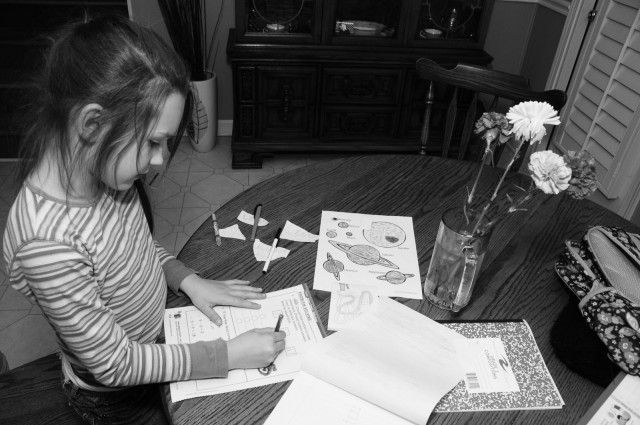
BW0_3771
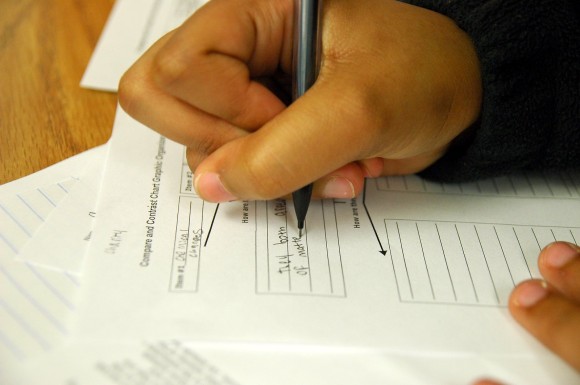
Doing math homework

Yet such an assignment is intended to get students to read to understand for themselves. Historically, teachers have been guilty of giving too much background information, and students can rely on this instead of the text itself. Taking some — and note that by no means did the model lesson say no context should be provided — of that away forces all students to look to the text itself for understanding, not what the teacher provided before reading.

When we turn to math, the situation is similar. Conservative critics bemoan the fact that elementary level math uses terms like “number sentences” and encourages “guess and check.” They eagerly post photos of their children in tears from the difficulty of the homework.

L, of course, is encountering CCS math now, so we’re getting a first-hand view of the supposed horrors, and I have to say so far, I’m impressed. Far from being convoluted and confusing, it seems to me that CCS math concepts teach a fluent understanding of basic mathematical concepts rather than rote memorization of math facts.

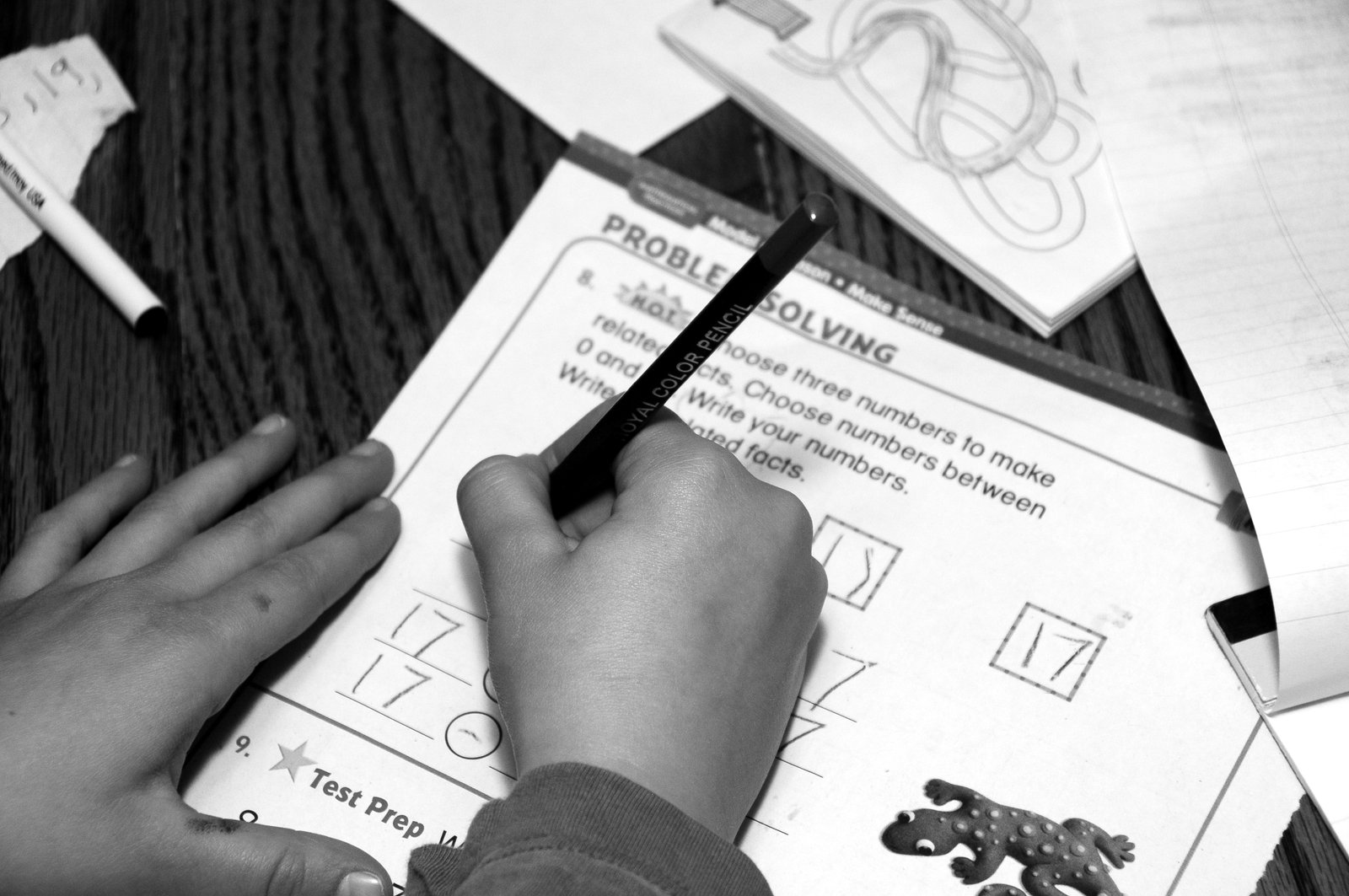
One problem that L recently encountered had the following instructions:

Choose three numbers to make related math facts. Choose numbers between 0 and 18. Write your numbers. Write your related facts.

“Math facts” is CCS-speak for equation, but it goes beyond that: it teaches students to see the relationships between the three numbers as a matrix of facts rather than a bunch of randomly memorized equations.
BW0_3774
The problem under discussion

It gets them thinking that if 6 + 11 = 17, then similarly 11 + 6 = 17. It teaches them that they can reverse the numbers and change a sign for another group of facts: 17 – 6 = 11 and 17 – 11 = 6. By drilling students in this kind of thinking, CCS-based math seems to encourage students to think of clumps of math facts and see them as interrelated.

As to the vocabulary, using “number sentence” or “math facts” as opposed to “equation” seems to be merely semantic. They’re all valid descriptors of the same thing.

Here is a recent example of uninformed criticism of “guess and check.”

L has yet to start “guess and check,” but I can already guess about the thinking behind that: it’s an effort to teach children from an early age how to estimate, something that I find with my own students is a skill that is sorely lacking. Granted, I don’t teach math, but I use math in the classroom from time to time. For instance, as we’re nearing the end of the third quarter, we begin informing parents and students who might fail that repeating the eighth grade is an impending danger. To help students who might be facing such a situation calculate how much they need to improve for the fourth quarter, I present them with the following scenario:

In order to pass, you must have an average of 70 for the year, which would also work out to an average of 70 for each quarter. Therefore, you can add those four quarters up to determine how many points you need to pass: 280. Take your first semester grade, multiply it by two, add your third quarter grade, and subtract all that from 280. You’ll come up with your necessary fourth quarter grade.

They look at me like I’m speaking Greek, so we break it down. 280 – (first semester grade * 2 + third quarter grade) – what you need to pass. Then we plug in some hypothetical numbers: 280 – (68 * 2 + 63) =  x. “So what’s 68 times 2?” I ask. Blank looks. No one has ever taught them the multiple ways you could estimate this in your head. Indeed, not even estimate: it’s easily calculated. 60 * 2 + 8 * 2, or 120 + 16, or 136. You could also do it with 70 * 2 and then subtract. Either way, you end up with the answer in a matter of moments. Or you just estimate with 70 * 2. Yet for so many students, this is completely foreign thinking. (In the above example, in case you’re curious and not inclined to finish the calculation, the hypothetical student would have to score an 81 for the fourth quarter to pass.)

Common Core math, it seems, is trying to teach students these skills from an early age by getting them to do it all the time. It’s not meant to be a replacement for actually working the problem. Indeed, it’s called “guess and check,” not just “guess.”

For me, as a right-leaning moderate, I find it embarrassing that so many who share some of my other political views can be so very ridiculously uninformed and, quite frankly, can show such a frightening lack of critical thinking. Maybe it would be a good idea for these critics to add “and check” to their own guessing.
PD

It’s four thirty; no one really wants to be here, yet at some level, we’re all keenly aware of how important it is to be here. Still, we’ve wished our students well for the day, we’re hungry, and really the last thing we want is to sit through professional development — i.e., a Power Point presentation.

In all honesty, it’s a great disservice to the district head of secondary English instruction to reduce down all her research, planning, and background conversations to three words: “a Power Point.” Mrs. B has done a superb job helping us all get a grasp on the changes Common Core mean for our teaching, and without her quarterly professional development (PD), I’d be much further behind the curve than I am now. I walk away from each session feeling better about my teaching, feeling I have a lot of new strategies to implement, and feeling generally more confident in my ability to prepare kids for high school. But in the tired haze of a Thursday afternoon, it can all seem just a bit much.

“You want me to teach for eight hours, then sit for ninety-minutes on the other side of the desk?” You can see that question almost visibly in thought-bubbles above every attendee’s head. Glance around the room and you’re not likely to be surprised at what you see: bottles of various sizes and materials, filled with diet soda, iced tea, water, and various mysteries — no, not those mysteries — as well as coffee cups, snack wrappers, smart phones, laptops, watches, jewelry. It’s like we’re all getting ready for bed and watching television at the same time: we’re all as comfortable as we can be without actually kicking off our shoes. The presentation starts, and you see someone surreptitiously scrolling through messages on her phone, someone else looking at the news on her laptop. You hear someone desperately trying to open a snack — perhaps a bag of pretzels — without making too much noise. You see two teachers huddled together, finishing a conversation that started before the presentation. You think of how tired you are, of how much you’d like to be napping. And then it occurs to you: “We’re just as bad as our own students.”

Gratitude

The small steps one takes to the greater goal: with the Boy today, it struck me that I don’t do enough with him during Mass to help him develop spiritually. I’d fallen into that silly line of thinking that he’s too young to get it. How ridiculous. We’d begun teaching him how to cross himself after dinner prayer. He gets the head — belly and shoulders, not so much. And he ends folding his hands together for “amen.” “If he can get that, of course he can begin other rudiments of the faith.” So today, during the Liturgy of the Eucharist, we knelt together for a moment. He ran his car on the floor after a few seconds, but it’s the small steps.

Small steps can of course grow into gigantic leaps, and Polish Mass today showed that as well. The choir, which began simply as K singing along with the organist, has grown in all senses, so that today the choir boasted seven members including an international accompaniment section that included a trumpet player who’d learned the hejnał played from St. Mary’s Basilica in Krakow hourly. I recorded the final hymn; watching the video, K mused about the irony: “That’s one of our most patriotic hymn, and we had a Latino accompanist and an Irish-American trumpet player.”

I can’t deny that at times, K’s choir involvement bothered me. Not because of what it was but the lengths to which she sometimes went to participate, singing when she was sick, singing when she’d rather do just about anything else. To have such a woman in my life at all could not fail to make me a better man; to have such a woman as my wife often leaves me speechless.

Given the rambunctious nature of our daughter, such a temperament as K’s seems nonnegotiable. It’s certainly not environment and it’s not obviously genetic — at least not in the first generation — but there it is all the same: energy that can be frustratingly exhausting, frustratingly difficult to redirect, frustratingly everything. Yet it’s not hard to see the gifts and wonder packed into her small frame as well. While playing tag after Mass, she reminded me just how incredibly nimble-minded she is. “JesteÅ› berkiem!” one of the boys called out, and she smiled as she ran after him: “I know I’m it!” She lives in the midst of two languages, two cultures, so effortlessly. If only it were effortlessly: it’s another struggle sometimes, but these little moments that show us that it’s not all in vain are welcome.

Back at home, I returned to my morning task, grading essays on Romeo and Juliet. As they’re all turned in online through a course management system, I can see the resulting word-counts in a simple list. Quantity is not quality, but seeing word-counts that average close to a thousand words, I remembered students’ incredulity at the beginning of the year when I told them that by the end of the year, five hundred words would seem restrictively short. And here it was, right on my computer screen: proof that I’ve had an impact. It’s easy to say, “We teachers can only plant seeds,” after days that seem like staying at home and bashing one’s head into the wall repeatedly would have been more productive, but such moments of clarity make those days all worthwhile.

Four things to be grateful for, in four different categories — spiritual, spousal, familial, and career. And the fact that it was so easy for me to think of these four things is itself something for which I can be thankful.

Ancient Modern

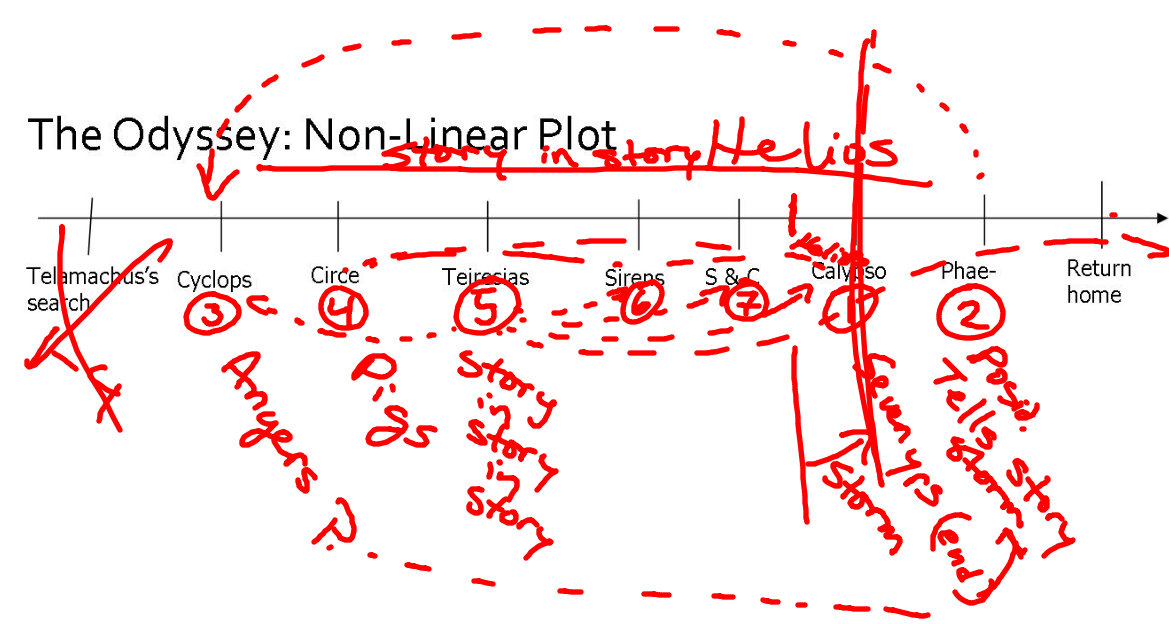
In English I Honors, we’ve been accompanying Odysseus as he struggles to make it back to Ithaca and his beloved Penelope. We reach Tiresias’s prophecy from the underworld and the confusion starts.

‘Great captain,
a fair wind and the honey lights of home
are all you seek. But anguish lies ahead;
the god who thunders on the land prepares it,
not to be shaken from your track, implacable,
in rancor for the son whose eye you blinded.
One narrow strait may take you through his blows:
denial of yourself, restraint of shipmates.
When you make landfall on Thrinákia first
and quit the violet sea, dark on the land
you’ll find the grazing herds of Helios
by whom all things are seen, all speech is known.
Avoid those kine, hold fast to your intent,
and hard seafaring brings you all to Ithaka.
But if you raid the beeves, I see destruction
for ship and crew. Though you survive alone,
bereft of all companions, lost for years,
under strange sail shall you come home, to find
your own house filled with trouble: insolent men
eating your livestock as they court your lady.
Aye, you shall make those men atone in blood!
But after you have dealt out death–in open
combat or by stealth–to all the suitors,
go overland on foot, and take an oar,
until one day you come where men have lived
with meat unsalted, never known the sea,
nor seen seagoing ships, with crimson bows
and oars that fledge light hulls for dipping flight.
The spot will soon be plain to you, and I
can tell you how: some passerby will say,
“What winnowing fan is that upon your shoulder?”
Halt, and implant your smooth oar in the turf
and make fair sacrifice to Lord Poseidon:
a ram, a bull, a great buck boar; turn back,
and carry out pure hekatombs at home
to all wide heaven’s lords, the undying gods,
to each in order. Then a seaborne death
soft as this hand of mist will come upon you
when you are wearied out with rich old age,
your country folk in blessed peace around you.
And all this shall be just as I foretell.’

They see the line about being “lost for years,” and with with some guidance, realize that this is Calypso and that the blind prophet says it using future tense (“under strange sail shall you come home”).

“Wait,” they say. “That’s what the Odyssey begins with? How is it in future tense?” (We begin our exploration of the Odyssey on Calypso’s island in book five, skipping all of Telemachus’s search in books one through four.) With some more guidance they realize it’s a story within a story. A prophecy in something like a flashback. Which itself is all set within the larger story: a story within a story within a story.

1-Fullscreen capture 2192014 13743 PM
Notes from the board

“And people liked to praise about Pulp Fiction‘s non-linear storyline,” I say with a smile, but no one gets it.

Glimpse into Your Future?

As an eighth-grade teacher, I’ve sometimes found myself in a situation that is difficult to believe: a student, already in trouble, burrows herself even more deeply into the issue, verbal fangs and claws showing. “It’s surely a defensive mechanism,” I thought, wondering why this person was essentially standing in front of a wall banging her head mercilessly against the cinder blocks and growing more angry that the only result was pain for her with no visible effects to the wall. “Surely this is automated response,” I almost mused aloud.

Such situations have left me wondering what I could do to help such a student and frustrated that I didn’t handle the situation better at the time. In such cases, if the kid has been somewhat troubling through the year, it can be difficult to resist the temptation to poke at the situation a bit like a bloodied knee. What does it cost me? It only hurts the other person, and don’t she deserve it for all the nonsense I’ve put up with through this year? Yet I’m the adult in the situation, and thankfully I can say that I’ve generally resisted the temptation to provoke further in such situations.

“Surely it’s something they grow out of.” It’s the only hope sometimes. And then I saw this.

Increase

Among all the metrics we use to measure kids’ performance, the most useful in many ways is the MAP test. We give it at the beginning of the year and again at the end, and in past years, we’ve set personal performance goals using it as a standard. Average yearly growth for an eighth grader reading at grade level is about three points. Great growth is around seven or eight points. For those a little below eighth grade level, good growth is around six or eight points.

This year, I’ve conducted an experiment, pairing daily during silent sustained reading students who excel at reading with those who excel at other academic ventures. The idea was simple: the strong readers would help the weaker readers by explaining what and how they inferred things in the article, working together to figure out word meanings in the article strictly from context clues, discussing the contents of the article, and a number of other tricks and practices. We’ve been doing that most of the semester. Recently, the students took a shortened version of the MAP test and the results merited a Klondike ice cream party: average growth for one semester was 7.4 points, with two students increasing by an astonishing 15 points and one student by 14 points.

It was a good day to be a teacher.

Up

Dear Terrence,

To see your excitement when you got your report card this afternoon was one of those moments that makes all the silliness I have to put up with as a teacher worth it. You’re the type of kid who is simply used to having an F or two on your report card. The question for you, I think, has always been how many. And so when I told you “Not a single F” as I handed the report card to you, I would have loved to capture your expression. We could use it as a visual illustration of “pride.”

Next goal: honor roll.

Smiling with you,
Your Teacher

Intent

Dear Terrence,

I’m really starting to wonder if you’re not doing this on purpose. I mean, you just got back from a long out-of-school suspension today, and yet you didn’t even make it through the whole day before you got into a fight. (When I wrote that, I dithered between “couldn’t make it” and “didn’t make it.” I figured the former was too fatalistic.) You tell me you want to do well in school. We have the conversation about impulse control at least once or twice a week. I explain to you regularly the effect your reputation — created from experience and rumor — has on how teachers treat you. And yet you do it still: indeed, if you hadn’t gotten into a fight today, you still likely would have been suspended, for I know a teacher wrote an administrative referral on you because of your completely disruptive behavior in class.

So I’m wondering what the deal is.

There are two options, both frightening, but one is positively terrifying. The first option is that all this is intentional, that you’re trying to get into alternative school. Don’t laugh — it’s not so far fetched. One of your colleagues just down the hall has expressed that intention openly. Still, you insist that’s not what you’re up to when I ask you about it. That leaves the second option. The terrifying option: you honestly don’t have a clue how to control your impulses. You’ve built up such a habit of just going with whatever wild thought enters your head that that’s your standard operating model now. What’s terrifying about that? People like that usually don’t meet with a lot of success in life. People like that usually end up bouncing in and out of jail, spending some time in prison, collection welfare while not incarcerated, completely unable to hold down a job, and if they happen to be male, leaving several fatherless children in their wake. (Yes, I know, it does take two to do that particular dance, but that simple fact does nothing to negate your responsibility.)

At its heart, your unwillingness to control your impulses is a kind of immaturity. Toddlers don’t control impulses well, but with guidance from parents, teachers, and other adults, they learn how to curb those crazy compulsions. So your refusal — and at this point, I’m not sure how else to describe it — to reign in these urges is at heart a refusal to grow up. Sure, that’s not fun in a way, but I would imagine it’s a whole lot more fun than a lifetime of incarceration, joblessness, dependence, frustration, and anger.

I end reiterating what I’ve said to you many times: I’m here for you. You drive me absolutely nuts in class, but I’m still not giving up on you. Your decisions today, though, make me wonder if you’ve given up on yourself.

Sadly,
Your Teacher

In the Text

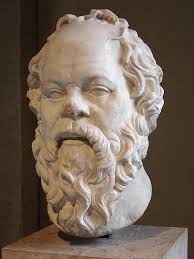
Socrates
Socrates

In all my classes, I emphasize the importance of being able to back up assertions about a given text with information from the text. “Where do you see that in the text?” It’s a typical question in the classroom.

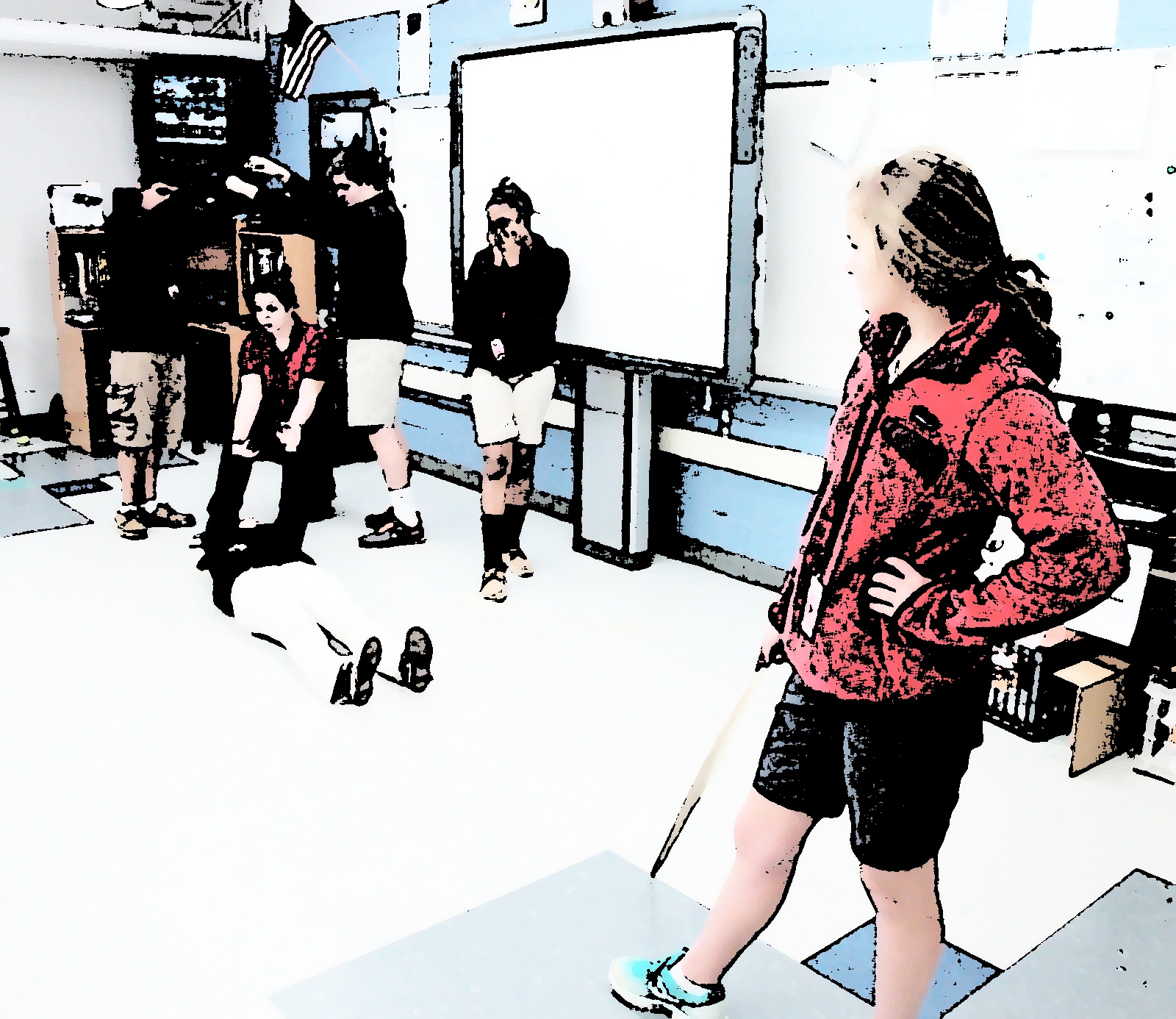
With one group today, we were doing a Socratic Seminar on the question of who is ultimately responsible for Juliet’s fake death at the end of act four in Romeo and Juliet. Our discussion skill focus was on backing everything up from the text and, equally important, recognizing when others have made claims that aren’t necessarily backed by the text and calling them on it.

“Where do you see that in the text?”

“Show me from the text.”

“I don’t see that in the text.”

At the end of the day, a young lady came back to inform me that during math class, she’d felt the teacher was wrong and said, “Excuse me, Mrs. M, could you show me that in the text?”

First Day 2014

I’m always a little bit nervous about the first day back to school after a long-ish break, and today was no exception. I’ve had some absolutely splendid days after Christmas break and some absolute nightmares. Every year, as I go to bed the Sunday (most often) before we head back to school, I find myself wondering what kind of day tomorrow will be.

Yet I’m also always a bit excited: it’s like a first day of school, a new school year without some of the frustrating awkwardness of an actual first day. There are no schedule changes following schedule changes following yet more. Students aren’t moving into and out of your class. I know all well, and there are no worries about figuring who might be the most problematic student as quickly as possible in order to deal with potential issues proactively.

1-DSC_4724
Stylized illustration actually of students who are productive in 99% of the time

Today was amazing, in all classes.

I have a couple of classes with several students who have substantial behavior problems, and obviously I was most nervous about these classes, but they amazingly well. Sure, there was a little side talk, but by and large, most students were on task most of the time. People were talking to each other about their work, helping each other, sharing fascinating facts they’d learned in their research process.

Where did that come from? Don’t ask such questions — just enjoy the glow of feeling productive through the entire day.

I’ll have to hold on to that feeling when the third quarter blues begin and I — no we — find myself ourselves wishing it would just be late-May already…

Exposure

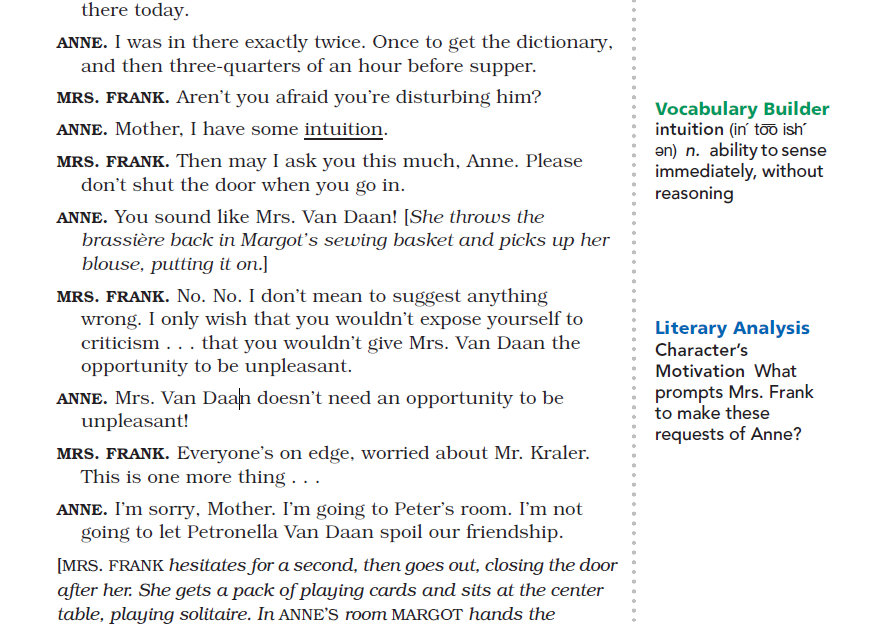
We’re in class, reading the play The Diary of Anne Frank, acting out some sections, comparing others to the original diary. Today, we’re working to analyze the text to determine places where one character implied something and/or another character inferred something. In the story, Anne and Peter’s romance is just beginning, and Anne is getting reading for an evening visit with Peter as she talks with her mother and sister in her room:

1-Fullscreen capture 12142013 80034 AM

In groups, after we act it out, students analyze the text together to find specific lines (“You have to be able to point to it in the text,” I explained) that clearly show either an implication or inference.

As we’re debriefing as a class, a student points out one of the key lines I was hoping students would see: “Then may I ask you this much, Anne. Please don’t shut the door when you go in.” Mrs. Frank is of course not implying that she thinks that Peter and Anne will do anything untoward; she’s merely worried about giving Mrs. van Daan (in reality, her name was van Pels) something else to complain about.

The student didn’t see it that way, though.

“What is she implying?” I ask.

“That Anne will expose herself to Peter!” he said proudly, with utmost sincerity and seriousness.

We all laughed, but my own belly laugh got them laughing even harder.

Romeo, Wherefore Art Thou So Disappointing?

1-DSC_4895-001

We’re knee-deep in Romeo and Juliet, as is always the case this time of year. One scene into act three, we’ve really hit the point in the play at which events start accelerating. Juliet will shortly embark on her gorgeous soliloquy about the dangers of taking Friar Laurence’s potion.

I have a faint cold fear thrills through my veins,
That almost freezes up the heat of life:
I’ll call them back again to comfort me:
Nurse! What should she do here?
My dismal scene I needs must act alone.
Come, vial.
What if this mixture do not work at all?
Shall I be married then to-morrow morning?
No, no: this shall forbid it: lie thou there.

What if it be a poison, which the friar
Subtly hath minister’d to have me dead,
Lest in this marriage he should be dishonour’d,
Because he married me before to Romeo?
I fear it is: and yet, methinks, it should not,
For he hath still been tried a holy man.
How if, when I am laid into the tomb,
I wake before the time that Romeo
Come to redeem me? there’s a fearful point!
Shall I not, then, be stifled in the vault,
To whose foul mouth no healthsome air breathes in,
And there die strangled ere my Romeo comes?
Or, if I live, is it not very like,
The horrible conceit of death and night,
Together with the terror of the place,–
As in a vault, an ancient receptacle,
Where, for these many hundred years, the bones
Of all my buried ancestors are packed:
Where bloody Tybalt, yet but green in earth,
Lies festering in his shroud; where, as they say,
At some hours in the night spirits resort;–
Alack, alack, is it not like that I,
So early waking, what with loathsome smells,
And shrieks like mandrakes’ torn out of the earth,
That living mortals, hearing them, run mad:–
O, if I wake, shall I not be distraught,
Environed with all these hideous fears?
And madly play with my forefather’s joints?
And pluck the mangled Tybalt from his shroud?
And, in this rage, with some great kinsman’s bone,
As with a club, dash out my desperate brains?
O, look! methinks I see my cousin’s ghost
Seeking out Romeo, that did spit his body
Upon a rapier’s point: stay, Tybalt, stay!
Romeo, I come! this do I drink to thee.

Capulet will soon make his ultimatum to Juliet: marry Paris or be not my daughter!

Day, night, hour, tide, time, work, play,
Alone, in company, still my care hath been
To have her match’d: and having now provided
A gentleman of noble parentage,
Of fair demesnes, youthful, and nobly train’d,
Stuff’d, as they say, with honourable parts,
Proportion’d as one’s thought would wish a man;
And then to have a wretched puling fool,
A whining mammet, in her fortune’s tender,
To answer ‘I’ll not wed; I cannot love,
I am too young; I pray you, pardon me.’
But, as you will not wed, I’ll pardon you:
Graze where you will you shall not house with me:
Look to’t, think on’t, I do not use to jest.
Thursday is near; lay hand on heart, advise:
An you be mine, I’ll give you to my friend;
And you be not, hang, beg, starve, die in
the streets,
For, by my soul, I’ll ne’er acknowledge thee,
Nor what is mine shall never do thee good:
Trust to’t, bethink you; I’ll not be forsworn.

Of course the dual suicide scene, with Romeo’s melodrama: “Eyes, look your last!”

You’d think it’s the perfect play for thirteen-year-olds. It’s got so much pathos that it almost chokes you on it. Yet they’re beginning to find Romeo tiresome, and when he falls on the floor in Laurence’s cell in a few days, they’ll have lost the last shred of respect for him that they might have been clinging to.

It is, in a short, the highlight of my school year: students’ first real experience with Shakespeare and their budding recognition that they can make sense of his seemingly convoluted, inverted sentences, his arcane vocabulary, his foreign sense of propriety, and his unexpected sense of humor.

Queen Mab

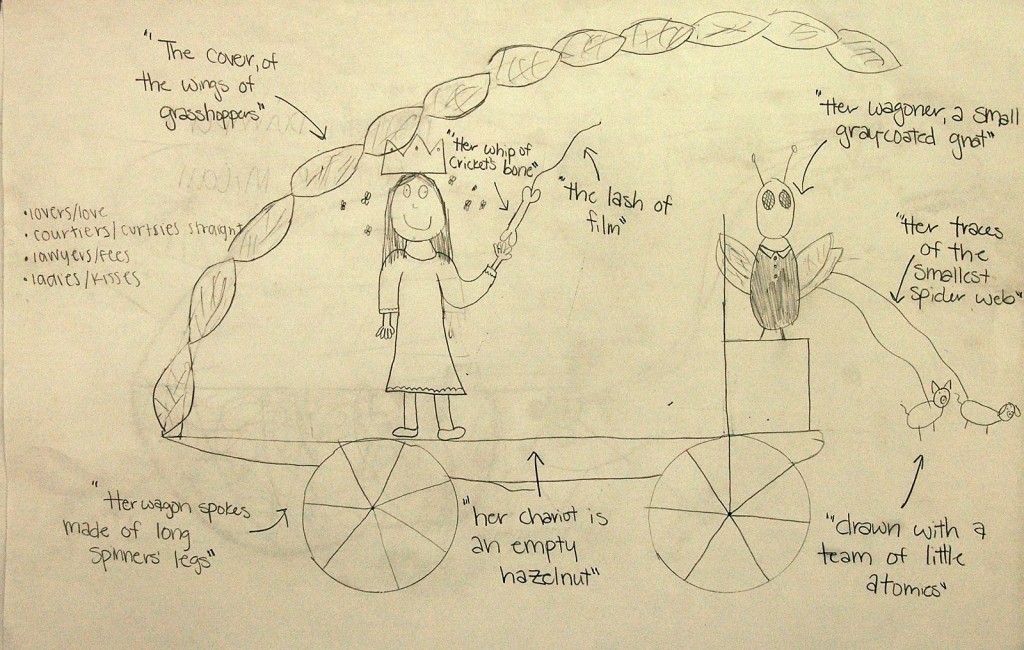
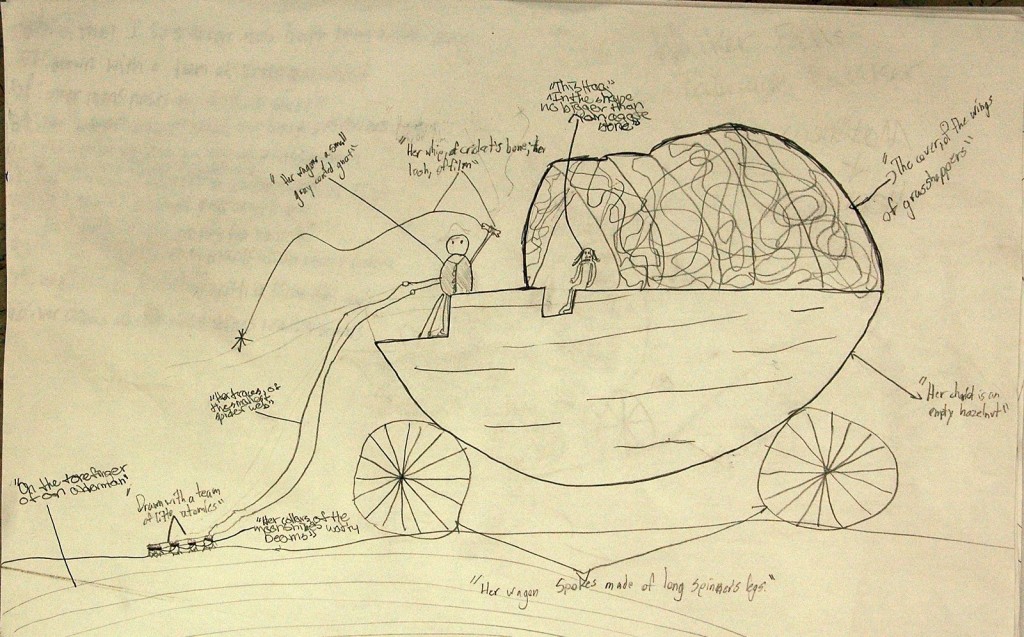
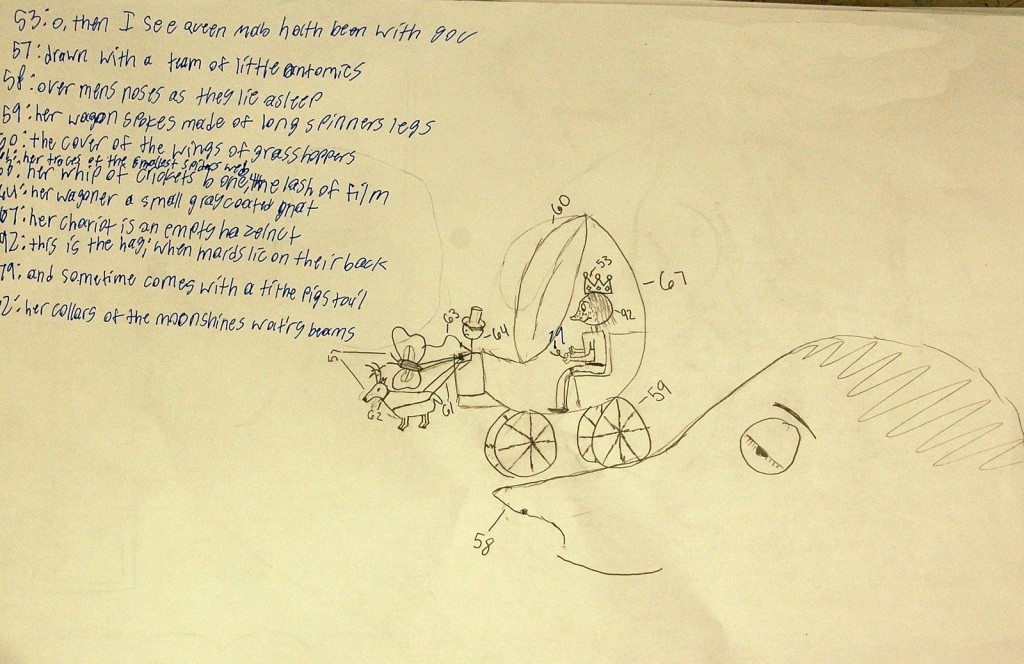
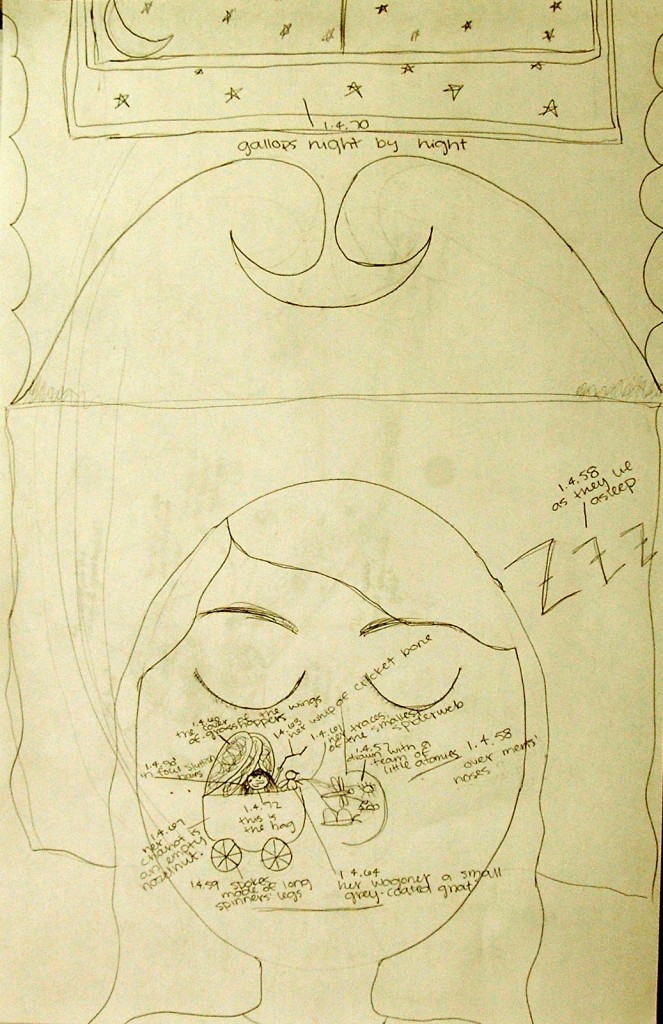
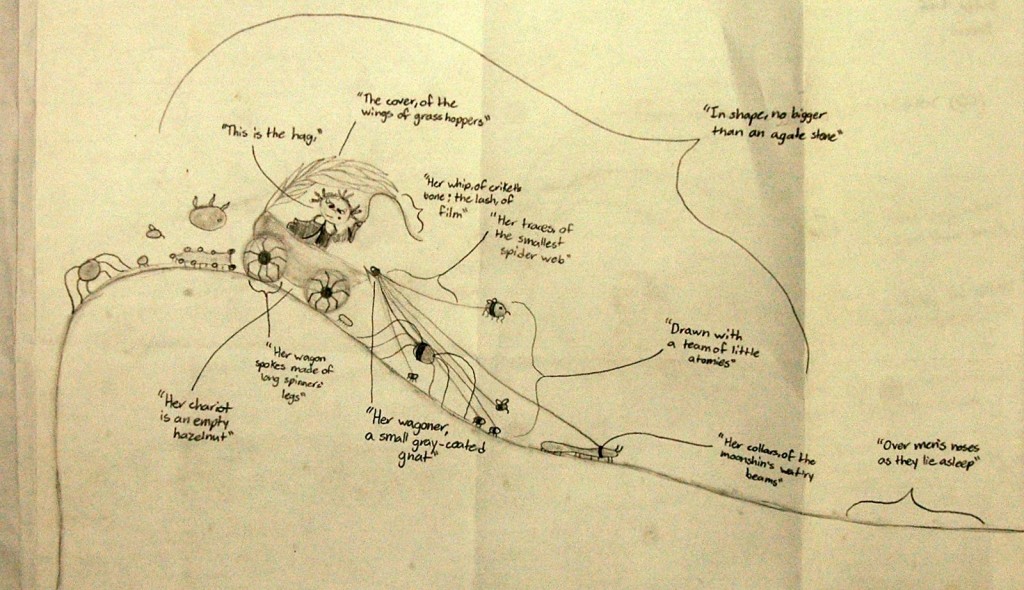
Students’ drawings of Queen Mab.

O, then, I see Queen Mab hath been with you.
She is the fairies’ midwife, and she comes
In shape no bigger than an agate-stone
On the fore-finger of an alderman,
Drawn with a team of little atomies
Athwart men’s noses as they lie asleep;
Her wagon-spokes made of long spiders’ legs,
The cover of the wings of grasshoppers,
The traces of the smallest spider’s web,
The collars of the moonshine’s watery beams,
Her whip of cricket’s bone, the lash of film,
Her wagoner a small grey-coated gnat,
Not so big as a round little worm
Prick’d from the lazy finger of a maid;
Her chariot is an empty hazel-nut
Made by the joiner squirrel or old grub,
Time out o’ mind the fairies’ coachmakers.
And in this state she gallops night by night
Through lovers’ brains, and then they dream of love;
O’er courtiers’ knees, that dream on court’sies straight,
O’er lawyers’ fingers, who straight dream on fees,
O’er ladies ‘ lips, who straight on kisses dream,
Which oft the angry Mab with blisters plagues,
Because their breaths with sweetmeats tainted are:
Sometime she gallops o’er a courtier’s nose,
And then dreams he of smelling out a suit;
And sometime comes she with a tithe-pig’s tail
Tickling a parson’s nose as a’ lies asleep,
Then dreams, he of another benefice:
Sometime she driveth o’er a soldier’s neck,
And then dreams he of cutting foreign throats,
Of breaches, ambuscadoes, Spanish blades,
Of healths five-fathom deep; and then anon
Drums in his ear, at which he starts and wakes,
And being thus frighted swears a prayer or two
And sleeps again. This is that very Mab
That plats the manes of horses in the night,
And bakes the elflocks in foul sluttish hairs,
Which once untangled, much misfortune bodes:
This is the hag, when maids lie on their backs,
That presses them and learns them first to bear,
Making them women of good carriage:

Apologies

Dear Teresa,

Two observations.

First, not all apologies begin with I’m sorry. In fact, some of the most graceful and moving apologies have ended with those words.

Second, and more significantly for you, not all utterances including “I’m sorry” are in fact apologies. For example, if you were to get in trouble with a teacher yet feel that you had done nothing, saying “I’m sorry you think that I…” only feels like an apology because it includes those sometimes-deceptive words. It is, in fact, an accusation.

Mildly amused and annoyed,
Your Teacher

How to Plagiarize

Dear Terrence,

I understand you didn’t really like the sonnet assignment. That’s fine: not every assignment has to be to your personal liking or approval. Understand, though, that, because this is not a poetry writing class, I had no intention of grading it with the kind of severity that would result in a bunch of failing grades. It was the struggle of writing in iambic pentameter that I was after, as well as the experience of having to think about each and every word as you wrote. That’s probably not something you’ve ever done before, but you’ll write plenty of things in your life that you should consider word by word.

Cheaters
Cheaters

But, you didn’t like it. Perhaps you even thought you couldn’t do it. As a solution, you decided to bounce around the internet for a while until you found a sonnet that you thought you could pass off as your own, then you typed it up and attempted to do just that.

I wish you had spoken to me about this earlier: I could have given you some pointers to help you not get caught. But you are caught. Still, in the spirit of charity, I’ll share the pointers anyway.

  1. Be aware that I have taught English for a long time. I know how eighth graders sound, even the most gifted, when they’re writing. I know what kind of topics they choose. I know what kind of vocabulary they’re likely to use. So at least choose a sonnet that sounds like a kid wrote it, not a hormonally challenged adult. With that much experience, I have a pretty strong intuition about what is and isn’t from the pen of an eighth grader.
  2. Understand that I know your personal writing voice. It’s not just that I know how eighth graders write; I know how specific eighth graders — including you — write. I know what kind of ideas you’re likely to write about and which ideas might never cross your mind. I’ve given you standardized testing that provides me with ample information about what kinds of words you’re likely to understand and to use in your own writing.
  3. I expect it. I know someone will do this, and I read every paper with the thought that, no matter who the author, there’s a latent (don’t pawn off work with that word in it: I know you don’t know what it means) chance of someone trying to pull one over on me.
  4. I’ve caught them all. Every single one. Remember the Terminator? That’s me. Only without the bulging muscles. Or the Austrian accent.
  5. Make sure you know all the words in your plagiarized work. It’s awfully telling when a teacher uses a word (intentionally, of course) that you’ve used in your work only to receive blank looks from the one person who used the word (a word like, say, “latent”) in “her” work. (I put her in quotes because, well, you understand.)
  6. Choose a sonnet that’s about a topic that the average eighth grader would be interested in. I know you personally, so it’s not just a matter of an abstract idea: I know what type of thing you’re likely to write about. Burning passion is not one of them. No eighth grader would write about that topic, especially you.
  7. Finally, I know I’ve said this before, but it bears repeating: make sure it sounds like an eighth grader. Eighth graders to speak of anyone’s “wanton fiery beauty.” Eighth graders don’t write poems with final lines beginning “pleasure me.”

With these ideas in mind, I’m sure you’ll be more successful in your next efforts to act as a thief and pass off someone else’s work as your own.

Regards,
Your Disappointed but Not Surprised Teacher

Where’s Waldo?

A pleasant Friday afternoon surprise: two students, classified by some as “average” in every way, working on a web site evaluation activity, noticed something I hadn’t even noticed. First, they notice that two sites mention the same book.

1-Fullscreen capture 1182013 15145 PM

Next they notice that one site gives the title incorrectly.

2-Fullscreen capture 1182013 15157 PM

Excitement.

“I guess this means it’s a less reliable web site, right Mr. Scott?”

I’ll say.

Letter from a Former Student

I simply adore my school and the people in it, especially the teachers. I haven’t had any English teacher as great as you though. I still value and appreciate your teachings. You greatly influenced my writing by inspiring and cheering me on. Every time we receive a writing assignment, you appear in my mind.

Enough to make you puff your chest out a little more…

Bell Ringer

The idea is to get students working immediately. They walk into the classroom and find work projected on the Promethean board and are to get started.

From today.

GATHER ye rosebuds while ye may,
Old Time is still a-flying:
And this same flower that smiles to-day
To-morrow will be dying.The glorious lamp of heaven, the sun,
The higher he ‘s a-getting,
The sooner will his race be run,
And nearer he ‘s to setting.That age is best which is the first,
When youth and blood are warmer;
But being spent, the worse, and worst
Times still succeed the former.

Then be not coy, but use your time,And while ye may, go marry:
For having lost but once your prime,
You may for ever tarry.

Robert Herrick. 1591—1674

AND AFTER YOU’RE DONE GATHERINGYE ROSEBUDS, GATHER YE STARTERS WHILE YE MAY. OLD MR. SCOTT’S A-CHECKING THEM TODAY