general

Baseball Surprise

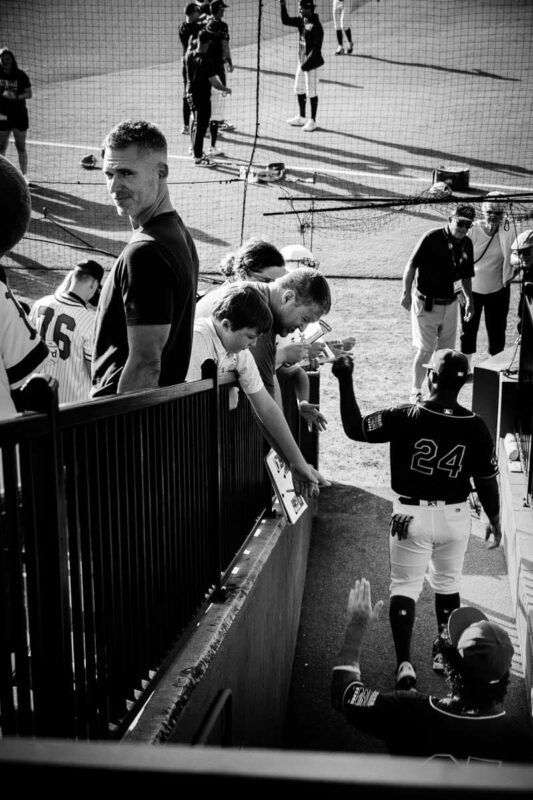
Greenville Water bought tickets for its employees to watch a Greenville Drive baseball game. It was all going along like a normal baseball game (hype man, mascot, etc.) and then it came time for the national anthem. The announce explained that the young lady who’d be singing it was already an accomplished artist, performing as Annie in Annie and several other leading roles. He explained that she would begin her studies shortly at Boston Conservatory and asked us to give a warm welcome to AW.

“AW?!” I exclaimed, turning to K. “She was my student!”
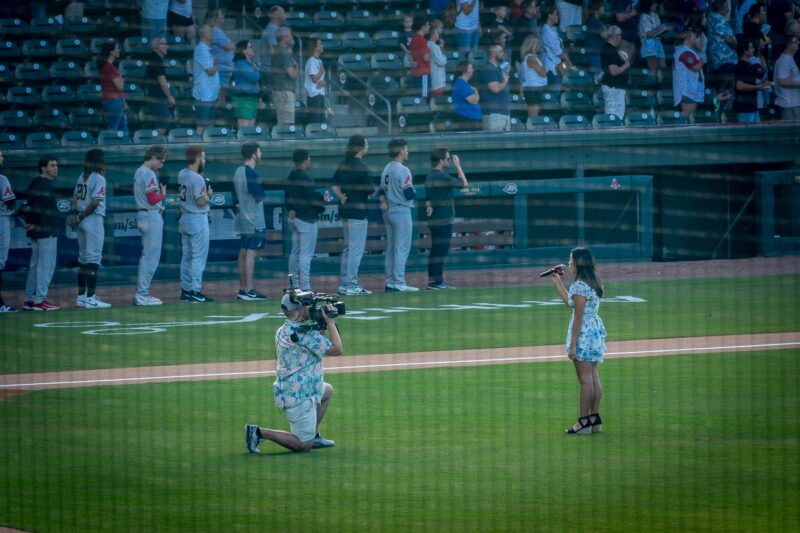
After she sang, of course, I spoke with her. We talked about how wonderful Boston is, how her fellow students from her class were doing, and then I told her, “You probably don’t know this, but I’m not teaching at Hughes anymore.”

“I know,” she said with a grin. “Gossip travels fast at Greenville High.”


First Day Back for Teachers

The first day back for teachers has been for the last several years a stressful experience. I don’t like change that much. I especially don’t like being told to change how I’m doing my job when I don’t really feel my methods need such drastic improvement. I especially don’t like being told to change how I’m doing my job when I am certain that not only will the new way be more labor-intensive but also the new methods will be less effective. Public education is always looking for the magic potion, the new method for this, that, or the other (or, more likely, this, that, and the other). We change essential questions to learning targets (which really is little more than changing an interrogative to a declarative) and think this is somehow going to make everything better.

Texting with teachers who are still at my old school, I mentioned that to day was the first time in years that I didn’t walk into the building with a bit of trepidation about whatever changes the district might be imposing on us. We heard from several sources, “You’re professionals. We hired you because we were convinced you could do the job and do it well. Just do your job.” Another novel notion: “I trust you’ll be planning your lessons because you’re professionals. The format and level of detail of your plans is up to you.”

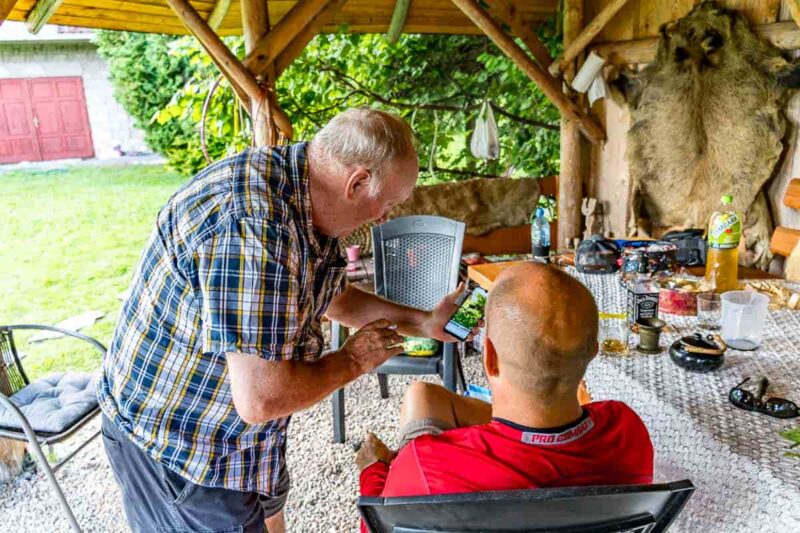
It’s strange being treated like a professional…

L Leaving

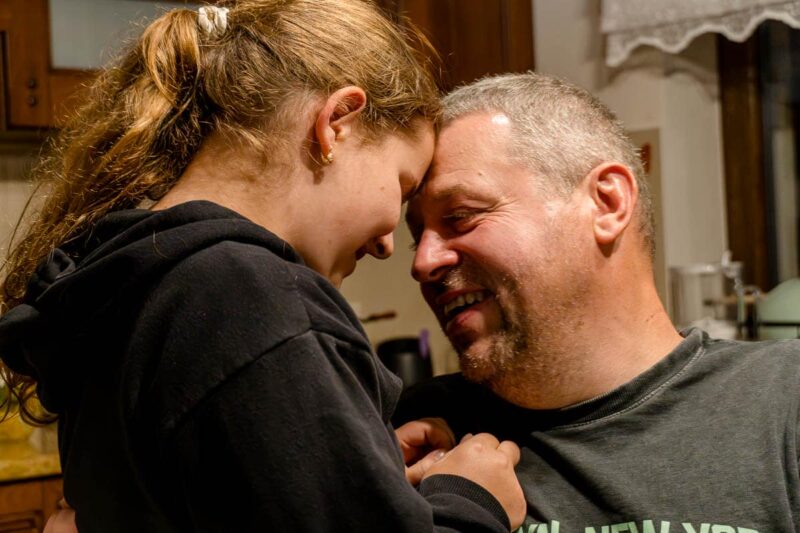
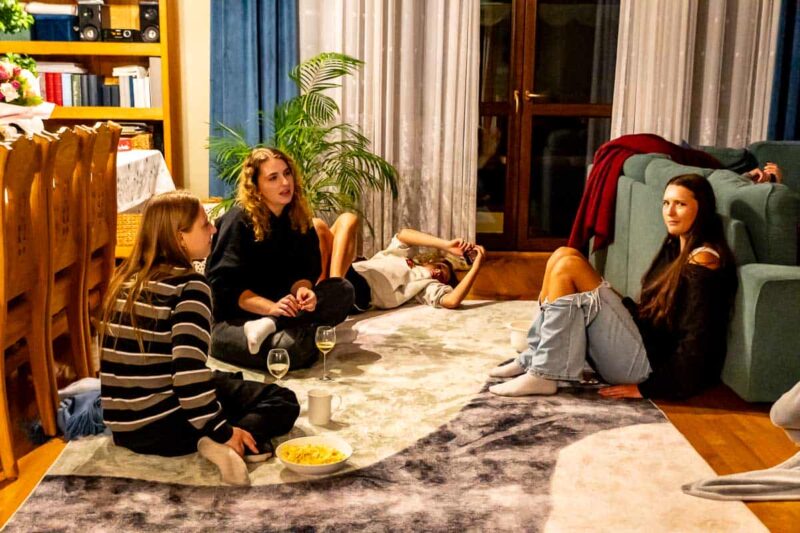
After having L as a daily aspect of our everyday reality — a blessing, a source of joy, an occasional annoyance, a cause for worry, a source of pride, and everything else children represent in their parents’ lives — she’s about to leave for college. We have a handful of days remaining until she’s gone for good. Of course, there will be visits (some longer, others shorter), but chances are, she won’t live with us much after she leaves for the University of Florida. She’ll come for Thanksgiving and Christmas. She’ll spend a good part of summers with us. But she’ll always be returning, first to the U of F, then to wherever she pursues her graduate degrees. Then she’ll be getting her first post-college/grad school job, and the summer visits will all but disappear. She might be involved with someone by then seriously enough that Thanksgiving and Christmas will no longer be guarantees, either.

In other words, it’s nearly the end of our roles as parents of a growing girl and the beginning of a new role: parents of an adult, of a woman who is out finding her way in the world, her existence completely separate from ours in so many ways. No longer dependent on us for anything, she’ll learn to navigate the complexities of adulthood on her own terms, with as much or as little input from us as she herself chooses.

I’ve never been good with endings. They’ve always tugged at my nostalgia and regret, making me wonder if anything will ever be as good as whatever it is that’s ending. Leaving Lipnica in 1999 was so tough on me that I ended up returning. Leaving Hughes left a lingering worry that perhaps whatever followed would be somehow inferior to what I was leaving despite the advantages. Every year as a kid, the end of our week-long, vacation-like Feast of Tabernacles, which was essentially a Christmas replacement, was overwhelming: next year could never be as incredible as this year. Most visits to Poland leave me feeling a little nostalgic when we leave: “did we make the right decision coming back to the States?” I wonder for the briefest of moments while I’m still enthralled with the magic of Poland, forgetting about its drawbacks and all the opportunities living in the States provided our kids.

Logically, this ending should be the hardest of all for me. Our little girl (who is no longer a little girl) is leaving. Yet I’m strangely calm about it. Perhaps it simply hasn’t registered fully. Maybe I’m in such blinding denial that it doubles back on itself and poses as calm. It would be difficult to deny it to myself, though, as the signs are everywhere: nearly-daily trips to this or that store are producing an ever-growing pile of boxes in one corner of her room. Brief exchanges often begin, “Do we have…” and end with expressions of gratitude or furiously typing an addition to this or that shopping list on her phone. She has a growing interest in things like bedsheets and dehumidifiers, her quest for a refrigerator is entering is a recurring conversational motif. “Being an adult means paying for things one really doesn’t want to pay for” has been my refrain of the last few weeks as she complains about how much this or that costs.

The evidence abounds: why am I so relatively relaxed about L heading out to make the world her own, thus ending an eighteen-year reality for our family? Part of it certainly comes from the simple fact that she’s spent the last three or four years gradually creating her own world with her own friends, her own interests, her own passions. Pulling away, in other words. Not tugging violently (usually, though that has happened, too) but simply shifting her time from family to her own world. And K and I, in turn, have slowly released that firm grip we had on her as she starts to turn away. So in truth, we haven’t been holding hands with her (to continue the metaphor) for some time but rather walking beside her as she puts more and more distance between us. Now she’s heading down her own road as we continue down ours. Roads that will be parallel in some sense, to be sure, but not the same road.

We’ve known this was coming, in other words, and in that sense, we’ve been preparing both ourselves and her for this moment. We’ve done what we could: now it’s time to let her be L fully.

New School Year

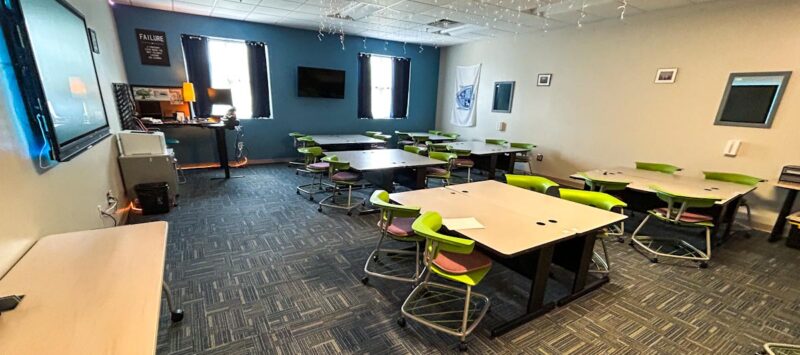
This week, I’ve begun moving into my new classroom in my new school. After eighteen years in the same school and seventeen years in the same classroom, I’ve not had a substantial change in my teaching environment in almost twenty years. Had you asked me some years ago when I was still comfortable and content teaching eighth-grade English in Hughes whether or not I’d be comfortable changing absolutely everything about my physical environment with only ten days or so until the first day of school, I would have responded calmly that I’d rather not, but inside I’d be in a mild panic at first. New understanding points out we’re all on the autism spectrum to some degree or another, and my absolute avoidance of change is definitely my spectrum element. However, I sit writing about this with the full understanding that my room is not even close to ready with a certain calm I would not have expected.

My calmness likely comes from the peace I’ve made with the change I’m embarking on. When I first tendered my resignation and began really thinking about what I’d done, I couldn’t accept it in some ways. “I’m leaving Hughes,” I’d mutter to myself while walking the dog when my thoughts circled back around as they always did. “After eighteen years, I’m leaving Hughes.” Unfathomable. A month in Europe with almost all thoughts of school banished my mind and I’m approaching it differently as I knew I would. Excitement isn’t quite the word, but I certainly feel an anticipation that I haven’t experienced in a few years. 

This time last year, just days before returning to school, all I felt was dread. What new assessments are we going to have to do? How acceptable (notice — I didn’t think how good but how acceptable) would the new textbooks be, and just how closely would we be expected to follow them? How much new “analysis” would we have to do on the district-obsessed “data” would we have to do? (I put those in quotes, though I am loath to do so, because all the data collection and analysis we had to do seemed just to be going through the motions to produce numbers for those making six-figure salaries at the district office to justify their jobs.) What changes will we implement to behavior management in the school? How much new paperwork will I have to complete? What new requirements will we have to meet with our lesson plans? These were the thoughts that made me dread going back to school, not the thought of actually working with the kids. 

Looking at the new school year with a calm anticipation I’ve not felt in years is recursive: the fact that I’m so calm, in turn, calms me more. So today, I was able simply to drop off a few things in my classroom and head back out. Gone is the bookshelf that sat in the middle of our finished basement all summer, prompting K to ask sweetly, “When do you think you might be able to take that out of here?” Gone are some of the boxes of books stacked in the storage room. Because gone is any anxiety about the new school year.

Collins and the Mind

Sam Harris, author of the excellent The End of Faith, has an op-ed in the New York Times about Obama’s selection of Dr. Francis Collins to head the National Institutes of Health.

Collins is famous for his work leading the Human Genome project as well as his stance that there exists “a consistent and profoundly satisfying harmony” between science and Christianity. While he is not a proponent of Intelligent Design, Dr. Collins believes both Genesis and Darwin. Harris explained it thus:

What follows are a series of slides, presented in order, from a lecture on science and belief that Dr. Collins gave at the University of California, Berkeley, in 2008:

Slide 1: “Almighty God, who is not limited in space or time, created a universe 13.7 billion years ago with its parameters precisely tuned to allow the development of complexity over long periods of time.”

Slide 2: “God’s plan included the mechanism of evolution to create the marvelous diversity of living things on our planet. Most especially, that creative plan included human beings.”

Slide 3: “After evolution had prepared a sufficiently advanced ‘house’ (the human brain), God gifted humanity with the knowledge of good and evil (the moral law), with free will, and with an immortal soul.”

Slide 4: “We humans used our free will to break the moral law, leading to our estrangement from God. For Christians, Jesus is the solution to that estrangement.”

Slide 5: “If the moral law is just a side effect of evolution, then there is no such thing as good or evil. It’s all an illusion. We’ve been hoodwinked. Are any of us, especially the strong atheists, really prepared to live our lives within that worldview?” (Source)

Harris is concerned about this blending of religion and science. He writes that when Collins is

challenged with alternative accounts of these phenomena – or with evidence that suggests that God might be unloving, illogical, inconsistent or, indeed, absent – Dr. Collins will say that God stands outside of Nature, and thus science cannot address the question of his existence at all.

Similarly, Dr. Collins insists that our moral intuitions attest to God’s existence, to his perfectly moral character and to his desire to have fellowship with every member of our species. But when our moral intuitions recoil at the casual destruction of innocents by, say, a tidal wave or earthquake, Dr. Collins assures us that our time-bound notions of good and evil can’t be trusted and that God’s will is a mystery.

In short, Harris is worried about the fact that, when it comes to the moral dimension of the universe, Collins ceases being a scientist and becomes a theologian. Certainly the statement “God’s will is a mystery” is not something that can be tested scientifically, Harris rightly points out.

But Harris is up to more, though. He rightly points out that this view of creation — evolution to one point, divine spark-of-morality injection at another — recreates an age-old problem: the mind-body problem.

Just how is the mind/soul connected to the body? Where does one end and the other begin? Things we’ve traditionally thought of as part of the mind/soul (such as personality) are oddly susceptible to influence through physical media. The most famous example is Phineas Gage, a railway who, through a series of unfortunate events, had a railroad stake placed in his skull. He survived, but was never the same. He changed. Instead of the kind, fun-loving Gage, he became a foul-mouthed, short-tempered jerk. His personality changed through violent manipulation of his brain. It kind of indicates that personality is not an aspect of the soul.

Contemporary examples abound. As a teacher, I see it every day: Ritalin. Over-medicate a child on Ritalin and you’ll get a somber, introverted, sleepy individual; get it just right, and you’ll get a “normal” person; under-medicate and you’ll get someone almost bouncing off the walls. When I was in school, this would have all been chalked up to “personality.”

This is exactly what Harris has in mind when he writes,

Most scientists who study the human mind are convinced that minds are the products of brains, and brains are the products of evolution. Dr. Collins takes a different approach: he insists that at some moment in the development of our species God inserted crucial components – including an immortal soul, free will, the moral law, spiritual hunger, genuine altruism, etc.

As someone who believes that our understanding of human nature can be derived from neuroscience, psychology, cognitive science and behavioral economics, among others, I am troubled by Dr. Collins’s line of thinking. I also believe it would seriously undercut fields like neuroscience and our growing understanding of the human mind. If we must look to religion to explain our moral sense, what should we make of the deficits of moral reasoning associated with conditions like frontal lobe syndrome and psychopathy? Are these disorders best addressed by theology?

Dr. Collins sees morality as an element of the soul; Harris points out that this is untestable and amounts to a re-introduction of the mind/body problem into contemporary science. It’s an insightful point, and Harris builds to this point very effectively.

It’s a tricky issue. Religious beliefs are often bedrock beliefs: they inform and shape other beliefs. Would we want a Christian Scientist in the role, someone who believes that all ailments are spiritual, figments of an unenlightened imagination?

But will Collins’ religious beliefs affect his scientific reasoning? I’m not convinced, like Harris, that it will. It didn’t when he was director of the Human Genome Project. Then again, Sam Harris is a long-tailed atheist in a Christian rocking chair country: he’s more than a little skittish, and often justifiably so.

Source: Gary Stern, at Blogging Religiously.