

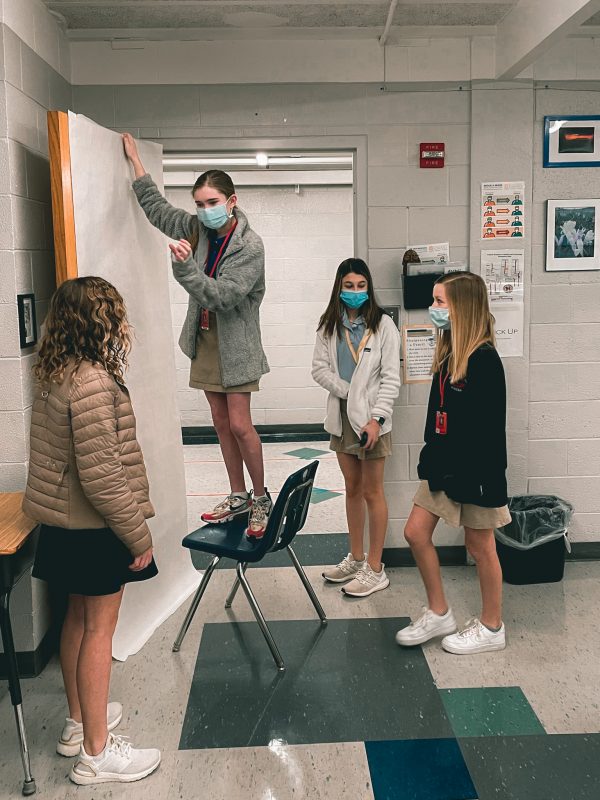
Today, after some girls in homeroom were working on our door decoration for Black History Month (that’s Lisa on the far left), I went back to grading study guides. And I found four more in another class who were copying off a different paper. You’d think that, after all of the raging gossip about the incident yesterday, they would wonder if perhaps it wasn’t time to cut their losses and confess before getting caught — throw themselves on the mercy of the court and all that. But no. So I sent them to Mrs. D, and she ran them through the ringer, then sent them back to class. More gossip.
At the end of the day, when I went back to grading the final batch of study guides, and, well, you probably know what I discovered…
The last question for the act three study guide was to complete a paraphrase of lines 94-103. It was one of the few questions I actually check — the rest of them, I skim and make sure they put something close to correct. This one I read.
One young lady (we’ll call her Lisa) turned in the following:
I’m so upset about my cousin’s death that I’ll never be satisfied with Romeo until I see him dead. Mother, if you could find a man who sells poison, I would mix it myself so that Romeo would be dead. My heart hates hearing his name and not being able to go after him, not being able to avenge the love I had for my cousin.
The second part wasn’t as simple: explain the paradoxical/ironic phrases in this passage.
This passage is ironic because Juliet has to pretend that she hates Romeo and wants to kill him even though in reality she loves him and wants to protect him. Juliet says that she will never be satisfied until she sees Romeo dead when in reality she won’t be satisfied until she sees Romeo and can hug him and be with him. Juliet tells her mother that she wants to mix up the poison to kill Romeo but she really wants to mix up the poison so she can protect Romeo and make sure that the poison doesn’t kill him. Also, Juliet hates to hear Romeo’s name and not go after him, but she says that she hates hearing Romeo’s names and not being able to avenge Tybalt’s death to cover-up that fact that she loves Romeo.
My comment: “Good work. A thorough examination of all the levels of irony.” Lisa is, in all respects, a star student. She never gives less than 115%, and she absolutely hounds me to death for extra feedback and additional help. As a result, she finished the second quarter this year with an eye-popping grade of 100. She had a 99 without the extra credit for the quarter, but she did every possible bit of extra credit so I was more than happy to give that one point, though she didn’t have to do everything to get that point. But she would have done it all even if I’d told her she didn’t have to. “I just want to make sure,” she’d likely say.
A couple of students later, I was skimming through the answers, thinking how much more complete these answers seem than what I’m used to receiving from the boy (we’ll call him James). Then I get to the paradox question and read his answer:
This passage is ironic because Juliet has to pretend that she hates Romeo and wants to kill him even though in reality she loves him and wants to protect him. Juliet says that she will never be satisfied until she sees Romeo dead when in reality she won’t be satisfied until she sees Romeo and can hug him and be with him. Juliet tells her mother that she wants to mix up the poison to kill Romeo but she really wants to mix up the poison so she can protect Romeo and make sure that the poison doesn’t kill him. Also, Juliet hates to hear Romeo’s name and not go after him, but she says that she hates hearing Romeo’s names and not being able to avenge Tybalt’s death to cover-up that fact that she loves Romeo.
A few more students later, I read another boy’s work. We’ll call him Nate. Nate has been struggling with the class, but he’s constantly saying he wants to do better. I read his paradox answer:
This passage is ironic because Juliet has to pretend that she hates Romeo and wants to kill him even though in reality she loves him and wants to protect him. Juliet says that she will never be satisfied until she sees Romeo dead when in reality she won’t be satisfied until she sees Romeo and can hug him and be with him. Juliet tells her mother that she wants to mix up the poison to kill Romeo but she really wants to mix up the poison so she can protect Romeo and make sure that the poison doesn’t kill him. Also, Juliet hates to hear Romeo’s name and not go after him, but she says that she hates hearing Romeo’s names and not being able to avenge Tybalt’s death to cover-up that fact that she loves Romeo.
At this point, there was only one thing to do: go back through all the other papers and check. Nothing else seemed suspect, but these Lisa’s, James’s, and Nate’s study guides were, upon closer inspection, identical. Completely. Perfectly. A medieval scribe would be jealous of the letter accuracy.
I was puzzled, though. I couldn’t get a single thought out of my mind: “This just does not seem like something Lisa would do.” James and Nate — maybe. Conceivably. But Lisa? Never.
I took the three papers to Mrs. D, the eighth-grade vice principal, and she sweated a couple of more names out of them. I got a call during my planning period asking if I’d print out Sam’s and Jacob’s paper. I did so, but they were identical to the other three. Mrs. D applied a little more pressure while I stood there: “You want to tell me what happened or should I immediately just start suspending people?” It turned out that both James and Nate had gotten the study guide from Jacob.
While they were providing details, I looked down at Lisa. Her brow was furrowed in confusion; her eyes glistened; her chest was heaving slightly. She was utterly terrified.
It wasn’t difficult to understand why: here was a girl who’d probably never gotten in trouble at school. Ever. For anything. She’s chatty because she’s so very bright, and she just wants to share all the thoughts she has. (She puts Post-It notes on her article of the week in addition to all the marginal comments. “I just have a lot to say,” she explained with shrug of the shoulders when I asked her why she was doing so much more than was required.)
I left the room to get ready for class — their class. Students began filing in, and I heard the talk:
“Who else got called to the office?”
“Lisa’s in there.”
“Then it must be some star student thing or something.”
“No, I think she’s in trouble.”
Just before class started, the vice principal came down to my room to tell me that Jacob had rather casually admitted that he’d swiped the study guide from Lisa. While she had gone to the restroom, he noticed the study guide was up and quickly jumped on her computer to send a copy to himself. He then shared it.
Poor Lisa, I thought.
I went back into the classroom and made sure everyone was working, then called Lisa outside.
“Are you okay?” I asked.
“Yes. Did Mrs. D tell you what happened?”
“Yes, and I’m glad it all came out. I’m sure you were quite confused.”
“Very,” she said, shaking her head vigorously.
“Well, this should serve as a lesson to you that’s a little different than the lesson the boys are going to learn.” I asked her if Mrs. D had told her what I’d said initially.
“No, not really.”
“Well, I told her that it just didn’t seem like you. That I doubted you’d just shared this. I didn’t have any way to explain it, but I really didn’t think you would do something like this.” She smiled, and I continued, “So the lesson I hope you learn in a very real way is how valuable the reputation you’ve created for yourself is, how important it is to maintain such a reputation because it will serve you well in ways you probably didn’t previously imagine.”
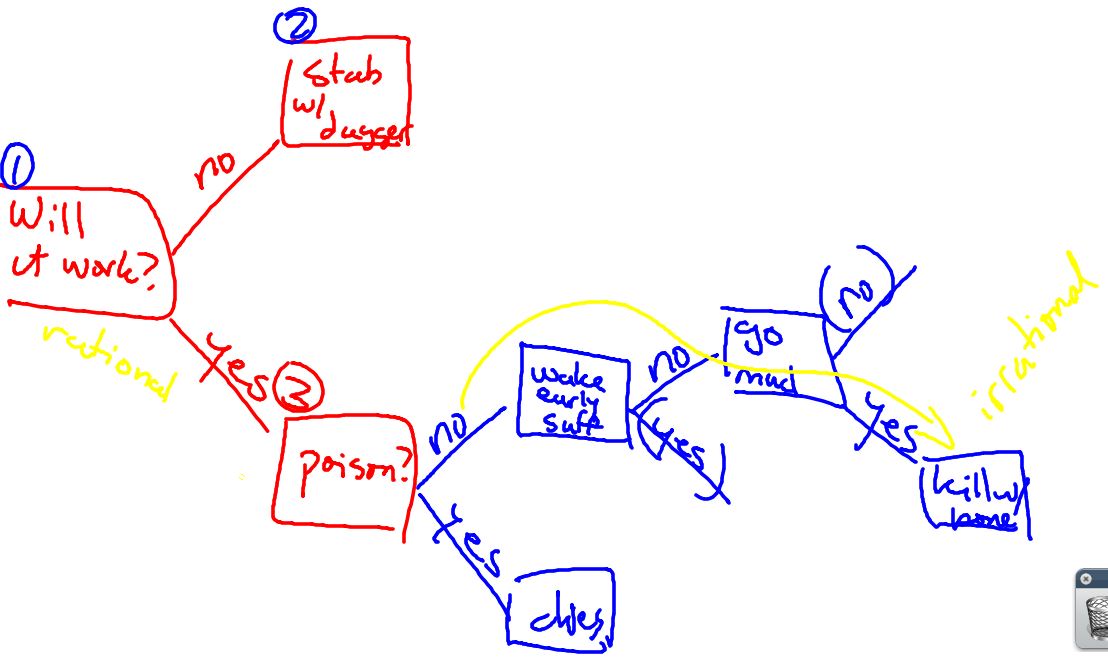
She smiled again, and we went back inside and had a great class, making a decision tree of Juliet’s concerns about taking Friar Lawrence’s potion.
Farewell! God knows when we shall meet again.
I have a faint cold fear thrills through my veins,
That almost freezes up the heat of life:
I’ll call them back again to comfort me:
Nurse! What should she do here?
My dismal scene I needs must act alone.
Come, vial.
What if this mixture do not work at all?
Shall I be married then to-morrow morning?
No, no: this shall forbid it: lie thou there.Laying down her dagger
What if it be a poison, which the friar
Subtly hath minister’d to have me dead,
Lest in this marriage he should be dishonour’d,
Because he married me before to Romeo?
I fear it is: and yet, methinks, it should not,
For he hath still been tried a holy man.
How if, when I am laid into the tomb,
I wake before the time that Romeo
Come to redeem me? there’s a fearful point!
Shall I not, then, be stifled in the vault,
To whose foul mouth no healthsome air breathes in,
And there die strangled ere my Romeo comes?
Or, if I live, is it not very like,
The horrible conceit of death and night,
Together with the terror of the place,–
As in a vault, an ancient receptacle,
Where, for these many hundred years, the bones
Of all my buried ancestors are packed:
Where bloody Tybalt, yet but green in earth,
Lies festering in his shroud; where, as they say,
At some hours in the night spirits resort;–
Alack, alack, is it not like that I,
So early waking, what with loathsome smells,
And shrieks like mandrakes’ torn out of the earth,
That living mortals, hearing them, run mad:–
O, if I wake, shall I not be distraught,
Environed with all these hideous fears?
And madly play with my forefather’s joints?
And pluck the mangled Tybalt from his shroud?
And, in this rage, with some great kinsman’s bone,
As with a club, dash out my desperate brains?
O, look! methinks I see my cousin’s ghost
Seeking out Romeo, that did spit his body
Upon a rapier’s point: stay, Tybalt, stay!
Romeo, I come! this do I drink to thee.
I’ve always loved this lesson: the decision tree helps them literally see how increasingly irrational Juliet is becoming:
Lisa was classic Lisa: she took control of her group; she offered her ideas enthusiastically but humbly; she listened to others and helped everyone synthesize their thoughts. Back to normal. Classic Lisa. The Lisa everyone was thinking of, scratching their heads, wondering, “Lisa, in trouble?”
And the boys? Well, I didn’t talk to them. After all, what could I say that Mrs. D hadn’t already said?
At some point recently, K was reading to the Boy about Moses and the plagues, and as children are wont to do, he zeroed in the most shocking one: the death of the firstborn male. He was trying to figure out who in the family would be the firstborn male.
“Would it be Papa?” he asked.
How does one respond? How does one say the obvious: “No, it would be you”?
“But why would God do that? It’s against the commandments.”
This is the crux of the issue of me of late: how are we to incorporate all those horrible things the god of the Old Testament does with the notion that the Bible supposedly comes from the mind of an omnipotent, omniscient, all-beneficent being? (The story of the death of the firstborn is problematic both for God’s beneficence and his omniscience: the Hebrews are to mark their doorway with the blood of a sacrificed lamb in order to indicate that the angel doing the killing is to pass over that house — why wouldn’t the angel know without that?)
Believers start with the premise that the Bible is from an omnipotent, omniscient, all-beneficent being, and then they work backward to try to explain these horrible passages. A skeptic like me starts with the premise that the Bible is supposedly from an omnipotent, omniscient, all-beneficent being and looks for evidence of that within the pages. The clear evil that the god of the Old Testament does, then, is clear and damning evidence against the supposition that the Bible reflects the mind of an omnipotent, omniscient, all-beneficent being. That god is petty and selfish, jealous and immature, narcissistic and self-absorbed, and above all, that being as portrayed in the Old Testament is evil, toying with some by demanding human sacrifice and then rescinding the order at the last minute (thinking of Issac here) and accepting human sacrifice in other situations (I’m thinking of Jephthah here). He is murderous and rampaging on both an enormous scale, commanding the Israelites to wipe out whole nations, men, women, and children, and a small scale, sending bears to maul children:
He went up from there to Bethel, and while he was going up on the way, some small boys came out of the city and jeered at him, saying, “Go up, you baldhead! Go up, you baldhead!” And he turned around, and when he saw them, he cursed them in the name of the LORD. And two she-bears came out of the woods and tore forty-two of the boys. From there he went on to Mount Carmel, and from there he returned to Samaria. (2 Kings 2.23-25)
Believers have to become apologists for God, coming up with reasons why these horrible actions are perfectly reasonable and in fact good. (Here’s an attempt to explain the bear mauling.) They resort to explaining what it means in that time and culture, failing to realize that they’ve just placed a limitation upon this supposedly-divinely inspired book that counts against their argument. They discuss the nuances of the original Hebrew, failing to realize that they’ve just placed a limitation upon this supposedly-divinely inspired book that counts against their argument. They produce wildly different interpretations and explanations, failing to realize that they’ve just placed a limitation upon this supposedly-divinely inspired book that counts against their argument.
For the skeptic, things are so much simpler. Occam’s razor simple. We mark these passages in the “Against” column and move on. In the end, we look at how many marks are in the “For” column and how many are in the “Against” and make a summary judgment from that. And there are vastly more things in the “Against” column.
The Girl has, for all intents and purposes, outgrown play dates. Her friends come over occasionally, and they sit on the bed and talk. Or play games on the Chromebook together. But they’re not play dates. But we call them that anyway.
L’s best friend N came over yesterday and one of the highlights for them was walking together down to the CVS near us to buy snacks. K told me that after L told her friends about doing that, all her friends want to come for a visit to walk down to the CVS.
What a change from the summer L experienced in Poland a couple of years ago. She met with her newly-made village friends for pizza, went shopping with them, met them for ice cream, walked to their houses for visits. So much independence for a then-twelve-year-old. So relatively incomprehensible for American children.
Yesterday and today, we covered one of my most favorite mini-lessons in the Shakespeare unit. It tags onto the end of one day’s work and requires a couple of minutes the next day to answer the question, “Just how much time has passed in this play?” For several scenes in the play, it’s a little unclear to a reader who is not looking for clues, but they’re there, scattered throughout, but it doesn’t become obvious until 3.4, when Paris comes to talk to Capulet again about Juliet’s hand, we know it’s late, for Capulet explains, “‘Tis very late, she’ll not come down to-night: / I promise you, but for your company, / I would have been a-bed an hour ago.” But late on what day? We get the answer shortly when Capulet, deciding when the wedding will be, asks what the day is: “Monday, my lord,” responds Paris.
Juliet won’t come down because she’s weeping for Tybalt, or so the Capulets think. In the scene before, she learns of Tybalt’s death, and while she’s initially upset with Romeo, she reconsiders: ” Shall I speak ill of him that is my husband? / Ah, poor my lord, what tongue shall smooth thy name, / When I, thy three-hours wife, have mangled it?” She explains that she’s only been his wife for three hours, so the wedding had to have taken place sometime after 12 but before the evening. We know that Romeo doesn’t fight Tybalt because he’s now related to him:
I do protest, I never injured thee,
But love thee better than thou canst devise,
Till thou shalt know the reason of my love:
And so, good Capulet,–which name I tender
As dearly as my own,–be satisfied.
This means that the fight between Romeo and Tybalt happens after twelve but before the evening, because Juliet says she’s only been Romeo’s wife for three hours. But how do we get the twelve I keep referring to? Simple: in 2.4, when Juliet is waiting for the nurse’s return, she complains that “from nine till twelve / Is three long hours, yet she is not come.” We know from the balcony scene in 2.2 that Romeo is supposed to meet with someone to arrange the wedding at nine the next morning.
But how do we know for certain that the balcony scene was the night before? Simple: when Friar Laurence makes his entrance in 2.3, it’s clearly dawn:
The grey-eyed morn smiles on the frowning night,
Chequering the eastern clouds with streaks of light,
And flecked darkness like a drunkard reels
From forth day’s path and Titan’s fiery wheels:
Now, ere the sun advance his burning eye,
The day to cheer and night’s dank dew to dry,
I must up-fill this osier cage of ours
With baleful weeds and precious-juiced flowers.
Shortly after that, he encounters Romeo at his door and pondering how it is that Romeo is up so early, he suggests “then here I hit it right, / Our Romeo hath not been in bed to-night.” Romeo confirms that he’s been with Juliet the night before and hasn’t gone to bed: “That last is true; the sweeter rest was mine.” This puts the balcony scene and the party on Sunday evening/night.
When Lady Capulet comes to speak initially to Juliet about Paris, she asks, “What say you? can you love the gentleman? This night you shall behold him at our feast.” This would put the scene in which it happens, 1.3, sometime in the late morning or early afternoon on Sunday.
In the scene before, Paris asks Capulet for Juliet’s hand. Capulet refuses the offer, insisting that they wait two more years. He then tries a deflationary tactic:
This night I hold an old accustom’d feast,
Whereto I have invited many a guest,
Such as I love; and you, among the store,
One more, most welcome, makes my number more.
This happens concurrently with Lady Capulet’s discussion with Juliet or just before it. We know that Capulet’s conversation with Paris is almost immediately after the opening fight scene because he explains, “But Montague is bound as well as I, / In penalty alike; and ’tis not hard, I think, / For men so old as we to keep the peace.” So the fight that opens the play must have happened Sunday morning.
Benvolio, in explaining to the Montagues in 1.1 why Romeo was fortunately not involved in the fray explains to Lady Montague,
Madam, an hour before the worshipp’d sun
Peer’d forth the golden window of the east,
A troubled mind drave me to walk abroad;
Where, underneath the grove of sycamore
That westward rooteth from the city’s side,
So early walking did I see your son:
With all this in mind, we returned today to 3.5 and examined the opening lines: “Wilt thou be gone? it is not yet near day: / It was the nightingale, and not the lark, That pierced the fearful hollow of thine ear.” Clearly, it’s morning, but just to make it clear, Shakespeare has Juliet later say ask, “Who is’t that calls? is it my lady mother? / Is she not down so late, or up so early?” So it’s early Tuesday morning.
They met Sunday evening.
“How many of you thought it was a matter of weeks that had passed?” I asked, as I do every year. Most hands go up. “It puts the whole thing in a new perspective, doesn’t it?”
The Boy is often playing catchup with his school work. I’ve often brought it up here. We’re both tired of it — K, too. Recently, we made a deal with the Boy. Well, not so much a deal as a threat. A hostage situation. No electronics of any kind until he is all caught up. No TV in the morning with breakfast. No YouTube on the weekends. No Minecraft. Nothing. And so he has really buckled down and began doing the work.
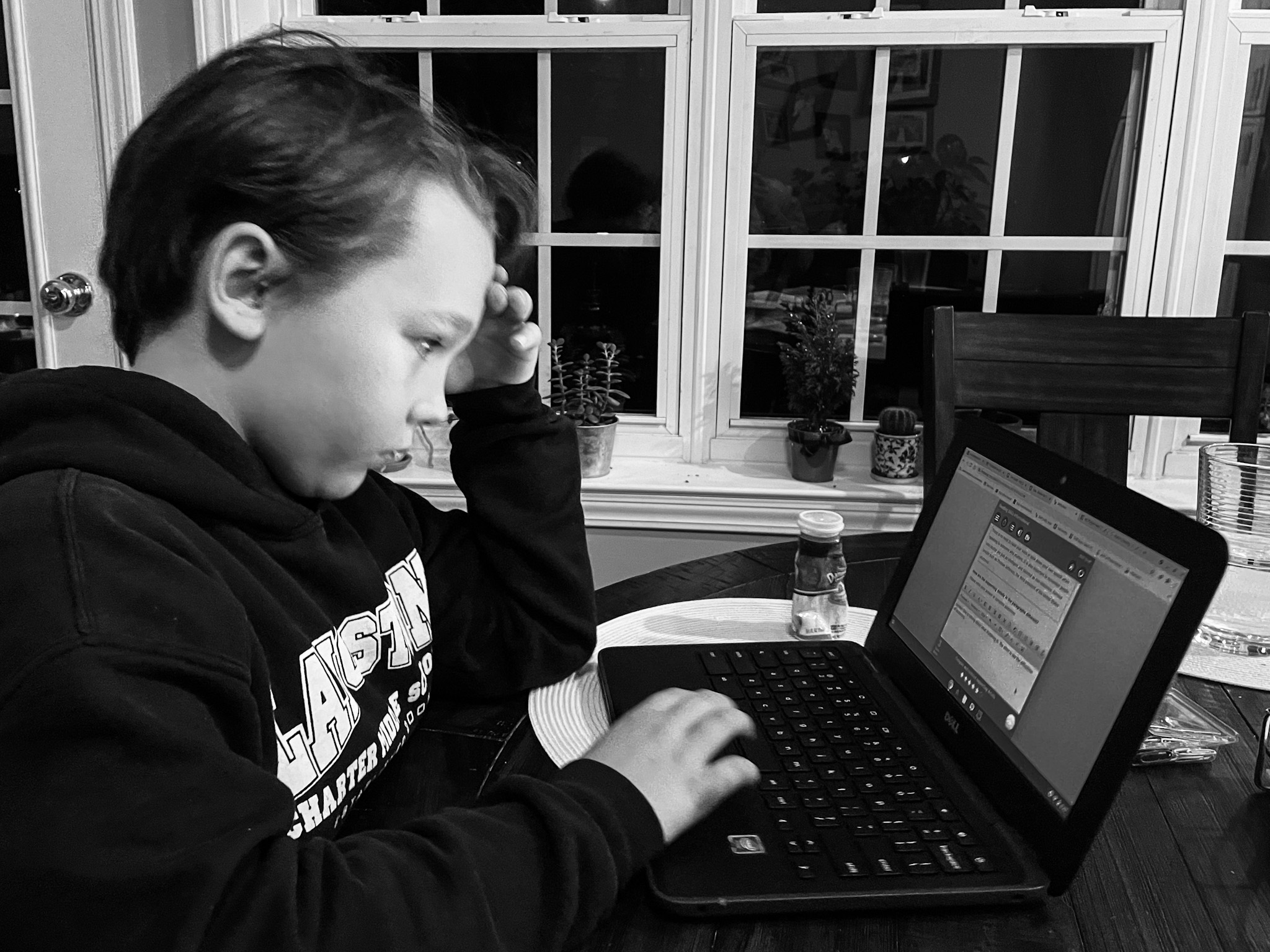
Most of it — on his Chromebook…
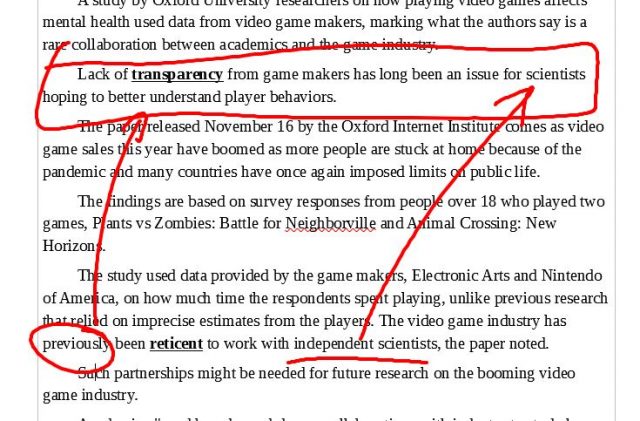
We began today by going over the latest article of the week, looking at a complete of connections that I wanted students to make within the text.
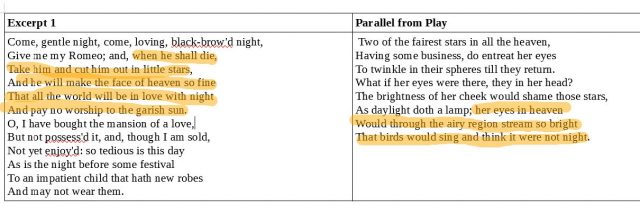
Afterward, we returned to the work of tracking down some of the ways that Shakespeare has characters start echoing each other. For example, we covered this unique echo:
| Excerpt 1 | Parallel from Play |
| Come, gentle night, come, loving, black-brow’d night, Give me my Romeo; and, when he shall die, Take him and cut him out in little stars, And he will make the face of heaven so fine That all the world will be in love with night And pay no worship to the garish sun. O, I have bought the mansion of a love, But not possess’d it, and, though I am sold, Not yet enjoy’d: so tedious is this day As is the night before some festival To an impatient child that hath new robes And may not wear them. |
Two of the fairest stars in all the heaven, Having some business, do entreat her eyes To twinkle in their spheres till they return. What if her eyes were there, they in her head? The brightness of her cheek would shame those stars, As daylight doth a lamp; her eyes in heaven Would through the airy region stream so bright That birds would sing and think it were not night. |
They’re both comparing the other in terms of brightness so intense that it would overpower the night and turn it into daytime. There are a few differences, though:
I’m tempted to give a little spoiler tomorrow as we finish act 3 and Romeo climbs out of the house in a sort of bookend balcony scene: “This is the last time they will see each other alive.” Tempting…


As we move toward the end of the play, I want students to start picking up on how characters echo each other. I want them to see that Juliet in act three echoes Romeo’s words in the balcony scene in act two:
Come, gentle night, come, loving, black-brow’d night,
Give me my Romeo; and, when he shall die,
Take him and cut him out in little stars,
And he will make the face of heaven so fine
That all the world will be in love with night
And pay no worship to the garish sun.
O, I have bought the mansion of a love,
But not possess’d it, and, though I am sold,
Not yet enjoy’d: so tedious is this day
As is the night before some festival
To an impatient child that hath new robes
And may not wear them.
I want them to see that Juliet expresses her anger in act three the same way Romeo does in the first scene of the play, with a litany of oxymorons:
O serpent heart, hid with a flowering face!
Did ever dragon keep so fair a cave?
Beautiful tyrant! fiend angelical!
Dove-feather’d raven! wolvish-ravening lamb!
Despised substance of divinest show!
Just opposite to what thou justly seem’st,
A damned saint, an honourable villain!
O nature, what hadst thou to do in hell,
When thou didst bower the spirit of a fiend
In moral paradise of such sweet flesh?
Was ever book containing such vile matter
So fairly bound? O that deceit should dwell
In such a gorgeous palace!
I want them to see that Juliet echoes Friar Lawrence when they learn that Romeo has killed Tybalt. She says about the situation:
Shall I speak ill of him that is my husband?
Ah, poor my lord, what tongue shall smooth thy name,
When I, thy three-hours wife, have mangled it?
But, wherefore, villain, didst thou kill my cousin?
That villain cousin would have kill’d my husband:
Back, foolish tears, back to your native spring;
Your tributary drops belong to woe,
Which you, mistaking, offer up to joy.
My husband lives, that Tybalt would have slain;
And Tybalt’s dead, that would have slain my husband:
All this is comfort; wherefore weep I then?
He says:
What, rouse thee, man! thy Juliet is alive,
For whose dear sake thou wast but lately dead;
There art thou happy: Tybalt would kill thee,
But thou slew’st Tybalt; there are thou happy too:
The law that threaten’d death becomes thy friend
And turns it to exile; there art thou happy:
A pack of blessings lights up upon thy back;
Happiness courts thee in her best array;
But, like a misbehaved and sullen wench,
Thou pout’st upon thy fortune and thy love:
Take heed, take heed, for such die miserable.
Echoes.
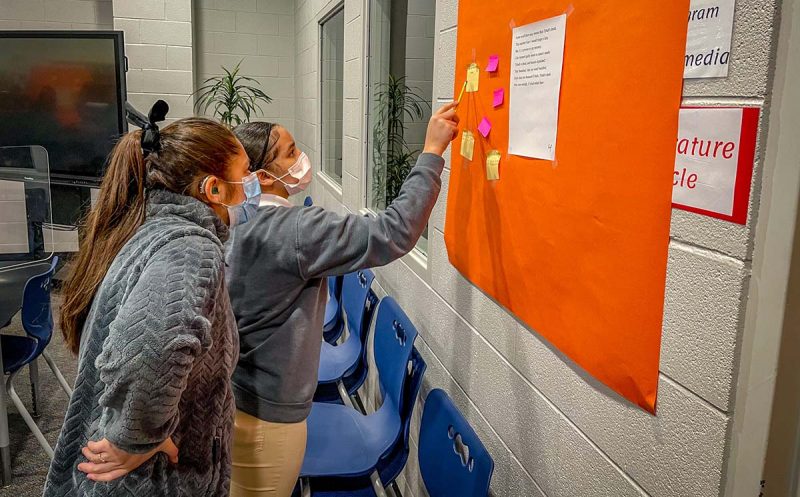
To do this, I’ve developed what’s called a gallery walk: each passage is printed out and put on a large piece of butcher paper. Kids circulate in groups with Post-It notes, making comments about vocabulary, motifs, inversions, elliptical constructions, and, most importantly, other portions of the play about which given passages remind them.

As they circulate, the passages become covered with comments, and students learn from each others’ observations. With each rotation, it becomes increasingly difficult to say something original. They have to dig a little deeper, think a little more critically.
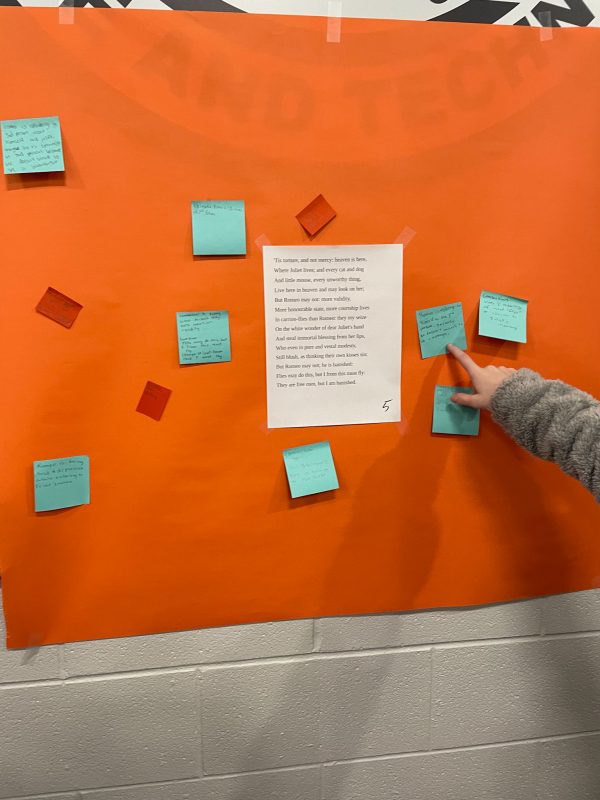
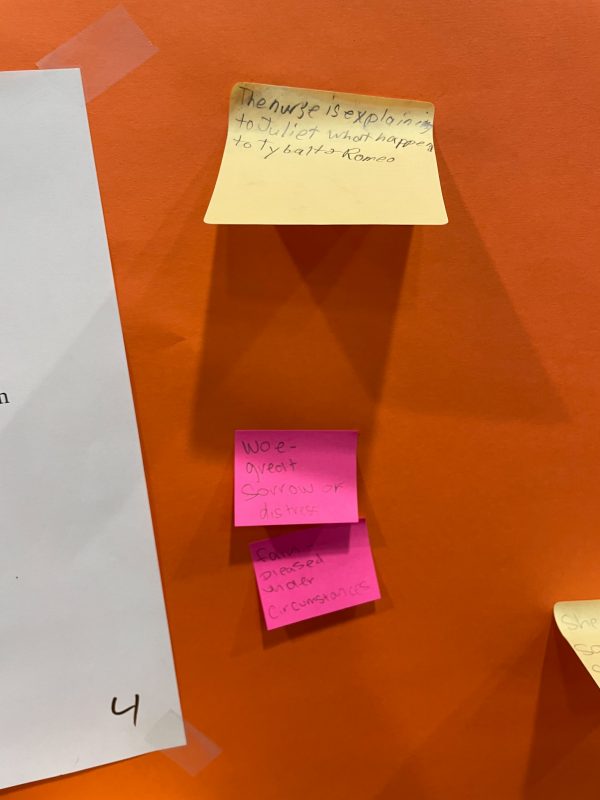
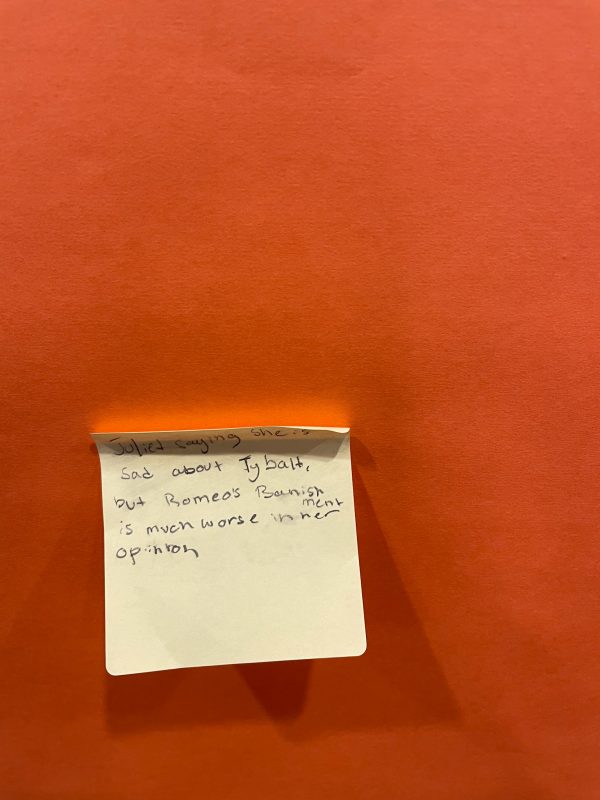
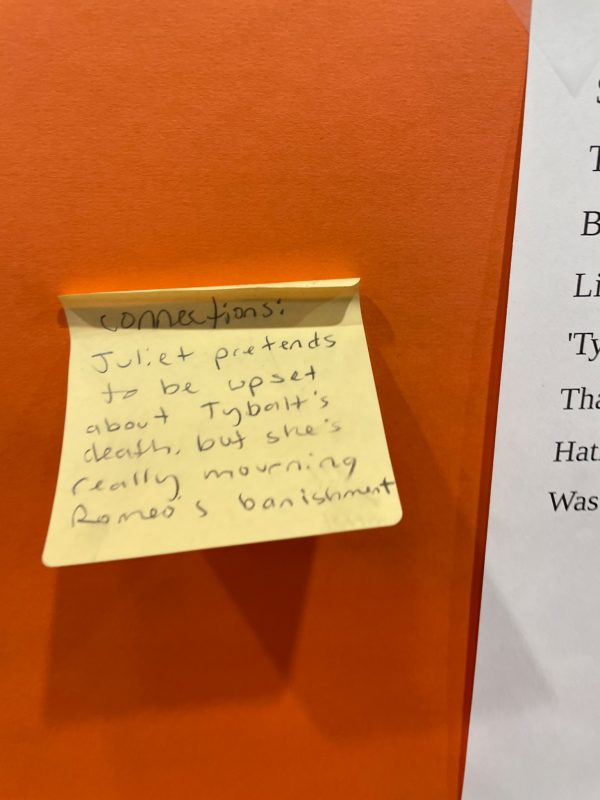
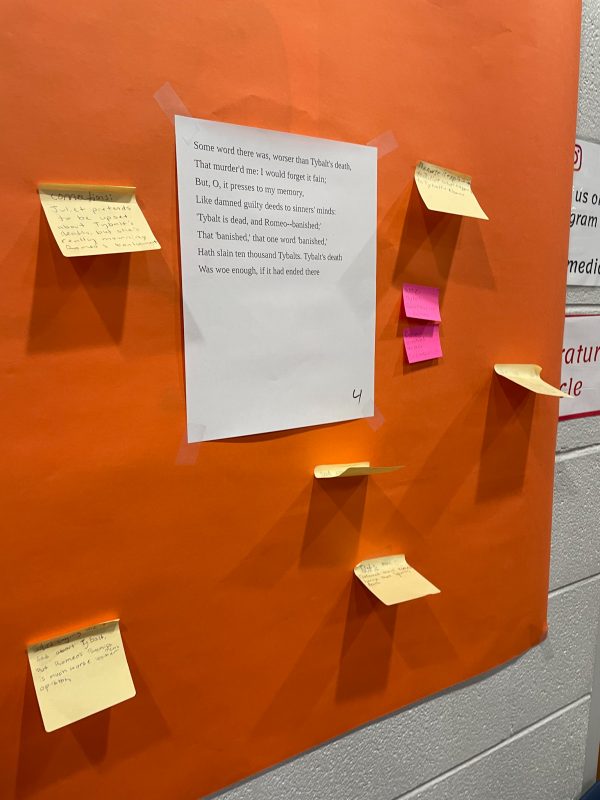
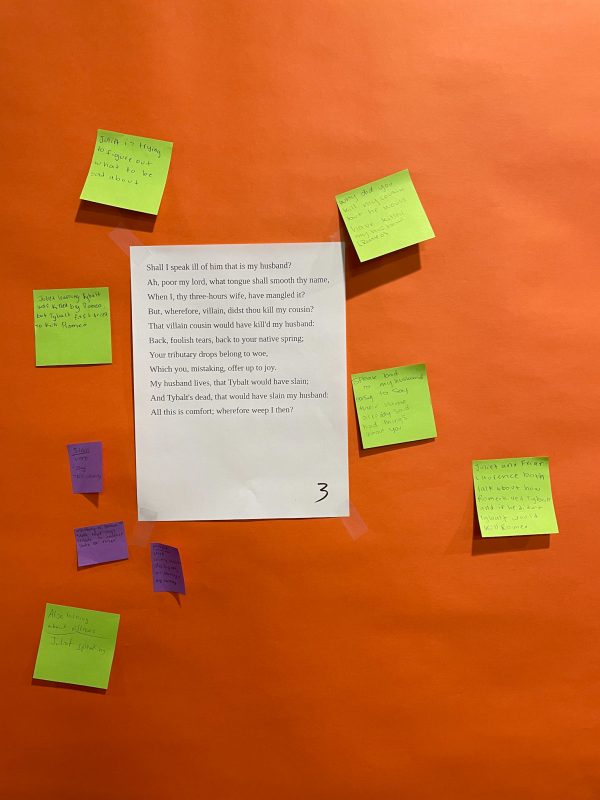
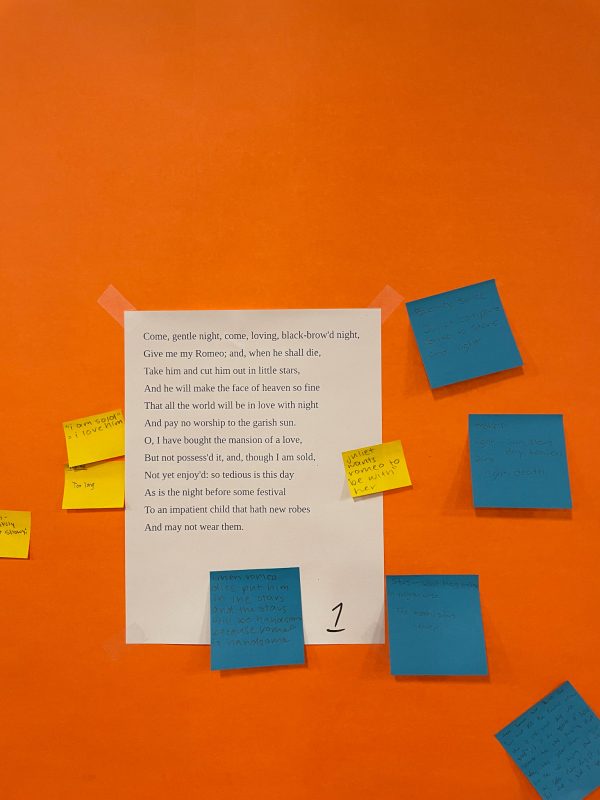
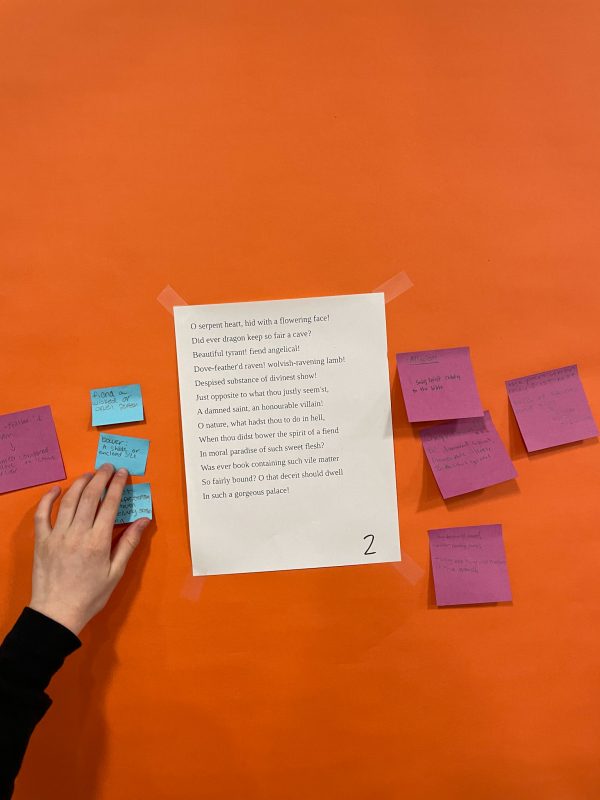
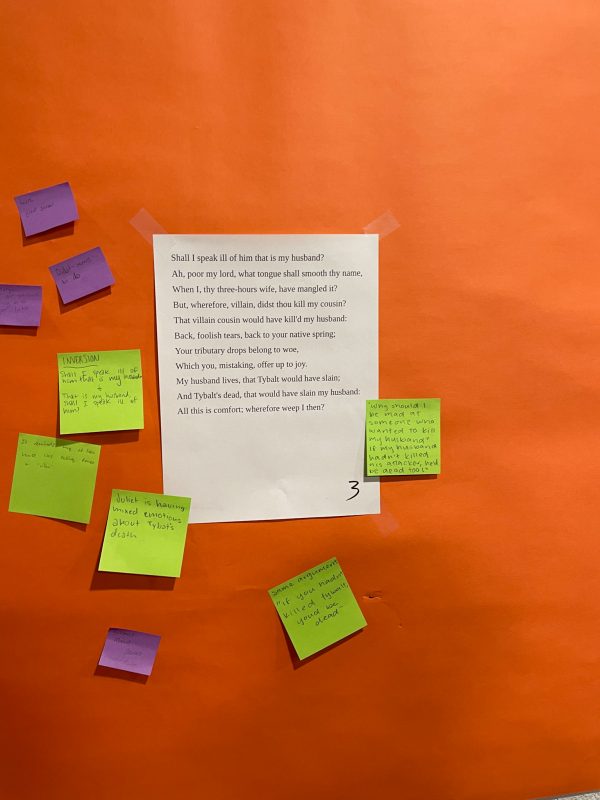
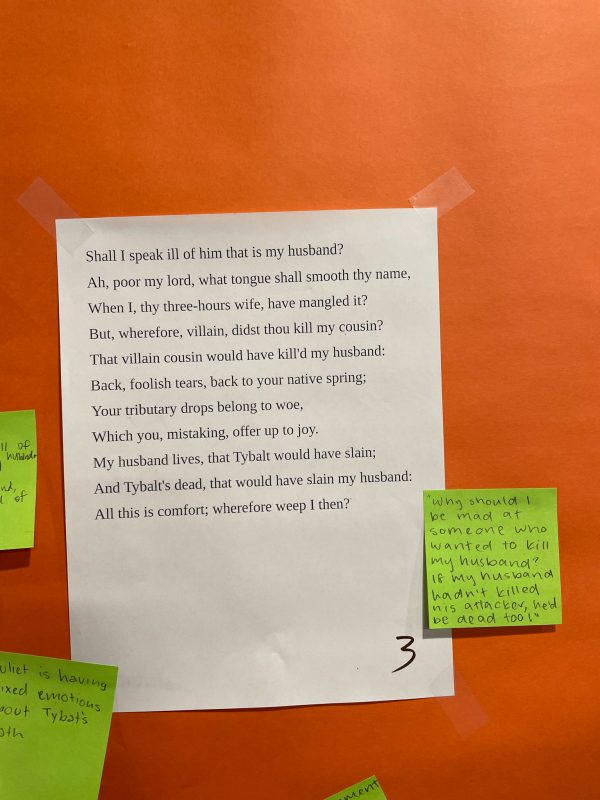
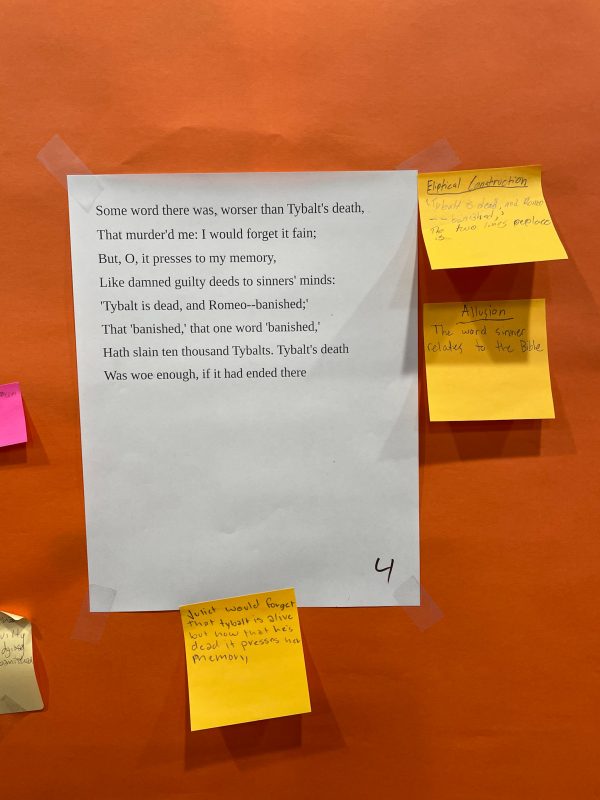
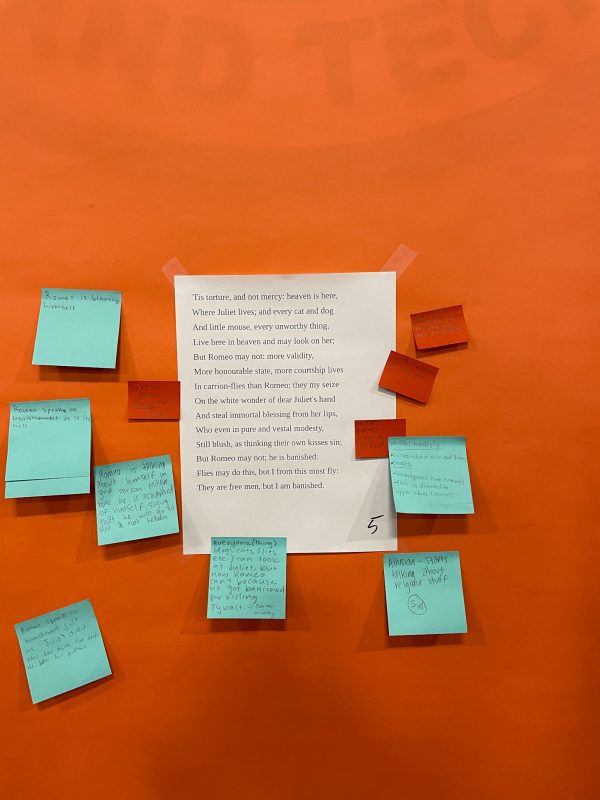
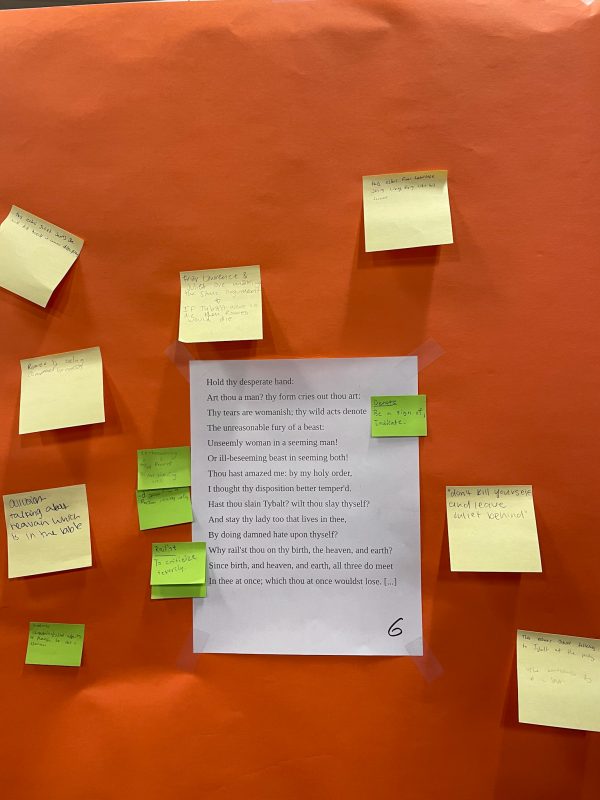
And sometimes, a bit of humor appears. While one group was reading this passage
O, I have bought the mansion of a love,
But not possess’d it, and, though I am sold,
Not yet enjoy’d: so tedious is this day
As is the night before some festival
To an impatient child that hath new robes
And may not wear them.
I overheard an outspoken girl — one of my favorite students this year, though I’m not supposed to have those, right? — summarize it succinctly to her group: “Juliet just wants to get laid.”
At their age and ability level, the Girl and her teammates can go from one extreme to another. For example, they can lose the first set 25-16 and then turn around and win the next set 25-16.
They can make a brilliant play and follow it up by letting the ball flop slowly and gently in between three players as they all look at it, each on expecting someone else to get it, each one making a move for it and then backing off, each one remaining perfectly silent.
The Girl can hit serves that float over the net gently and then power rockets over the net. Then she can miss her timing and the serve doesn’t even make it to the net.
Today, they got third place in the silver division. That means, roughly, they finished seventh place overall, I think.

Not horrible but not what they wanted. Still, they were all in a good mood at the end of the tournament, which is what counts.
We polished the nails/axels, cut and weighted the car so that the center of gravity is in the optimal location, rough-sanded, and talked about goals for the derby next week.
“I’d like to get at least third place,” the Boy said.
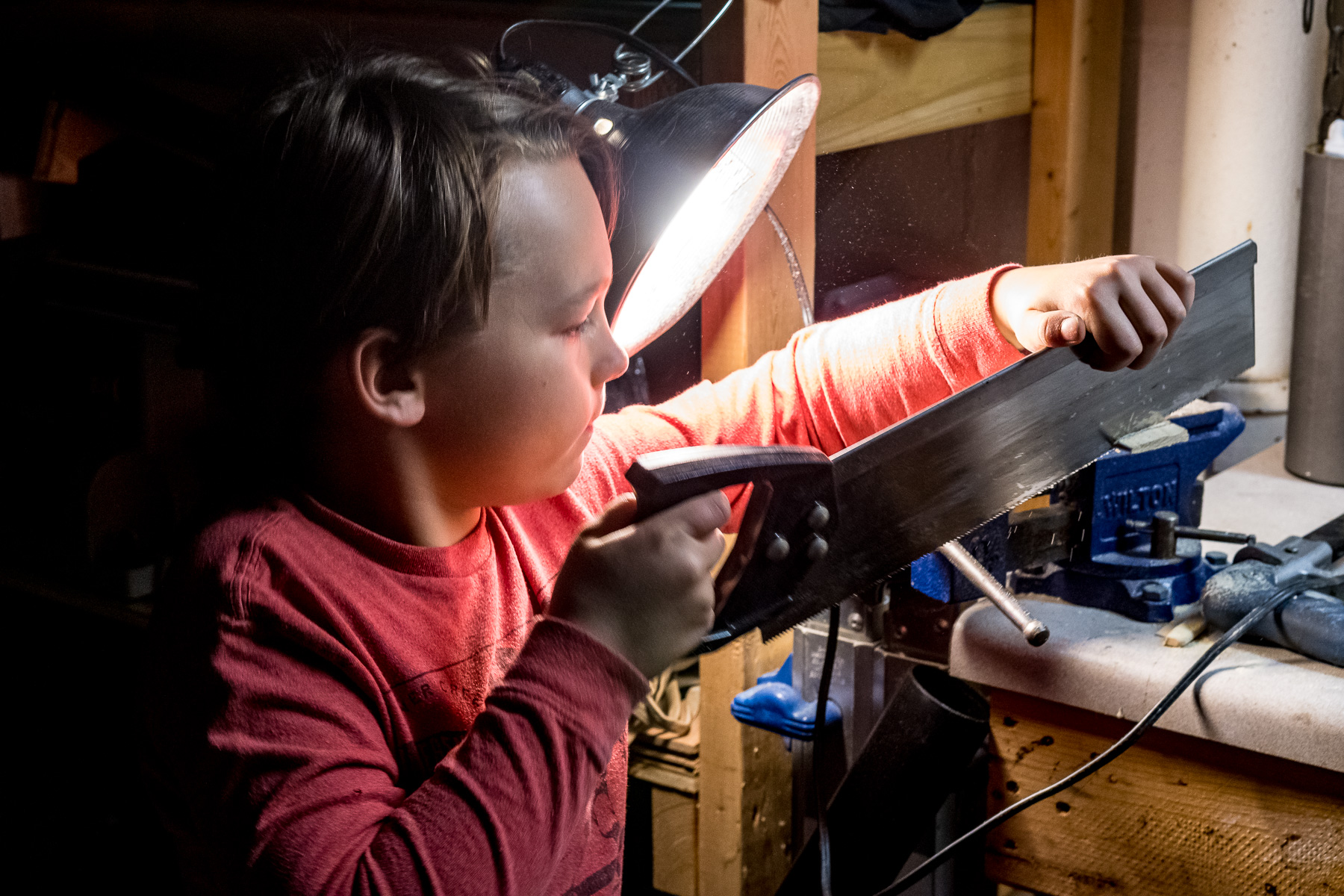
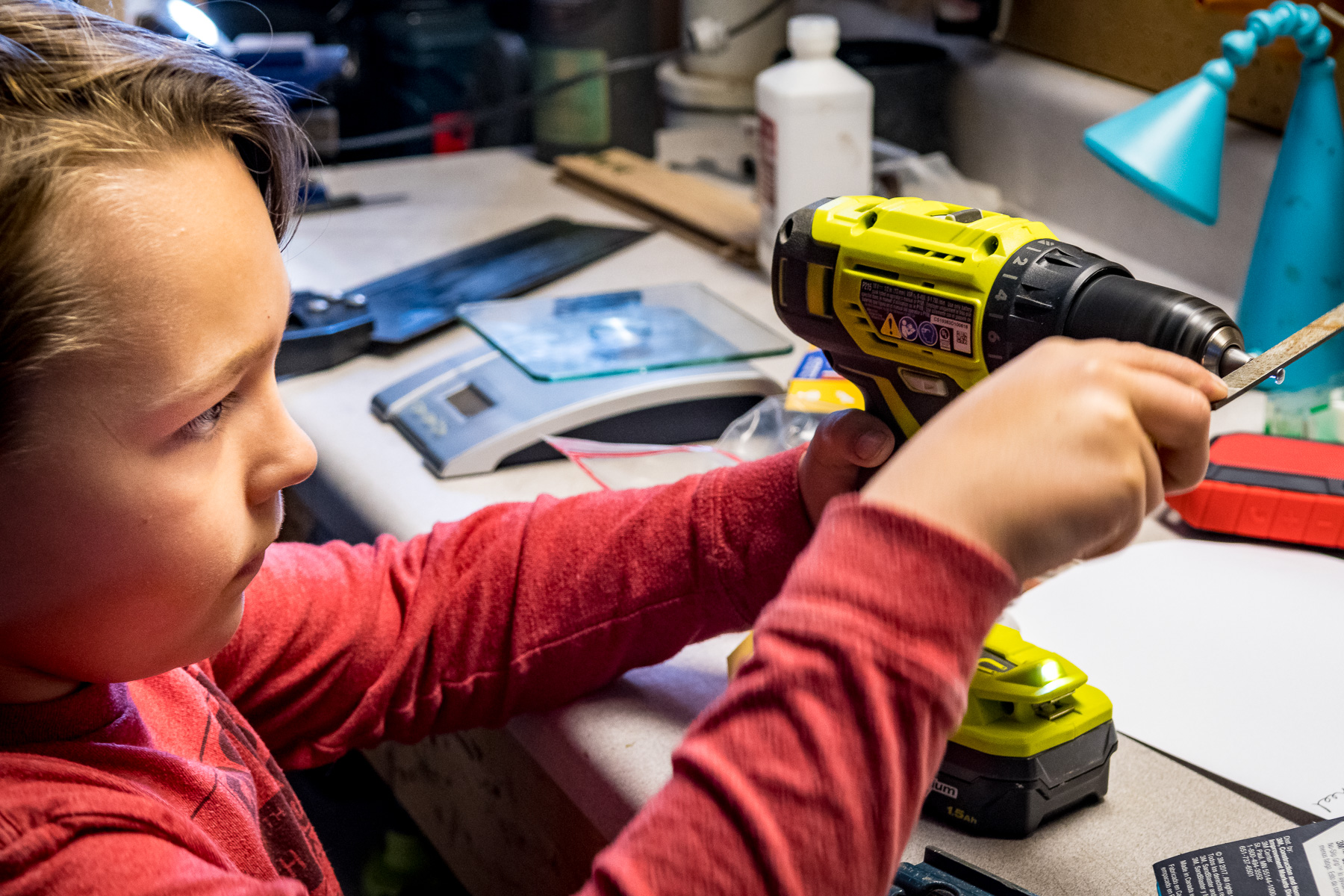
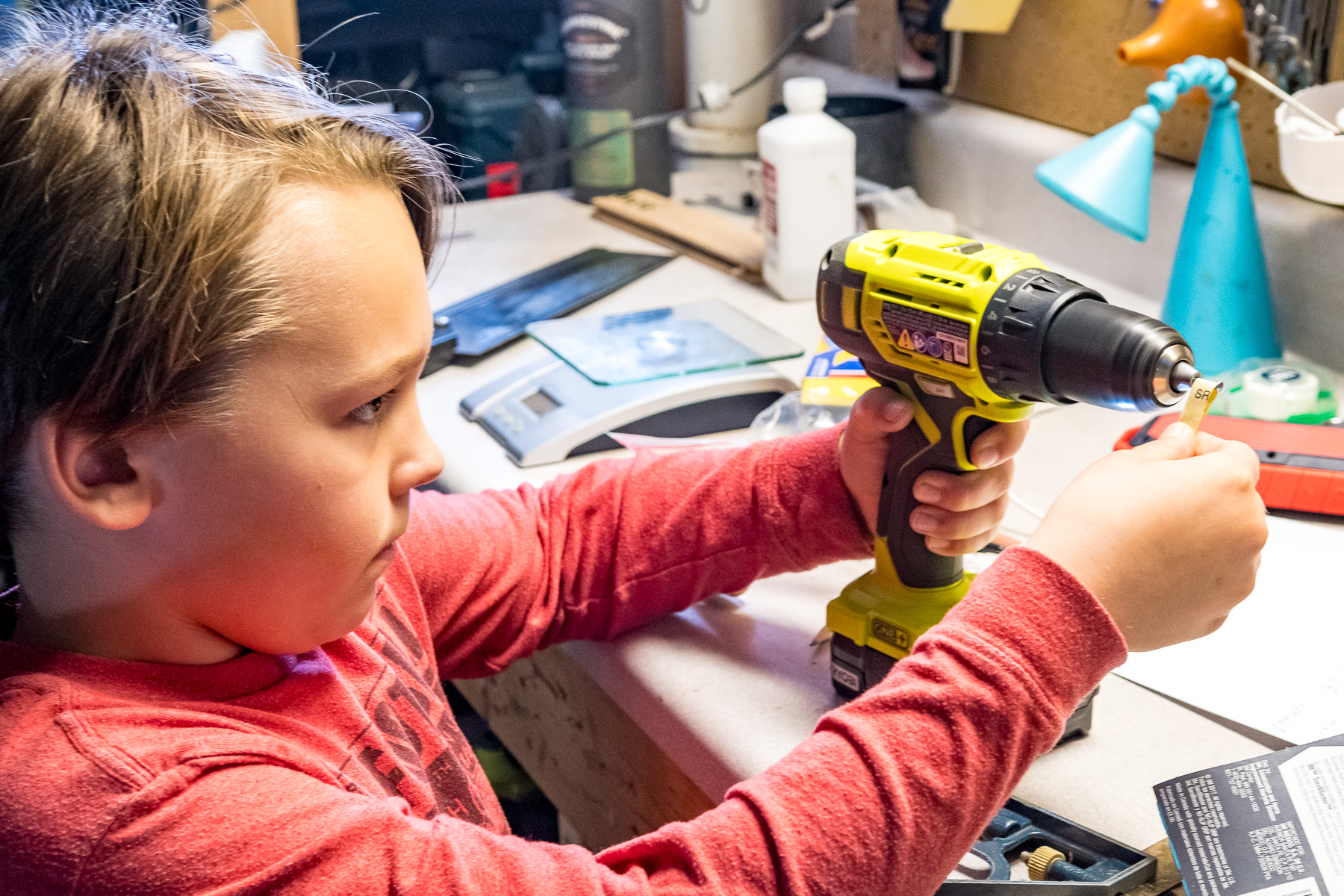
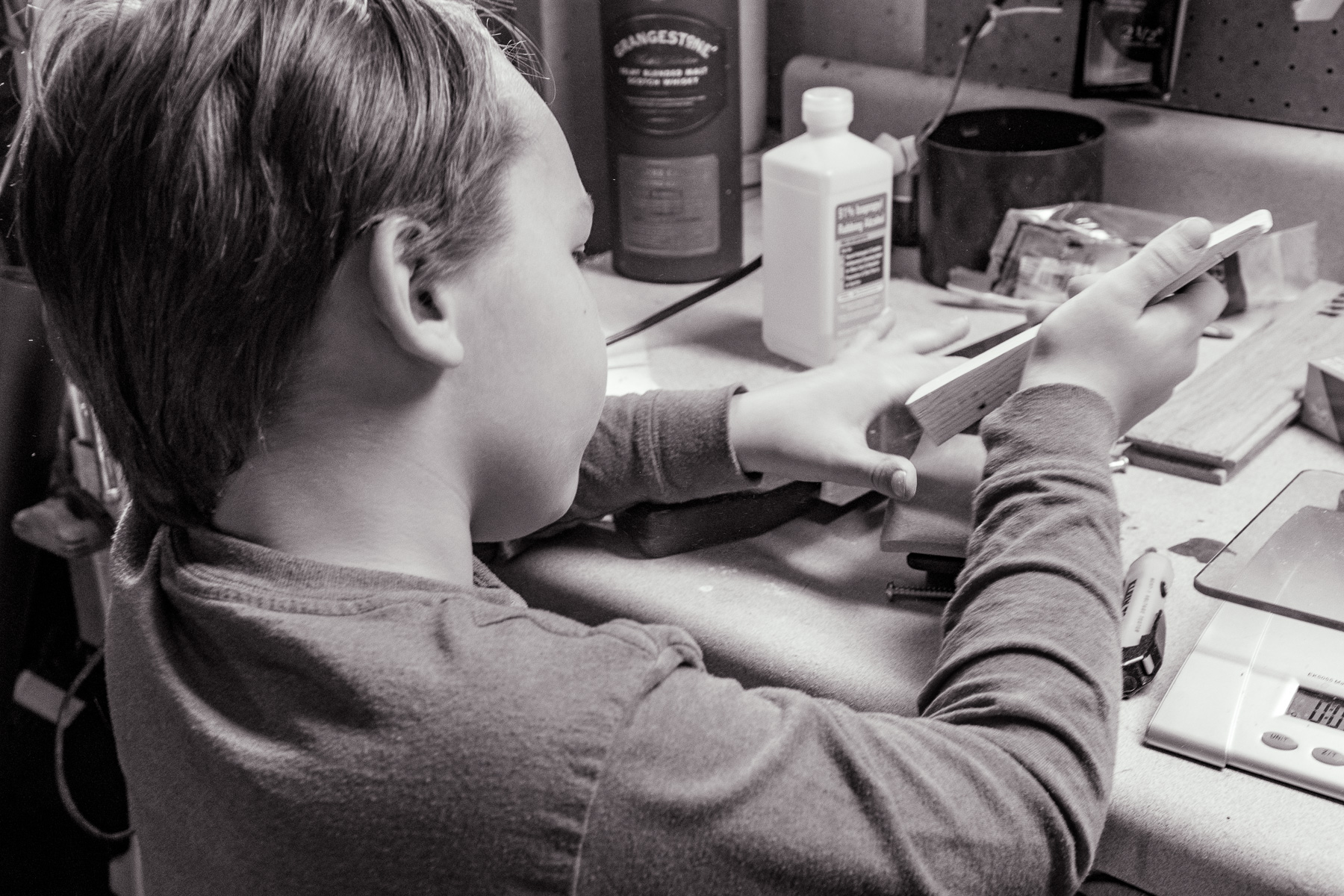
It’s a good goal: realistic, modest. We’ll see.
It’s funny how much meaning a few notes scribbled on the board can have for a group of fourteen-year-olds and yet be completely incomprehensible to others — to other students, to other teachers, to other adults in general.
Below are the notes from today’s class. The scribbles don’t look like much, but to the kids with whom I’ve been working now for several months, they represent the last little bit (though critical bit) of guidance for a major writing assignment. These few words and abbreviations include notes about organization, notes about planning, notes about content, guidance for self-correction, potential problems and their solutions
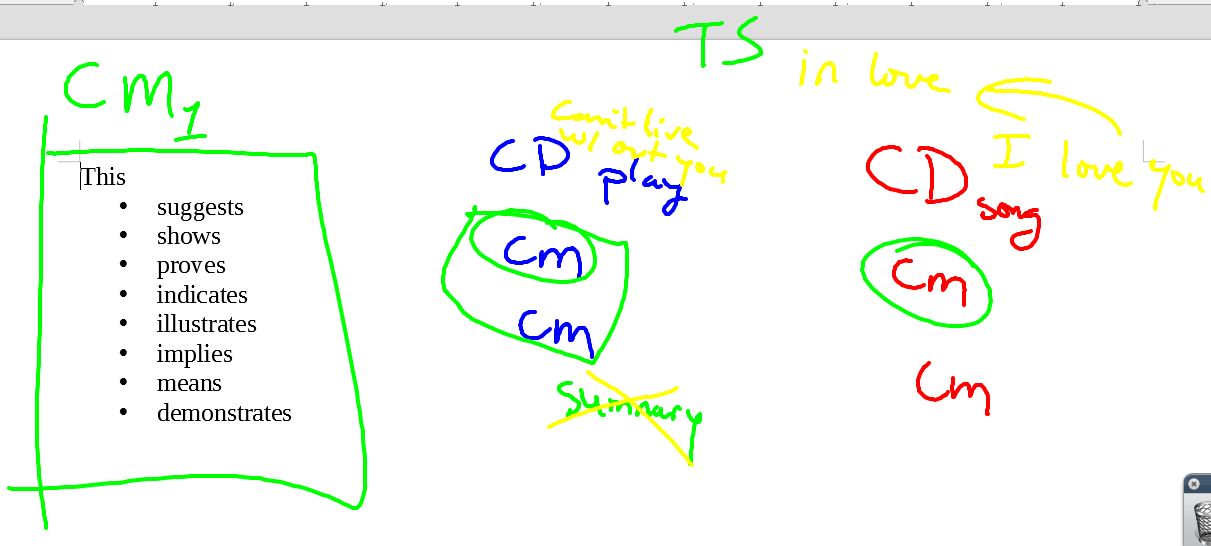
We’ve developed our own shorthand, or own codes, or own abbreviations, as I do with every class every year. And it all moves the students toward writing that they would have found impressive a few months ago and now is their new-normal, their new standard.
It’s an honor to be a part of that growth, to play a small part in it.
I’ve sometimes wondered what would be the reaction in the Christian community if somehow some irrefutable proof surfaced that Jesus would never be coming back, that the second coming was all a pipe dream. Now, I know that no such proof is possible, and the events of recent weeks demonstrate all too clearly that irrefutable evidence can be refuted simply by a movement in the will, a forcible rejection of what is clearly and demonstrably true. We see that in the election; we see that in denial of climate change and evolution; we see that everywhere. But let’s just run this thought experiment: there’s somehow evidence that Jesus’s second coming will never happen, that the Christians, who have been predicting for 2,000 years now that Jesus is coming back “any day now,” were completely wrong. What might that look like?
I think we’re seeing it in real time now as Qanon conspiracy theorists grapple with the reality that none of Q’s theories have come true and that, with Biden now sworn in, they won’t come true.
One account on Reuters:
On Wednesday, they grappled with a harsh reality check: Trump had left office with no mass arrests or other victories against the supposed cabal of Satan-worshipping pedophile cannibal elites, especially Democrats, he was ostensibly fighting.
Instead, Democratic President Joseph Biden was calmly sworn into office, leaving legions of QAnon faithful struggling to make sense of what had transpired.
In one Telegram channel with more than 18,400 members, QAnon believers were split between those still urging others to ‘trust the plan’ and those saying they felt betrayed. “It’s obvious now we’ve been had. No plan, no Q, nothing,” wrote one user.
Some messages referenced theories that a coup was going to take place before the end of Inauguration Day. Others moved the goalposts again, speculating that Trump would be sworn into office on Mar. 4.
“Does anybody have any idea what we should be waiting for next or what the next move could be?” asked another user, who said they wanted to have a ‘big win’ and arrests made. (Source)
Two movements here: one, a return to reality; the other, a doubling-down, squirming deeper into the hole.
The BBC includes this:
Many reacted with shock and despair as Joe Biden was sworn in as the 46th US president.
“I just want to throw up,” said one in a popular chat on the Telegram messaging app. “I’m so sick of all the disinformation and false hope.”
Others insisted “the plan” had not failed, finding new theories to latch on to.
For weeks, QAnon followers had been promoting 20 January as a day of reckoning, when prominent Democrats and other elite “Satanic paedophiles” would be arrested and executed on the orders of President Trump.
The 65 days that led to chaos at the Capitol
What is QAnon?But, as Mr Biden took his oath and no arrests were made, some in the QAnon community had an uncomfortable meeting with reality.
“It’s done and we were played,” wrote another. (Source)
Those who are doubling down are coming up with increasingly bizarre explanations of what’s going on:
Some of them just don’t even make any sense at all:
https://twitter.com/CopingMAGA/status/1352272333130657793?s=20
Some of them are waking up, though. One TikTok video, now viral, is supposedly from a Qanon woman who has come to her senses:
So, who else is feeling just a little silly? […] I went too far down the rabbit hole, now I’m back out again — and it nothing happens on the 20th, how many of you are going to feel stupid as hell? And who the f*** is Q? Who is it? Who is this person? Because none of it has come true, and I was just thinking — what if this person knows that none of this stuff is true and they’re just messing with people, like getting inside their heads.
The video is here:
So what does this tell us about Qanon and conspiracy theories? I feel like these reactions would mirror what would happen in our hypothetical proof of the non-return of Jesus. There would be some who would accept it — probably more liberal believers. For that matter, there are Christians liberal enough already to say that Jesus didn’t really rise from the dead, didn’t really ascend into heaven, won’t really return, but insist that that doesn’t really matter. “It’s all about the teachings!” they say, and then they paint this picture of Jesus who seems in some ways at odds with the Jesus in the Bible. (He certainly seemed to think he was coming back, so there’s that…)
Most believers would stick by their guns. Nothing — absolutely nothing — could convince them otherwise.
This leads to the thought that has plagued me for a few years now, a thought that ultimately pushed me back away from Christianity: If a belief is not falsifiable, if nothing counts against it, to what degree can we call it a rational idea?
This, in turn, leads to another thought I’ve had rattling around in my head for some time now: there are a lot of similarities between conspiracy theorists and religious believers. And in fact, I think an argument can be made that religion in general and Christianity, in particular, are, at heart, a gigantic, cosmic conspiracy theories.
One of the things I’m most looking forward to in the Biden administration is being able to go for days on end without giving a single thought to the president and what he’s doing. That’s how it’s always been, even with presidents I didn’t particularly like or agree with. I’ve always just assumed, “Well, he’s an adult. He’s a reasonable human being. How much do I possibly have to worry about something over which I have no control?”
Act 3 scene 1 — everything changes. The challenging becomes almost impossible. Romeo effectively erases any hope of any future with Juliet.
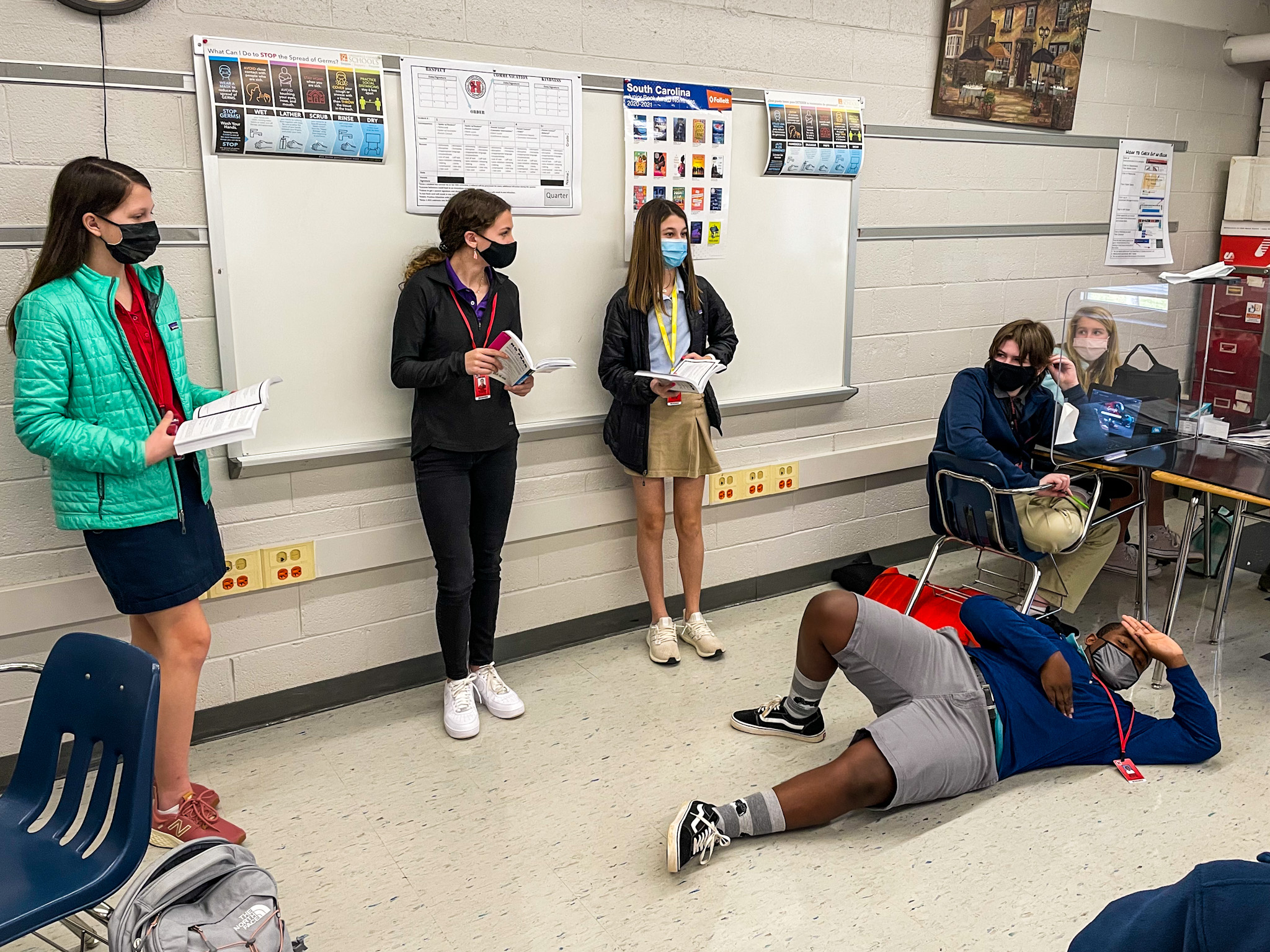
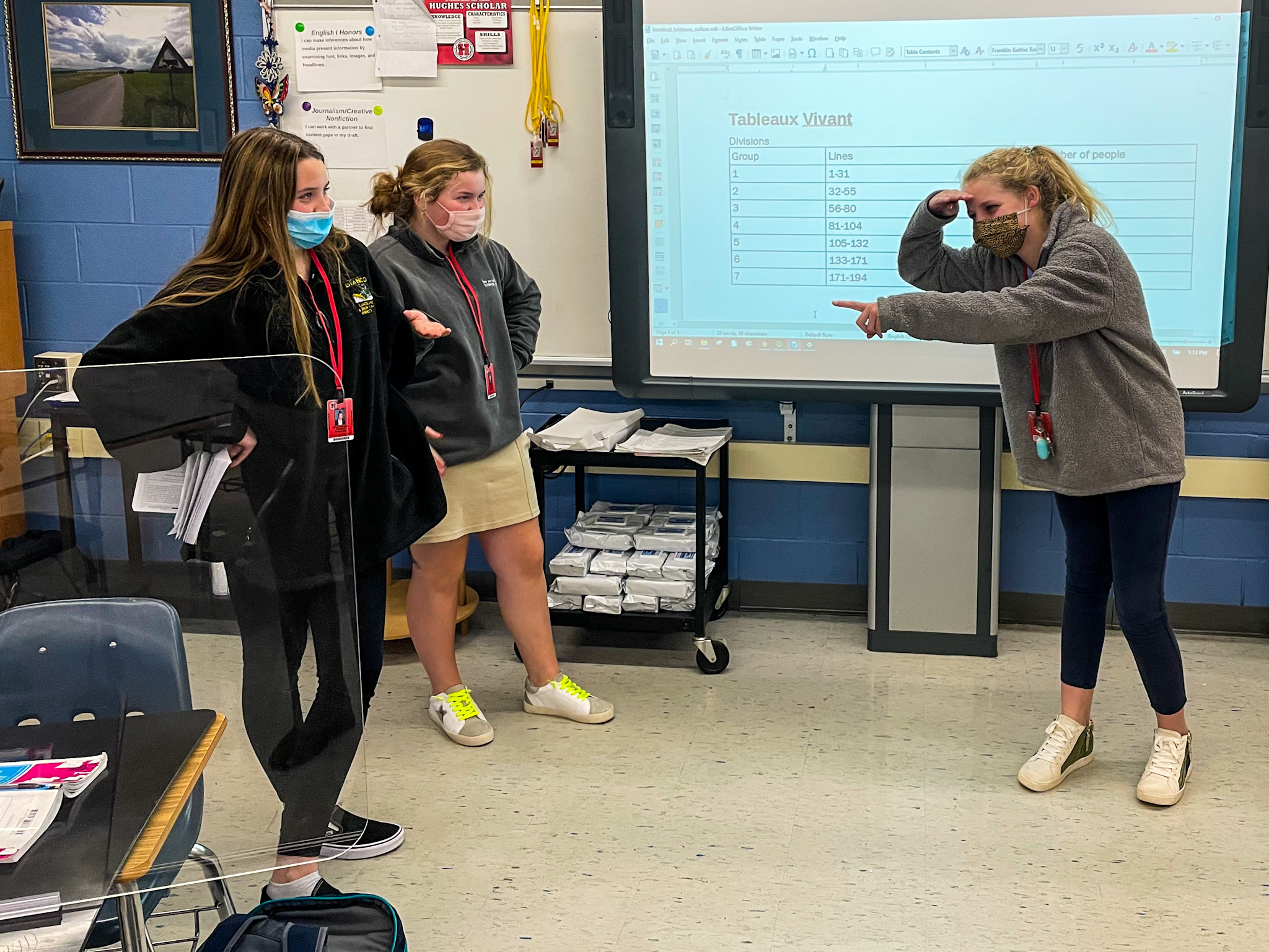
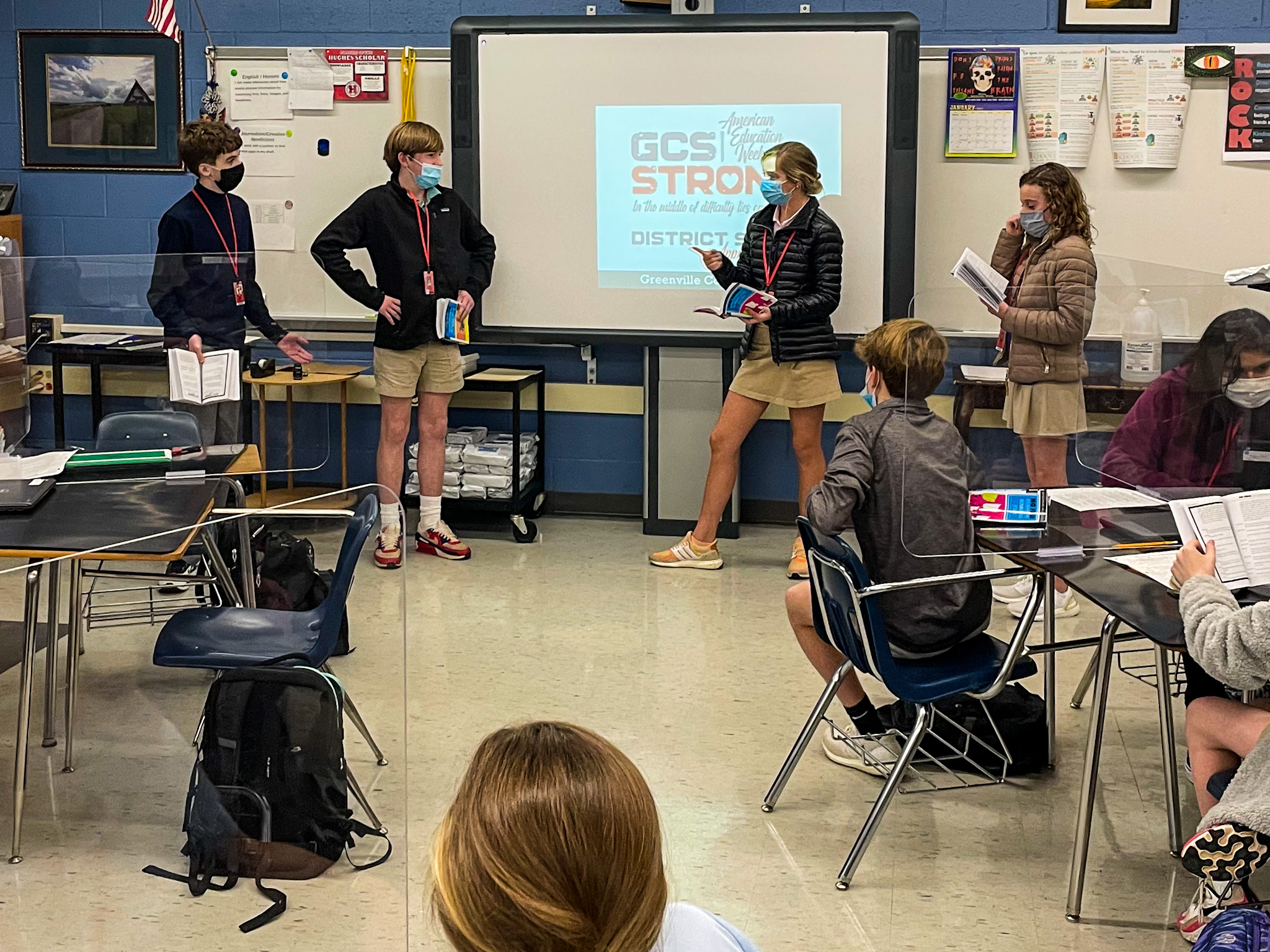
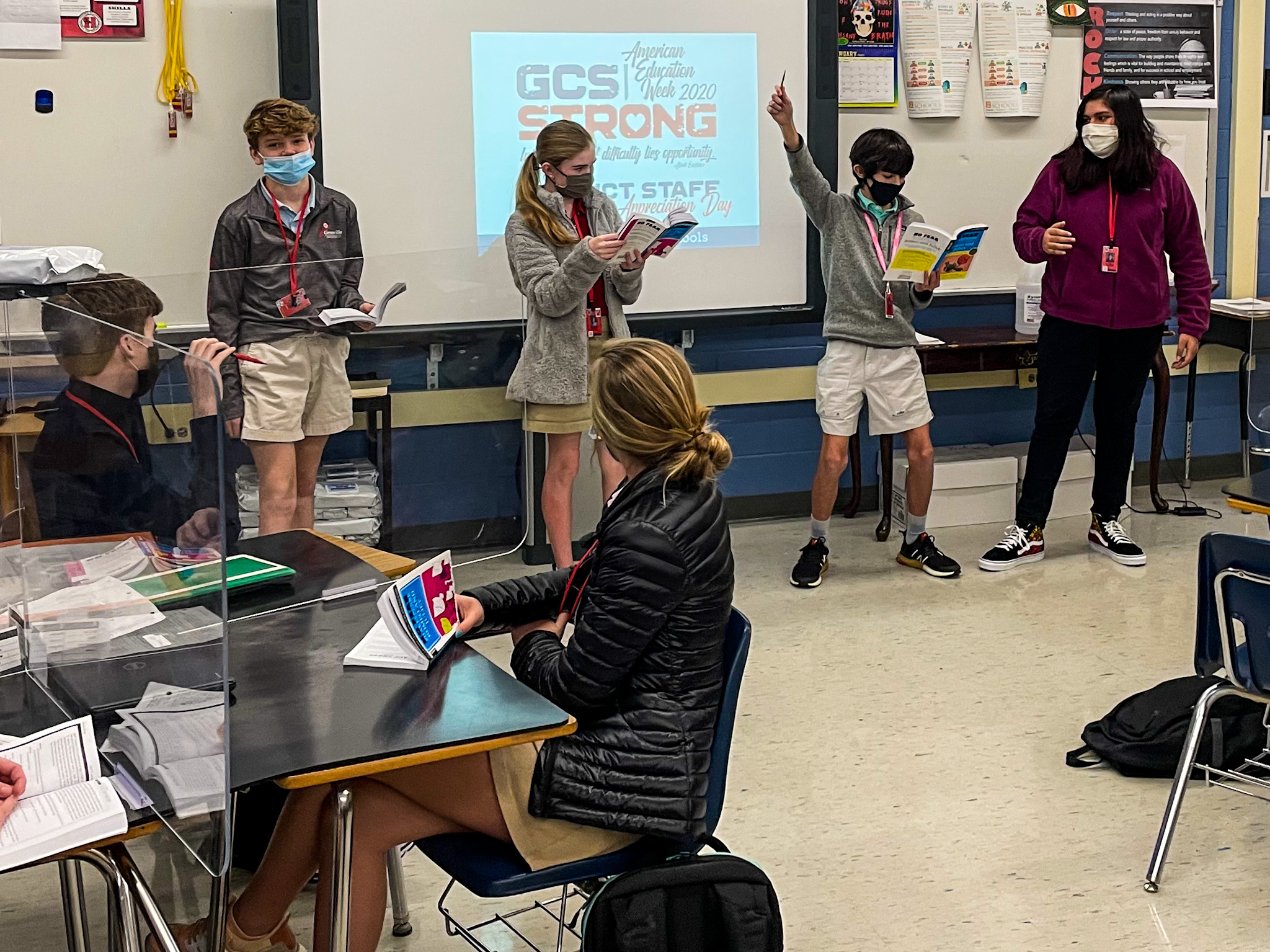
“Things are going to speed up from here on out,” I tell the kiddos.
Part of it was laziness, but we’ll chalk it up to Polishness: we finally took down our Christmas tree today. We’d been meaning to do it for a couple of weeks, but we didn’t adequately work it into our schedule.
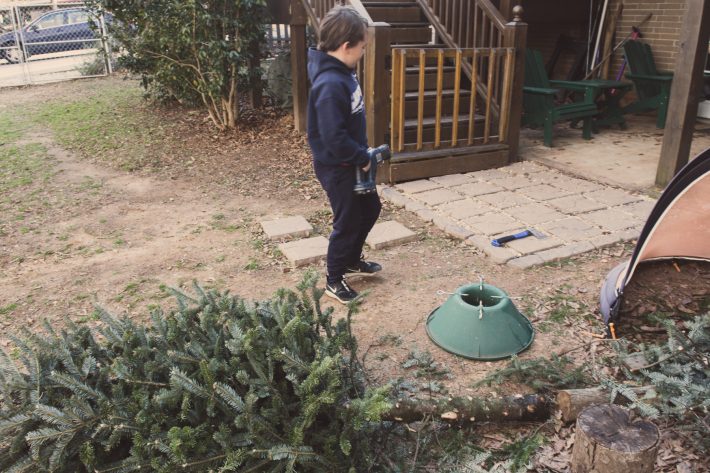
Or we can use K’s Polishness as an excuse: Poles always put their Christmas trees up later (sometimes, only a couple of days before Christmas) and take them down later.
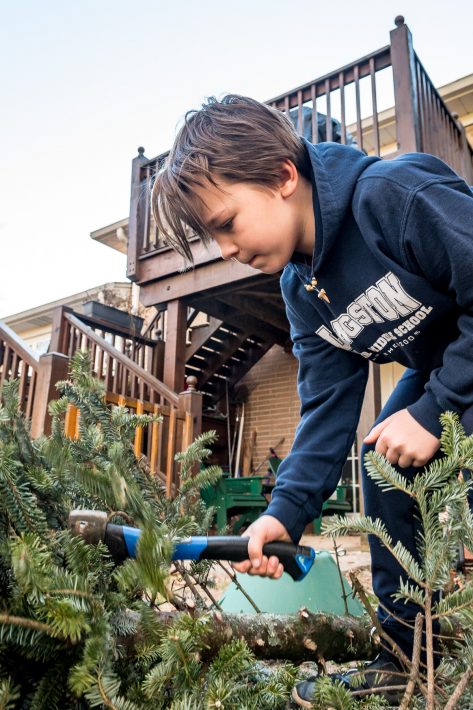
The Boy and I chopped it up in the afternoon. “This is so satisfying,” he said. For us all, in different ways…