g

In the Moment

The two girls were having an argument over how they were supposed to complete their homework. One girl insisted that they were supposed to write much more — much more — than I’d required. And she wrote much more. (That’s her in the upper left corner with the puffy jacket on, hair in a bun, looking down at her computer.)

“You know, H, I’m really going to miss you next year,” I said with a laugh when we got everything cleared up. “You’re the type of kid who never takes the easy way out, and that’s going to serve you well as an adult.” She smiled a little (or so it appeared — it’s hard to tell with masks on), thanked me, and headed back to her seat, shooting playful daggers at the girl she’d been arguing with and jokingly hissing, “See? I told you!”

Fear and Trembling

Today’s reading included Deuteronomy 28, which is about the blessings and curses that God offered (for lack of a better term) the Israelites. I guess you could say they constituted the terms of the contract. It begins,

If you will only obey the Lord your God, by diligently observing all his commandments that I am commanding you today, the Lord your God will set you high above all the nations of the earth; all these blessings shall come upon you and overtake you, if you obey the Lord your God

Right away, I noticed how this seems to be such conditional acceptance. Fr. Mike argued that this was simply the same as parents do (laying out consequences for actions), but I beg to differ. The consequences are quite harsh, including this gem from verses 54 and 55:

Even the most refined and gentle of men among you will begrudge food to his own brother, to the wife whom he embraces, and to the last of his remaining children, giving to none of them any of the flesh of his children whom he is eating, because nothing else remains to him, in the desperate straits to which the enemy siege will reduce you in all your towns

It’s not the first time God has threatened his people with conditions that induce them to cannibalism, but this one notches it up a level somehow. It’s not that they’ll eat each others’ children; they’ll eat their own children and not even share! That sounds like I’m being flippant, and I guess I am — I don’t know how else to react to this but mock the brutal stupidity of it. A god that threatens to do this is somehow good?

Verse 63 states that not only will God do this, he’ll enjoy doing it:

And just as the Lord took delight in making you prosperous and numerous, so the Lord will take delight in bringing you to ruin and destruction; you shall be plucked off the land that you are entering to possess.

What does Fr. Mike say about these troubling passages? Not a single word. Why? There’s nothing he can say. There’s no way to excuse it. (I sound like a broken record, but I want to keep an account of all these issues that arise, and this silly blog is the easiest way to do it.)

Finally, though a little earlier (verses 58 and 59) there’s this gem:

If you do not diligently observe all the words of this law that are written in this book, fearing this glorious and awesome name, the Lord your God, then the Lord will overwhelm both you and your offspring with severe and lasting afflictions and grievous and lasting maladies.

I don’t get this desire to be feared and worshiped. It feels a little like what a despot would want. It feels like it could come from Kim Jong-Un more than an omnipotent, omniscient being.


First Spring Sunday 2021

We are creatures of habit and ritual, and I am a blogger of habit and ritual for constantly pointing that out. But sometimes rituals fall away, replaced by others as we outgrow them or simply lose interest in them.

Exploring up the creek, trying to catch minnows, talking about snakes and snapping turtles — these used to be nearly daily events in the spring and summer. Last year, though, the Boy and I didn’t go out to the creek all that often.

But once we establish rituals, they seem to bubble up again from seemingly nowhere. Today, with his friend N over for a visit, the Boy regained his interest in the creek.

They caught minnows and crawdads, talked about the possibility of seeing a snake, discussed where the snapping turtles might be.

And spent a lot of time looking into the net to see what they’d scooped up.


lot of time looking into the net.

First Spring Saturday of 2021

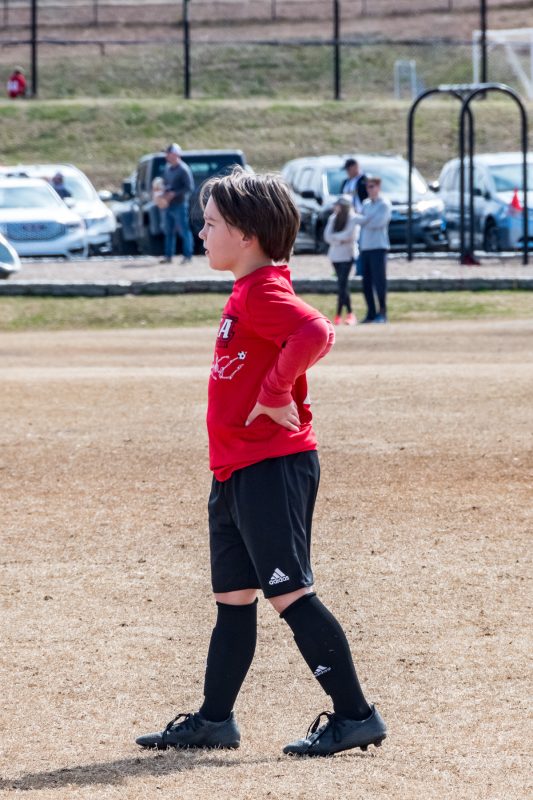
We had to be on the soccer field at 8:15 in order to warm up for the 8:45 game. That meant leaving before eight, which we didn’t accomplish, which is why we were late.

We finished the game (we won 3-1 — glad the opposing team got a goal as it’s always disheartening to be blanked) and headed to his scout den’s morning fishing trip.

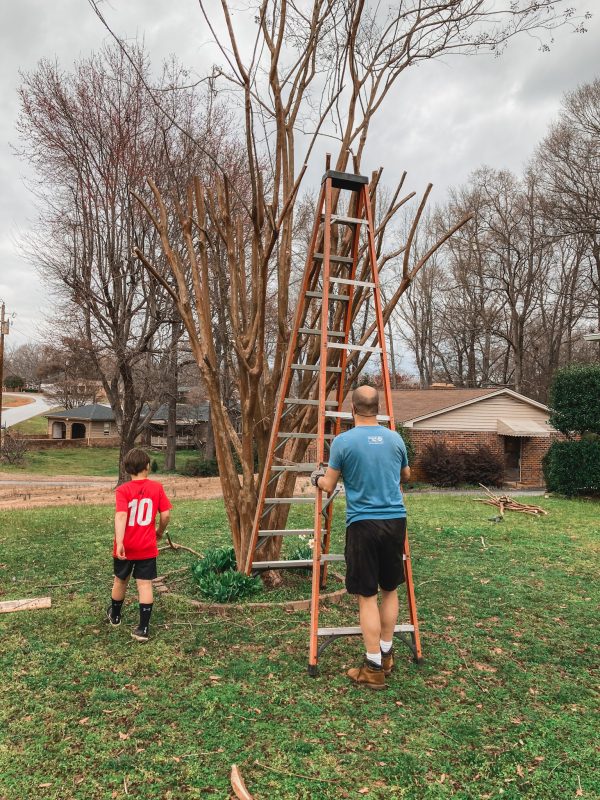
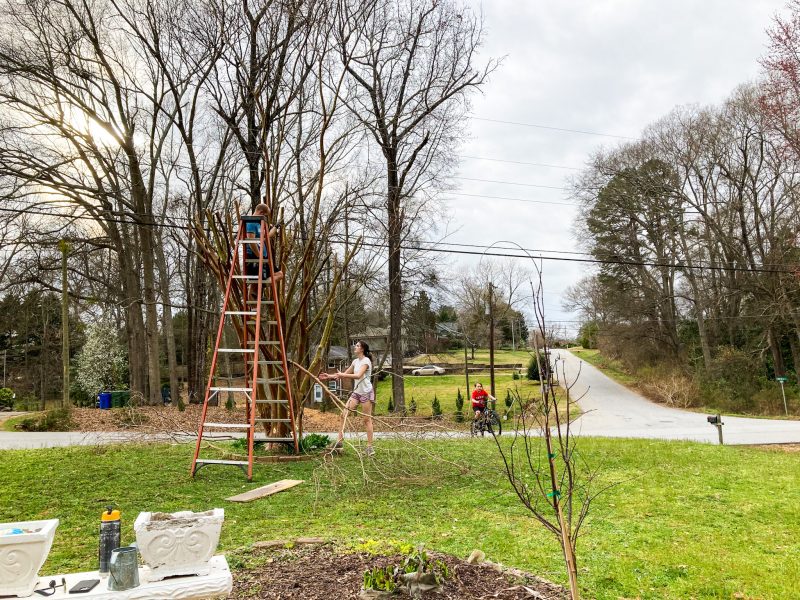
After lunch, it was time for chores — trimming the crape myrtles in the front.

Nothing left to do but light the cigar and play some chess.

More Fr. Mike

We’ve been going through a rough stage with Fr. Mike. It’s stoning, stoning, stoning. I finally got sick of screaming into the wind and joined a discussion group to talk about it.

I struggle greatly with all these passages about stoning. Why would God command such a brutal and barbaric method of execution? I wish Fr. Mike would address that. Thoughts?

People responded, but they tended to be the same thing. Later, more stoning, so I posted again:

Today’s reading was the most shocking thing I’ve ever encountered in the Bible. Stoning your own children because they’re incorrigible?! Does anyone really think there’s any way to defend this command? I think this is the last straw for me.

I’ve heard the same argument so many times now that it’s almost predictable: “But God was dealing with barbaric people in barbaric times.” It’s the justification believers make for the barbaric passages in the Old Testament that so upset our modern moral sensibility. People are commanded to stone rebellious children, stone people who break the sabbath (including a man who was simply picking up sticks), stone women who don’t scream when they’re raped, and genocides are demanded time after time. All those verbs were in passive voice to reflect what seems to be happening in believers’ brains. There is a strange bifurcation that happens that prevents believers from seeing what is startlingly incorrect in their argument.

Their suggestion is that we can’t judge these passages by modern standards because God was working with a barbaric and backward people. He was civilizing them step by step. This argument would be applicable if the passages in question read like this:

Now the Israelites sought a method of punishment for adultery, and they decided that stoning was an adequate deterrent. God saw these things and was displeased at their decisions but understood that it was an improvement over the barbarity they had been displaying. He said, “I will allow this for a time, but know that there are more humane ways of living. I wish to raise you to the highest moral standard, and you will not behave this way forever.”

In other words, it would work if these were acts of free will, acts the Israelites committed of their own volition, acts which God was simply allowing.

But they’re not.

These are God’s commands to the Israelites. These are God’s statutes, God’s requirements, and God’s prescribed punishments. This is God saying, “You shall do this.” What’s more, the god of the Old Testament says over and over that these commands to be kept in perpetuity.

And I’ve yet to see anyone really confront that directly.

Soccer

Today I got to watch E play soccer for CESA (Carolina Elite Soccer Academy) for the first time. His first game was a couple of weeks ago, but L and I were in Knoxville for a volleyball tournament. Last week’s game got rained out, so this was the first time I got to watch him play.

In the first half, he played for about half the time as a defensive player. He was a little less aggressive than some of the other boys, but he soon gained some confidence and went after the ball.

In the second half, the coach put him in as an offensive player. He had one break and pulled back for some odd reason, turning to look (or so it seemed to me) to see if he had any backup. But he was alone, and ahead of all the defenders.

I meant to talk to him about what happened, but we never did.

Five, Six, Pick Up Sticks

Today’s reading with Fr. Mike included Numbers 15, and if I’m writing about it, you can probably guess why: more brutality. Verses 32 through 36 read


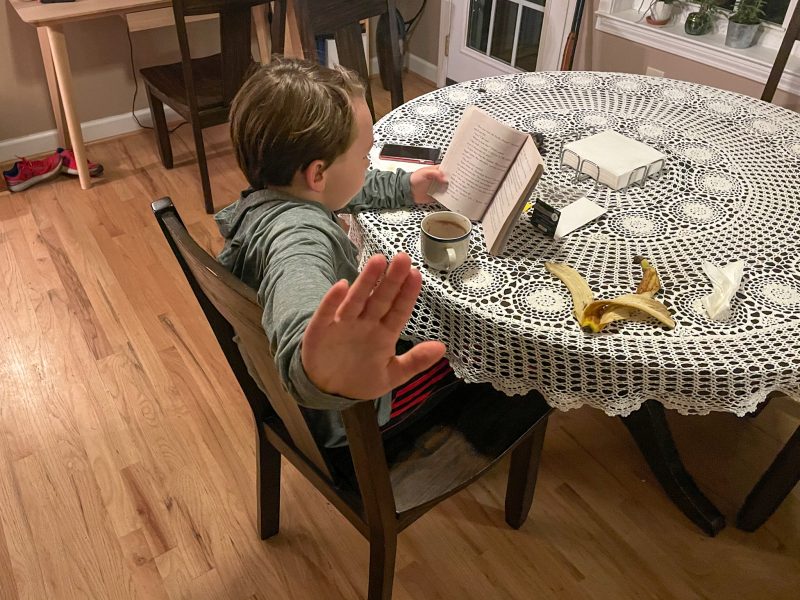
When the Israelites were in the wilderness, they found a man gathering sticks on the sabbath day. Those who found him gathering sticks brought him to Moses, Aaron, and to the whole congregation. They put him in custody, because it was not clear what should be done to him. Then the Lord said to Moses, “The man shall be put to death; all the congregation shall stone him outside the camp.” The whole congregation brought him outside the camp and stoned him to death, just as the Lord had commanded Moses.

Fr. Mike knew that this was a troubling passage. I could hear it in his prayer after the final reading:

Father in heaven, we thank you for your word. We thank you for your scripture today. We thank you also for the great wisdom you give to us in helping us understand your word. Lord God, for all the times we are perplexed and troubled — not just perplexed but deeply troubled, even troubled in our heart by you, by your teaching, by what you reveal about yourself, we ask that you give us not only a, not only take away a spirit of skepticism or spirit of cynicism, but you give us a spirit of openness, a spirit of truth and of honesty. A spirit of trust that when we don’t understand, we ask. And when we still don’t understand, we continue to ask. Lord God, give us a spirit of trust. Give us a spirit that is open to whatever it is you will for us this day and every day.

What’s wrong with a spirit of skepticism? Shouldn’t we be skeptical about a great many things? Just look at the news — Qanon, claims of a stolen election, anti-vaxers. There’s plenty we should be skeptical of. Being skeptical just results from being a critical thinker, so I feel like Fr. Mike is asking his god to turn off our critical thinking faculties for this passage.

To his credit, Fr. Mike does try to explain things this time. In the past, he’s just glossed right over it, but he deals with the troubling passage this time:

Remember: the heart of these laws is that God has said, “No, you are my people.” He has set his love upon them. This is so important. These laws, the consequences of sin, the consequences of going against the Lord are so great that they shock us, right? Capital punishment as a violation of the sabbath. For picking up sticks, it says here in Numbers chapter 15.

Then he reviews the passage before continuing,

We can look at that, we can hear that and think, “That is, um, I don’t want to say crazy, but that is something we wouldn’t expect […] out of God’s law. Clearly it’s not something we would expect from the god that is mercy and love. How do we understand this?”

That’s exactly my point: it’s something we wouldn’t expect out of a God that is described as loving and merciful. How do we deal with that contradiction? There are a few options:

  1. Suggest that this is evidence that this god is not loving and merciful.
  2. Suggest that this god’s sense of love and mercy is conditional at best, barbaric at worst.
  3. Suggest that we might not understand it and move on.
  4. Suggest that it is indeed loving and merciful but that we simply don’t understand it.

“It can seem so extreme for us,” Fr. Mike admits, but he simply points out that there is a provision for those who do this unwillingly. They’re not to be executed. It’s only those who do so willingly, flagrantly — those who thumb their noses at this god’s commands. He then suggests that the third tithe

Third tithe mentioned in Deuteronomy 14 somehow makes up for it.

Every third year you shall bring out the full tithe of your produce for that year, and store it within your towns; the Levites, because they have no allotment or inheritance with you, as well as the resident aliens, the orphans, and the widows in your towns, may come and eat their fill so that the Lord your God may bless you in all the work that you undertake.

It can seem “schizophrenic” (his word), but he points out that it’s extremely generous and merciful to take care of widows. That’s what we’d expect from a god of love

I joined a FB group for this Bible in a Year reading plan and posted my concern: “I struggle greatly with all these passages about stoning. Why would God command such a brutal and barbaric method of execution? I wish Fr. Mike would address that. Thoughts?”

One person responded, “That’s what they could understand 3,500 years ago. You can’t read the Bible with a 21st Century lens.” I’ve heard that argument so many times, but I just don’t understand it. From a Christian perspective, if it’s wrong it’s because God says it’s wrong; so if it is wrong in 21st century, it had to be wrong in all time.

I took a slightly different argument in my response, though:

God is not just condoning this. He’s not looking down from heaven and saying, “Well, they’re stoning people now. That’s wrong. I’ll take care of that, but it will take time because they’re so backward now. By the 21st century they’ll have outgrown this.” He commanded it. It was his instruction. There are other ways to kill that they could have easily understood. They would understand, “Hey, don’t stone people. It’s brutal. It’s awful. To execute them, here are some herbs you mix in water. It’s painless and nearly instant.”

At this point, there are lots of likes for the response to my question, little acknowledgment of the content of what I asked. And I get if: I’m asking questions that challenge comfortable belief. I’m asking questions about one of the many things that led me away from belief. I can understand if no one wants to touch it.

Flat

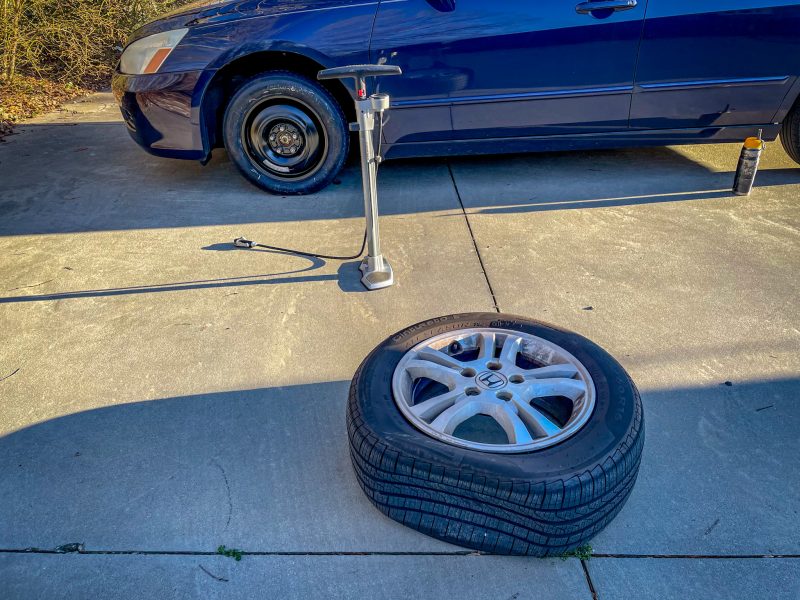
I came out this morning, cranked K’s car, walked around to my car ready to head to work when I saw I had a flat. Not just a tire with extremely low pressure — a tire with no air at all. It made for a rushed morning.

When I got home in the afternoon, my first priority was to get the flat off and the spare on. The spare had been in the trunk untouched since we bought the car. It had probably been untouched since the car rolled out of the dealership. And it was predictably flat as well.

One would think it’s a Monday…

Polish Butcher

Buying meat in an empty shop, Warsaw in 1982 by Chris Niedenthal.

All Here

Everyone was in first period for the first time in weeks.

Last Sunday of the Month

The last Sunday of the month means only one thing: Polish Mass. Of course, it’s only been Polish Mass in name and spirit for several years now. The local parish priest conducts the Mass, and he’s from Columbia. He’s learned a little Polish for the Mass itself, but otherwise, he’s a complete non-Polish-speaker. The “Polish Mass” part comes from the community that gathers.

This week, though, there was a little something different: the new parish center, complete with gymnasium, is now open. Several families headed over after Mass to try it out.

Dinner

Yes, that’s right — cinnamon rolls.