










I had a conversation with B today about differences she’s observed between my classroom and other teachers’ rooms, particularly with English I classes. She said that it’s not better or worse, just different. And apparently, the students are noticing and talking about it. “And if the students are talking about it, the parents will be soon, too.”
So the question is what makes me different from other English teachers on the hall? Well, with G, it’s experience: she’s just starting in eighth grade, and though she has experience in that grade, it’s well in the past. “I’m just following the curriculum guide and the book,” she’s told H and me several times.
With H, it’s a difference of teaching styles. I’m much less old-school. I don’t read things to them and then explain it. I don’t have whole-class discussions very often. I do a lot more collaborative work with the kids. I design lessons that don’t involve me doing much more than coaching them along the way. I let them struggle and get frustrated. I answer their questions with questions.
Overall, I think I’ve somehow managed to be more rigorous than other teachers. I expect a lot more of my students, and things in my class seem to have a more intellectual feel.
“The clearlest solution,” I told her, “is just to let me teach all the English I classes.”
After lunch, the students at our new school have a short recess. The school is trying to get back to some more traditional ideas in school, and providing kids with a chance to get out and run about and be kids once in a while is an important element in the planning of the schedule. Right now since, we are just visitors in the building that houses are small school, we don’t have a lot of space for this recess. On days when the weather is fine, we simply go out to a grassy area in front of the school and let the kids have some free time. The boys throw a football, and the girls and a few boys for a circle and knock around the volleyball. everyone seems to enjoy it, so much, so this several of that we have mentioned it in the school journals, they are keeping in my class. Most days it has been intolerably hot for me during this break, so I have sought shelter under an awning in the front of the school. Today, however, the weather was simply perfect. It was sunny, but not hot. It invited rambunctious play but not sweat. it was a perfect Polish summer day in other words right here in South Carolina. Combined with the cool mornings we’ve had this week, this simply suggest that autumn is finally approaching.
This will be our first autumn without the Girl living in our house. And although she will not have much of an autumn in Florida, this will be the first autumn of her college days. Eventually, she might associate cooler days with the beginning of a school year, and cool mornings like we’ve had this week might bring back little floods of memories of her time in college.
For me, autumn brings back memories of my childhood growing up in a heterodox Christian that still insisted on observing the Jewish Old Testament festivals, although they gave them a unique and somewhat twisted spin. The highlight of all of this is always the Feast of Tabernacles, an eight day extravaganza Filled with activities, restaurants, and daily church services. The daily church service was really just the price we had to pay all the rest of the fund. At least that’s how we kids looked at it.
For kids, this weeklong convention was little more than a replacement for Christmas, which was forbidden in the church because of its pagan roots. My own parents would bribe me to behave well in the daily services by giving me a new Matchbox Car every day to play with. They would also buy one or two large gifts, toys that I had an eyeing for months on end at Sears or Kmart, toys that lured me like a sirens call every time we entered those stores, toys that I would play with his best I could through the packaging, which was Just cleverly enough open for little kids to get their fingers in and manipulate the toy, just enough to heighten the desire. One year I got a large diecast tractor with a working frontend loader and functional backhoe.

Another year, when I was in my full summer succession, they bought me Millennium Falcon. I thought I was in heaven.
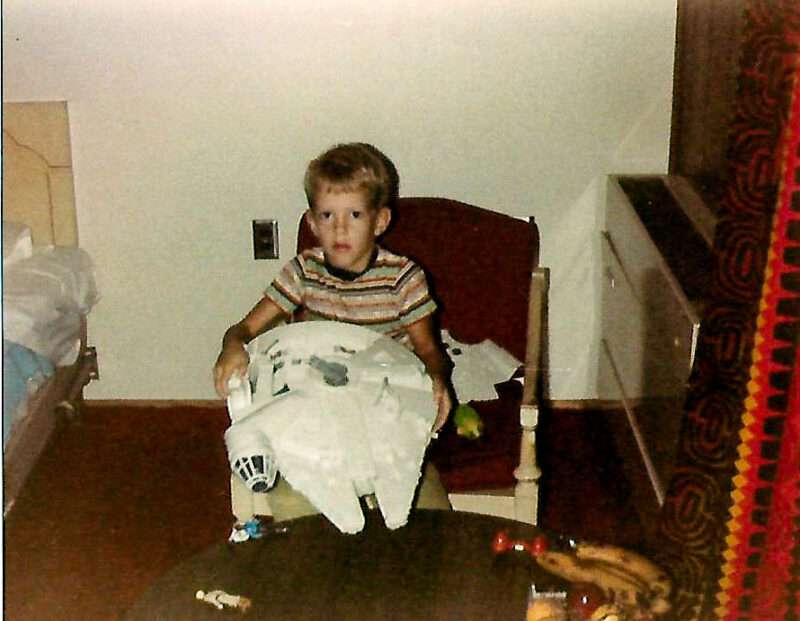
Of course, once I got to be about Emil’s age, a teenager in other words, this eight-day festival really met one thing: a fling. In fact that’s just what we all called it. A feast fling. Teenagers would start to search for likely candidates from the very opening service, which was always an evening service before the first day proper, which always necessitated two church services. One in the morning and one in the afternoon. The day was just that special. Still, while these daily church services were simply the cost of the rest of the enjoyable week, that first day having double services was actually something of a blessing, for it was just before, and just after the services that the real hunting happened. Since we had so sequestered ourselves away from the rest of “the world,” that diabolical morass of the unchosen all out to steal our salvation, most members of the sect came well before weekly church services and stayed long after in order to fellowship. With that habit well established, it simply spilled over into these extraordinary days in the fall. Before and after services, clusters of teens would roam throughout the auditorium (or arena, depending on the popularity of a given location) rented for the week, all of the most one thing on their mind: to meet someone of the opposite sex.
Truthfully, it wasn’t just the teens who are doing this. Although they took a more nuance to approach, most single members of the site approach these festivals with a similar mindset. Because the group discouraged or even forbade members from marrying outside the sect, these weeklong gatherings offered everyone a chance to meet someone who was safe, who could be eventually married without the risk of losing one’s place in the church and therefore one’s salvation and eternal life. I, too, participated in this gigantic mating dance, although it was somewhat half hearted, I believe. By that time, it was clear to me that I would not be staying in the church forever, and I would eventually drift out and leave my parents behind and their religion. Little did, I know that they too, due to the changes that have occurred, would eventually just return to plain Jane Christianity.
Still, after all these years (it’s been well over 30 since I last attended one of these gatherings), those yearly retreats remain to my mind one of the few benefits of growing up in what truthfully could be called a cult. Because of the double layered tithing system of the sect (and triple layered every third year), members entered these weeklong festivities with approximately 6 to 8% of their yearly earnings to blow in one week. That meant going to restaurants that we would never have gone to, visiting sites we would have never seen, staying in cities we would’ve never visited otherwise. This did come in a price, of course. When you’re taking off 20% of your salary every paycheck (and that was 20% of the gross not the net), even an engineer like my father made wages that could sometimes be stifling small. But in truth, that really just made the feast all the more special. It was a week of excess, a Bacchanalia as much as a conservative sect could allow itself to have.
So when the morning turn chilly, and the evenings finally become actually cold, my mind turns back to those magical weeks when just for a moment, just for the shortest of files, we lived like royalty.
A traumatized kid enrolls in our school, and only weeks later, he’s gone, entangled in the court system with all the fatalism and unfulfilled dreams that that entails for a fourteen-year-old black boy.
That sentence itself is a tangle of contradictions and enigmas. “A traumatized kid enrolls” suggests that the kid made the decision, completed the paperwork, and entered our school community. Or it implies a parent made the decision to enroll him in our school and completed the requisite paperwork to enroll. In this child’s case, neither is likely: the kid, of course, is a minor and couldn’t do it; the parent (and statistically likely only one, and most statistically likely only the mother) seems from all accounts to be relatively uninvolved.
“Only weeks later, he’s gone” suggests more volition that he likely lacked. It implies that he just didn’t like it — wasn’t challenged or felt the dress code too stifling. In truth, he was taken away, with all the ambiguity that passive-voice sentence suggests. More accurate from our perspective is simple: “only weeks later, he disappears.” That still suggests he is in some sense a agent in the decision, and while his behavior certainly played a role in it all, that behavior was likely not entirely consciously volitional and at least in part the crusted-over habit of years of surviving a trauma-filled life no kid should endure.
When I first met him, he was respectful, demure even: “I don’t like saying I came from West Greenville,” he quietly began when we first met, referring to one of the district’s alternative schools, “because they think I’m a bad kid.”
“Well, we all make mistakes in life,” I reassured him. “I’m sure no one will judge you on where you came from but rather on your behavior.”
Yet his record suggested he was what quick judgment would label a “bad kid.” He came to us from alternative school, and as teachers reviewed his records, we saw that he had been in not one but two different alternative schools that year. A kid who makes a single bad decision that lands him in alternative school — say, bringing a vape to school — would not have such a record.
Still, he knew how to play the game: he knew first impressions count, and he made a good one. Once he got into class, though, it was another story. Passive incorrigibility and even the occasional aggressive defiance became the norm. Once, in the hallway when I was trying to direct him where he needed to go, he shouted, “Man, this is why I hate white people.”
Over a few weeks, I’d managed to establish a decent relationship outside of class, though, and that helped inside the class. He began applying himself just a bit, here and there, occasionally. But much like an abused dog will bear its teeth at any perceived threat or provocation, KB’s interactions continually belied that demure front he’d put on at the start of his time with us.
“Who’s that kid?” A teacher on another team asked as KB passed by. I told her, and she replied, “He’s really something.” Soon, everyone on the hall knew who he was, and not because of the sterling impression he was making on everyone.
Occasionally he would be absent and return to school a few days later explaining he’d had a court appearance. “For days?” I’d think, but I kept my doubts to myself.
There are kids teachers encounter that we know will disappear into the vast cracks in our system and appear on the evening news as a suspect in some crime or other (one former student), or perhaps as a fatality after a police chase involving a stolen car (another former student). We all pay for these kids: our tax dollars will support them in one form or another. But they pay for it as well with lost and wasted lives that represent a net negative on our society, indicting us all: that’s the true price we pay.
The board of directors of the charter school, where I now teach, has a meeting this evening. The principal of our school asked me to have my students in the leadership class to write brief notes of gratitude to the members of the board of directors.
“What else can we write other than ‘thank you for our school?’” they asked.
I suggested they could be specific: “Thanks to them, you can attend a school that has a bit more freedom in its curriculum than the average public school.”
“You mean, they’re the ones who decided we don’t have to do benchmarks?” one student asked.
When I confirmed this, I can see that several of them immediately began adding that to their thank you notes.
Later in the day, when the principal came by to pick up, thank you notes, I mentioned this to her. She said that some Greenville County schools are even worse. Apparently, they had a pretest recently for the benchmark. This is, I’m assuming, so that they can even use his first quarter to measure growth somehow. Here’s how students started in the first quarter; here’s how they ended the first quarter. Previously, we had to wait until the end of the second quarter to get that data. Now Greenville County teachers have more data. But I’ve always maintained it that useless data is just trivia. And there’s no data more useless than the data benchmarks and pretest and CFA and CSA‘s gather.
So why did they do it? Why does Greenville County even require so much testing? it’s a conservative county, which means its constituents should want fiscal conservative principles as well as social conservative principles. I’ve never met a teacher who suggested that this data was in anyway truly useful. I’ve never spoken to a parent who spoke positively of these benchmark tests. And every single kid I’ve ever met (including my own) complains about them. So the tests seem to be one colossal waste of money.
And it would have to be an enormous amount of money because all of these tests are created by third parties and they administered to third-party software. That means these test questions cost money. Subscriptions to Mastery Connect software costs money. And it’s all just a waste of time, which means the salary for teachers to administer the test costs money. None of the true stakeholders see any value in it. Why do we keep doing them?
Simple. There are a whole class of administrators in the district office who have to justify their six figure salaries.
I started doing some research about just how many people at the district office make over $100,000, and I found an article in the local paper about it:
More than 100 administrators earn six-figure salaries in Greenville County Schools, according to the school district.
That’s more than $10 million in annual salaries for just the 100 top-paid employees in the state’s largest district.
None of the district’s 4,000 classroom teachers earns a six-figure salary, according to a document provided by the district.
The 100 top-paid school employees are all district-level and school-level administrators.
Some of the top earners:
Of the top 25 earners in the county, four are principals, twenty-one are district administrators, and not surprisingly, none are teachers.
Here’s the real kicker, though: that article is from August 28, 2017. It’s eight years old. There are even more administrators at the district office. There are deputy superintendents and assistant superintendents and associate superintendents. And they all have to justify their jobs, show that they’re doing something to earn their money. What better way than to make spreadsheets and PowerPoint presentations for speeches to this or that group of other administrators. (Or rather, to have their secretaries make these spreadsheets and PowerPoint presentations — you don’t think they do that?)
One of my daily rituals is to look through the Time Machine widget at the bottom of this page: it combs through all 7,000+ posts here at MTS and finds the ones published on today’s date. Twelve years ago today, we threw a surprise birthday party for Nana, who was turning seventy.
We invited some friends but mainly family to the occasion, and since both of Nana’s brothers had passed years before, it was mainly from Papa’s side of the family. Three of his four sisters came. We had a cookout and some cake, then we took the Boy on a train ride in the park we were at. The family stood by the fenced-off track and waved at us as we passed. Of the five that were there waving, four have passed away. Of the other guests, three more have passed since then.

Twelve years is not a terribly long time, and yet six of our guests have passed in that time. That’s one every two years. That’s too many too quickly, but it’s to be expected. It just surprises everyone, I suspect, when it starts happening to those around them.


For our students, our school is all of ten days old now. That’s how much experience our volleyball team has, as well. Less, in fact. Add to it the fact that, unlike all other middle schools in the area, we don’t have any eighth-grade players because we don’t have an eighth grade and it’s clear the girls are going to be in for a tough year.

You know it’s going to be a tough year when the first set finishes 4-25, the the girls celebrate wildly after ever point they get. Big celebrations. Wide-eyed smiles and literal jumps for joy. Every single point.

But today, they achieved the unexpected: a second-set win. It was classic middle-school volleyball. The other team clearly outmatched them, but they fell apart in the second set and made a lot of unforced errors, and our girls took advantage of it. They ended up winning 25-22, and their reaction was as if they’d won the national championship.




I never do well with lasts, and one of the most significant lasts for our family has arrived today: L’s last full day at home. She’ll be heading to Gainesville tomorrow in the early afternoon to move into her dorm, meet her roommate, and settle into her new life. The move-in won’t be until Tuesday, but she’s leaving tomorrow.
“She’s leaving home” echoes in Paul McCartney’s voice as I type that. Such a different departure for our Girl tomorrow. No running away. No confused parents reading a note the next morning. No sense of an underlying, unseen, misunderstood neglect. The suggestion in the song is that the unnamed girl won’t be back to see her family for a long time, perhaps the longest of times. Our Girl will be coming back for Thanksgiving for sure, but those three months will be the longest time we’ve been without her. So in a sense, I guess I still relate to the parents in the McCartney song.
It resonates for another reason, though: the parents in the song in some sense or another failed their daughter, and they didn’t even realize that they had. It’s every parent’s nightmare: that you’ve somehow failed your children without realizing you’ve failed them. We’re sending our daughter out into the world, the first steps she’s taking to her freedom, and that fear haunts us both, I think. Parents always reassure each other when they express these fears, “Oh, you did a good job with her. She’s going to be fine.” But everyone says that, and everyone can’t be right. That’s what the song is all about: everyone would have reassured those parents that they did a fine job raising their daughter. I know we made mistakes — some big mistakes. But the effort itself counts for more than we realize, I think.
I understand that only now about my own parents. They made mistakes with me, no question. But I never doubted their motivations were pure. I never doubted the security they were trying to provide for me in ways that I know view as less-than-ideal.
I also understand how difficult it must have been for them when I left shortly after college for Poland. They know it would be months, possibly a couple of years, before they’d see me again. And when I came back to the States, I settled in Boston — a fourteen-hour drive from their town. And when I left Boston, I returned to Poland. From 1996 to 2005, I really only saw them a handful of times. That must have been more difficult for them than I even now can imagine. Certainly more difficult than what we’re facing with L leaving, for we have E still at home with us, and my parents had no other child to comfort them with his proximity.
Tomorrow our daughter is leaving for college. That sounds a lot less harsh than “tomorrow our daughter is leaving for good,” but in truth, I think that’s what’s happening. Certainly, she’ll come home for long visits (she’ll be here for almost a month for Christmas), but I doubt she’ll ever live with us again in the sense that she lives with us now. And has lived with us for eighteen and a half years. She is indeed leaving home in that sense. After college, there will be grad school or a job, and even when she’s done with all of that, she won’t want to come back to this little corner of the world. With a degree in biomedical engineering, she’ll have more opportunities in bigger cities with more universities and research facilities. She’s already talking about California So perhaps we’ll see after all what my parents went through.

In the meantime, we enjoyed the day the best we could. K made racuchy for breakfast and rosół for dinner. It’s been a pattern for the last few days: fixing her favorite foods (crab cakes for dinner Friday; K’s specially marinated chicken for dinner last night).
And then there was the final packing. L went to get a few favorites to take with her, including an entire bulk box of Cheez-Its. “I can’t live without my favorite junk food,” she laughed.

The Boy chipped in, washing L’s car for her as he listened to some podcast or another.

And then an early dinner.
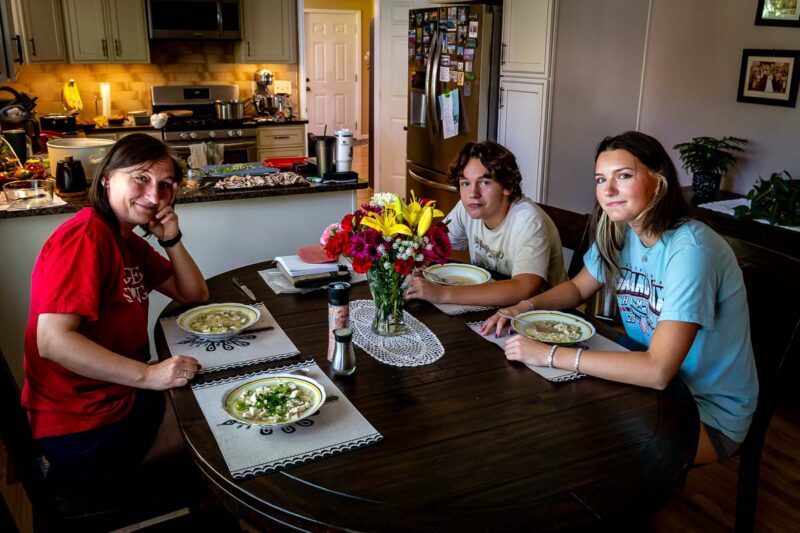
Thus passed L’s final Sunday here.
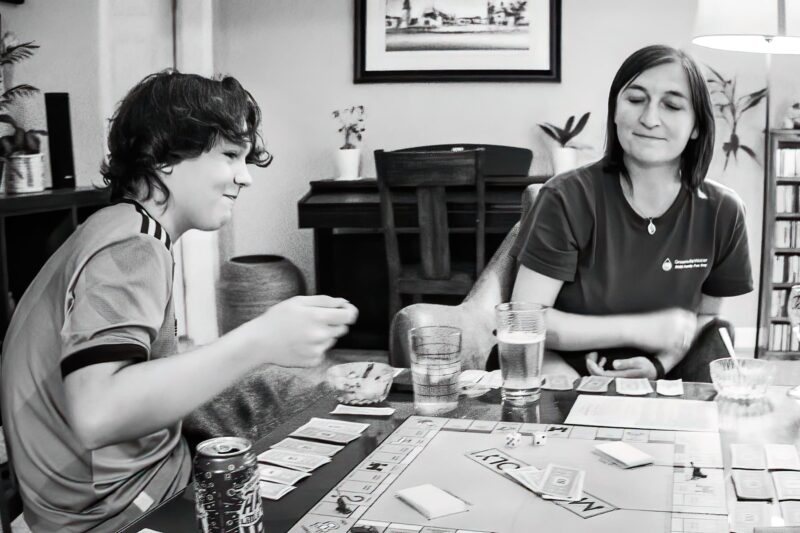
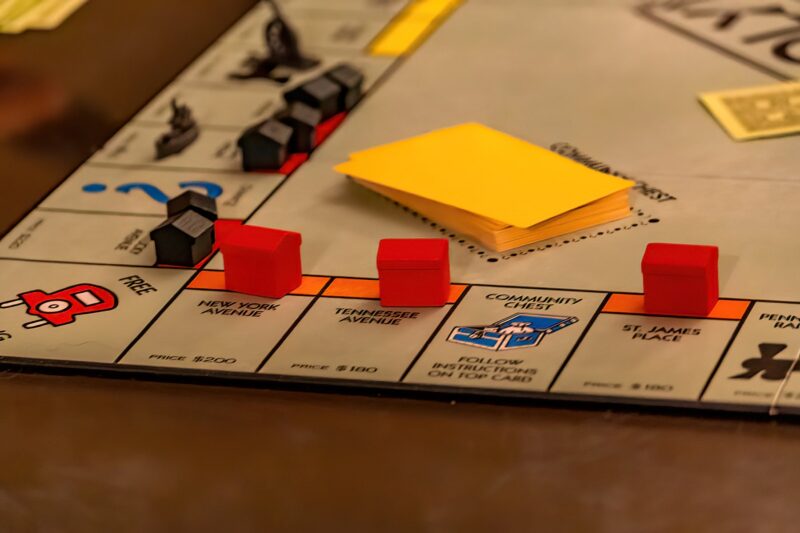
I took only one picture yesterday. Unfortunately, I caught L mid-bite. And you cant

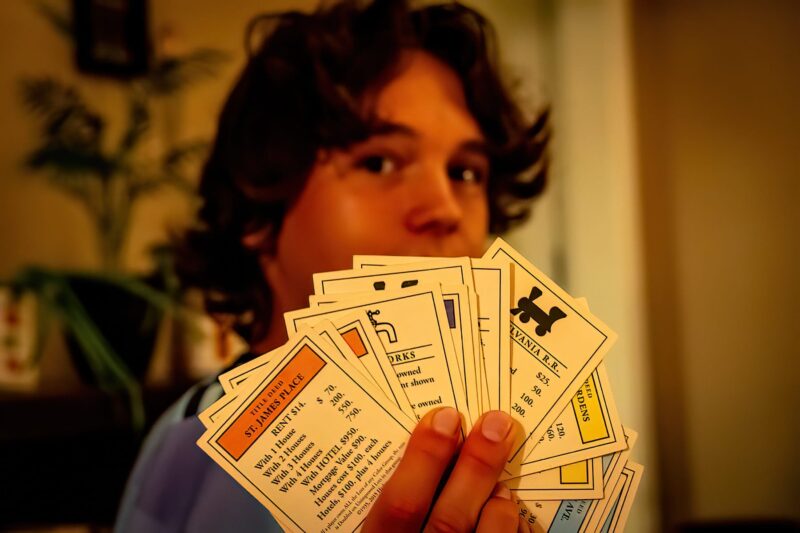
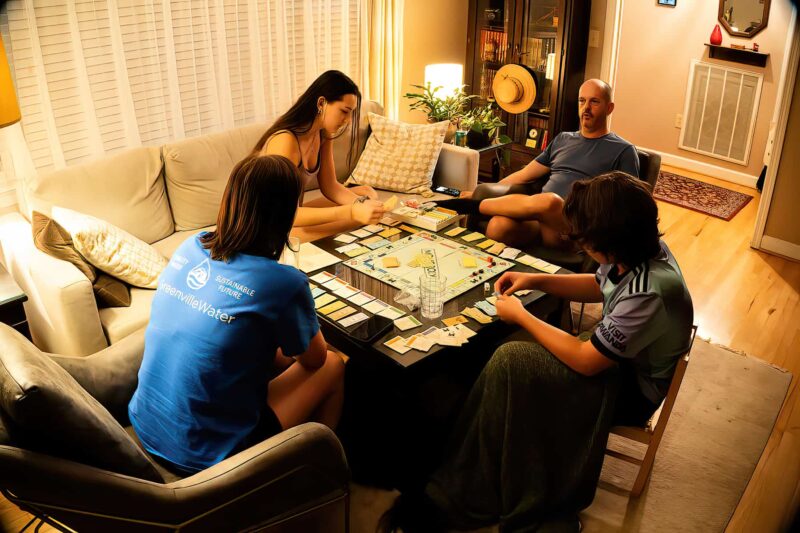
the Boy had won in Monopoly.












Of my six classes this year, four are with sixth graders. It’s a whole other world. Of course, there’s the issue of size: one girl I teach, a sweet and observant girl who quietly observes everything around her, barely comes up above my belly. She probably only weighs double her bookbag. I suggested that today as she waited in the hallway for her next class. She smiled and agreed. Most eighth-grade girls are getting close to their final height, and few of them don’t at least reach a little past my shoulders.
They’re also just a little more helpless. They’re coming from elementary school where there’s a lot more coddling, a lot more worrying. Hall passes are an entirely new thing. Having different classes with different teachers among different students each period is an entirely new thing. They have to adapt to the personalities, habits, and routines of six different teachers instead of just a main teacher and a couple of related arts teachers.
But most strikingly different from eighth graders is the pure sweetness some of them exhibit. One girl came up to me between classes, insisted on giving me a hug, and said, “I love you, Mr. S.” The most you’d ever get out of an eighth grader is “I tolerate you.”