matching tracksuits

fun in threes, sometimes fours

Yelled at for a Week

A tent revival is something that is particularly American, and conjures up images of snake-handling believers and wheezing, beet-faced preachers who can stretch the name of Jesus into four syllables, who preach hell fire and damnation, the dangers of card playing, and the outright evil of dancing.

It doesn’t seem to go with the ordered liturgy of a Catholic Mass. And yet, for the week of 9—18 October [2004], that’s exactly what the parishioners of Lipnica Wielka[, Poland] were getting.

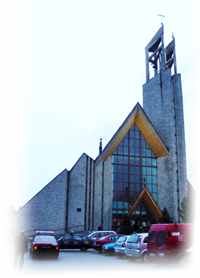
The techniques used in the construction of the church are among the best and most expensive. – Three Times Superlative.

Entitled “Misja Swietych” (“Mission of the Saints”), it featured multiple, daily Masses with a particular focus: the family, the mystery of the Stations of the Cross, the sick. It was a fairly big thing, as it happens only once every five years or so.

This year it was led by Wojciech Chochól, a rector of a parish some hundred and fifty kilometers northeast of here, near Tarnów.

Chochól is a short, somewhat paunchy man who appears to be in his mid-forties and who, it seems, stepped directly from the 1950s into the twenty-first century. He believes in what some American Southerners might call “old time preaching.” Translation: he yells at people about their sins.

The Polish- and Italian-granite entry stairs to the new church cost so much that, says Father Wojciech, “for that kind of money, you could frame an entire, new church.” – Three Times Superlative

I suppose there’s nothing really wrong with that. Such “soul-pastoring” (a direct translation of the Polish term for the verb “pastor”) treats the parishioners as children and has a particularly humiliating feeling, but perhaps some feel at home being humiliated in church. They might refer to it as “being humbled.”

I heard him preach when I went to church Sunday afternoon (10 October) for the special “Men’s Mass.” [My wife] didn’t want to go alone, and I was curious what the priest would say to a room full of men.

"Everything here that glistens is gold plated," adds rector [Chochól] , taking the time to show all the internal marble [ . . . , ] the same marble that is in the walls and the entrance to the bathrooms. Marble also rules in the cemetery’s chapel. – Three Times Superlative

I wasn’t disappointed, though somewhat provoked. Some of the highlights:

  • suggested people throw out television and unplug the “Satanic Internet;”
  • castigated people who have only one or two children, saying that children are only “normal” when there are three of them (One child is a little god in the house; two kids are two hysterics; only when you have three can you expect to have normal kids in the house);
  • said people should be worried about money with their kids (“They don’t have to have a gold watch right way. They don’t have to have a car or a mountain bike right away.”);
  • advised fathers to look in their fifteen-year-old children’s pants pockets to look for narcotics or “swinska gumeczka” – “filthy condoms”;
  • told of a little two-year kid who at Mass was lying in the floor, crying, waving his arms and such – being a fairly regular two-year-old. “And I thought, ‘You’ve got a little bin Laden!’” he told everyone. And they laughed – that’s the most disturbing part about it
  • said a child’s salvation lay in the fathers taking a fence board and “lay on as much as fits” (A child’s salvation = beating the daylights out of him);
  • recommended that fathers no let their daughter’s boyfriends sleep in the house;
  • pondered what sons who came home late at night or early in the morning were doing (“And later, three of them come to the altar for a wedding,” he concluded.);
  • told the story of a boy who came into the parish house to use the phone, calling the police and life-saving crew because his father had come home drunk again and began beating his mother. “I don’t know how much longer we can stand this hell,” he exclaimed, then left money on the priest’s desk for a Mass to be said the following day in their intention. And Chochól left the money hanging – didn’t say, “I gave the money back to him and said, ‘You all need this more than I do.’”

All in all, it was the usual, backward, uneducated tirade that, were it to take place in a clapboard building in Appalachia or in a mosque in Cairo, would be labeled fundamentalism: railing against the evils of modern society and the need to return to a Godly life, as defined by the priest, of course. Chochól showed that he knew nothing about children and even less about contemporary society. He showed his disrespect for parishioners by refusing to treat them as adults but screaming at them as if they were children

"The church is being built slowly, but also as expensively and as beautifully as possible." – Wojciech Chochól quoted in Three Times Superlative.

Covering the usual litany of religious anti-modernism, yelling at people about their sinful indulgence in modernism and their material mindset, is one thing.

It’s an entirely different story when the priest is guilty of the very things himself.

It turns out, there might have been a reason he referred to the Internet as “Satanic,” for a few keyboard clicks at Google, and I found “Trzy Razy ‘Naj,’” an interesting article from 2002 about a then—new church being built in Chochól’s parish, with some choice quotes (which appear in the side inserts).

The picture we end up with by combining the sermon and the article is that of a hypocrite. In his sermon, Chochól anecdotally mentioned several times the churches “he’s built,” and so it is obviously a matter of pride to him, which he probably crows about whenever he can. Others derive their pride and self-esteem from what they own; still others from what they’ve built, I guess.

When village priests come caroling and collecting money, they don’t schedule a particular time, but tell their parishioners simply they day they might come – and expect them to wait around all day. Kids miss school for this; parents miss work. If a priest suggested this in a city, such as Krakow or Warsaw, he would be laughed out of the church.

Contrast that with a friend who lost her father when she was still a young girl. “Not once,” she said, “Did any priest come by to ask if everything were okay, to see if they needed anything.” They came about as is the Polish custom during the Christmas season for caroling, which is accompanied by (guess!) a collection. So they came to get money, and nothing else.

As a non-Christian, I find this particularly offensive, and I can think of a few things I might like to say:

  • Religion that is pure and undefiled before God, the Father, is this: to care for orphans and widows in their distress, and to keep oneself unstained by the world – James 1.27, New Revised Standard Version (NRSV)
  • Jesus said to [the young rich man], “If you wish to be perfect, go, sell your possessions, and give the money to the poor, and you will have treasure in heaven; then come, follow me.” – Matthew 19.21 (NRSV)
  • All who believed were together and had all things in common; they would sell their possessions and goods and distribute the proceeds to all, as any had need. – Acts 2.44, 45 (NRSV)
  • [Jesus said,] “Again I tell you, it is easier for a camel to go through the eye of a needle than for someone who is rich to enter the kingdom of God.” – Matthew 19.24 (NRSV)

The second sermon I heard from this jerk was the next Sunday. Highlights from that one:

  • Without priests, you will not go to heaven.
  • Priests are a second Jesus.
  • A wife of a communist official who’d refused permission to build a church came to Chochól when her husband died to ask him to anoint his body. Chochól’s response: “Well, now you can go anoint him with lard.” And this by his own admission.
  • He criticized the church in Lipnica, saying it was old and dirty. He wondered how priests could work in such an environment “without granite, without marble.”
  • He told a couple of stories of people who’d died shortly after criticizing priests.
  • Priests are hated just as Jesus is hated – for their holy example.
  • He whispered to the children in a sickeningly sweet voice, “Don’t say anything bad about priests.”
  • He said that when people go on pilgrimages without a priest, “it’s just an outing.” (“Wycieczka” was the Polish he used.)
  • He said that if you criticize a priest, then you’ll die without a priest (i.e., You’ll go to hell.).
  • He told people don’t send money to other parishes but keep it here. But just earlier, he’d thanked everyone for the donations given to his parish.

The irony: it was labled a “children’s Mass!”

The general reaction of parishoners after this joker wen home: “What beautiful preaching!”

Well, I’m criticizing him, so let’s see how long I last before God kills me for my blatantly Satanic attitude.

(An interesting thread at Catholic.com’s form about this, started by yours truly.)

Update from 18 October 2020

I was looking at this through the Timeline plugin (see footer) when I decided to Google his name. Apparently, he died 17 October 2020 (source, in Polish). I wonder if anyone anointed him with lard...

In the Fields

Apartment for Two

After the wedding, my cozy, two-room apartment grew just a little cozier with the addition of a roommate for life.

1-DSC00001

2-DSC00002

In the Fields

Reading Strobel

I began reading The Case for Christ by Lee Strobel this week. My parents brought it to me in addition to the two books I’d requested. I’d read some reviews of it on Amazon, and the common complaint against it is that it doesn’t present the other side of the issue. There is a short chapter on the issues raised by the Jesus Seminar, but that’s about it other than occasional objections raised here and there by skeptics. I’ve no problem with this in a way, for the book is The Case for Christ and not Christ on Trial. In other words, even in the title it makes it clear that it’s presenting one side of the story.

One thing I do have a problem with is how much of the argument is based on something being “reasonable” or the alternative being “unlikely.” For example, “Given that Jesus’ followers looked upon him as being even greater than a prophet, it seems very reasonable that they would have done the same thing [(i.e., record his words accurately)]” (41, emphasis mine).

It’s often just conjecture. For example, concerning the casting of the demons into the swine, Strobel points out that Mark and Luke say it happened in Gerasa, with Matthew putting it in Gadara. After the scholar (Blomberg) suggests that one was a town and the other a province, Strobel adds, “Gerasa, the town, wasn’t anywhere near the Sea of Galilee.” Blomberg responds:

There have been ruins of a town that have been excavated at exactly the right point on the eastern shore of the Sea of Galilee. The English form of the town’s name often gets pronounced ‘Khersa,’ but as a Hebrew word translated or transliterated into Greek, it could have come out sounding something very much like ‘Gerasa.’ So it may very well have been in Khersa — whose spelling in Greek was rendered as Gerasa — in the province of Gadara (46, 47).

Goodness — proper understanding of the Bible requires knowing how people could have transliterated or misspelled words! Isn’t the Bible of divine origin? How could this happen?

This issue of divine origin comes up again when discussing the consistency between the gospel accounts. Blomberg says,

My own conviction is, once you allow for the elements I’ve talked about earlier — of paraphrase, of abridgement, of explanatory additions, of omission — the gospels are extremely consistent with each other by ancient standards, which are the only standards by which it’s fair to judge them (45).

The only standards? How about the standard of them coming from a supposedly omnipotent, omniscient source? Of course, apologists like to conjecture that if there was perfect consistency between the gospels, that would be suspect in itself. Perhaps, but there is such a level of inconsistency on basic issues (who saw the resurrected Jesus first, for example).

In some ways, the book is strangely persuasive. I guess it comes from this strange, nonsensical desire to believe again. A childish desire, I suppose — and Christians wouldn’t deny that. “Unless you become like a child” and all that.

Balaton Day 4: Travel to Balatonederics

Balaton Day 3: Tihany

Balaton Day 2

Balaton Beach

Departure

I can't deny I wasn't a little nervous about the thought of traveling close to 700 kilometers (420 miles) with two bikes strapped to the roof. The bike racks seemed to be less than stellar examples of design.

This became evident the day before as we were actually putting the bike rack together and it turned out that two of the u-bolts were too long and so the threads didn't extend far enough to enable us to tighten them properly. A few extra nuts and the problem was solved.

Putting the bikes on the rack (that sounds Inquisitorial) Wednesday morning revealed the need to improvise some more: we had to secure the front wheels with nylon string so the handle bars didn't bang together as we rolled along.

Before our departure, a group photo was in order.

On the Way

The trip itself was somewhat uneventful – just the third time from Poland to Budapest.

We stopped in Donovalay for a snack, in Sachy for coffee, Vac for a walk, and somewhere for lunch, though I can't remember where.

Gary denerwował się trochę tymi rowerami na dachu, ale w gruncie rzeczy mieliśmy poczucie, że nasz samochód wyglądał po prostu – cool – z tak wspaniałym bagażem. Największy stres przeżyliśmy jednak na ulicach Budapesztu. Jest to miasto wyjątkowo nieprzyjazne dla kierowców, szczególnie tych obcych. Centrum miasta to labirynt ulic jednokierunkowych, w tygodniu miasto jest niewyobrażalnie zakorkowane, a do tego budapesztańscy kierowcy nie mają za grosz cierpliwości i nie zdejmują nogi z gazu, jak tylko warunki na drodze im na to pozwalają.

Poza tym jechaliśmy sobie beztrosko, słuchając dobrej muzyki. Gary przygotował wcześniej najróżniejsze składanki na wszelkie możliwe nastroje, jakie mogły nas dopaść na trasie.

After my folks got on the plane Thursday morning, Kinga and I headed to Balaton, finding a wonderful room with a fenced yard where we could leave the car in Felsoors.

Sunday After our Wedding

Our Wedding

02c

The blessing is one of the most personal times of the whole wedding. Only family and closest friends are present as both sets of parents offer their blessings and best wishes to their children before the ceremony.

04b

It's usually a very teary affair, with one or both of the mothers crying and perhaps a guest or two joining in.

04a

It's at this point, I suppose, that the seriousness of what's happening really starts to settle in.

03c

Było bardzo uroczyÅ›cie z tymi wszystkimi mowami, na szczęście obeszło sie bez zbyt głoÅ›niego szlochania.

04c
05a
05b

After the blessing, it's off to the church.

According to Polish custom, the bride and groom are actually the first to enter the church. They go in and sit down in front of the altar while all the guests file in.

06a

We decided to do it a little more "American" style: my Dad escorted Kinga's mother in, and I escorted my Mom, followed by the bridesmaids and groomsmen.

06c

I stood by the altar for a few moments and then Kinga came in.

07b

Shortly after that, Kinga and I went to a small room off the main altar with Johnny, the best man, and Maja, the maid of honor, for all the paper signing and other technicalities.

07a

After that and a small misshap concerning a Bible, we returned to our places and the Mass began.

The Mass, despite all the unexpected pre-Mass adventures, started on time at one o'clock.

Our Mass, conducted by the rector, Stanisław Górecki was somewhat Spartan in that we elected not to have the traditional organ accompanyment during the prayers and recitations, so there was a spontaneous element to the Mass as no one really wanted to be the one who started belting out the "Amen" and such.

12b

We did have music, though: the local youth choir sang, and a traditional Highlander band played (though not together, of course!).Other than that, the Mass was pretty much according to the patter of Masses for the last, I guess, few hundred years: two readings, some hymns, some prayers, a sermon, communion, and a benediction.

12c
11a

There was an anxious moment for me as we neared the giving of the communion. I had earlier been told that, as a non-Christian, my vows would be a little different than Kinga's as a Catholic. The Catholic wedding vow, after promising to be faithful, loving, and so on until death, ends with something like, "So help me God and all the Saints." Since I don't believe in these beings, it doesn't make sense for me to be asking for their help, and so in perfoming mixed marriages, the priest usually leaves that out for the non-believing partner.

In my case, though, the priest had me say that. Suddenly I was worried that he might have forgotten and later might offer me communion.

10b

After kneeling at the main altar (which, apparently, everyone was supposed to do, but didn't),

10c

Kinga and I left arm in arm.

Msza podobno była piękna. Tak słyszeliśmy od gości, bo my widzieliśmy tylko kolejne wpadki – z Biblią na początku; ksiądz proboszcz osobiście biegał na plebanię. Do tego zapomnieliśmy przynieść świec do kościoła, no i przez 10 minut myśleliśmy, że księdzu wszystko się pomieszało z tym ślubem. No ale jakoś wytrwaliśmy, chociaż to był dla nas ogromny stres. Zresztą, jak powiedział ksiądz na kazaniu: czymże jest olimpiada w Atenach i wizyta Papieża we Francji wobec tego, co my w tym momencie przeżywaliśmy.

11b

With the Mass over, it was time to leave. I suppose of all the moments one imagines about one's wedding, this is one of the (for me) least exceptional. No shudders; no thinking, "I really feel married now"; no sense of anything except, "Whew, the most stressful part is now over."

Well, no, that's not true. There was a certain amount of pride I personally felt. After all, look how beautiful the bride was that day.

After all the guests came out, it was time to kiss them. All. One after the other.

After the newlyweds and guests leave the church, the bride and groom "receive" all the guests — nothing particularly novel about that for a non-Pole. What is novel is the kissing.

Mwa, mwa, mwa — left cheek, right cheek, left cheek again.

The men kiss the bride; the women kiss the groom; the women kiss the bride; and most disconcertingly, the men kiss the groom.

Having been raised in a non-kissing culture, it's taken a little while to get used to it. It's not just at weddings — most official, congratulatory occasions require kissing.

On Saturday 14 August 2004, I kissed about 120 people. I tried not to take the initiative, especially with the men. But if a man wanted a smooch, well, culture dictated that I pucker-up.

When Dave came along in the receiving line, we shook hands like men and left it at that.

Kissing finished, the photographer took over.

Preparing for the Wedding

The Cooks and the Cakes

The four cooks began working Tuesday, actually. First order: making the cakes. Because it's part of the Polish wedding tradition to give departing guests a small box of cakes to take home, about double the logical amount of cakes is necessary. In other words, the cooks baked enough cakes for double the people.

An abbreviated view of the assorted collection is below.

Thursday and Friday the cooks were chopping, grinding, frying, boiling, and everything else imaginable. And they were loading the main stove with coal, for people still cook with traditional ovens and stoves here.

Four cooks, four days: that makes an estimated 130+ man-hours just for preparing the food.

The Drinks

The amount of beverages for a twelve- to fifteen-hour party of one hundred forty people is almost back-breaking. Soft drinks, juices, and mineral water were on every table in abundance, and this meant it all initially had to be delivered and worse, taken upstairs.

Fortunately, we had quite a bit of help doing this. (Actually, "we" is not quite right, because I wasn't even there. I was off on another errand.) But when the party was over and all the empty bottles and unconsumed beverages had to be taken back downstairs, there were just two of us: my Dad and I.

The Decorations

Over a thousand balloons were used to decorate the hall. Instead of ten of us sitting around half a day blowing up balloons, we hired a company to do it.

The tables were all our responsibility, though.

The Car

"Now, this is history," someone commented as we cleaned the car. "Four Americans cleaning a Pole's car!"

It's inconceivable to go to a wedding in a less than a perfectly clean car, so Dave and I set out cleaning it, inside (i.e., even deep into the trunk) and out Frday afternoon. Soon my father joined us, and Mom held the hose for a little while, giving rise to the history comment.

Dave and Kuba wax as Jan (my father-in-law) supervises
Johnny stops by
Dave and Dad get down to the details
Dave drinks to Kuba as Dad and Jan look on

Of course, what's the good of cleaning a car in such a big group if there isn't a little bit of socializing going on as well? Jan called us all into the garage from time to time and gave everyone a shot of wedding vodka and instead of a chaser, we sampled the wedding oscypek. And Johnny, the best man, dropped in for a while on his way from Liverpool (!?!), making for a nice little afternoon.

And finally: the car's washed; the food's prepared; the clothes are ready.

Next: the wedding.

Review: Letters Between a Catholic and an Evangelical

McCarthy admits up front, in his foreword, that both he and Waiss had one aim: to convert the other. That the book is published by an evangelical publishing house testifies to the fact that Waiss failed; that the book is not titled “Letters that Converted a Catholic Priest” testifies to the fact that McCarthy failed.

Who won the debate is more a question of readers’ preconceptions than anything else. Catholics will be unconvinced by McCathy’s arguments, and few Protestants will be moved by Waiss’s somewhat bland presentation.

Of the two, McCarthy is much more aggressive, and in many ways, much more rational. But there is a mystical element in Catholicism that doesn’t mix well with pure rationalism. Recall that after consecrating the host in Mass, priest speak of the “Great mystery of faith.”

At the heart of the book is the question of authority: both accept the Bible as an authority, but evangelicals stop there, where as Catholics see Tradition and the Church as on equal footing as the Bible, comprising together the Word of God. Much of the book, then, revolves around Waiss trying to show how the Church’s extra-Biblical notions (i.e., those not specifically detailed in the Bible, such as the papacy, Mary’s Immaculate Conception, etc.) are, in some way, Biblically based while McCarthy chips away at Waiss’s arguments. The tables turn from time to time, especially discussing “sola scriptura,” but by and large, it’s a game of “Prove it from the Bible.”

As such, McCarthy and Waiss toss one phrase (or a derivative) at each other quite often: “No where in the Bible do we find X.” McCarthy fills in the variable with Papal authority, Marian devotion, the importance of Tradition; Waiss replaces “X” with the notion of “sola scriptura,” the Trinity, and a couple of other ideas. With the exception of “sola scriptura,” Waiss’s contention seems to be that McCarthy and evangelicals are essentially “guilty” (my term, not his) of the same thing they accuse Catholics of: incorporation of extra-Biblical doctrines. Waiss could have pushed McCarthy a bit harder on this point, I think, for he doesn’t even mention a host of non-Biblical based notions that “sola scriptura” evangelicals accept: Sunday worship, non-observance of Jewish holidays (i.e., no where in the Bible does it explicitly say that followers of Jesus are to stop observing the Jewish festivals), Easter, and Christmas come to mind.

This shows the Protestant notion of wanting to have its theological cake and eat it, too. Protestantism accepts the early Church councils’ decisions about the New Testament canon, the proper day of Christian assembly, the appropriateness of celebrating Jesus’ birth and resurrection, but most denominations (especially evangelicals) are unwilling to accept the Catholic Church’s continuing authority. This is one of the paradoxes of the Protestant movement, which necessarily implies that the Church started off correctly, but somewhere got tangled up in a mess of legalism and false belief. Sadly, questions like “At which point?” and “Why would God let such a thing happen despite his promise to the contrary?” aren’t mention in the book. It leaves me feeling that Waiss pulled some of his punches.

On the other hand, McCarthy demolishes some Waiss’s arguments in support of Catholic theology. His handling of whether Jesus had half-brothers (i.e., whether Mary remained a virgin her whole life and whether “brothers” in the New Testament should be translated “cousins,” as the Church maintains) is well done, for example.

As I mentioned earlier, who won the debate depends on readers’ preconceptions. As a non-Christian skeptic, I found the debate to be a draw. This is because “Letters” is a debate about the tenants of a religion based on a self-contradictory book, a notion neither McCarthy nor Waiss would take into account. For example, is one saved by faith alone or by faith and works? It depends on where you look in the Bible. Did Saul/Paul’s traveling companions on the road to Damascus hear a voice or not? It depends on which chapter of Acts you read. Does the bread and wine become Jesus’ actual body? It depends on how you read a couple of different NT passages. With such a flawed starting position, a draw is the best outcome either participant could hope for.

When such contradictions arise, the great literal/figurative differentiation arises. Indeed, much of the book also seems to be an argument as to whether or not to interpret this or that passage literally or figurative, with each side accusing the other of taking the passage out of context.

On the other hand, it is refreshing to see debate that doesn’t often (though sometimes, to a slight degree) slip into personal insults. While many Protestants (and this almost always includes fundamentalists, and often includes evangelicals) think the Catholic Church is the Whore of Babylon and the Pope the Anti-Christ and many Catholics regard Protestants as heretics, McCarthy and Waiss keep things civil the whole time.

One final criticism: the length precluded truly in-depth discussion, and many of McCarthy’s and Waiss’s comments go unanswered.

Overall, I would say it’s an interesting read for the simple fact of seeing to opposing views clearly (though perhaps too succinctly) presented.

Best Friend in Krakow