general


Nearing
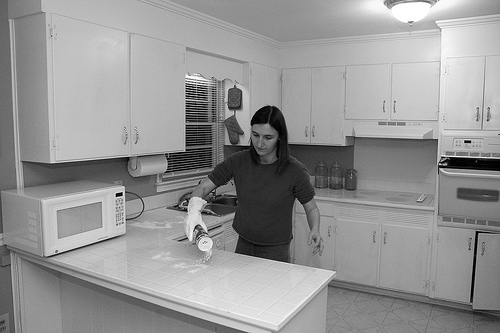
Christmas is nearing -- in a Polish household, that means cleaning.
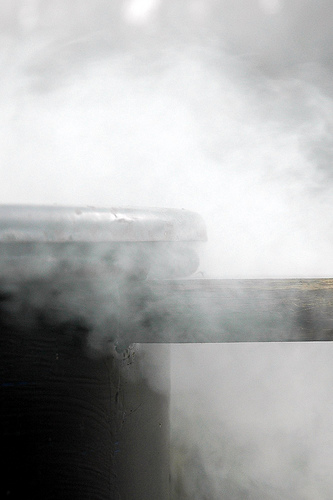
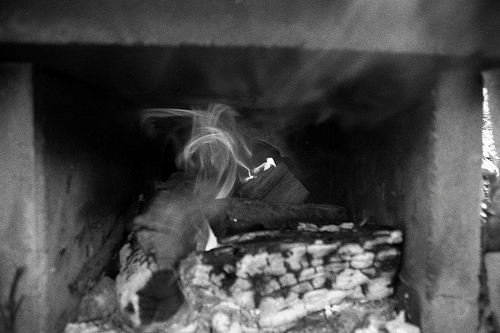
For us, it also means smoking. Sure, it is a redneck-looking smoker, but the elegance of the pepper-corn-encrusted tenderloin I have in there now will make up for it, I'm sure.
Tree

Atheism and Public Life
I am an atheist: I have no positive belief either way about the existence of God or the supernatural. Though it sounds more like agnosticism, my particular worldview is generally called weak atheism: I make no claims either way regarding the existence of a god (I won't say "There is no god!" in other words.), but I do find it to be more unlikely than likely that such a being exists.
To my knowledge, I am the only atheist in my family. I am not, however, the only atheist in the country. Yet you wouldn't know it to look at the religious distribution within Congress.
A report on a study from the Pew Forum on Religion and Public Life regarding the religious affiliations of members of Congress begins,
Members of Congress are often accused of being out of touch with average citizens, but an examination of the religious affiliations of U.S. senators and representatives shows that, on one very basic level, Congress looks much like the rest of the country. Although a majority of the members of the new, 111th Congress, which will be sworn in on Jan. 6, are Protestants, Congress - like the nation as a whole - is much more religiously diverse than it was 50 years ago. Indeed, a comparison of the religious affiliations of the new Congress with religious demographic information from the Pew Forum's recent U.S. Religious Landscape Survey of over 35,000 American adults finds that some smaller religious groups, notably Catholics, Jews and Mormons, are better represented in Congress than they are in the population as a whole. However, certain other smaller religious groups, including Buddhists, Muslims and Hindus, still are somewhat underrepresented in Congress relative to their share of the U.S. population. (Pew Forum)
Read further, and we find the following, handy chart[, which has been removed].
Look closely -- I have, and for the life of me, I can't find myself in that chart.
Where are the atheists? Are we lumped in with "Unaffiliated" or "Unspecified"? Was there an "atheist" option for the survey? If so, did no one check it because no one is an atheist or because no one is politically naive enough to admit it?
This set me on a hunt to determine how many atheists there are in America. "Atheist Revolution" reports that there is "a commonly reported number is that 1.6% of Americans identify themselves as atheists" (AR). Toward the end of the post, a figure of 10% is suggested.
Applied to the House survey, that would leave some 50+ members as atheists. Yet how many openly atheistic politicians are there? One, that I've found: 18-term Democratic congressman Pete Stark from California.
There's good reason for this: the Pew Forum also contains the opening of a USA Today article about atheism in America.
Being an atheist is not easy in this age of great public religiosity in America. Not when the overwhelming majority of Americans profess some form of belief in God. Not when many believers equate non-belief with immorality. Not when more people would automatically disqualify an atheist for the presidency (53%, according to a USA TODAY/Gallup Poll) than a gay candidate (43%), for example, or a Mormon (24%).
Anti-atheism might have found its ugliest public expression during an episode in the Illinois Legislature this spring. As atheist activist Rob Sherman attempted to testify against a $1 million state grant to a church, Rep. Monique Davis railed, "This is the Land of Lincoln where people believe in God, where people believe in protecting their children. … It's dangerous for our children to even know that your philosophy exists! … You have no right to be here! We believe in something. You believe in destroying!"
Lest we dismiss the legislator's harangue as an anomaly, consider the organizations that bar atheists from membership -- the Boy Scouts of America and American Legion, to name two, as well as some local posts of the Veterans of Foreign Wars -- and the conspicuous absence of openly atheist politicians on the national stage. (The Pew Forum)
The most famous -- and in some ways, the most significant -- public expression of anti-atheism comes from Bush, Sr.'s comment to Robert Sherman: "I don't know that atheists should be considered as citizens, nor should they be considered patriots. This is one nation under God."
And yet we're taking over America, taking God out of everything. My only question is, in what sense?
If anyone is a persecuted religious minority in public life, it's atheists. Mike Whitney, at Dissident Voice, wrote in 2005 of a study that
showed that in the 1960s only very small minority of the public would vote for blacks, Jews or atheists (all of them in the 20 to 30% range). In the late 1990s when the same question was asked, blacks and Jews scored in the 70% range; not perfect, but much better. Atheists, however, still dithered in the 20 to 30% range. No change. The distrust and bigotry are still as alive today as they were 40 years ago. (DV)
The link Whitney provided is dead, and I have no way of confirming this study, but it certainly seems plausible. We've seen that the race barrier is, thankfully, surmountable. When will we have an atheist president? Indeed, when will we have a major-party atheist candidate? My bet: never.
Here in Greenville, I guard my atheistic stance very carefully. I avoid discussing religion with anyone other than close friends. I am fairly certain that no student or co-worker knows that I am an atheist.
I am especially careful around students: I answer students' occasional questions about my religious views as ambiguously and politely as possible. When showing pictures of a Polish Christmas (as I did this last week) to provide students with a firsthand account of traditions very different than their own, I was asked, "Mr. S, are you Catholic?" I responded: "What do you think?" When the student stated that I must be, I simply said, "Well, remember that our assumptions aren't always correct," and left it very ambiguously at that.
The same girl came into class and asked, completely out of nowhere, "Mr. S, what do you think of homosexuals?" How does an atheistic, liberal teacher answer such a question with such obvious religious overtones? I wanted to say, "I think they're human beings with every right to happiness that you and I have, and I see nothing whatever immoral in their behavior," but that would have only spiraled into a "But the Bible says" conversation, and it was not where I wanted to go just before class. I don't remember exactly how I replied, but I know I did my best to dodge the topic entirely.
One of my students has, in large, bold letters, the question "Have you witnessed to anyone today?" written on her English binder. She became frustrated that the Greek underworld as presented in the Odyssey did not conform to her conception of what a proper hell would look like: people writhing in agony for rejecting Jesus. I simply pointed out that the Odyssey was written well before Jesus' birth and left it at that. "Yeah, I guess, but still..." came her reply, and I actually had to tell her privately, "We can't take class time discussing why the Christian hell and the Greek underworld are so different." It would have mad a fascinating discussion, I'm sure, but it would have been a discussion that I would have had to step through very carefully.
The truth is, I felt much more comfortable in Poland being openly atheistic than I ever would in the States. It's not that I went around with a "God is dead!" shirt on or anything so silly. Moderation: I'm all for everyone believing or not believing exactly as he/she chooses, and I certainly don't want to be a proselytizing atheist. At the same time, I once used my lack of belief to stimulating an amazingly successful conversation class, and I never tried to hide the fact that I don't believe.
A lot of this has to do with the differences in the state view of religion in Poland and America, as well as the makeup of the religious landscape itself. Poland is almost exclussively Catholic. There is no competition for souls, and as such, dissenting opinion can be marginalized much more effectively. In America, though, we have free market religion, particularly within Protestantism. Here, everyone is competing for souls. Denominations can handle the competition, but they cannot handle a group saying, "You're all wrong." Believers of all faiths can band together against that, and in America, they do. The religious variety in America heightens the us-them dichotomy compared to what I experienced in Poland.
But America is Jesusland.
Take a walk
out the gate you go and never stop
past all the stores and wig shops
quarter in a cup for every block
and watch the buildings grow
smaller as you goDown the tracks
beautiful McMansions on a hill
that overlook a highway
with riverboat casinos and you still
have yet to see a soulJesusland
JesuslandTown to town
broadcast to each house, they drop your name
but no one knows your face
Billboards quoting things you'd never say
you hang your head and prayfor Jesusland
JesuslandMiles and miles
and the sun goin' down
Pulses glow
from their homes
You're not alone
Lights come on
as you lay your weary head on their lawnParking lots
cracked and growing grass you see it all
from offices to farms
crosses flying high above the malls
A longer walkthrough Jesusland
Jesusland
Ben Folds "Jesusland"
jesusland
A country that has religious messages posted on billboards cannot ever be a nation that elects an atheist.
Decorating
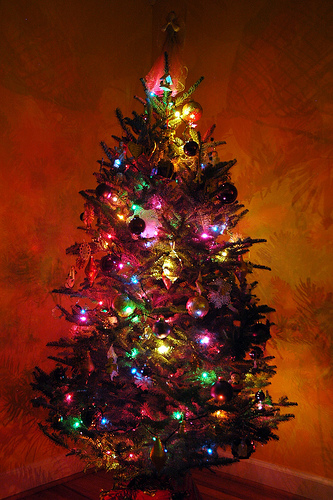
We got our Christmas tree last Friday, but with the party and accompanying chaos, we didn't get it decorated until Monday. For L, the empty decorations box was the most interesting.
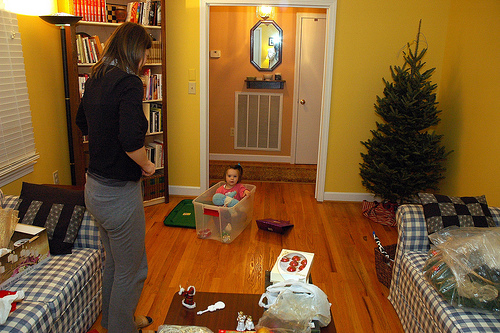
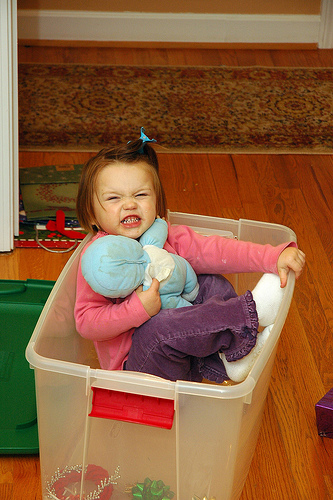
She played for a little bit, posing as well: she's taken to saying "Cheese" whenever the camera is aimed in her direction.
Eventually, L was especially helpful. "L turn!" she cried every time K or I hung an ornament from the tree. At first, she herself needed some help.
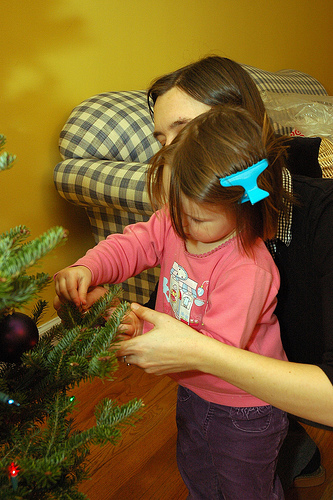
But in true L-independent fashion, she quickly declared she must do it "Sama! Sama!"
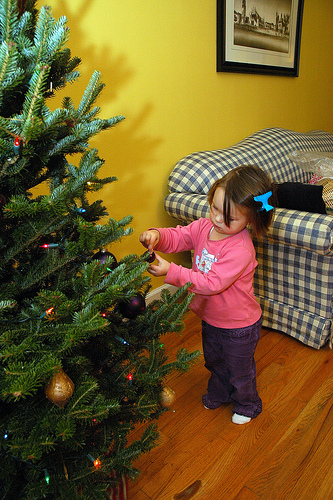
That declaration that she must do it "Alone!" is both a blessing and a curse. It bodes well for her future, but it often results in rice spread for a square mile beneath her chair and yogurt smeared about everywhere. Then again, is it really a curse, your daughter learning to do things independently? Some cleaner and a paper towel takes care of it, so what's the big deal? Besides, what are we going to do -- discourage independence?
Happy To You!
"When you wake up," I told L before her Sunday afternoon nap, "it will be time for 'Happy to you!'" She'd been waiting all week, and she was too excited to fall asleep immediately, but eventually she drifted off.
When she awoke, it was her day.
First, lunch. In two years she's gone from milk and mush to shrimp, an all-time favorite.
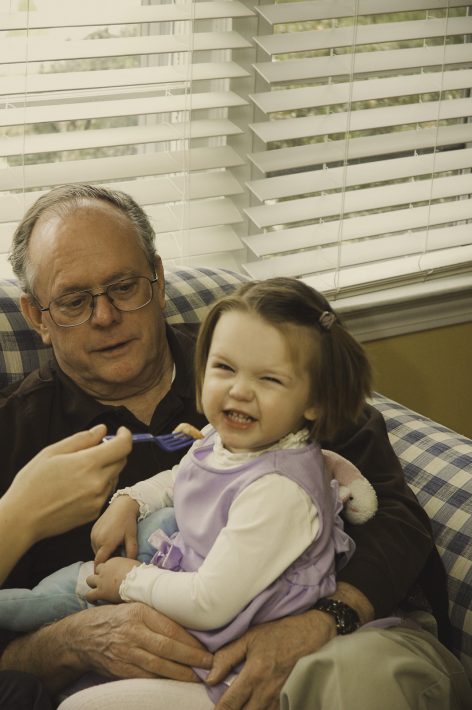
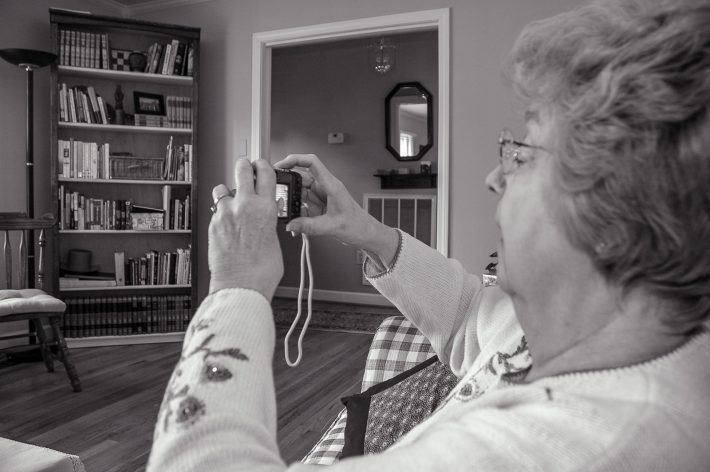
Papa held the Girl as Nana practiced with their new camera. "It was rated best in this level at this price by this place and that," said Papa, proudly relating the story of how he got it for a song.
The guests arrived and L became the center of attention. She's used to it, I guess: she demands it often enough, though fussing or simply asking.
"Mama, trzym," she says. "Hold" in Polish, but L-ized. She's not shy about asking for attention, though we we she'd ask for it like that more often.
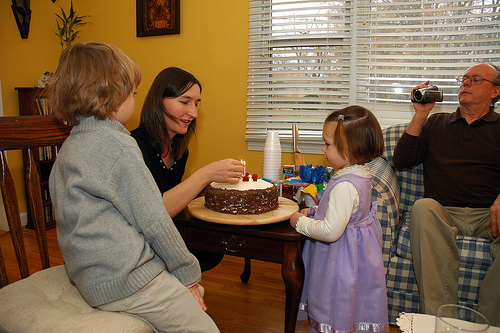
Candles out and it was time for gifts. L had a little helper, F: the son of Polish friends we met here. He wanted to help with the candles, but L and I had practiced. She knew what she was doing.
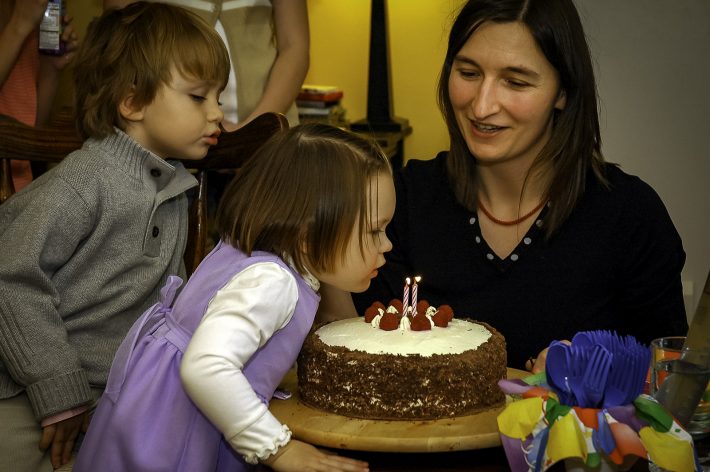
F began by helping L with her presents; by the end, he was unwrapping them for her. A year ago, that might have been problematic: the Girl was more interested in the paper and boxes than the presents. This year, she knows what's inside is what counts. Hopefully, it's a lesson she'll apply universally.
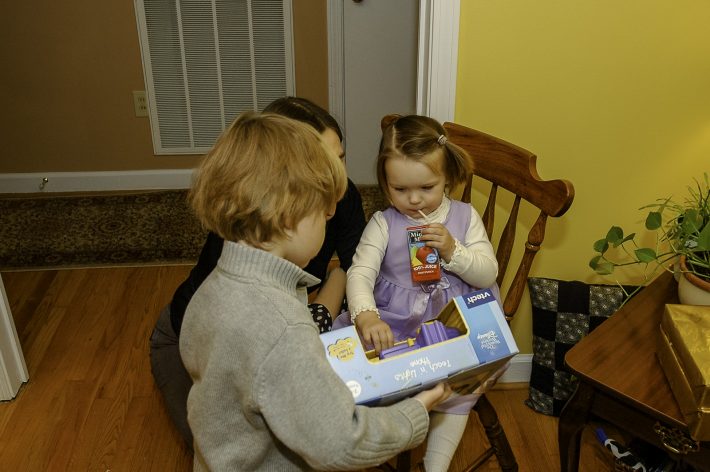
The GIrl came away with quite a haul: Tinker Bell, a couple of games, a Madeline book, a Pooh phone. It was tempting to hide some of the toys and bring them out a little later, but for now they're all out -- literally.

Of course, Nana got the sweetest present of all.

Happy to you, L. Two down, one hundred and two to go. Sto lat!
Celebration I
It’s clean-up time now, but the party was a success — and so was the extinguishing of the candles.
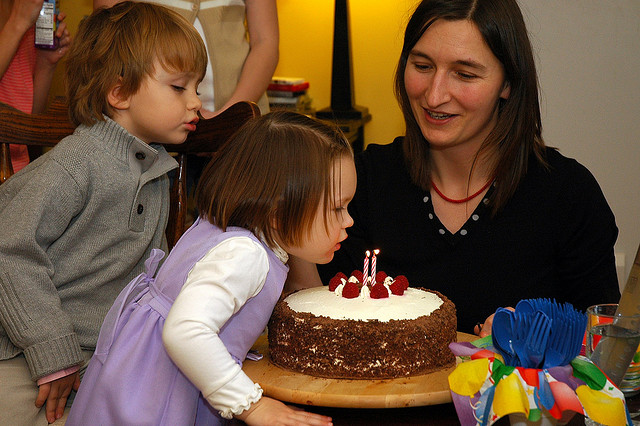
More to come.
Party Preparation
Later today, L will celebrate her second birthday party. Her birthday is not until Tuesday, but one doesn't have parties on Tuesdays. We've been practicing: thank you, happy birthday to you (which comes out "happy to you"), dziekuje, sto lat, blowing out candles, and so on.
Last night, K baked a cake, as I did some touch-up work on our new door.
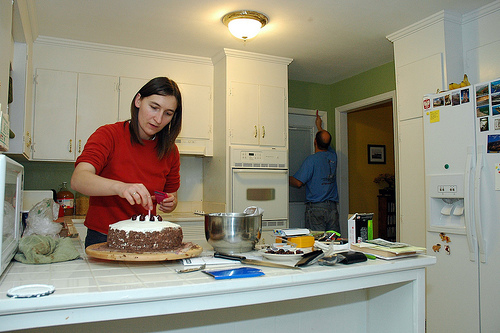
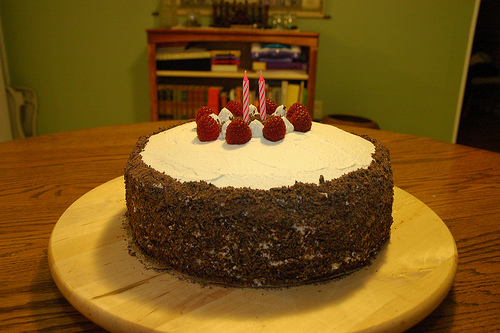
The cake, when finished, was quite a masterpiece:
Today, we tried blowing up some balloons, but L was a bit wary:
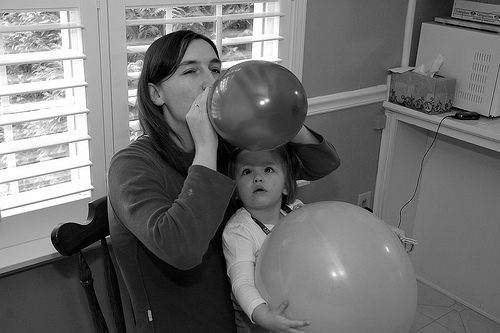
Right now, she's asleep. "When you wake up," I told her, "It'll be time for 'Happy to you!'"
I'm surprised she even managed to go to sleep.
Religious License
Here in South Carolina, the Department of Transportation began issuing religious-themed license plates. They have stained glass, a cross, and the words “I believe.”
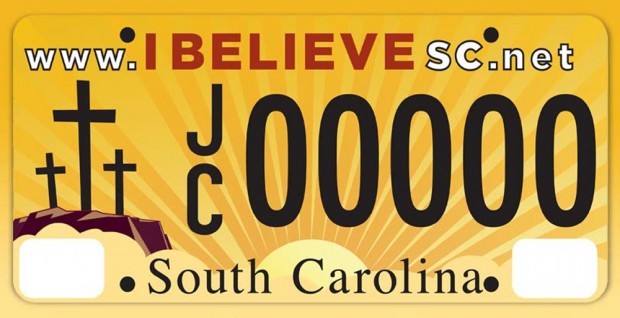
One guess as to what happened:
A federal judge says South Carolina must stop marketing and making license plates that feature the image of a cross and the words “I Believe.”
A federal judge issued a temporary injunction during a court hearing Thursday after opponents said the plates violate the separation of church and state.
U.S. District Judge Cameron McGowan Currie said the case needs to be heard in court. In the meantime, the judge said the Department of Motor Vehicles cannot take any more orders for the plates.
Department spokeswoman Beth Parks said the agency stopped taking orders more than a month ago, after it collected the 400 needed to cover the cost of making the plates. She said they are in production, and none has shipped. (AP)
I’m sure there are many in the state who are appalled by this. Just another example of those damn goddless bastards trying to destroy religion in America. That’s what the Andre Bauer, the Lt. Governor, says:
For those who say this violates the Constitution by giving preference to Christianity, I think this lawsuit clearly discriminates against persons of faith,” Bauer said in a statement. “I expect the state attorney general to vigorously defend this, and it is time that people stand up for their beliefs. Enough is enough.” (Harold Online, cached at Google)
 Yet how could anyone argue that it doesn’t give preference Christianity? There are no other freaking choices! I’d have gone for a FSM plate myself, but I don’t think my wife would have appreciated it.
Nate, at Shots from the Battery, really hits on the important issue, though:
I really wish we could sue the fundegelical state lawmakers who are forcing us taxpayers to bear the burden of the litigation they knew they were inviting. It’s a waste of $$ that the state taxpayers cannot afford. (SFTB)
Every morning going to work, it seems like I hear about the state making more and more budget cuts because of the falling tax revenue. South Carolina is predicted to have a stunning 14% unemployment rate by the spring, and these nitwits are out trying to make a mindless religious point.
Bilingual Breakthrough
We’re getting ready to go to the zoo — just L and I, a newly forming bi-Sunday tradition. L is excited: she’s chattering on and on in her own way: 10% Polish, 20% English, 70% L-ese. (One of the problems with raising a bilingual baby is that you never know whether she’s trying a new Polish word, a new English word, or just making up something in her own language.)
In the midst of the babbling, L suddenly says, “Mamma, afant.”
“Afant? I don’t know what that is,” K responds, as always, in Polish.
“Afant!” declares L.
“Honey, I don’t know…” K begins, then L switches languages.
“Slonik!” translates L.
“Oh! ‘Elephant!'”