Out of curiosity, I uploaded a photo from Jablonka to ChatGPT and Grok and asked them to create a story based on the image. Chat's is superior, I feel, but they both determined that this was an old house, not a health center.
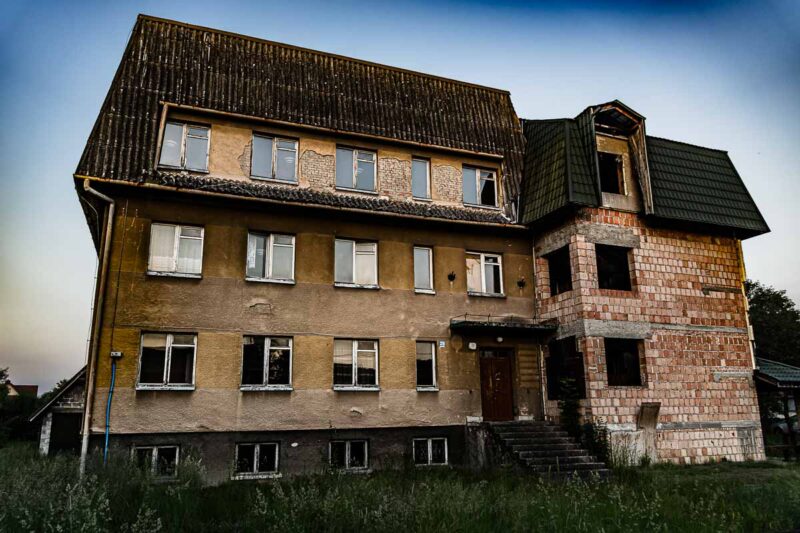
Chat GPT
The House That Waited
Everyone in the village called it the big house, even though no one had lived there for years.
Its windows stared out over the road like tired eyes. The plaster had begun to crumble, exposing old brick beneath. On one side, an unfinished addition stood frozen in time, as if the builders had simply laid down their tools one evening and never returned.
People made up stories.
Some said the family had run out of money.
Others insisted they had moved to another country.
Children whispered that the upper rooms were haunted because one attic window was always open, no matter the season.
The truth was much quieter.
Thirty-five years earlier, Stefan had begun building the house with a single dream: every one of his children would have a room of their own. Every Saturday after work he mixed concrete, carried bricks, and nailed boards into place. Neighbors stopped by to help. His brothers poured the foundation. His father framed the roof. The unfinished wing was supposed to become apartments for his sons after they married.
Then history intervened.
One son found work in Germany. Another left for England. His daughter married and settled in Kraków. They all promised they would come back someday.
"Just a few years," they said.
Stefan believed them.
Every summer he repaired something. A broken gutter. A cracked window. A loose stair. He never finished the addition because he wanted his children to help decide how their homes would look.
Years slipped by.
His wife passed away first.
Stefan grew older, climbing the stairs more slowly each year. Eventually he closed off the upper floor because heating the entire house no longer made sense. He lived alone on the ground floor with a small kitchen, a radio, and photographs that filled the walls.
His children visited when they could. Christmases. Weddings. Baptisms.
Each time they stood in the unfinished rooms.
"We should really finish this someday," someone would say. Everyone nodded. No one brought a hammer.
When Stefan died, the house became what it had quietly been becoming for decades—a monument to plans that had outlived the people who made them.
Today the grass grows tall around the front steps. Rain seeps through cracked mortar. Birds build nests where children were once supposed to sleep. Travelers slow down as they pass, wondering what happened inside those empty rooms. They imagine tragedy.
But the house was never destroyed by disaster.
It was undone by something far more common. Time. Time that scattered a family across continents. Time that turned "next year" into "maybe someday." Time that proved a house can remain standing long after the dream that built it has moved away.
Yet if you stand there on a quiet evening, when the setting sun catches the worn plaster and the old windows glow gold, it doesn't seem abandoned. It seems patient.
As though, even now, it is waiting for someone to come home.
Grok
The wind whispered through the cracked windows of the old sanatorium like a forgotten patient still calling for help.
Once known as “Villa Aurora,” the grand building had opened its doors in 1938 on the edge of a quiet Polish town, promising rest and recovery to weary factory workers and tuberculosis patients. Its mustard-yellow walls and solid brick wings stood proud against the pine forests, a beacon of state-of-the-art socialist care after the war.
But time is a cruel doctor.
By the late 1990s, the funding dried up, the patients were moved to newer facilities, and the doors were simply locked. No one ever came back to turn the lights off properly. For nearly thirty years the building stood empty, slowly surrendering to nature and memory.
Now the roof sags like an old man’s shoulders. Tiles are missing in jagged patches, revealing dark wooden ribs beneath. Windows stare out like blind eyes—some still holding dusty curtains, others completely shattered. The once-elegant entrance staircase is choked with tall grass and wildflowers. Brickwork on the right wing has crumbled away, exposing the building’s red skeleton.
Yet if you stand still long enough on a quiet evening, you can almost hear it: the distant echo of laughter from the common room, the soft shuffle of slippers down the long corridors, the clink of medicine bottles.
Local teenagers dare each other to sneak inside. Old residents of the town still drive by slowly, pointing out the window where their grandmother once recovered. Some say the place is haunted—not by ghosts, but by what it represents: a time when the state promised to take care of everyone, and then quietly walked away.
Villa Aurora waits. Not for demolition crews (the town can never quite agree on what to do with it), but for someone brave enough to remember what it once was… or bold enough to give it a completely new story.
For now, it simply stands—majestic, melancholy, and magnificently ruined—watching the grass grow taller every summer.