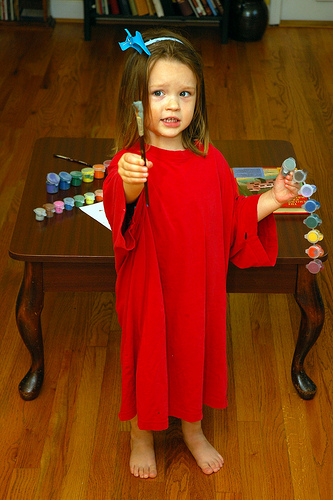
Occasionally, a picture can capture someone's personality perfectly.
fun in threes, sometimes fours
general
Occasionally, a picture can capture someone's personality perfectly.
The room was dark; L and I were in the rocking chair, just moments before she went to bed. A time to calm down, this time of day often brings out stories about how L's school day went.
L began telling me about the order they sit in during circle time. She's in a new group, and most of the children in there are new friends, so there were lots of new names floating about. She hardly finished one name when she started another. Then a pause.
"And beside Alex..." her voice tapered off.
"Who's beside Alex?"
"I don't know." We rocked for a few moments, then she amended it. "I don't know her name."
"Why don't you ask her."
"No," said L in a quick, clipped voice: it's how she's shortened "I don't know" for many months.
"You just have to introduce yourself. Walk up to her and say, 'Hi. My name's L. What's your name?'" A few more rocks, then I suggested we practice.
Within a few moments, she began improvising -- "What's your name? My name's L." -- and adding a handshake with, "Nice to meet you."
The following night, I asked her how it went. "Did you meet that girl from your circle time?"
"No," she replied, and then gave a meandering explanation that only a toddler could come up with. Still, we practiced again.
Funny how an odd thought can lead to nostalgia. Thinking about Boston before going to bed, I did a quick search on YouTube. I found a video of the MBTA (Massachusetts Bay Transportation Authority) stop at Maulden Center, Orange Line.
Like Poland, I don’t miss it and I do.
Two things I miss: first, Boston is a big city packed in a small town. The area the Greater Boston area covers is really small, and the are Boston proper covers is minuscule. The rest is Cambridge, Allston, Brighton, and a handful of others. And Malden, where I lived. Yet it has a lot of the advantages of a larger city: vivid downtown, arts, music, etc.
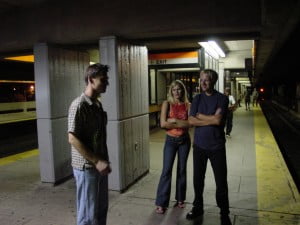
Second, I miss public transportation.
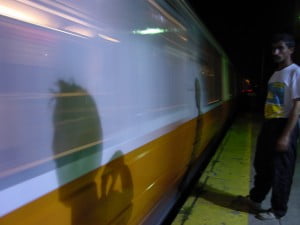
I miss being able to travel from here to there to way over there and back again without a car. A monthly T-pass, a bicycle, and the occasional taxi were all I ever really needed.
Teaching writing means reading things like this
How can you not smile when gems like this are scattered through student writing? Evaluating each assignment becomes a treasure hunt.
I try hard in my class to keep my political and religious opinions hidden. When students asked me, "Who'd you vote for," I simply replied, "That's not a topic I feel is appropriate for the classroom." Some students asked why; most seemed satisfied.
In today's political climate, though, I'm not so much worried about students determining my political beliefs as much as I am concerned at the prospect of them thinking they have sorted out my political views -- and then discussing that with their parents
We were working on Greek and Latin roots and affixes today in class, and we came to the word "magnanimous." We went over the meaning, and as an example of magnanimity, the name "Obama" floated into the room.
To say I equivocated (another of today's vocab words) would be an understatement. I was, for at least three to four seconds, speechless. Running through my head were concerns with how to avoid even an appearance of bias and a bit of paranoia about what might happen if I couldn't succeed in the attempt.
"Sure," I said haltingly. "Especially when he speaks. Most presidents seem magnanimous when they're addressing large groups."
Why couldn't it have simply been "Sure?" Even if there weren't all the political frothing at the mouth about Obama's recent address to students, I would have been uncomfortable leaving it politically unbalanced. But I wouldn't have briefly panicked about it.
Later in the day, in going over a new selection, we were discussing when it was morally permissible to defy a law, and the general conclusion hovered around the idea of unjust laws. We made a list of people in history and literature who'd done this: Rosa Parks, Gandhi, Thoreau. Someone mentioned Robin Hood, and I replied, "True -- robbing the rich to give to the poor."
From the back row comes a distinct, unsolicited comment: "Just like Obama."
I let it slide, choosing not even to acknowledge it, which I think was the right decision. Still, that panic returned. "If I let it stand, will I look like I agree and that my class has a political bias? If I mention it's inappropriateness, even if I say that the real problem was not the content but the method of delivery, will I look like an Obama defender?"
And then I thought, "I'm worried about appearing to defend the President of the United States?"
It's not that I'm concerned about some McCarthy-ian consequences. I couldn't lose my job about something so trivial. But in this time of heightened sensitivity toward anything connected to Obama, particularly here in South Carolina, where many folks view Representative Wilson as a hero, I find myself thinking, "You can never be too careful."
Constantly thinking about the political implications of student and teacher remarks makes for particularly effect pedagogy.
A Mongolian throat singer performing one of the most beautiful songs I've ever heard.
Simultaneously foreign and comforting, it somehow captures the Mongolia that exists in our imagination: harsh yet beautiful.
Similar to this is Tuvan throat singing -- creating whistling harmonics while singing.
I could listen to this music endlessly, I think.
When you get a large group of Poles together (especially expats), there are two things that are certain to happen:
That predictability is somehow comforting.

I began keeping a journal my freshman year in college. I wrote almost every single day. When I arrived in Poland in 1996, I kept the journal daily for two straight years.
One night -- though "early morning" might be a better description -- I realized, as I lay me down to sleep, that I hadn't written anything that day. I picked up my pen, scribbled the date, and quickly wrote, "I'm writing this to keep my streak going." I'm not sure if that really counted, but it did give me a sense of closure as I drifted off to sleep.
I don't write in my journal as much these days: much of what I would write, I write in here. I try to write dream of writing daily, but sometimes, I just have difficulty motivating myself.
Like this evening.
Many of my students expose their emotional buttons and switches freely and openly. Within a few minutes of meeting some of them, I can tell what their sensitivities are.
"How many administrative referrals did you get last year?" I ask some of them, with a smile that I hope says, "I'm not trying to size you up -- I'm just curious."
"A lot," a girl -- call her Ann -- responds.
"Did you notice my question?" I query. "I didn't ask, 'Did you receive any referrals?' but rather 'How many did you get?' I'll bet you got several of those referrals because you simply walked away from a teacher who was saying something you didn't want to hear."
I have her attention: she's curious, and that's always a good thing.
"How could you tell?" Ann asks.
With their posture, gait, tone and volume of voice, many of these kids speak loads without saying a word. Yet they're totally unaware of it. Of more concern is that they're unaware that others are aware of it and can use it against them.
"When you advertise what 'makes' you lose control," I explain, "You provide others with ammunition. The teacher who doesn't like you at that moment knows: 'All I have to do is push a little harder and she'll definitely give me something to write up.' You let others know your weakness and they might use them against you." I pause for a moment, deciding to use a bit of vernacular: "Then who got played? Who got owned?"
"Me," she says meekly.
I have these little conversations after class with the kids that would be labeled "at risk" because they are at risk: they're in danger of becoming slaves to their own impulses and the people who can pick up on those signals and use them.
Occasionally, there are moments that illustrate that they are indeed beginning to pick up on the signals they give off. They are aware that others can only "make them" mad if they allow it by advertising their sensitivities and reacting predictably.
This afternoon, while students were waiting for their buses, I was joking with a young man that I could probably get him in a state that would end in a disciplinary referral for him. We'd been joking with each other all class about such things, and he stridently denied that I could "push his buttons."
"How about you," I ask the boy's neighbor. "Do you think you have advertised what gets you hot? Do you think I could push your buttons and get you furious in just a few moments in class" He shrugs his shoulders.
I turn to Ann, always one of the last students waiting for her bus. "I'll bet I could get you." I know I can: I already have, inadvertently. The question -- the hope -- appears in my mind: "Will she own up to it?"
"You already have, Mr. S." Her grin is an odd combination of devilish delight and sheepish vulnerability.
I smile. "Do you think I could do it again if I tried? I won't ever try, but if I were to try, what do you think?"
She shrugs her shoulders and looks away. For just a moment, though, her eyes say, "I don't think so. At least I hope not." A first step -- an admission of ownership and of personal responsibility.
"One small step for man..." I think, as the students leave for the bus. I glance down at the roll book and see four more names that need to have such a brief moment of self-confidence in their ability to control their lives.
"I'll start on him next week," I mumble.
It's all part of the growing realization I'm having about working with these "tough" kids. The cliche is spot on: they don't care what I know until they know that I care. And they're beginning to know that I care because with me, it's not business as usual in the discipline department. The etymology of "discipline" includes notions of teaching, not notions of punishing, and I try to put that into practice in the classroom.
Many people were concerned about Obama's speech, and some conservatives were voicing fears that Obama would try to indoctrinate the youth. Concerned conservative groups urged parents to keep their children at home, to shield them from the insidious message of socialism. "Parents have a right to decide what their children hear!" they protested, "And we're only trying to protect our children."
The irony is, in trying to shield their children from a perceived socialist threat, they were engaging in behavior that historically has been most commonly exhibited by -- surprise! -- socialist regimes.
One of the most frightening features of the Soviet Union and its satellite states was the complete control they had over information. Orwell's 1984 had the Records Department of the Ministry of Truth, which altered historical documents to create the appearance of Big Brother's omniscience. The Soviet Union, in many ways, did the same thing.
More importantly, though, anything and everything from the corrupt West was censored. The capitalist message was so insidious that it might indoctrinate the happy citizens of the Soviet Union and lead to the downfall of the the most perfect civilization on Earth. Capitalism was bad, so bad that even to think about it was deadly.
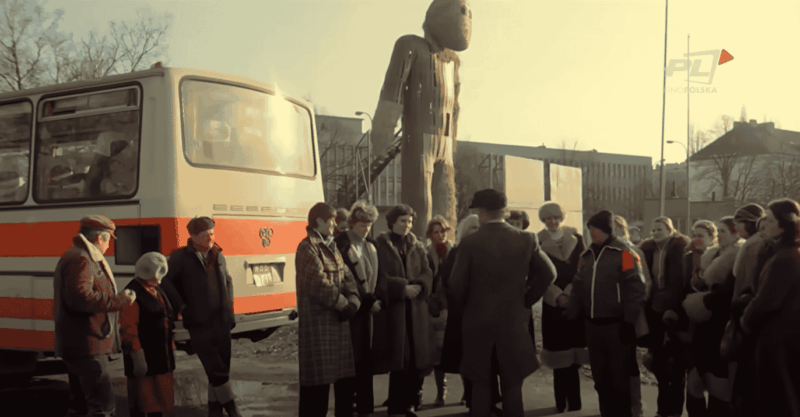
The Polish cult classic Mis ("Teddy Bear") has a scene dramatizing what surely happened each and every time a sports team from a communist country traveled West for a competition. The director of the sports club gives the standard speech before getting on the bus:
You're going to a capitalist country, which might have it's own, well, advantages. Take care that those advantages don't overshadow the disadvantages.
The advantages could be so seductive that they could cast their spell even in the midst of post-war destruction: Stalin imprisoned many of the Soviet soldiers who'd been on the far Western front. They'd seen too much; they'd been contaminated. Indoctrinated.
The Soviets didn't want informed citizens who could weigh the advantages and disadvantages of socialism and capitalism and choose wisely. Big Brother knew very well how seductive the dark side could be, and he took great pains to shield his younger siblings' eyes and plug their ears.