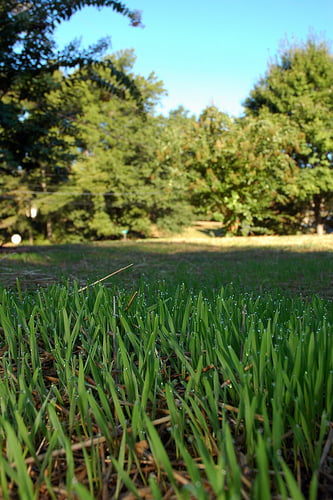
With new grass everywhere -- "baby grass" as L calls it -- we do a lot of watering these days.
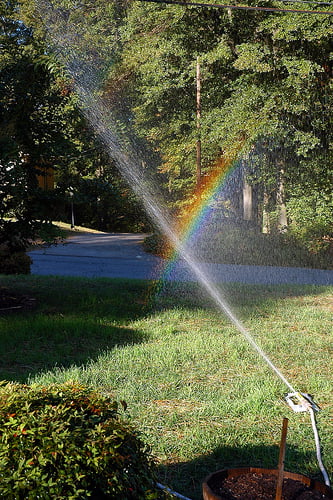
It's enough to make me think we should have installed an irrigation system.
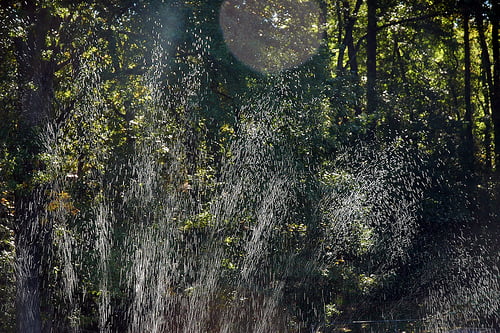
But then we wouldn't get sights like these.
fun in threes, sometimes fours
general
With new grass everywhere -- "baby grass" as L calls it -- we do a lot of watering these days.
It's enough to make me think we should have installed an irrigation system.
But then we wouldn't get sights like these.
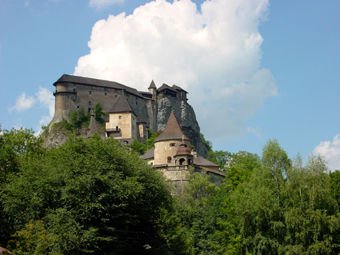
When I start a favorite book with a class, I recall the weeks I was a tour guide for my folks and best friend from high school, all of whom flew to Poland for K's and my wedding.
I knew, for instance, as we rounded the bend and the Oravski castle (where Nosferatu was filmed; watch from 20:00-22:00 and 25:35-27:00 for the castle's main scenes) came into view that everyone's jaw would drop. Perched on the top of a rocky hill, the castle tends to have that effect on people.
Later, in Krakow, I knew what the reaction would be as we entered the Basilica of St. Mary on the market square. The high Gothic walls draw all gazes upward, and all mouths fall open.
So, too, with books. As we approach the shocking moments, the truly moving scenes, I anticipate students' reactions. When Samneric tell Ralph that Roger has "sharpened a stick at both ends," students ask, "Does that mean what I think that means?" When they meet Anne Frank in the pages of her diary, the knowledge of her fate shakes them.
Yet I've never seen a student react so emotionally to a novel as I did recently, as we read Nightjohn. It's the story of a young slave girl who surreptitiously learns to read with from John, a slave who escaped north but returned to lead other slaves to literacy. There are some brutal depictions of violence against slaves, including the story of Alice, young girl who is whipped and then attempts escape. The pursuing slave owner finds her and lets his dogs attack. She survives, only barely.
"My heart hurts," said a young African American girl who sits toward the back of the room. By the time the bell rang, a few tears were rolling. As she was leaving, I spoke to her, a little concerned.
"Are you going to be alright?"
"No," she cried. She walked out of the class and completely broke down. As she sobbed, friends -- who hadn't been in class with her -- crowded around her compassionately.
It was bittersweet, in the truest sense of the word. That someone was that moved by a book was both a source of hope and empathy.
Last year, we overseeded our front yard. It looked fantastic.
"We have the best grass on the block!" K and I would congratulate each other. It was thick, lushly dark, and totally carpeted our entire front yard.
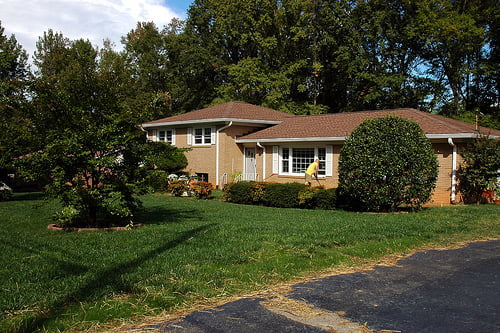
Over this summer, it all died.
All of it.
We looked at our wretched front yard and looked at what it used to be like, and a sort of "why do we even try?" depression would set in.
But we don't give up. Not we. We continue to dump money into projects that probably should be left alone. So last week, we rented semi-heavy machinery,
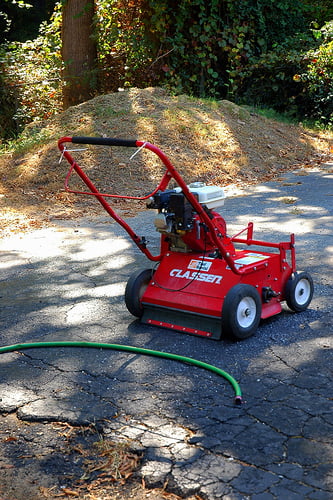
and started all over.
Technically, it was called "dethatching." Practically, it was called "pulling up all the grass, most of which had long-since died."
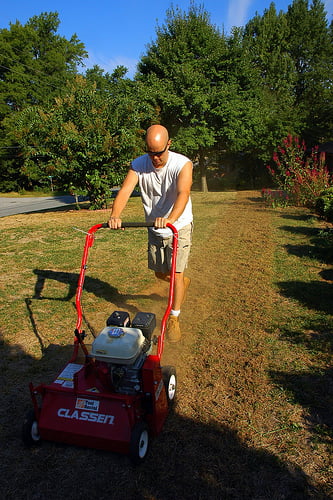
We were left with rows of rubbish -- weeds, dead grass, almost-dead grass -- that had died for mysterious reasons. Bugs? Disease? (Certainly not fungus: it was too dry this summer for any fungus to survive more than a few moments.)
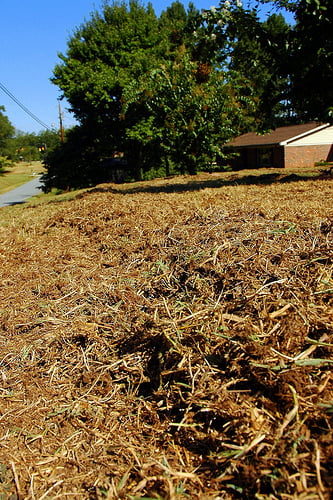
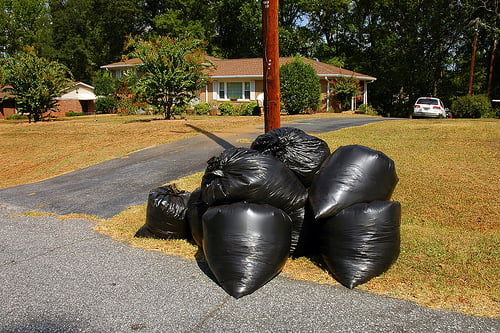
Whatever it was, we didn't want it. So ten bags of it went out to the curb.
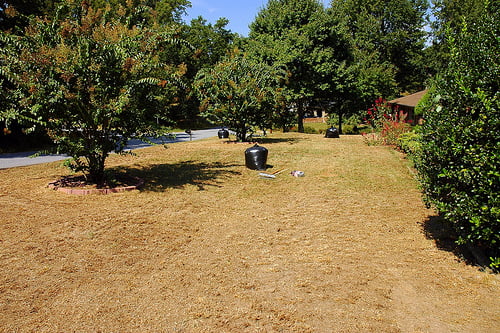
What a waste, really. It got me thinking -- if our lawn survives this coming summer -- whether or not I could simply run our mulching mower over the dethatched refuse and let the yard self-feed.
After applying top soil, mulch, seed, fertilizer, and straw, the rain came. After many dry weeks, we had thirty-six hours of continual rain, followed by sporadic showers through the following week.
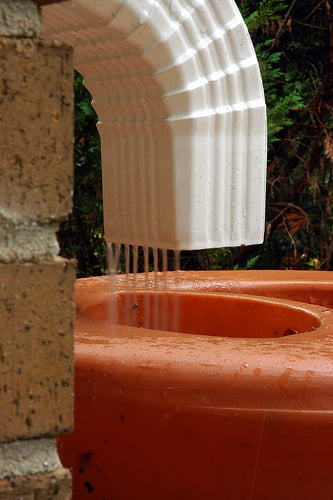
I couldn't have planned it better if I'd tried.
A week later:
My English 1 Honors class is about to start the Odyssey. For their weekly short essay assignment, I asked about heroes and heroism. Commenting on the usual association of "hero" with super powers, one student wrote the following:
In fact in the real world having superpowers would make you a villain sooner than it would a hero because though the idea of superheroes saving the world on a regular basis is nice and all, name one superpower and there are probably more than ten different ways to exploit it for personal gain and in a world where “look out for number one” is a personal motto for most of the world it is no long shot that with real superpowers there would be more villains than heroes in the world.
Getting these kinds of results is a real boost: such potential in this kid's writing. The problems are purely cosmetic: nothing a few mini-lessons on sentence variation, punctuation, and voice can't buff out.

Bonnie Davis writes in How to Teach Students Who Don't Look Like You,
In searching for the causes of the achievement gap, [Haycock] and her research colleagues ask adults why there is a gap. They hear comments from educators that the children are too poor, the parents don't care, and they come to school hungry. The reasons, she adds, are always about the children and their families. Yet, when she talks to the students, she hears different reasons. Students talk about teachers who do not know their subject matter, counselors who underestimate their potential and misplace them, administrators who dismiss their concerns, and a curriculum and expectations that are so low level that students are bored.
I'm curious about the methods of this study. Were teachers simply asked to share their assumptions, with researchers later collating and categorizing them? Or was there a questionnaire? Either way, there is an element of interpretation necessitated by such research that might make it far from objective.
I'm particularly curious about the claim that students find the curriculum so low-level that they're bored. I don't doubt their claim to be bored, but I'm skeptical about the cause of that boredom.
In my own classroom experience, I've found the state-mandated curriculum to be too challenging for many of the students placed in on-level classes (students who, generally, actually read two to three grade levels lower than their actual grade). I often feel my expectations are too high.
But is this why children are bored in the classroom? Is there a societal element? I believe there is. Contemporary entertainment media -- games, television, the Internet -- have taught students to expect short, entertaining bites of information.
The question is obvious: are we competing with the new media?
We might be in competition for students' attention, but to that I'm tempted to say, "Well, that's at least equally the students', parents' and teachers' fault." I agree that teachers should be interesting and engaging, but the point of the classroom is not entertainment, and the defining criterion of an effective twenty-first century teacher should not be their ability to entertain students.
We began a new unit on Nightjohn and literacy in the English Studies class today. Just as the students were starting the kick-off, which was to answer the essential question, "How does literacy change lives?", I had remembered William Meredith's "The Illiterate." It's always been one of my favorites, a sonnet that takes all the rules about sonnets and bends them slightly. Cursing (internally only), I was frustrated that I hadn't thought of it earlier. It was one of those moments where the teaching-as-an-art kicked in. I thought about it for a moment, Googled the title, and, finding it available online, decided to improvise.
I thought I'd try a technique I'd learned at the South Carolina Middle School conference at Myrtle Beach last year, but not having printed copies, I had to improvise.
I projected the poem on the whiteboard and read it aloud to the students.
The Illiterate
By William Meredith
Touching your goodness, I am like a man
Who turns a letter over in his hand
And you might think that this was because the hand
Was unfamiliar but, truth is, the man
Has never had a letter from anyone;
And now he is both afraid of what it means
And ashamed because he has no other means
To find out what it says than to ask someone.His uncle could have left the farm to him,
Or his parents died before he sent them word,
Or the dark girl changed and want him for beloved.
Afraid and letter-proud, he keeps it with him.
What would you call his feeling for the words
that keep him rich and orphaned and beloved?
"Turn to a partner," I said when I finished, "and select the five to eight most important words in the poem." As they finished up, we went though the poem line by line, and I circled important words students called out from behind me. In the end, with a few suggestions from me, it looked something like this:
Touching your goodness, I am like a man
Who turns a letter over in his hand
And you might think that this was because the hand
Was unfamiliar but, truth is, the man
Has never had a letter from anyone;
And now he is both afraid of what it means
And ashamed because he has no other means
To find out what it says than to ask someone.His uncle could have left the farm to him,
Or his parents died before he sent them word,
Or the dark girl changed and want him for beloved.
Afraid and letter-proud, he keeps it with him.
What would you call his feeling for the words
that keep him rich and orphaned and beloved?
"That's more than five to eight words," one student pointed out.
"True, but this was what I was aiming for in the long run, so it worked out well."
I read the poem again, and then we talked about its meaning based on the highlighted words. They quickly saw that the letter contains three options: riches, sadness, and love. We jumped to the last line and reread it.
"Turn back to your partner and come up with three words that might describe his "feeling for the words that keep him rich and orphaned and beloved." The responses were varied, as I'd hoped:
We went back to the poem once more, and I led them to see that the  majority of the poem is an extended simile to explain the poets feeling when touching the unnamed subject's goodness.
Turning it back to the essential question, I had students write in their journal how literacy would change the narrator's life. We shared a few, then moved on to the next portion of the anticipatory lesson for Nightjohn.
As I write this, though, it occurs to me that I missed a significant portion of the potential power of the improvised activity. The narrator is not illiterate in the literal sense of the word (pun not intended). He is, however, illiterate. It might have been worthwhile to see if the kids could pick up on the emotional illiteracy that the poem is expressing.
Still, not bad for ninety seconds of planning and another sixty seconds of preparation.
By Wisława Szymborska
The photograph halted them in life,
and now keeps them
above the earth toward the earth.
Each is still complete,
with a particular face
and blood well hidden.
There's enough time
for hair to come loose,
for keys and coins
to fall from pockets.
They're still within the air's reach,
within the compass of places
that have just now opened.
I can only do two things for them–
describe this flight
and not add a last line.
Skoczyli z płonących pięter w dół
- jeden, dwóch, jeszcze kilku
wyżej, niżej.
Fotografia powstrzymała ich przy życiu,
a teraz przechowuje
nad ziemią ku ziemi.
Każdy to jeszcze całość
z osobistą twarzą
i krwią dobrze ukrytą.
Jest dosyć czasu,
żeby rozwiały się włosy,
a z kieszeni wypadły
klucze, drobne pieniądze.
Są ciągle jeszcze w zasięgu powietrza,
w obrębie miejsc,
które się właśnie otwarły.
Tylko dwie rzeczy mogę dla nich zrobić
- opisać ten lot
i nie dodawać ostatniego zdania.
Translated by Clare Cavanagh and Stanisław Baranczak.
Every morning, I have a student thumb through the myriad writing prompt books I've collected and choose a prompt for the day's journal writing. While I've tried other starters (or kick-offs, or bell-ringers, or whatever one wants to call the activities intended to get kids actively productive from the moment they enter the classroom), I like journal writing the best. It ensures that, no matter what else happens in the lesson, the kids have done some writing.
As I prefer to teach by doing, I too take a moment to write a response to the day's prompts, especially when kids choose a particularly thought-provoking one.
Today's was one such prompt:
You answer a knock at the door and find a delivery guy holding a package for you. You open it up to find ... what? Describe the best package you can imagine receiving.
What could I possibly want that would fit in a box? I want my daughter to grow into a self-assured woman. I want my wife always to smile when she thinks of me. I want my parents to stay healthy and active for many, many more years. I want my students to leave my class with skills and knowledge that will serve them for a lifetime.
How could I put these things into a box? Perhaps the box contains a photo album recording my daughter's successes, my wife's smile under gray hair, my parents standing with my daughter after graduation, my students holding college diplomas -- a peek into the future that's a reflection of the past.
A three-day weekend allows us to do things we wouldn't ordinarily do over the weekend. Trips and mini-vacations come to mind on Labor Day weekend, but we elected to stay at home. A hurricane brewing and a coughing daughter made us cancel our plans of camping at the beach, so we did things out of the ordinary.
Like go to Target.
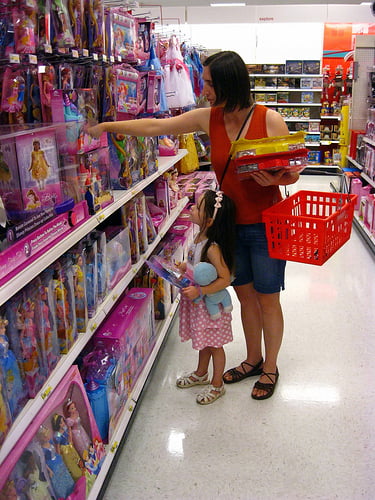
L spent her own money, which Nana and Papa (from whom else would she have received it?) had intended the money for our trip to Polska. She'd received so many gifts -- from friends, family, and a particularly sneaky godmother -- that we simply didn't encourage her to spend it.
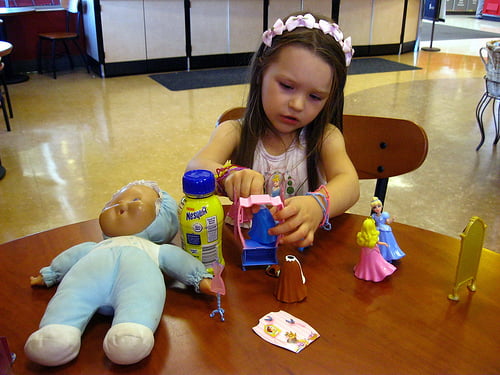
Now the encouraging begins. What to buy? So much cash, so many princesses, so little parental support. In the end, she went with Cinderella and Sleeping Beauty. The classics.
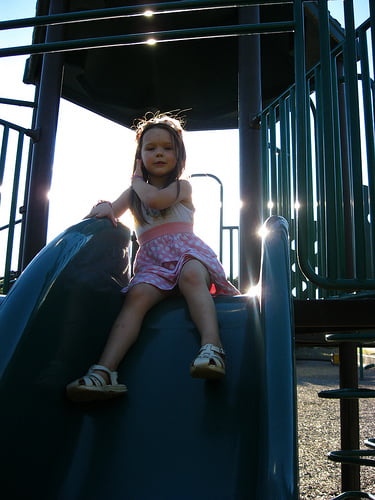
We finished Saturday at the park, with K and I musing how much she's grown since the first time we went to this neighborhood playground. Saturday she ran wildly, losing sight of us and popping up here and there giggling. Our first visit was cautious: no running without knowing where Mama and Tata are. No climbing without a protective hand on the bottom. No swinging without a toddler swing seat.
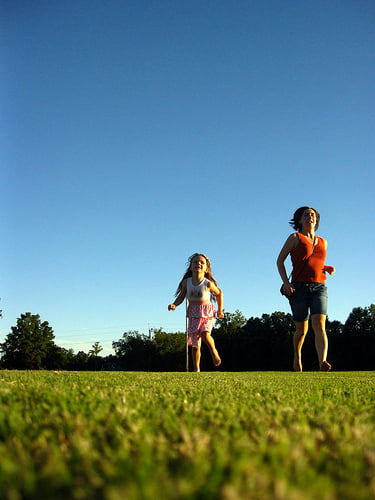
The follower has become the leader. "Come on, Mama!" she cried out when we went to the empty baseball field. "Chase me! Catch me!" We can still catch her, but it's not a question of three quick steps and swoosh! she's in our arms.
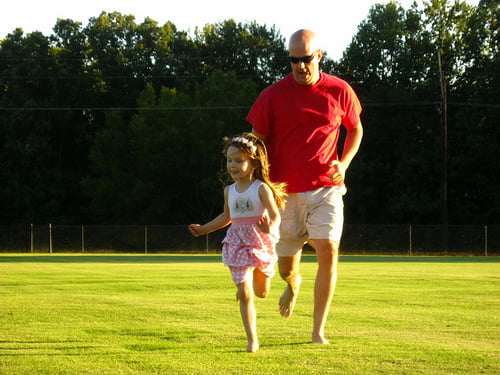
She's become a moving target, with a sure, steady gait and a strong sense of independence.
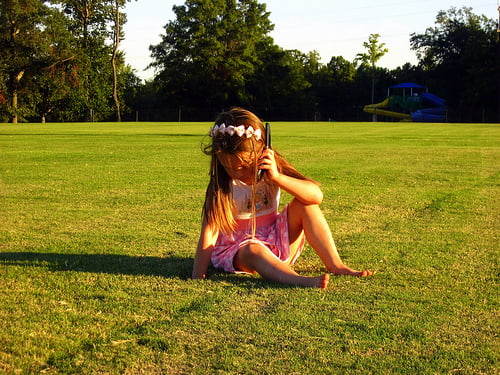
As she sat, talking to Nana and Papa, the "I can see her as a tween, as a teen, as an adult" moment washed over me all over again. The independence, the quick feet, the willingness to explore: all these things indicate the inevitable, but we so infrequently notice it.
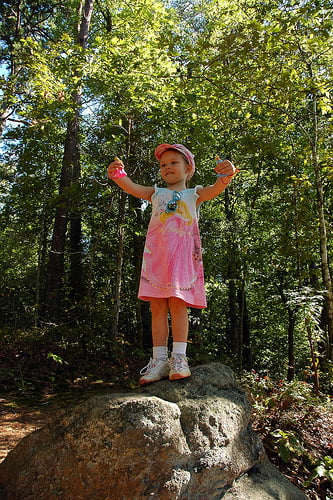
Sunday, we headed back to the park, but this time, a large state park with a couple of lakes, a few miles of trails, and plenty of rocks for climbing.
And boats.
Blue boats.
Blue glittery boats.
"The only thing that would make this more perfect," I suggested as we neared the paddle boats, "would be for the sparkles to be pink."
"Right!" came the response.
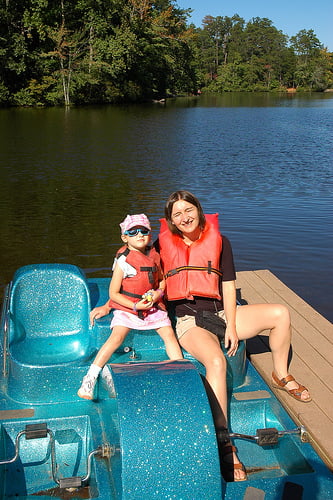
Where did this love of pink come from? Pink is the stereotypical girl color, and we have in fact tried to avoid purchasing pink clothes for her. Yet pink remains the eternal runner-up in the "my favorite color" contest.
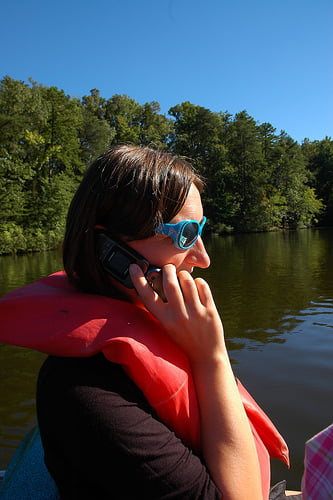
The only way to make the day more perfect was a picnic. "A picnic!" L cried. "I'm so happy!"
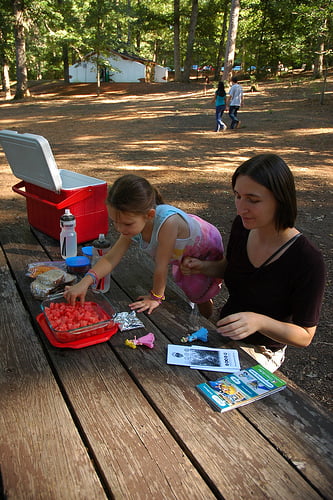
With a mayonnaise-cheese sandwich (what odd taste little girls can have) and all the watermelon she could eat, she certainly had cause for joy.
The walk that followed somewhat damped that joy. "I want to go home!" was a common refrain,
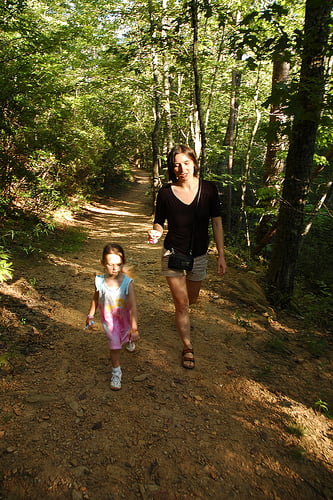
until we reached a small clearing with plenty of rocks for skipping ("making ducks" in Polish) and general tossing.
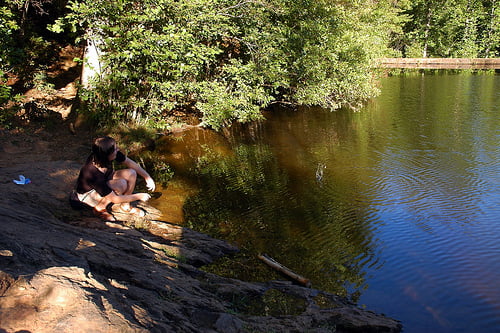
As might have been expected, L modified the previous refrain, adding a quick "don't" when we suggested it was time to go.
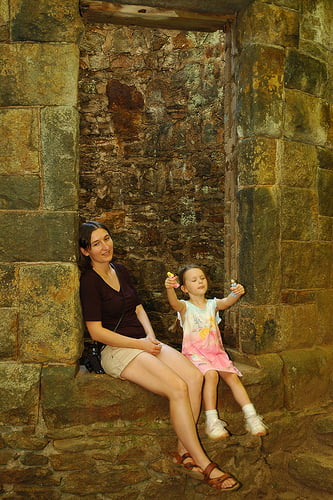
But we were all tired, and bedtime was approaching. Only the princesses were still on their feet.