matching tracksuits

fun in threes, sometimes fours

general

Transfer

I sit in class with fourteen other adults, and we go through essays that students have submitted for group review. We share what we like and what works for us as well as what we think could be improved. We're courteous but sufficiently critical. We take initiative, ask and answer questions, volunteer observations. The author jots notes about this or that comment, sitting silently yet respectfully listening.

Why can't I get this to happen in my own classroom? I have a list of excuses:

  • Students don't come prepared.
  • Students don't have the necessary background knowledge.
  • Students don't have the sufficient motivation.
  • Students don't have the necessary skills, social or subject.
  • Students don't care.

For any given student, one or more of these end-of-the-day excuses might be true. Or none. Or all. Some are in my control; many are not. The common element, though, is probably the problem: "Students don't."

I make an effort to incorporate workshops into my teaching. Things don't go as well as I'd hoped, so I refocus -- "Stop thinking 'students can't' and 'students don't'!" -- and re-plan and try again. Somewhere, the right balance of innumerable factors exists, and someday, I'll be leading a class like the one I participate in every Tuesday evening.
Treasure

A four-year-old has treasure stored up in every corner of the house. There's the princess umbrella that sits in the toy basket downstairs, ready for deployment. There's the scooter downstairs, festooned with princess regalia, parked by the pink bike. There's a bookshelf packed with books, new and old, tall and short, thick and slim.

And then there's the jewelry.

All L's treasure had its own, proper, fitting place before today except for the jewelry.

DSC_0161

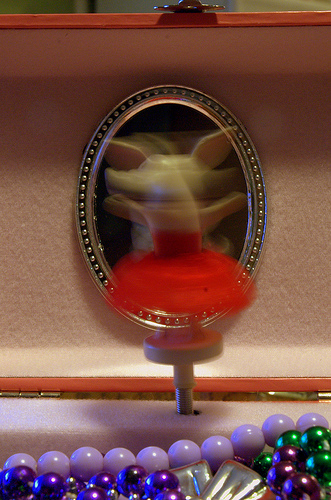
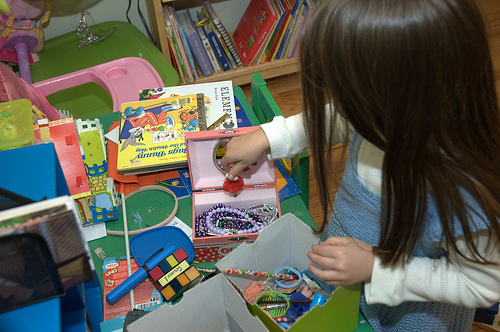
A small but colorful cardboard from Ikea held L's beads and rings, her bracelets and necklaces, her charms and her gems. And so when she saw the jewelry box at Barnes and Noble this afternoon, there was no question. She'd come with money sent from Poland with the intention of buying a book.

DSC_0163

She left with a new treasure,

DSC_0169

to hold all her other treasures.

Tłusty Czwartek

Yesterday was Tłusty Czwartek, "Fat Thursday." In Poland, it's traditionally a time for pączki, doughnuts. "Ile pączków zjedliście?" asked a friend in Poland of his Facebook friends. How many doughnuts did we eat? On Thursday we ate none. Dunkin Dounuts and Krispy Kreme don't count. They're doughnuts, not pączki. Traditionally filled with rose petal jam, Polish pączki really look, smell, and taste nothing like what we usually get in the South.

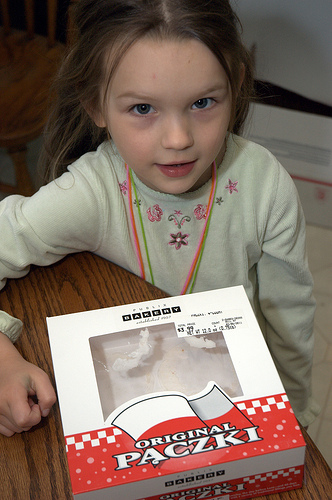
And then K discovered that Publix -- of all places -- sells "Original Pączki."

Polish Paczki

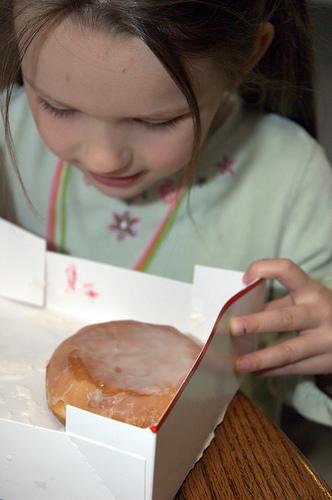
They're filled with raspberry jam instead of the ineffably good rose jam, and there's something not quite right about the consistency of the crust, but they're an acceptable substitute for a mid-sized Southern town.

Jam-filled

L had one for dinner. "It's time she learned what 'Fat Thursday' is all about," proclaimed K. For her part, L was less interested in the doughnut than the filling, which she fingered out and declared to be delicious.

Studying

I'm taking two classes this semester, still working toward a Master's; I have to study.

K is taking a class this semester, beginning her course work toward an eventual professional license; K studies.

Language Work

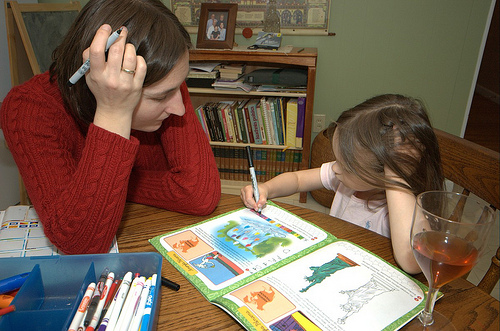
L, seeing the two of us, has decided she needs to study.

Games with Nana

Shadows

It was a mystery: walking down the street in our home outside of Rock Hill, I found that no matter how I jumped, sprinted, or turned, my shadow stayed with me.

It's a novel observation, but one we all experience. So ubiquitous is the discovery that are shadows are inescapable that it finds its way into our cultural imagination. Recall that in Disney's imagination, Wendy first meets Peter Pan when he's trying to capture his shadow.

Yesterday, the Girl discovered her shadow is relative.

"Tata, look! My shadow is big

DSC_0017

and then it gets really little."

DSC_0018

The rest of the swing time, L kept her chin buried solidly in her right shoulder as she contemplated the mysteries of her ever-changing shadow.

Bibo, ergo…

The Girl, tucked in bed, is trying to convince me that, despite having trekked down the hall just six minutes ago, she has to go again.

“Tata, I’m lying in bed,” she begins, thrusting her right fist out in front of her. “I’ve been drinking juice,” she continues, thrusting her left fist out as well. They float there, swaying back and forth as if she doesn’t know what she’s going to do with them.

She claps them together, providing an apt conclusion: “When the two halves meet…”

Letters, Part Two

Over the summer, a former student tracked me down on Facebook and sent me a note. I'd had an interesting relationship with the young man: at times, I felt he was very frustrated with the class. Indeed, he said as much. And he also said that very often, when he'd asked for help, I didn't really help him. I thought about this for a moment, then realized that he wasn't yet recognizing what I was trying to do. It's something along the lines of the saying about giving people fish versus teaching them to fish.

The young man's note included one of those compliments that feels a little like a backhanded insult. He wrote, "I want to thank you for being such a great teacher and making the class not extremely boring." Apparently I was boring, just not extremely so. Yet the next few sentences simply set me to smiling:

You would help me sometimes and most of the time you didn't, and I am glad you did that. I realized that I can't be helped all the time and that I need to learn to do things on my own more often.

He closed by saying that I "made the class and literature enjoyable" for him, but that's really of little significance compared to helping him develop self-reliance.

One of the things I love most about teaching eighth grade is the simple fact that I teach more than my subject content. I came to realize this fully the other day, when I received the third letter.

To be continued, again...

R&J

It’s that time of the year, the highlight of my teaching year in many ways: I go over Romeo and Juliet with my English I class. I know I’ve mentioned this before, even at roughly the same time of the year. (The start of the second semester is just such a perfect time to begin the most challenging read of the year.) I suspect I’ll be writing about it every January, because I get such a thrill out of introducing a new group of kids to arguably the greatest writer in English.

It’s such a time of uncertainty for the students. Shakespeare has held such a vaunted place in their imaginations for so long that they’re certain it will be the most stilted, boring bunch of aristocratic nonsense they’ve ever encountered.

And then they hear the nurse making one sexual innuendo after innuendo: “I am the drudge and toil in your delight, / But you shall bear the burden soon at night.” They notice that Juliet is prone to making them, too:

‘Tis but thy name that is my enemy;
Thou art thyself, though not a Montague.
What’s Montague? it is nor hand, nor foot,
Nor arm, nor face, nor any other part
Belonging to a man.

They see Mercutio being a positively provocative smartaleck: “And but one word with one of us? couple it with / something; make it a word and a blow.” They find themselves not liking characters: “Mr. Scott, Romeo is kind of creepy in a way.” And out of the seeming blue, they find themselves able to follow three scenes (2.4-2.6) in a recorded performance without the aid of the text before them.

Every day, I ask the same question: “On a scale of one to five, how difficult are you finding Shakespeare now?” I ask students to hold up the number of fingers to express their difficulty with the text. After the first reading of the prologue, it was all fives. Now, after two acts, it’s a mixture of fours, threes, and twos.

I have the privilege of watching 100+ eighth graders grow and develop over the course of nine months. I see them developing self-control, self-confidence, and occasionally even calm humility, but these are part of the natural course of growing up. Seeing them gradually make their peace with an author they feared only months before (and I can claim all 100 for this, for everyone in my classroom comes to terms with the Bard at some point and some level) is something I can claim at least partial credit for, and it’s one of the many thousands of reasons I can’t imagine doing anything else.

Photo by -JvL-