Nap
Wednesday 10 August 2011 | 2 Comments
fun in threes, sometimes fours
general

We jostle about in our adolescence, bumping against others and ourselves, usually questioning where we stand with others, often unsure of where we stand with ourselves. Such tumultuous times of identity formation, questioning, and reformation. We make and remake ourselves year after year, month after month, even day after day, and we’re all nagged by the same question: is the me I see in myself what others see? Or more to the point, is the me I see in myself the real me?
Sociologists and psychologists tell us that adolescence is a relatively recent cultural phenomenon, a product of the same innovations that created the leisure class and free time. In the past, one’s position in life was fairly well determined generations before one was born. Once born to generations of farmers, always a farmer; once born to a family of wealth and position, always an aristocrat. These days we wake up and find ourselves in possession of a driver’s license and a handful of friends, unsure what to do with either, and we struggle to make decisions that weren’t even available ten decades ago.

Every year, as an eighth grade teacher, I see my own students going through this, yet with seemingly infinitely more choices that I had. Their thumbs can move at over a phone’s small keypad at the speed of gossip, and last week is ancient history. They come to class sometimes with tears in their eyes, and I think, “Someone broke someone’s heart, and they’re both sure they’ll never survive it,” and I smile to know they will, because I did, and a hundred and twenty kids in my cohort did as well. “Love is blindness” I mutter under my breath.

I want to say, “Twenty years from now, you won’t worry so much about this. Like precipitates in a Chem II experiment, love and your personalities will seem somehow to have settled and congealed.” I want to tell them, “You’ll quote the Beatles: ‘I am he as you are he as you are me and we are all together,'” until I realize that U2 is their Beatles. (A student mentioned to me that he likes U2: “My friends think I’m crazy for listening to that old music,” he confided. Thanks.) I want to confide, “You’ll think to yourself, ‘Love is blindness,’ go to your twenty-year reunion, and find that you had more in common with everyone in your class than you ever realized.” But I know the words will do no more for their shattered hearts (egos?) than such words would have done for mine, and I’ll hope that some day, perhaps they’ll invite me to a reunion.


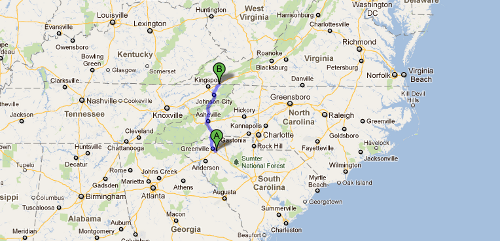
I grew up in a border town -- half in Virginia, half in Tennessee -- about three hours north of where we presently live.

In the last fifteen years, I've only gone back a handful of times. Today, K and I are making the trip to meet with people I haven't seen in twenty years, most of whom I knew only in passing, and many of whom I probably won't recognize, and if I do, I likely won't remember their names immediately. Yet there are a few, and to see them again will be worth it.
I wonder, in the age of social networking, will future generations have twenty-year reunions?
Sometimes I wonder whether popular bands shouldn’t hire grammar consultants for their lyrics. I was listening to the Black Crows the other day, and as “Hard to Handle,” the Isbell/Jones/Redding standard, played, I noticed a grammatical flaw made the protagonist accidentally bisexual:
Actions speak louder than words
And I’m a man of great experience
I know you’ve got another man
But I can love you better than him.
I’m sure the lyricist meant, “I can love you better than he,” which is an elliptical version of, “I can love you better than he can love you.” Choosing the objective “him” instead of the subjective “he” simply means he’s loving the guy. Adds a whole new meaning to the earlier line about being “a man of great experience.”
The Beatles also fell into this exact same trap: using the objective case pronoun when it should have been the subjective case. This time, though, the song inadvertently turns the two girls between which the narrator is dithering into bisexuals:
If I give my heart to you
I must be sure
From the very start
That you would love me more than her
I’m sure Freud would have loved these.
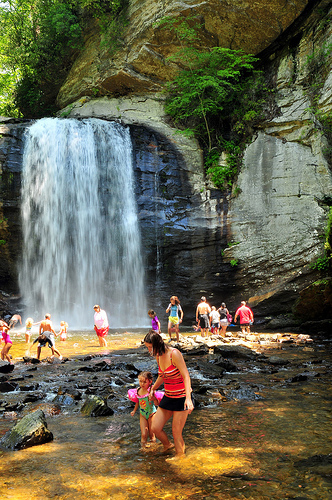
Throughout Transylvania County, North Carolina, there are virtually countless waterfalls. One can purchase a guide that provides directions to various sites, with some of the less popular ones including instructions like, "Turn right on the gravel road just past the fish hatchery. Drive 1.1 miles." Yet many of them are easy to find; indeed, they're hard to miss, like Looking Glass Falls.

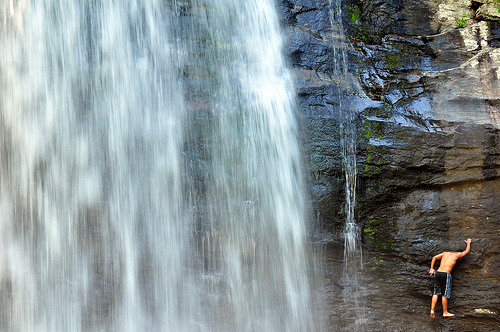
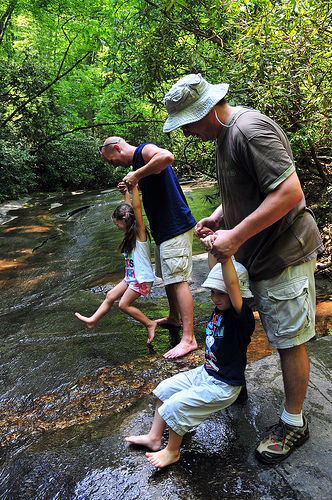
Down a winding, paved path to an enormous rock outcropping, our family and our guests find our way to one of the most significant falls in the area. A fine mist drifts through the gorge combines with the cool water for a most effective chilling experience. All that's missing is a chair and a good book (preferably a ratty copy: it's likely to get ruined in the mist).
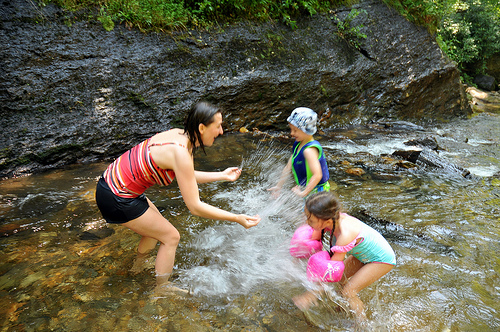
Lacking those things, we do what comes natrually: the children splash each other and K, and I switch the camera to the six-frames-per-second mode to capture fifty photos of the fun that will be whittled down to one or two.

We're not the only ones playing, but it seems to me we're taking the saner route to amusement. Of course, the adolescent head is impervious to rocks, adolescent arms never lose their grip, and adolescent feet are always sure and balanced.

After a bit of splashing around, it's time to head further up the stream to Sliding Rock, the most famous and most popular attraction in the area. Indeed, it's so popular that we arrive to find the parking has closed because of overflow, which means the wait times for the main attraction -- obviously a large rock one sides down -- are close to fifteen minutes.
Instead we head further up the stream to the education center, which houses the fish hatchery. In the outdoor "race tracks" (do they actually have contests?), we find the trout are, according to our New Jersey Polish visitors, upchani jak śledzie: apparently commuters and fish of all species can be described this way. The saying refers to the habit of packing pickled herring tightly in jars for storage.

After a picnic break, we contemplate returning to Sliding Rock. Instead, we go for one of the "turn right on the gravel road just past..." waterfalls.

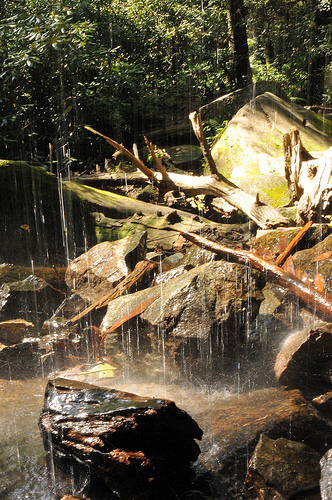
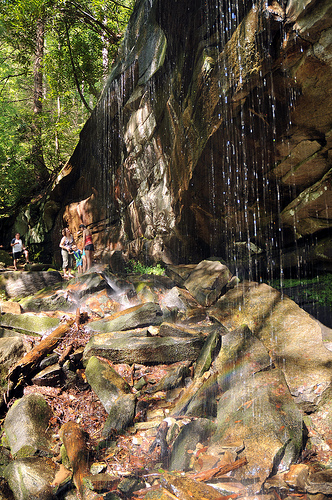
It turns out to be not as much of a waterfall as it is an outdoor, stone-faced sprinkler. The floaties and life jacket we brought for the children are for naught.


Still, a lovely view, some nice light, and a chance to trek through the forest for a while. It is a teaching experience, one could say. But not a lot of fun. That would be Sliding Rock, and we decide finally to head back and see if it's still packed.
It's not, and in fact, there is virtually no line for the star attraction.

K goes first. After a while, she talks the Girl in to a short run with her.


Perhaps Sliding Rock will become yet another metric of growth: the first time the Girl slides solo. Eventually.
Immigrants bring all sorts of things with them when they move to a new country. They bring items of their culture: language, songs, recipes.

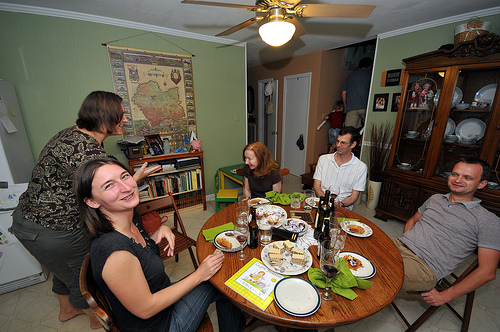
They bring a love of native-language literature (even if it's actually translated from another tongue) that excites them beyond words when they find someone else who seems to love a given book as much as they do.

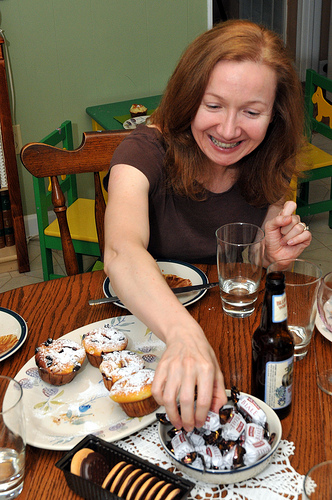
But one thing they must leave behind is the confectionery that brings a smile to their faces and warmth to their hearts.

The plan was simple: get up at a reasonable hour, drive two hours to a spot in northern Georgia, and be awed at the fantastic views of a canyon known as the "Grand Canyon of the South." But such plans begin taking shape the evening before, and when the evening drifts into the morning and all the adults are still awake, the likelihood of the plans coming to fruition diminishes greatly.

The backup plan -- the realistic plan -- was a return to Table Rock State Park. At only forty-five minutes away, it seemed a more logical choice for a late start. Being in the mountains, it also seemed a more comfortable choice.

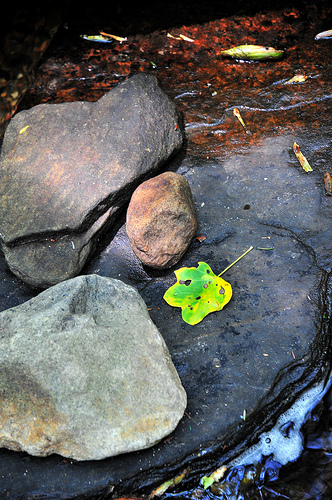
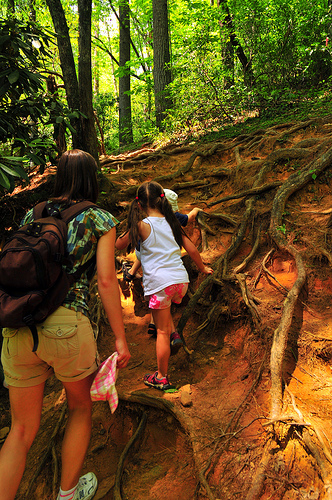
We hiked the trail we always tale: Carrick Creek trail, appropriate both for its length (four-year-olds can walk only so far) and for its scenery, which is both beautiful and, more importantly for the kids, amusing. (Who doesn't love playing in waterfalls or slipping and sliding on moss-covered rocks?)

The hike was more engaging with a game, so the kids had a contest: who could find the most trail markings on trees? It's a common game we play with L to keep her interested in the walk. We played it in Slovakia a year ago, and every time we're on a trail by ourselves, we encourage the Girl to look for the signs.

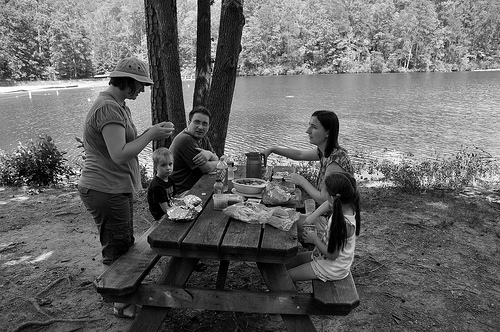
Despite the fact that both contestants marched right by trail makers without noticing them as they tried desperately to be first (apparently it was a dual contest), the game ended in a tie, which was frustrating for both the kids but a relief to the adults: one less wound to soothe. No one likes to eat a picnic when one of the diners is tinged with tragedy, feeling the sting of an unfair loss.

Any heated tempers would have been quickly cooled, though: the lake's swimming area was closed, leaving only one option for cooling off after an arduous mile hike.