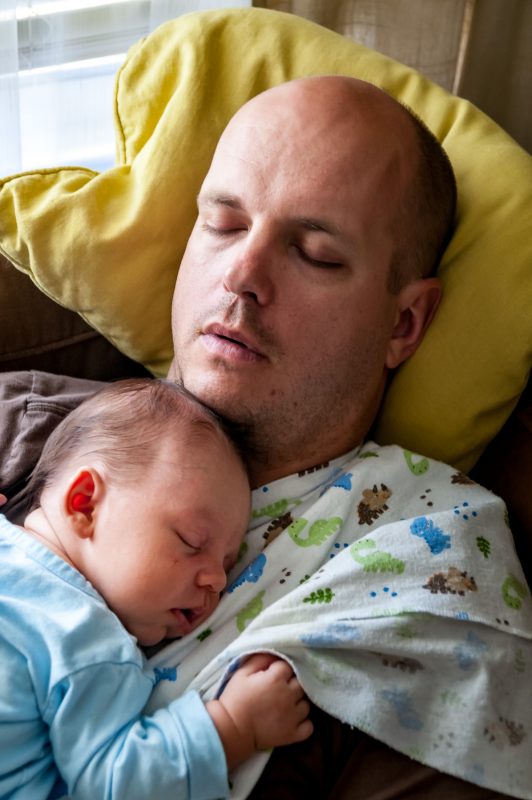
“Can you hold the boy?”
Sure — for as long as necessary.
fun in threes, sometimes fours
general
“Can you hold the boy?”
Sure — for as long as necessary.
Infants are deceiving: they sometimes look as if they’re entranced with something, gazing into the distance and lost in thought.

The pediatrician assures us that the Boy can’t even really focus at this point. His muscles have little minds of their own, and things blur and crystallize without his conscious thought or control.
Sometimes its better to read into it what we will, though.
"Daddy, can we play chess?" the Girl asks almost daily now. She's learning -- slow steps -- but her enjoyment of the game is most gratifying. Today: knight study.
"Put a pawn at each square this knight is attacking," I say. She forms the circular pattern around the knight.
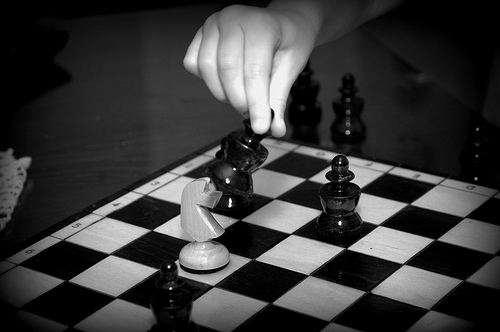
"Notice," I continue, "that the knight is on a white square but is attacking all black squares." I hope this will help her complete the exercise, but we end up getting pawns on random black squares in a few moments.
I suppose the next lesson -- moving the knight to the edge of the board to show how its power is effectively halved in doing so, proving the old adage, "A knight on the rim is grim" -- will have to wait.
It’s a good sign: the Girl is utterly fascinated with the Boy. “I want to hold him!” is a common refrain. “That’s so cute!” is a frequent chorus.

The question is, how long will it last?
We’ve come a long way in the last couple of years. The Girl swims; the Boy is; and I’m still expanding.


We have a new child in the house, and I'm barely updating. I could make excuses.
We're too busy taking walks:


Backyard twirling sessions have taken up all of our time:

Testing new snorkeling equipment has eaten into our time:

We've been busy jumping into the water:

We've been learning to drive a stick:

Lots of excuses; none of them convincing.
Yesterday the school year ended; I’ll take some pleasant memories from this year’s group.
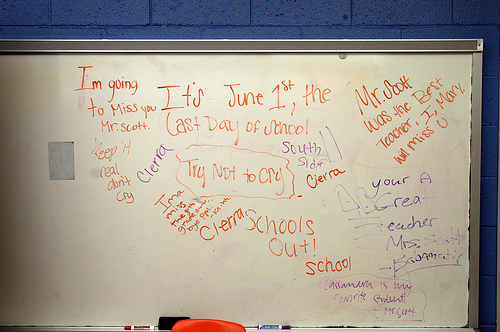
How many ends can we face? The end of elementary school; the end of a fable; the end of a friendship; the end of a marriage; the end of a book; the end of an evening; the end of a song; the end of a project; the end of a journey; the end of a sunrise; the end of a bike ride; the end of a cigar; the end of a sunset; the end of a relationship; the end of a concert; the end of a line; the end of a story; the end of a caress; the end of a smile; the end of a blog post; the end of a bottle of ginger ale; the end of middle school.

Weren’t we all so broke by endings when we were young? Weren’t we so unable to discern the difference between “the end” and a conclusion?
Today, two hundred and fifty — if not more — eighth graders met another in countless endings. For some who’d lost a parent or a sibling, it paled in comparison. For others, it was a tearful afternoon. Those who don’t know will all learn soon enough.
The Boy can be amusing as he wakes.


The professor was terribly kind to give me a job as her assistant on her great exploratory backyard safari.

We had an important mission, a mission of discovery in lands of danger.

First up, the incredibly rare Knockout Rose. The professor discovered that it was possible to determine where old blossoms had been.

It was an important scientific development, but not nearly as important as the realization that “roses provide bees.” So important was this new scientific understanding that the professor decided to make a short note of it in her special notebook.


Yet nature is full of surprises, like sleeping lightening bugs,

and mushrooms growing under a stand of Leyland Cypresses.

My job was simple: do whatever the professor required. I held the sample case and made a record of each location the professor took a sample.

What was best was all the free lectures I received. The professor is a generous teacher, and she explained many mysteries as we wandered about our backyard and the neighbor’s.


Throughout the day, the professor also conducted experiments. Finding a seed pod from a sweet gum tree, she made a most scientific declaration. “My hypothesis is that it won’t float,” she declared, marching over to the small stream that forms our lower property line.

She tossed it in, watched it bob about, then summarized the experiment with true scientific objectivity: “My hypothesis was wrong.”

“That provides water from the toilet.”

But some of the time, the professor simply observed.

“What about pay?” I asked, knowing I’d already been paid many times over by just being present with her.

“Well, we can pick some berries,” she replied.