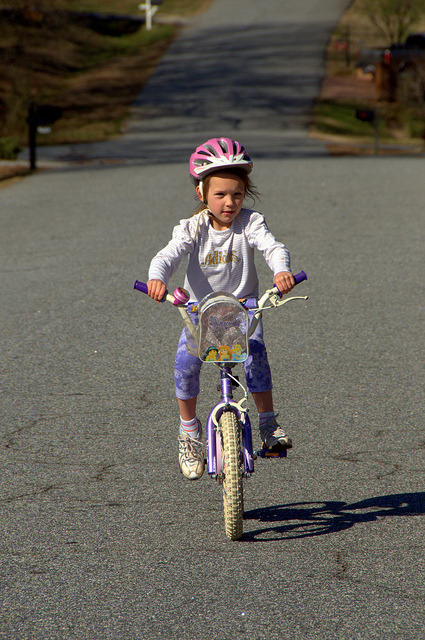
matching tracksuits

fun in threes, sometimes fours

general

First Sunday of Lent 2013

Technically speaking, the Sundays within the Lenten season are not fast days; Sundays, the Church teaches, are always feast days. Which means that theoretically, all the things one gives up for Lent are fair game. “Isn’t that cheating?” I’m tempted to ask.
DSC_3695

After all, I really didn’t sacrifice anything of real value — that’s sort of the purpose of Lent, that realization. What’s in my life that has any value remains: family. Cigars? Alcohol? Coffee? Sweets? These things are all relatively meaningless in the larger picture — again, what Lent helps us focus on.
DSC_3699

It’s not like I’m only just barely refraining from desperately grabbing at this or that. Sure, the things I give up for Lent give me a certain amount of pleasure, but they come with a price. Cigars, no matter how infrequently enjoyed, are in no way healthy. Alcohol is easily enough abused and doesn’t add much to life other than some relaxation and pleasure. Sweets? No problem: it’s not really surrender if you hardly ever do it. Coffee? Well, I thought in giving up coffee for the first time this year I might actually be sacrificing something I would really notice, and believe me, that first day without caffeine, I noticed it.
DSC_3713

But after that first day, it was no problem at all. (A small admission: I did drink coffee today. Couldn’t resist.)

Still, when taking into account all the things I could lose, voluntarily or not, I think most all Lenten sacrifices are fairly insignificant — again, a realization that gets at the heart of the whole point of Lent.
 

#4 — Goodness and Will

Good which is done in this way, almost in spite of ourselves, almost shamefacedly and apologetically, is pure. All absolutely pure goodness completely eludes the will. Goodness is transcendent. God is Goodness.

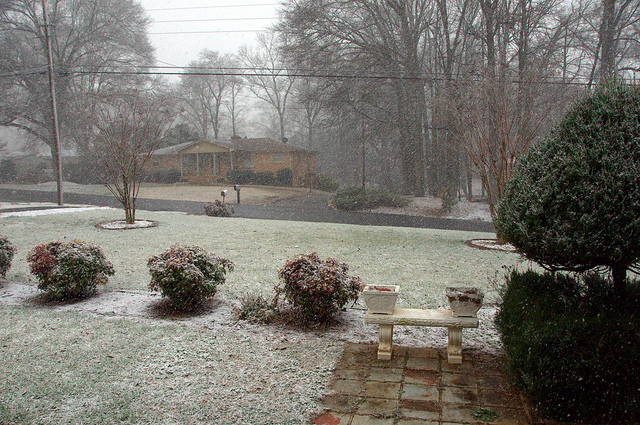
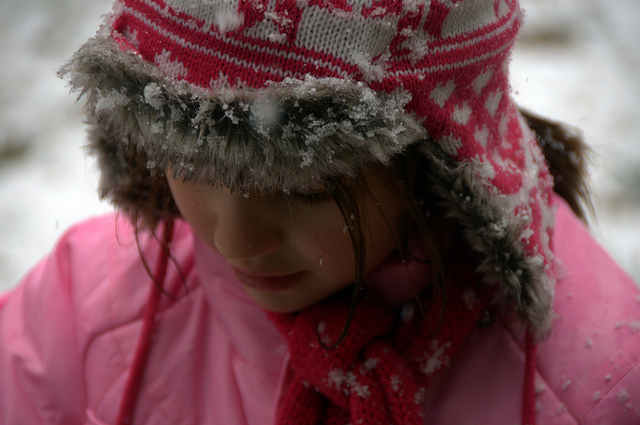
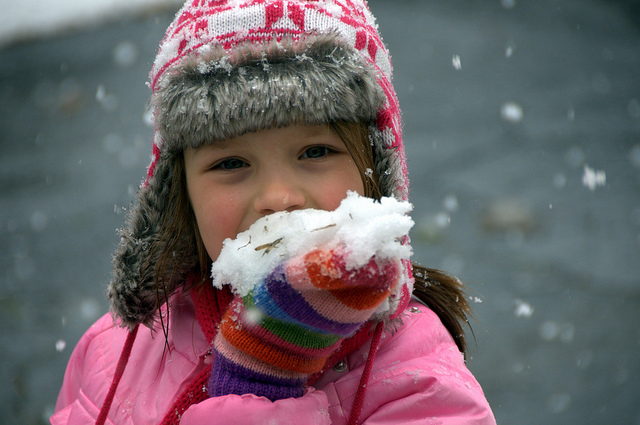
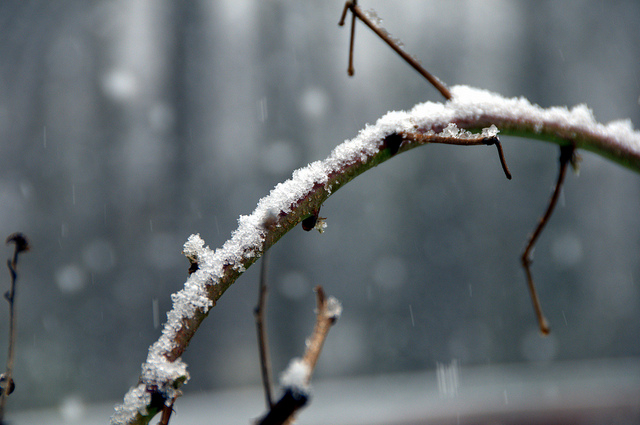
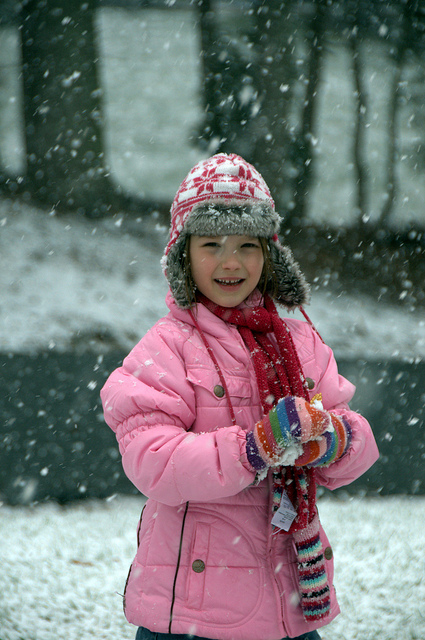
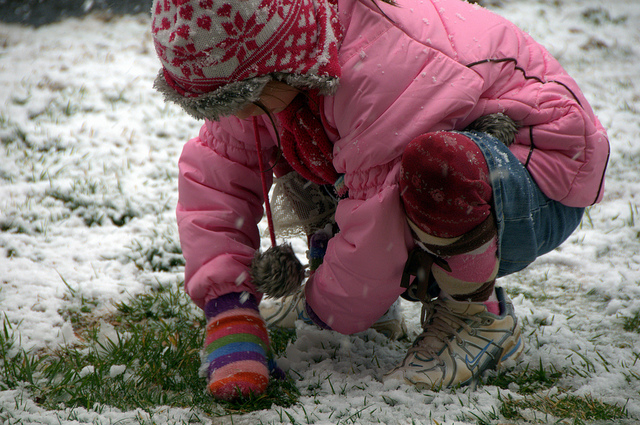
It started with a few, hard flakes that looked more like ice pellets than anything else. Perhaps it was ice. But I didn't worry: it was good no matter what it was. I strolled back into the house and calmly told the girls, "You won't believe what's happening: it's snowing." Within a few minutes, the flakes were fat and heavy, a wet snow that accumulated quickly despite the relatively warm weather. L and I changed our afternoon swimming plans and got dressed as quickly as we could, both excited about the prospect of snow. By the time we made it outside, the flakes were enormous and plentiful, and I found myself watching both the snow and the Girl's excitement with the snow.

Living in South Carolina, snow is such an unpredictable goodness. It's so rare it can only be counted as a good: at most, it might disrupt traffic for a little while; it could close the school system down for a day or two; but even the most sour, pessimist in the Upstate must smile a bit to see the occasional snow.

Yet it's so unpredictable. We can literally go for years without any snow, apparently. Every winter, we wonder: will there be snow this winter> Well, at least I wonder, K wonders, the Girl wonders.

First moments outside

I stood there today, though, marveling at the difference between our Upstate winter reality and that of southern Poland. Here, the question is whether nor not it will snow; there, the questions are when the first snow will come, how long it will last, and if it will melt completely before the next snow falls. There, the first snow fall is just the promise of more, just a whisper of what's to come. Here, it's the promise, the whisper, and the whole story.

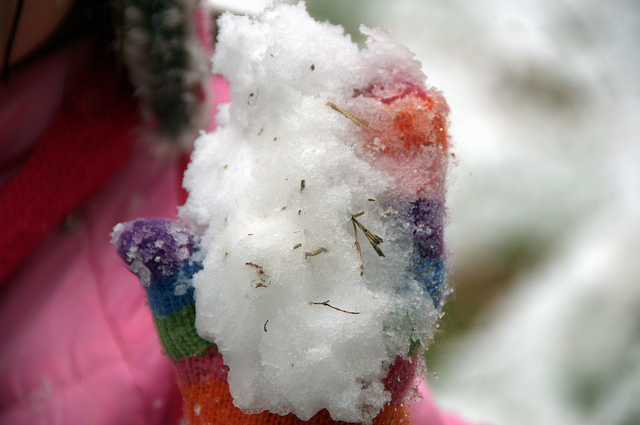
Muddy snowball
Muddy snowball

Sometimes I wonder what it might be like to live in such a place with my family. Perhaps with that much snow, the Girl would come to take it for granted. Is that even possible? Can a child ever grow tired of making snowballs, of digging snow forts, of sledding?

And what of the good, the transcendent good that eludes the will? Perhaps sometimes that good comes from an unexpected change in the weather, a sprinkling of white in an otherwise gray afternoon.

#3 — Choice

When we become conscious that we have to make a choice, the choice is already made for good or ill.

I often speak to my students about choice and habits. So many kids have such ingrained reactions that they've brought into the classroom from various environments -- home, the street, the community center -- which simply do not work in a comparatively-formal setting like a classroom. Perceived slights or insults must be avenged, for lack of a better term, and often very little thought has gone into the decision. These habits, I tell them, are going to get them into some serious trouble at some point in the future. "It won't just be a referral from some teacher who's fed up. It will be dismissal from work."

Hanging on my wall is an almost-cliche but very succinct expression of the principle I'm trying to explain:

Be careful what you think, for your thoughts become your words.
Be careful what you say, for your words become your actions.
Be careful what you do, for your actions become your habits.
Be careful what becomes habitual, for your habits become your destiny.

Yet even when some of them try to break their habit, even when they begin thinking before speaking, there's something in them that just compels them, despite the newly-formed warnings and whistles, to go ahead and say it. That's the habit part, because hidden in every habit is a bit of an addiction. And so these kids are aware of the choice, but in many ways, by the time they're aware of it, they've already made the decision.

Certainly, to a greater or lesser extent, the same is true for almost all of us. The awareness of this tendency, though, like the awareness of an addiction, is the first step toward correcting it. Or so we tell ourselves.

#2 — Drawn to Chains

We are drawn toward a thing because we believe it is good. We end by being chained to it because it has become necessary.

Certainly the image of being caught in chains or wire is a common image, but for me, the most vivid comes from Legends of the Fall, definitely the most vivid because of the conscious decisions of the writer and director, who juxtapose two such images in the film. The first comes during the First World War: a brother struggles to free another brother, tangled in barbed wire and blinded by mustard gas, as German troops prepare to fire on the helpless young man. The second appears later in the film, as the surviving brother tries to free a calf from a barbed wire fence on his father's ranch, thus triggering the painful war memories. In both cases, the greater the struggle, the tighter the barbed wire held. It's probably why sin -- or its modern, secularized equivalent, addiction -- is so often pictured as a chain.

But the more telling part of Weil's thoughts here is the phrase "because we believe it is good." I don't know where I read it, but a couple of years ago, one of those deliberately incomplete statements meant to be somewhat initially provocative: no one ever commits evil. The knee-jerk reaction is simple: "But of course they do! Just look around the world!" What's left out in this initial formulation is simple idea that every act we commit we justify until we think everything we do, in some way or another, is good. Even the sadist, who commits awful atrocities against others, somehow thinks his actions are good -- at least good for him. Even when we say to ourselves, "I know this is wrong, but I'm going to do it anyway," we're adding elliptically, "But in this case, it's good, not evil." And thus we are drawn to all sorts of evils because we believe all our acts to be good. Soon, this so-called good becomes necessary, just like nicotine or caffeine.

That's what I love about Lent. It forces me to look at those things in my life that I have come to regard as necessary and try to loosen the chains a little by simply abandoning them. Lent encourages me to hit a cosmic reset button on myself -- inasmuch as that is possible, or even exists, without supernatural aid.

#1 — Gravity and Grace

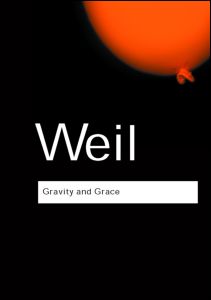
It might be an odd choice for Lenten writing: a book by a Jewish thinker, a woman who spent a significant amount of her life under the banner of "radical leftist." Yet in later life, Simone Weil came as close to converting to Catholicism as one can without actually crossing the line.

Born in France in 1909, Weil studied philosophy before doing the fairly typical leftist "live like the proletariat masses" move. It's easy to slight that, to suggest that because she had an upper-middle class family to return to it somehow invalidated her effort. Yet reading Weil's later work and knowing how she died, I'd suggest it was genuine.

For a while, early in World War Two, she stayed on the farm of Gustave Thibon, a philosopher and farmer. It was due to this time spent on the farm that we even have any writings from Weil: when she left for America in 1942, she left a satchel of notebooks with Thibon for editing. She later wrote a letter that informed him that, if he didn't hear from her for three or four years, he should consider the contents of the manuscripts his own. He didn't hear from her, and after editing the manuscripts, he published them as Gravity and Grace.

For 40 Things this year -- I am trying it yet again -- I will be sharing passages from Gravity and Grace (one of the most remarkable books I've read) and the thoughts they prompted.

No Access

It shouldn't be an excuse. After all, the post office overcomes greater difficulties. Still, no internet access yesterday meant no post then -- though I don't think this is cheating to back-date the explanation. Not cheating much...

Retirement

It's not something one expects to read: "Pope to step down." "Pope resigns." Since it hasn't happened in centuries, I guess it's inevitably big news. "Pope prepares for a monk's life" reads one headline, only partially satisfying speculation about what a retired pope might do with his time.

This will be the first papal election I've witnessed as a Catholic convert, and unlike eight years ago, I have some definite preferences for a new pope. Of course, it's not up to me in any sense, so further speculation and wish-making seems fruitless. Whoever is Benedict XVI's successor, he won't be the last, and if history is any guide, it's unlikely he'll do much radically to change anything in the church. It's odd: I find myself more in step with more traditional Catholics every day despite my agnostic, progressive past, but there's one "progressive" change I'd like to see in the papacy: a non-European. Peter Kodwo Appiah Cardinal Turkson has been mentioned as a very possible successor, and I find myself thinking that there could be no better selection for a church that calls itself the Universal Church.

A Bit of Time Out of Doors

The Boy has been sick the last few days. Recurring fever, loss of appetite, congestion. The pediatrician says it's nothing serious -- at least, no visible infection or signs of other serious issues -- but it means late nights and tired days for us all, especially K.

VIV_8627

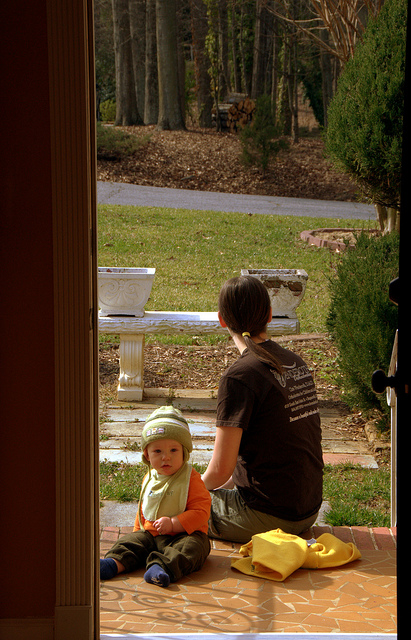
A bit of sunshine and fresh air in the early afternoon, though, leaves him smiling and ready for a nap.

God in the Dative

We must not help our neighbor for Christ, but in Christ. [...] In general, the expression "for God" is a bad one. God ought not to be put in the dative.

One of the more difficult, perhaps the most difficult, challenges to learning Polish was getting accustomed to its inflected nature. In English, we tell who did what to whom in a sentence by syntax, where it appears in relation to other words. In the sentence "The dog bites the man," we know who is doing the biting and who is being bitten by the order: subject verb object; biter bites bitee. Polish and other inflected languages determine these things by adding endings (inflections) to the words. Instead of meaning coming from word order (subject verb object), it comes from word endings. The different meanings are called cases. The subject of a sentence is in nominative case. The direct object is usually in accusative case in most inflected language, but Polish is an odd ball because some direct objects are in genitive case, and all direct objects of negative verbs are in genitive case. Indirect objects, to whom or for whom (i.e., "We gave the dog some treats."), are in the dative case. In Polish, that usually means adding "-owi", "-ze", "-u", or "-i"to the end of the noun. In English, we just slip it between the verb and the direct object.

So what puzzles me about Weil's contention that we shouldn't put God in the dative is how it seems to fly in the face of so much we hear in contemporary Christianity in America. We have "10 Things Young People Can Do for God" and "How to Work for God Effectively" and "Working for God in the Public Square" to name a few articles one can find easily enough. Indeed, it seems to have a Biblical basis. So I wondered what Weil might mean. Perhaps it's a case of not limiting oneself to the dative case but also the instrumental, accusative, genitive, locative, and vocative cases.

Independence

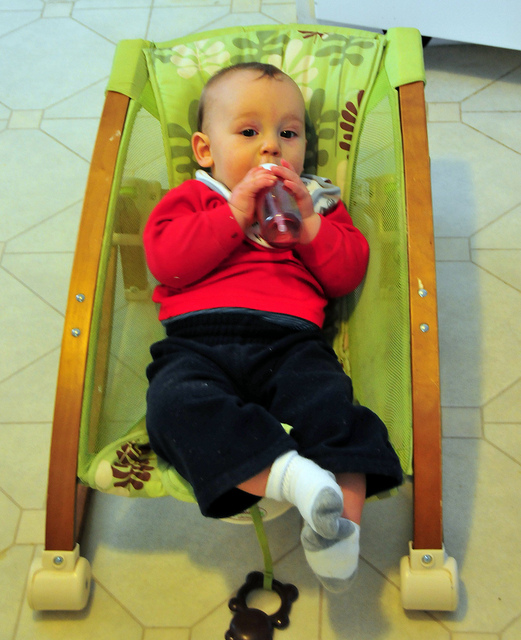
Independence comes in small developments: gripping a bottle.

1-VIV_8573

Riding a bike.

1-VIV_8602