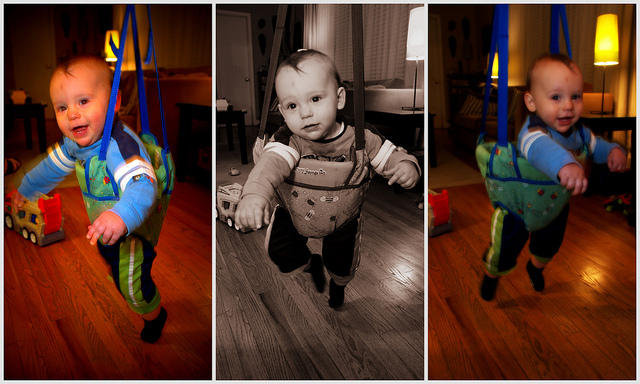
matching tracksuits

fun in threes, sometimes fours

general

#24 — Time and Incarnation

There is always a relationship with time to be taken into account. We must get rid of the illusion of possessing time. We must become incarnate.

The desire to possess time and the realization that it's an utter impossibility is one of the marks of the transition to adulthood we all go through. It was a troubling time for me, as it is for most, because it means, on some level, the relinquishing of the idea of eternal youth. Perhaps that's what the acceptance of one's on mortality is about in some way.

It's just this desire to possess time that Adam Duritz sings about in "A Long December," a song that haunted me as I thought about things past that would never return.

And it's been a long December and there's reason to believe
Maybe this year will be better than the last
I can't remember all the times I tried to tell myself
To hold on to these moments as they pass

We can't hold on to these or any other moments, and the continual effort to do so would only be a sign that we're not maturing, emotionally or spiritually.

#23 — Creation

Creation: good broken up into pieces and scattered throughout evil.

Some days, I hate my job. That's nothing new, I guess, but some days, working with over a hundred eighth-graders and dealing with all their hormone-driven nonsense, feeling that the evil -- for lack of a better term, though it is hyperbolic -- vastly outweighs the good, pondering whether teaching is not "good broken up into pieces and scattered throughout evil," I want to stand up and say something like this:

I don’t care. I don’t care who called you a name. I don’t care who’s tapping a pencil and bothering you. I don’t care if you left your pencil in your last class. I don’t care if you didn’t have a pencil to begin with. I don’t care if you think last night’s baseball game was great. I don’t care if you’ve lost your book. I don’t care if you like someone. I don’t care if someone teased you about your haircut. I don’t care if you forgot to do your homework. I don’t care if you left your book at home. I don’t care if you don’t like someone. I don’t care if someone beside you passed gas. I don’t care who’s spreading rumors about you. I don’t care if the person seated behind you is tapping your desk with her foot. I don’t care if someone told you shut up. I don’t care if you’ll forget what you were going to say if you don’t say it now, to someone seated on the other side of the room. I don’t care if someone made a comment about your shoes. I don’t care if someone threatened to pour milk on your head. I don’t care if you wanted to talk to him. I don’t care if you don’t want to work with him or with her. I don’t care if someone made a joke about your grades. I don’t care if you needed some attention and so continually cut up in class. I don’t care if someone threw your book in the garbage on the way out. I don’t care about any of your childish, kindergarten problems.

All of these statements have been true. Sometimes many of them have been true at the same moment; at other times, only a handful. Usually, the moment passes and I remember that I do care. Of course, some of these things are so trivial that my concern matches their triviality, but I think you’re still too young to understand that fully. Still, the moment most of them become true most of the time or, heaven forbid, all of them are true all of the time will be the moment I realize I must leave teaching.

I thought for a moment this afternoon that that was the case.

Fourth Sunday of Lent 2013

The Girl was off for the weekend, the house was quiet, and it was tempting to be lazy.

But.

The sun was out, the day warm, and the swing beckoned.

#22 — A Break

130309

#21 — Filling and Creating Emptiness

To harm a person is to receive something from him. [...] We have gained in importance. We have expanded. We have filled an emptiness by creating one in somebody else (50).

Perhaps the best example of filling an emptiness by creating one in another is bullying. Working at a middle school, I'm witness to many major and minor instances of bullying on a daily basis, and it seems to be getting only worse. Statisticians tell us that's definitely the case, but even if they weren't providing empirical evidence, I get enough anecdotal evidence daily to make a strong case.

As a teacher, I find I have to walk a thin line. On the one hand, we've seen the headlines of recent years, this or that tragic suicide traced back to prolonged bullying, actions that have created situations in which some people feel suicide is the only alternative. Bullying, then, is literally a deadly serious, and as the authority figure in the room or hallways, I have a responsibility to put an end to it when I encounter it. Yet most bullying today is not like the bullying I occasionally encountered. Today's bullying, ban and large, is verbal. Indeed, there is a whole category of bullying that could be only mental: cyber bullying. In other words, a lot of bullying is of the type "Sticks and stones will break my bones but words will never hurt me." Yet the truth is, words do hurt. Still, we need resilient, self-assured kids who can take care of themselves and who know how to avoid internalizing the stupid little comments they hear and will hear, in one form or another, throughout life, so I don't want to help kids become dependent on me -- or anyone else -- to swoop in and save the day every single time says something mean and bullying.

And so when I do encounter something that I judge to be relatively minor but still behavior that could be considered "bullying," I try to strike a balance. I deal with the individual who said the hateful words, but I spend more time talking to the person to whom he or she directed the words. (That was a long way to get around saying "victim." It was a conscious choice.) I tell her that there are individuals who only feel good about themselves when making others feel bad. To quote Weil, these individuals have "gained in importance," but only in their own mind.

#20 — Evil as Remedy

We must accept the evil done to us as a remedy for that which we have done.

"That's not fair!"

As a teacher who works with fourteen-year-olds -- that strange beast that has a hyperactive, hyper-sensitive notion of justice and fairness -- I hear those words all the time. Yet to be honest, we all react that way at some point or another, and sometimes it really isn't fair.

Yet more often than we'd like to think, we've probably been on the dealing end of injustice (or its petty cousin unfairness). Weil suggests that we must accept one as payment for the other.

Injustice as justice -- the ultimate paradox.

#19 — Refusal

Weil writes,

God gave me being in order that I should give it back to him. It is like one of those traps whereby the characters are tested in fairy stories and tales of initiation. If I accept this gift, it is bad and fatal; its virtue becomes apparent through my refusal of it. God allows me to exist outside himself. It is for me to refuse this authorization.

It's not something I pretend to understand. Even with a conversion to Catholicism and resulting reading and studying, the whole reason for a deity to create anything confuses me. If God is perfect, why create anything? What does that provide a perfect being that said being doesn't already possess?

#18 — Future Pleasure

2012 Calendar

When we are disappointed by a pleasure which we have been expecting and which comes, the disappointment is because we were expecting the future. And as soon as it is there, it is the present. We want the future to be there without ceasing to be the future. This is an absurdity of which eternity alone is the cure (66).

As a kid, I used to look forward to the autumn with almost visible excitement. Every fall, we headed off for the closest thing to a vacation we ever had: a week-long religious festival that included enough relatively free time to make it feel like vacation. It meant missing school, which made it all the better, and given the fact that we saved all year for the one week, the relative affluence I experienced made it seem like Christmas every day. Yet every year, a strange melancholy overtook me ever so briefly at the beginning: it had finally arrived, and while I was thrilled about that, I also knew that I had nothing else to look forward to afterward.

Yet I think Weil is talking about more than the mere excitement of being in a metaphorical candy store. Underneath this longing for the future, this “absurdity which eternity alone is the cure,” is a very serious attempt to sketch out what some have described as a hint of the beyond, or as Peter Berger might have called it, a rumor of angels. That sense of never being fulfilled is a hint, Catholic writer Peter Kreeft argues, that there is something more to fulfill it.

Photo by danmoyle

#17 — Evil and Duty

Evil when we are in its power is not felt as evil but as a necessity, or even a duty.

He stood in the hallway, thinking I don't really know what. Was he not aware that I'd heard the profanity coming from his mouth? Was he not aware that the profanity, misogynistic and vile. had indeed come from him mouth? Was he bluffing, hoping for some -- what?

If I had asked him what possessed him to say those things, to call the female student a b----, to become enraged, he would probably (indeed, likely, even predictably) justify it.

"She started it."

"Did you see what she did to me?"

"Nobody's going to do that to me and get away with it."

A thousand and one excuses. A million and one reasons why the evil was not evil, but a necessity. A duty.