matching tracksuits

fun in threes, sometimes fours

general

#30 — Transposition

Weil on transposition:

We believe we are rising because, while keeping the same base inclinations (for instance: the desire to triumph over others), we have given them a noble object. We should, on the contrary, rise by attaching noble inclinations to lowly objects.

My thoughts -- bed...

(Yet another cheat...)

#29 — Divided Intents

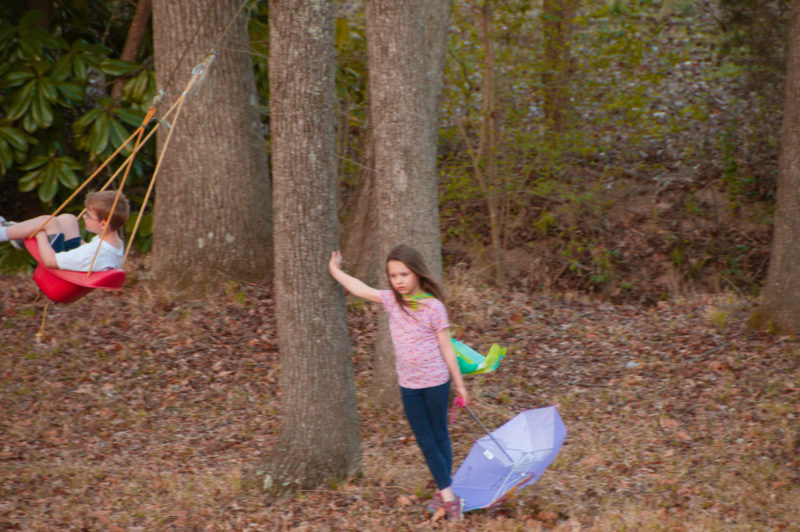
I’m certain that somewhere, in all the notebooks she kept, Simone Weil wrote something applicable to today, something that I could pair with the pictures of the Boy and the Girl playing on the kitchen floor, the Girl pretending to teach E how to bake.

VIV_9298

Perhaps she wrote something about the importance of play, the relationship of siblings, or something equally profound. She does seem only to write about profundity in the journal excerpts collected in Gravity and Grace. With a title like that, though, one could hardly expect much frivolity. And considering her biography, it’s hardly surprising.

VIV_9302

Still, it would have been convenient to look at the topical index and find “Play” instead of just topics like “Evil” and “Illusions” and “Self-Effacement.” How can I find any suitable quote from such topics to go along with the day’s pictures?

VIV_9308

Perhaps if she’d had kids…

Fifth Sunday of Lent 2013

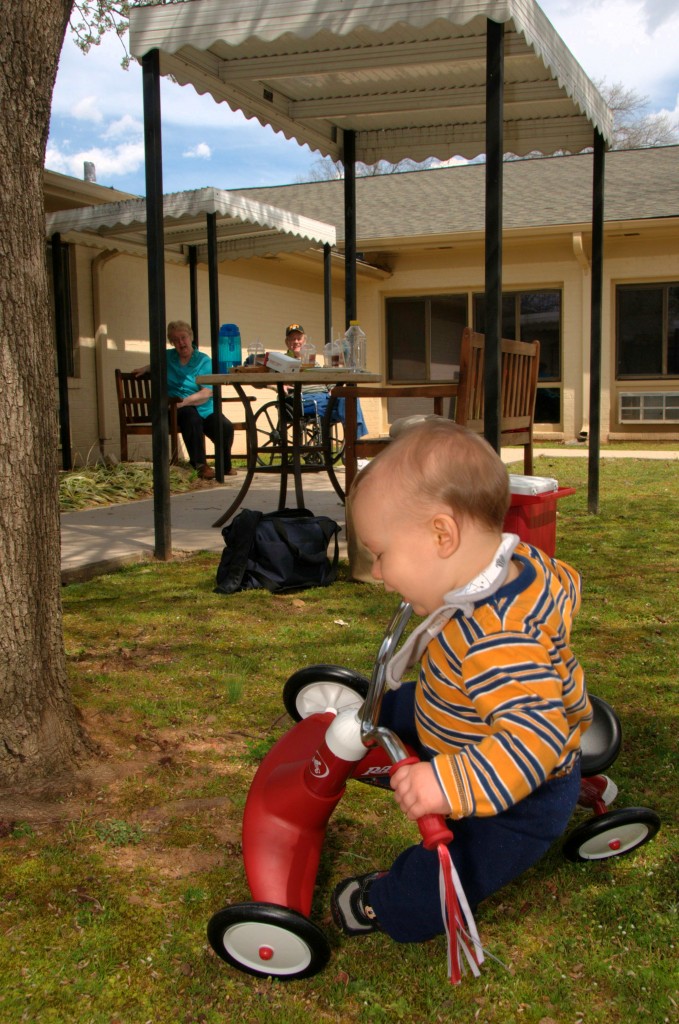
It's been some time since the whole family was together -- Nana, Papa, the Girl, the Boy, K, and I. But with a prognosis for wonderful weather and a completed recovery, there was only one thing to do: pack up the family and meet Nana at Papa's "spa" to have a mid-March picnic.

We took the kids' bikes (though E tends to use his four-wheeler more as a walker than anything), some sandwiches, a fresh Polish spring salad, some mango juice, and made an afternoon of it.

#28 — Chance and Good

Beauty is the harmony of chance and the good.

The element of chance in our lives would probably overwhelm us if we knew its extent. A decision not to go with a newly-founded school's students on a field trip to the Baltic might lead to a chance invitation to a bar where one meets a new friend. A chance meeting of one's student with the friend's neighbor might get you both invited to an eventual wedding, where one suddenly discovers that the friend is really someone more wonderful than one imagined.

And from that string of chance -- or is it more? -- comes good. And so beauty.

A chance walk on an uncommonly warm February day might lead to a meeting that leads to a dear friend.

#27 — Monotony of Evil

Monotony comes in many forms.

Monotony of evil: never anything new, everything about it is equivalent. Never anything real, everything about it is imaginary.

It is because of this monotony that quantity plays so great a part. A host of women (Don Juan) or of men (Celimene), etc. One is condemned to false infinity. That is hell itself.

This is becoming one of those forms.

#26 — Eternity

Stars and blossoming fruit trees: Utter permanence and extreme fragility give an equal sense of eternity.

How can utter fragility provide a sense of eternity? I've sat and thought about that for a while, and it seems one of those things that I understand intuitively but am unable to put into words. The fact that it could pass out of existence at any moment fixes it firmly to that moment, but eternity doesn't seem to be about moments -- it appears to be the opposite, in fact. Yet the usual way of thinking of eternity is to imagine it as infinite moments, one after another, in a never-beginning, never-ending line. Indeed, a line in the strictest geometrical definition. That's the paradox of eternity: it's every moment in a never-ending moment.

It is a succession of spring blossoms under an unchanging blanket of constellations.

#25 — Conditioned Choices

Man is a slave in so far as, between action and its effect, between effort and the finished work, there is the interference of alien wills.

Dear Terrence,

I've heard that a reputation is permanent, that once you teach people how to treat you -- and we do teach others how to treat us -- people will always treat you that way. Once people come to expect behavior x from you, they will always expect behavior x.

In my own educational experience, this certainly rang true. I had a good reputation; I was trusted among my teachers; I made sure I rarely got in trouble. As a consequence, I could easily ask to go to the restroom and roam the halls for a little if I so chose. And every now and then, I did so choose. When confronted by a teacher, I could simply make up a quick convincing story and move on. No one ever asked me for a pass because no one ever suspected I was up to no good, even when I was. My reputation saved me, and I used that to my advantage -- especially during my senior year in high school, when my best friend and I sneaked off campus almost every day during lunch.

You, though, have the opposite problem. Even when you're trying to do the right thing, you've taught most everyone -- teachers and administrators -- to doubt your sincerity, to suspect you're up to no good. Quite frankly, you often were at the beginning of the year.

So now you find yourself in this dilemma: you're at risk of receiving an administrative referral for something that, even if you did it, probably doesn't really deserve that level of action, especially if, as you say, one more referral will get you expelled. But because of your reputation, there's little you can say or do to talk your way into a less serious consequence.

You planted seeds that are now beginning to sprout even though you're trying to prevent it. But the seeds are there; your reputation is set. No matter what you do, you'll receive the short end because you've lost the trust of those around you. In fact, those seeds -- your reputation -- have taken such firm root that a teacher could lie about some encounter with you, could say you cursed her and walked away with a huff, and even if it's all a fabrication, the administration would believe the teacher. Why? Because it sounds like something you would do. Let's be frank: it sounds like something you've already done, several times.

So what can you do about it? The truth, at this stage in the school year, at this stage in your middle school career, is simple: not a whole lot. If you kick a dog every time you walk into the room, pretty soon that dog will get up and leave the room every time you enter; if you habitually deal with your frustrations in negative, disruptive, destructive ways, those around you will come to expect that from every counter, and their support for you walk get up and walk out with the hypothetical dog.

All that being said, there is some good news: you'll be going to high school next year. (Let's be honest: having already failed one grade, you're not at risk of being retained even if you fail every single subject, which you currently are.) At high school, you get to start over. You get the great academic reset. All counters are returned to zero. Your reputation is a blank canvas upon which people will begin to paint their expectations of your behavior as you begin to teach them what to expect. In other words, you have a chance to start over and put it all behind you.

I hope at the very least you take that opportunity seriously.

Concerned as always,
Your Teacher in Room 302

High Heels

L was out with K shopping recently. She found a pair of slightly-high-ish heel shoes that she fell instantly in love with and begged K to buy them. When K didn't consent, L proclaimed, "But all I dream about are high heel shoes. All I see, everywhere I look, are high heel shoes. All I hear are high heel shoes, click! click! click!"

Evening in the Yard

Spring is here?

#24 — Time and Incarnation

There is always a relationship with time to be taken into account. We must get rid of the illusion of possessing time. We must become incarnate.

The desire to possess time and the realization that it's an utter impossibility is one of the marks of the transition to adulthood we all go through. It was a troubling time for me, as it is for most, because it means, on some level, the relinquishing of the idea of eternal youth. Perhaps that's what the acceptance of one's on mortality is about in some way.

It's just this desire to possess time that Adam Duritz sings about in "A Long December," a song that haunted me as I thought about things past that would never return.

And it's been a long December and there's reason to believe
Maybe this year will be better than the last
I can't remember all the times I tried to tell myself
To hold on to these moments as they pass

We can't hold on to these or any other moments, and the continual effort to do so would only be a sign that we're not maturing, emotionally or spiritually.