g

Review

One of my classes is working on clauses — recognizing them, using them, transforming them. Today we had a lower-than-usual attendance because of a Junior Beta Club field trip, so it was a somewhat relaxed day. We finished with a game of Kahoot, an online learning site that gamifies quiz-type reviews. We played a variant called Submarine Squad. According to the site,

You and your crew are stuck in the deep blue! A hungry fish is quickly approaching. Answer questions correctly to boost your submarine and follow instructions to escape.

Kahoot usually encourages a bit of competition; this particular variant encourages teamwork and cooperation. They have to work together to escape, and as the beast approaches, opens its jaws, and slowly begins to crunch down on the ship, the encouragement to each other increases.

When they do manage to escape (they didn’t make it the first round), they all jump out of their chairs and cheer, giving each other high fives and doing silly little happy dances.

It’s one of the reasons I love teaching eighth grade: they’re still kids at heart.

Emptiness of Philosophy and Theology

Nearly twenty-five years ago, I had my career track all planned: a Ph.D. from Boston University in the philosophy of religion followed by a lifetime of teaching (hopefully at a small college where I could work in both the philosophy and religion departments) and writing. I was in a seminar about Friedrich Schleiermacher’s On Religion: Speeches to Its Cultural Despisers, and I couldn’t get out of my mind the homeless man who was bedding down in front of the building where we were all sitting, talking about a 200+ year old treatise about religion.

It all seemed so impractical, so useless: I dropped out after that semester.

I’m still pleased with that decision because my work now is so very practical: I teach kids how to read and write better. And as for my writing bug, there’s this site.

A few weeks ago, though, I thought I’d look up an acquaintance from my undergraduate years who was going to do graduate work in philosophy as well. I found him: he completed his doctorate, and now he teaches philosophy at a university and writes.

Reading an interview with him, I got a glimpse into what my life would be like if I’d continued at B.U. One thing I’d be doing is writing jargon-filled nonsense of little practical value.

Modern philosophers can’t seem to write without stuffing as much falsely impressive jargon into every inch of every sentence. Instead of asking an acquaintance, “Would you like to see a movie with me?” they say things like,

Ah, my dear interlocutor, I extend to thee an invitation to partake in a cinematic sojourn, wherein we shall immerse ourselves in the ineffable tapestry of visual narratives. Let us engage in a dialectical exploration of the celluloid realm, dissecting the ontological nuances and epistemological quandaries presented therein. As we traverse the cinematic landscape, let our minds intertwine in a hermeneutic dance, unraveling the semiotic layers that cloak the underlying existential motifs. Join me, and together we shall embark upon a transcendental odyssey through the silver screen, transcending the quotidian boundaries of perception. What sayest thou to this proposition?

Chat GPT in response to the prompt, “write a jargon-filled invitation to a date to the movies that a philosopher might say.”

I honestly wonder if this reliance on jargon has become second nature to them. When they live in the echo chamber of academic writing, this use of jargon likely becomes the norm.

Another similarity between all these writers is their unshakable conviction that what they’re doing is somehow brave. They speak of “opening up radically new forms of thinking and practices” and “the courage” to push “the limits and boundaries of traditional orthodox thinking so intrinsic to forms of American feminism, neo-conservatism, liberalism, religion, politics, aesthetics and so on that only serve as ideological masks behind which corporate power strangles academic and political freedom.”  This is an “insurrectionist movement [that] takes a stance against this political and academic tyranny by risking freedom.” These “wonderfully intrepid” philosophers are courageously creating an “indispensable provocation to thought,”

With all this talk of intrepid risk-taking, I can’t help but ask what exactly is the chance they’re taking? What are they risking? Is someone going to imprison them for questioning the “ideological masks behind which corporate power strangles academic and political freedom”? They must be the new models of bravery in our thought-driven First World. The next time I see a firefighter rush into a burning building, I’ll think, “I haven’t seen that kind of bravery since I saw some philosophers challenging the ‘boundaries of traditional orthodox thinking so intrinsic to forms of American’ thought!” A related series of questions arise from this thought: What exactly are those boundaries? Are they walls? Are they bars? How do they restrain us? Perhaps these great thinkers realize that their contribution to society is minimal at best, and they console themselves with the thought, “Well, at least we are brave and know how to string a lot of big words together.”

Finally, what they’re writing, even discounting the overwhelming obsession with jargon, makes no practical sense at all. They speak of a “concrete and materialist commitment to that surplus of a life lived to openness and joy and not the law and security,” and in fact, there’s nothing concrete, material, or applicable about it. What would this look like? What concrete actions could these writers take that we could look at and say, “Hey, I see in those actions a “commitment to that surplus of a life lived to openness and joy and not the law and security”? How can we recognize if our ideas are “married to an identity politics looking to preserve a certain predetermined zone of ‘desire,'” and what steps could we take to file for a divorce? What are the signs that “ideological structures of power have tried to denude natural powers into a deity” and how could we then determine whether those efforts “once again limits infinity by assigning them a personality, an ethnic history”? How can we identify “the need for intellectuals to organize around the core building blocks of life, air, water, and food” and how will that help us non-intellectuals?

And most critically, how can we recognize that a given “theology tumbles kenotically, inexorably, into political economy, literature, climate science, postcoloniality, critical race theory, and nonequilibrium thermodynamics, forcing us to face the earth, sky, mortals, and gods as they are―and in all that they’re not―and only then as they might yet be”? What line in a given treatise about this revolutionary theology could we point to and say, “Here, this is theology tumbling kenotically into nonequilibrium thermodynamics”?

I seriously don’t know how anyone can take themselves seriously when they write this stuff.

Louisville 2024 Day 1

There’s more to the story than these pictures, but it’s a fairly succinct vision of the first 8 hours of the day…

We made it to a Buc-ee’s — one of L’s favorite places. Why? It’s a big gas station, nothing more. Still, she gets some kind of silly joy out of it, and they are relatively rare in our part of the country (none near us in Greenville), so we stopped.

Part of the reason we stopped was the charm of the visit; part of it was the passenger-side rear tire, which had a slow leak.

Which led to me spending the first couple of hours in Louisville getting it fixed…

The girls went undefeated again in pool play, so it was a successful day. Pictures on the camera, though — no computer about…

Is this crazy

There is no way I am posting tonight — I prepared this last night because at the normal time I’d be getting something ready for this silly site, I’ll be somewhere in the midst of this insanity…

Lessons and Blooms

“I need to work on my Polish,” the Boy recently declared, so he and K have been working on Polish lessons again. He doesn’t look enthusiastic all the time, but he is (still) willing.

Almost as lovely as his effort were the azaleas blooming this morning.

Still More Testing

The results of this test will pass into mysterious silence: the students would get more feedback about their writing from a random stranger on the street than they will from this test. Other than the practice they gain from writing yet another analytic piece about a text (which was likely painfully boring and irrelevant to them), this test is an utter waste of time.

Yet I admire these kids for the effort they are putting into a largely Sisyphean task, for even those who’d had their heads down at one point complete the test and appear to do their best. This shows a perseverance and maturity that I, in my increasingly cynical fifties, seem to lack. Were I taking this test, my temptation would be to submit a rebellious, snarky response: “We are completely sick of all this testing, and I for one refuse to participate in this charade.”

What would be the reaction of the evaluator? Would she nod in agreement, lowering her head a bit in shame at her admittedly-minimal role in the process? Would he grow indignant, frustrated that the student didn’t see the value of a test he regards so highly, angry at the student’s teacher who so obviously neglected to impress upon the student the critical nature of the test? In short, just how much faith do the creators and evaluators of these tests have in the tests themselves? It’s hard to imagine how they could see any value in today’s test that will be unevaluated and provide students with absolutely no feedback, so we’re all left wondering just why we did it. We all, teachers and students alike, develop the sense that test in general is just a tool to provide numbers to some group of bureaucrats so they can create for educators arbitrary comparisons and goals to provide these bureaucrats with a false sense of effort and accomplishment. We’ve recognized the problem, determined its scope, and created (or rather, ordered the creation of) a set of tests sure to solve the problem. And if they do not solve the problem, we can always create still more tests and metrics that ignore the actual issues but can serve as a balm for our consciences.

This all assumes that something will be done with the test. For all we know, the responses could simply be saved on some computer somewhere, completely forgotten soon enough and totally meaningless as a result.

Eclipse

I forgot to put pictures up from the eclipse yesterday. Our district had an e-learning day (?!?) and so only the teachers were at school.

Playful Monday

It used to be something we did fairly frequently in the spring: all four of us would go outside and do something together: swings, trampoline, badminton, or just a walk. I guess we all took it for granted, but soon enough, schedules shifted, kids grew up, calendars filled up, and these evening family times disappeared.

But we still have the net up from Easter; and we still have two kids who enjoy badminton. So all four of us were out playing, though never at the same time — that schedule thing again.

First I took on the Boy. He’s getting so much better, but he flubs some that should have been fairly easy. No pictures of that one.

Then K came out and played with the Boy. I snapped a couple of pictures, but not many — not even one of K playing.

Then the Boy went inside while K and I played a bit. We’re down to two working rackets, so options were limited.

Finally, the Girl returned home from getting crickets for her Australian Tree Frog — I don’t know that we have a single picture of her, but L has had her since eighth grade.

She plays with the Boy for a while, but then I suggest I take the Boy’s part and the Boy take the camera.

And so I promptly have fun while making a bit of a fool of myself. L wins at everything — it’s time we face it.

K, for her part, was inside, studying.

When will the stars align again for such a day?

Sand

The Girl and the son of our dearest Polish friends — two kids who always argued when younger — played in a short sand volleyball tournament. L had just finished up a track meet, winning the high jump and placing second in the javelin, so she was a bit tired, I thought.

“No, I’m fine,” she insisted.

Youth…

The Change

This year, we are trying a new approach to scheduling. Different times of the day affect kids in different ways. Medications that in one class were effectively helping kids control their impulses have declined in effectiveness. The energy levels of some kids increase through the day and of other kids decrease. Some periods during the day are closer to times when kids have eaten, and this can make them sleepy as the blood starts to shift to their digestive systems or tired as they run out of fuel to help them move and think. Some teachers have more patience at the beginning of the day; some teachers have more energy at the end of the day. And all these facts interact with each other, affecting students’ learning and teachers’ effectiveness. All this means that some kids will learn better earlier in the day and some kids will learn better later in the day. REcongizing this, our principal enacted a shifting schedule this year: at the start of each new quarter, the order of the core classes (math, English, science, and social studies) flips — the last class becomes the first class, and the first the last.

The difference for my inclusion class, which is a mix of regular education students and special education students, is remarkable. When they were my final class, they were my most challenging class. They were tired; I was tired. Their meds had worn off; I was hoping for any kind of medication myself. Now that I see them first, they are a different class. A joy to work with.

Nowy Targ Standstill

A photo from a couple of summers ago. It could have just as well been from 1996, though, as that building has not changed at all.

Poland–the country that manages to surge forward and stand still all at the same time.

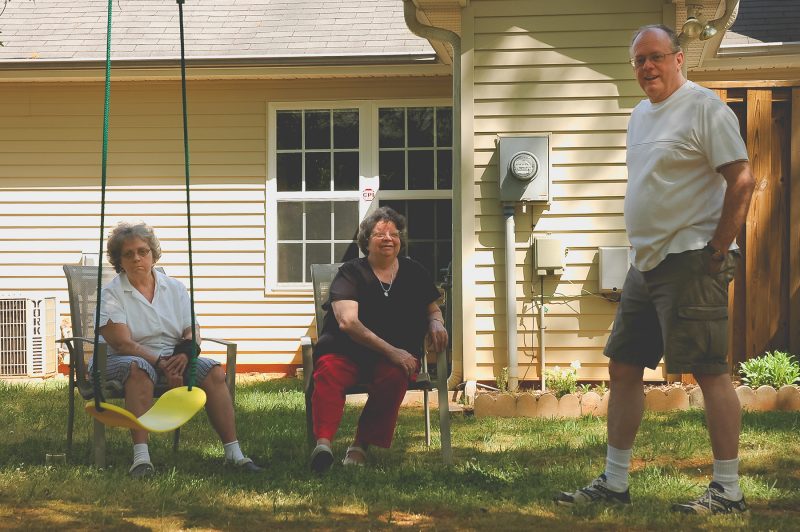
Down at the Swing

Remember when we used to cuddle in the hammock?

Can we try again , the Boy asks.

We fit. Barely.