Now Taking Orders
The Girl is creative: there are no two ways about that. She’s always making something, recycling something, inventing something. Sometimes, it comes about after some searching for DIY methods; sometimes she just thinks of something.
Her latest obsession is stress balls — balloons filled with various items. Rice, flour, slime, sugar (white and brown), quinoa. Whatever she can find. I think that’s the experimental part coming out.
Kids at school have asked her to make them their own stress balls. Or perhaps she just offered to make them. At any rate, she was buzzing around the kitchen in the afternoon, looking at the notes she’d made, filling orders for rice stress balls and flour stress balls and sugar stress balls.
Lost Acquaintances
At some point in the day, I often look at the “Time Machine” module at the bottom of this blog to see what was going on one year, two years, ten years ago. The other day, this one popped up: L’s fourth birthday party.
I clicked through and read. It was the party we had at the horse farm near our house. A fun party that involved lots of brushing horses, talking about horses, and even riding horses.
A picture from L’s fourth birthday party stopped me.
I didn’t recognize a single person — not one adult or child — other than family. It’s not that I looked at a child or a parent and thought, “Yeah, I remember her. What was her name?” It was as if I was looking at people I’d never seen in my life. Complete strangers.
I find that lots of commenters that visited the site in the early days, when I promoted it, have not maintained their own hobby-horse blogs — sometimes for over ten years. Some of them were simply one-time commenters, probably leaving a comment just with the hope of a follow-up visit to their site. But some of them were regular commenters who have completely disappeared, and their own blogs with them. And here I am, fourteen years later, still plugging away at it, not promoting it, writing for myself as something of a journal replacement, but occasionally wondering where everyone went.
Christmas Tree
It’s really such a silly idea, positively kitsch in a lot of ways: we cut down trees, bring them into our home, and hang silly baubles on it. For many, it’s more than that: it’s positively evil. Some Christians look at Jeremiah 10:2-5 as something of a condemnation of the Christmas tree. One religious group explains it thusly:
This passage states, “Thus says the LORD, Learn not the way of the heathen, and be not dismayed at the signs of heaven; for the heathen are dismayed at them. For the customs of the people are vain: for one cuts a tree out of the forest, the work of the hands of the workman, with the axe. They deck it with silver and with gold; they fasten it with nails and with hammers, that it move not. They are upright as the palm tree, but speak not: they must needs be borne, because they cannot go. Be not afraid of them; for they cannot do evil, neither is it in them to do good.”
These verses illustrate an idol made out of wood. However, idols were also made out of other materials, such as stone, marble, etc. So this is not a comprehensive description of idol-making. More specifically, it speaks of Christmas tree-making, even as it is still done today.
A reference to the signs of heaven in verse 2 is better translated today as the winter solstice. Most people are unaware of the connection between Christmas and the winter solstice, and that the origin of the holiday is pagan. They observe it because of the customs in our society. We need to be aware of what some of the customs signify. In fact, we read in verse 2 above, “learn not the way of the heathen.” God commands us not to follow that way.
Although the scripture above undoubtedly reflects the ancient practices during Jeremiah’s time, we know that the book is also prophetic. Therefore, we ought to take it as an instruction for our day and age as well.
The use of such a tree amounts to idolatry. This is a transgression of God’s law, stated in Exodus 20:4-6. To learn more, you may wish to request our free booklet The True Origin of Christmas.
So it’s far from a harmless bit of cheesiness for some.
In The True Origin of Christmas, the author, David Pack, explains it thus:
No booklet about Christmas is complete without some explanation of the “Christmas tree.” We have touched on it without directly focusing on it. The modern Christmas tree originated in Germany. But the Germans got it from the Romans, who got it from the Babylonians and the Egyptians.
Like many articles from Pack, he fails to provide any documentation for the assertion that the Romans got it from the even more ancient sources. To be fair, there is something to Pack’s assertion:

The ancient Egyptians worshipped a god called Ra, who had the head of a hawk and wore the sun as a blazing disk in his crown. At the solstice, when Ra began to recover from the illness, the Egyptians filled their homes with green palm rushes which symbolized for them the triumph of life over death.
Early Romans marked the solstice with a feast called the Saturnalia in honor of Saturn, the god of agriculture. The Romans knew that the solstice meant that soon farms and orchards would be green and fruitful. To mark the occasion, they decorated their homes and temples with evergreen boughs. In Northern Europe the mysterious Druids, the priests of the ancient Celts, also decorated their temples with evergreen boughs as a symbol of everlasting life. The fierce Vikings in Scandinavia thought that evergreens were the special plant of the sun god, Balder. (The History Channel)
But Pack believes we’re just supposed to take his word for it. He is the authority.
By and large, it seems to be a tempest in a cliche. So it has pagan origins. So Christmas is a Christianization of solstace celebrations. So what? I find it hard to believe that an omnipotent being would care much about such relatively petty matters when I take into consideration all the other things he should be worried about.
Such considerations fail to take into account all the good that comes from it, the joy my family experiences sharing those couple of hours as we set up the tree, haul out the decorations, and get busy with hot cocoa and ornaments.
Games
The kids stayed home today, and so I stayed home. What to do on a day off? Simple — play games.
First, Sorry. I love how this game teaches patience: you get all your pieces moving around the board, making real progress, and suddenly someone draws an 11 and switches places with you, destroying the work of the last few moves in an instant. Or worse: your opponent draws a Sorry card — back to the beginning for you. Then there’s the opposite problem: you’re right at the entrance to your safety zone, and you draw a 12 card.
“Time to make another lap,” I told E when it happened to him. He was frustrated, but dealt with it well. (Yes, I see it. I choose not to acknowledge it.)
The real surprise for me these last few days has been our children’s desire to play chess with each other. I’ve been teaching the Boy to play chess, and since L already knew, she decided to take it upon herself to teach him the final pieces (king and queen) and start playing with him.
Naturally, she beats him as badly as I would beat her were I to play seriously against her, not pulling my punches, so to speak. Still, Magnus Carlsen began taking chess seriously at about E’s age because his older sister kept beating him and he didn’t like losing. Now he’s the world number one, with an astronomically high rating, and by and large seems unstoppable. Doubtful, but one never knows. The love of the game and the patient critical thinking it encourages are enough .
Two Versions
My model response in a Romeo and Juliet online discussion forum at school. The question: We watched two versions of the balcony scene (2.2). Which one more-realistically shows two people in love? Provide three pieces of evidence from the video that touches on pacing and/or tone of voice. Additionally, you might want to use body language.
Of the two versions of the balcony scene, the Royal Shakespeare Company’s interpretation shows more realistically that Romeo and Juliet are in love simply because the actors’ performances are so natural as opposed to the wooden, flat way the BBC actors appear. This is first most noticeable in the famous lines, “O Romeo, Romeo! wherefore art thou Romeo? / Deny thy father and refuse thy name.”
The way she says “Deny thy father” makes it clear that she thinks this is an absurdly impossible idea and yet says it as if she were suggesting he change his mind about what he’ll have for lunch. She looks down and laughs just before she continues as if she’s laughing at her own absurdity.
This continues to the point where she says, “Be some other name,” which she says so slowly that it emphasizes her frustration with the situation.
A final touch that makes it all seem more realistic is the way they interrupt each other during the passage about swearing to the moon.
Twice Juliet begins her lines before Romeo has finished his, and that is a much more natural way of speaking. We often talk over each other in our excitement or frustration, and by talking over each other here, it highlights the excitement they feel about each other and the frustration they feel about their situation.
Christmas Tree 2017
Slush
We never know when we’ll get snow here in South Carolina. We once went several years without much more than a little flurry that melted the instant it touched the ground, so when we do have snow, we have to make the most of it. We have to get out into it, feel it, hear it (if it’s mixed with ice crystals, which it often is here).
So last night, with dinner done and the kitchen cleaned up, we all took the dog for a walk in the snow. Unfortunately, the snow was mixed with rain, and what lay about the road was a slushy mix that got everyone wet almost immediately. K and the kids turned back quickly; I went with the dog for another mile or so.
Today proved to be better. It was supposed to stay below freezing all night, and there was a forecast for continued snow throughout the morning. And fall it did — big fluffy flakes that floated down delicately that would then transform to smaller flakes that fell quickly. Back and forth between the two forms of snow throughout the morning.
But the kids begin still sick, we were reticent to let them out. The Boy and I decided to play a bit of chess. He’s learning piece by piece. For a few weeks, we played only with pawns until he got the hang of their basic nuance. Then we added bishops — after all, they move in a way similar to how pawns attack. Then rooks. Finally, knights. We spent several evenings just practicing how knights moved.
“Daddy, can we play with rooks, bishops, and knights now?” he asked this morning, and so we went for it.
“Are you sure you want to move there?” became my mantra. Occasionally, he would look and reconsider.
“Oh, no! You can take me there!”
“But can you take me back?”
And so we played. I made purposefully stupid moves for him to take advantage of, but I made a little rule for myself: if he didn’t reconsider his move after I suggested it, I would take the piece, so in the end, I won. (The aim in king-less/queen-less chess? Get one pawn to the other end of the board so that it can’t be taken. It’s how I teach my students at schoool as well.)
Still the snow fell — but almost none of it was sticking to the roads, which were wet and relatively warm.
“Maybe we’ll have a snow day Monday!” L pondered.
“Likely not.”
Still, we have a large district, and we have had snow days when there’s not a flake on the ground here because of what was going on in the northernmost edges of the district.
First Snow
The announcement was simple: “Teachers, please check your email.” Though there was not a word said about the content of the email in question, we all knew, teachers and students alike, what it said. It had been snowing for an hour, and there was only one option: early dismissal.
By the time all the kids were gone, it was only a few minutes before teachers’ normal departure time. Still, with everyone — absolutely everyone — on the road then, it took over double my normal time to get home.
By the time I got home, the Boy and the Girl had already spent a good bit of time in the snow, such as it was.
The Dog, Kids, Tramp, and a Ball
Mess Up
It’s important to admit to your failures as a teacher, small and large, and so when I realized that I hadn’t actually made the assignment in Google Classroom this afternoon, I muttered apologetically, “Sorry, I mess up.”
“Yeah, you messed up. You messed up my grade,” came a voice behind me. I knew immediately who said it: I’m a teacher, and it’s almost a requirement to be able to recognize students’ voices for any number of reasons, but also the young lady has a distinctive voice. It’s hard to miss C.
She’d just checked her grade while waiting for our work to load, and she discovered that her grade had dropped from a D to a F. The reason was simple: she hadn’t done the work earlier in the week when I was out with a sick little boy, and she hadn’t studied twelve Greek and Latin stems sufficiently to pass a quiz on them.
“I turned in several articles of the week just earlier this week,” she had complained.
“Yes,” I had agreed. “And since you turned them in late, they are a secondary priority when compared to other work that students turned in on time. It wasn’t a priority for you to turn it in on time, so it’s not a priority for me to grade it, I’m afraid. If you turn it in on time, I get it assessed quite quickly.”
It hadn’t been enough, and she’d been fuming, so when I admitted my silly mistake, she used it.
There’s a part of me that says, “What kind of thirteen-year-old thinks she can talk to an adult that way?” There’s a part of me that wonders how she could possibly think that anything positive could come of being aggressively disrespectful like that. There’s a part of me that wonders just what she thought my reaction might be. There’s a part of me that questions if she’ll ever learn how to deal with disappointments more effectively. There’s a part of me that wonders if she’ll spend all her life blaming others — it was my fault that her grade was so bad and not her fault for not preparing for a painfully simple quiz or for not turning in work on time.
What really made the situation frustrating for her was that she, as a basketball player, can’t play if she has grades below Cs. She missed a game because she had a D in my class; now she’s got an F in my class, and the prospect of playing again anytime soon seem painfully remote. And her frustration was understandable but directed at the wrong person.
Neighbors’ Lights
Playing in the Leaves
It was a job the Boy wanted to do from yesterday morning.

“Now can we rake leaves?” he kept asking.

“No, first we’re putting up Christmas lights.”

He wandered off to play with a neighbor, to have a break inside, to ride his bike, but he came back occasionally to help out.

“Now are we going to rake leaves?” he asked after I finished with the last lights.

“No, now I have to mow.”

“Why?”

Indeed. It’s December. Why should I be mowing now? That’s the reality of living in the south. I’ll likely mow again before Christmas. The primary motivation was to take care of the leaves, but the grass was looking a bit unkept as well.

“Now are we going to rake leaves?”

“No, now we’re going to Nana’s and Papa’s to help with their Christmas decorations and to have dinner.”

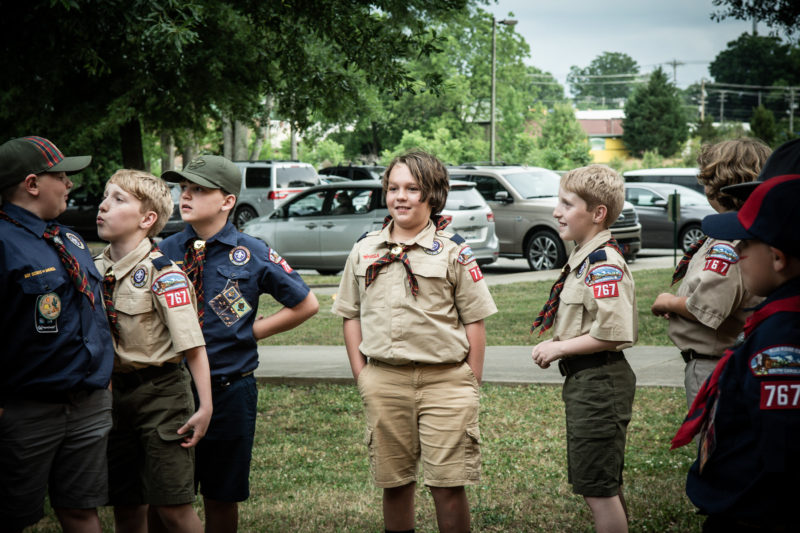
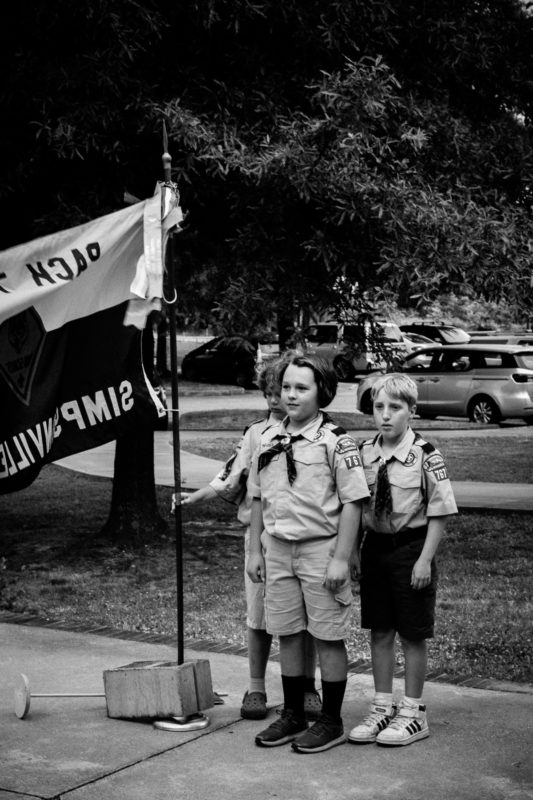
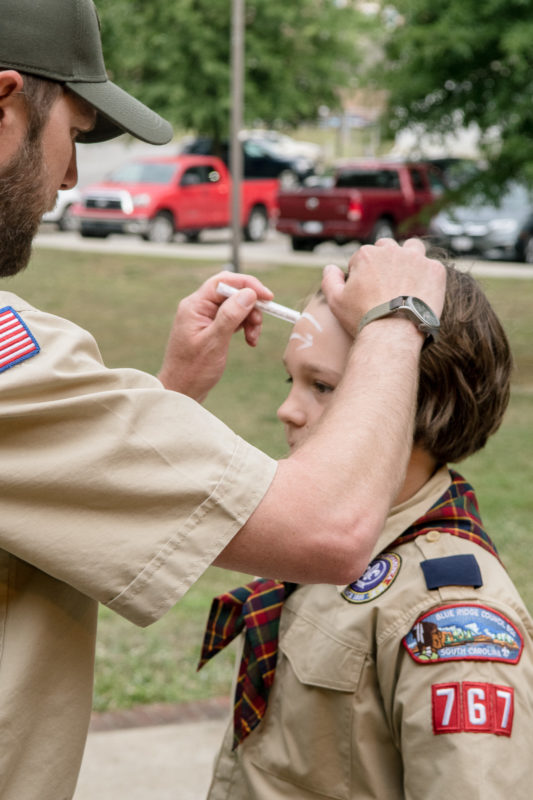
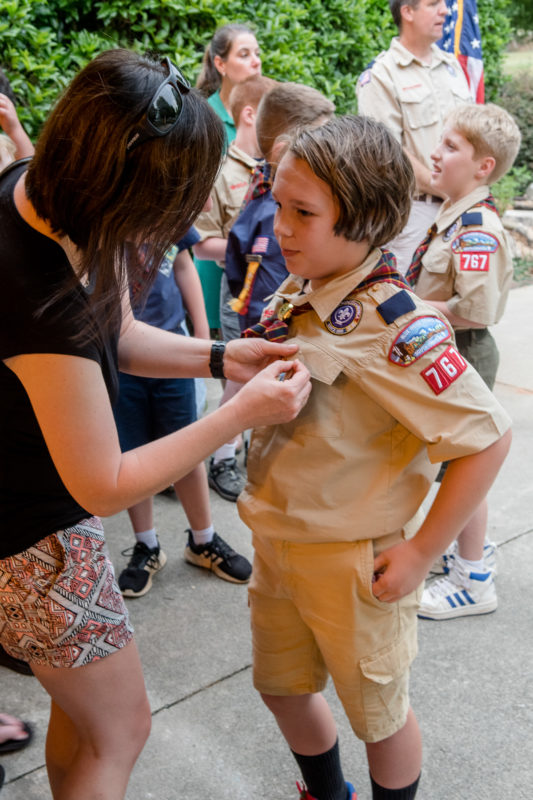
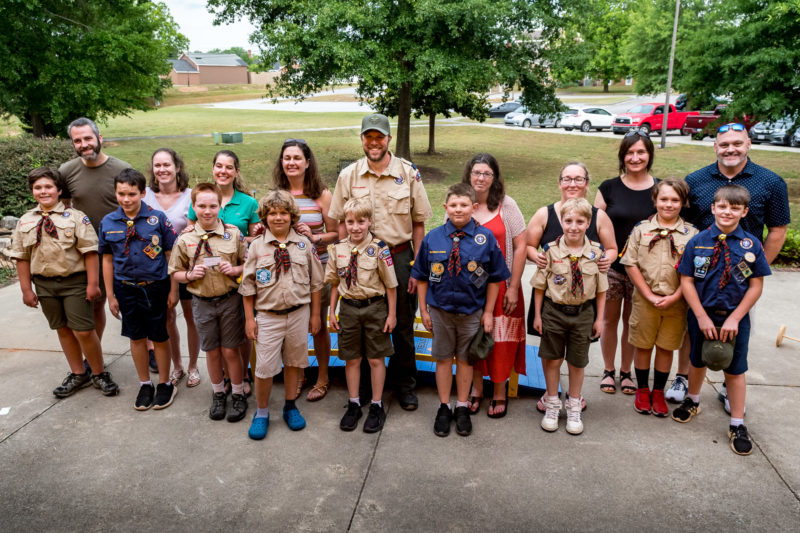
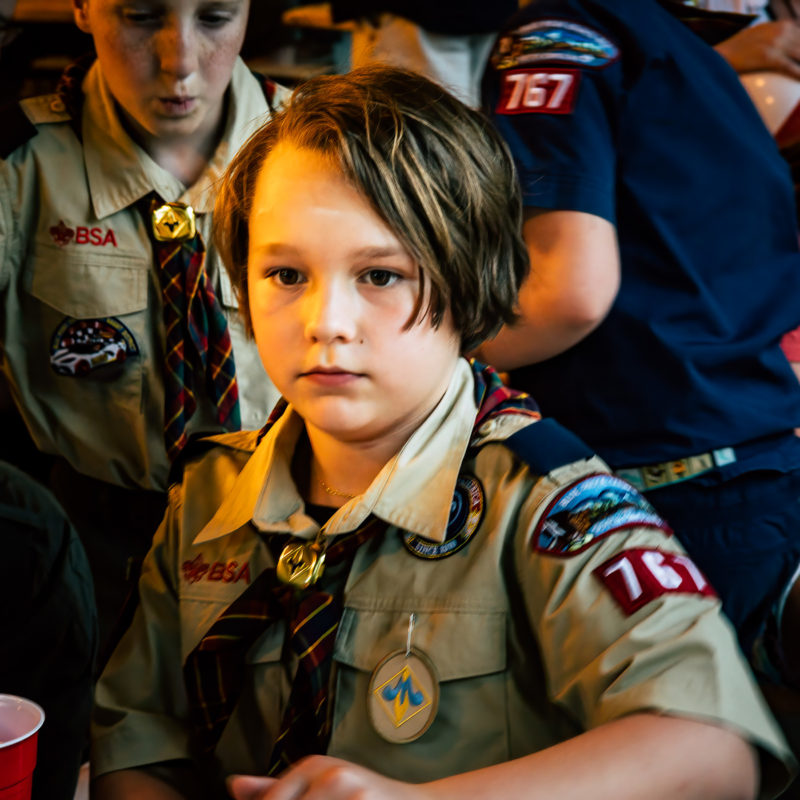
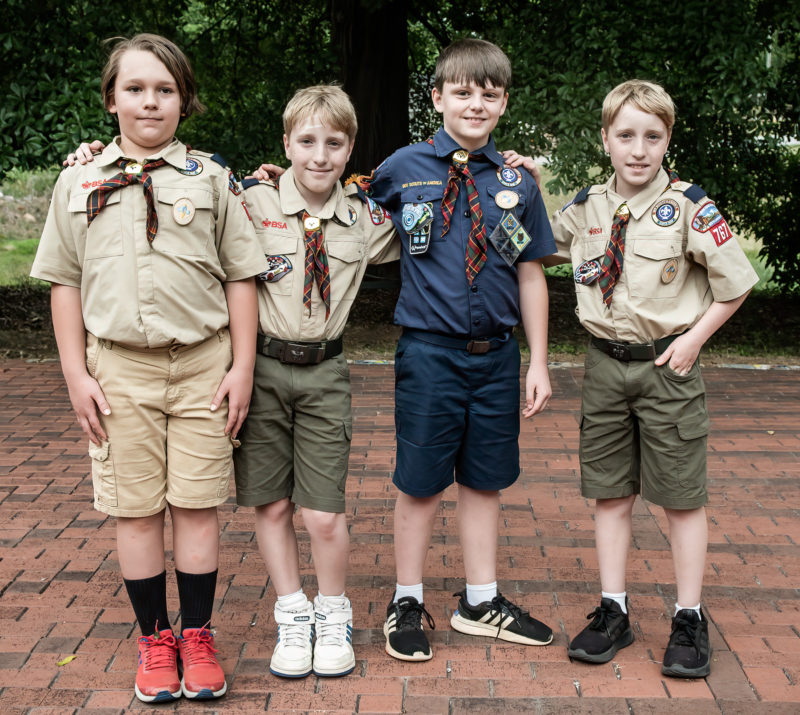
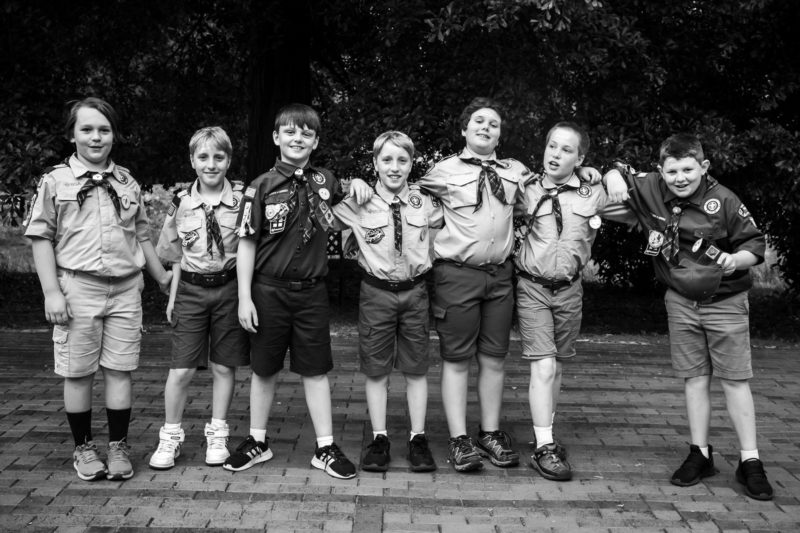
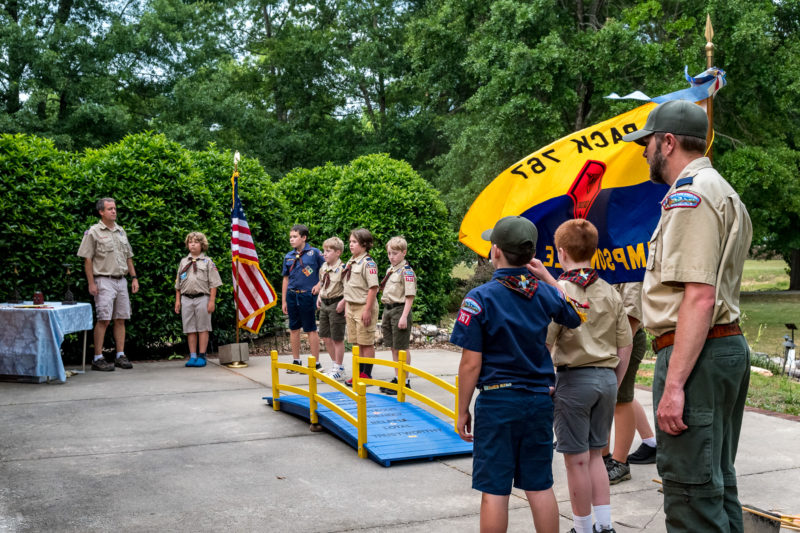
So when we got back from Mass just after noon today, we started raking and blowing the leaves. After Scouts today, we finished up.

The Girl joined us, because what was the end goal of it all? Simple: a pile of leaves to play in.

Lighting the Tree 2017
Backyard Play
Evening
The kids are both at an age that they can find something to do all by themselves. The Boy less so, since he’s only five; the Girl more so, because she’s nearing her teens.

This evening, the Girl was researching prices for an electronic item she is saving up for. She’s saved for several items in the past: a Barbie camper, a Barbie bike, and others. Those items are long gone, as well as the dolls which they accessorized. I hadn’t thought about that, though, until I sat down to write this: it’s been so long since she’s played with Barbies that I’d forgotten, on some level, that she ever had. More evidence of that strange way we tend to fall into thinking that the way things are now is how they always have been. And always will be. Remember a Barbie camper reminds me that things change.

The Boy soon contented himself with drawing. I’m not sure where the urge came from, but he suddenly wanted to draw cupcakes.
“Okay, Google, show me cupcakes” he commanded our Chromebook. It’s become a favorite activity: “Okay, Google” activates the voice search, and off he goes. It’s a blessing and a curse: it allows him to research things he wouldn’t be able to investigate otherwise due to his still-blossoming literacy, but it could lead to a kind of laziness if not monitored as he learns to write.
After L made some decisions about which iPod was within her budget, she sat down at the piano and began picking through some songs. She stopped taking piano lessons at the end of the school year, but dear friends’ visit this weekend got her interested again, I think. At least on some level.

I’m a little torn on the whole issue: there’s an argument to be made for insisting that a child learn a musical instrument. But that whole argument is made moot by the fact that the Girl sings three hours a week in the church choir. Let her find her passion, a wiser voice says. Let her follow that.
Interpretation
My English I Honors students have just finished up a four-week poetry unit, which is in a way one of my favorite units we do. It’s not just that I love poetry, which I do, or that I hope to instill in them an appreciation of or even love of poetry, which I do, but it’s also a one of the units where we all see real growth in students’ ability to read and think critically.
At the start of the unit, there are the concerns: Some suggest they cannot understand poetry. Some suggest poetry is just about emotions. Some suggest that learning about poetry has no practical value later in life.
To the first concern, I always point out that learning to read increasingly challenging texts with greater levels of intentional ambiguity is just like everything else: it takes time and practice. I assure them that I’ll give them some skills — some tricks, I call them — that will help them ease the process.
To the second suggestion, I point out that while emotion is a critical element in a lot of poetry, it’s not the end of poetry in itself. It’s a means to an end. The emotion one finds in poetry is not what it’s about — except for some confessional poetry, of course. Even then, there’s always something bigger. I don’t tell them then, but what I’m referring to of course is the lyric moment of a poem, that point at which the reader has an epiphany because the speaker has an epiphany. (I am speaking of modern poetry, of course. When we move back into the nineteenth century and beyond, lyric moments tend to disappear a bit. Just a bit.)
The third worry is easy: No, you won’t read and interpret poetry your whole life, but you will need the skills — picking up on connotation, determining tone, reading for changes in mood — your whole life. No matter what you do, I say, no matter what the job, you’ll need these skills.
So we dive in. We read Elizabeth Bishop and Billy Collins, Dylan Thomas and Theodore Roethke, Langston Hughes and Howard Nemerov, Robert Hayden and in preparation for Romeo and Juliet, Shakespeare. There are others, but I’ve found it most fruitful to read less and read more deeply than read more and only skim over the surface. We read poems and then go back to them again when we’ve learned another skill. We read poems once, twice, three times — again and again and again.
Then comes the test. A simple, four-question test. “Four questions, Mr. Scott?! Only four?!” they all reply when we prep for it. I give them two poems, both by W.D. Snodgrass: “Momentos, 1” and “A Locked House.”
Momentos, 1
Sorting out letters and piles of my old
Canceled checks, old clippings, and yellow note cards
That meant something once, I happened to find
Your picture. That picture. I stopped there cold,
Like a man raking piles of dead leaves in his yard
Who has turned up a severed hand.Still, that first second, I was glad: you stand
Just as you stood—shy, delicate, slender,
In that long gown of green lace netting and daisies
That you wore to our first dance. The sight of you stunned
Us all. Well, our needs were different, then,
And our ideals came easy.Then through the war and those two long years
Overseas, the Japanese dead in their shacks
Among dishes, dolls, and lost shoes; I carried
This glimpse of you, there, to choke down my fear,
Prove it had been, that it might come back.
That was before we got married.—Before we drained out one another’s force
With lies, self-denial, unspoken regret
And the sick eyes that blame; before the divorce
And the treachery. Say it: before we met. Still,
I put back your picture. Someday, in due course,
I will find that it’s still there.
We read it together, make sure there are no unknown or confusing words, then move on to the second poem.
A Locked House
As we drove back, crossing the hill,
The house still
Hidden in the trees, I always thought—
A fool’s fear—that it might have caught
Fire, someone could have broken in.
As if things must have been
Too good here. Still, we always found
It locked tight, safe and sound.I mentioned that, once, as a joke;
No doubt we spoke
Of the absurdity
To fear some dour god’s jealousy
Of our good fortune. From the farm
Next door, our neighbors saw no harm
Came to the things we cared for here.
What did we have to fear?Maybe I should have thought: all
Such things rot, fall—
Barns, houses, furniture.
We two are stronger than we were
Apart; we’ve grown
Together. Everything we own
Can burn; we know what counts—some such
Idea. We said as much.We’d watched friends driven to betray;
Felt that love drained away
Some self they need.
We’d said love, like a growth, can feed
On hate we turn in and disguise;
We warned ourselves. That you might despise
Me—hate all we both loved best—
None of us ever guessed.The house still stands, locked, as it stood
Untouched a good
Two years after you went.
Some things passed in the settlement;
Some things slipped away. Enough’s left
That I come back sometimes. The theft
And vandalism were our own.
Maybe we should have known.
The questions:
- Identify tone and tonal shift of each poem. Make sure you quote specific passages of each poem in order to provide evidence.
- What is the lyric moment of each poem? What epiphany does the speaker have in each poem?
- Compare and contrast the two poems. How are the topics, tones, and lyric moments similar? How are they different?
- The author of these poems was an early writer of what’s called “confessional poetry,” in which the “I” in the poem is very often the poet himself/herself. It involves writing not about what’s going on in the world but what’s going on in the heart and mind of the poet. What can you infer about the author if we assume that the “I” in each poem is the poet himself?
These are somewhat tricky poems. “Momentos, 1” has a couple of tones in the first part of the poem that are then echoed in mutated form in the second half.
“A Locked House” uses a long, extended metaphor that, being a metaphor, is never expressly explicated. Experienced readers immediately see that the house is a metaphor for the speaker’s and his wife’s marriage, but thirteen-year-olds don’t always see that at first.
Flood
The Lost Art
You want to enter every conversation assuming you have something to learn.
Teaching
“I just realized we haven’t read E the Christmas story,” my wife said to me this evening. I thought of the Dickens tale, and remembering the new film version of its making that is now out, I thought, “What a great idea.”
“You mean the Dickens story?” I asked to confirm.
“No, the Christmas story,” my wife replied.
I’ve just crashed. I haven’t so much lost my faith as given it up. Tossed it. Or rather, I think I’ve realized that I never had it to begin with. This is the second time in my life that this has happened. Why I didn’t learn the first time is beyond me, but something made me want to be a Catholic like my wife. A desire for consistency? Who knows. I do know that that desire is gone now. It all seems so preposterous, the Bible, the saints, the Son of God — it just seems like a fairy tale to me again.
So the last thing in the world I want to do now is to teach this to my children. But the next-to-last thing in the world I want to do now is come clean to my wife about my new, old skepticism. I’ve decided to just play along, for now, living in a sort of spiritual closet with my children and trying to keep quiet about my doubts in front of them.
And yet I hope to plant a seed of skepticism in my children, a questioning spirit that doesn’t settle for simple answers, that doesn’t accept answers without asking further questions.
As he was eating his pre-bed yogurt, I began reading the story from the illustrated Bible someone gave him.

It begins with the Annunciation, an angel appearing before a young girl and announcing that she will bear the child of God.
My mind immediately began running through the problems with this: the whole nonsensical doctrine of completely human and completely divine; the oddly perverse insistence that the girl must be a virgin out of a desire to use this to fulfill a supposed Old Testament prophecy that the Messiah will be born of a virgin, which in fact was based on an inaccurate translation from Hebrew to Latin; the whole question of why in the world a god would announce his presence in such an oddly ineffective way. All this and more. Yet I just asked a simple question: “What do you think about this?”
“It’s good,” my son said.
“What do you mean?”
“Because God can do anything,” came the odd answer. He is, after all, five: critical thinking is not a skill he yet possesses.
On the next page, we read about Joseph’s concerns about marrying Mary and the account in Luke of an angel appearing to him to soothe his worries.
My mind immediately began running through the problems with this: was he just worried that Mary, being unmarried yet pregnant, risked some sort of horrible punishment at the hands of the first-century Jews, who were still stoning people? Did he find it odd that this happened before marriage, knowing the potential societal reaction? Did he wonder if perhaps Mary was just promiscuous? Why exactly did the angel need to calm his fears?
A few pages later, angels appear again, this time to the shepherds in the fields.

“Has an angel ever appeared to you?” I asked.
“No,” came the direct answer.
“Me neither,” I said. “I wonder why.” And I continued reading.
It’s in these types of conversations that I hope to spark a bit of probing skepticism. Does this mean I am seeking superstitiously to undermine my wife? I suppose it does. Is that a bad thing? I suppose it’s a bit dishonest.
If I keep this up, the real conundrum awaits in the probably-not-too-distant future: what will I say when my daughter, who is almost eleven, begins noticing the changes? I can’t bring myself to say the creed during the Mass because I don’t believe in one God, the Father almighty, maker of heaven and earth, of all things visible and invisible, and I don’t believe in one Lord Jesus Christ, the Only Begotten Son of God, born of the Father before all ages. I won’t be going for communion anymore because when the priest says, “The body of Christ,” I am to assent to that belief by saying, “Amen.” And I don’t believe that the priest is giving out anything other than tasteless wafers and overly-sweet wine.
So she will notice, and she will ask, “Daddy, why don’t you go to communion anymore?”
And what will I say?