g

Wednesday Evening Vignettes

In a flash, the cherry tomatoes were rolling across the concrete floor like greased bearings — E had been unloading the shopping cart when, in a moment of slightly careless abandon, the container of tomatoes crashed into the side of the buggy as he was lifting them out, then crashed to the floor.

“It was an accident!” he said, looking up at me.

“Well, clean up the accident, then.”

He began picking up the tomatoes and hustling them to a garbage can. Behind us, a mother and her daughter, probably around four, stood watching. When E returned for another load, the little girl walked over and began picking up tomatoes with him.

When we returned home, K and L were in the midst of figuring out a new board game. Well, not quite a board game — there’s no board to speak of. Still, a game. An exceedingly complicated game. With multiple decks of cards. And two different sets of tokens. And so many rules to remember that it seemed impossible that a human could keep that many exceptions in her mind at once.

Of course, I started making silly comments.

L, very much wanting to play, naturally got a little irritated with my silliness.

E, content to entertain himself, worked with Legos as all this went on.

And K, determined to make it through all the instructions — a multi-page book, mind you, not just a few short paragraphs on the underside of the box — kept explaining the game to us.

“We have fifteen minutes before it’s E’s bedtime,” K said. “We have a little time to play.” Between all the complicated rules and steps, everyone got a single turn in those fifteen minutes.

Yellow

It’s been a couple of years since we’ve had a yellow jacket infestation. For a few years, we had one or two nests just about every summer, and taking care of them became a simple process: a few gallons of boiling water around ten in the evening, when they’re all bedded down in their nest, and no more problem.

This year, though, one hive made its home under the slab that supports our heat pump. If it were a concrete slab, I might consider the water method again, but it’s some strange concrete/foam “slab” that is just a little bigger than the unit itself. The thought of pouring water into that area, possibly destabilizing the whole unit — not a good thought. The other hive has made its home within a bush: it’s impossible to pour the water through the bush to make a good clean shot.

So today, I went by a DIY pest control place, bought some Talstar and Evergreen Pyrethrum Dust and let them have it.

I hit the nest under the heat pump while it was still daylight: I turned the nozzle on my sprayer so it was a fast, fat stream, stood back about ten feet, and sprayed into the opening for a good ten to fifteen seconds. I went back ten minutes later and did it again. After ten more minutes, I hit them a third time. Then a fourth time.

By then, there were yellowjackets everywhere, all rolling around on the ground, all struggling through their last moments.

It’s a strange moment: on the one hand, I feel a little bad for the guys. There they are, just doing what instinct has trained them to do. They’re breeding, raising young, defending them when necessary. On the other hand, they’re assholes. It doesn’t take much to get them riled up, and with two kids, two cats, and a dog around, it’s not a chance I’m willing to take.

Still, I can’t help but feel a little like Ender

Dinner

Volleyball

The Polish men’s team won the world championship today; the Girl is working to reach that level.

Scout Almost-Campout

The idea behind a campout is that we take a temporary home with us, setting it up in a forest and staying there for a night or two. Without that little element, it’s a day trip.

But what if you forget something? No, not the tent. The tent arrived with us safe and sound in the trunk. Along with the sleeping bags, air mattresses, camera, water-and-snack bag, shoes, Class A uniform, and cell phone. What didn’t make it? Our backpack filled with clothes. And toiletries. And flashlights.

K called just as we were crossing into North Carolina.

“Where are you?”

“We’re still on our way, just crossing into North Carolina.”

A long pause.

“Because you forgot the backpack with everything in it.”

I’d so meticulously packed everything, taking care to plan for all eventualities — long sleeves for sleeping, a jacket for the morning, extra contact lenses for me, extra everything — and double-checking that I had everything. And then I didn’t double-check that I had everything in the car.

We made plans: perhaps friends were coming and they could bring the bag. Nope, not this year. Perhaps the den leader knew of someone who was coming later and they could bring the bag that K would take over to them. Nope. In the end, we decided to wait a few hours and see. If the Boy wanted to stay, K and I could meet halfway, making it only an hour-and-a-half round trip for both of us. If not, we’d just go home after the evening’s bonfire.

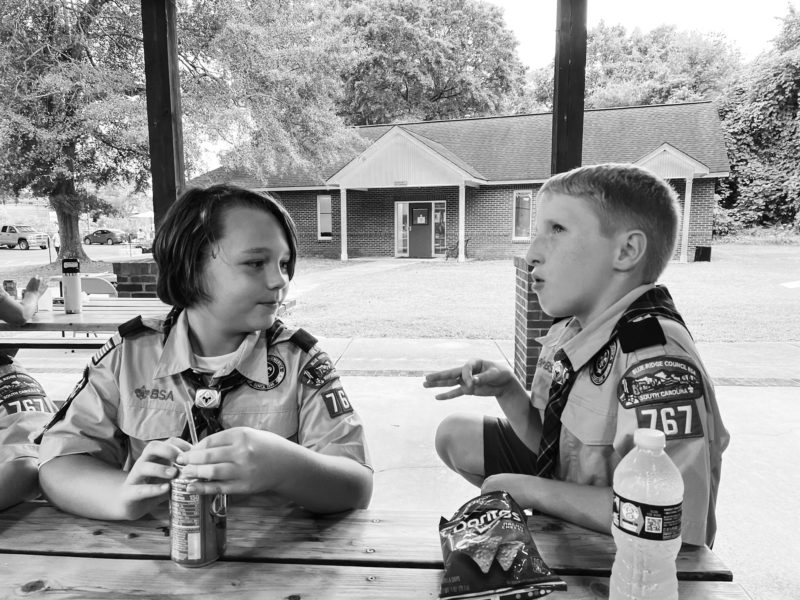
As often happens, the Boy was reticent to engage with the other boys at first. He clung to my side for the first half hour or so. Eventually, he joined in.

It’s a common theme for the Boy. He likes to watch from the periphery for a while, check out what’s going on, see who’s who. I think he gets it from me. K just dives in — she’s one of the most socially fearless people I’ve ever met. I’m a bit more cautious, and whether by example or genetics, the Boy has gotten that from me.

Once he felt comfortable, once he joined in with a couple of boys from his den, I didn’t see him all that much during the free play times. He was a totally transformed boy, and his chattiness and silliness took hold, for once he’s figured out the what’s going on, he chats with everyone. He used to chat with players on the opposing soccer team during games, for heaven’s sake, so perhaps he’s a mix of K and me.

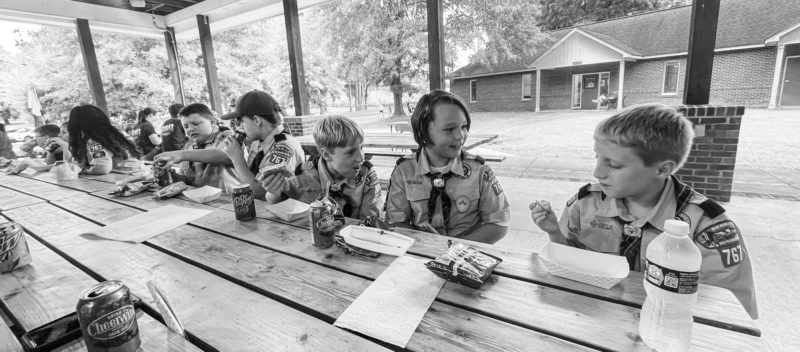
After games, we went for a den hike. Four boys from the den were there, four fathers as well, along with a big sister.

Mr. B, the den master, taught the kids about a few plants and trees, helped them find insects, discussed the possibility of fish living in the pond we were walking beside, and explained to the boys what was on tap for the evening.

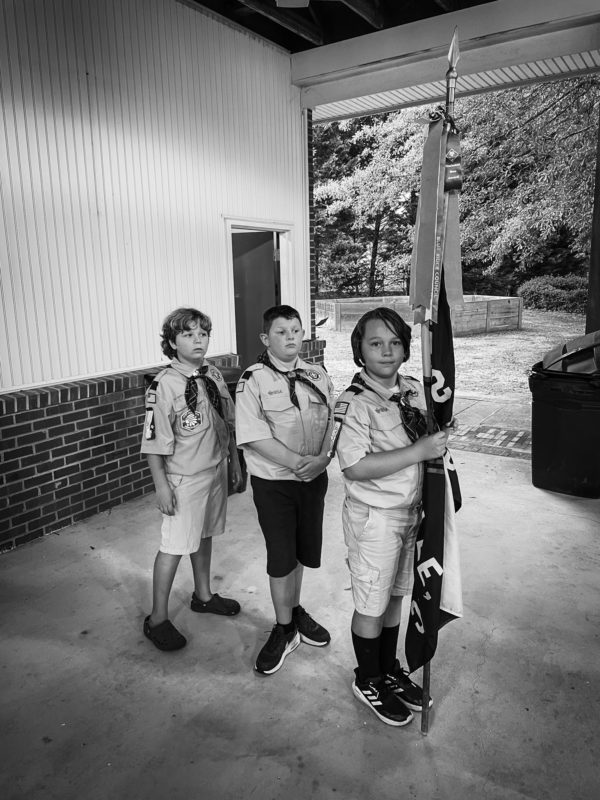
“In the evening, we’ll be having a flag retirement ceremony and a little variety show,” Mr. B explained. “We’ll have to prepare a skit for tonight’s show.”

I’d already talked to the Boy about the flag ceremony. Last year he’d been disturbed by the fact that the scouts were burning flags.

This year, we talked about it several times before the event, so he was not nearly as worried. This year was different as well because there were so many flags for retirement that every scout received a flag to put on the fire.

After the ceremony and the skit, the Boy and I headed home.

“I definitely need a shower when we get home,” E proclaimed, but I knew with an hour and a half trip ahead of us, there was little chance of him being awake when we got there. And indeed, by the time we were ten minutes out, he was fast asleep.

Conspiracy Theories

From Anne Applebaum’s latest article in The Atlantic:

The emotional appeal of a conspiracy theory is in its simplicity. It explains away complex phenomena, accounts for chance and accidents, offers the believer the satisfying sense of having special, privileged access to the truth. But—once again—separating the appeal of conspiracy from the ways it affects the careers of those who promote it is very difficult. For those who become the one-party state’s gatekeepers, for those who repeat and promote the official conspiracy theories, acceptance of these simple explanations also brings another reward: power. (Source)

The conspiracy theories swirling around in Poland right now about who was responsible for the disaster at Smolensk includes thought Jews were somehow responsible, that the Russians did it, that the previous administration — kind of like the deep state conspiracy theory in the States — was responsible don’t at first appear similar to the conspiracy theories in the States like birtherism, Pizzagate, and the malicious omnipotence of George Soros. But Applebaum’s article points out some frightening similarities in the central commonality of all these conspiracy theories: the politicians who encourage and spread them do so as part of a mechanism to solidify power.

It’s been happening in Poland for some time now, and Applebaum’s article draws some parallels with how such thinking developed in Poland and led to an unquestioned leaning away from democracy. Both countries have experienced a demonization of the press, with our own president going so far as to call it the enemy of the people. A free press is only the enemy of someone with totalitarian aspirations, someone who looks at demagogues admiringly. Both countries are incredibly polarized with differing definitions even of the truth. Civil discussion has become all but impossible for many, and the article discusses how these political differences have divided and broken families. I’m sure it’s happened here in the States as well.

The article is worth a read.

First Game Fall 2018

The day started with the first game of the season, in a new age group, the six- to seven-year-old age group, which made the Boy one of the younger players on the field. It showed, but only a little bit. The star of our team, a young man named S, was seven years old and had some definite ball handling skills. He could weave in and out of defenders like a pro, and he must have had five or six shots on goal, making two of them. The Boy, by contrast, attacked best when he had a bit of room to work with. Charging through the opponents was still a bit beyond him, but I could see he was watching S, probably planning his own implementation of such a strategy.

In the afternoon, a little creek play with the first radio controlled car the Boy ever got.

Scrabble Homework

The Boy had no homework tonight, so we played Scrabble, which was sort of assigned as homework when you don’t have homework. “Play a word game,” the instructions said, and what better word game than the word game?

We played the basic version of Scrabble Junior, which has words laid out for young players — good for working on spelling and reading. We looked through the instructions but couldn’t find anything on how to play that version. The back of the board is a more traditional, blank graph for players to make their own words, and the instructions dealt exclusively with that, so we made up our own rules.

A pre-game shot when E realized, with K’s help, that he had “CVS.”

We could, in short, build words letter by letter, and one only got a point when one finished a word. E got the first point, finishing “ball” like a champ.

But at one point, I finished a word knowing that the Boy could have finished it in the following turn. K had had the opportunity to do it earlier, but he’d have fallen behind, so she elected not to take the point from him. I was the only one with no points, and I decided to offer him a learning opportunity.

He was not happy.

Storming off to the living room, he declared, “I’m not playing!” At first, we tried to get him back through his competitive spirit: “Okay, you’ll just lose your turns.”

“I don’t care!”

We needed more drastic measures, so I simply and firmly instructed him to return. “This is not good sportsmanship. There is no need to get upset because someone else gets a point. No one else at the table was upset when you got points. Indeed, we were all happy for you. Now, calm down, sit down, and play with a mature young man.”

A few minutes later, he drew a G, which meant he could finish “dog” and “grapes” for two points. (We were playing one point per word, not one point per letter of completed words.)

In the end, he came in last place, but we were all separated by single points, and by then, he didn’t care. Hungry, he didn’t even stick around to count points.

Mission accomplished.


Eulogy for the Ages

No matter what one thinks of him, Obama’s eulogy for John McCain was absolutely masterful. It is undoubtedly one of the best speeches I’ve heard in a long time.

What struck me most was this line: “We never doubted we were on the same team.” Such a difference from so many politicians and pundits who constantly demonize the other side.

Another standout passage:

So much of our politics, our public life, our public discourse can seem small and mean, and petty. Trafficking and bombast, and insult, and phony controversies, and manufactured outrage.

It’s a politics that pretends to be brave, and tough, but in fact is born of fear.

John called on us to be bigger than that — he called on us to better than that.

It’s a speech for the ages, sure to be included in anthologies of eulogies in the future.


Meetings and Homework

As a teacher, I’ve been in a number of meetings. I’m fortunate to say that I can’t make a claim like, “Not a day goes by that I’m not in some meeting or another,” but I suppose that’s possible.

We have grade-level meetings every Friday. We sit around and talk about what’s going well with the logistics of our grade — moving from class to class, getting materials out of lockers, going to the bathroom, going to lunch, heading back from lunch, getting to related arts classes. All these things and a million more. We talk about students who are showing bad behavior in multiple classes and make a plan for dealing with the kid, hopefully with more positive outcomes for the kid than he is currently experiencing.

Working on math homework

Every Tuesday we have professional development. We learn about new websites, new methodologies, new laws, new tools, new books, new paradigms. We go over how to accommodate children with mental and behavioral challenges in ways that are productive and in accordance with the documentation (IEPs/504s) in place for them.

Lately, we’ve been learning about the new way the district requires us to write our lesson plans. It’s tempting to think that since the lesson plan is a tool primarily for the teacher that the district would allow a great deal of flexibility in this endeavor, but that would be a faulty assumption. Verbiage, formatting, pacing, sequencing — all of this is decided for us. And when the district decides that it wants to make a change to this or that element of our lesson plans, we, as far as I know, have little to no input into the changes and are simply told, “This is how you do it now.” Perhaps some select few teachers get to attend those meetings where such matters are decided, but I’ve never met anyone who’s had a sense of having any input into these issues.

On altering Wednesdays after school, we have faculty and department meetings. These usually just turn into information-dissemination sessions, and I’m sure many participants find themselves thinking, “If you could just give me this in writing, I can read it on my own time.” Sometimes department meetings provide professional development as well.

A frustrating moment

While sometimes there’s a distinct feeling in the room that everyone would like to be doing something else (planning lessons? assessing student work? recording grades?), many of these meetings are indeed helpful. A large organization has to have meetings.

Today, however, I attended a first in my meeting-strewn career: we had a meeting about upcoming meetings. A meta-meeting.

Scout