Matching Tracksuits

fun in fours

Month: March 2015

Seeing You in Them and Them in You

Dear Terrance,

You did some work today. It's a rare occurrence, to be honest, and most of the time you seem more interested in drawing attention to yourself by any negative means necessary. But today, for some reason, you worked.

I've said it before, and I'll likely say it many times again, but the only substantive difference between you and the folks in the class you call "the smart class" is that they work as consistently as you disrupt. But if you could start to see them in yourself, perhaps we could start making some real progress.

However, I worry. I see you in another group all too easily. Perhaps you heard about the lynching that occurred in a Brooklyn McDonalds, where seven or so girls ganged up on a single girl and beat her unconscious while onlookers cheered, laughed, and filmed it on their cell phones. Sadly, it's not too hard for me to imagine you among them, cheering the girls on, holding your cell phone while eagerly thinking about what you'll tag this with on Twitter. Not a single patron stepped in to help the girl, who ironically is now bragging on social media about the fame she has. Twisted world, Terrance, and sadly, as I said, I can somehow see you in that crowd. It's not hard to imagine.

But after seeing you work today, it's not hard imagining you being in an entirely different group.

The choice is yours, I suppose, but I wonder if it hasn't already been made through fourteen years of habituated behavior. I hope not, because the future of people who stand around and cheer while someone is getting assaulted is not a bright one. You deserve better, so choose better.

With a glimmer of hope,
Your Teacher

Split Pea Soup

DSCF3043

A Tragedy in the Making

hwa
Herbert Armstrong

It had to happen. From the morning of January 16, 1986, it became an inevitability. When the charismatic leader of a religious organization dies, change is inevitable. I suppose it doesn't have to be a particularly charismatic leader to necessitate change when he dies, but the more charismatic, the harder it is to maintain the same arch of theological development because so much of the theology is grounded in the leader's personality, whether or not followers admit or even are aware of it.

When Herbert Armstrong (HWA) died in 1986, there was no way things could go on as they had before. The most basic reason was simple: everyone believed, implicitly or explicitly, that Armstrong would be alive until the end of time as we know it, until Jesus's second coming. When he passed in his sleep without a single trumpet blast from heaven, without a chorus of angels announcing the return of God incarnate to Earth, it was the first of several inevitable changes in theology. When the new leadership began changing doctrinal distinctives like British-Israelism and the nature of God, the changes were simply too much for some who longed to return to the age of Armstrong. They removed themselves from fellowship and formed an offshoot. More like a hundred-and-some offshoots, but three or four main ones.

Each of these offshoots were in competition for new members as they left the parent organization for the dozens of newly-forming off-shoots, and for many, the medium for measuring the acceptability of this or that splinter group (as they came to be called) when considering membership became the group's faithfulness to Armstrong's teachings, which constituted true Christianity restored again. But slowly, inevitably, these groups began tinkering around the edges of Armstrong's theology. This point was "clarified," and that one "elucidated." Nothing ever really changed -- it was all euphemistically described to the followers, just as it had been in the original group after Armstrong's death.

Press-2
David Pack

David Pack, though, founded a group called the Restored Church of God that built its whole membership on the solemn promise that nothing about HWA's teachings would change. But reality tends to get in the way of such far-reaching promises, and one of the earliest dilemmas for the church was the appropriate use of the Internet in spreading Pack's (and by extension, HWA's) theological musings. After all, Mr. Armstrong didn't use the Internet: he used radio and television. For the outsider, this seems like a simple issue: Herbert Armstrong didn't use the Internet because it didn't exist, and so it wasn't any kind of doctrinal issue, just an administrative decision. Still, Pack took a whole sermon to explain to his small flock that, even though it looked like he was making a change, he wasn't making a doctrinal change.

But further challenges waited.

As Pack was only ordained a pastor in Armstrong's church before the breakup, and as he recognized only Armstrong as an authority, he had another problem: He wasn't doing a pastor's job. He was preaching the Armstrongite Gospel to the world, which Herbert Armstrong always taught is an apostle's job. Armstrong was, in the eyes of his followers (which is really all that matters), an apostle on the same standing as the New Testament apostles, and for a pastor to step out of his assigned roll like that seemed mutinous. It was change. So in 2004, Pack declared himself an apostle as well. Problem solved.

But a door opened.

Once a leader who has sworn not to change a single teaching of his claimed predecessor, all doctrines become open for review. This is what happened in the Worldwide Church of God that ultimately led to its turn to orthodoxy and the thousands upon thousands of members who fled to other splinter groups to hold on to the faith once delivered. Pack would have to be very careful not to make changes that seem too drastic, too far-reaching. The solution: add doctrines. Don't change any existing ones -- just add. "These weren't revealed to Herbert Armstrong because he didn't need to know it, but now I can restore this truth."

He has criticized other leaders for doing this, but it was of course inevitable that he do it himself. But how far could he go? He declared himself an apostle in 2004 shortly after declaring himself to be the prophesied "Watchman." It's been over ten years since he made a major change that he's revealed to the public. In his most recent sermon, though, Pack makes the biggest and most dramatic change of his career, arguably of just about any of the splinter leaders.

In short, he makes the claim that if "you were called by God, and you are to participate in his work and walk in his ways, you have to turn over your assets to God's church" and that "salvation is attached to [this new doctrine]." He calls this doctrine "Common," and roots it in the observation that the New Testament church apparently shared a lot of things."Not even Armstrong went that far," a friend and fellow cult-watching enthusiast commented, and that's about right: it is such a drastic change from Armstrong's simple requirement of a 10% tithe on pre-tax income figures that it amounts a wholesale theological change. After all, how can you tithe 10% when you've already contributed all your assets?

This change reveals a megalomaniac mindset of literally historic proportions, a cult of personality that is simply dangerous.

Yet how could this happen? How could he go so much further than Herbert Armstrong ever dared, demanding more fiscally from his followers than Armstrong even dreamed of requiring? It is in part because I believe Armstrong was more mentally stable. Armstrong declared himself to be prophesied in the Bible, but he claimed no supernatural powers for himself. Pack has done just that.

Just what these extraordinary powers might be remains unanswered. But clearly there's a disconnect between reality and how Pack sees reality. But when you see yourself literally in the Bible -- well, when you see yourself in the Bible after using some horrible interpretative techniques -- there's almost no limit to what you can attribute to yourself. It's not too hard to see how far reality has taken leave from Pack.

To suggest that because one Greek word appears to be pronounced like the man's hometown -- that shows just how little Pack understands basic exegetical concepts. But it gets worse:

Moses's "strong hand" equals Armstrong? It would be laughable if it weren't for the fact that so many people are allowing themselves to be duped with this nonsense.

One would think that after the long history of false predictions, both in the Armstrong community and in the general Christian prophecy-loving population, that a leader of a group in 2015 would have learned some lessons. If he hadn't learned from others, one would think that Pack at least learned from himself. In 2004, for example, he stated the following, playfully edited:

It is now 2015, so apparently we did have ten years remaining until the end of the world as we know it, and I would wager that, come 2019, we still won't have seen the end of the world. And yet, on and on he will go until the day that he dies continually proclaiming that "time is short," just like Armstrong did.

Repetition

G. K. Chesterton wrote,

A child kicks its legs rhythmically through excess, not absence, of life. Because children have abounding vitality, because they are in spirit fierce and free, therefore they want things repeated and unchanged. They always say, 'Do it again'; and the grown-up person does it again until he is nearly dead. For grown-up people are not strong enough to exult in monotony. But perhaps God is strong enough . . . It is possible that God says every morning, 'Do it again,' to the sun; and every evening, 'Do it again,' to the moon. It may not be automatic necessity that makes all daisies alike: it may be that God makes every daisy separately, but has never got tired of making them. It may be that He has the eternal appetite of infancy; for we have sinned and grown old, and our Father is younger than we.

Which explains why the Boy, when given the chance to go outside today -- an opportunity we'll take every chance we can get for the next several weeks -- he wanted to explore. Just as we did Saturday. Just as we did yesterday evening. And in exploring, go to all the same places we always go.

"Do it again, Daddy."

DSCF3030
DSCF3034

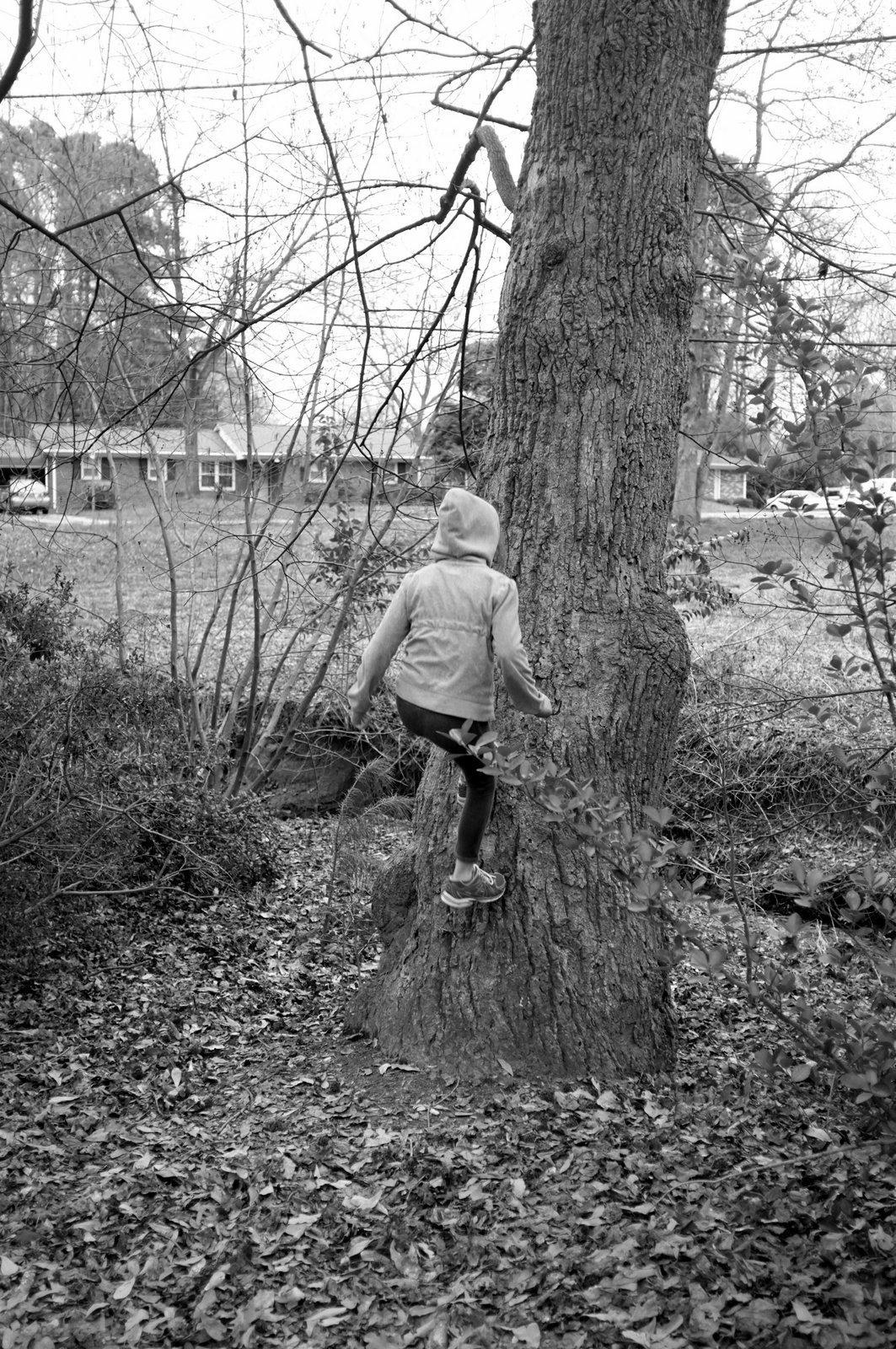
In the meantime, the Girl made a discovery:

It's possible to run up a tree.

Change

A warm day in early March makes us all think that perhaps we've turned the corner, that maybe we'll leave behind all the cold and dark of winter for the year now and begin thawing.

01-VIV_2796

Granted, as someone in South Carolina, I can hardly complain about the cold, about true cold, but this year, we've had a few doses of true cold, of temperatures in the single digits, and we're all tired of it.

02-VIV_2808

And so today, we got out as often as we could. Before the Boy's nap, we headed out to play Red Light, Green Light, one of the Boy's favorites, even if he doesn't quite understand it. Call "Red light!" and he trots up beside whoever his opponent is and only then stops, most often with a smile.

03-VIV_2815

Afterward, we head to the backyard for some exploring. That usually, no always, means wandering and wondering about the two backyards, ours and our absent neighbor's, going to all the same places we always go -- our little hideouts, our little lookouts.

04-VIV_2816

The trees, we discover during our walk, are eager for spring as well.

After the exploring, it's time to swing. Those two activities are the staples of our backyard adventures, with the order changing. Yet there has been a change in the last year: the Girl has taken over our role of pushing the Boy. But in true Girl fashion, she turns it into a game in and of itself. When the Boy accidentally kicks her, she moves into position to let him do it again -- after she fusses just a few moments -- and then begins performing. Only a slideshow can do the performance justice.

After a few minutes, it's time to switch. And that reveals another change: the Girl is far more patient these days than she was a year ago, a month ago. Well about some things.

"Is it my turn, Daddy?" she asks.

"No, let him swing a little longer," I reply, and she does. But eventually, it's time to be fair. She gets in the swing, her legs flopping over the edge, and the Boy heads off to find things to toss into the drainage ditch we call our stream.

15-VIV_2857

He prefers sticks, but I collect them all to divide between our fire ring and our smoker, the better going to the latter.

16-VIV_2880

By and large, I manage to convince him that spiky balls -- Sweetgum seed pods -- are far better for tossing. They carry farther, and the far more numerous.

The Girl, though, takes out her Explorer's Notebook, which is also her Drawing Notebook, and begins making notes of all the "extraordinary" (a new favorite word) discoveries we made, all the poisonous trees and plans, the Wild Cat, the imaginary creatures -- all our near-misses.

17-VIV_2888

After the Boy's nap, we head to a local park. We were going to go to the small park by the small local airport, but the Girl was eager to go exploring more, somewhere new, and the Boy, to our surprise, was eager to change our plans.

3-DSC_2951

We head out for a walk, making our way to the observation deck.

2-DSC_2949

And back.

8-DSC_2961
7-DSC_2969

We end with some time on the playground.

Some things just don't change.

Wrong but Right

"Daddy, is she a good student?" The Girl was helping me grade papers (she loves going over multiple choice work -- no really, there's no convincing or arm-twisting necessary), and as she always does, she asked about this student and that student. I glanced at the name.

Is she a good student? How I answer that question would depend on how we define a good student. If we define it as a student who is always hard-working, who is always pleasant to be with, who always gets her work done and always does stellar work, there was no way I could possibly describe the student L was asking about as a "good student." Indeed, by that metric, she is just about everything -- anything -- but. Or at least she was. At the beginning of the year, she was belligerent, often refusing to work, often showing nothing but unreasonable anger about any correction or redirection. She was, in short, a nightmare student. And that means that I was immediately drawn to her, immediately interested in helping her, and immediately frustrated with her more often than not.

But the last few months, she's been changing. Some days, she works. Some days, she's incredibly attentive during whole-class instruction. And then some days, she's back to her old games. But there is progress. And really, if we look at any definition of a good student, progress must be factored into the definition.

"Sometimes, sweetie, sometimes," I said, then added, "Why?"

"Because she got them all right."

Learning

Tonight, the Boy and the Girl both showed just how well they can adapt to new situations and learn from them. The Boy wanted marshmallows. He knew where they were, but at not even three years old, he was knew he was far too little to reach them. Without assistance. He also knew that he would never get us to help him -- he knows when sweets are allowed and when they're not an option -- and so he figured, "Who needs help for any of it?"

DSCF2918

The Girl, on the other hand, has been complaining that school is boring because it's too easy. "All we do is go over stuff I already know." Perhaps that's why her teacher gave her her new assignment, or perhaps it was just coincidence. At any rate, this evening she was complaining that the new work was way too hard. "It's third-grade work, at least!" I took a look at it and realized the work would require a rudimentary understanding of long division. And so I sat down with her and showed her how to do it. With the help of several examples, a multiplication table, and consistent help ("No, now you have to subtract."), she got it.




DSCF2922

Children’s Museum

It's cold. It's raining. And we've been inside for what seems like forever. What to do? Go to the children's museum.

We haven't take the Boy, and the Girl, while she went with her class last year, went with us when she was only a little older the Boy. And the result? What fun!