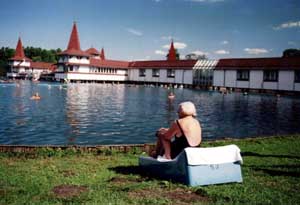
Heviz is home to one of the largest and most famous warm sulfur springs in Europe. A few numbers:
- The water has an average summer temperature of around 36 degrees celcius (96.8 Farenheit)
- It has average winter temperature of around 24 degrees celcius (75.2 Farenheit).
- At its deepest point, it’s 38.5 meters (126.3 feet) deep.
- The spring feeding the lake pumps an amazing 410 liters (108.3 gallons) a second into the lake, at a temperature of 39.8 degrees celcius (103.6 Farenheit). That means the lake entirely refreshes itself ever thre and a half days. (Now, I don’t know where the heck the water already there goes – I’m relying on the guidebook Kinga and I were using for my information, and it doesn’t say. Does it evaporate? Get swallowed up by bathers? Who knows.)
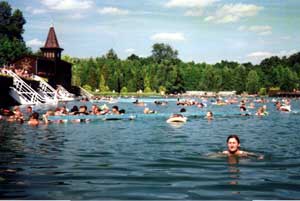
Enough of the numbers.
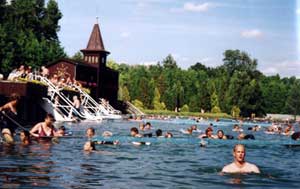
Built into the middle of the lake is an enormous dressing room/restaurant/sunbathing/spa facility, with at least two others built long the shores.
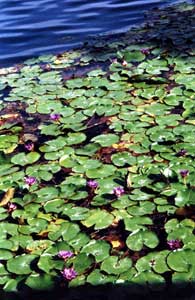
At the end of the nineteenth century, one Sandor Lovassy brought in lotus plants from Africa and India, and they continue to grow along the bank of the spring – the one place in Europe where they are cultivated freely (i.e., one can go up and touch them!) out of doors.
There is one year-round average I failed to mention: the smell of rotting eggs. You don’t really notice it that strongly until, strangely enough, you come out of the water. It’s especially evident when you’re rinsing at one of the many fresh-water showers, and then it’s almost overpowering.
With all the sulfur odor floating about, it was only appropriate that I was at the time reading C. S. Lewis’Screwtape Letters.
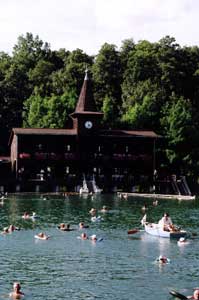 To jest przepiękne miejsce. Osobiście nie przepadam za źródłami termalnymi, ale okazuje się, że jeśli są ładnie zagospodarowane, to nawet tłum ludzi, który zwykle można tam spotkać, nie jest tak uciążliwy. Jest to jedno z największych w Europie jezior termalnych. Głębokie nawet do 38,5 m, ze średnią temperaturą w lecie wynoszącą 36 stopni. Położone jest w środku parku – dookoła zieleń, a na samym jeziorze i na jednym z brzegów drewniane budowle-sanatoria. Wszystko trochę przypomina nasz Biskupin, tak mi się przynajmniej skojarzyło, mimo że jeszcze w Biskupinie nie byłam. Polecam – robi wrażenie, a sama kąpiel jest bardzo przyjemna i nawet woda tak bardzo nie cuchnie. :-)
Kinga and I went in the middle afternoon, and to our surprise, discovered it was open only until five. We spent there only about an hour and a half, which is a shame, because it was so relaxing that I could have easily spent twice that. But instead, we went to Szigliget.