Matching Tracksuits

fun in fours

writing

Motion

Those things which we take most for granted are usually the same things that we could not do without. It’s the paradox of familiarity: we sometimes say nastiness to those we love the most because familiarity breeds, if not contempt, at least laziness: we assume there will always be time for amends. We go from day to day assuming that the last words we say to our wife, daughter, parents that day won’t be the last words. We take for granted that we’ll wake up in the morning and be able to start, if not afresh, certainly again.

The alarm clock chirps and without thinking of the miracle unfolding in front of us, we casually slide our arm from under the sheet and smack another seven minutes of silence out of the clock. When we finally pull ourselves out of bed, an entire ballet of muscular motion has made it possible to sit up on the edge of the bed and rub our eyes in an attempt to smear the last bits of drowsiness away. A yawn is an engineering marvel that goes unappreciated, and lacing our shoes is as complicated as any dance.

Certainly that which we waste the most of is that which we can never replenish: time. We waste it as if our present moment were eternity, as if we were some kind of god, able to alter time and space and make an endless loop of tomorrows. Of all the meaningful things I could do with my time on a Friday night, for example, why do I sit and troll YouTube videos or play chess? “One day I will take all the photos and memories I have of Poland and write a book,” I promise myself continually, yet there’s always a caveat: “But not tonight. Tonight, I just want to relax,” and I load chess.com and drive myself to frustration over a silly game.

These three are related: the ability to move freely and the time to do so allows us to place our bodies in nearest proximity to those who mean the most to us. With few exceptions, these freedoms are universal, even in the most repressive regimes. It’s rare that something takes them away, at once, in a flash. It is necessarily an act of aggression, an imprisonment, a forcible, irresistible subjection of one’s will to the will of another.

Sometimes we imprison ourselves through misplaced priorities. We watch YouTube videos when there are more productive goals; we go to a class instead of attending our daughter’s performance; we rush conversations with our parents because some trifle is more important at the moment.

Occasionally, though, we’re blessed: something shakes us out of our assumption that that which we have now will never change and is therefore not worth cherishing fully at this moment. It might be something we experience that shakes us, that turns our head around, that lifts us for a moment to see where we stand and forces us to appreciate the view, regardless of what it might be.

Usually, though, it’s a vicarious glimpse of someone else’s experience, and often it’s an experience that we find ourselves wondering whether we could endure it, much less profit from it in any way. Watching The Diving Bell and the Butterfly (or reading it, I would assume–something that’s now a high priority) is just such an experience. French journalist Jean-Dominique Bauby, almost completely paralyzed by a massive stroke, wrote the entire book by blinking his left eye, the only part of his body that he could move. Claude Mendibil recited the letters of the French alphabet in order of their frequency, and Bauby blinked his left eye when he heard the next letter of the word he wanted to dictate. “E S A I T N R U L O” began Mendibil again and again until Bauby dictated, letter by letter, the entire text of the memoir he composed and edited in his head. That alone says more than most could in a lifetime of babbling.

It is, in short, a film all should see.
Potential

My English 1 Honors class is about to start the Odyssey. For their weekly short essay assignment, I asked about heroes and heroism. Commenting on the usual association of "hero" with super powers, one student wrote the following:

In fact in the real world having superpowers would make you a villain sooner than it would a hero because though the idea of superheroes saving the world on a regular basis is nice and all, name one superpower and there are probably more than ten different ways to exploit it for personal gain and in a world where “look out for number one” is a personal motto for most of the world it is no long shot that with real superpowers there would be more villains than heroes in the world.

Getting these kinds of results is a real boost: such potential in this kid's writing. The problems are purely cosmetic: nothing a few mini-lessons on sentence variation, punctuation, and voice can't buff out.

14-year-old Poetry

People write about what they know. One of the prime motivations of confessional poetry was that we theoretically know more about ourselves than about anything else.

When you ask a group of thirteen- and fourteen-year-olds to write poetry, there is one guarantee: the boys will write about video games. In one portfolio of ten poems, one young man wrote two poems about games (including a haiku about “Call of Duty 5”), two poems about sports (one about playing, the other about watching), and one about hunting.

I mentioned this to a colleague this afternoon. She thought for a moment, then made a suggestion: “Next year you could tell them that each poem had to be about a different topic.”

“Then they’d simply say, ‘Well, they’re two different games, so that’s technically two different topics.'”

Teaching Writing

Teaching writing means reading things like this

  • The crowd looks like a box of crayons with their colorful shirts on to support their favorite school.
  • The most magnificent and wonderful part of day is the night that takes us within. It gives you your dreams and time to think about the day that trailed behind you.
  • I ask my mom. “I’m too busy at the moment. How about later?” Knowing that later will be near 7 PM, I slither back to my room.

How can you not smile when gems like this are scattered through student writing? Evaluating each assignment becomes a treasure hunt.

Daily

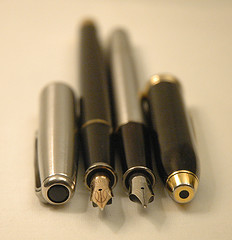
Pens on Flickr

I began keeping a journal my freshman year in college. I wrote almost every single day. When I arrived in Poland in 1996, I kept the journal daily for two straight years.

One night -- though "early morning" might be a better description -- I realized, as I lay me down to sleep, that I hadn't written anything that day. I picked up my pen, scribbled the date, and quickly wrote, "I'm writing this to keep my streak going." I'm not sure if that really counted, but it did give me a sense of closure as I drifted off to sleep.

I don't write in my journal as much these days: much of what I would write, I write in here. I try to write dream of writing daily, but sometimes, I just have difficulty motivating myself.

Like this evening.

Journals

How does one keep a journal? It’s something I’ve done for so long that I no longer even think about it. And yet when you’re starting out, doing it on command–and for a grade, no less–then it might seem a little intimidating.

“Three hundred words, three times a week,” I said. “About anything.”

“Anything?” the students ask incredulously.

“Yes, anything.”

“Anything” is an awfully big topic. So big it could be overwhelming. I understand their concerns.

One thing I mentioned was writing about school work and projects. I need to tell them, “You should think of a journal as a place where you simply think aloud.” Perhaps that will help. “It’s a place where you can think through the Lord of the Flies project or tease out all the reasons you don’t really like So-and-so, or where you can simply play with language.

“Here language, fetch.”

Students tend to question the value of it, especially when I tell them that I won’t be reading each journal in its entirety. “Then why write it?”

“Writing is just like any other activity: the more you do it, the better you get.”
Some buy it, some don’t.

Finding Our Space

“I don’t know what to write about” is a common complaint among eighth graders, often regardless of whether or not a topic has been provided. To alleviate that, we began an extended lesson: “How do I find topics for my writing?”

It seems abundantly clear to me: just look around and there are things to write about everywhere: the jostling silliness and/or frustration of a class change; the way five minutes can just drag by even in the best classes; the dress code to which students are required to adhere; the difficulty of coming up with a topic for writing–topics are simply everywhere.

To give students a starting place, we worked on creating Expert Inventories today. “Imagine a teacher told you to write a paper on the topic of ‘blank.’ What topic would make you make you think, “Oh, that’s easy. I can do that I no time!” All the kids dutifully began creating the same lists. The boys wrote “basketball, football, Madden 09.” Many of the girls included shopping, texting, boys.

There were some surprises. One girl enjoys making bricks with her dad. “We like to experiment with how things used to be done,” she explains. Another is good at making mortar. “Mortar?” I asked, wondering if I heard her correctly.

Next step: branching out some of the general terms to more specific ideas. “What do you mean when you say you’re an expert at basketball?” I asked. “Playing it? Watching it? Commentating on it?”

“Shopping–shopping for what? Shoes? Music? Clothes?”

The kids expanded their list, some of them writing endlessly. “Can we use the back of the page?” one girl asked. A good sign.

What I’m trying to do is fairly simple, not to mention fairly obvious: before kids can get serious about improving their writing, they have to enjoy it, or at least tolerate it. Having them to “analyze the author’s craft” (as one of the required “artifacts” is to do) in a short story will not bring “Ooohs!” and “Ahhs!” of excitement. For it to be enjoyable, it has to be meaningful; for it to be meaningful for many eighth graders, it needs to have a personal connection. And so I’m taking the whole idea of required this and required that and tossing it in the recycling bin for a moment. We’ll return to these ideas soon enough.

By Hand

Kinga bought a new notebook for taking notes at her job. New vocabulary, new measures, new everything.

It’s a sturdy notebook, with a rough plastic cover and a cloth-covered binding. Very nice.

It makes me wish I could write something by hand, in a hard-bound notebook, with one of my fountain pens. But I keep a journal by computer, remain in contact with friends via email, and blogging by hand? Well, I guess I could write it on a page, take a picture of it, the post the image.

Such are the costs of an electronic age.

When I first moved to Poland, I didn’t have a computer, so I kept my journal by hand, in flimsy notebooks with pictures of unknown teenage girls on them in semi-provocative poses. They were the only ones I could find.

When I got my laptop in Poland, I started transcribing all the entries, but got through only a few months.

I recently found them, going through boxes packed away years ago. For a brief moment I considered getting started again on the transcribing, in some misguided attempt to make them “permanent.”

Still, my journal documents on the computer are password protected, keeping out any casual snooper. These obviously enough are not.

Do I care if anyone reads them? Not really. They read about like this entry…