During K’s next-to-last night in Poland, we went out for a little family-and-friends party. I posted several pictures, but only now have I gotten around to the video.
Who could listen to this and sit still? Apparently, not many…
fun in threes, sometimes fours
travel
During K’s next-to-last night in Poland, we went out for a little family-and-friends party. I posted several pictures, but only now have I gotten around to the video.
Who could listen to this and sit still? Apparently, not many…
The Girl loves to sing. It turns out her cousin does too, as does the daughter of her godmother.
Two Polish songs and a number in English about butterflies.
Coming back to the States after a few weeks in Poland requires a few adjustments. Among them:
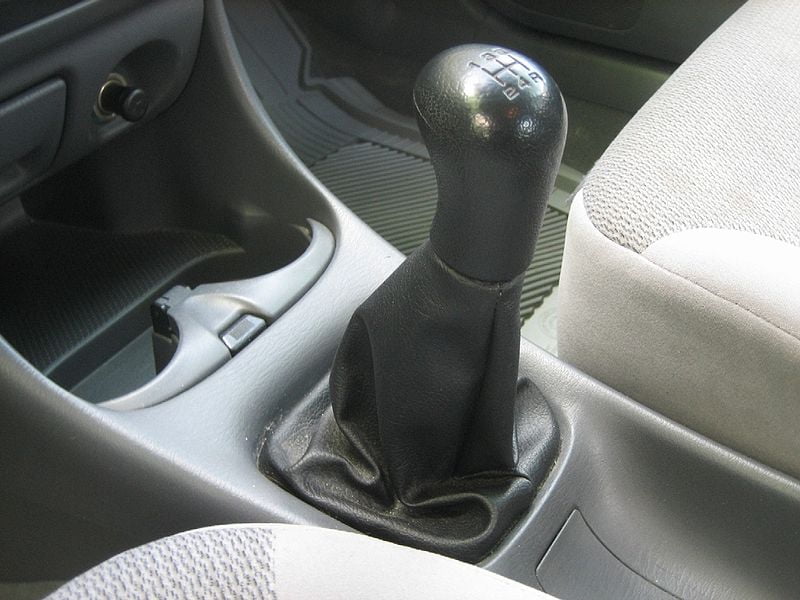 Driving a car with an automatic transmission. My left foot is bored, restlessly searching for a non-existent clutch, and my right hand wanders to the gear shift every time we approach an intersection.
 Seeing boys’ underwear in public. On the way back home, we stopped to grab a little something for the Girl to eat because she didn’t eat too much during the journey. Waiting in the check-out line: two adolescent African American boys with their pants seemingly at their knees. I’d mentioned this style in Poland: it seemed incomprehensible to them. It seems incomprehensible to me.
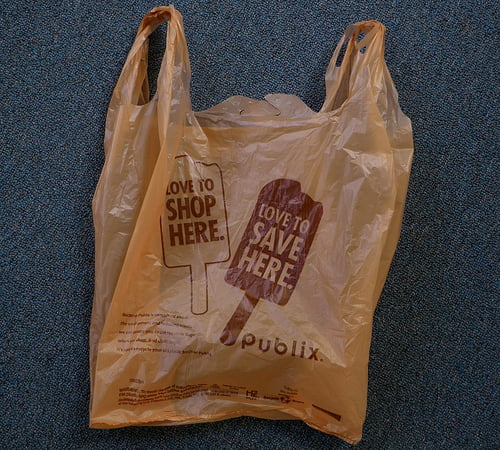 Having someone bag your groceries for you. Perhaps it’s the ultimate sign that Americans are in some way spoiled, but it still surprises me when I go into any grocery store in Poland and have to frantically bag my own groceries before the next customer’s purchases start sliding down into the bagging area. Why not bag as the cashier working? That’s another thing to get used to: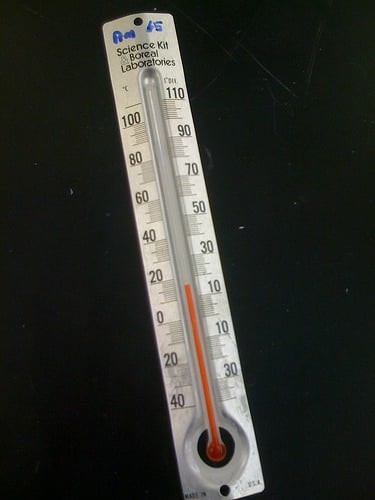
Henry John Deutschendorf, Jr. made the sentiment famous: bags are packed, and L and I are ready to go, next post from the States, yet mixed emotions linger.
“I want to go home” became L’s refrain a couple of days back, and talking to K on Skype only worsened the situation once. There were variations: “When are we going home?” “Are we going home tomorrow?”
I, too, am ready to go: vacation is great, but returning home is the true heart of any journey. K awaits, as do infected trees await, a likely overgrown lawn, a course to begin Monday, and a host of other things. One can only sit around doing little for a very short time before the feeling of uselessness sets in.
And yet, leaving Poland is always bittersweet. “Would you want to move back?” friends and family asked. Or “When are you all moving back?” Would we move back? Yes, and no. When are we moving back? Soon and never.
I wonder if other countries produce such mixed emotions among its ex-pats and virtual ex-pats?
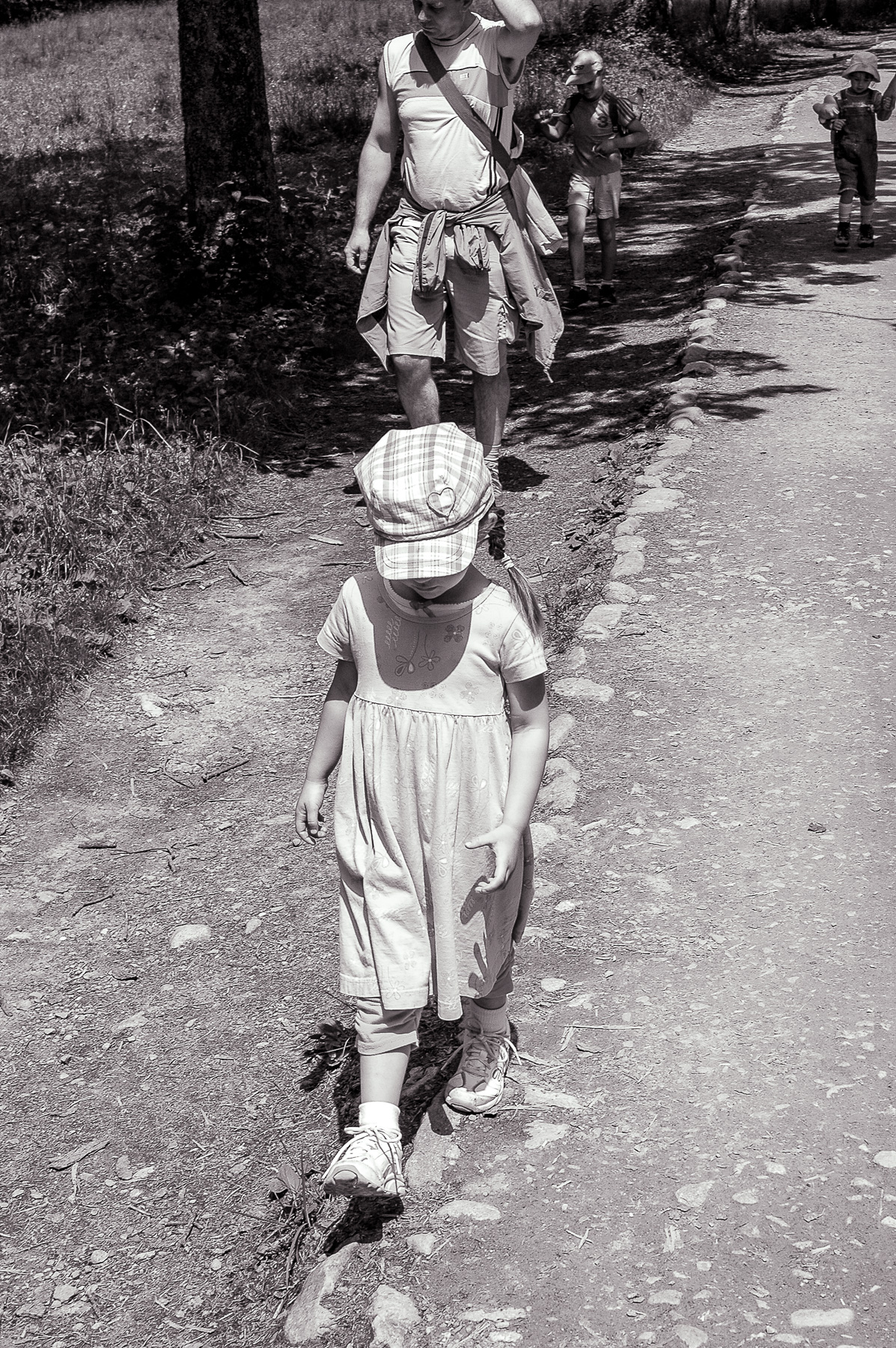
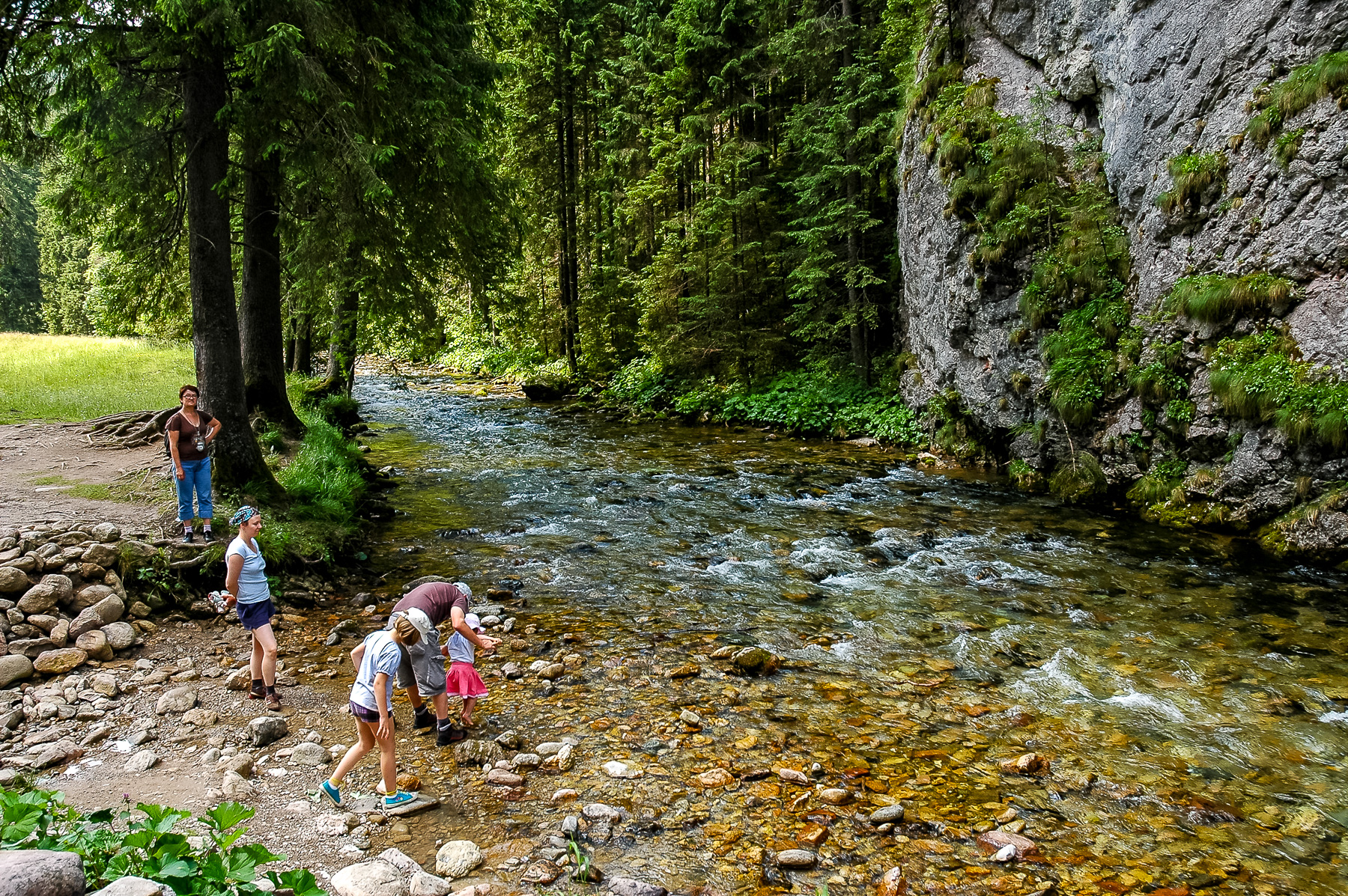
"Bolą mnie nogi," was L's chorus. Aching legs was something to expect: after all, taking a little, semi-city girl for a walk in the mountains is no walk in the park, if one will excuse the obvious pun/cliche. Especially when she's the kind of girl that wants to climb every obstacle she encounters.
A beautiful morning with no other plans, though, called for an introduction to the Tatra Mountains.
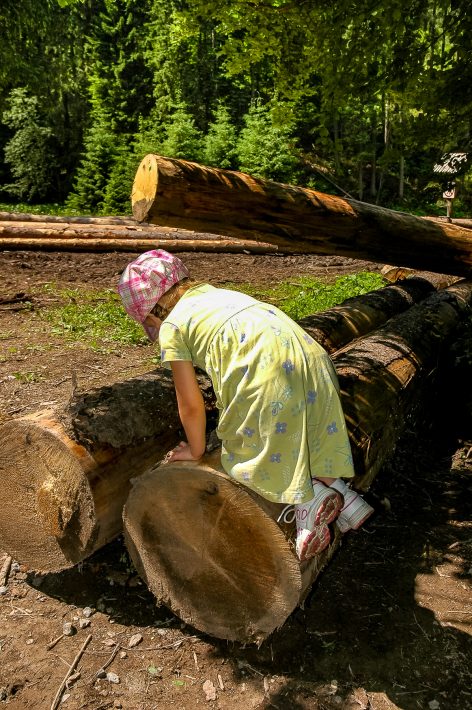
We set out with two rolls, a container of strawberries, and a bottle of apple juice. And a plan: walk as far as we can up Dolina Kościeliska (Kościeliska Valley). With a prognosis of rain only a couple of hours away, I wasn't terribly optimistic, but even a twenty-minute walk would have been worth it.
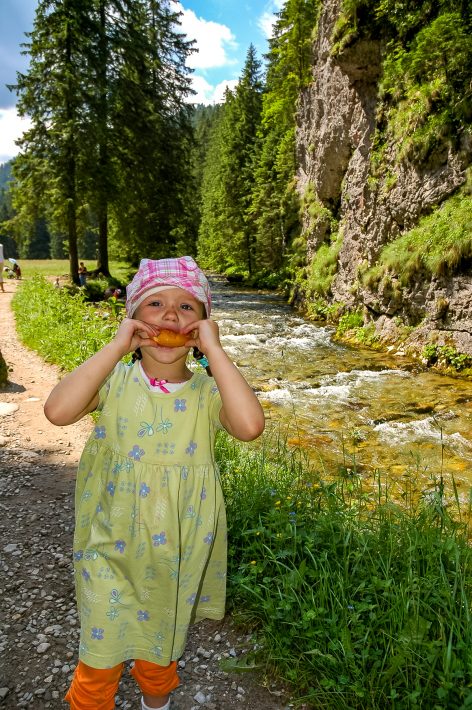
The two rolls lasted only a few minutes.
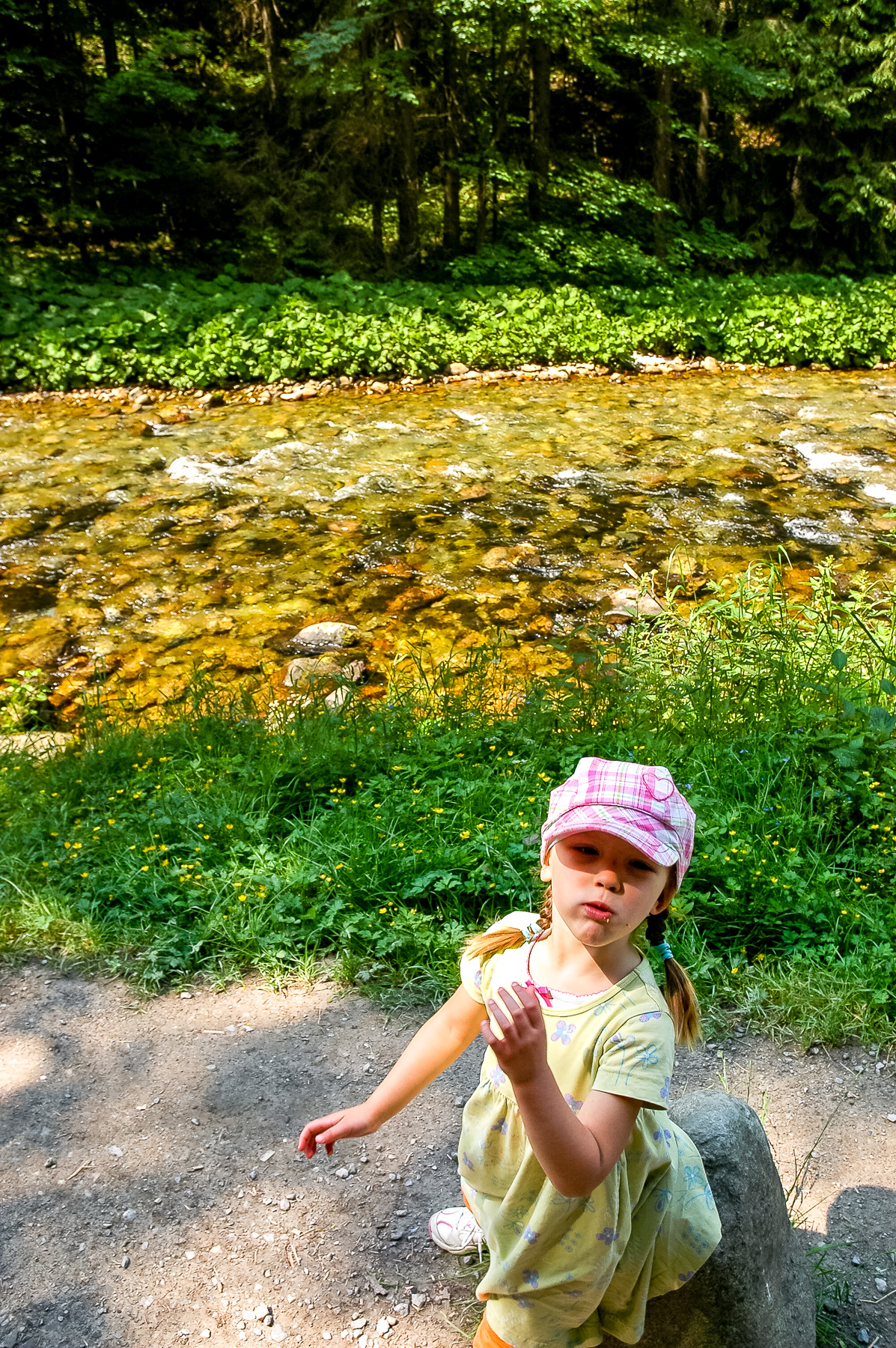
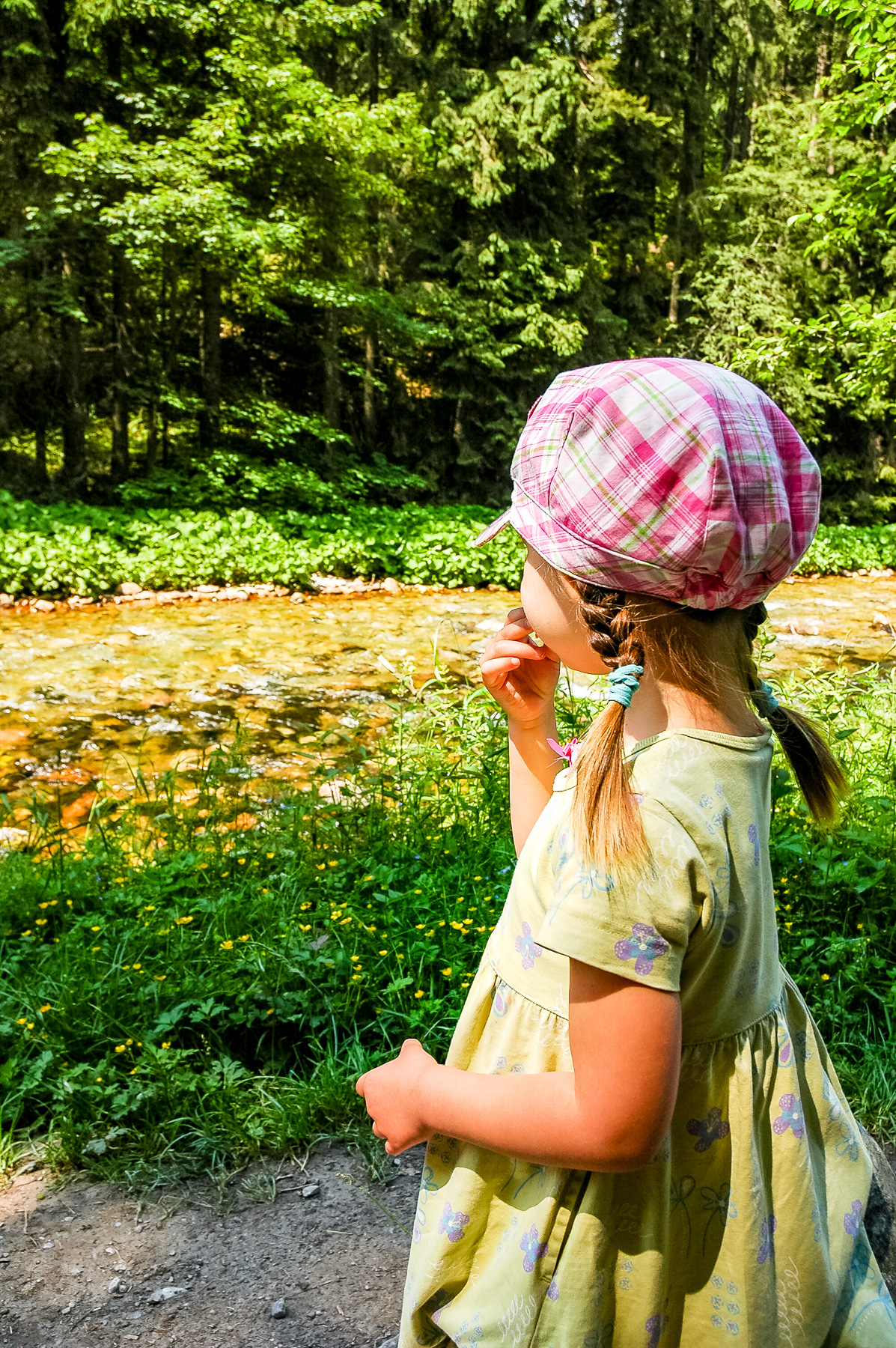
"Can I something to eat?" the Girl asked shortly after we started walking. Immediately after finishing the first roll -- obviously not even pausing for pictures -- she asked for a second. The strawberries lasted through the first two breaks.
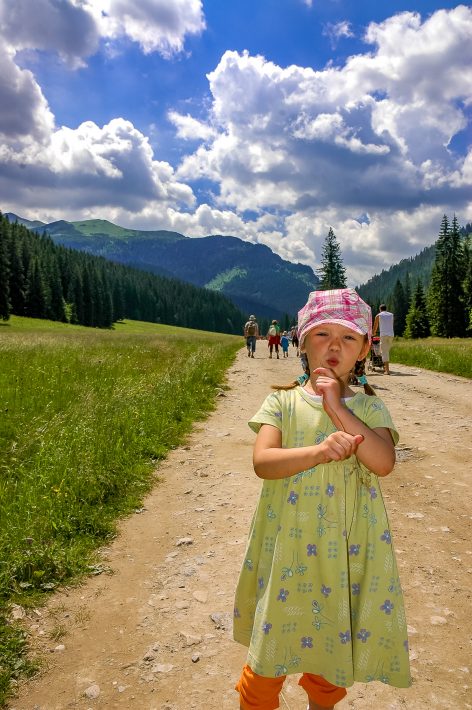
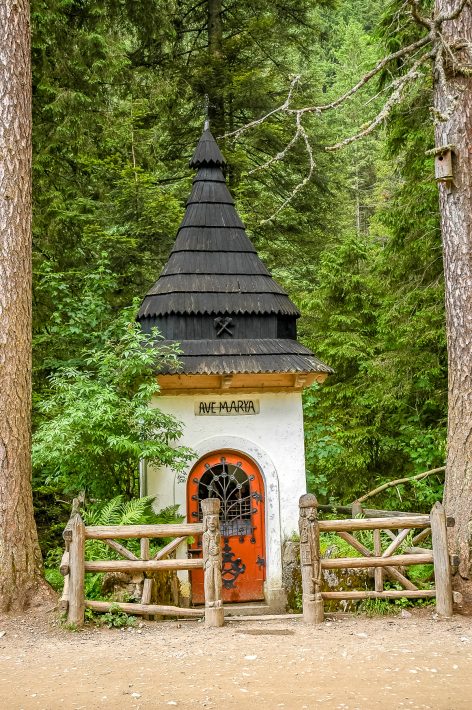
Surprisingly, and proudly, the complaining about the legs didn't happen until we'd almost reached the point at which we actually turned around: a small chapel situated between two large pines. Up to that point, it was all fun and smiles. Horse-drawn carts traveled up and down the road, and the Girl only expressed regret that we weren't travelling in more style.
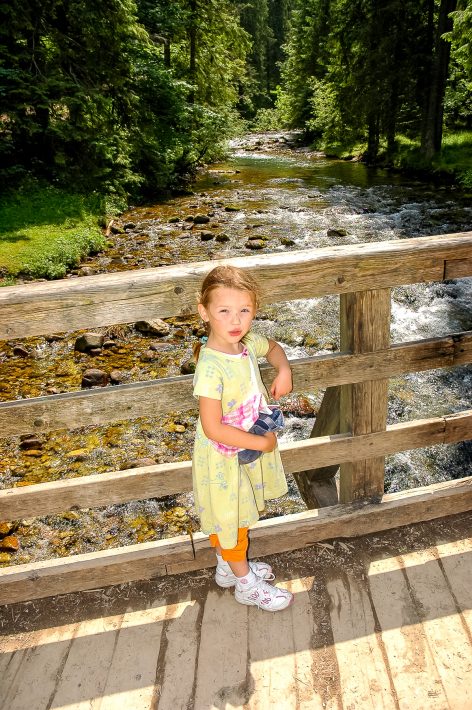
It seems to me that a three-and-a-half-year-old stomping her way up a small incline toward an unknown reward is style enough. Still, the Polish idea of recreation is different from the American idea, and the Girl wasn't the only, or even the youngest, child heading up the valley. In fact, it was from another three-foot sojourner that the Girl got the idea of aching legs.
"Bolą mnie nogi," a young girl said as she passed us with her father. Shortly thereafter, L declared, "Bolą mnie nogi." Coincidence? Definitely. At the same time, certainly true, considering how far she'd already walked.
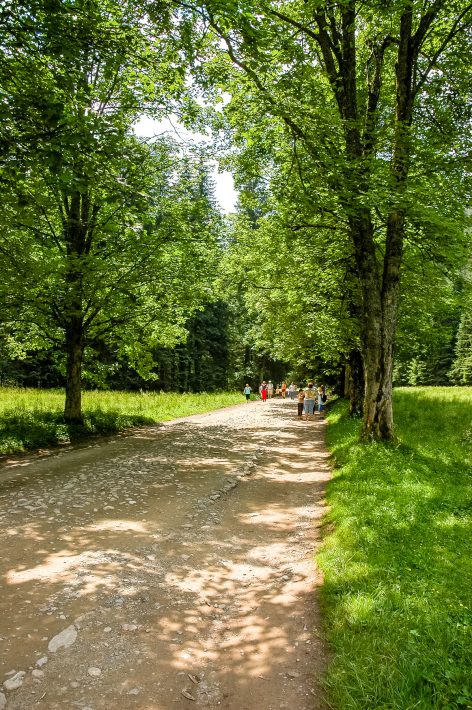
We took a break at a small chapel, and while L polished off the strawberries, I snapped a few pictures and glanced at the sky. The wall of gray that characterized the Polish sky during most of my years in the country was bearing down on us. Literally a wall: sunny, blue sky on one side, solid gray sky on the other. Behind, the sky was an ominous dark gray that strongly hinted at rain. It was two hours later than forecasted, and for that I was thankful.
And so was the Girl.
"You want to head back now?" I asked rhetorically.
"Do babci?"
"Yes."
She slammed down the lid to the container and declared, "Tak!"


I first made the journey to Krakow in the summer of 1996. I took an 8:00 am train from Radom, an industrial city just outside of Warsaw, to Krakow along with a compartmentful of co-volunteers from the Peace Corps. An industrious group took a train leaving at five something in the morning, but valuing my sleep more than sightseeing, I waited for the next train.
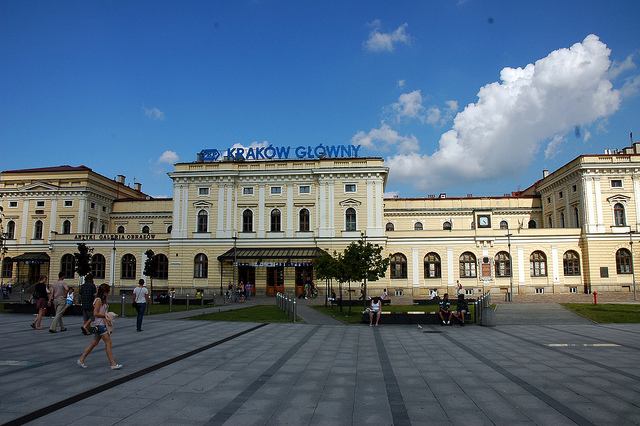
In ’96, Krakow Główny was an average Polish train station. There was a parking area in front, and across the street from it was the main bus station: a sad, dirty affair that I came to avoid at all costs. Krakow Główny wasn’t much better, particularly the waiting area.
These days, it’s somewhat more spectacular.
The approach to the market square is much the same as it was fourteen years ago.
Out of the station, a broad walk leads to a passage under Westerplatter Street.
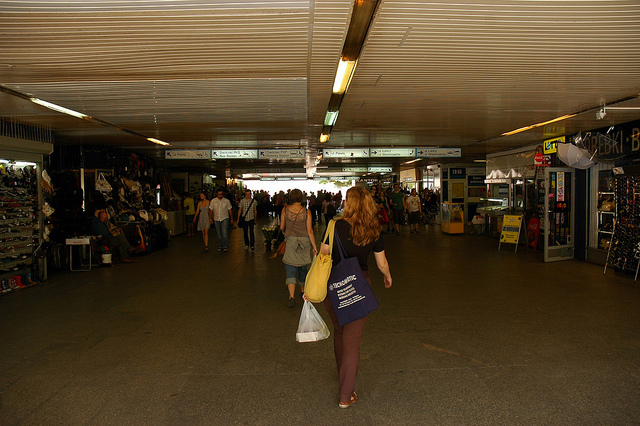
In the mid-ninties, this was where the “shopping” started. The intended clientele here was not the few Westerners who might, in comparison, be relatively rich. These small shops and kiosks sold things for Poles; by and large, they still do.
Emerging from under Westerplatter Street,
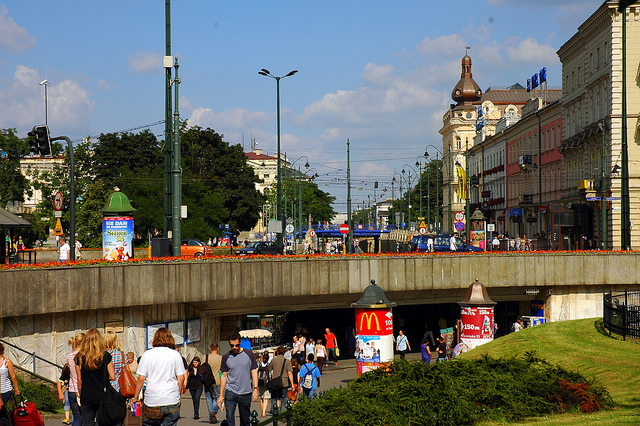
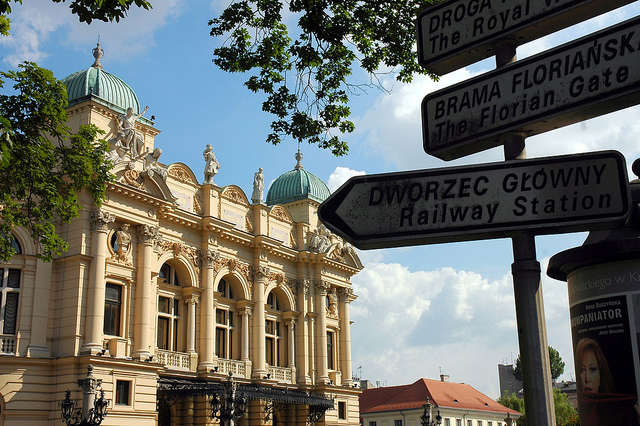
the walkway passes beside the Juliusz Slowacki theater.
The walk to the rynek continues down ulica Pijarska past the only real tobacconist I could find in Krakow.
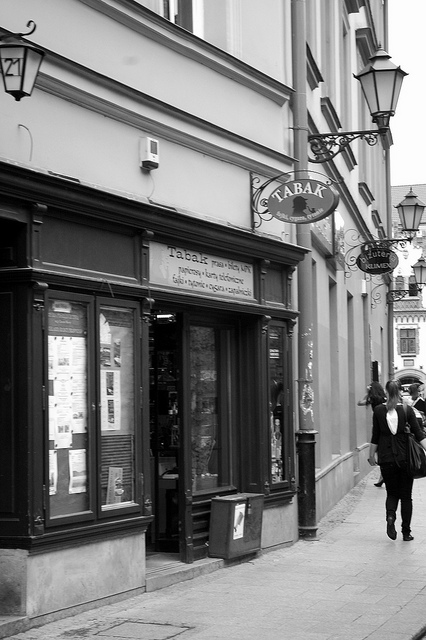
It was here that I first bought what became my favorite pipe tobacco: Dunhill’s Mixture 965. Dunhill no longer produces the blend, and even if they did, I wouldn’t be able to buy it here now: no real tobacco blends to speak of.
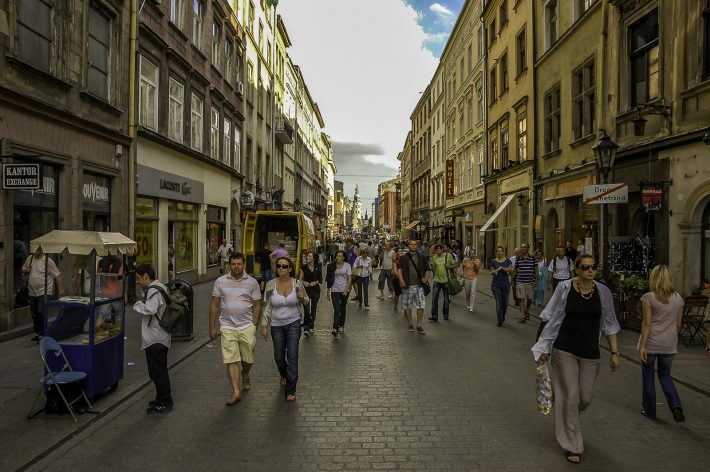
The walk continues by the Florianska Gate,
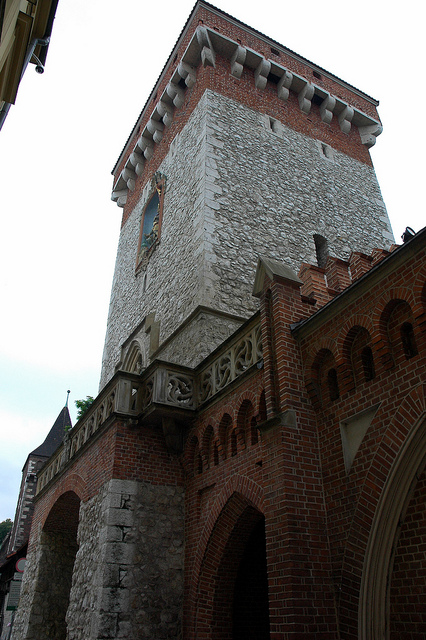
turning left onto Florianska street.
The MacDonald’s on Florianska has been there since my very first visit. Whenever I was in Krakow, I dropped by. Not for food, but for the one thing that American chains did better than just about anyone else in Poland at that time: bathrooms. Only at McDonald’s could I count on clean facilities, and apparently others discovered that as well: within a year, McD’s had switched to a pay bathroom, something seemingly unthinkable for many Westerners but common at that time (and still quite common). One had to be a customer to use the restroom, so I bought a small order of fries.
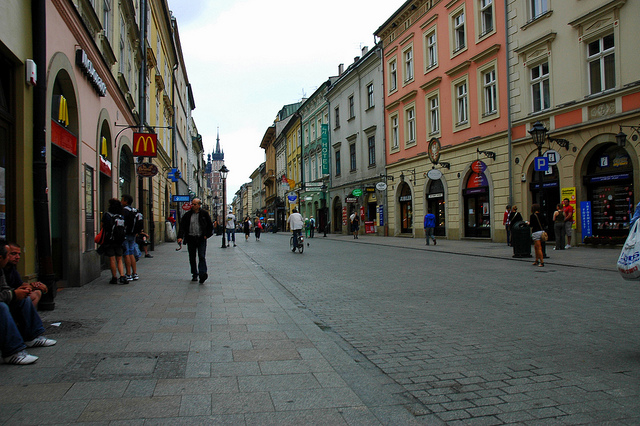
My first visit, I was completely unaware what awaited me at the end of the street.
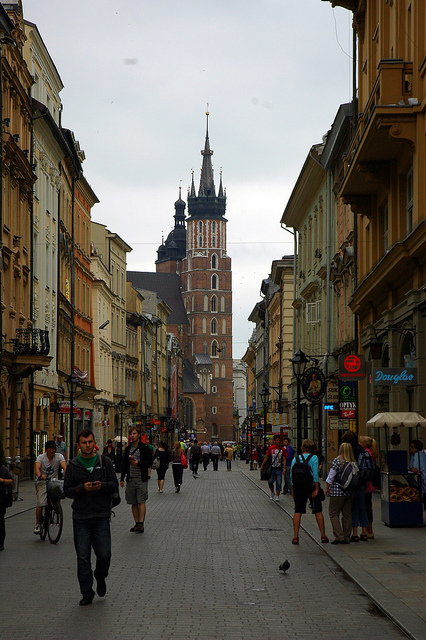
Stepping onto the rynek (main market square), it’s difficult not to stand motionless in awe. But that’s for another day.
I always feel a little guilty, heading out with a camera and my backpack of accessories to take a walk in Jablonka and photograph people who are putting in a normal day's work in the field that is harder than I do most days of my life. That is why I always hesitate to approach. A massive zoom lens -- call it the coward's approach.
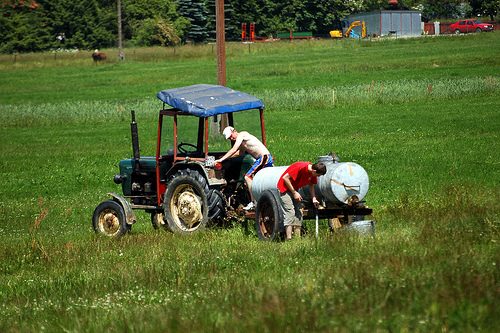
fortunately, hard-working Poles are not the only attraction. Much of the farm work here -- such as turning hay on the fields for drying -- is done with somewhat antiquated machinery by commercial/industrial Western farm standards. The machines are rusty but elegant reminders that not all heavy machinery needs computer chips and miles of cables. A few rusty springs will do just fine.
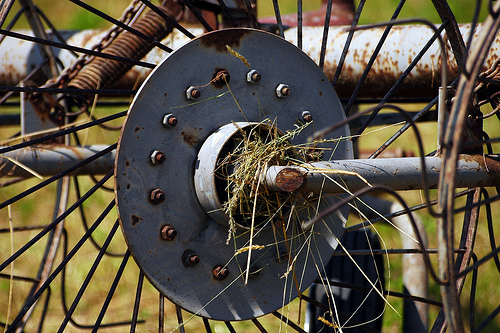
At first, one might say, "There is no comparison to the scale of large, commercial Western farms," and that's correct, partially. But when you see how Orawians load a trailer with hay, it puts questions of scale into proportion.
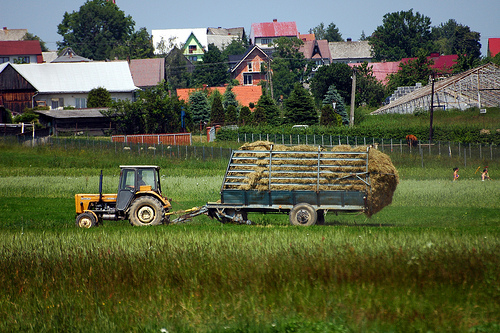
Remember: this trailer was load manually: one or two guys on the ground tossing up pitchfork-loads of hay to one or two guys (or women, or even adolescents) standing on the growing pile. At least that's how it ends. The wagon actually has a device that forks the hay into the wagon bed automatically, but one doesn't make wagon loads this high by letting machines do all the work.
The odd thing about the fields they're working is their shape: long and narrow. Most of them are no wider than thirty or forty feet, but they are often three or four times that long.
It's the result of generations of inheritance: dividing the land to pass it on to further generations creates not a checkerboard but, well, yes a checkerboard, but out of some Dali painting, where the dimensions and shapes of everything are exaggerated and warped.
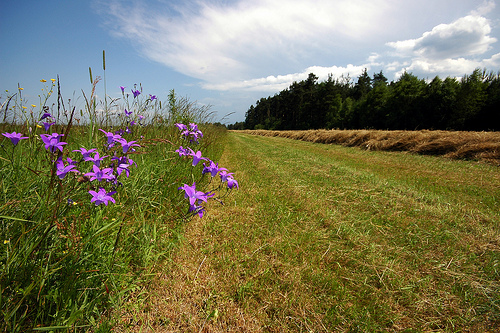
The big mystery: with so many fields crammed side by side, how does anyone know anyone's borders? I go out for a walk and find one field's hay cut, neatly put into piles; the neighboring field is wild with grass and flowers. How does the owner know where his land stops and his neighbor's begins?
"They just know," I'm told.
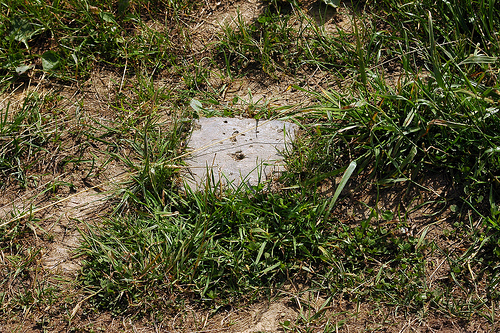
Apparently, though, some have gone to the cost of having surveyors come out and set boundaries.
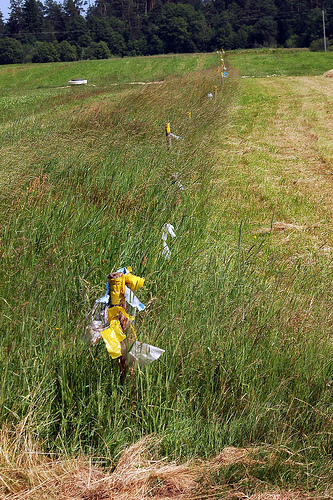
Others use less technologically-dependent methods.
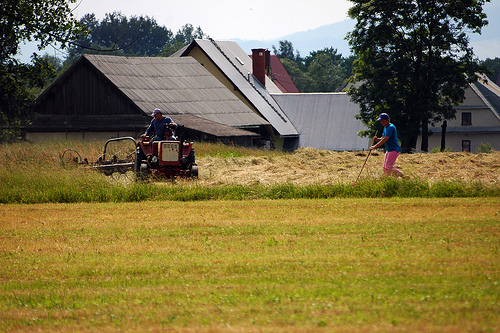
When K and I began dating, we met every one evening a week at Pasieka, a small restaurant in her home village. It gave us a chance to see each other during the week (it was a long-distance relationship: all of seven kilometers between our villages), and I didn’t have to cook for myself one day a week.
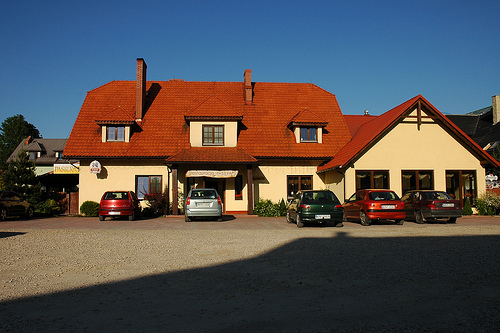
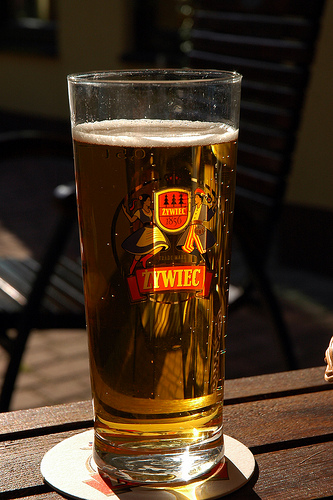
We’d have a beer or two, talk about our week thus far, make plans for the weekend — it was the highlight of the week. After our marriage, we visited Pasieka less frequently, but when we come back to Poland, we have to go back to Pasieka.
We walked to the restaurant for a bite of supper and to meet with “Johnny,” a friend who now lives abroad.
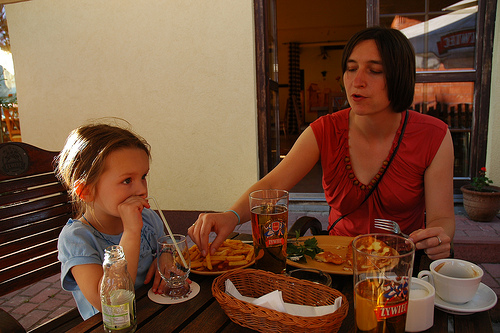
Except for the order of fries for the little girl who joined us, it was just like old times.
Just a few kilometers outside Krakow and couple of hundred meters higher lies a small group of homes on top of a small hill that have earned the name G. Is it a town? I'm not sure. When preparing the GPS, I asked my father-in-law, "What street does D [K's brother] live on?"
"There are no street names in G," he laughs. "Only numbers."
Such a small place that has no street names -- sounds pleasant.
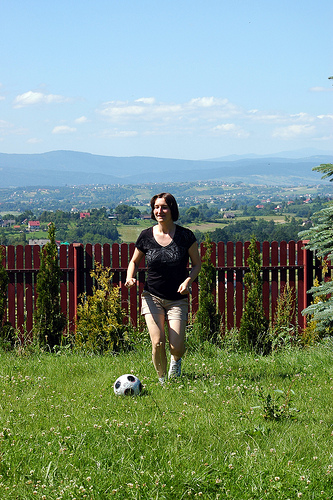
And a great place to spend the evening after a long day in Krakow. Family and a great view: what else could we want? Perhaps a little entertainment, and the sport of choice in Europe is soccer football.
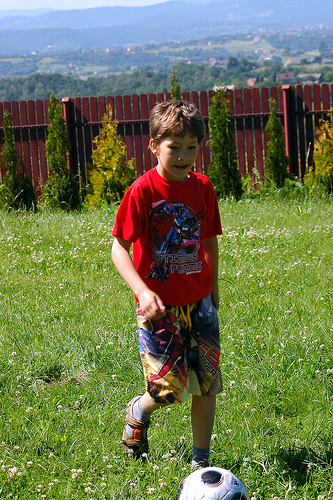
The mutual opponent: W, who is K's godson. He's quite the footballer, and to be honest, both K and I have a hard time keeping up.
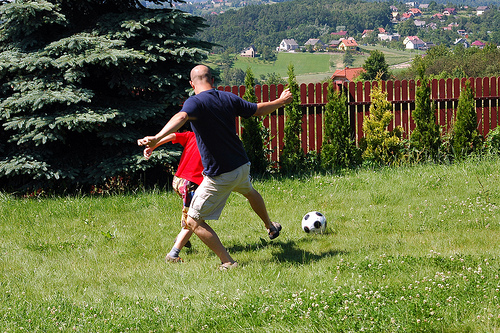
When I face off against him, I think in terms of basketball: every beginner has one or two moves he feels comfortable with and repeats. I watch W as we play, figure out his favorite moves (a fake to his right, my left, followed by a charge to his left). He makes the move again and again. I come to expect it. I charge him, hoping to force the move.
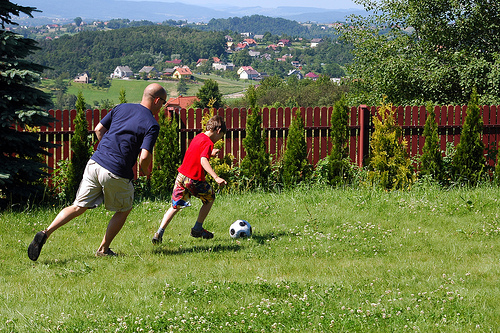
Sure enough, fake right, charge left. And every single time he fakes me out. I know it's coming; I throw out a leg like I see the pros do on television, and he shoots right past me.
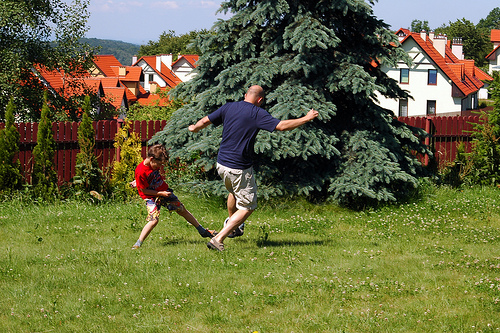
If I charge and unfairly use my size advantage, I occasionally catch up and manage to kick the ball out-of-bounds. It works a time or two, but I realize anew how footballers have to be in amazing condition: I'm tired within a few minutes, and panting shortly there after.
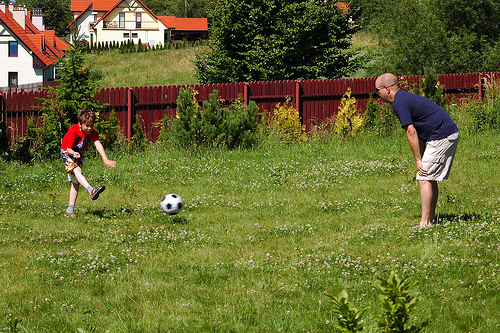
Finally, a new strategy: keep my distance and force him to shoot from afar. It works. Temporarily.
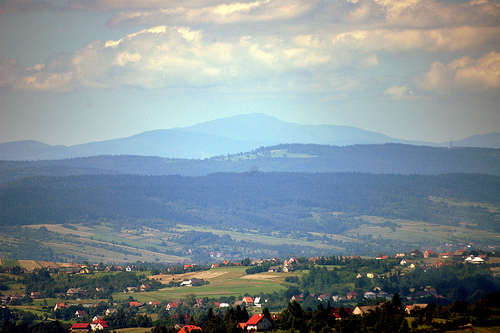
In the end, the views win: W goes in to play video games, and I give up panting, looking at the view from our improvised football pitch.
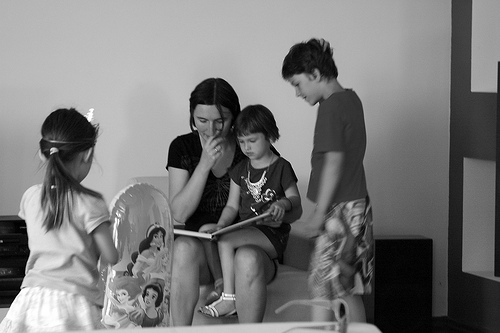
I go inside to find K reading classic English nursery rhymes to the kids. She translates them to Polish, but they just lose something -- the rhyme, the rhythm just aren't there. The same goes with translating nursery rhymes the other direction:
Once upon a time there lived a witch named Baba Jaga,
who lived in a house made of butter.
It just doesn't sound as good as
Była sobie Baba Jaga
Miała chatka z masła
Certainly part of it is cultural: in the original there's no mention of "a witch named." Everyone simply knows that Baba Jaga is a witch. Koniec. Kropka.
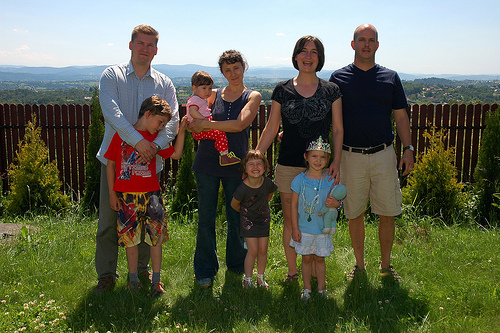
Before heading out, we gather everyone for a quick group family portrait,

and other with just the kids -- something of a trick with the smallest.
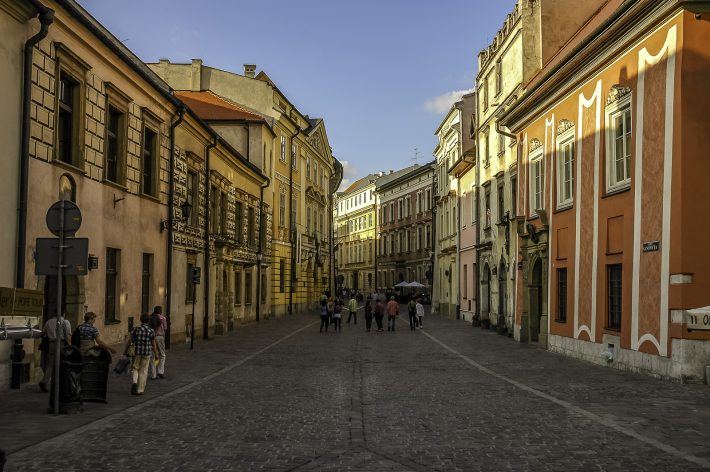
From Wawel, we head up ulica Grodzka toward the rynek, looking for food. We find a small restaurant that’s essentially an upscale bar mleczny and sit down for lunch. Nothing special, but good Polish eats — the sign of a good bar mleczny.
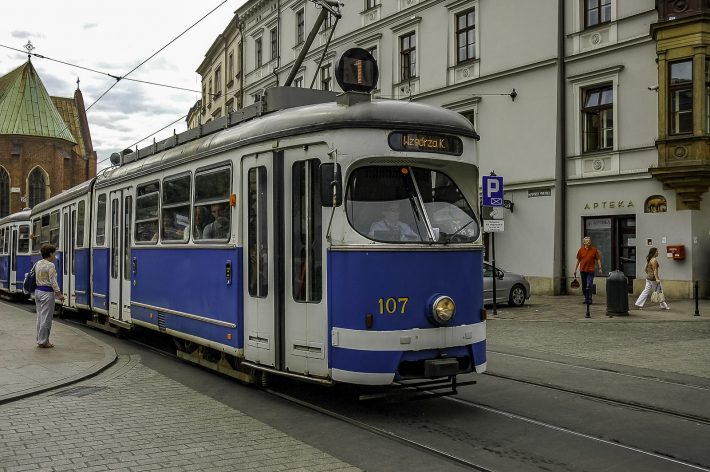
Arriving at the rynek, we begin looking for the countless bird seed mongers that traditionally seem to fill the rynek. We can’t find a single one. What’s more, the centerpiece of the rynek, the Sukiennice (Cloth Hall), is closed for renovation, with all the booths moved outside.
It’s not the same rynek.
Still, we have crackers in a backpack, so L wades into the mass of pigeons and begins aggressively throwing crackers at the pigeons.
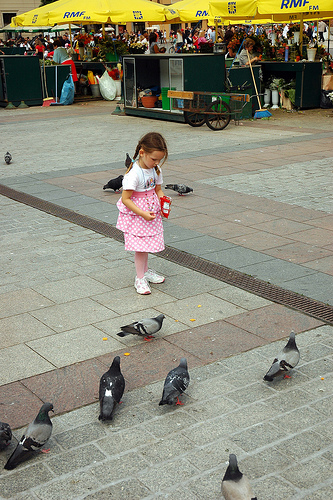
The result is predictable.
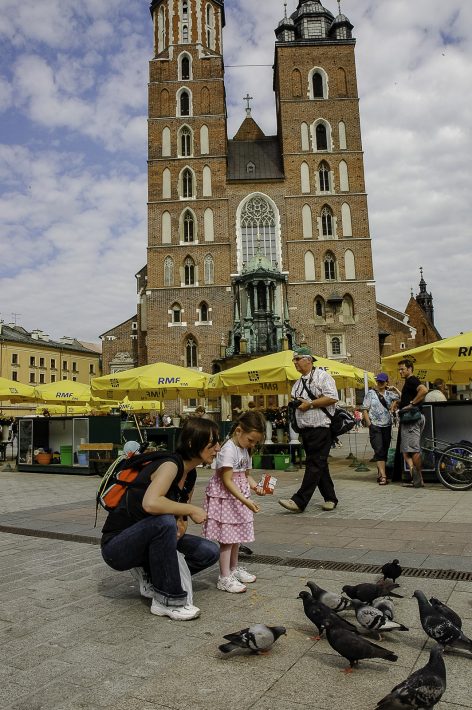
After a few moments, K provides the much-needed assistance. But it seems that cheese crackers are not a favorite of Krakow pigeons. Perhaps there are too many chemicals — after all, what are preservatives? A frightening thought. Maybe we should make our own? After all, how difficult can it be?
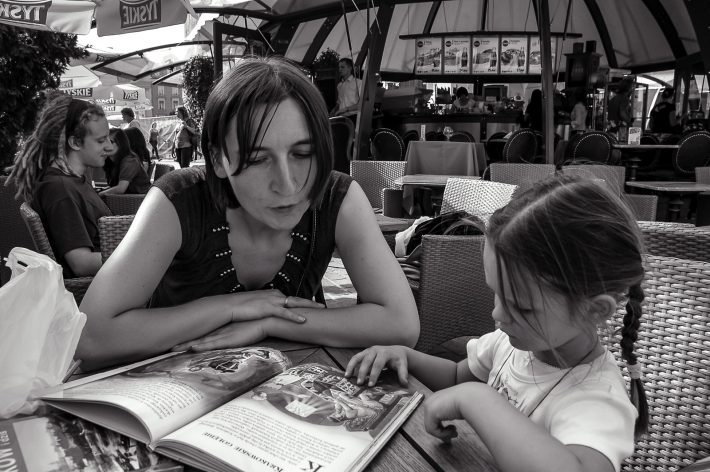
It can’t be more difficult than finding refreshment on the rynek for a decent price. It’s something like the airport: cafe owners know that the average person is, at least temporarily, there to stay. Who’s going to walk two blocks to save a few zloty?
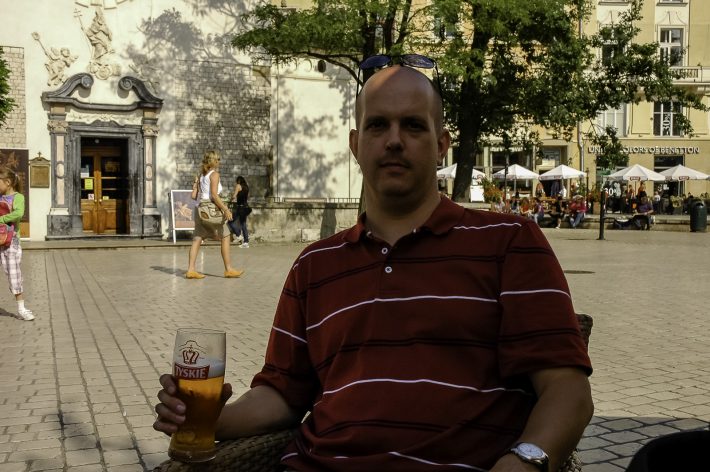
And lose such a view? Location is everything, for buyers and sellers.
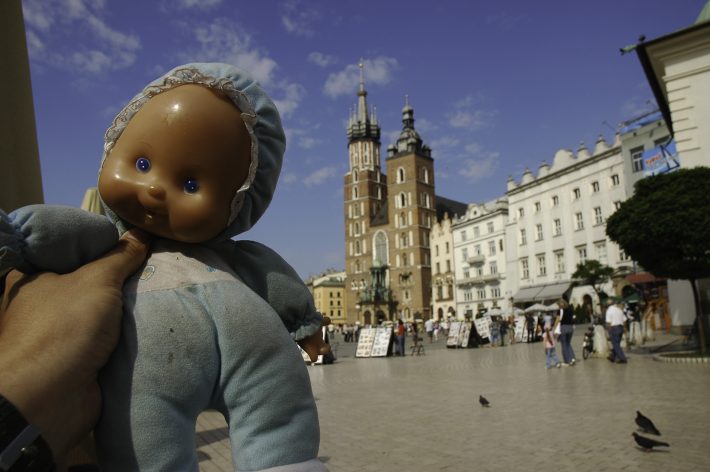
Given the view, the price might just be worth it. Baby certainly thought so.
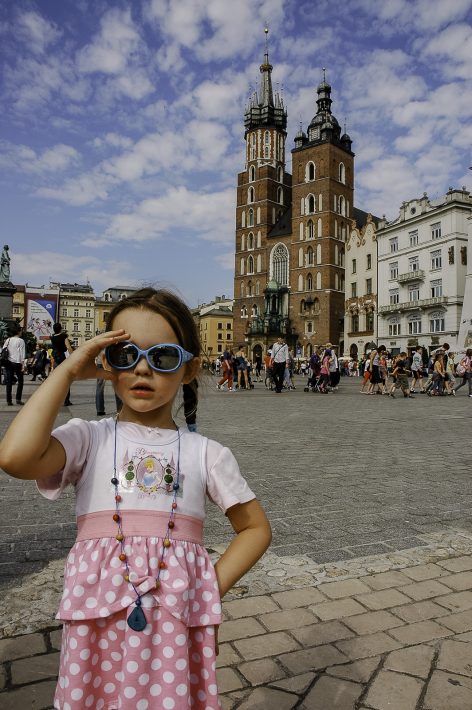
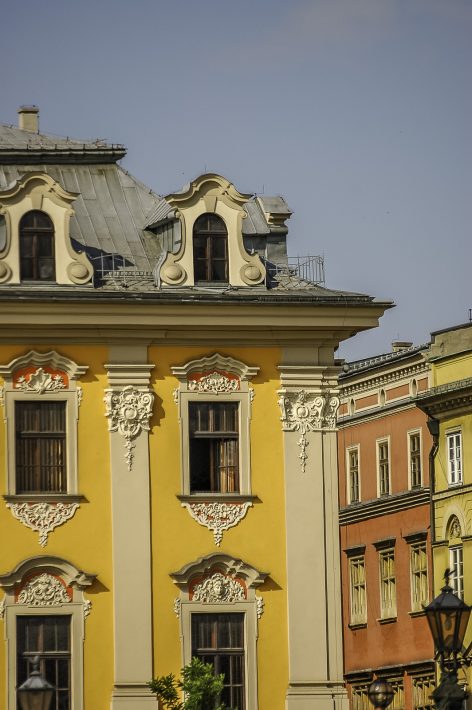
The last stop: Empik — something like a Polish Borders Books or Barnes and Noble. Though L has a relatively large library, we’re of the opinion that she can never have too many books. Especially Polish books. And so we arrive in the hopes of loading up on new books. What is L interested in? Disney. The Polish version of the “Princess Collection.”
As K is working to convince L that a Polish “Princess Collection” is entirely unnecessary, I look out the window of the third floor. One of the many street performers begins his act. Relatively original. No face paint, nothing to suggest a clown.
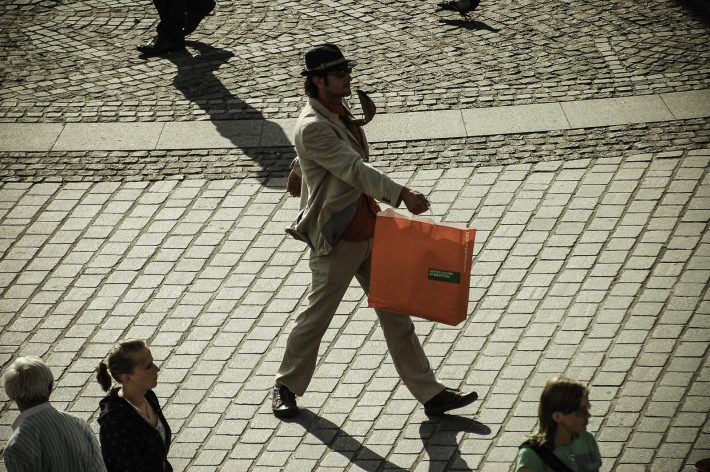
Just someone in a hurry to get home with his shopping. As passers-by stop and imitate, the performer drops the bag, startling observers. He pulls out smaller bags and invites them to join him.
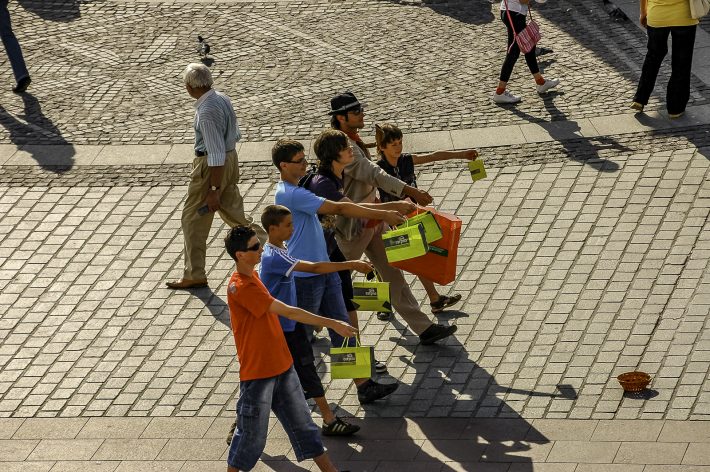
An amusing act, but not the famous Biala Dama. We didn’t see her last year either. We’re not the only ones looking for her.
We sit next to the Basilica of St. Mary for a rest, planning on going inside, when Mass begins and we realize we won’t see the interior this year. Disappointing, but we’re all probably too tired to worry much about it.
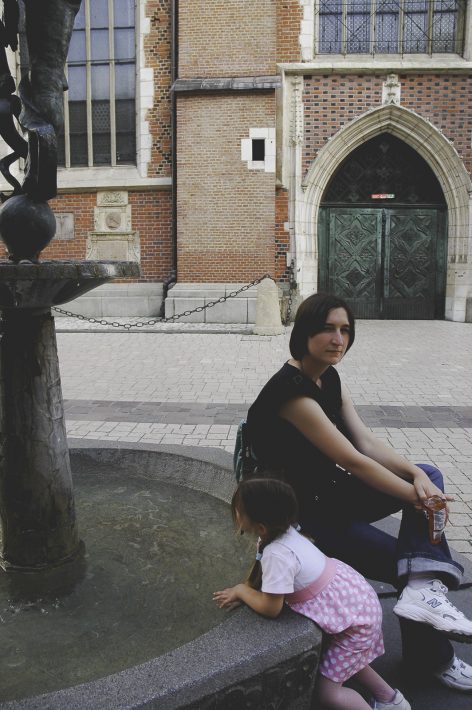
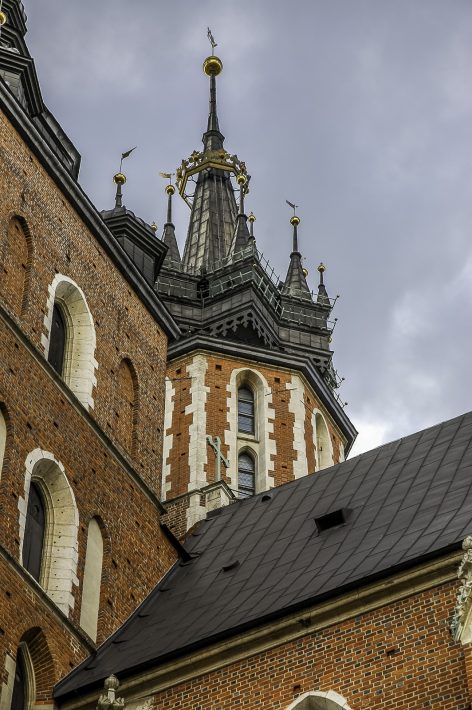
The views from the outside are spectacular as it is.
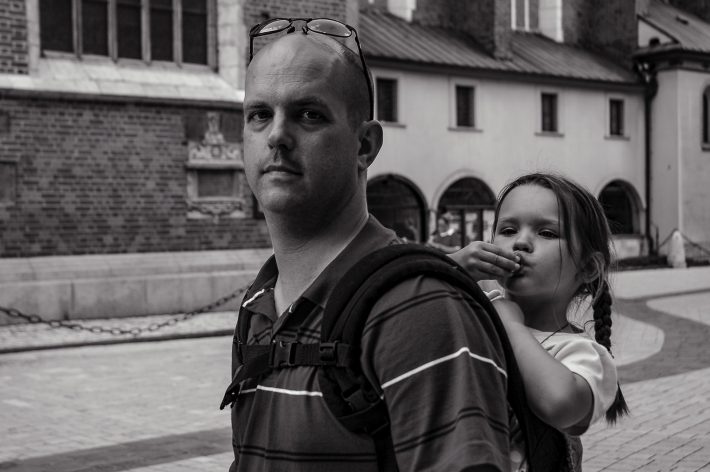
Finally, it’s time to go: the call from K’s brother has come. He and his family are on their way home. Suddenly, we’re in a hurry. Still, there’s always time for a little ice cream.
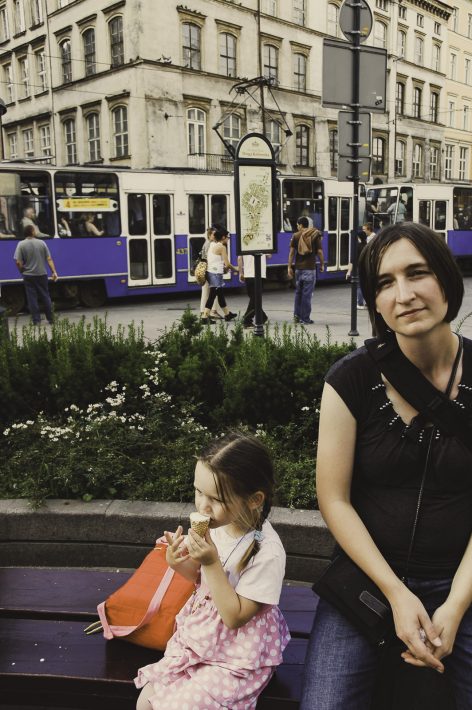
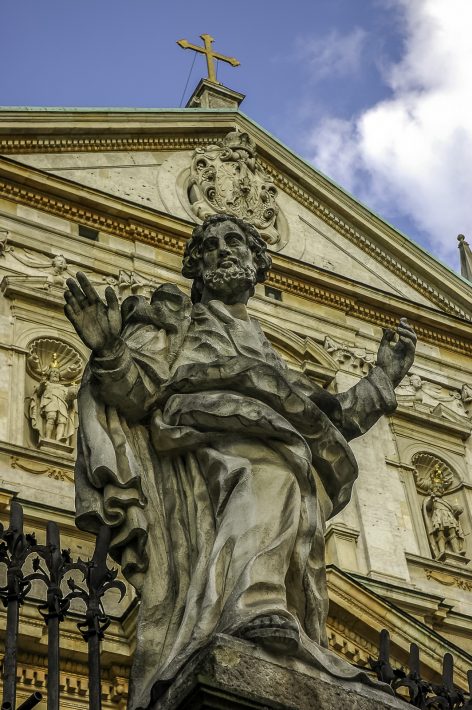
And a shot of one of the famous statues in front of the Church of Saints Peter and Paul.
A couple of last glances and we’re back at our car.
The spell is broken as we fight our way out of Krakow: aggressive drivers, narrow roads, unexpected detours, and exhaustion all make it more difficult. Next time, perhaps we’ll just buy a small apartment on the rynek.