matching tracksuits

fun in threes, sometimes fours

the girl

Lent 2012: Day 31

Lent is about sacrifice, and a significant part of our everyday reality is sacrifice in the form of delayed gratification, when we sacrifice the immediate satisfaction of our desires for some further, greater good. For example, we could buy that new camera lens we want (and I have been drooling over Nikon's 17-55 2.8 for some time) on credit and have immediate gratification; delaying said gratification by saving for the lens (and at $1,500, that particular lens would take quite a bit of saving of my personal spending money) means not racking up unnecessary debt that could hurt us in the long run. So we delay gratification for a good that is even further in the distance, and in this case, hypothetical. But the immediate price is a sacrifice of potential joy.

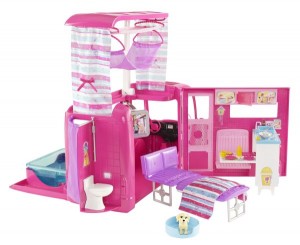
The Girl has been saving for a Barbie camper for months now. Granted, it only began a little before Christmas, but five-year-old time is like dog-years: it's all relative. She gets a little cash here and there, from us and her grandparents, and this week, she made it: $70, the Wal-Mart website price.

So this evening, we went to Wally-world to buy it, only to find the price there was $94. I took it to customer service to inquire about the justification for the price difference. It turned out, they were aware of it -- and they did nothing about it.

"We'll price-match with a competitor..." began the customer service rep.

"But not with yourself," I finished.

"Right. Not even store to store."

I sensed a crisis brewing, but the Girl handled it marvelously: a few whimpers of disappointment but nothing significant.

Back home, we shopped around and found it on sale for $50. And now the Girl has a good start on her savings for a Barbie house -- and a lesson learned about delayed gratification.
Lent 2012: Day 28

Conversation often turns into an excuse to discuss oneself, and talking with someone who seems to have a knack for turning the conversation back to himself is exhausting.

The unselfishness of speedily and gracefully distracting ourselves from self is also singularly difficult to practice.

Yet it's somehow a natural conversational occurrence. Whether it's a sincere desire to help someone by sharing a similar experience or an unconscious competitive streak, we hear a story and we want to add something from our own lives into the mix. Resisting this urge is critical for what Faber calls "kind listening. But like many other kindnesses, it involves a degree of self-sacrifice.

I think of the Girl dating at some point in the future -- within the next, say, 25-30 years -- and one of my most deeply held requirements (as if I'd have any say) for any young man interested in her would be that he show the ability to listen. It's a rare gift these days, and I fear it will be rarer still when the time comes.

The quoted excerpt is from Father Frederick Faber’s Spiritual Conferences, excerpted here.

Lent 2012: Day 26

After a beautiful day yesterday, it seemed only appropriate that this morning begins with rain -- a drizzle that suggests an afternoon movie and, if we're lucky, a nap. But by noon, it's sunny, and the backyard calls.

DSC_7549

There, we find that the cabbage in the backyard planter, growing since sometime in October or November, has reached the point that putting off consuming it would be almost wasteful -- at the very least, it would hint of sin.

DSC_7559

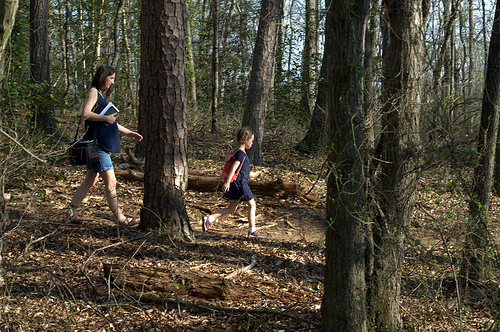
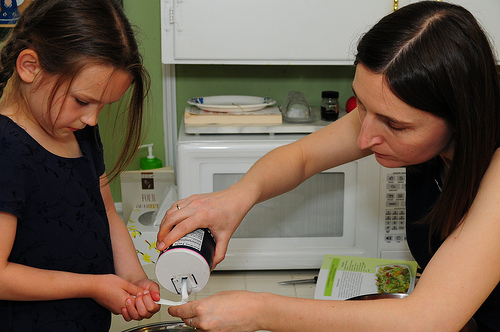
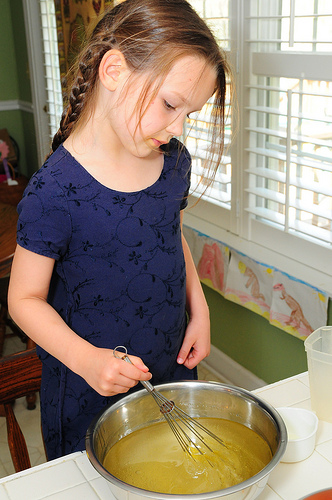
So what's a Polish girl to do but make a surowka out of it -- basically, a vinegar cole slaw. The Girl helps with the sauce/marinade. But that only keeps us busy for so long: our newly discovered park is only four miles away, so K packs some fruit while I entertain the Girl in the swing, then just before four, we head out.

VIV_7568

We take a different route, with a trail head buried in the back of a Little League park I've passed almost every day for five years. Who knew?

VIV_7584

Same park, different sights.

VIV_7588

A quick stroll through the woods brings us to the lakeside and a small observation platform built out into the water.

VIV_7589

With the temperature and the amount of green, it's difficult to believe that spring is still technically two days away. And from what I've been reading, it seems to be the same situation through most of the States.

DSC_7599

"If it's this warm now, what will it be like in August?" people wonder, as if weather had a cumulative effect.

VIV_7605

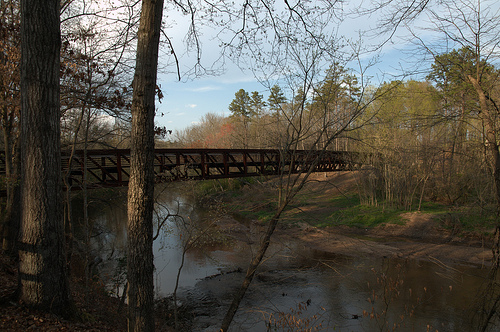
Cumulative effect or not, there is a cumulative effect of all this walking: a tired, fussy girl who's ready to head home and get some food. We make it across the largest bridge in the park just to sit long enough to decide it's time to head back

VIV_7627

counting and noting the steps along the way.

VIV_7633

And what does this have to do with the twenty-sixth day of Lent?

DSC_7636

With an end like this, does it really matter?

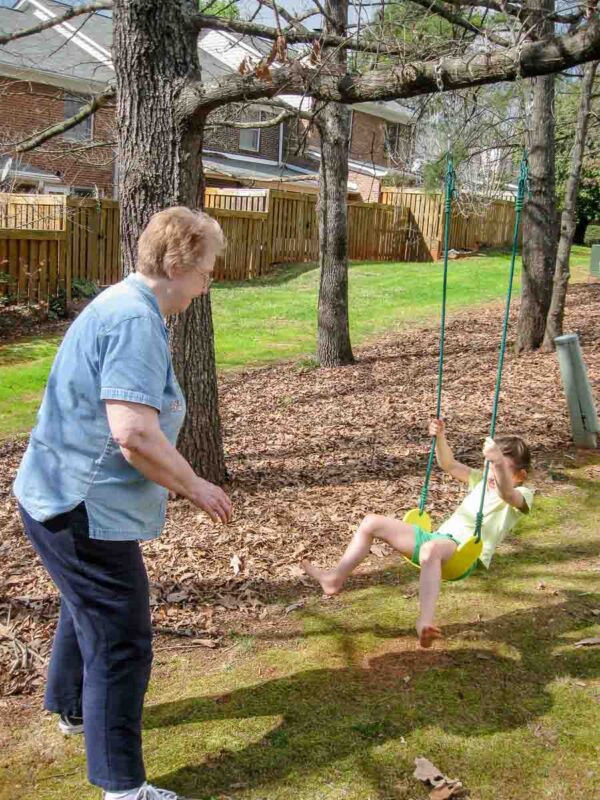
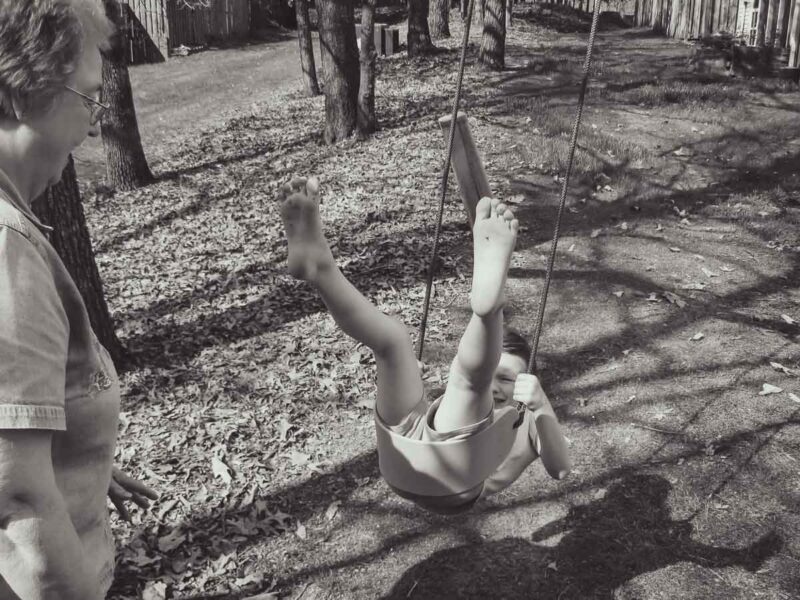
Nana, the Girl, and the Swing

Playing and Building

DSC_7180

Helping

DSC_7232

Food

dinner

Teachable Moments

DSC_6782

It often astonishes me how few social skills some students have. Among other tendencies, they exhibit an inability to accept criticism, to delay gratification, to express frustrations in a positive manner, or to know when it's best to keep a particular thought to themselves. "How is this possible?" I sometimes wondered in the past; having a child whose verbal abilities and cognitive skills increase daily has taught me: these students simply haven't had sufficient direct instruction.

There are so many things that kids pick up on without being taught directly -- chief among them, the most unique characteristic of humans: language -- that it's easy to forget that some things we take for granted actually have to be taught. We think that correction is teaching.

Tonight, I came home with a bit of spare change in my pocket, and as the Girl is saving for a Barbie camper, I give her a bit of my loose change when I have it. I gave her a quarter; she smiled and asked, "Can I have more?"

The easy response -- the response I suspect a few of my students got as children -- would be, "Can you what?! Don't you go asking me for more when I've already given you something!" And that would be the end.

Tonight, I took the quarter back and explained calmly that, when someone gives you something, it's really not very polite at all to ask for more. "Let's try it again," I said, directing the Girl to return to the spot where she was standing.

"I have something for you," I smiled again.

"What!?" she asked in almost genuine excitement -- she's a good play-actor.

I gave her the quarter, raised my eyebrows ever so slightly, and she replied, "Thank you!" and put it in the piggy bank.

Explicit teaching followed by directed practice. Sounds like I what I do eight hours a day...

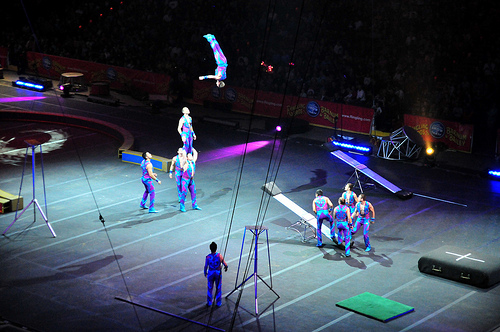
Circus

Remember your first circus?

Entry

The excitement as the animals and performers all came in, music blaring, ring master chanting?

Swords

Remember your gasps as you watched acrobats perform what seemed to your young eyes to be impossible feats?

Flight

Remember seeing the elephants and thinking, "It's not just Dumbo. They really do line up like that"?

Pile Up

Remember the ball in the pit of your stomach as you watched riders in this or that steel cage of doom?

Speed

My folks took me to my first circus when I was about L's age, and I still remember those sights. Hopefully the Girl will remember today's first as well.

More photos at Flickr.

The Games We Play

DSC_6585

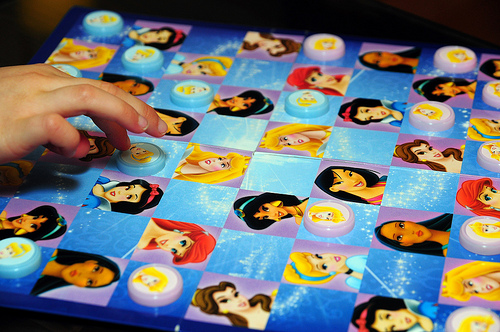
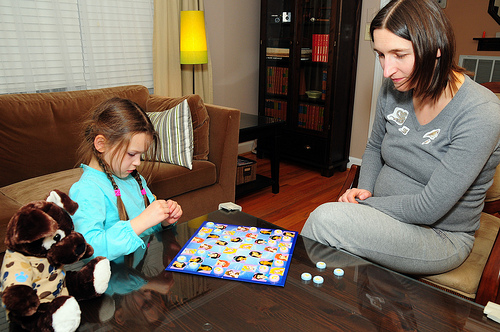
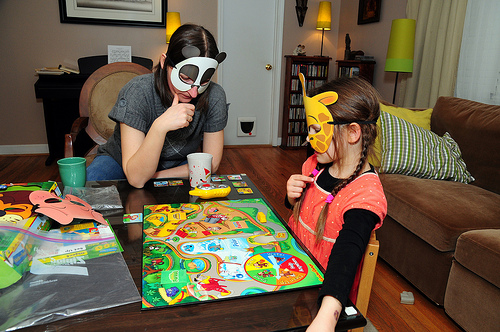
The Girl simply loves playing games: Candy Land, checkers, Go Fish, "the memory game" (Never just "memory" for her), Curious George -- you name it, she'll play it.

DSC_6583

The long-standing challenge for us as parents has always been teaching her to win with humility and lose with dignity. It's tough to teach a child something you yourself are not good at, for it must be said that I don't always lose with dignity myself. Chess is about the only game I play, and while I don't pitch a fit, my pulse quickens at a loss, and I'm soon berating myself for my obvious mistakes.

DSC_6596

Yet by their very nature, these games make excellent benchmarks for social skills development. There are countless metrics:

  • How far into the game does the first fuss appear?
  • How long does the first fuss last?
  • Once it subsides, does the first frustration return immediately?
  • Is the Girl capable of finishing the game or has she worked herself into an irreversible tizzy?
  • When it begins to look like a loss is inevitable, does she give up or continue playing?

Recent gaming adventures have shown that L is developing a tolerance for the inevitable eventual loss, an ability to recover quickly from initial frustrations, and the poise to win and lose well. It was, in short, truly a phase.