matching tracksuits

fun in threes, sometimes fours

the girl

Hold Your Head Up High(er)

L's been able to lie on her stomach and hold up her head from some time now. Recently, she learned that her arms can help her in the endeavor.
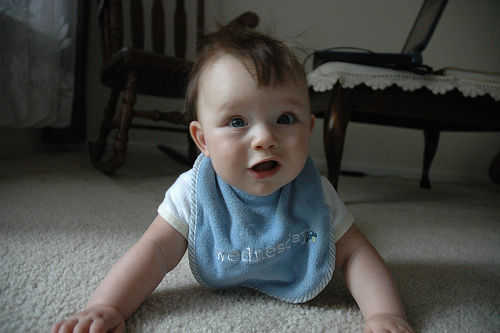
Support III

It's the first step to crawling, no pun intended. At least we hope. We're a little worried that she might want to skip crawling since she's already "standing" and "walking" all the time. Why? Well, there's all the hype about the importance of crawling, like this:

There have been some studies that indicate that late walkers score better later in life on academic achievement tests. It is hypothesized that because of the use of alternating sides of the body (e.g., right arm and left leg, then vica versa), there is increase communication between the two sides of the brain thus enhancing learning. (The Mentor Mom)

On the other hand:

There are many perfectly normal, well-coordinated children who bypass the crawling stage to move onto other modes of locomotion. Two of our own children, Robert and Erin, had very short crawling stages. Robert (now a partner in the Sears Family Pediatric practice) scooted on his bottom with one leg straight out and the other leg bent under him. Our daughter, Erin, stopped crawling at nine months and "walked" on her knees. (Parenting.com, via the Way Back Machine)

It's just one of the many "do I really need to worry about this?" parenting issues...
Sitting

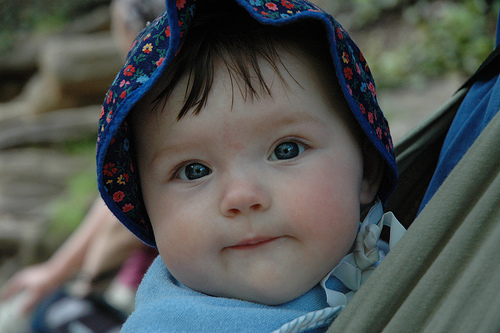
Sitting requires a lot of development, balance and strength chief among them. While L has, for some time, been sitting with supports, she's recently begun sitting (and falling) all by herself.

Sitting brings a whole new set of possibilities. The ability to entertain herself by picking up things she sees around her is a big plus when everyone's busy. The promise of crawling emerges when L leans forward and puts a fair amount of weight on her still-weak arms. Sitting is the first step toward mobility, for it means a much-expanded horizon for the Girl -- much to see, much to tempt...

Crystal Ball

I often wonder what L is going to look like when she's older -- three, seven, ten years old. Once she reaches three it will be easier to guess what she might look like five years later.

At five months, though, it's fairly difficult to imagine what she might look like as a little girl rather than an infant.

But sometimes, when her expression is just right, there's a little glimpse.

Within Grasp

The girl has begun reaching for things. For anything. If it's in her field of vision, she'll put out her little hands and try to grab it.

The other day, she grabbed a glass of water while we were eating dinner and turned it over on K. First time, certainly not the last.

And so, for the first time, I proposed making pre-planned video. "Just go around the apartment and hold her in front of things," I asked K.

Kanał Part II

L, most unexpectedly, also has her own little canal. It too is singularly effective at channeling .

L doesn’t do much of anything without putting her full effort into it, and pooping is no exception. But with pooping, she has a particular gift. Without some much as a raised eyebrow, L can expel her cottage-cheesy poop with such energy that, upon impacting the diaper, it follows the path of least resistance, right up her back.

A good poop means that she leaves wet marks mid-way up her back. A spectacular poop goes three-fourths of the way up to her shoulder blades. Her personal best is just below her shoulder blades.

It’s spectacular. I had no idea babies could achieve something as wondrous as pooping halfway up their backs. And when she’s done, there’s a little mischievous smile that, though I know is from relief, seems like it just might also have a bit of pride mixed in.

Limits and Liquids

We went to visit family yesterday. This meant a lot of time in the car, which meant, for L, a lot of time in the car seat.

We discovered, much to our surprise, that L doesn't really like the car seat as much as tolerate it. Imagine -- she doesn't like being strapped into a virtually immovable position for hours on end.

We think liquids might help, because she seemed to cry much less violently during that last hour when she was working on a bottle of tea.

In Poland, in summer, potatoes -- those ever-present tenants of the Polish table -- are always served with fresh dill. All told, I had to scrape of pounds of it during my years there, and no one could understand that I just don't like the stuff.

"Tea!? You give your 5-month-old tea?" I can just hear the voices now. Well, to call it "tea" is really a stretch. It's a special granulated herbal concoction J brought from Poland with her. It's made specially for infants, and it's made from dill and aniseed. To my nose, it stinks like the dickens, because I don't like either one. But the girl likes it, and it eases her stomach, and it will undoubtedly ease time in the car.

After all, K and I buy green teas for the road. Why shouldn't she have something to drink to?

Maybe it's just one of those paradigms you slip into when your baby is breastfed. Additional drink is like additional food -- unnecessary. What we're learning is that that is only true -- duh -- for the first four or five months.

Subtle

When I was in Poland, I eventually reached a point in my linguistic development at which I understood everything going on around me. It wasn’t fluency, because in any given sentence there might be one or even two words I didn’t know, or couldn’t immediately place, but I learned that understanding 100% of the language doesn’t mean understanding 100% of the words spoken.

Once I reached that linguistic milestone, it felt I’d always been at that point. It felt like I’d always been able to understand everything, even though I knew it wasn’t the case. Like swimming and reading, understanding Polish was something I couldn’t remember what it was like not to be able to do. (What an awful example as a teacher I’m setting with that sentence! And this one…)

Today, we went to see my cousin and her recently-adopted baby. The little girl — S — is six weeks. She’s about a pound heavier than L when she was born. And I looked at that little girl, her eyes still mostly closed, and I couldn’t imagine L being that size. I know she was. We have the pictures to prove it. But, as with the language, I just feel she’s always been this size; that she’s always been able to hold her head up; that she’s always been able to look around, to smile, to cry from boredom, to giggle, to coo.

And then, a little voice: “That is how you’ll wake up one morning and realize she’s going off to college and for a brief moment, feel complete unprepared for it, and feel she’s completely unprepared for it.”

It’s not quite synonymous with “taking for granted,” but it’s awfully close.

And I think that’s one reason why I’m trying so hard to write in this silly blog so often. To mark the lines of development; to make a record for later — to make an online baby book.

Besides, what else am I going to write about in my newly realigned universe?

Cut!

L's had a lot of hair since she was born. Recently, we decided that it had grown too long -- at least the little lock that was swooping down into her eyes.

First step: wet the hair and get it standing up -- as Elmo looks on...

Next: cut it. Given L's propensity to jerk suddenly when a flash fires, I didn't actually get a shot of that.

Finally, comb it.

And in the end, she looks like one of those wet-hair-look Euro-trash boys (and I say that with tongue firmly in cheek).

All she needs now is a tracksuit and she'd fit in perfectly at any Polish soccer match...

Note To Future Parents

When playing with your child, some common sense is in order. After eating, for example, is not the best time for bouncy play.

That's fairly logical, but there's a derivative from this: after eating (up to, say, an hour after), avoid any play that places the child's head directly above your head.

As a newly washed car is to a bird, so your face, with it's stupid, wide-open-mouth smile, is to your child...

Skills, Part II

L is gaining increasing control over her hands -- so much so that she now can use her fist as a substitute when she's lost her pacifier.

I originally wrote this several weeks ago, then put it on hold for some reason or another. Now it's off hold, but I forgot to change "three months." As of today, she's just a little more than a week shy of five months.

Translation: we have a budding thumb-sucker.

Now, sucking a thumb is not bad. All parenting books I've read say as much. In fact, once L starts teething, our pediatrician informs us, it'll be better if she sucks on her thumb than on her pacifier.

But for some reason, whenever that cute fist goes partially into her mouth, K and I instinctively pull it back out and re-insert the pacifier.

Why?

After all, a thumb is much more convenient than a pacifier.

  • It never falls to the floor.
  • It never gets lost.
  • It never gets left behind.
  • It's readily available in the dark.

I suppose it's an unfounded worry that, by letting our little girl start sucking her thumb, she'll have a hard time later stopping. As she's only three months old, it's about like us worrying that she'll want to go to a school known more for partying than learning.

It's called "exaggeration."