
fun in threes, sometimes fours
religion
Any posts about religion are my views alone and do not represent any attempt to de-convert anyone.
"YOUR own future is laid bare, now, in prophecy!" Though intended as a compelling beginning, a startling call for readers to wake up and realize the cold reality they're facing, almost sixty years later the opening sentence of Herbert Armstrong's 1975 in Prophecy reads like the dating advertising copy it essentially was.
Written in 1956, it was a centerpiece booklet in his radio ministry. Claiming to have discovered -- rather, to have received through divine inspiration -- the key to unlocking Biblical prophecy, Armstrong claimed a certain clairvoyance unique among other religious figures. To his credit, he didn't take credit for it: he was merely an instrument of God. Still, there is a certain headiness in being the one to whom has been revealed a startling truth that, for ages, no one knew.
Prophecies that were closed and sealed tight now stand REVEALED. This mystifying, neglected third of the Bible now becomes plain. Mysteries of God, never before understood, now become crystal-clear. God's own time for this revealing has come. The KEYS that locked the future have been found.
Hidden prophecies seldom sell if they're absolutely and completely good. Like those who slow down and crane their necks when passing the scene of an auto accident, we all have a touch of the morbid in us and a suggestion of how bad things are really going to get can be utterly fascinating. This could be even more true in the 1950s, when 1975 in Prophecy first appeared. As the Cold War continually escalated, nuclear war with the Soviet Union seemed a very real possibility. Indeed, it wasn't so much a question of if it happened but rather when for most Americans. Catastrophe waited in the not-so-distant future, and it was this uncertainty upon which Armstrong built his ministry, and it was with this expected nuclear showdown with the Soviets that Armstrong created his catch, because of course, there was always a catch, according to Armstrong:
But what is actually going to happen is not what the world expects!
Today this world is changing - fast! Unprecedented events are shaking the world already. Yet what we have seen is mild compared to the catastrophic happenings that will rock this world in the near future!
You'll have to live into these tremendous times. This is YOUR life! You live here, in this erupting world! It behooves you to know what the Creator-RULER of the Universe now makes known!
Armstrong claimed that the United States and Western Europe were in fact the original ten tribes of Israel, supposedly lost to the mists of time. (Jews were only of the two break-away tribes the formed the Kingdom of Judah.) The Germans, though, were an exception: they were the ancient Assyrians, forever battling the Israelites. This battle spilled into the twentieth century, and explained both world wars. It was to be the Germans, not the Soviets, who attacked and conquered America.
Before getting to the bad news, though, and perhaps in an effort to pad the manuscript, Armstrong rehearses all the technological advances of the mid-twentieth century.
Feverishly, science, technology and industry are working to produce a fantastic, push-button world of leisure by 1975. The emphasis today is on "saving steps." Everything is to be done for us, by machines. Just push the magic button, and your work will be done automatically.
Already automobiles are equipped with push-buttons to shift the gears, raise or lower windows, move the seat forward, backward, up or down.
It's difficult to look at our current reality, with in-dash GPS, smart phones, and loads of cheap Chinese imports, and not think the advances of the 1950s somehow quaint. In spite of the stresses of the Cold War, there was a certain naivety at the time, on both sides of the Communist-capitalist ideological spectrum. Both sides were sure that their economic model would produce a not-too-far-in-the-future utopia. Francis Spufford recently portrayed this in Red Plenty, a clever, well-researched novel about the hope in the Soviet Union under Khrushchev that the Soviet Union would soon be the envy of the West; Armstrong beat Spufford by fifty years with his visions in 1975 in Prophecy:
In the dream-world MAN is devising for tomorrow, it will no longer be necessary to cook food on stoves. Food is to be cooked by heat waves in packages. You'll no longer bother taking a bath in a tub or shower. You'll take an effortless and quicker waterless bath by using supersonic waves! When you pick up your telephone, you'll see the party at the other end! The new automobiles, the new homes, the new schools are to be truly fantastic. The stores, hotels, and railroad trains will take your breath!
So far, surprisingly close to the reality we experience. Of course the waterless shower never took off -- or appeared, as best I can remember -- but we have had microwave dinners for over thirty years now while Skype and smart phones make land lines obsolete.
And air travel? Well, already leading air lines have placed multi-million dollar orders for still larger jet planes that will leave New York at 11 in the morning and arrive at Los Angeles by noon. These are under production, now. But what do you suppose air travel will be like by 1975?
For one thing, it is expected that many people will commute in their own private helicopters. Very probably these immense jets now being built will then be obsolete, and we'll travel in rockets at two or three thousand miles per hour. Think of it! Elapsed flying-time, New York to Los Angeles reduced to one hour! Since it is only 9 A.M. in Los Angeles when it's noon in New York, we may be flying across the continent, and arriving in Los Angeles two hours before we start! And elapsed flying-time from London to New York will be reduced to 1½ hours! As it is noon in London when it's only 7 A.M. in New York, we may be flying across the Atlantic and arriving in New York 3½ hours before we start!
Yes, MAN is devising fantastic things!
Unfortunately for Armstrong and the other futurists of the 1950s, their own predictions were among the "fantastic" things, though in their case, it's meant in the original adjectival form of "fantasy."
It's easy to look back on those predictions and mock them. We have the obvious advantage that it's no longer prophecy but history.
Under Cover in Europe
While America has been focusing its sole attention on its clumsy effort to meet psychological cold-war with antiquated diplomacy and military might, the real number one enemy has been perfecting its plans SECRETLY, UNDER COVER, IN EUROPE!
These plans were laid by Adolph Hitler, during World War II. The methodical Germans took into consideration the possibility they might lose, even as they had lost World War I. This time their plans for coming back and launching World War III were carefully laid before the close of World War II.
The day that war ended, the Nazi organization went underground! Their plans for coming back have been proceeding, under cover, since 1945!
Already Nazis are in many key positions-in German industry - in German education-in the new German ARMY!
In World War I, the Kaiser, allied with Austria, sought to conquer France, Britain and America. American Industry finally beat him. In World War II, Hitler tried to conquer the world, first by taking Austria and the Sudetenland thru diplomatic gangsterism; then second, with lightning-quick war, taking Poland, Denmark and Norway, Holland, Belgium and France; and third, while holding these nations by the throat with his Gestapo, and allied with his junior partner Mussolini, to conquer Russia on the east and Britain on the west. But again, American Industry, three Acts of God, at Dunkirk, El Alamein, and the destruction of the German hydrogen-bomb plant at Peenemuende defeated Hitler.
But this time the Nazis plan to side step the causes of past defeats. Instead of exhausting their own strength by holding European nations as captives at the expense of vital Gestapo man-power, they plan to head and dominate a UNITED STATES OF EUROPE -- and add the man-power of those nations to their own military divisions. And secondly, they plan to strike their first blow, NOT at France or Poland in Europe, but with hydrogen bombs by surprise attack on the centers of AMERICAN INDUSTRY!
I suppose with enough imagination, one could imagine in the mid-fifties, only ten years on from World War Two, that the Nazis had somehow managed to regroup and were planning a horrific third attempt at world domination. Such a theory certainly would work well with those still dealing with the consequences of the war, with so many people still dealing with the loss of life and property in the war.
It was this coming cataclysmic doom -- famines and pandemics would also accompany the military defeat -- that 1975 in Prophecy was using to sell Armstrong's theology. The booklet came complete with graphic, violent images depicting the coming horrors, called the Great Tribulation in Armstrongian theology.
The man-made horrors would not be enough to cause humanity to repent, Armstrong reasoned, so the natural world would add to the world's misery with great earthquakes, tidal waves, famines, and pandemics.

Armstrong had Basil Wolverton, a cartoonist who joined Armstrong's church in 1941, used his typical over-the-top comic style, creating images that disturb not only because of their content but also their style.
When I flipped through the booklet as a kid, I found these images repulsive and fascinating at the same time, not to mention confusing. They were supposed to be depictions of the coming holocaust, but by the time I was flipping through the booklet, it was the mid-eighties and all of this was supposed to have already taken place.
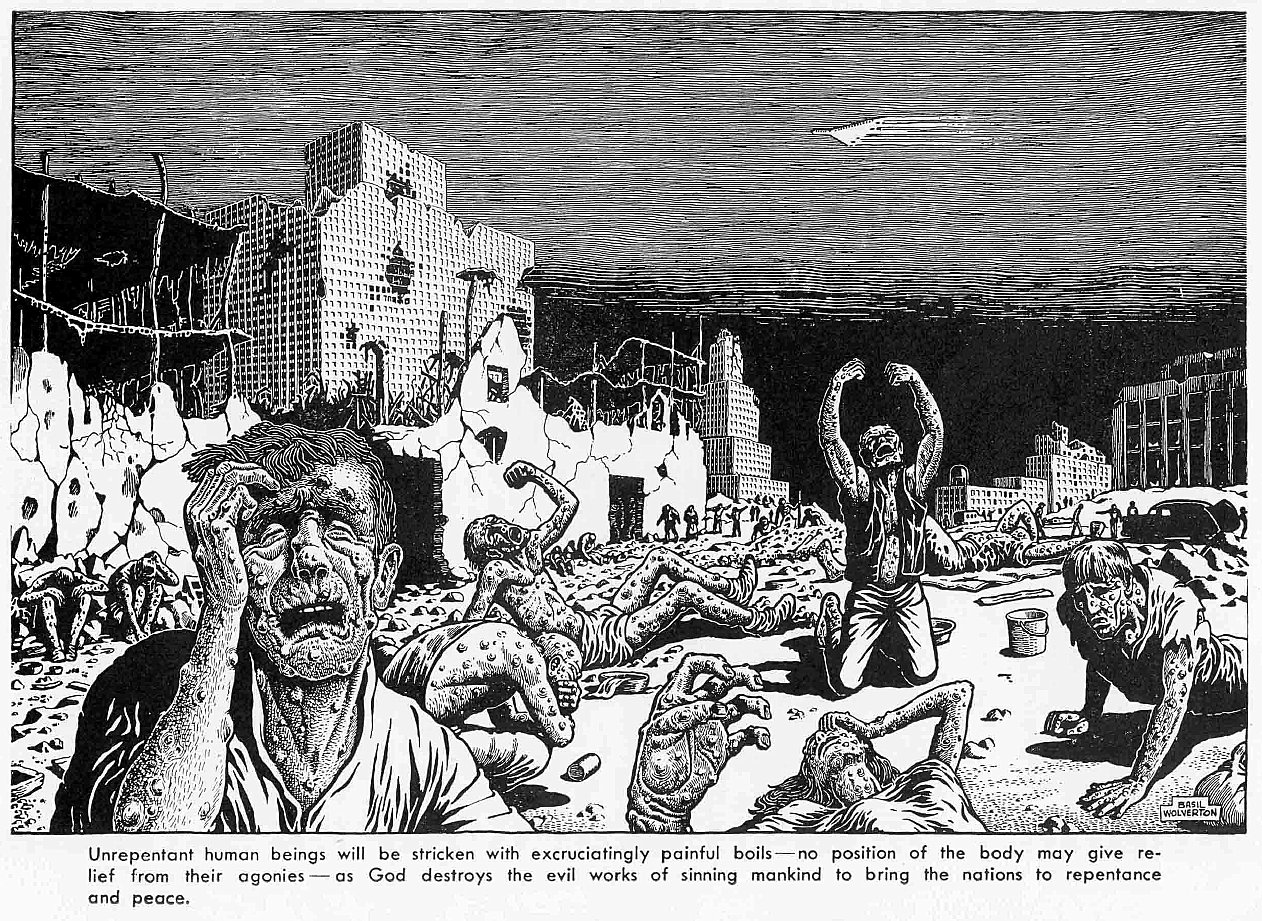
It will be, yet it was supposed to have already been.
And now, forty years later, there are still religious groups that believe Germany at the head of the EU will rise again and conquer the United States. The Philadelphia Church of God, the Restored Church of God, the United Church of God, and the Living Church of God are the three biggest groups holding such beliefs, with dozens of smaller groups professing the same thing. They all insist that this is coming, that Armstrong was ultimately correct, and that these pictures are legitimate depictions of the coming horrors.
I find it difficult to believe that people could be so naive, given the fact that so much of what Armstrong taught has been shown to be false. Most significantly, Armstrongists are in the same situation as Mormons due to advances in DNA testing, which show that both groups' claims about the ultimate destiny of the so-called Lost Tribes of Israel are radically wrong: there are no Semitic markers in the European population (except, surprisingly, the Jews), thus discounting Armstrong's theory, and the Native Americans similarly lack such markers, thus disproving Joseph Smith's theory. Still, these organizations pull in members and money.
Long ago I wrote a letter to one of these organizations only to find out later that my letter was read to the entire church as an example of the horrendous persecution that awaits the leader.
I regret that letter in a sense: it seems like I'm saying at the end that I look forward to the death of the group's leader, David Pack. Not at all. Even in my most skeptical periods, I would have never have wished death upon someone. What I meant was that I was looking forward to seeing the scramble for power and more interesting the desperate attempt to remold Pack's statements that he would live to see these prophecies come to pass as something less prophetic than they were, just as Armstrong apologists do with Armstrong's assurances that it would all be over by 1975. Perhaps I should write again and apologize?
Even our beliefs have become trend statements. We don't even believe things because we believe them anymore. We only believe things because they are cool things to believe.
The problem with Christian belief -- I mean real Christian belief, the belief that there is a God and a devil and a heaven and a hell -- is that it is not a fashionable thing to believe.
Yesterday's reading at Mass was one of the most famous in Scripture: the commanded sacrifice of Isaac. Here's a thought experiment I wrote over fifteen years ago when I was still in college.
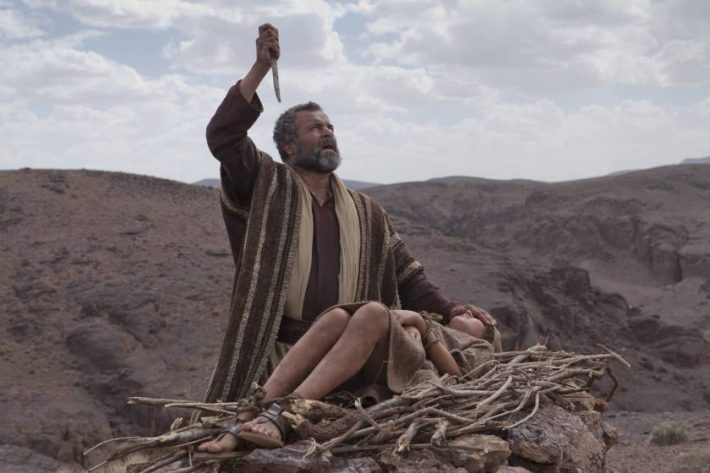
Some time later God tested Abraham. He said to him, "Abraham!" "Here I am," he replied. Then God said, "Take your son, your only son, Isaac, whom you love, and go to the region of Moriah. Sacrifice him there as a burnt offering on one of the mountains I will tell you about."
So begins one of the most extraordinary stories in literature. The story of God's command to Abraham to sacrifice Isaac is undoubtedly one of the best known Biblical stories. Soren Kierkegaard says, "The story of Abraham is remarkable in that it is always glorious no matter how poorly it is understood." Indeed, it is an amazing story of faith and an incredible testament of ultimate trust in God.
One wonders, though, how the story might have changed had Abraham said, "No" to God's command. The possibilities are endless, for there are so many variables. God might simply have accept the answer and go off in search of someone else to become the Father of the Faithful. He could roar, "How dare you defy me!" and strike down Abraham in fiery wrath. God might take a more human approach and beg: "Ah, come on. Trust me; I know what I'm doing!"
However, before pondering God's response, one would have to take into account Abraham's reason for refusing to follow God's command. Perhaps it would be for selfish reasons. After all, Isaac is Abraham's only offspring, a miracle child born when Sarah was well beyond child-bearing years. It is only natural for Abraham to cling stubbornly to his only child; certainly, old age would prevent Abraham and Sarah from having another. Possibly it would spring from incredible love for Isaac: "I'll not do that to my son!"
Or it could be because Abraham feels homicide is wrong. He could shake a fist at God, declaring, "No! I will not kill, for any reason. I will not violate my conscience for any reason, not even divine command."
This produces an entirely new possibility in the historical story of Abraham: God's test of Abraham is open-ended. When God commands, "Take your son, your only son, Isaac, whom you love, and . . . Sacrifice him . . . as a burnt offering" God might be willing to accept either answer, "Yes" or "No."
Once Abraham submits to God's injunction, then there is no change from the actual account found in Genesis. Abraham is still regarded as the Father of the Faithful and the Bible remains in its present form.
If, however, Abraham refused on the grounds that the commanded act – murder – violates his conscience, God could respond, "I swear by myself that because you have done this and have not compromised your conscience for any reason, I will surely bless you and make your descendants as numerous as the stars in the sky and as the sand on the seashore." Abraham would then become the Father of the Morally Steadfast. The entire Bible might be radically and totally different. Wholly different lessons would be learned from the story of Abraham. James 4.17 might read, "Anyone, then, who knows the good he ought to do and doesn't do it, sins. For Abraham did what he knew to be right in his heart, even when God commanded otherwise."
A series of questions then arises: If it was an open-ended test, what was God hoping it would reveal about Abraham's character? If either obedience or disobedience was acceptable in this particular instance, what was God looking for in Abraham's response? The only answer is passion. God was simply looking for someone who would act vigorously, someone who was zealous and complete in his actions. Whether or not Abraham was obeyed would not have mattered, for obedience could be learned more easily than zeal.
God has a way of changing people's minds, but usually, they are already zealous in their activities, such as the apostle Paul or Jonah. Both men lived lives violently opposed to what God ultimately desired of them but both were dynamic and spirited in what they did. Jonah ran from God and his destiny and Nineveh with all the strength he could muster, and Paul persecuted the early Christians mercilessly, with every ounce of his strength. In both cases, God turned the men around and put them to his work, which they accomplished with even greater vigor, for they were now working toward a goal instead of running away from one.
This kind of passion could be exactly what God was looking for in Abraham. What God sought was a man who would be decisive and would back up the choices made with all his energy, ready and willing to accept the consequences of each action. God didn't want someone apathetic, someone lukewarm.
Of course, Abraham did not say, "No." He obeyed God even when it made no sense to him, even though God was asking him to do something from which there seemed to be nothing good that could arise, something ridiculously absurd. Some would label it blind devotion. Others call it faith. It is a kind of faith that to most of us in the twentieth century find alien, for there would be few – if any – people today willing to commit himself so fully to God's will. Many people are not able – or willing – to understand why Abraham did what he did. Antagonists of Christianity point to this story as evidence of the absurd cruelty represented in the Bible, in an attempt to discredit the Bible as barbarous and antiquated. Yet the story records Abraham's faith to the disbelief and astonishment of readers throughout the centuries.
The fact that Abraham did not disobey God makes the story even greater, adding immeasurably to its authority and puissance. It is a story of strength, of a strong man passing a test offered by an infinitely mighty God. Even the most fervent Christian must sometimes feel a little apprehensive about serving a God who would ask so much of one person, and this apprehension leads to great respect for Abraham and his faith. Underlying all of this is the question, "How could God ask such a thing, and how could Abraham obey such a ludicrously evil command?" It is the same question that antagonists of the Bible ask in an attempt to discredit the Bible. There must be an answer that glorifies the Bible and God. Yet it is sometimes difficult to get beyond the command itself and to understand the motivation of it's charge and the power of Abraham's obedience.
While talking to a friend about the magnificence of the story of Abraham and Isaac I was presented with a startlingly beautiful answer to this delimit. The test was not supposed to prove anything to God – the test was simply for Abraham to realize the power of his own faith. As God is spirit and outside of time, he would have been able to know exactly what Abraham's response would be. Not only that, but God's omnipotence would allow him to see inside Abraham's heart to behold the energy of faithful obedience pulsing deep within Abraham's being, out of even Abraham's knowledge. It took such a powerful test as God gave to bring into fruition such a powerful force as Abraham's faithful obedience.
Both Biblical precedence and common sense underscore the logic of this position. God commands obedience and the Bible is the story of those who obeyed and those who disobeyed. Always God rewards those who submit to his will and do what he commands. He didn't reward Jonah for running. He didn't reward Paul for persecuting. Yet he did reward Abraham for his obedience.
From a common-sense position, to say that the test was for God's sake is ridiculous, for God knows everything. He is outside of time, therefore knows the future, present and past all simultaneously. God is omnipotent, all-knowing – there was nothing that he could learn from Abraham's response that he didn't already know from the beginning of time.
On the other hand, to say that the test was for the sake of Abraham works either way – God wanted to prove to Abraham his own moral fortitude of his own powerful faith. God, being outside of time, knew Abraham's reaction long before Abraham was even born. God, therefore, knew the quality his test was to exemplify for as equally long. Accordingly, God knowing Abraham's reaction does not disqualify the submission that the test was open-ended.
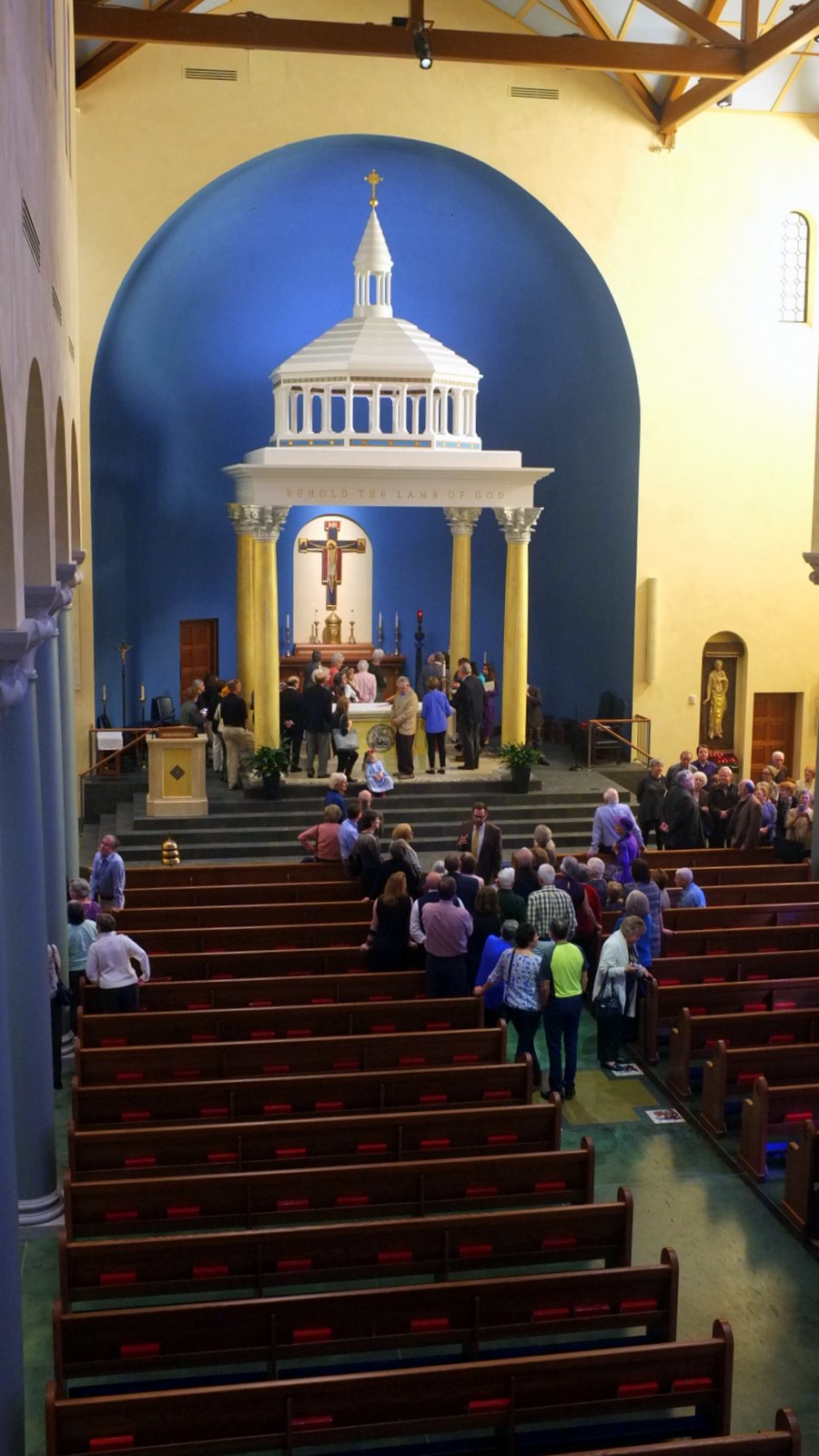
Catholicism is filled with sacred words to accompany the sacred gestures, time, space, and objects.
The most sacred words, of course, are the words of Scripture, and within that, the Gospel accounts. One of the first things visitors notice is the treating of those words as sacred. When the priest or deacon begins the reading, saying, "A reading from the Gospel of...", parishioners make three small crosses with their right thumb: one on the forehead (belief), one on the lips (desire to proselytize), and one on the breast above the heart (desire to keep the words in one's heart). Thus, the sacred words are a catalyst for sacred gestures.
Prayer is another moment when sacred words bring forth an accompanying gesture. When a Catholic begins a prayer, she intones, "In the name of the Father, and of the Son, and of the Holy Spirit," and makes the sign of the cross simultaneously. The one without the other is incomplete, and while it might become a mere habit with some Catholics, I've seen some obviously sincere moments was parishioners cross themselves, and that sincerity itself is moving.
Not all sacred words are for all Catholics, though. Some obviously are reserved for priests. Blessings and absolution come to mind, but they're not the most important sacred words a priest can utter; the Eucharistic Prayer is. The highlight of the mass is the Eucharist, which Catholics believe to be the body, blood, soul, and divinity of Jesus. They revere it accordingly. Of course this is not always the case: unconsecrated hosts are simply that -- hosts. So there comes a moment when, according to the Church, the Holy Spirit transforms the hosts. A skeptic might say, "Hocus pocus -- nothing more than cheap parlor magic," and I myself said the same thing for years. Yet whether or not it's effective is not my point here: the fact that the tradition of sacred words continues is somehow admirable. I suppose it's the faith that impresses me.
For a long time I felt a little ill at ease when I was attending a Mass and realized I wasn't doing the gestures everyone around me was doing. On entering the Church, they dipped a finger in holy water and crossed themselves; I didn't. When crossing in front of the tabernacle, they stopped genuflected or bowed; I didn't. Just before entering the pews, they genuflected and crossed themselves; I didn't. When the priest opens the Mass with "In the name of the Father, and of the Son, and of the Holy Spirit," they crossed themselves again; I didn't. When they spoke the creed or the Confiteor, I remain silent. When they struck their breast during the "mea culpa" phrase of the Confiteor (at least in Poland), I remained motionless. When they made the sign of the cross on their forehead, their lips, and their heart before the reading of the Gospel, my hands stayed by my side. I stood when they stood, knelt when they knelt, and sat when they sat, but otherwise, I was strictly an observer.
And I felt conspicuous.
At last I began going through the motions, literally and figuratively. What an odd feeling to begin crossing oneself at the age of thirty-eight.

I am aware of the tactile sensations of my body in a Catholic church in a way that I never was in any Protestant church.
Part of this goes back to my first experiences with Catholicism in Poland. Going to a Mass with someone -- most often, K -- I knew would be painful. It was not that I hated the liturgy or thought it a waste of time. I knew it would be physically painful: there was very, very rarely free space in any pew, so we spent the Mass standing or kneeling. On a stone floor, this was always tough on my already-injured knees and prematurely-paining back. It added an ascetic dimension to Mass.
Yet mortification of the flesh is not the only -- or most common -- sense that I think of Catholicism as tactile. Anointing, genuflecting, crossing oneself, baptizing, and kneeling all heighten, in one for or another, one's awareness of the body. As a non-Catholic, I often feel the distinctness of my lack of action when the individual before me genuflects before entering the row of pews and I don't, or when my neighbor crosses herself along with everyone else and I don't.
I wonder if that would change were I to follow suit...
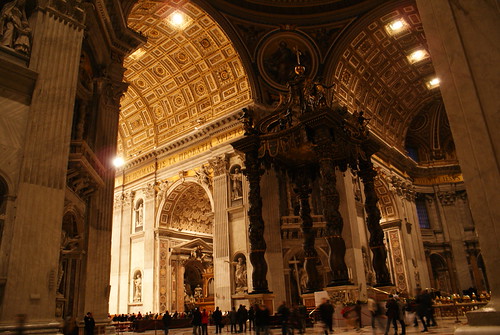
The sacred -- an idea that, in the ancient world, was an everyday reality. To be sacred is to be "consecrated: made or declared or believed to be holy." It's only been in the last few centuries that this notion disappeared from the everyday life of Everyman.
In a Protestant church, the idea of the sacred is almost non-existent except in a historical, Biblical milieu. The Ark of the Covenant was sacred; the showbread and the Holy of Holies were sacred; God's name is, in some sense, sacred. But in the sense that time, space, gestures, words, or objects can be sacred, Protestantism proclaims loudly and, for its own part, definitively, "No!" Only God is sacred. Nothing on Earth is truly sacred.
The rest of the religions in the world beg to differ. And Catholicism (as well as the Orthodox East) in particular would argue that there is sacredness on Earth. Indeed, Catholicism is, in part, all about bringing that sacrality to humanity on a daily basis.
A daily game of Candy Land has wiggled its way into our routine. L has mastered the concepts: she knows what the cards are for and she generally knows which direction her piece needs to move.
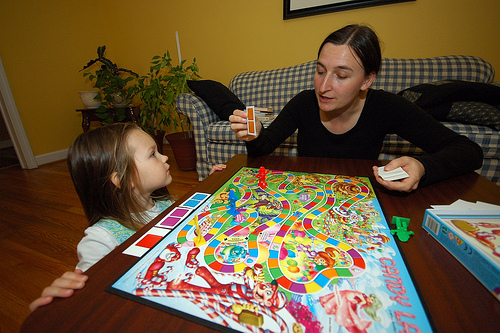
The problem is that Candy Land is unimaginably dull: draw a card, move your piece, wait. Repeat. While L was learning, it was a pleasant game: actually playing the game was not the objective, and as I love teaching, any educational activity is enjoyable.
Now that she knows how to play the game, though, it can drag.
I feel a little guilty about that. I should adore every single moment with her, but let's face it: there are only so many times you can feign surprise at having to go back to the Gingerbread House.
When I was working with autistic children, Candy Land was a popular free time choice. I got so utterly sick of it that I -- and I am somewhat ashamed to admit it -- stacked the deck to make sure the kid I was sitting opposite got all the good cards.
"What!? Another double-purple? Well, you're well on your way, aren't you?"
I haven't done that with L yet. In the truest sense of "stacking the deck." I might have switched the top two cards after a quick peek at my own, making sure she got another double-purple, but that's not really stacking the deck. That's helping.