Matching Tracksuits

fun in fours

religion

Any posts about religion are my views alone and do not represent any attempt to de-convert anyone.

The Sacrifice

Another post on social media about Abraham’s near-sacrifice of Isaac, this time as a comedy:

I would think that such an event would cause near-trauma in the mother: any other reaction seems unhealthy. I would hope that if I came home with one of our children and told K that I’d almost killed the child because I was sure God had told me to sacrifice the child but thankfully an angel stepped in and stopped the whole thing that she’d gather the children and get away from me as fast as possible until I got substantial counseling.

As for the child, I would think it would be more than just a mere reluctance to go into the woods with the father.


Miracles and Belief

A priest in a local parish recently included in his homily a quote that appears to be a variant of something Thomas Aquinas said. The priest phrased it thusly: “For those who don’t believe, no miracle is enough; for those who believe, no miracle is necessary.” Aquinas’s quote is a little different: "To one who has faith, no explanation is necessary. To one without faith, no explanation is possible." The order is different, but the idea is the same.

The quote has a certain rhetorical symmetry to it, a certain parallel structure that makes it resonate in believers' minds. That symmetry makes it more memorable, and that memorableness combined with its emotional resonance means it will stick.

The quote will seem clever as well. In believers' view, it encapsulates both the weakness of the skeptic's position and the strength of the believer's. It creates a simple juxtaposition that both validates their own position and invalidates the position of opponents. In short, it’s the perfect rhetorical flourish believers can take home with them and use when talking to or about skeptics.

Like many rhetorical constructions, however, this one ultimately fails because of its oversimplification of both sides of the structure. From the skeptic's point of view, it represents neither the skeptic's position nor the believer's position accurately. It is filled with generalizations and question-begging most believers would not notice.

The first part of this quote deals with skeptics. The assertion is that no miraculous event could convince the skeptic. There is some degree of truth to that. Were someone to rise from the dead, for example, the skeptic's first response would not be, "Oh, this is possible proof of God's existence." Rather, she would begin looking for natural explanations. Even if no natural explanation were obvious, the skeptic would not default to a supernatural explanation. Rather, the skeptic would simply say, "We don’t know." So in that sense, the assertion is correct: it’s doubtful that anything so puzzling could happen that a skeptic would move beyond a simple "I don’t know" into a theistic explanation based on the supernatural suspension of natural laws.

Believers, though, already primed for belief, eagerly accept as miraculous anything they can't understand. It's the argument from incredulity, which could be framed thusly: "I don't understand how this could happen, therefore God must have done it." Much creationist theorizing that attempts to refute the clear evidence of evolution lies along these lines.

This is no to say theists are not willing to admit ignorance. Indeed, when pressed on contradictions in their faith, the fall-back position is often simple: "God is a mystery."

"Why would a loving god allow such suffering among children who can gain nothing from it and who simply suffer?" the skeptic asks.

"I don't really know. I just know God has a plan, and that this is somehow part of that plan," the believer responds.

The second element of the quote in question that we need to examine is the nature of miracles: A miracle is the suspension of natural laws. Yet because it is is it a suspension of natural laws, there’s no way to test a miracle to prove that it is a miracle. All of our knowledge is bound up in the natural laws that govern the universe. The suspension of those laws in order to create a miracle would be indistinguishable from a new law or principle we have yet to discover, and as miracles are one-time events, there’s no way we could test it to prove that it was not, in fact, some bizarre quantum event but instead a miracle. So in that sense, this assertion is correct: because skeptics generally deny the possibility of miracles, it would not even be an option.

Yet if the purpose of miracles was to convince skeptics, an omniscient god would know exactly what it would take to convince a skeptic. The Christian god’s very characteristics make this merely a question of will: if this god exists and it wants a skeptic to believe, it knows what it would take and would merely need to do this. The fact that it doesn’t suggests — again, if it exists — that it chooses not to, that it doesn’t want to.

The quote from the believer’s side is quite disingenuous, but it’s not immediately obvious. It states that “for those who believe, no miracle is necessary.” This suggests that miracles are secondary to some other method of conviction. But if we’re discussing Christianity (as the priest obviously was and as Aquinas was), the entire religion is based on faith in a central miracle: the resurrection of an executed first-century Jew. So in fact, the quote has it exactly backward: the central tenant of the Christian belief system is a miracle.

When discussing why they believe in this miracle, Christians point to accounts of the event in the New Testament and to personal experiences they claim to have had with “the risen Christ.” In order to accept the accounts in the New Testament, one has to have a certain degree of confidence in the accuracy of the New Testament’s accounts, and given the fact that there is not a single eye-witness account in the whole collection of books but instead multiple second- and third-hand accounts decades after the event, most skeptics find the Biblical evidence weak at best.  On the other hand, to accept the authenticity of a believer’s accounts of personal inner experiences with Jesus, skeptics must necessarily accept that believer’s interpretation of that inner event. No one would doubt that the believer had that moment of clarity, that experience of warmth and love that they claim. However, just because a believer had that experience doesn’t mean that experience came from some god or other. Believers are often looking for reasons to believe: they’re looking for miracles large and small. They’re seeking these quasi-mystical experiences with their god. Since they’re looking for them, they often find them. As Augustine of Hippo said, “Faith is to believe what you do not see; the reward of this faith is to see what you believe.”

Yet a believer is likely to protest that such an analysis is going too far. “It’s about skeptics’ calls for miracles to aid in belief now. ‘God, give me a miracle so I believe!’ skeptics proclaim, but this quote is suggesting that’s not necessary for believers.” Skeptics are skeptical, though, not because there are no miracles today; we’re skeptical because we find the evidence for the source of any potential miracles lacking. To look at an event, proclaim it a miracle, then use that as evidence for a god is question-begging: it assumes the god exists in the first place. It works backward to an unwarranted assumption. Skeptics see things that believers proclaim to be miracles and say, “Now hold on — there’s probably another way to explain that phenomenon.” And if there’s not, skeptics will simply say, “We don’t know how to explain it.”

In the end, the quote is just as much an indictment of believers’ question-begging as it is of skeptics’ lack of faith.

Yoga Fears

I'm still following a couple of Bible in a Year podcast groups on social media, and the other day I saw this post:

Hi. I was wondering If someone can tell me if practicing yoga goes against the Catholic religion? If you are doing it for stretching and relaxation purposes ? Thanks. I met a woman in a store that heard me mention yoga and went off on how that’s like devil worshipping.

I remember encountering such concerns when I was a kid. Everything seemed a potential link to the Dark One: popular music, popular films, popular anything. The devil, it seemed, was always lurking just around the corner, always waiting for us to slip up so he could slip in. Yoga was among these worries.

Not everyone was having it, though:

You would think the church would worry about important things...and I don't think yoga and keeping your body healthy and breathing are much of a problem.

Every now and then, I see a kindred spirit on these message boards, someone who thinks, "Hold on -- that doesn't make sense," and then goes ahead an says it.

How many people are actually like that, though? I'm fairly sure that thought comes into plenty of people's minds and they simply disregard it or even banish it as being a trick of the devil.

Some people in the message stream, though, seemed to be of two minds, or to have changed their mind:

Yoga has become so mainstream and it seems so innocent. I did it for years. Then I learned how it was occult and stopped.

"It seems so innocent." That is how the devil lures you in: he seems so innocent and then, boom! He's got you!

I find myself wondering whether these folks see the contradiction in their thinking. On one hand, they're always saying that "the Lord's got this" and "I have no fear because I trust in God." Yet moments latter, they're hyperventilating about how the devil can sneak in unawares and possess your soul.

At this point, an authority figure -- a church deacon -- stepped in and shared his thoughts:

As a deacon in the church and someone who has been specifically trained and has done deliverance ministry within the confines of the church, while i can’t go into detail, practicing yoga like Ouija boards, like believing in horoscopes telling the future, like tarot cards, like hypnotism, like spiritualism, like seances etc. is like opening a crack into the evil one’s domain.

Specifically to yoga, the poses emulate the postures of Hindu gods, the mantras can be prayers to the pagan gods, etc.. While. the rationale of intent is used as a reason, I. E. That it depends upon the intent, when the guard is down, inadvertent openings occur. While you likely won’t find a definitive statement from Rome, I believe it safe to say that avoiding a potential issue is practicing safe spirituality. It is best practice to avoid the near occasion of evil. there are alternatives. Often seen as new age which should be avoided.

The things he lists as potential entry points for a demonic spirit just waiting for a chance, for a moment when everyone's guard is down, deserve some scrutiny.

Ouija boards appeared in the late 19th century, but it wasn't until World War I that spiritualists began claiming that they could use the boards to contact the dead. Scientific inquiry has determined that participants are moving the planchet through ideomotor responses, which are all involuntary. In other words, it's not spirits doing the moving; it's the participants themselves.

Next the deacon listed "believing in horoscopes." Other than just making you look gullible, I'm not sure how believing in the vaguely written horoscopes so-calls psychics create can in any way open you up to demonic possession.

Derren Brown, the English mentalist, has shown how these horoscopes are vague nonsense by giving readings to different people and providing them with the exact same horoscopic predictions. They were all of different astrological signs and had all had in-depth conversations with Brown, but they all felt that the reading and prediction that followed was eerily accurate even though it was the same one for each and every one of them.

The skeptic James Randi once wrote horoscopes for a newspaper by taking old horoscopic predictions from other newspapers and simply scrambling them.

The same thoughts apply to tarot cards as to horoscopes, so I won't rehash that.

Hypnotism, more than anything else, shows the weakness of the brain to manipulation than it shows any sort of spiritual danger. In an odd way, then, it counts against another element of these conservative Christians' belief, that of creationism. A brain that can so easily be manipulated does not seem to be the creation of an omnipotent being, but Christians have an easy out for this: the Fall corrupted everything. Press that issue with questions (How exactly? What is the mechanism that this mythical disobedience led to physical changes in humans and the planet itself?) and many will simply resort to, "I don't know how, I just have faith in God's word, and that's what God's word says." Point out that actually the Bible says nothing about the so-called Fall leading to a deterioration, a spoiling of the physical world and that that, therefore, is mere interpretation and you'll likely see that this person doesn't even understand the objection and will simply reiterate earlier points. It's easy to see why: opening up to such doubts is more dangerous than opening up to potential demonic possession, because doubts lead to visible consequences (people leaving churches) where as demonic possession -- not so much.

The deacon next mentioned "spiritualists," which I assum he means those who claim they can talk to the dead. People like James Randi and Derren Brown have so completely and thoroughly debunked this whole practice, this whole industry, that it's shocking anyone still thinks these spiritualists are talking to the dead. In fact, they are doing nothing more than cold reading.

Seances were nothing more than parlor tricks of the late nineteenth century, and those conducting seances were hucksters and con artists. The bumps, thumps, and noises were manipulations, and the levitation was nothing more than common performance tricks.

So science, logic, and common sense have shown every concern the deacon raised to be, in fact, nonexistent, or worse, a hoax.

Next, the deacon explained that "While. the rationale of intent is used as a reason, I. E. That it depends upon the intent, when the guard is down, inadvertent openings occur." I have so many questions about this.

First of all, what is this guard he's talking about? It would have to be some kind of spiritual guard since we're talking about spiritual issues. (Never mind the fact that a consciousness without a physical brain is, as far as science has determined thus far, impossible, thus rendering the whole existence of any spiritual being, good or bad, impossible.) If we don't even know what it is, how can we be sure it is up or down?

Second, what are these openings he's talking about? If it's all spiritual to begin with, there are no "openings" or "closings" because those are descriptions of physical things, places physical objects can slip through other physical objects. A spirit doesn't need an opening. Even in the New Testament, the resurrected Jesus walks through walls and such. What is this opening?

Third, how can these things be on purpose or inadvertent if we don't even know what they are or how to control them?

This leads to the most troubling question: what kind of god, who loves his followers and wants them to be safe, would allow such inadvertent openings to exist? Is it out of his control? It also calls into question the supposed benevolence of such a being. It seems like he's saying, "Oops -- you let your guard down. I know you didn't realize you'd done it, but that's how these things go. I'm just going to let this demon slip on in and control you."

Of course, the whole idea of demonic possession in the twenty first century is laughable. It's oddly telling that only Christian believers get possessed and not atheists.

I'm sure most Christians would simply reply, "Well of course they get possessed: they just don't realize it or even believe in it, so they're not going to do anything about it." Indeed, evangelical podcasters and broadcasters regularly declare that this person or that person is, in fact, demon possessed.

Finally, someone just asked point blank:

I may be dumb, but why in the world would that go against our religion.

I guess this individual hadn't read the deacon's detailed response, but another member gladly and succinctly explained it:

because of the yoga positions are honoring Hindu Gods

You can only prod a skeptic so long before he responds: I had to join the conversation.

Just what do you think, [name redacted], being in those positions does? Doesn't intent matter? If one is not doing it in order to honor the Hindu gods, is one actually honoring those gods? It seems odd to think that getting into position X with the motivation of strengthening certain muscles would cause harm just because someone else gets into position X with the motivation of honoring some non-existent god.

Another participant tried to explain it this way:

sometimes our subconscious leads us into places WE don’t need to go so I’m just suggesting you watch the women of Grace video and I have a different opinion but mine is lead by our GOD so I’m trusting HIM. I respect each person opinion as well

I replied,

So getting into these positions will somehow trick our subconscious, which will then subvert our conscious intent and make us unconsciously worship these gods? I'm not trying to sound snarky -- I just don't understand.

The other participant simply pointed out that it was not her job to convince me and that I need to turn this over prayerfully to God for guidance. Reason had broken down. Logic had disappeared. Faith had entered.

My ability to hold back ever diminishing, I got a little ridiculous:

What if I am playing with my son, wrestling around, being silly, and one of us accidentally strikes one of these poses? If intent doesn’t matter, then I could’ve accidentally opened some demonic gateway just by playing with my son. Does that make sense? It doesn’t to me.

It seems like a childish objection, but in fact, it's a serious concern if these Christians are right about yoga. If intent doesn't matter, then getting into one of these compromising positions accidentally should be a major concern.

The opposite, though, is another concern: what about non-Christians making the sign of the cross? Does this have some kind of inadvertent effect? Is God just waiting for us to slip up and slide a little grace in just like the devil is waiting for us to slip up and take our souls?

I suspect the deacon, were I to ask him these questions, would not have a ready answer, or he would not have an answer that, in turn, raises more logical issues. Believers see this as getting carried away. "You can always find a loophole, some kind of 'what if' question," they might respond. They might call it a juvenile objection as our parish priest once did on his blog when discussing the problem of pain. They'll likely tell you that they're praying for you. But they will all eventually reach this point, where there's no rational response to the objection.

In the past, I avoided all this by simply not asking the questions to begin with. I was, quite honestly, scared to ask those questions because I knew there were no answers, and I knew the doubts such questions would bring could swamp what little bit of faith I had. I ignored it, and I suspect I'm not the only one who does that. No, I don't merely suspect; I know. Statistically speaking, it must be the case for some percentage of believers.

God of the Gaps, Again

The pastor of K’s parish tweeted a link to “Has quantum physics smashed the Enlightenment deception?” by John Moran with the comment, “Reality is Rubbery.” I clicked through thinking, “Great — another ‘God of the Gaps’ article,” but hoping that I might be wrong. I wasn’t.

The article begins,

Forget Richard Dawkins, Stephen Hawking, Steven Pinker and the other high-profile God-denying “clever” boys. It is time for the broader implications of the 20th-century physics revolution, often described as quantum mechanics, to again be debated seriously and out in the “town square,” not just the backrooms of academia or in “deferring to the expert” interviews and documentaries.

The critical word there is “implications.” I’m not sure what Moran is suggesting here. At its heart, it’s simple: “Quantum mechanics is so weirdly different from the physics of our everyday reality that there must be implications for the nature of our everyday reality.” But must there be? There must be if we’ve already nurtured for millennia a belief in the supernatural, but all “quantum mechanics is weird” implies is “quantum mechanics is weird.”

Whatever these implications are in Moran’s mind, though, should be “debated seriously and out in the ‘town square,’ not just the backrooms of academia or in ‘deferring to the expert’ interviews and documentaries.” Part of the reason we “defer to experts” is because they are just that: they’ve forgotten more about their specialization than we laypeople even begin to understand. So when the people who actually work in quantum mechanics say, “No sorry — your implications that you want to discuss are based on misunderstandings of the quantum world,” as they do, we can just dismiss them. Who wants to defer to experts? After all, we’re seeing the benefits of not deferring to experts in the way covid is ravaging the conservative Christian anti-vaxers.

What does Moran say these implications are, though? To introduce them, he begins with a quote from a video by Leonard Susskind

It is hard to understand. Our neural wiring was not built for quantum mechanics. It was not built for higher dimensions. It was not built for thinking about curved space-time. It was built for classical physics. It was built for rocks and stones and all the ordinary objects and it was built for three-dimensional space. And that’s not quite good enough for us to be able to visualize and internalize the ideas of quantum mechanics and general relativity and so forth. …that can be extremely frustrating when trying to explain to the outside world. The outside world, by and large, has not had that experience of going through the rewiring process of converting their minds into something that can deal with five dimensions, 10 dimensions, or the quantum mechanical uncertainty principle or whatever it happens to be. And so the best we can do is to use analogies, metaphors.

Moran jumps on this:

Metaphor? So quantum physics has brought science full circle, back to the world of religion and the story telling methods of Jesus Christ and other religious figures.

Where quantum physics challenges everything, including those who arrogantly dismiss things like spirituality, is that it basically tells us two things:

  1. There might not be such a thing as an objective material object; and
  2. Consciousness has to be fundamental.

Now, let’s be clear. This new science does not prove the existence of God or anything else of that nature. But, it does shatter the arrogant certainty of those who think science is all you need and has killed off the spiritual. Through quantum physics we were again reminded of just how much we don’t know, especially about the mystery of the universe and the atomic world. In fact, we were not even close. This new quantum world was nothing like what scientists had envisaged prior to its discovery.

Why Moran gets so excited about Susskind using the word “metaphor” is confusing: does he not think that we use metaphor for anything other than religious ideas? After all, when we’re examining the quantum world, we’re looking at something so different from what we’re used to that we have to ground it in something we are used to — that’s what metaphor does. The use of metaphors does not equate scientists with theologians. This is an important distinction because scientists study the thing they study; theologians, unable to study gods directly, only study what other theologians have said. Scientists base their ideas on evidence; theologians’ try to do that, but their only evidence is ancient and anonymous manuscripts — again, studying what others have said about gods rather than studying the gods themselves. If, of course, we could study the gods themselves, there would be fewer atheists. Theologians would reply, “If we could study God, he wouldn’t be God,” but for one thing, that doesn’t necessarily follow. It’s based on the presupposition that gods must be so far beyond us that we can’t interact on their plane of existence. That very conveniently explains why there is no evidence for gods. For another, any god worth its salt could easily manifest itself regularly for study and confirmation of its existence. I do that with my own children daily; it’s too bad gods don’t do that with their children.

From there, Moran goes into a layman’s analysis of quantum theory brought about by this quote from Andrew Klavan’s article “Can We Believe?” subtitled “A personal reflection on why we shouldn’t abandon the faith that has nourished Western civilization.”

And is science still moving away from that Christian outlook, or has its trajectory begun to change? It may have once seemed reasonable to assume that the clockwork world uncovered by Isaac Newton would inexorably lead us to atheism, but those clockwork certainties have themselves dissolved as science advanced. Quantum physics has raised mind-boggling questions about the role of consciousness in the creation of reality. And the virtual impossibility of an accidental universe precisely fine-tuned to the maintenance of life has scientists scrambling for “reasonable” explanations.

Like Pinker, some try to explain these mysteries away. For example, they’ve concocted a wholly unprovable theory that we are in a multiverse. There are infinite universes, they say, and this one just happens to be the one that acts as if it were spoken into being by a gigantic invisible Jew! Others bruit about the idea that we live in a computer simulation—a tacit admission of faith, though it may be faith in a god who looks like the nerd you beat up in high school.

In any case, scientists used to accuse religious people of inventing a “God of the Gaps”—that is, using religion to explain away what science had not yet uncovered. But multiverses and simulations seem very much like a Science of the Gaps, jerry-rigged nothings designed to circumvent the simplest explanation for the reality we know.

The problem with Klavan’s thinking here is simple: he doesn’t realize that these conjectures are just that. No one is making dogmatic proclamations about multiverses or computer simulations. Why? Because there is no evidence or at least not enough evidence. Science is free to do what religion can never do: reject ideas it itself has created when evidence to the contrary appears. Indeed that is what science is all about.

It might seem ironic, though, that Klavan himself brings up the “God of the Gaps” fallacy in this article that amounts, in short, to the latest installment in the “God of the Gaps” theory since his whole idea here is nothing more than that. “Quantum theory is spooky and weird, and it’s outside our understanding now: therefore, God.” But irony is when the unexpected happens, and I’ve come to expect “God of the Gaps” theorizing in any apologetic piece, so far from being ironic, it is instead expected.

It is the Enlightenment Narrative that creates this worship of reason, not reason itself. In fact, most of the scientific arguments against the existence of God are circular and self-proving. They pit advanced scientific thinkers against simple, literalist religious believers. They dismiss error and mischief committed in the name of science—the Holocaust, atom bombs, climate change—but amberize error and mischief committed in the name of faith—“the Crusades, the Inquisition, witch hunts, the European wars of religion,” as Pinker has it.

By assuming that the spiritual realm is a fantasy, they irrationally dismiss our experience of it. Our brains perceive the smell of coffee, yet no one argues that coffee isn’t real. But when the same brain perceives the immaterial—morality, the self, or God—it is presumed to be spinning fantasies. Coming from those who worship reason, this is lousy reasoning.

There are just so many issues with this line of thinking here that I don’t even know where to start: with the false equivocation, with the question-begging, or with the general lack of experience this short passage exhibits.

To begin with, equating “the Holocaust, atom bombs, [and] climate change” is a curious mix. Certainly, some Nazis promoted pseudo-scientific reasoning for their antisemitism, but a far amount of it was good old-fashioned Christian antisemitism: the Jews reject the Christ, and so that is at the heart of their malevolence. The atom bomb is an unquestionably evil application of science so I’ll give him that. Climate change, though? I’m not even sure what he’s suggesting here. Is he saying that climate change was brought about by science? Well, it certainly was enabled by it, but our voracious appetites for convenience that science facilitated seem more responsible for climate change than the science itself. On the other hand, is he suggesting that climate change is a hoax that science is perpetuating on the world? That would seem more in line with the article’s source, City Journal, which is an unabashedly right/nearly-hard-right publication.

Klavan then equates, for all intents and purposes, the smell of coffee with God. “Our brains perceive the smell of coffee, yet no one argues that coffee isn’t real,” he writes, and I just scratch my head on that one. When my brain perceives the smell of coffee, I assume that there is coffee somewhere around because in my own experience, that odor has always been associated with coffee. However, if it’s terribly important to me to prove that there’s coffee, I can search for it. I can find evidence that the smell I’m encountering is indeed coming from coffee. It’s worth noting, however, that just because my brain perceives the smell of coffee there is coffee somewhere. I want to scream at Klavan, “Good grief, man, have you never encountered Scratch-And-Sniff stickers?!” We can fool our brain into thinking there’s coffee when in fact it’s not there. That’s why we investigate and examine and confirm. The smell of coffee is a bad example, though: we do this all the time when we think we smell something burning.

Klavan then equates smelling coffee with perceiving “the immaterial” such as “morality, the self, of God” in a perfect example of question-begging. No one suggests that people who say they are perceiving “the immaterial” are not having some sort of cognitive experience. Instead, skeptics are simply pointing out that what we think might be an experience of God isn’t necessarily that. We can fool people into thinking they smell coffee; atheists simply suggest that the mind is fooling itself into thinking it’s experiencing God.

It’s important to point out here that attaching the label “God” to any such experience depends on prior exposure to the idea that a god exists. If no one believed in a god, would we deduce it exists simply from these experiences? Scientifically illiterate people might; scientifically literate people probably wouldn’t. So this is a strange kind of cultural question-begging: the idea of a god was already in place; these experiences simply provide another hook on which to hang it.

Klavan concludes his article thusly:

Pinker credits Kant with naming the Enlightenment Age, but ironically, it is Kant who provided a plausible foundation for the faith that he believed was the only guarantor of morality. His Critique of Pure Reason proposed an update of Plato’s form theory, suggesting that the phenomenal world we see and understand is but the emanation of a noumenal world of things-as-they-are, an immaterial plane we cannot fully know.

In this scenario, we can think of all material being as a sort of language that imperfectly expresses an idea. Every aspect of language is physical: the brain sparks, the tongue speaks, the air is stirred, the ear hears. But the idea expressed by that language has no physical existence whatsoever. It simply is. And whether the idea is “two plus two equal four” or “I love you” or “slavery is wrong,” it is true or false, regardless of whether we perceive the truth or falsehood of it.

This, as I see it, is the very essence of Christianity. It is the religion of the Word. For Christians, the model, of course, is Jesus, the perfect Word that is the thing itself. But each of us is made in that image, continually expressing in flesh some aspect of the maker’s mind. This is why Jesus speaks in parables—not just to communicate their meaning but also to assert the validity of their mechanism. In the act of understanding a parable, we are forced to acknowledge that physical interactions—the welcoming home of a prodigal son, say—speak to us about immaterial things like love and forgiveness.

To acknowledge that our lives are parables for spiritual truths may entail a belief in the extraordinary, but it is how we all live, whether we confess that belief or not. We all know that the words “two plus two” express the human version of a truth both immaterial and universal. We likewise know that we are not just flesh-bags of chemicals but that our bodies imperfectly express the idea of ourselves. We know that whether we strangle a child or give a beggar bread, we take physical actions that convey moral meaning. We know that this morality does not change when we don’t perceive it. In ancient civilizations, where everyone, including slaves, considered slavery moral, it was immoral still. They simply hadn’t discovered that truth yet, just as they hadn’t figured out how to make an automobile, though all the materials and principles were there.

To begin with, the suggestion that an idea doesn’t have a physical correspondence only works with abstract things like morality and love. Two plus two equal four is simple: take two items; set two more beside them; count them. There. I don’t even know what Klavan is suggesting using that idea. “I love you” is harder to prove physically: we can’t scan brains and say, “Look — see that? That’s love.” Yet. All evidence points to the fact that our consciousness is bound in our brain, so it’s not unreasonable to think that we will indeed be able to do something similar in the future. It’s more “God of the Gaps” in action. “Slavery is wrong” is tricky because morality is tricky. Yet morality is very fluid at the same time. The Bible itself endorses slavery, and nowhere in scripture does Jesus or anyone else condemn the owning of other people. Indeed, it seems to suggest the opposite: in 1 Peter, we see an appalling command: “Slaves, in reverent fear of God submit yourselves to your masters, not only to those who are good and considerate, but also to those who are harsh” (1 Peter 2.18). The book of Philemon is almost as bad:

I am sending [Onesimus, your slave]—who is my very heart—back to you. I would have liked to keep him with me so that he could take your place in helping me while I am in chains for the gospel. But I did not want to do anything without your consent, so that any favor you do would not seem forced but would be voluntary. Perhaps the reason he was separated from you for a little while was that you might have him back forever—no longer as a slave, but better than a slave, as a dear brother. He is very dear to me but even dearer to you, both as a fellow man and as a brother in the Lord. (Philemon 12-16)

Here Paul could have said, “Slavery is wrong.” Here he could have said, “I am not sending him back because I have no authority to do so. He is a free human being with his own will.” But he sends him back and suggests that, since Onsemus is a Christian too, perhaps Philemon should treat him a little better.

Many proponents of slavery used the Bible to endorse the position so maybe this wasn’t the best moral to use in trying to suggest that morality implies a god.

From there, though, Klavan makes a hard, awkward turn to Christianity. He’s essentially saying, “Words often don’t have physical referents in the real world, and Christianity calls Jesus ‘the Word,’ so it’s likely true.” It’s a hard sell, completely out of the blue, completely illogical, for anyone other than a Christian who already accepts all this. Of course, given the fact that it’s a conservative source, Klavan is justified in assuming that most of the readers already accept these presuppositions, but the ideas themselves make very little sense without those presuppositions, which we skeptics reject. This, then, is still another example of question-begging.

The idea that Jesus spoke in parables in order to make the connection between language and ideas that have no physical referent is just speculation like scientists’ speculations about multiverses, so I’m not even going to deal with it.

Finally, there’s this: “In ancient civilizations, where everyone, including slaves, considered slavery moral, it was immoral still. They simply hadn’t discovered that truth yet, just as they hadn’t figured out how to make an automobile, though all the materials and principles were there.” Funny: if there was a god that felt that slavery is immoral and he wrote a book, it’s ironic that he didn’t say as much in that book but left it for us to discover while untold millions suffer in slavery.

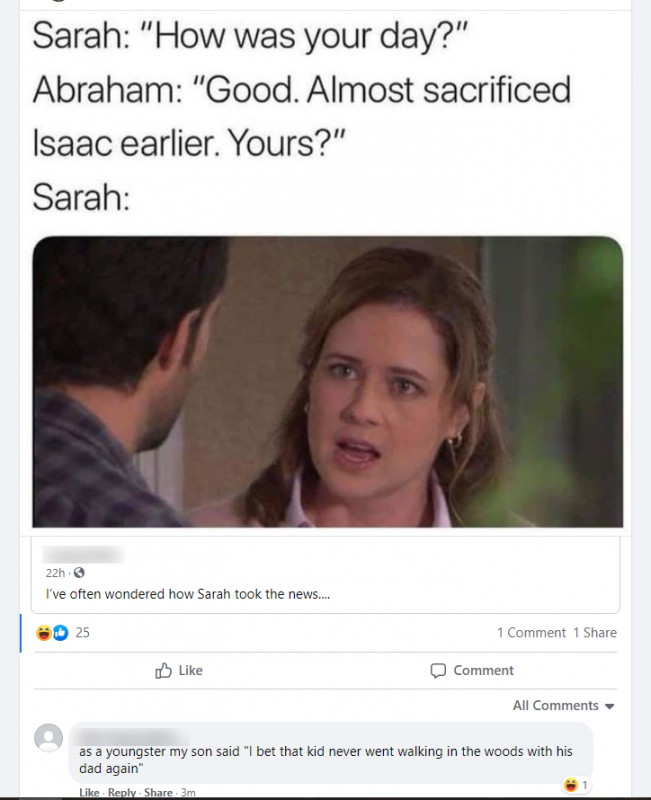
Social Media Theology

I'm scrolling through a social media group dedicated to the Bible in a Year program with Fr. Mike when I see a post that took me aback:

This seems to be a parody caption put under a Family Circus cartoon. I suspect this because:

  1. Family Circus is a fairly pro-Christian cartoon, and this particular cartoon is pointing out the circular logic and near-absurdity of the Christian idea of salvation and
  2. It seems like the font just doesn't fit the rest of the cartoon.

I recall when I expressed my own doubts how I was attacked and lambasted when, instead of accepting the offered explanations serenely, I replied the rebuttals I'd thought of long ago.

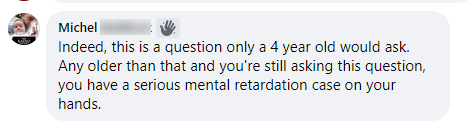
Michel, as if on cue, enters with a classic ad hominem argument.

I try to keep quiet, but I can't: "An ad hominem argument from an apologist is always effective."

Yet one person doesn't see it that way:

How to interpret this? A misunderstanding or the dawning of doubt? Probably the former. But I was curious how they would respond to this ineloquent way of explaining a weird little knot of contradiction that lies at the heart of Christianity, all complicated further by the doctrine of the trinity.

The basic idea is this: Christianity teaches that Jesus had to die in order to make humanity right with God somehow. Through the "stain of Original Sin," humans are separated from God, and to bridge this separation required a sacrifice. But only a pure and unblemished sacrifice would do the trick because God is completely holy. So God sent "his only begotten son" down to die a horrid death he didn't deserve because he lived a perfect and sinless life, thus serving as the sacrifice that makes all good with God. God did this because he loves humanity and wants humans to spend eternity with him, but the sinful nature of humans prevents this. He's perfect; we're not. He can't be around the imperfect, so there must be some way of atoning for those imperfections. (I probably didn't explain that well because there are a million different interpretations on what exactly Jesus's sacrifice accomplishes depending on the denomination of the apologist. I know for a fact that I mixed and matched several different explanations of what Jesus's sacrifice, in the eyes of believers, really does, but that's kind of the point. They can't even agree on what's going on here.)

The first problem with this comes when we consider the supposed omnipotence of God. If God is all-powerful, why not just forgive and welcome everyone back into the fold? Why all this song and dance about Jesus? What's more, if you don't believe this and accept it, it's back to square one with you: you'll remain forever separated from God, destined for the eternal firy torments of hell. (Never mind for a moment the painfully obvious question: why would a being who is even vaguely decent let alone completely benevolent like Christians teach their god is send anyone to eternal punishment for anything?)

The biggest problem comes when we mix the trinity into all this. Because God and Jesus are the same entity (as well as the Holy Spirit -- never mind how that seems to make no sense in and of itself), we can replace all those instances of "Jesus" with the more generic "God." That shows the absurdity of it clearly. God is doing the sending and is sent. God is doing the condemning and the restitution. God is sending God to die to satisfy God's demand of punishment for humanity's disobedience of God. What kind of sense does that make at all? Skip all the middle man stuff and just forgive humanity.

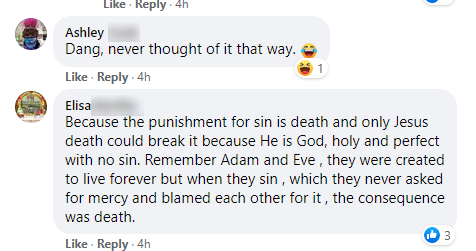
That's what the cartoon is highlighting. The poster's comment of "I've wondered about this too" as well as Ashely's admission that she "never thought of it that way" with a smiley face indicates that the circular logic breaks through to others' thinking for just a brief moment.

Others jump in quickly, though, trying to explain why Jesus had, in Christian theology, to die.

Elisa's contention is that Jesus could only "break" (not sure what that means) "the punishment for sin" by dying because "He is God, holy and perfect with no sin." Yet this doesn't get at the heart of the objection in the cartoon, which is that an omnipotent God shouldn't have to go through all this rigamarole to forgive people: if he's omnipotent, he just forgives them. End of story. This suggests that Elisa doesn't really grasp the underlying objection.

Others' explanations show the same lack of understanding:

They all turn back to the same explanation I butchered above. Sin separates us. God loves us. God wants to bridge that gap. So on and so forth.

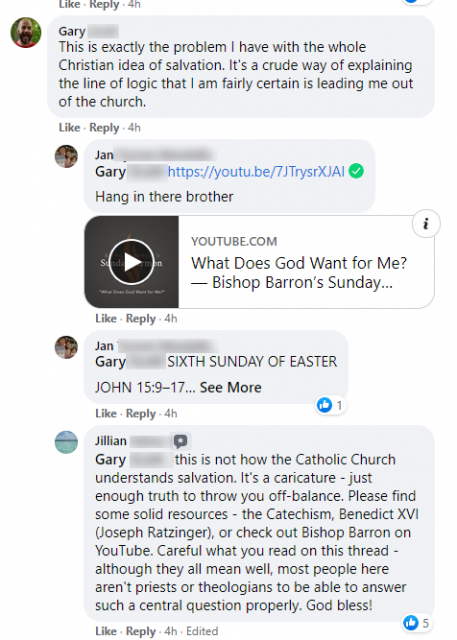
It is at this point that I jump in:

Granted, it's not "leading me out of the church." It and countless other objections have already done that. I just don't want to sound like an aggressive outsider. I want to see how they'll respond.

Bishop Barron's sermon that Jan links to just reiterates how God is love and that's why he died for us. It doesn't answer the question of why he couldn't just forgive outright.

Jullian rightly points out that "this is not how the Catholic Church understands salvation." He correctly admits that it's "a caricature." But that's the point. Caricatures by design highlight the absurdity of something to bring it in sharp relief. To make it stand out.

What's more interesting about Jullian's response is that "most people here aren't priests or theologians" who would be "able to answer such a central question properly." That raises an objection in and of itself. Why would an omnipotent god create such a convoluted system of salvation that only a specialist with years of theological study behind him (and remember that theologians don't really study God but simply study what other men have said about God) could answer?

Finally, Margaret calls a spade a spade:

Mary-Ann, the post author, quickly reassures everyone (and likely herself) of her undying faith

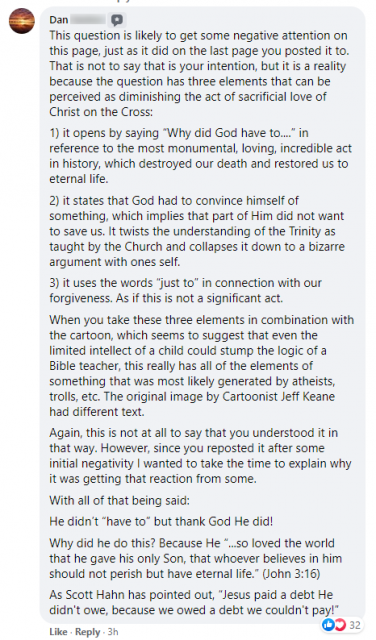
Finally, Dan tries to explain everything:

Dan's first objection is in using the formulation "Why did God have to." He didn't even answer what's behind the question: the notion is that without doing this, we can't be with God. If that's the case, and God wanted humans to be with him, then God did indeed have to do this.

Dan's second objection comes from the confusion this creates regarding the trinity: it "collapses it down to a bizarre argument with ones [sic] self." That is the point. In doing so, it highlights the absurdity of the doctrine of the trinity.

Dan's third objection is with "just to." I think that's meant to highlight the fact that, if God is omnipotent, he should be able just to forgive humans our foibles and move on. It's another reflection of the first objection, in other words.

He ends with Scott Hahn's assertion that "Jesus paid a debt He didn't owe because we owed a debt we couldn't pay." And we're right back where we started.

All this simply confirms what I've come to realize over the last couple of years: most believers don't seem to understand what's at the heart of most skeptics' objection to Christianity. Whether this is an inability to understand it because of their blind faith or an unwillingness to try because of a fear of the consequences, I don't know. Of course, there are other explanations, and it's likely the case that for most believers, it's a mix of any and all of them.

But I see these problems. And I can't unsee them.

Back to BIAY

Although I haven’t listened to a Bible in a Year podcast in over a month now, I’m still following a couple of groups on social media. Every now and then, I’ll see something that interests me: someone expresses a doubt or a worry, and I immediately begin listing the ways people will try to help. Sometimes, I make my own comment.

Today I read,

Although I had a lot of children’s bibles growing up, went to catholic school, and go to Sunday church so I know the stories of the Bible for the most part – this is my first time really “reading” the Bible all the way through with BIAY.

And honestly – I’m struggling. Every day it just seems like one depressing story after the next. Every day it’s just horrifying tales, little Joy, and lists of names. Men being awful and women’s lives being ruined. […]

I decided to use the line of reasoning that’s not entirely true at this point in time but was true some months ago:

I had similar problems. So much of the awfulness comes with God’s tacit approval or, worse, at his command. I’ve taken a break, but it’s done serious damage to my faith.

Granted, I’ve rejected faith altogether (again), but I did go through this process. I was wondering (again) how people would respond. Typically, there are a few responses to “Oh, that gory stuff in the Old Testament is troublesome.”

  • It’s for the Israelites, not for all of us.
  • Just because it’s in the Bible doesn’t mean God approves of it.
  • God in the Old Testament is slowing bringing about moral change. It’s a slow, gradual process. These are the first steps.
  • God said to do it, so it is right. Who are you to judge God?

Eric jumped right in with the tried and true “just because it’s in the Bible doesn’t mean acceptance” argument, almost word for word:

Assuming the existence of tacit approval is a dangerous move to make. It assumes that because a bad thing is recounted, it is recounted with approval, but that’s just not how biblical texts are written. I’m sorry to hear your faith is wounded, but rest assured God does not approve of immoral actions, even when He brings good out of them.

This reply always frustrates me because it misses the point. I’m not saying that the immoral behavior of various characters is troubling: I’m saying the immoral actions and commands of God are troubling. I replied:

Just look at all the awful punishments he commanded. Look at the genocides he commanded. That goes well beyond tacit approval.

His response? The classic “God said to do it, so that makes it acceptable” line. He didn’t ask me directly “Who are you to judge God,” but it was implicit:

OK so for those, did people other than God make those commands, or was it God, who after all does decide, every day, who lives and who dies? If I commanded that, or my national leader, that would be wrong, but when God commands punishment of people that are very clearly morally in the wrong, isn’t that the one time it’s OK?

It’s important to point out that according to this theory, the only thing that Islamic suicide bombers got wrong was the god. The reasoning behind what they’re doing is sound: God commands it; that makes it right.

Still, I didn’t go that line. I simply asked, “To punish by stoning?”

At this point, Eva jumped in:

God had to do a cleansing, just as he will when Jesus comes again. After all the evil in the world God still gave his son for our salvation. How much more can we ask of God? The world is lucky God is making the decision not mortal man because I as a human would have given up on humans a long time ago.

“God had to do a cleansing” sounds an awful lot like “God had to do an ethnic cleansing,” and that’s because it’s exactly what he does in the Bible. He commands the Israelites to wipe out whole nations. The Bible says it’s because they’re so immoral, but that just sounds like propaganda to me. Add to it the fact that there’s no evidence any of this immorality that keeps appearing in apologist arguments (namely, that the Canaanites burned their children alive as offerings to Ba’al). There’s simply a claim in scripture, which sounds a lot like after-the-fact justification.

Eric also replied, using another of the popular arguments: it’s a gradual movement to a more moral society:

Remember that God was leading his people gradually to an end point. The original moral framework He gave was just the 10 commandments. But when Moses came down Mt. Sinai and the people had sinned, God gave more laws—a lot more. And those extra laws are the ones that contain more age-specific laws that we rightly shake our heads at today.

Jesus himself made this exact point when he said that Moses had allowed things like divorce, it was not b/c that’s how things should be, but b/c that’s what the people were capable of at the time, but it was not always so and hence that’s not the rule now. Laws and commands for a people in 1000BC were tailored by God for them at that time. They weren’t His vision for How Society Should Work; they part of a larger plan for guidance, so they only needed to be Better Than What Came Before. Case in point: the lex talionis “an eye for an eye”. This sounds terrible compared to today, but the comparison we should make is with what proceeded it. “An eye for an eye” was *limiting* revenge to something approaching proportionality. And so on with other decrees of the law of Moses. You absolutely have to judge them in comparison to the societies Israel was surrounded by.

I’m sorry, but stoning someone is not a moral step up from anything. I can’t think of anything that would rank below that. Still, it shows how people fall back on familiar tropes to justify the unjustifiable because the alternative (rejecting the Bible, even in part) is utterly unthinkable.

The End

Every now and then, I learn something so profound that it marks a significant change in my thinking. The last two days have constituted such a change. I listened to Josh Clark's podcast The End of the World, and I can't remember anything having a more profound effect on me. Not the realization that I doubted the existence of God; not the change I made from being very left-leaning to being right-leaning and the return to the left I seem to be experiencing now; not the knowledge that I was going to be a parent.

The podcast deals with how the world might end, and by that it means how humanity might end. The world itself might continue on but humanity might not. And the podcast begins with an odd question: given the size of the universe, the number of galaxies it contains, and the number of stars in those galaxies, the universe should be absolutely teeming with life. We're talking about billions upon billions of galaxies each with billions of stars. Even if the odds of developing intelligent life were a 1-in-100-billion, there should be almost countless examples in the universe. So why have we found no sign of them? That's the Fermi paradox, and it is the material for the first couple of episodes. The fact that we see no signs of intelligent life anywhere has one of two explanations:

  1. It exists, and we simply haven't found it.
  2. It doesn't exist currently, and we alone constitute all the intelligent life in the universe.

Option one is the less interesting of the two, but Clark convincingly illustrates that it's unlikely. It's the second option that is terrifying, because it breaks into two options itself:

  1. There never was any other intelligent life -- we're it.
  2. There was once intelligent life somewhere in the universe, but it no longer exists.

Thinking about option two leads us to question what could have happened to them? Presumably, they advanced at least as far as we have, and presumably, they would have advanced further if they could, spreading out into the cosmos and colonizing their solar system, their galaxy, significant portions of the universe itself. That they didn't suggests that they never existed (back to option one) or that they met an insurmountable obstacle that resulted in the end of their existence. This is known as the Great Filter -- in this case, the thing that prevented a given alien species from colonizing beyond its original planet.

What does all of this have to do with the end of the world? Simple: due to the technologies we have developed now, we are almost certainly about to pass through our own Great Filter. There are so many threats to the continued existence of humanity that it seems inevitable that one of them will catch us by the ankle, so to speak, and drag us back down to primordial sludge (or nothingness). Clark covers several of them, including artificial intelligence, biotechnology, and physics experiments, but in my mind (and in Clark's as well, I believe), the greatest risk comes from artificial intelligence, though biotech is not far behind.

The risk from artificial intelligence is not a Terminator- or Matrix-style war between robots and humans. It's something much more subtle. Imagine, for example, that a paperclip factory hires a programmer to create a program to maximize paperclip production. The programmer creates algorithms that have the freedom to make their own decisions about how to go about the productivity improvements. Its goal is simple: create more paperclips. Should it attain super-intelligence, it could wreck the world in its effort to make more paperclips. It takes over other computers in order to increase its computational capacity to make more paperclips. It develops machines that make machines that make machines that make machines to improve paperclip production. Eventually, it learns how to create nanotechnology that can actually manipulate things at an atomic level. It can then literally begin the process of turning everything into paperclips, manipulating atoms to transform everything into aluminum to make paperclips -- everything, including us. It then launches probes into space and eventually turns the whole universe into paperclips.

It's hyperbolic and a little silly, but it gets at the heart of the concern: once AI achieves super-intelligence, it will be to us as Einstein is to an earthworm. There are no guarantees that it will have any concern with us at all. After all, could we expect Einstein to spend his tremendous intellect and life worrying about the happiness of every earthworm? So we have to figure out a way to program these things in a way that they have morals compatible with ours.

The biotech and physics experiment risks are equally fascinating, but it was about this point in the podcast (this would have been episode five out of eight) that I began thinking of how any one of these might be our Great Filter -- the thing that we run up against which destroys us -- in terms that Clark never mentioned: the impact of religion on all of this. Most believers would not take this seriously at all because they already are convinced that there's intelligent life out there, and it's responsible for our existence and has a plan for us. That plan doesn't include us destroying ourselves, so they would be unlikely to take this situation seriously. "Eradicate ourselves from the earth? Come on -- Jesus will return before that could ever happen." God would never let the pinnacle of his creation destroy itself entirely. This is in part why so many Christians don't take global warming seriously (and after listening to this series, I'm of the mind that global warming, while a threat, is at least not an existential threat to all humanity).

This itself could be the Great Filter: time after time, intelligent life has arisen that evolves tremendous intelligence at the same time it holds radically superstitious ideas. At the point when the species has developed the technology capable of destroying itself, it harbors the superstitious lack of wisdom to know how to handle those technologies, and they destroy themselves.

Much of Clark's podcast was on the foundation of Nick Bostrom's work. He's been thinking along these lines for a long time:

Fear and Trembling

Today’s reading included Deuteronomy 28, which is about the blessings and curses that God offered (for lack of a better term) the Israelites. I guess you could say they constituted the terms of the contract. It begins,

If you will only obey the Lord your God, by diligently observing all his commandments that I am commanding you today, the Lord your God will set you high above all the nations of the earth; all these blessings shall come upon you and overtake you, if you obey the Lord your God

Right away, I noticed how this seems to be such conditional acceptance. Fr. Mike argued that this was simply the same as parents do (laying out consequences for actions), but I beg to differ. The consequences are quite harsh, including this gem from verses 54 and 55:

Even the most refined and gentle of men among you will begrudge food to his own brother, to the wife whom he embraces, and to the last of his remaining children, giving to none of them any of the flesh of his children whom he is eating, because nothing else remains to him, in the desperate straits to which the enemy siege will reduce you in all your towns

It’s not the first time God has threatened his people with conditions that induce them to cannibalism, but this one notches it up a level somehow. It’s not that they’ll eat each others’ children; they’ll eat their own children and not even share! That sounds like I’m being flippant, and I guess I am — I don’t know how else to react to this but mock the brutal stupidity of it. A god that threatens to do this is somehow good?

Verse 63 states that not only will God do this, he’ll enjoy doing it:

And just as the Lord took delight in making you prosperous and numerous, so the Lord will take delight in bringing you to ruin and destruction; you shall be plucked off the land that you are entering to possess.

What does Fr. Mike say about these troubling passages? Not a single word. Why? There’s nothing he can say. There’s no way to excuse it. (I sound like a broken record, but I want to keep an account of all these issues that arise, and this silly blog is the easiest way to do it.)

Finally, though a little earlier (verses 58 and 59) there’s this gem:

If you do not diligently observe all the words of this law that are written in this book, fearing this glorious and awesome name, the Lord your God, then the Lord will overwhelm both you and your offspring with severe and lasting afflictions and grievous and lasting maladies.

I don’t get this desire to be feared and worshiped. It feels a little like what a despot would want. It feels like it could come from Kim Jong-Un more than an omnipotent, omniscient being.


The Inevitable Move

A few days ago, Fr. Mike, on day 50 of his Bible in a Year podcast read Exodus 37 and 38 as well as Leviticus 26. The passages in Exodus all had to do with sacrificial offerings, but the chapter from Leviticus was, in many ways, the most troubling passage in the whole Bible so far. It is, in short, a list of the punishments the god of Old Testament will mete out on Israel if they abandon the proper worship of him, but it presents such a conditional love, which bears all the hallmarks of an abusive relationship that I don't see how someone can read these chapters and not absolutely cringe.

It begins with a promise of what will happen if they do remain faithful:

“If you walk in my statutes and observe my commandments and do them, then I will give you your rains in their season, and the land shall yield its increase, and the trees of the field shall yield their fruit. And your threshing shall last to the time of vintage, and the vintage shall last to the time for sowing; and you shall eat your bread to the full, and dwell in your land securely. And I will give peace in the land, and you shall lie down, and none shall make you afraid; and I will remove evil beasts from the land, and the sword shall not go through your land. And you shall chase your enemies, and they shall fall before you by the sword. (Leviticus 26.3-7)

One might question whether this god would be upset to discover that people were worshiping him because they want all the benefits, but this supposedly omniscient being should know that and perhaps work that into the passage. "You must honestly love me and worship me." Something like that. Still, that's a trivial point compared to what happens later in the chapter.

By verse 14 it turns quite troubling:

“But if you will not hearken to me, and will not do all these commandments, if you spurn my statutes, and if your soul abhors my ordinances, so that you will not do all my commandments, but break my covenant, I will do this to you: I will appoint over you sudden terror, consumption and fever that waste the eyes and cause life to pine away. (Leviticus 26.14-16)

Fr. Mike, in his commentary, explains, "There are consequences for actions. [...] He hands them over because he loves them." If this doesn't call Israel back to their god, Fr. Mike explains, then their god will let more stuff happen to them until they do turn back to him. "The whole point of this is not punishment," Fr. Mike assures us. "The whole point of this is rescue." This is the first problematic idea, and it hits at one of the biggest issues I've had with Christianity for some time now. "Rescue" suggests the following:

  • Force A
  • affects entity X
  • and entity Y somehow stops force A by
    • getting rid of force A,
    • removing entity X from the effects of force A, or
    • mitigating the effects of force A.

Within all of this is the idea that force A is separate from entity X doing the rescuing. If I'm beating my son and then stop beating him, I'm not rescuing him. If I'm holding my daughter's head underwater and then stop holding her head underwater, I'm not rescuing her. It's only a rescue if someone or something else is doing it, and I somehow stop it.

The problem with Christianity is simple: this god is the one doing the beating; this god is the one holding heads underwater. How so? Simple: Christians frame all this "rescue" as a rescue from the consequences of sin. But the god of Christianity defined sin. He designed the consequences of sin (and everything else) by creating the world as he did. He's ultimately the victimizer and the savior. That's not rescuing. That's a sick relationship.

Putting that aside, though, it's disturbing to look at the consequences listed in Leviticus, through verse 45:

  • I will bring more plagues upon you, sevenfold as many as your sins.
    This is not a consequence. This is God responding to one's actions, and with a sort of severity that might even be rare in the mafia.
  • I will let loose the wild beasts among you, which shall rob you of your children, and destroy your cattle, and make you few in number, so that your ways shall become desolate.
    Who is really paying the price if the children are getting devoured by wild beasts? And what kind of relationship does this inspire? We're just cowering in fear of what this being might do to us.
  • I will walk contrary to you in fury, and chastise you myself sevenfold for your sins. You shall eat the flesh of your sons, and you shall eat the flesh of your daughters.
    What!? God here is saying he will, in fury, bring such desolation that the Israelites will turn to cannibalism. Will he be like with Pharaoh in Egypt? Remember: several times Pharaoh agreed to let the Israelites go, but according to Exodus, "God hardened his heart" so that he would change his mind. Is God going to harden the hearts of the Israelites to make them turn to cannibalism, or will things just get so bad that they won't feel they have any choice? (And when would a parent ever really feel that way?)
  • And I will devastate the land, so that your enemies who settle in it shall be astonished at it.
    The implication earlier is that Israel's enemies will do all this destroying, but here it seems to indicate that God doing it. After all, the enemies come and are astonished, presumably at the brutality which has swept through the land.
  • And as for those of you that are left, I will send faintness into their hearts in the lands of their enemies; the sound of a driven leaf shall put them to flight, and they shall flee as one flees from the sword, and they shall fall when none pursues.
    Again, God does this, not the enemies. He seems to be suggesting that he'll make them such cowards that they'll be eradicated.

How does Fr. Mike explain all this? He makes the move I've been waiting for him to make the whole time, really the only move he can make: The fact that it doesn't seem right is our fault. "We just need to trust God and understand that there is an answer to all these questions," he argues:

This is the discipline of a father, and this is so important to us. You know, when we approach scripture, and we don't trust God, we see these things and go, "Wow, that's crazy. I'm done with this. Day 50, that's it. I'm out." But when we approach the word of God, and we have that spirit of trust where it's like, "Okay, if I don't understand this, it must be me that doesn't understand this."

If I begin to be suspicious of God, and I say, "Wait, let me pause. God is a good dad. And while I don't understand what he's doing here or not doing there, I have to look at him, look at life, look at myself through the lens of 'Okay, God is a good dad.' So why would a good Dad allow these punishments to come upon those who are disobedient?" Well, because, like any good dad, like any good parent, I want more for you than just your comfort. I want more for you than for you to just go about your life and do whatever it is you want to do. I want the best for you.

So this is God, who is the good dad. And he says, "I want the absolute best for my children, so if they refuse to walk in my ways and walk contrary to me, here's the consequences. Because I want to bring them back to my heart."

But how do we know that this god is a "good dad," as Fr. Mike suggests? It hits at the very heart of the question of theism: how do we know anything about this supposed being? All Christians claim to know about him comes from three sources:

  1. Personal experiences with what we call the divine.
  2. What the church teaches about this being (and here I have in mind the Catholic idea that the Bible and the church are equal authorities).
  3. What the Bible says about this thing we call the divine.

Personal experiences are just that: personal. If you have a warm feeling in your heart, that's all you know. To attribute it to the Holy Spirit or anything else is interpretation and therefore highly subjective. In this sense, the believer is putting faith in herself and her interpretation of her inner experience. The other two sources, though, inform that faith.

What the church says about its god is just what other people say about, and so ultimately the believer is putting her faith in these other people.

The Bible is just a book. Nothing more, nothing less. If believers purport it to come from the hand of their god, there should be evidence of some sort in the book itself. The safest way to approach it, then, is to look at the Bible and ask, "What sort of god is presented in its pages?" From this reading in Leviticus, it seems a stretch to say that this being is in any sense "good." He's vindictive, envious, and petty at best and ghastly, wretched, and unspeakably cruel at worst.

So where does Fr. Mike get this "good dad" stuff? Simple: it's his working preconception. He's making assumptions about the Bible before he reads the Bible, and he's suggesting believers do the same. And to be fair, what else are they going to do? If they're committed to his idea that their god is good, they have to approach it with that assumption, and no one really wants to worship an evil god. In addition, if they were raised in the church, they were taught that their god is a good and loving god long before they can read the Bible for themselves and see all these terrors.

It is here that the true horror of the situation enters, for it is here that believers being to look like spouses in an abusive relationship. Take what Fr. Mike said about his god and reframe it: imagine that Fr. Mike is an abused wife and his god is the husband:

If I begin to be suspicious of my husband, and I say, "Wait, let me pause. My husband is a good husband. And while I don't understand what he's doing here [with all the unspeakable abuse mentioned earlier] or not doing there, I have to look at him, look at life, look at myself through the lens of 'Okay, my husband is a good a good husband.' So why would a good husband allow these punishments me? It must be because I am disobedient." Well, because, like any good husband, he wants more for me than just my comfort. He wants more for me than for me to just go about my life and do whatever it is I want to do. He wants the best for me.

That is classic victim-blaming. Worse: it's victim self-blame. "My husband beats me because I deserve it. It's for a greater good, and if I don't understand that, it's just because I'm not as smart as he is."

If any of our friends spoke this way, we would encourage her to go to a shelter immediately with her children. But Christians simply stay in this relationship. They believe they deserve it because of Original Sin and their own short-comings. How many times have I heard Christians talk about how wretched they are? "Amazing grace, that saved a wretch like me."

Most Christians would respond, I think, by saying, "That's the Old Covenant. Look at how beautiful the New Covenant is! That's where I draw my faith. Jesus saved us from all of that!" Yet the response to this is so simple that even a child can make it -- and has. "But that's the same god!" These are not different entities. The Christian doctrine of the trinity paints them into a corner, and they fail to see that it's happened. In doing so, it makes the relationship even more toxic.

I, for one, got out of that relationship, and I feel so much better for it.

Forever Throughout Your Generations

Today, Fr. Mike went through Exodus 32 and Leviticus 23. The passage in Exodus deals with the golden calf that the Israelites started worshiping. Fr. Mike also pointed out that this is where the Levitical priesthood is born, in verses 25-29:

And when Moses saw that the people had broken loose (for Aaron had let them break loose, to their shame among their enemies), then Moses stood in the gate of the camp, and said, “Who is on the Lord’s side? Come to me.” And all the sons of Levi gathered themselves together to him. And he said to them, “Thus says the Lord God of Israel, ‘Put every man his sword on his side, and go to and fro from gate to gate throughout the camp, and slay every man his brother, and every man his companion, and every man his neighbor.’” And the sons of Levi did according to the word of Moses; and there fell of the people that day about three thousand men. And Moses said, “Today you have ordained yourselves[a] for the service of the Lord, each one at the cost of his son and of his brother, that he may bestow a blessing upon you this day.”

Adoration of the Golden Calf, by Nicolas Poussin

So what made the tribe of Levi so special that priests could come only from them? They slaughtered a bunch of me who were stupid enough to worship a damn cow that they themselves had made. I mean, it's no secret where the cow came from. The chapter begins with a command from the people: "When the people saw that Moses delayed to come down from the mountain, the people gathered themselves together to Aaron, and said to him, 'Up, make us gods, who shall go before us; as for this Moses, the man who brought us up out of the land of Egypt, we do not know what has become of him.'" These idiots see the idol being made and then turn right around and credit it with their deliverance from Egypt. They're simple people at best. They'll literally worship just about anything. God should have had pity on their stupidity, but instead, he had Moses kill a bunch of them.

At first, God wants to kill them all, but Moses talks him down from that ledge:

But Moses besought the Lord his God, and said, “O Lord, why does thy wrath burn hot against thy people, whom thou hast brought forth out of the land of Egypt with great power and with a mighty hand? Why should the Egyptians say, ‘With evil intent did he bring them forth, to slay them in the mountains, and to consume them from the face of the earth’? Turn from thy fierce wrath, and repent of this evil against thy people. Remember Abraham, Isaac, and Israel, thy servants, to whom thou didst swear by thine own self, and didst say to them, ‘I will multiply your descendants as the stars of heaven, and all this land that I have promised I will give to your descendants, and they shall inherit it for ever.’” And the Lord repented of the evil which he thought to do to his people.

It's amusing that the way Moses talks God out of killing them is by appealing to God's pride. "I mean, look -- you're going to seem foolish if you deliver all these people from Egypt and then just kill them." Strangely enough, though God never changes according to the Bible and never does evil (also according to the Bible), he "repented of the evil which he thought to do to his people."

Now how does Fr. Mike deal with these difficulties? Simple -- he doesn't. He talks about how we like to make God into an idol that we can control. We put him in our pocket and then take him out when times are tough. That's a fair enough assessment, I think, but it doesn't really deal with the weirdness of the passages he read for us today.

The other passage today was Leviticus 23, which deals with the feast days God wants people to celebrate. "These are the appointed festivals of the Lord, the holy convocations, which you shall celebrate at the time appointed for them" (verse 4). Obviously, Christmas and Easter aren't in there, but a whole bunch of feasts that I grew up celebrating are, and I grew up celebrating them for a very simple reason: the Bible says to do so, and nowhere in the New Testament does it say to stop celebrating them.

Indeed, the passages requiring them are quite specific that these are ordained for all time:

  • Verse 14 is about the offering of First Fruits: "You shall eat no bread or parched grain or fresh ears until that very day, until you have brought the offering of your God: it is a statute forever throughout your generations in all your settlements."
  • Verse 21 is about the Feast of Weeks (Pentecost): "This is a statute forever in all your settlements throughout your generations."
  • Verse 31 is about Atonement: "You shall do no work: it is a statute forever throughout your generations in all your settlements."
  • Verse 41 is about the Feast of Tabernacles (Booths): "You shall keep it as a festival to the Lord seven days in the year; you shall keep it in the seventh month as a statute forever throughout your generations."

Recall Zachariah 14:16 from a few days ago: "Then every one that survives of all the nations that have come against Jerusalem shall go up year after year to worship the King, the Lord of hosts, and to keep the feast of booths." It seems pretty clear that God is ordaining these celebrations for all times and all people. Why don't most Christians celebrate them anymore?

Fr. Mike, of course, did not deal with that. And I can't really blame him: this is "The Bible in a Year" podcast, not "The Bible in a Year for Skeptics" podcast. But it does illustrate one tendency I've noticed about believers. Those tricky parts, those troubling parts -- they don't see them. Even when they're there in front of them, they don't see them.

"God is mysterious," and it's all taken care of.