Matching Tracksuits

fun in fours

reading

Spring Tuesday Afternoon

Everything is finally waking up. Almost all of the raspberry canes now have leaves on them, and buds are poking out of our single blackberry cane. The irises are resurrecting themselves, and the grass has turned a dark green.

VIV_4354

"It's about time!" is just about what all of us would say. I'm not sure I recall being so glad to see winter go in years. The winter months in South Carolina are usually so very mild that I feel we really haven't had a winter at all, but this year, there's no doubting it: we had winter. And it hung on for a while. And kept coming back even after we thought it was gone.

VIV_4355

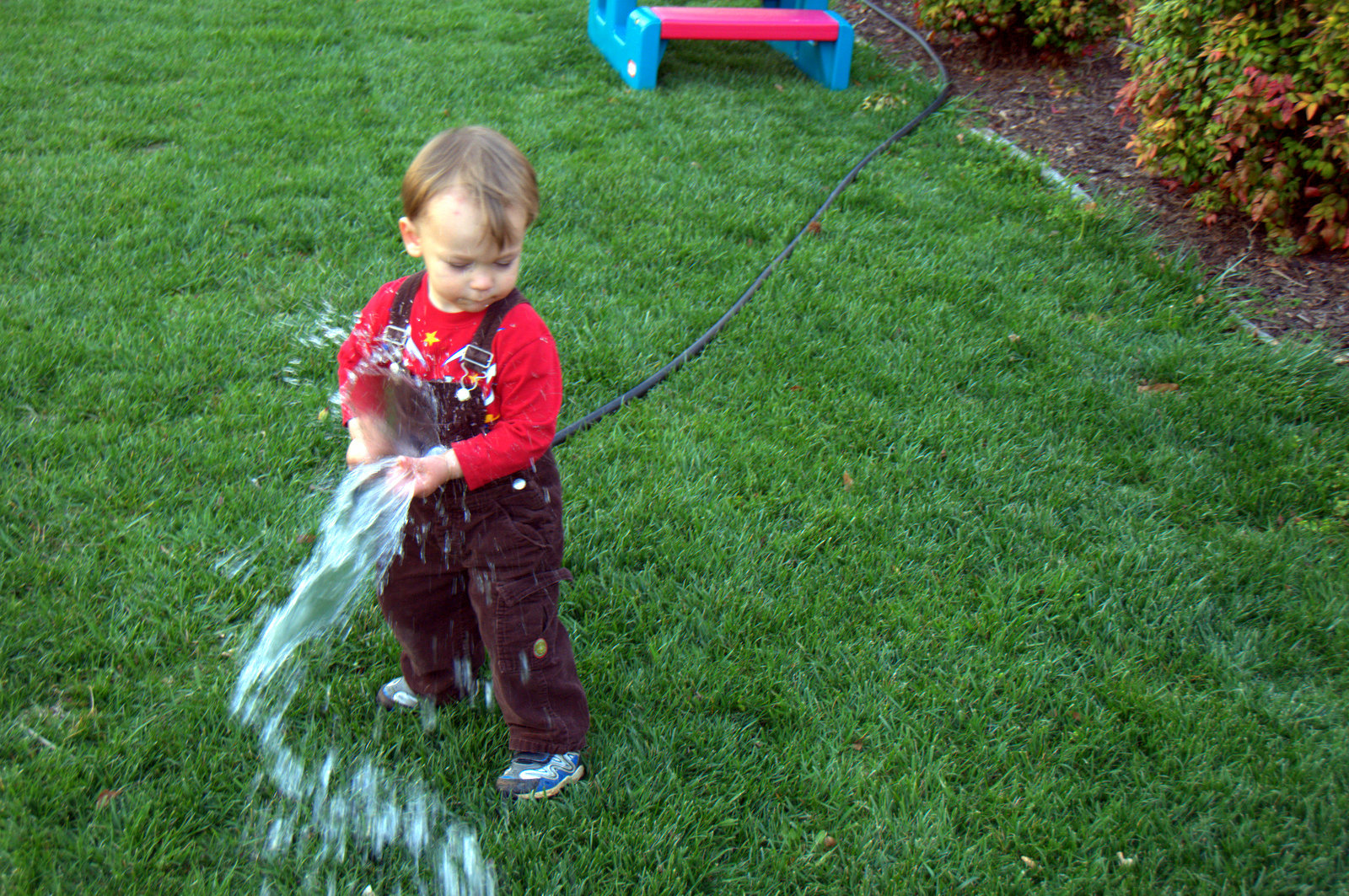
With the arrival of spring, though, come new chores, chief among them watering our new blueberry bushes, six here, six there.

VIV_4363

In typical fashion, the Boy watches and then quickly imitates. It's as if he's constantly thinking, "Oh, so that's how you do it. I'll have to give that a try." He remembers details from previous days, little touches that I'm surprised an almost-two-year-old sees.
VIV_4368

Some of it has been simply funny. A few times I gave him his bottle when he was younger, I held it as if I were a sommelier at some fine restaurant; he soon began doing his best imitation just before lifting the bottle to his mouth.

VIV_4376

Yesterday, he watched me try to jump-start K's car. "Try" only because the battery was too dead and my small, thin cables didn't have the capacity to deliver that amount of power -- too much lost in route due to the inefficiencies inherent in current.

VIV_4422

And so when he finds the jumper cables sitting out, he does the logical thing: he tries to attach them to his toy fire truck.

VIV_4378

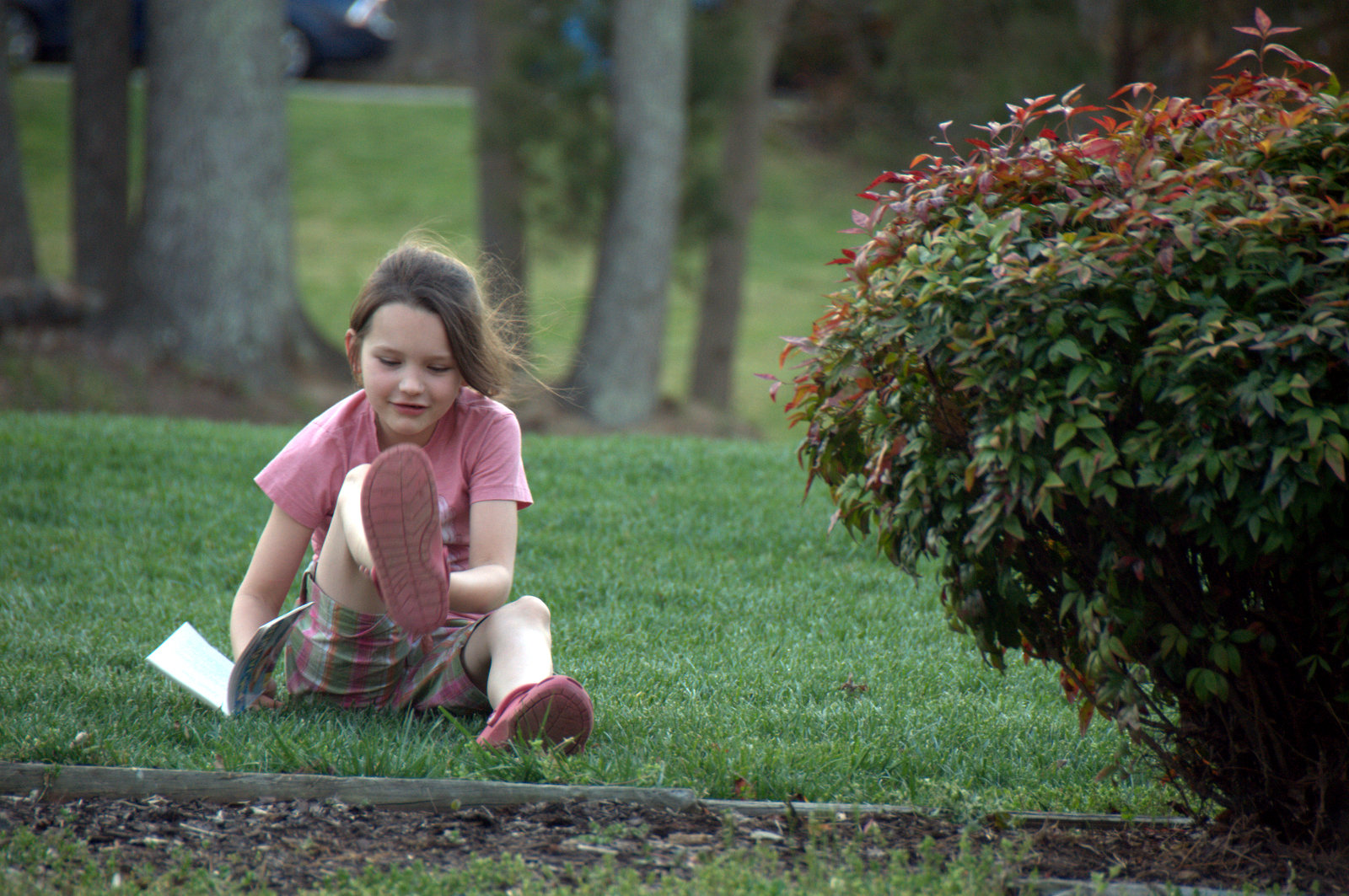
The Girl has her own concerns, though, like a budding reading obsession, that leads her to stumble and fall as she walks and reads. Or was that just the dramatic, theatrical part of her personality, pretending?

"She did that on purpose," K laughs as I snap pictures. Still, the end result is amusing, even if faked.
VIV_4390

Later, in the hammock, she reads aloud to me. She stumbles over a few words, proper names mainly, like Ester, but by and large, I just sit and listen.

VIV_4439

Words like "gracefully" gracefully fall from her mouth as if she's merely telling the story herself, from memory, with the inflections and drama of a professional storyteller. Well, almost.

VIV_4455

Exposure

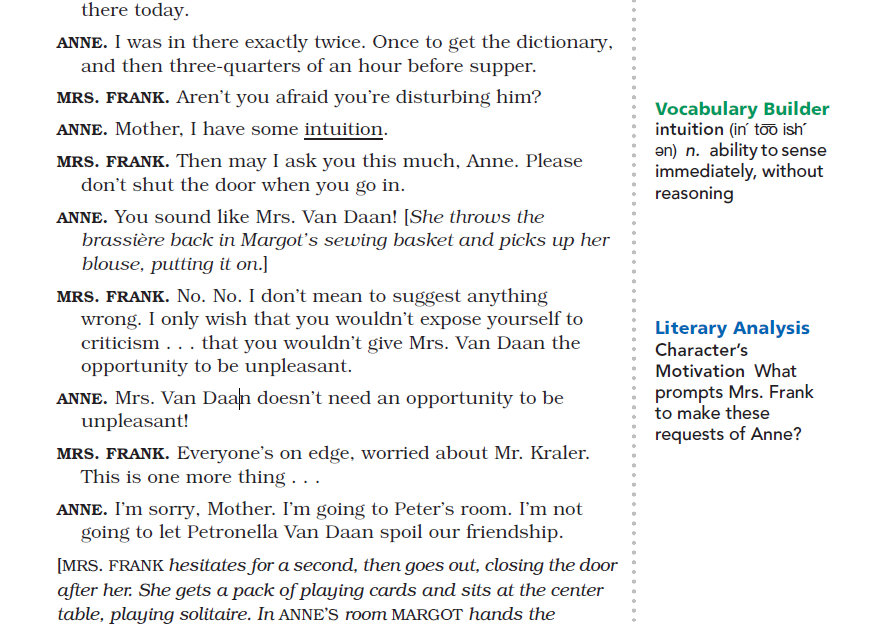
We’re in class, reading the play The Diary of Anne Frank, acting out some sections, comparing others to the original diary. Today, we’re working to analyze the text to determine places where one character implied something and/or another character inferred something. In the story, Anne and Peter’s romance is just beginning, and Anne is getting reading for an evening visit with Peter as she talks with her mother and sister in her room:

1-Fullscreen capture 12142013 80034 AM

In groups, after we act it out, students analyze the text together to find specific lines (“You have to be able to point to it in the text,” I explained) that clearly show either an implication or inference.

As we’re debriefing as a class, a student points out one of the key lines I was hoping students would see: “Then may I ask you this much, Anne. Please don’t shut the door when you go in.” Mrs. Frank is of course not implying that she thinks that Peter and Anne will do anything untoward; she’s merely worried about giving Mrs. van Daan (in reality, her name was van Pels) something else to complain about.

The student didn’t see it that way, though.

“What is she implying?” I ask.

“That Anne will expose herself to Peter!” he said proudly, with utmost sincerity and seriousness.

We all laughed, but my own belly laugh got them laughing even harder.

First Book Fair

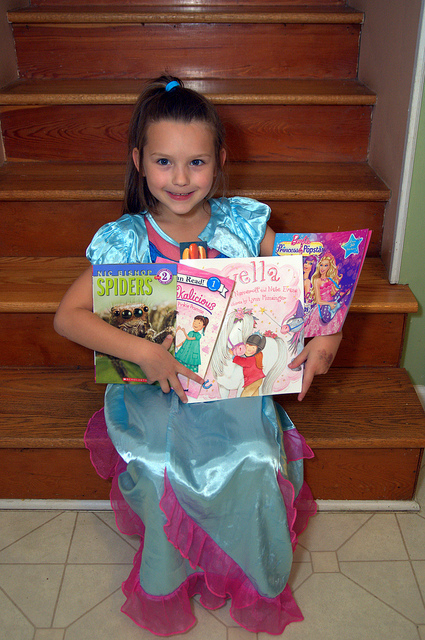
There are few things, I think, as joyful for a lover of books to attend her first book fair at school.

DSC_6011

Mark Up

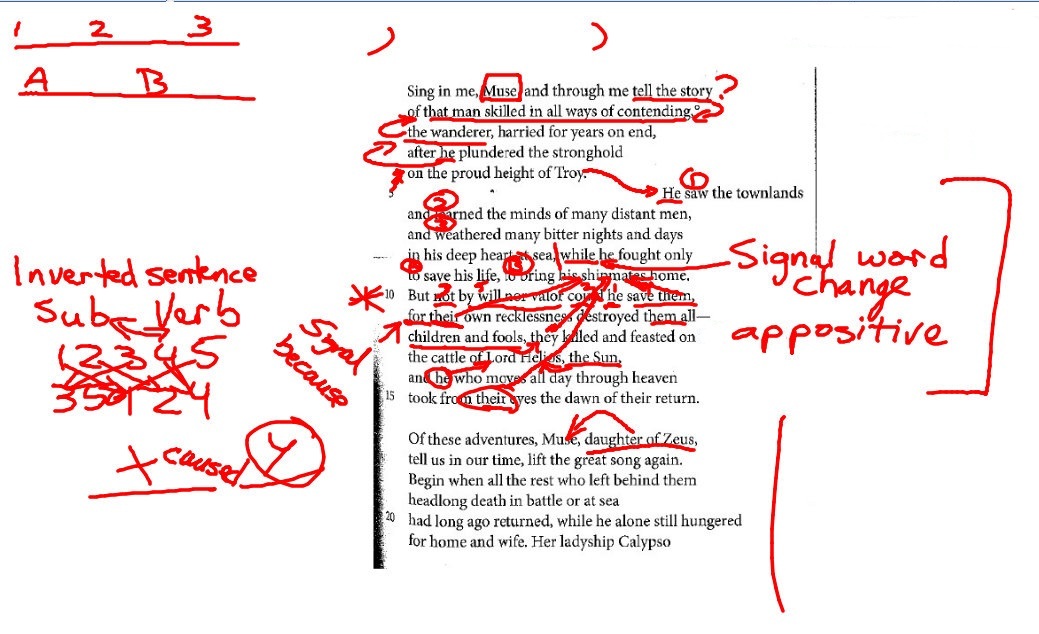
One class I teach -- though I'm fortunate to teach two sections of this course -- has begun one of my favorite pieces of literature, the Odyssey. Highly figurative language with a tendency toward oddly inverted sentences, it's a struggle for them at first, though. We take the time during the first reading to pick apart the opening lines to see how Homer works.

The first famous lines include it all (in this particular translation). There's inverted sentences like this: "But not by will nor valor could he save them." We work through the sentence, determining the subject, the verb, and the object, writing it out in normal order: "He could not save them by will or valor." Numbering the words, students realize just how inverted the sentence is.

Notes from the board

"Lord Helios [...] took from their eyes the dawn of their return" the stanza ends, and while many of us might find that easily enough understood, the average eighth grader doesn't have a lot of experience with figurative language.

As we work, there's a bit moaning, a bit of boredom, especially among the boys. Who wants to put this much effort into reading, and a poem at that? That's alright. I know that when the blood starts flowing -- Cyclops starts crunching bones and Scylla begins picking off men -- they'll all come around.

Our Own Trisha

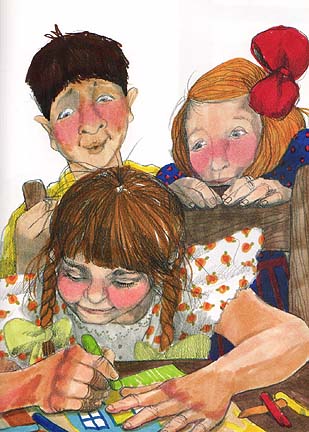
Every year, as we begin a unit on the Gary Paulsen novel Nightjohn, I read Patricia Polacco's Thank You, Mr. Falker. The story of a young dyslexic girl who was suffering the taunts of peers and the seeming neglect of teachers, the book emphasizes the life-changing nature of literacy. Trisha, the protagonist, spends the first four grades of school hiding her inability to read, feeling dumb for not being able to keep up with peers, and taking solace in her one skill, her exceptional artistic ability. It's such a touching story that even a room of rowdy eighth-graders ends up sitting in silence, visibly moved. Every now and then, a girl -- always a girl, for a boy will never show such a "vulnerability" -- sniffles in the back or wipes her eye occasionally as the story nears its conclusion.

"We have Trishas in this room, guaranteed," I tell the class this afternoon. "Someone here has felt stupid about something, been taunted for something out of her control, taken refuge in solitude and some seemingly non-academic talent that doesn't fit today's educational mold."

"We've probably all experienced it," says a boy who has never struck me as being particularly attuned to the pains and sufferings of others. I nod solemnly in agreement. And I think back to the quiet girl a couple of years ago who, leaving the classroom after that particular lesson, murmured, "I have a lot in common with Trisha."

Double Duty

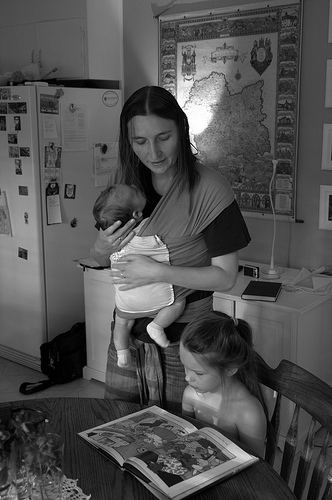
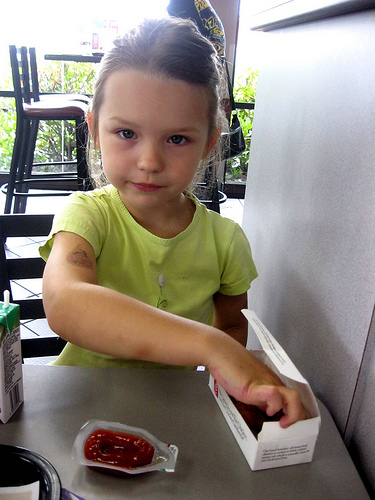
“Can you read to me?” is a common refrain.

DSC_0688

With two now, that means doubling up sometimes.

Greater Expectations

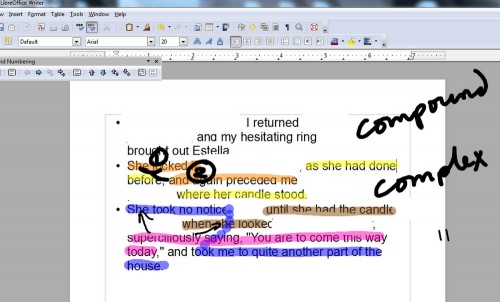
It’s the end of the year, which means the English I students are tackling Great Expectations, having just finished a brief overview/review of clauses and sentence types. “To understand Dickens,” I explained a couple of weeks ago, “you have to break apart some of his incredibly complex sentences into manageable chunks.” So we practice: every day, students entering class are greeted by a few sentences of from the previous evening’s readings. The bell-ringer, starter, whatever you want to call it:

At the appointed time I returned to Miss Havisham’s, and my hesitating ring at the gate brought out Estella. She locked it after admitting me, as she had done before, and again preceded me into the dark passage where her candle stood. She took no notice of me until she had the candle in her hand, when she looked over her shoulder, superciliously saying, “You are to come this way today,” and took me to quite another part of the house.

Students cross out unnecessary phrases — prepositional, gerund, participial — and try to find the gold: a single subordinate clause. “If you find a subordinate clause,” I explain, “you know it’s either a complex or compound-complex sentence; if you don’t, you know it’s a simple or compound sentence.”

The results are improving daily.

Prize

Read sixty books and you get a free meal at Chick-Fil-A.

Nagroda

Tour Guide

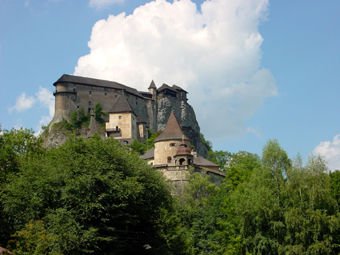
Oravski Castle, SlovakiaWhen I start a favorite book with a class, I recall the weeks I was a tour guide for my folks and best friend from high school, all of whom flew to Poland for K’s and my wedding.

I knew, for instance, as we rounded the bend and the Oravski castle (where Nosferatu was filmed; watch from 20:00-22:00 and 25:35-27:00 for the castle’s main scenes) came into view that everyone’s jaw would drop. Perched on the top of a rocky hill, the castle tends to have that effect on people.

Later, in Krakow, I knew what the reaction would be as we entered the Basilica of St. Mary on the market square. The high Gothic walls draw all gazes upward, and all mouths fall open.

So, too, with books. As we approach the shocking moments, the truly moving scenes, I anticipate students’ reactions. When Samneric tell Ralph that Roger has “sharpened a stick at both ends,” students ask, “Does that mean what I think that means?” When they meet Anne Frank in the pages of her diary, the knowledge of her fate shakes them.

Yet I’ve never seen a student react so emotionally to a novel as I did recently, as we read Nightjohn. It’s the story of a young slave girl who surreptitiously learns to read with from John, a slave who escaped north but returned to lead other slaves to literacy. There are some brutal depictions of violence against slaves, including the story of Alice, young girl who is whipped and then attempts escape. The pursuing slave owner finds her and lets his dogs attack. She survives, only barely.

“My heart hurts,” said a young African American girl who sits toward the back of the room. By the time the bell rang, a few tears were rolling. As she was leaving, I spoke to her, a little concerned.

“Are you going to be alright?”

“No,” she cried. She walked out of the class and completely broke down. As she sobbed, friends — who hadn’t been in class with her — crowded around her compassionately.

It was bittersweet, in the truest sense of the word. That someone was that moved by a book was both a source of hope and empathy.

Literacy, On the Fly

We began a new unit on Nightjohn and literacy in the English Studies class today. Just as the students were starting the kick-off, which was to answer the essential question, “How does literacy change lives?”, I had remembered William Meredith’s “The Illiterate.” It’s always been one of my favorites, a sonnet that takes all the rules about sonnets and bends them slightly. Cursing (internally only), I was frustrated that I hadn’t thought of it earlier. It was one of those moments where the teaching-as-an-art kicked in. I thought about it for a moment, Googled the title, and, finding it available online, decided to improvise.

I thought I’d try a technique I’d learned at the South Carolina Middle School conference at Myrtle Beach last year, but not having printed copies, I had to improvise.

I projected the poem on the whiteboard and read it aloud to the students.

The Illiterate

By William Meredith

Touching your goodness, I am like a man
Who turns a letter over in his hand
And you might think that this was because the hand
Was unfamiliar but, truth is, the man
Has never had a letter from anyone;
And now he is both afraid of what it means
And ashamed because he has no other means
To find out what it says than to ask someone.

His uncle could have left the farm to him,
Or his parents died before he sent them word,
Or the dark girl changed and want him for beloved.
Afraid and letter-proud, he keeps it with him.
What would you call his feeling for the words
that keep him rich and orphaned and beloved?

“Turn to a partner,” I said when I finished, “and select the five to eight most important words in the poem.” As they finished up, we went though the poem line by line, and I circled important words students called out from behind me. In the end, with a few suggestions from me, it looked something like this:

Touching your goodness, I am like a man
Who turns a letter over in his hand
And you might think that this was because the hand
Was unfamiliar but, truth is, the man
Has never had a letter from anyone;
And now he is both afraid of what it means
And ashamed because he has no other means
To find out what it says than to ask someone.

His uncle could have left the farm to him,
Or his parents died before he sent them word,
Or the dark girl changed and want him for beloved.
Afraid and letter-proud, he keeps it with him.
What would you call his feeling for the words
that keep him rich and orphaned and beloved?

“That’s more than five to eight words,” one student pointed out.

“True, but this was what I was aiming for in the long run, so it worked out well.”

I read the poem again, and then we talked about its meaning based on the highlighted words. They quickly saw that the letter contains three options: riches, sadness, and love. We jumped to the last line and reread it.

“Turn back to your partner and come up with three words that might describe his “feeling for the words that keep him rich and orphaned and beloved.” The responses were varied, as I’d hoped:

  • concerned
  • worried
  • mysterious
  • curious

We went back to the poem once more, and I led them to see that the  majority of the poem is an extended simile to explain the poets feeling when touching the unnamed subject’s goodness.

Turning it back to the essential question, I had students write in their journal how literacy would change the narrator’s life. We shared a few, then moved on to the next portion of the anticipatory lesson for Nightjohn.

As I write this, though, it occurs to me that I missed a significant portion of the potential power of the improvised activity. The narrator is not illiterate in the literal sense of the word (pun not intended). He is, however, illiterate. It might have been worthwhile to see if the kids could pick up on the emotional illiteracy that the poem is expressing.

Still, not bad for ninety seconds of planning and another sixty seconds of preparation.