Things slowly return to normal. The house teeters perpetually on the edge of a wreck; toys are everywhere; the laundry takes a day to do; and I end the day too exhausted to do much more than a few words here.
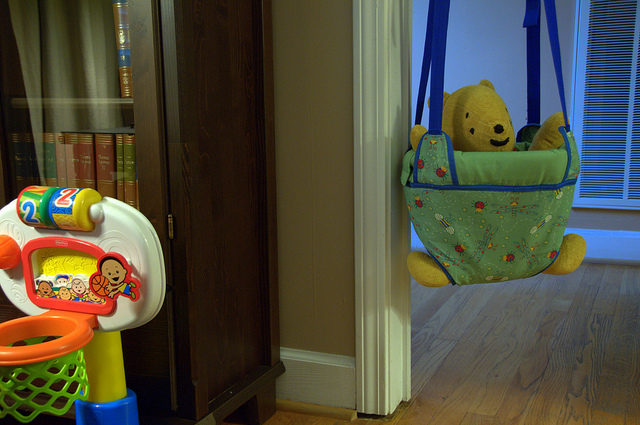
Back to normal; back to the basics.
fun in threes, sometimes fours
parenting
Things slowly return to normal. The house teeters perpetually on the edge of a wreck; toys are everywhere; the laundry takes a day to do; and I end the day too exhausted to do much more than a few words here.
Back to normal; back to the basics.
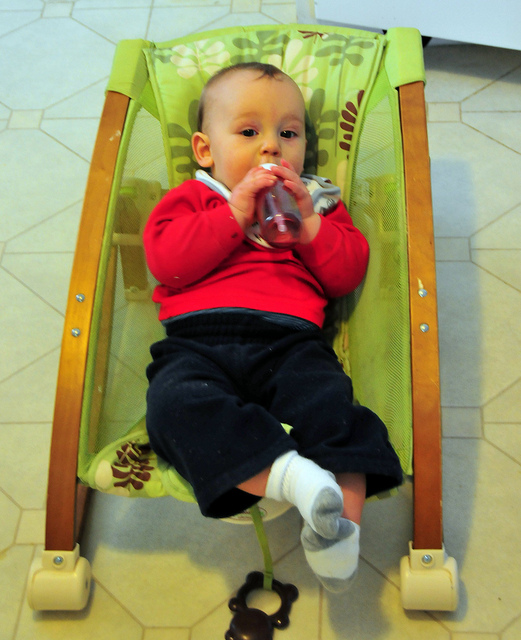
Independence comes in small developments: gripping a bottle.
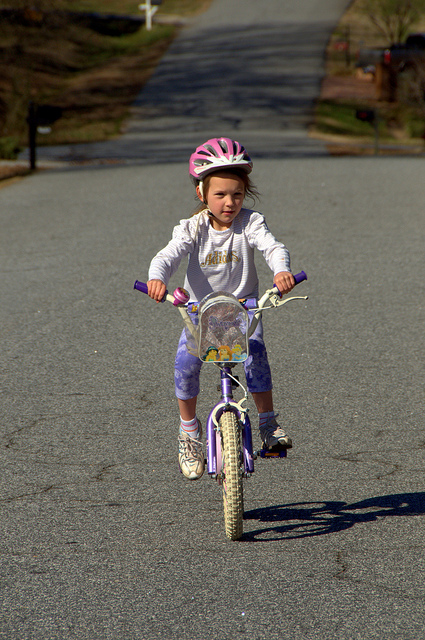
Riding a bike.
 He sits on my lap, Friday night and he’s tired. His head resting on my chest, he slowly opens his mouth as the spoon approaches. The pureed fruit in his mouth, he mushes it against his gums, swallows, and looks up at me. His glassy eyes stare off into the distance, and a balled fist slowly comes up, rubs an eye to the accompaniment of a little fuss. I feed him the entire jar of fruit, and it’s clear that he won’t last much beyond the last bite. Within a few minutes, we’re upstairs, his head on my shoulder as I pace about the darkened room. Moments later, he’s asleep.
The great honor of being a parent is being present in those moments of ultimate trust, those moments that make us so very mortal. I am responsible for two of his most basic, mortal needs: food and a quiet, safe place to sleep. As the Girl grows more independent, these needs come less immediately from my hands: she takes food out of the refrigerator for herself; she prepares her own snacks and even helps with her own meals. It’s easy to take those basic responsibilities for granted with her. But with him, K and I are still everything — for a while.
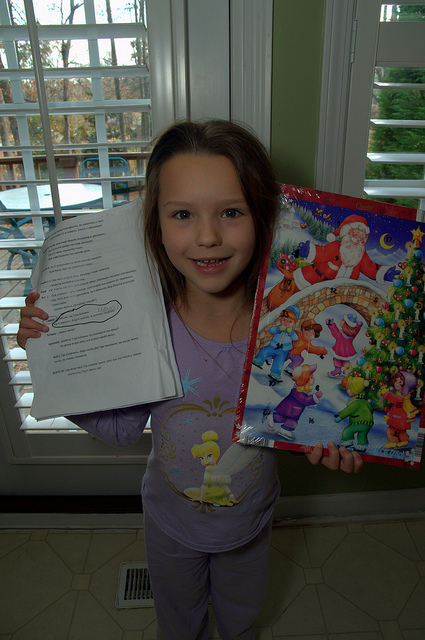
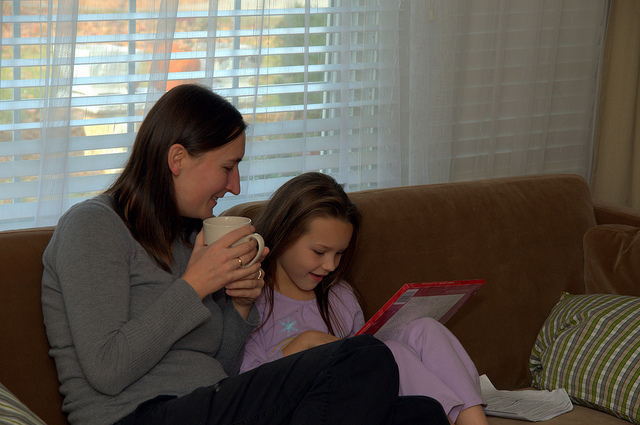

Surely you can piece together the day from the pictures and the tags.
A local priest, when discussing the Liturgy of the Eucharist -- which never changes, from day to day, week to week, year to year; in other words, something repeated hundreds and then thousands of times -- discussed how it might be easy simply to drift into auto-pilot (auto-priest?) and run through the liturgy without thinking, without really being there. He told us his secret for preventing such rote recitation is a prayer in which he asks for the grace to say the Mass as if it were his first Mass, his last Mass, his only Mass.
It might not be a bad way to approach every task.
I think of the excitement I felt every single "first" day I have had in the classroom: the first day at a new school, the first day ever in front of the classroom, the first day of a new school year, the first day back from a long break. Each and every first day has its own unique excitement, but the fact that it is exciting is the common element. By day sixty-five, that excitement seems somehow to have vanished, or at least diminished. The result is sometimes drudgery.
I think of the excitement I felt the first time I held our daughter. Such a charge, such a responsibility, such a humbling moment. Yet as the years pass and the fussing and independence increase, that energy sometimes seems a little tired. The daily routine, with its predictability, numbs the sense of wonder if one is not careful. Children are blessings, but the sometimes simply wear one down, and while I feel like a "bad parent" for admitting it, I'm sure it will happen with our son as well. It's simply easier to focus on the now, which can be frustrating, than the thrill that still resonates but sometimes seems hushed.
I think of the heart-stopping moment when I asked K to marry me, and while I love her more now than I did then, and will love her more tomorrow -- more deeply, more maturely -- than I do today, there are moments when we grate on each other. It's only natural. Still, in those moments, for the briefest flicker of time, that thrill seems gone. I know it will return; I know it never left; but in my human weakness, I can still focus on that moment and wallow in it for a while.
So what if I could live every moment as if it were my first, last, and only in front of a classroom; my first, last and only with my children; my first, last, and only with my wife. What if I could simply remember to reach each second as if it were my first, last, and only? Could I stand the intensity? The joy?
I grew up in a closed environment, literally. There was one way in or out of our housing subdivision, a fact that was of great solace to my mother as I was growing up: now strangers just “passing through.” And so I had almost complete freedom to go wherever I wanted in our neighborhood while growing up.
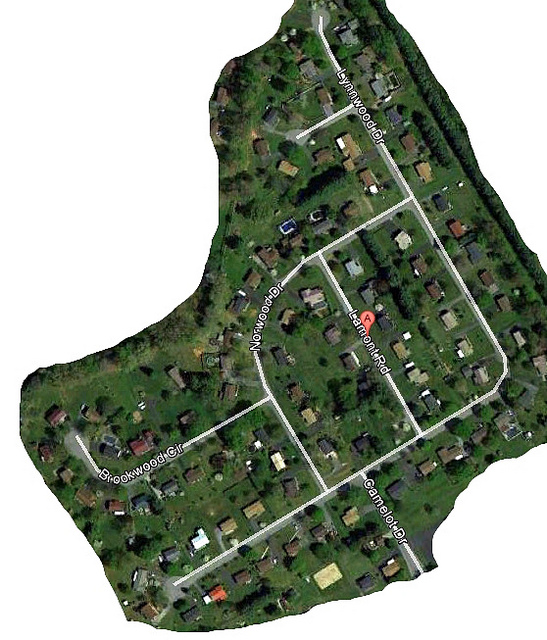
The only rule was that I had to be able to hear Dad whistle and get back within a reasonable amount of time.
I wish we lived in such a neighborhood now, for every time the Girl is outside playing alone, I’m a little edgy. It’s unlikely anyone would be just “passing through,” and it’s unlikely that anything would happen to her. Yet Amber Alerts, urban legend, and the Jaycee Lee Dugard case make a slightly paranoid father like me more so.
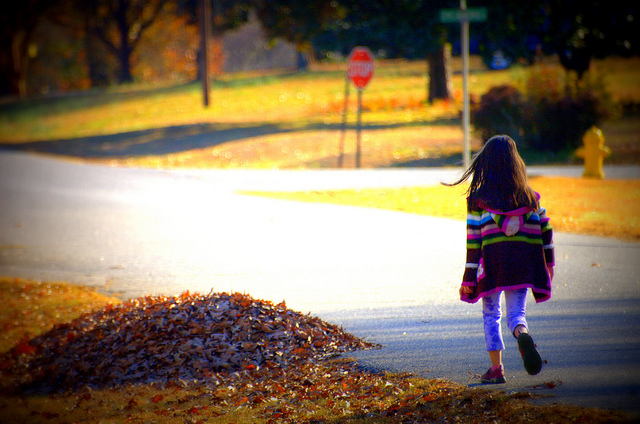
And so when she heads up the street to visit a friend, I stand at the end of our driveway and watch her head up. The friend’s parents do the same when he (or they) come back down to our place. It’s a simple enough matter, but I watch her bouncing up the street and realize, not for the first or last time, that she’s growing up, that she’s journeying from home and toward independence with a rapidity I’d been warned about but doubted for myself. And it will all repeat itself with the Boy, but I’ll be more prepared by then. I hope.
“Will you need your trusty gloves?” the Girl asks. We’re getting ready to go another backyard adventure — our own little version of the Backyardigans — and she is packing her bag. Among other things, she has retrieved her and my work gloves (in as much as hers are work gloves), but she can’t decide if we need them.
“Go ahead and pack them,” I tell her, and we’re off — first for a series of pictures.
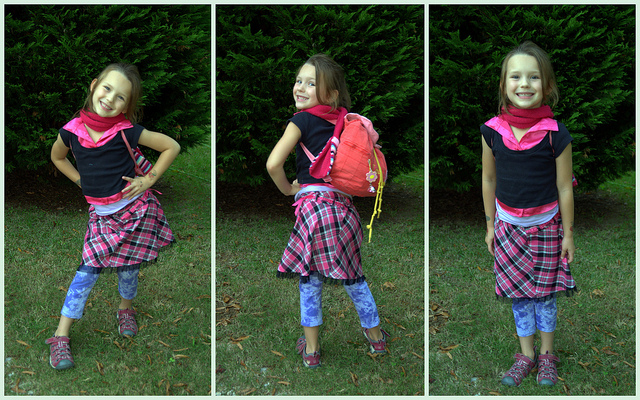
“When I say ‘snap,’ you take the picture,” she instructs. She says it three times; I take three pictures. Simple.
As we march through the backyard, I learn that everything is “trusty” today: I have with my my trusty camera; she has packed her trusty binoculars; she’s worried about her gloves in her trusty bag.
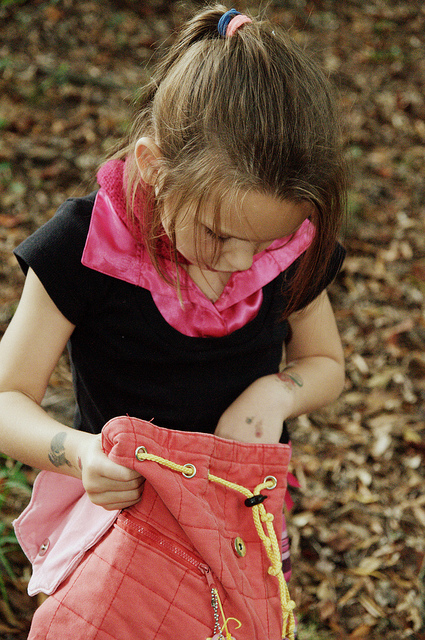
Everything is so trusty, and I ask her what it means to be “trusty.”
“That means it knows you can trust it,” she explains.
And it gives me pause. In that case, am I trusty? As a parent, I almost assume I’m trusty. Perhaps it’s parents’ eternal worry that they are never as trusty as their children assume and need them to be. Maybe it’s easier said than done. There are certainly times when doubt seems to be the only appropriate response — a moment of reflection that makes us think, “I guess I could always do better.”
In the end, I know I always want my children to think of me as their “trusty Tata,” and I always worry a bit that I’m not living up to that.
It was a gradual change, so gradual that we really only noticed it when it became a frequent-enough occurrence to get K and me talking about how much time the Girl had been spending in time out.
"Where did she get that?" we asked each other after the Girl had mouthed of again after just coming out of time out. It was a sassy, arrogant, and cruel tone of voice.
"No one talks to her that way here," I said, "so there's only one place she could have learned it: television."
For years, whenever I was walking in some department store and a voice from a little kiosk beckoned me over to look at all the advantages of Direct TV, I could stop the conversation immediately by stating semi-truthfully, "We don't have a television." It wasn't the whole truth: we had Nana's and Papa's old television in the computer room hooked up to a buggy DVD player, but "We don't have a television" was more convenient (and close enough to the truth) than "We have a television, but it's only hooked up to a DVD player; we have no cable service, and we're not interested in it." Somewhat reluctantly, though, we bought a small home theater system a year or so ago, and now that it's wirelessly hooked up to our Netflix account, we can sort of watch television like "normal" people. It led the Girl into whole new realms of cartoon viewing.

Ay, there's the rub.
"Where could she have gotten it" was only a rhetorical question because we both knew that she had spent time only with family and one close friend -- not enough to explain the attitude, the sass, the trying to act like a grownup in five-year-old shorts. We sat and discussed the situation, narrowing it down quickly to two cartoons in particular: Horseland and the newest incarnation of My Little Pony that includes the deceptive subtitle, "Friendship is Magic."

I thought back to all the snippets of these shows I'd watched -- and a couple of episodes I'd watched almost entirely -- and realized that both shows have characters that behave in just this sassy, nasty manner. "Well fine. I never liked it in the first place!" Things like that. Sure, by the end of the episode, all has worked out (after all, "Friendship is Magic"), but the behavioral model was still there, and the Girl had picked up on it.
We sat down with the Girl and talked about what was going on. Informed of our decision to eliminate Horseland and My Little Pony as well as to curtail general television watching, the Girl sniffled a little, but seemed fine.
A couple of weeks passed. I'd even forgotten about the two offending shows. Then:Â "Have you noticed how much L has changed in the last two weeks? The snotty, sassy little brat has disappeared and our sweet girl has returned."
This brings up the obvious question: what affect do media have on children's behavior? In many ways, it's certainly a chicken/egg mystery: culture influences what is acceptable in the arts (and I use that term loosely with most television programming), and the arts in turn teach members of society (often unawares) what acceptable society members find interesting and amusing. I know for certain, though, that the behavior modeled in the cartoons showed up in our daughter. This might be a function of age: younger children are less critical of the influences that affect them. Yet once a model, always a model: it seems that the longer one watches television uncritically, the more of an unconscious influence it exerts. Certainly that's what advertisers count on, to some degree.
But was it always like this? Were cartoons always issues of concern with parents? I certainly remember comments from my parents about how violent some cartoons are. Episodes of Tom and Jerry, Roadrunner, and many others always involve seemingly countless instances of extreme violence, acts which children are supposed to laugh at -- and do laugh at. Yet it seems more likely that a child will take on the sarcastic, disrespectful tone of voice she hears in an episode of Horseland than, say, she will drop an anvil on a friend's head. Then again, tone down the severity of the violence to a slap and I suppose they're equally likely. Still, tone of voice is something that is not even necessarily regulated automatically in children, so it seems more influential. To see the changes since I was watching cartoons, though, one only has to look in an average classroom to see that the uptick in general disrespect is significant, whereas there was never a real corresponding increase in violence (though there has been a significant increase).
The change is most noticeable when comparing today's cartoons to some created in the 1950's and 1960's. Still more noticeable are the differences compared to cartoons from that era that rely totally on visuals. I'm thinking here of two shows in particular.
Originally a comic from the 1930's, Koziołek Matołek ("Matołek the Goat") follows the adventures of Matołek as he searches out a mythical city were goat shoes are made. Matołek is goofy, clumsy, and a bit silly, but always naive and pure.
An import from Czechoslovakia, Krecik was the product of the 1950's, and it shows. The first episode shows a certain kind of self-reliance common to the times but strangely foreign to most of us today, and it certainly illustrates a kind of innocence lacking in many of the cartoons the Girl is drawn to.
"Name something you don't like to share."
Plinky
Shouldn't the selfless answer be something along the lines of "Absolutely nothing?" As a parent who is always working to teach my daughter (and soon, son) to share, I wonder if this isn't the perfect way to set an example. "Look, my child: there's absolutely nothing I would not share with you. I have my ice cream, but I'm only happy if it's our ice cream. In fact, it gives me more joy to give it all to you than simply to share it." Indeed, in such "sharing," I would certainly be getting the better end of the deal: ice cream melts, no matter what; joy lingers.
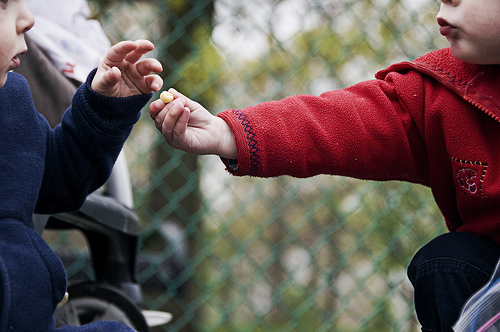
Yet isn't that also the reckless answer? As with most questions, the more one thinks about this, the broader the potential. Do I want to share my sorrows with my children? Do I want to share my pain?
And deeper still: if I don't want to share my sorrows with my children, why not? It would only be shielding them artificially from what they themselves would experience, and if I share my sorrow, I can control the dose. If I don't want to share my pain, then how can I expect them to share theirs with me, which is much more important?
The Girl has been the center of a small cluster of orbiting adults for her entire life. Mama, Tata, Nana, Papa, Babcia, Dziadek — all circle around her in their own cycles and epicycles, drifting into apogee, out of perigee, but always circling.
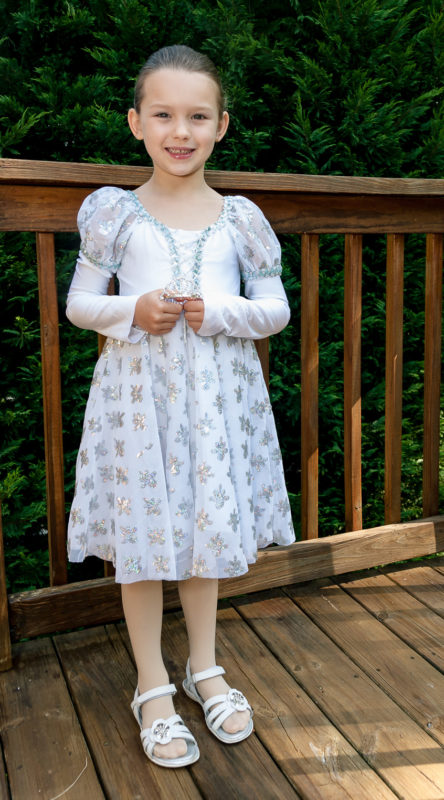
It’s been all about her dance rehearsal, her play dates, her mini photography sessions, her wants and needs.
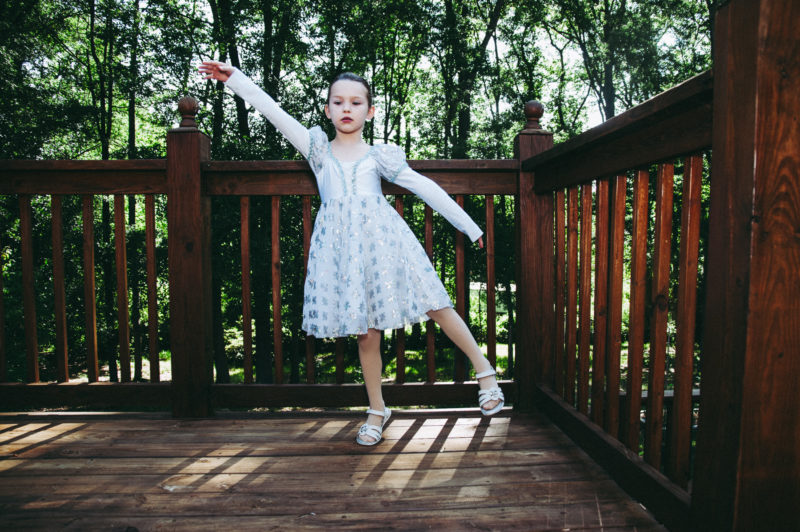
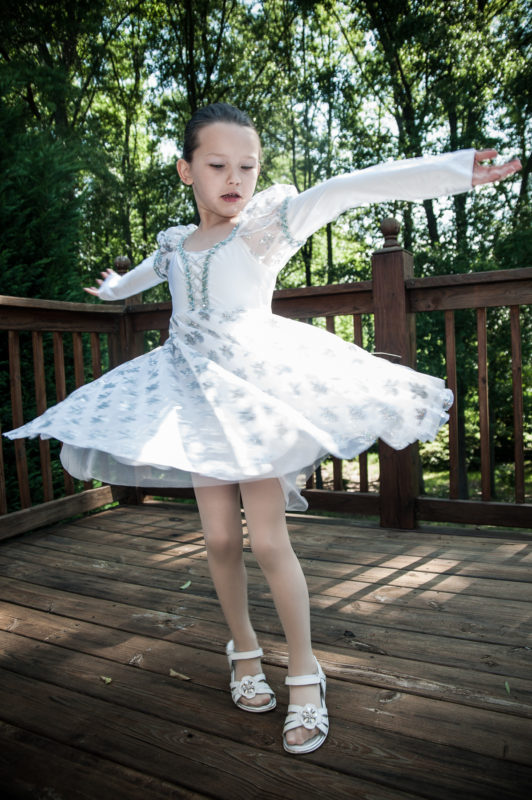
As she has spun, so we have rotated around her.
But now there’s competition. “The boy” has become a newly frequent tag for posts here, and the Girl is likely beginning to wonder just how many pictures of a baby sleeping we can possibly take. And she’s beginning to wonder just how much one little caterpillar can cry.
It’s a learning experience in countless ways. The Girl is learning she’s no longer the center; we’re learning now to make her realize that it’s now simply an elliptical orbit, with two foci.

A wise web visitor — as well as others — once pointed out that we’ll need to work on the sibling relationship as well. It’s a little trickier, because making the Girl realize she’s not suddenly an outsider is something within my control: I can take positive steps to affect that, like spending the afternoon with her riding bikes as we did today. The sibling relationship seems at first blush more like a “lead a horse to water” situation
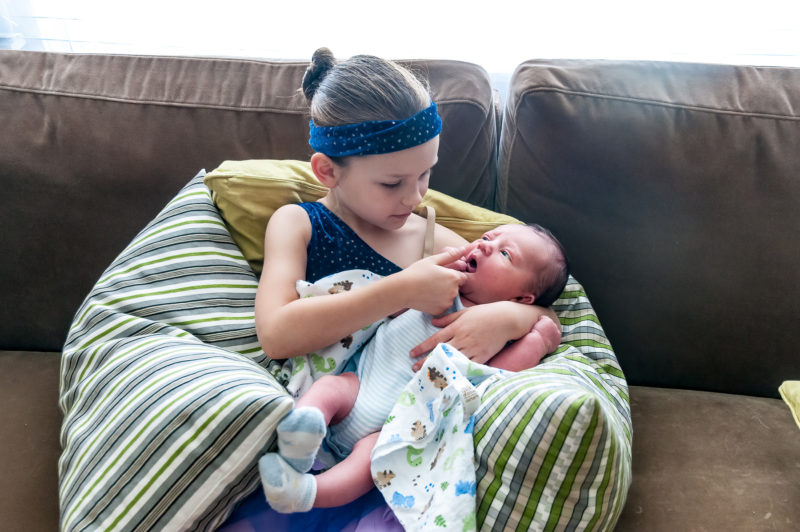
Yet there is an initiative from the Girl herself. Irritation about crying has been transformed into self-appointed pacifier duty: “When he spits it out, I’ll get it!” she proclaims.
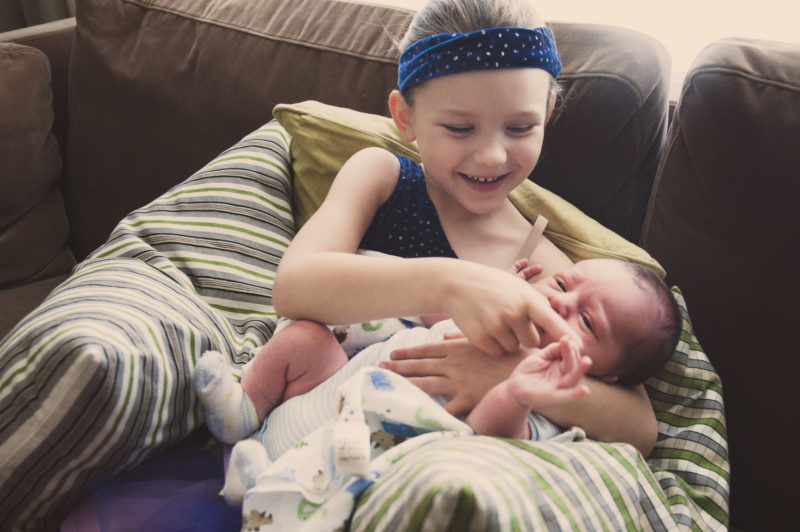
And of course she’s just dying to hold him.