Matching Tracksuits

fun in fours

parenting

Potty Training

Few things in life are more of a milestone for a child than to learn how to use the toilet. There’s tons of advice about when and how to begin. “Most children show signs of readiness to begin using the toilet as toddlers, usually between 18 months and 3 years of age,” writes one site. It continues,

These signs include staying dry for at least 2 hours at a time, having regular bowel movements, being able to follow simple instructions, being uncomfortable with dirty diapers and wanting them to be changed, asking to use the potty chair, or asking to wear regular underwear. You should also be able to tell when your child is about to urinate or have a bowel movement by his facial expressions, posture or by what he says. If your child has begun to tell you about having a dirty diaper you should praise him for telling you and encourage him to tell you in advance next time.

Well, L can’t communicate yet, and in fact she’s just learned how to sit up on her own. That doesn’t mean she can’t use a potty chair already. How do we know? Because she’s successfully used the chair several times.

Is this real “potty training”? I do indeed think so — we’re giving her an alternative to dirty diapers from an early age, and we’re showing her how “grownups” do it.

The key is knowing when she usually relieves herself. BMs are the easiest, because she announces it clearly and well in advance. But at least two times, we’ve sat her on the potty chair after eating when she wasn’t showing any signs, and within a few moments, she made use of the chair.

Our hope is that this will make “real” potty training more manageable. We’ll see in a few months…
Swimming

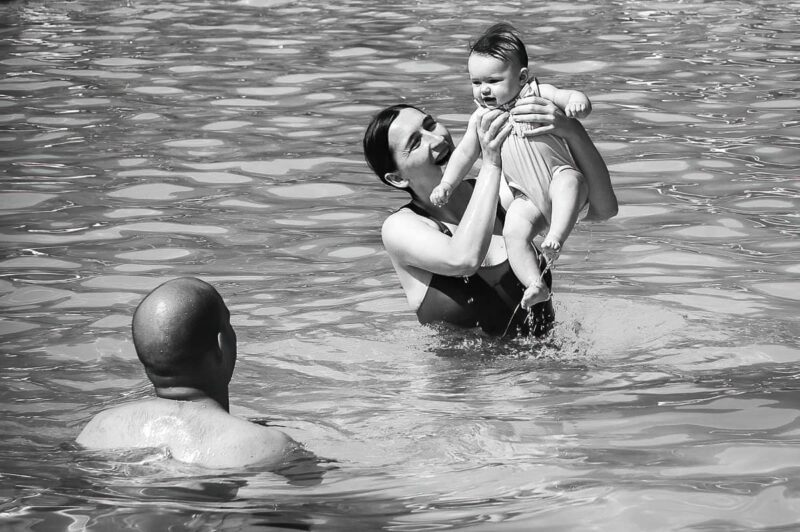
Last Monday we took L to her first swimming lesson. Granted, most of it was for us parents -- teaching us how to hold our children, how to roll over with them into a back float, etc.

L loves water. She splashes like mad when taking a bath, so it seemed fair to expect her to like swimming. And she did. Sort of. It got old relatively quickly, but she valiantly survived to the end of the thirty-minute lesson.

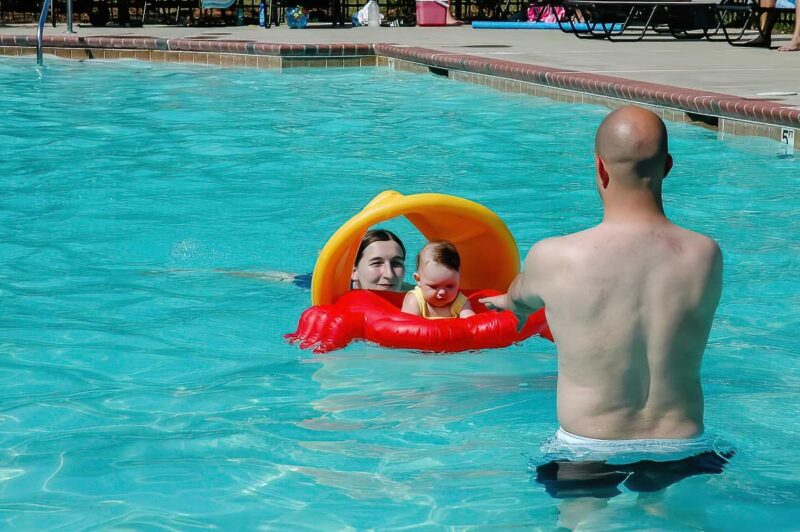
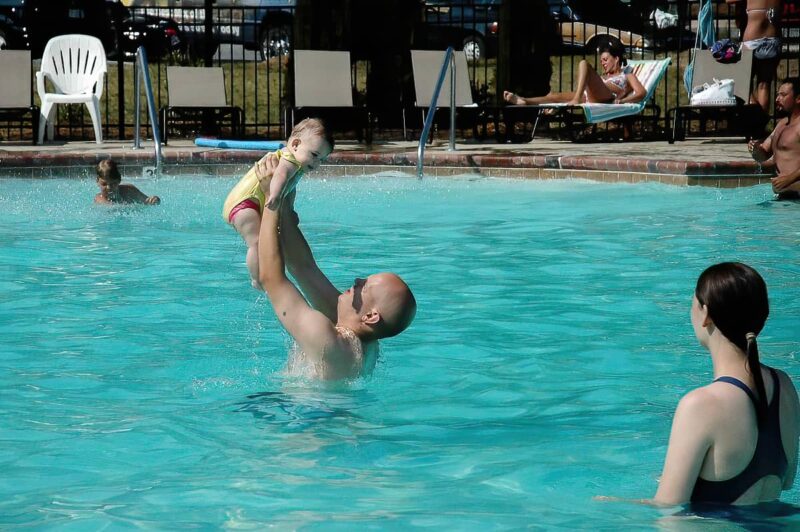
Yesterday, we finally took her swimming in our apartment complex pool, complete with the floating crab the grandparents brought:

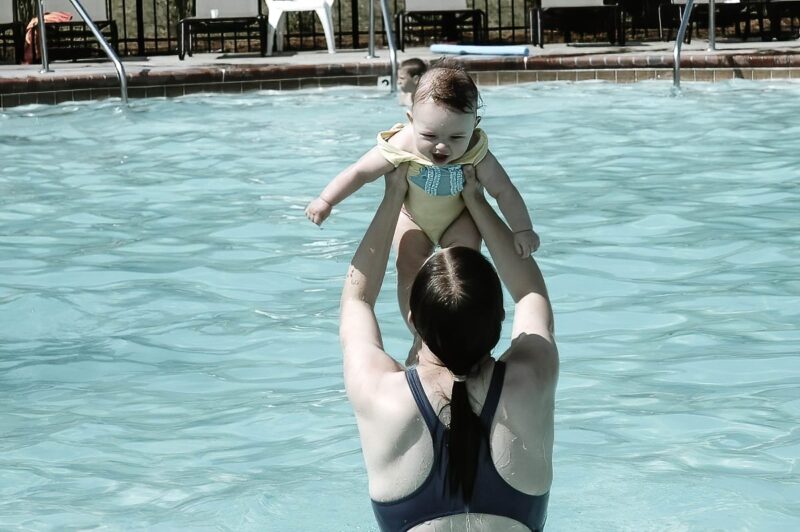
In reality, L really didn't like the crab that much. Or at least she tired of it quickly. Being tossed about was much more fun, I suppose.

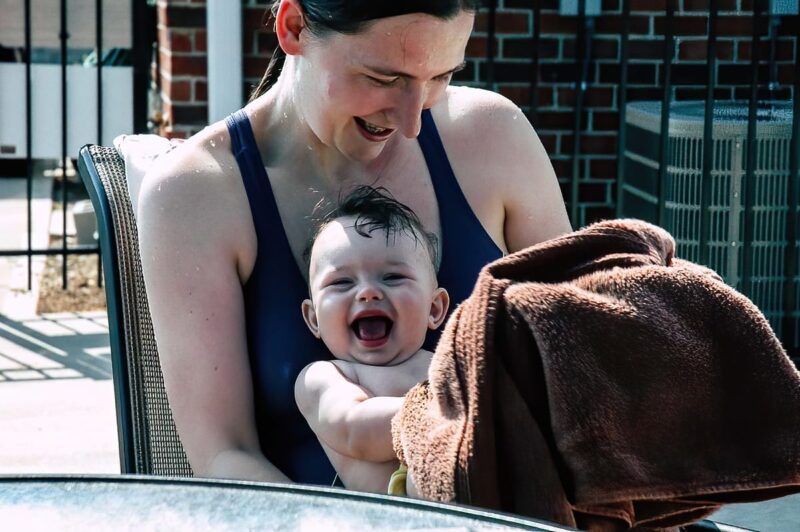
She enjoyed it, but she seemed happier while drying off.

A few more pictures are at Flickr.

“[Cloth] or Plastic”

Cloth DiapersWhen we first had L, we did what we thought was the environmental thing: we used cloth diapers. Today’s cloth diapers are not what they were thirty or so years ago. Now there’s liners of all sorts, including silk and impregnated wool liners that supposedly keep baby dry longer. “All night!” the makers boast, but at thirteen to eighteen bucks a piece, you’d think they’d just about have to change themselves to be worth it.
And then a little common sense. Though we were not filling the landfill with our daughter’s nasty diapers, we were using a heck of a lot more energy with all the extra washing. Our power bill more than doubled when we had L and were using cloth diapers. Of course, it was late December and we were keeping the apartment a lot warmer than we had been in the past. Still, a lot of that jaw-dropping electricity bill was due to the extra washing.

So, environmentally, it’s the cliche “six of one, half a dozen of the other.” Fiscally, disposable wins by a slight margin.

Sitting

Sitting requires a lot of development, balance and strength chief among them. While L has, for some time, been sitting with supports, she's recently begun sitting (and falling) all by herself.

Sitting brings a whole new set of possibilities. The ability to entertain herself by picking up things she sees around her is a big plus when everyone's busy. The promise of crawling emerges when L leans forward and puts a fair amount of weight on her still-weak arms. Sitting is the first step toward mobility, for it means a much-expanded horizon for the Girl -- much to see, much to tempt...

Crystal Ball

I often wonder what L is going to look like when she's older -- three, seven, ten years old. Once she reaches three it will be easier to guess what she might look like five years later.

At five months, though, it's fairly difficult to imagine what she might look like as a little girl rather than an infant.

But sometimes, when her expression is just right, there's a little glimpse.

Within Grasp

The girl has begun reaching for things. For anything. If it's in her field of vision, she'll put out her little hands and try to grab it.

The other day, she grabbed a glass of water while we were eating dinner and turned it over on K. First time, certainly not the last.

And so, for the first time, I proposed making pre-planned video. "Just go around the apartment and hold her in front of things," I asked K.

Kanał Part II

L, most unexpectedly, also has her own little canal. It too is singularly effective at channeling .

L doesn’t do much of anything without putting her full effort into it, and pooping is no exception. But with pooping, she has a particular gift. Without some much as a raised eyebrow, L can expel her cottage-cheesy poop with such energy that, upon impacting the diaper, it follows the path of least resistance, right up her back.

A good poop means that she leaves wet marks mid-way up her back. A spectacular poop goes three-fourths of the way up to her shoulder blades. Her personal best is just below her shoulder blades.

It’s spectacular. I had no idea babies could achieve something as wondrous as pooping halfway up their backs. And when she’s done, there’s a little mischievous smile that, though I know is from relief, seems like it just might also have a bit of pride mixed in.

Subtle

When I was in Poland, I eventually reached a point in my linguistic development at which I understood everything going on around me. It wasn’t fluency, because in any given sentence there might be one or even two words I didn’t know, or couldn’t immediately place, but I learned that understanding 100% of the language doesn’t mean understanding 100% of the words spoken.

Once I reached that linguistic milestone, it felt I’d always been at that point. It felt like I’d always been able to understand everything, even though I knew it wasn’t the case. Like swimming and reading, understanding Polish was something I couldn’t remember what it was like not to be able to do. (What an awful example as a teacher I’m setting with that sentence! And this one…)

Today, we went to see my cousin and her recently-adopted baby. The little girl — S — is six weeks. She’s about a pound heavier than L when she was born. And I looked at that little girl, her eyes still mostly closed, and I couldn’t imagine L being that size. I know she was. We have the pictures to prove it. But, as with the language, I just feel she’s always been this size; that she’s always been able to hold her head up; that she’s always been able to look around, to smile, to cry from boredom, to giggle, to coo.

And then, a little voice: “That is how you’ll wake up one morning and realize she’s going off to college and for a brief moment, feel complete unprepared for it, and feel she’s completely unprepared for it.”

It’s not quite synonymous with “taking for granted,” but it’s awfully close.

And I think that’s one reason why I’m trying so hard to write in this silly blog so often. To mark the lines of development; to make a record for later — to make an online baby book.

Besides, what else am I going to write about in my newly realigned universe?

Note To Future Parents

When playing with your child, some common sense is in order. After eating, for example, is not the best time for bouncy play.

That's fairly logical, but there's a derivative from this: after eating (up to, say, an hour after), avoid any play that places the child's head directly above your head.

As a newly washed car is to a bird, so your face, with it's stupid, wide-open-mouth smile, is to your child...

Note to Self