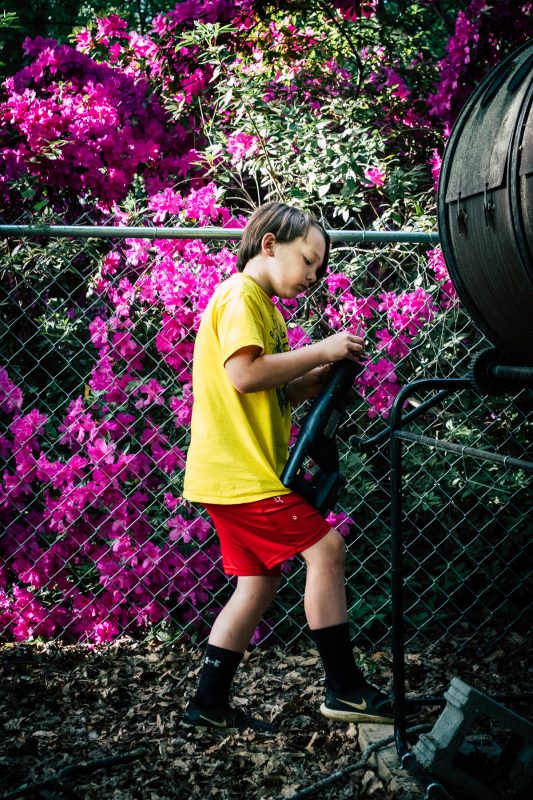
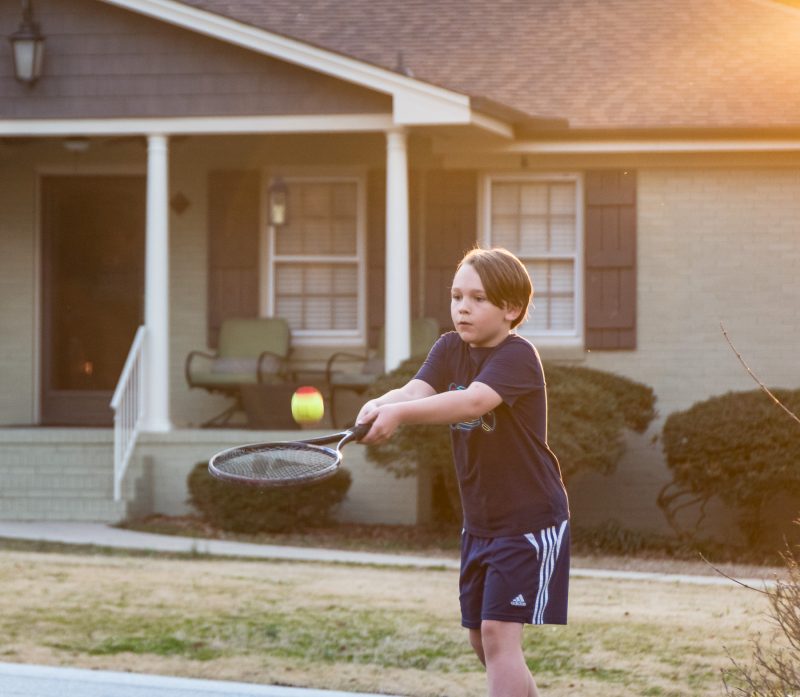
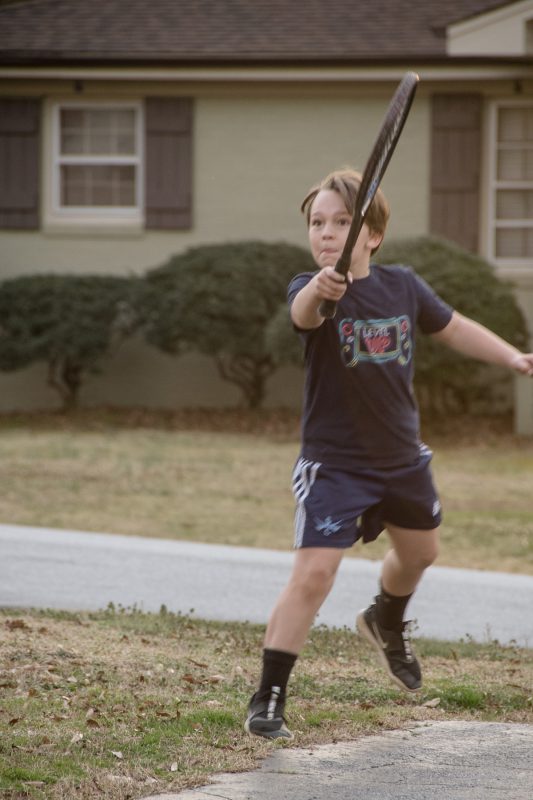
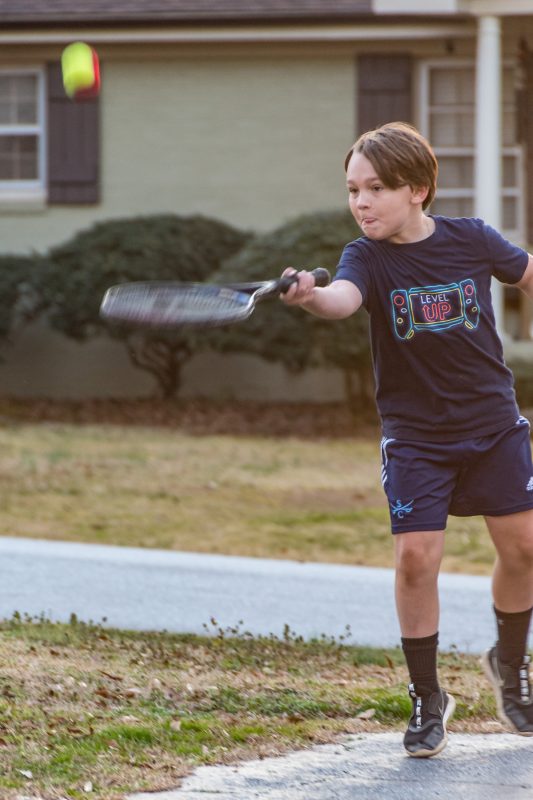
Matching Tracksuits

fun in fours

growing

First Swim Meet

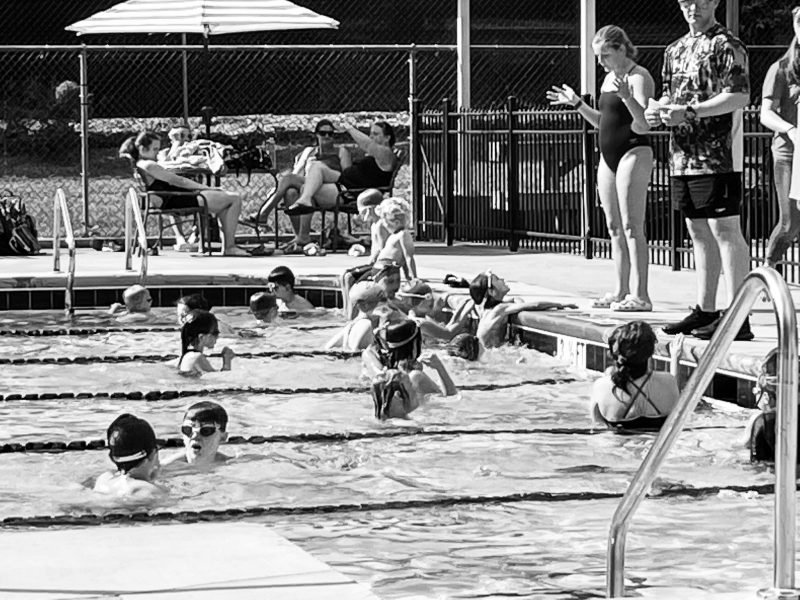
E had his first swim meet today. The team’s first meet was last week, but in classic E fashion, he wanted to go check one out before participating. For today’s meet, he agreed to swim one event: 25 freestyle. “I hate backstroke, and I really don’t know how to do breaststroke,” he reasoned. “And butterfly…” His voice trailed off to indicate it was a fantasy.

Since I’m finally able to find a little time with him at the pool, we spent a little time there these last two mornings working on improving his stroke. His kick was just knee action, which resulted in a lot of splash and very little propulsion. He sunk his chin into his chest, creating a large surface to plow through the water. He wiggled his upper body from side to side to compensate for his stroke rather than rotating his shoulders along his verticle (when standing of course) axis. All this combined resulted in a very inefficient stroke, so we worked to improve that a bit.

His event had three heats today, and he was in the last heat. I could tell as heat two prepared to go that he was nervous, having serious second thoughts about the whole project.

I’m fairly certain that if I’d walked over then and asked if he wanted just to ditch the whole thing, he would have enthusiastically agreed.

I thought he might be worried about the crowd. “I don’t like the idea of doing something I’m not very good at in front of so many people,” he confided in me this morning.

I thought he might be worried about coming in dead last. I feared he would: he really doesn’t have much swimming experience other than playing around, and some of those kids his age have clearly been swimming competitively for years.

I thought he might be worried about the starting blocks: I didn’t know how many times he’s used them, and to my knowledge, he hadn’t used them at all this summer.

It turns out, though, that he was most worried about being disqualified. “A and O told me that if you pull your head straight out of the water to get a breath instead of turning to the side, you’ll get DQ’ed,” he explained. “I really didn’t want to get DQ’ed.”

I assured him that was not the case even though it could very well be the case. “Whatever the case,” I thought to myself, “we’ll never know if he gets DQ’ed unless he’s a contender for one of the higher places.” In the end, he got second place in his heat. Granted, there were only two swimmers, but we laughed about that. “I’m just proud of you for conquering this fear,” I told him.

“Thank you,” he smiled, hugging me and telling me probably for the 100th time today, “I love you, Daddy.”

Jobs

My first real job was as a lifeguard at the pool in my high school. During the evenings, from 6:30 to 8:30, it was open for public swimming, and those hours were extended in the summer to include morning and afternoon swimming. Those hours on the lifeguard stand seemed endless, making the evening shift seem more than double its actual time. At times, I had to tell myself, to force myself, not to look at the clock, to resist the urge for as long as possible because I knew that, despite being sure fifteen or twenty minutes had passed, I knew I would look up and see that only five minutes had dragged by. After everyone had left, I had to clean the pool deck, clean the bathrooms, and once every few days vacuum the pool.

“Being a lifeguard is not as glamorous as it seems,” my boss (who was also my swim coach) warned us when we all began taking the requisite courses to become certified. “Being a lifeguard is, in reality, nothing more than being a glorified janitor.” He’d forgotten to mention the utter boredom.

Many teens start their working lives in fast food, and so the second job I got was at a Wendy’s franchise one summer. Tired of being a glorified janitor, I applied for the job on the advice of a friend who also worked there. It was a little better than being a lifeguard: there was at least some variety. One day I might be working on the grill; the next day I might be serving up fries. I never got to work the register, though, because I quit after a month: the manager was scheduling me to work so little that I was sure I could find a better way to spend my time — at least looking for a job with more hours.

One summer in high school, I worked mornings with a man who did landscaping. It was tiring work, and it was frustrating as well: he often didn’t explain things terribly well and then fussed at me when I didn’t do things the way he’d intended.

Today, E and I dropped off L at a local ice cream franchise for her to apply for her first job. Her friend S applied for and got a job there, and she was to start her first shift just after L’s interview.

“I’d have to work the register,” she explained on the way there, “because I can’t use any of the equipment. S said she can’t even touch the microwave.”

“How old do you have to be for that?” I asked.

“Sixteen.” So by the time she’s allowed to make milkshakes for people rather than just taking orders for them, she’ll also be old enough to drive herself to work. And that’s all in just two short years.

Going through some photos while taking an afternoon coffee today, I noticed some pictures I hadn’t remembered: the kids, out with Babcia and K during their Polska 2015 visit. The children are both vastly different in these images than they are now, with E currently just about the same age as L in the image. And the same old thoughts and realizations came back yet again…

The Ball

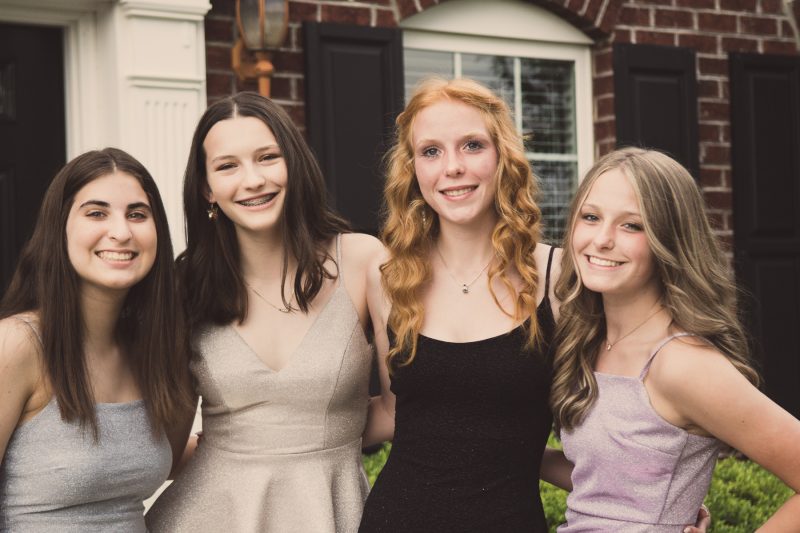
L's school had the eighth-grade ball this evening.

Swim Team

E has joined a swim team at a local pool, primarily because his three best buddies from school have joined the same team. I am naturally thrilled because competitive swimming was an important part of my life. I began swimming competitively in elementary school when I competed for the small community pool to which we belonged.

In high school, the swim team was my only athletic endeavor. I certainly would not have gone out for football or basketball, and while I ran track during my freshman year, an awful case of tendonitis made running more than a quarter of a mile excruciatingly painful: I quit after the first year. But swimming had always been kind to me, and even though I was always mildly frustrated that the swim team never got the kind of recognition that the basketball, football, or even baseball teams received, I would have continued swimming competitively even if the other swimmers and I were the only ones in the pool.

It’s not that I wanted to be seen as a jock — certainly not — but a little recognition for the amount of work we put into our sport would have been nice, I thought.  We did have one occasion to bask in a little attention. It was during my junior or senior year, and the head swim coach arranged for some of the cheerleaders to come to support us. A cheerleader stood behind the starting blocks for the home swimmers and cheered us on from there. That I can’t remember whether it was my junior or senior year and that I am only partially certain they were standing behind the starting blocks to cheer us on (that just doesn’t seem right) show how relatively insignificant the event was for me, so I suppose I really didn’t care that much about that recognition.

For the most part, what I liked about swimming was its solitary nature. Except for relay events, swimming was just the swimmer in the water. Everything else seemed to dissolve into the muffled yelling of the few spectators — mainly parents, boyfriends, and girlfriends — who came out to support the team. To train or to compete, we didn’t need anything other than a body of water.

I also found that training had a certain meditative quality to it: back and forth and back and forth. One two three breath; one two three breath; one two three breath. Count the strokes in each lap. Count the breaths in each lap. Get a song going in your head and just let it run in cycles. I lost myself in swimming many times.

The Boy, though, is just beginning. He doesn’t have a good breathing pattern. He takes as many strokes as he can and then pulls his whole head out of the water to gulp air for a few seconds, then plunges his head back under and goes at it again. There are so many kid on the team (probably close to 30) that I doubt he’ll get much one-on-one stroke help, so I’ll have to do that as soon as school is out, and we start heading to the pool together on a regular basis.

He also stops swimming when he gets too tired. That means he swims the first length entirely. In the second length, he stops at the 15-foot red markers. After a few more lengths, he’s stopping almost midway.

“That’s when you’ve really got to push it,” I tell him. “You’ve got to ignore that pain and push through it. That is how you get stronger.”

It looks like we’ve got a summer goal cut out for us.

In the Backyard

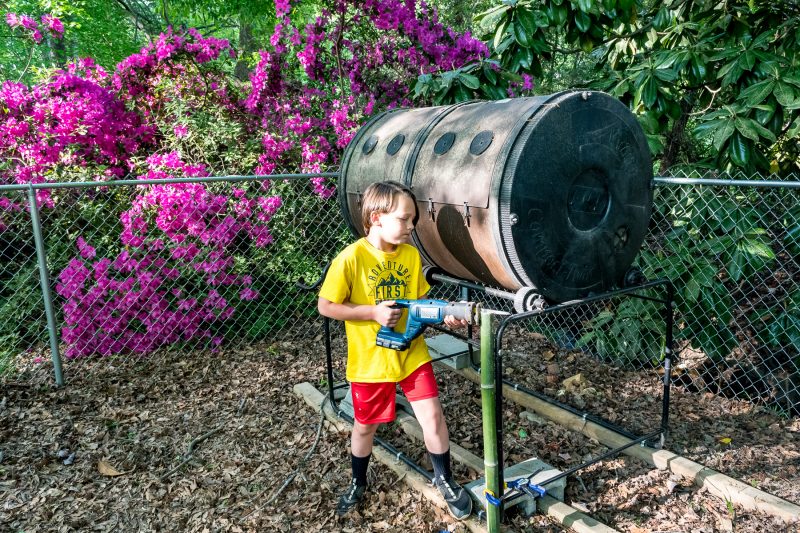
I sometimes feel guilty when E asks to spend some time with me, and all I end up doing is sitting and directing him. Today, for example, he wanted to work on a little project he devised some time ago. He’s got it in his head that he can dig a pool in our backyard like he has seen done on YouTube by those Filipinos who carve magnificent structures in the hard clay of their country. He settled on merely making it deep enough to soak one’s feet, and he decided that he wanted to line the sides and bottom with bamboo.

Yesterday in the time I had between coming home from school and heading back to school to photograph the girls’ soccer game, the boys’ soccer game, and the boys’ baseball game, almost all simultaneously, we went out to the woods behind our house cut down one cane of bamboo and brought it back.

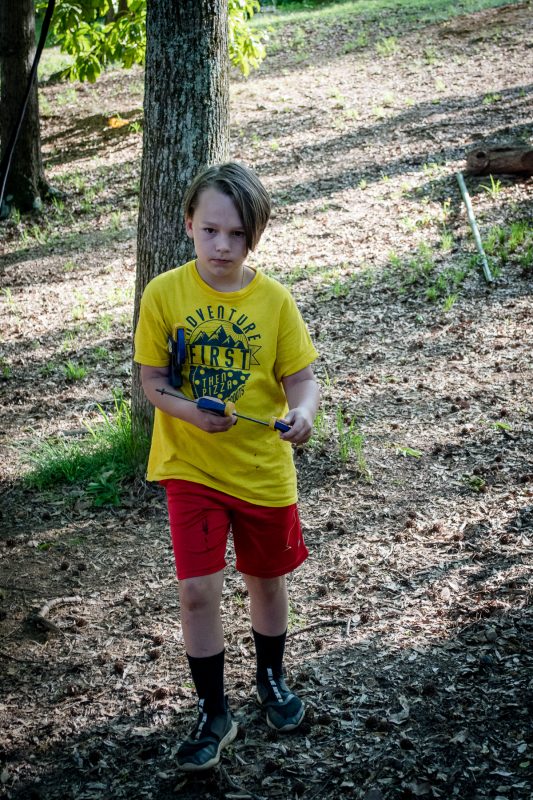
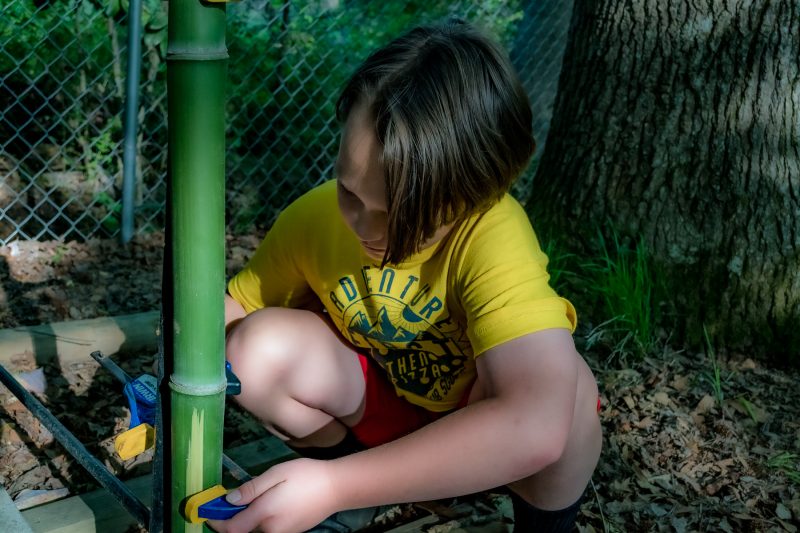
Today, he wanted to split it down the middle. His first idea was to partially bury it in order to stabilize it and then use the saws-all to cut it in half. Knowing that wouldn’t work, I suggested that we use clamps to clamp it to something to stabilize it, and he readily agreed to that. Yet everything we tried initially failed. I say everything “we tried,” but the truth of the matter is he did all the work and I simply sat and directed him.

And this is where my dilemma comes in. I was giving him suggestions, photographing him occasionally as he worked. I could’ve just as easily worked with him. Apparently, I saw more value in him having a little practice following instructions and working things out for himself. Or was this just me making excuses for my laziness?

Comforting the Boy

The Boy and I are finishing up the classic Where the Red Fern Grows. I remember my fifth-grade teacher reading that to us, and I knew how it ends: both Old Dan and Little Ann, the protagonist’s beloved hounds, die. We reached that part today, and it brought the Boy to tears.

“I’m just remembering Bida and Nana,” he said. “I miss them. I want them back.” He sobbed for a while as I comforted him, continually talking about memories he had with them.

After a while, when he was calming down, I asked the Girl to bring in a box of tissues.

“What?” she asked.

“A tissue box.”

What?!” she asked again, incredulously.

“A tissue box!”

“Oh, I thought you said ‘a fishy box.'”

And like that, the tears turned to laugher.

Friday Evening

The Boy has decided he needs to do more conditioning to improve his soccer game. Tonight, he ran a series of interval training exercises that we kind of made up as we went along. Then he decided he wanted to make up his own.

He struggles a bit this year in soccer. He’s one of the youngest on the team, and as a result, he’s less aggressive/experienced than others and a bit slower than many of them. To his credit, he’s not giving up, though he wanted to at first. The thing is, he actually likes playing soccer, and that makes all the difference.

In the evening, I took the dog for a walk and discovered our neighbor had started his weekend backyard fires. Perhaps I’ll go over for a visit tomorrow night.

February Evening

I head out for a walk with the dog as I listen to one of Sam Harris’s latest editions of the Waking Up podcast in which he discusses the nature of time with physicist Frank Wilczek. We like to think of time as this little moving slice of now that’s passing through the past into the future, but it’s really not like that at all. Time in a sense is the measure of change, and basically clocks things that change predictably and regularly against which we mark the seeming passing of time. In that sense, then, everything that changes is a clock, Wilczek points out.

Everything is a clock. I stopped in mid-stride to think about that. It’s so profound and yet so simple at the same time, an observation that’s been staring us in the face all our lives but eluding us at the same time. Simple, elegant.

As I continue my walk, I pass a man standing in his garage talking on the phone. I raise my hand in greeting. It’s a Southern thing — we wave at everyone — but he doesn’t wave back. “Perhaps he didn’t see me,” I think. Then, noticing some of the flags hanging in his garage indicating a political persuasion diametrically opposed to mine, a little thought experiment begins in my head. “What if we could read each other’s minds? We’d know where the other stands on so many issues that we otherwise keep to ourselves. We’d really, truly know one another. Would we be less likely to wave at each other?” And that’s a terrifying thought.

About this time, I grow tired of the podcast and switch to a playlist I’ve created called “Nostalgia” — songs to induce just that. The first song up: “Private Universe” by Crowded House. What a strangely perfect song. It’s not at all about the private universe I’ve been contemplating, but what a coincidence. Private universes — the physicists’ idea of a multiverse is a reality, because we all live in our own private universe. It sounds lonely, but it’s much more comfortable for us to live in these little walled-off universes because they afford some privacy that a non-private, evening-walk-thought-experiment mind-reading universe would render impossible. Even if that means we never truly know one another, it’s better in our private universes. We’re passing our experiences and memories, emotions and impulses through our own filters as we share them with others who then pass them through their interpretive filters. There are so many layers separating us that it’s a miracle we can claim to know anyone at all.

But there’s a hint of tragedy in this, because even with those with whom we’d be most willing to share such a non-private universe, it’s impossible. I will never truly know my children because of all the things they don’t, won’t, or can’t share with me, and they will never really know me. In a sense, we live with strangers, each and every one of us. The only thing we truly have in common is the fate that awaits us all — when the clock that is our body wears down and stops recording time for us as conscious individuals and begins to be a measure of unconscious decay.

It’s about this time that the next song comes on: Billy Joel’s “Lullabye (Goodnight My Angel).” This song has always made me think of Natalia, a student I taught in Poland who died before her senior year in the summer of 1999. “That’s almost 22 years ago now,” I think. “Had she not died, she’d now be old enough to have children older than she was when she died.” The song winds down:

Someday we’ll all be gone
But lullabies go on and on
They never die
That’s how you
And I will be

How did I never notice that nod to mortality at the end of the song? And how is it that a talk about physics can end with such nostalgia? I feel like I should have an answer, but I also feel like none is needed. I’ve done what I set out to do: record some thoughts I had one February evening as I walk our silly dog, and that’s really all this is for. Billy Joel writes his songs that will never die; I write a blog a decade after they ceased being hip.

Reputation

The last question for the act three study guide was to complete a paraphrase of lines 94-103. It was one of the few questions I actually check -- the rest of them, I skim and make sure they put something close to correct. This one I read.

One young lady (we'll call her Lisa) turned in the following:

I'm so upset about my cousin's death that I'll never be satisfied with Romeo until I see him dead. Mother, if you could find a man who sells poison, I would mix it myself so that Romeo would be dead. My heart hates hearing his name and not being able to go after him, not being able to avenge the love I had for my cousin.

The second part wasn't as simple: explain the paradoxical/ironic phrases in this passage.

This passage is ironic because Juliet has to pretend that she hates Romeo and wants to kill him even though in reality she loves him and wants to protect him. Juliet says that she will never be satisfied until she sees Romeo dead when in reality she won’t be satisfied until she sees Romeo and can hug him and be with him. Juliet tells her mother that she wants to mix up the poison to kill Romeo but she really wants to mix up the poison so she can protect Romeo and make sure that the poison doesn’t kill him. Also, Juliet hates to hear Romeo’s name and not go after him, but she says that she hates hearing Romeo’s names and not being able to avenge Tybalt’s death to cover-up that fact that she loves Romeo.

My comment: "Good work. A thorough examination of all the levels of irony." Lisa is, in all respects, a star student. She never gives less than 115%, and she absolutely hounds me to death for extra feedback and additional help. As a result, she finished the second quarter this year with an eye-popping grade of 100. She had a 99 without the extra credit for the quarter, but she did every possible bit of extra credit so I was more than happy to give that one point, though she didn't have to do everything to get that point. But she would have done it all even if I'd told her she didn't have to. "I just want to make sure," she'd likely say.

A couple of students later, I was skimming through the answers, thinking how much more complete these answers seem than what I'm used to receiving from the boy (we'll call him James). Then I get to the paradox question and read his answer:

This passage is ironic because Juliet has to pretend that she hates Romeo and wants to kill him even though in reality she loves him and wants to protect him. Juliet says that she will never be satisfied until she sees Romeo dead when in reality she won’t be satisfied until she sees Romeo and can hug him and be with him. Juliet tells her mother that she wants to mix up the poison to kill Romeo but she really wants to mix up the poison so she can protect Romeo and make sure that the poison doesn’t kill him. Also, Juliet hates to hear Romeo’s name and not go after him, but she says that she hates hearing Romeo’s names and not being able to avenge Tybalt’s death to cover-up that fact that she loves Romeo.

A few more students later, I read another boy's work. We'll call him Nate. Nate has been struggling with the class, but he's constantly saying he wants to do better. I read his paradox answer:

This passage is ironic because Juliet has to pretend that she hates Romeo and wants to kill him even though in reality she loves him and wants to protect him. Juliet says that she will never be satisfied until she sees Romeo dead when in reality she won’t be satisfied until she sees Romeo and can hug him and be with him. Juliet tells her mother that she wants to mix up the poison to kill Romeo but she really wants to mix up the poison so she can protect Romeo and make sure that the poison doesn’t kill him. Also, Juliet hates to hear Romeo’s name and not go after him, but she says that she hates hearing Romeo’s names and not being able to avenge Tybalt’s death to cover-up that fact that she loves Romeo.

At this point, there was only one thing to do: go back through all the other papers and check. Nothing else seemed suspect, but these Lisa's, James's, and Nate's study guides were, upon closer inspection, identical. Completely. Perfectly. A medieval scribe would be jealous of the letter accuracy.

I was puzzled, though. I couldn't get a single thought out of my mind: "This just does not seem like something Lisa would do." James and Nate -- maybe. Conceivably. But Lisa? Never.

I took the three papers to Mrs. D, the eighth-grade vice principal, and she sweated a couple of more names out of them. I got a call during my planning period asking if I'd print out Sam's and Jacob's paper. I did so, but they were identical to the other three. Mrs. D applied a little more pressure while I stood there: "You want to tell me what happened or should I immediately just start suspending people?" It turned out that both James and Nate had gotten the study guide from Jacob.

While they were providing details, I looked down at Lisa. Her brow was furrowed in confusion; her eyes glistened; her chest was heaving slightly. She was utterly terrified.

It wasn't difficult to understand why: here was a girl who'd probably never gotten in trouble at school. Ever. For anything. She's chatty because she's so very bright, and she just wants to share all the thoughts she has. (She puts Post-It notes on her article of the week in addition to all the marginal comments. "I just have a lot to say," she explained with shrug of the shoulders when I asked her why she was doing so much more than was required.)

I left the room to get ready for class -- their class. Students began filing in, and I heard the talk:

"Who else got called to the office?"

"Lisa's in there."

"Then it must be some star student thing or something."

"No, I think she's in trouble."

Just before class started, the vice principal came down to my room to tell me that Jacob had rather casually admitted that he'd swiped the study guide from Lisa. While she had gone to the restroom, he noticed the study guide was up and quickly jumped on her computer to send a copy to himself. He then shared it.

Poor Lisa, I thought.

I went back into the classroom and made sure everyone was working, then called Lisa outside.

"Are you okay?" I asked.

"Yes. Did Mrs. D tell you what happened?"

"Yes, and I'm glad it all came out. I'm sure you were quite confused."

"Very," she said, shaking her head vigorously.

"Well, this should serve as a lesson to you that's a little different than the lesson the boys are going to learn." I asked her if Mrs. D had told her what I'd said initially.

"No, not really."

"Well, I told her that it just didn't seem like you. That I doubted you'd just shared this. I didn't have any way to explain it, but I really didn't think you would do something like this." She smiled, and I continued, "So the lesson I hope you learn in a very real way is how valuable the reputation you've created for yourself is, how important it is to maintain such a reputation because it will serve you well in ways you probably didn't previously imagine."

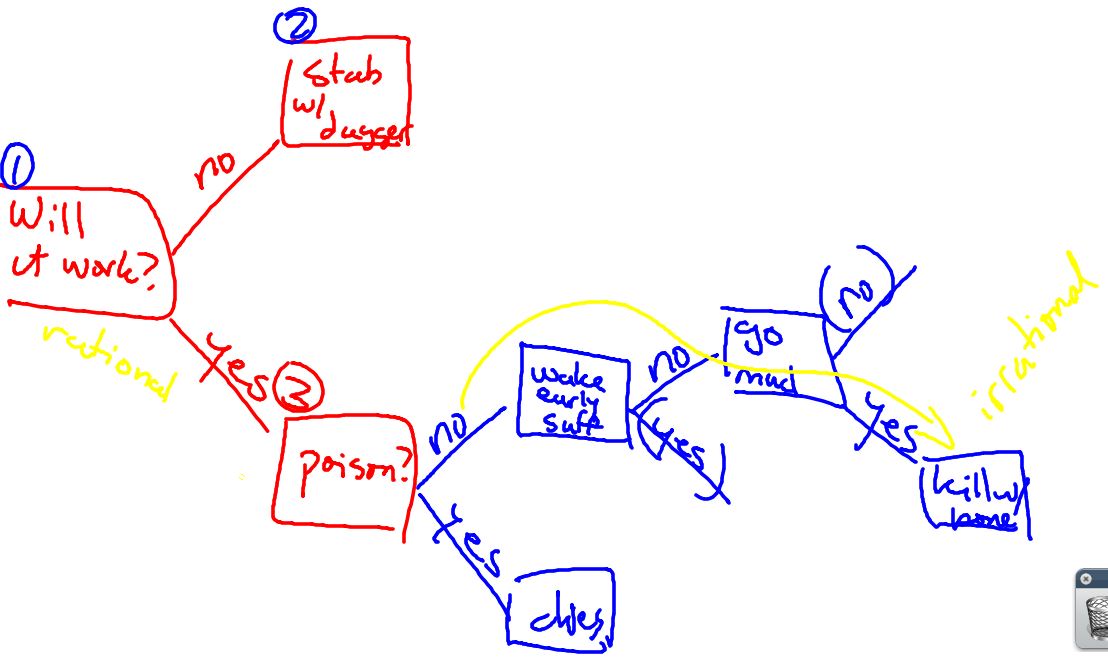
She smiled again, and we went back inside and had a great class, making a decision tree of Juliet's concerns about taking Friar Lawrence's potion.

Farewell! God knows when we shall meet again.
I have a faint cold fear thrills through my veins,
That almost freezes up the heat of life:
I'll call them back again to comfort me:
Nurse! What should she do here?
My dismal scene I needs must act alone.
Come, vial.
What if this mixture do not work at all?
Shall I be married then to-morrow morning?
No, no: this shall forbid it: lie thou there.

Laying down her dagger

What if it be a poison, which the friar
Subtly hath minister'd to have me dead,
Lest in this marriage he should be dishonour'd,
Because he married me before to Romeo?
I fear it is: and yet, methinks, it should not,
For he hath still been tried a holy man.
How if, when I am laid into the tomb,
I wake before the time that Romeo
Come to redeem me? there's a fearful point!
Shall I not, then, be stifled in the vault,
To whose foul mouth no healthsome air breathes in,
And there die strangled ere my Romeo comes?
Or, if I live, is it not very like,
The horrible conceit of death and night,
Together with the terror of the place,--
As in a vault, an ancient receptacle,
Where, for these many hundred years, the bones
Of all my buried ancestors are packed:
Where bloody Tybalt, yet but green in earth,
Lies festering in his shroud; where, as they say,
At some hours in the night spirits resort;--
Alack, alack, is it not like that I,
So early waking, what with loathsome smells,
And shrieks like mandrakes' torn out of the earth,
That living mortals, hearing them, run mad:--
O, if I wake, shall I not be distraught,
Environed with all these hideous fears?
And madly play with my forefather's joints?
And pluck the mangled Tybalt from his shroud?
And, in this rage, with some great kinsman's bone,
As with a club, dash out my desperate brains?
O, look! methinks I see my cousin's ghost
Seeking out Romeo, that did spit his body
Upon a rapier's point: stay, Tybalt, stay!
Romeo, I come! this do I drink to thee.

I've always loved this lesson: the decision tree helps them literally see how increasingly irrational Juliet is becoming:

Lisa was classic Lisa: she took control of her group; she offered her ideas enthusiastically but humbly; she listened to others and helped everyone synthesize their thoughts. Back to normal. Classic Lisa. The Lisa everyone was thinking of, scratching their heads, wondering, "Lisa, in trouble?"

And the boys? Well, I didn't talk to them. After all, what could I say that Mrs. D hadn't already said?

Play Date

The Girl has, for all intents and purposes, outgrown play dates. Her friends come over occasionally, and they sit on the bed and talk. Or play games on the Chromebook together. But they’re not play dates. But we call them that anyway.

L’s best friend N came over yesterday and one of the highlights for them was walking together down to the CVS near us to buy snacks. K told me that after L told her friends about doing that, all her friends want to come for a visit to walk down to the CVS.

What a change from the summer L experienced in Poland a couple of years ago. She met with her newly-made village friends for pizza, went shopping with them, met them for ice cream, walked to their houses for visits. So much independence for a then-twelve-year-old. So relatively incomprehensible for American children.