Matching Tracksuits

fun in fours

growing

Twenty

We jostle about in our adolescence, bumping against others and ourselves, usually questioning where we stand with others, often unsure of where we stand with ourselves. Such tumultuous times of identity formation, questioning, and reformation. We make and remake ourselves year after year, month after month, even day after day, and we’re all nagged by the same question: is the me I see in myself what others see? Or more to the point, is the me I see in myself the real me?

Sociologists and psychologists tell us that adolescence is a relatively recent cultural phenomenon, a product of the same innovations that created the leisure class and free time. In the past, one’s position in life was fairly well determined generations before one was born. Once born to generations of farmers, always a farmer; once born to a family of wealth and position, always an aristocrat. These days we wake up and find ourselves in possession of a driver’s license and a handful of friends, unsure what to do with either, and we struggle to make decisions that weren’t even available ten decades ago.

Every year, as an eighth grade teacher, I see my own students going through this, yet with seemingly infinitely more choices that I had. Their thumbs can move at over a phone’s small keypad at the speed of gossip, and last week is ancient history. They come to class sometimes with tears in their eyes, and I think, “Someone broke someone’s heart, and they’re both sure they’ll never survive it,” and I smile to know they will, because I did, and a hundred and twenty kids in my cohort did as well. “Love is blindness” I mutter under my breath.
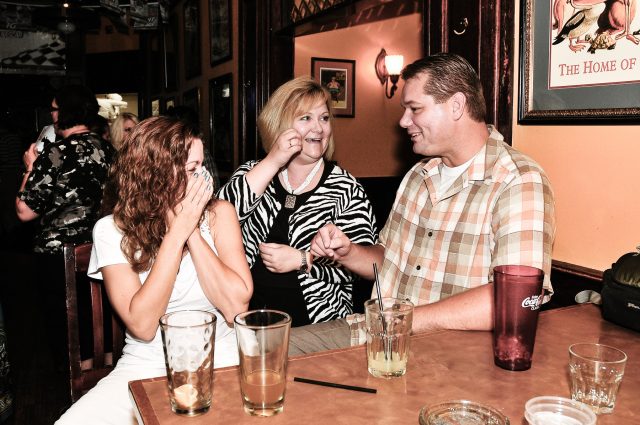
I want to say, “Twenty years from now, you won’t worry so much about this. Like precipitates in a Chem II experiment, love and your personalities will seem somehow to have settled and congealed.” I want to tell them, “You’ll quote the Beatles: ‘I am he as you are he as you are me and we are all together,'” until I realize that U2 is their Beatles. (A student mentioned to me that he likes U2: “My friends think I’m crazy for listening to that old music,” he confided. Thanks.) I want to confide, “You’ll think to yourself, ‘Love is blindness,’ go to your twenty-year reunion, and find that you had more in common with everyone in your class than you ever realized.” But I know the words will do no more for their shattered hearts (egos?) than such words would have done for mine, and I’ll hope that some day, perhaps they’ll invite me to a reunion.
Heading Home

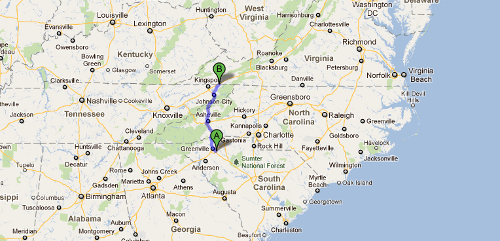
I grew up in a border town -- half in Virginia, half in Tennessee -- about three hours north of where we presently live.

In the last fifteen years, I've only gone back a handful of times. Today, K and I are making the trip to meet with people I haven't seen in twenty years, most of whom I knew only in passing, and many of whom I probably won't recognize, and if I do, I likely won't remember their names immediately. Yet there are a few, and to see them again will be worth it.

I wonder, in the age of social networking, will future generations have twenty-year reunions?

Independent Hands

It’s only expected that a four-year-old grows more independent daily. Lately, that independence has moved out of the normal realms of the everyday, personal actions — bathing, brushing hair, cleaning teeth — and into more wide-ranging spheres: cooking and buying.

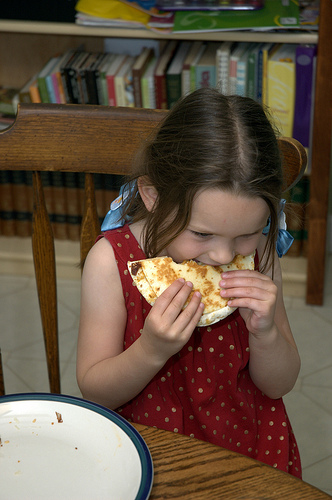
She wanted a quesadilla the other day, so I asked if she’d like to help make it.

DSC_0424

When it was done, she ate it with more relish than I’d seen her eat anything in recent memory.

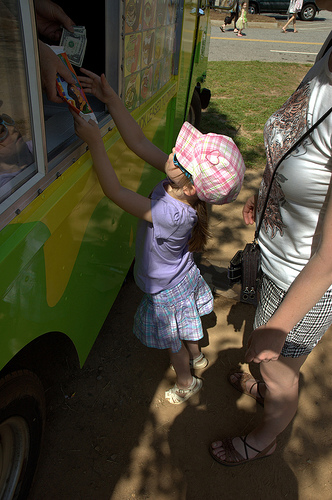
During our first spring zoo outing today, we stopped for an ice cream. L needed to pay by herself — it was imperative.

DSC_0434

The “I can do it!” phase is thankfully far from over.

Treasure

A four-year-old has treasure stored up in every corner of the house. There's the princess umbrella that sits in the toy basket downstairs, ready for deployment. There's the scooter downstairs, festooned with princess regalia, parked by the pink bike. There's a bookshelf packed with books, new and old, tall and short, thick and slim.

And then there's the jewelry.

All L's treasure had its own, proper, fitting place before today except for the jewelry.

DSC_0161

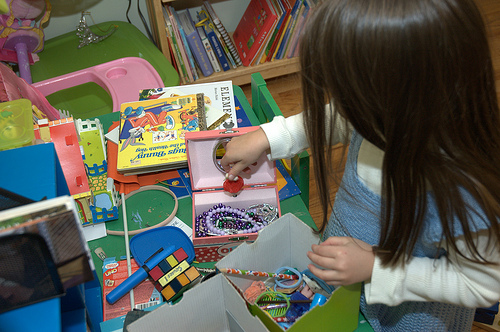
A small but colorful cardboard from Ikea held L's beads and rings, her bracelets and necklaces, her charms and her gems. And so when she saw the jewelry box at Barnes and Noble this afternoon, there was no question. She'd come with money sent from Poland with the intention of buying a book.

DSC_0163

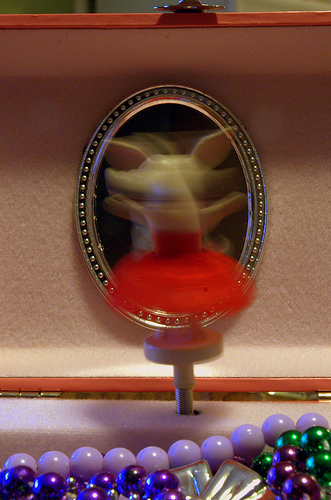
She left with a new treasure,

DSC_0169

to hold all her other treasures.

Journals

Frustration Bliss
Image via Wikipedia

Reading eighth-graders' journals is like jumping in a time machine: all the angst, all the broken hearts, all the frustration with school. I see myself a thousand times over. Bored with this. Frustrated about that. Irritated with him. In love with her.

"Nothing new under the sun."

They'll find this out for themselves. But when I leave comments in their journal, how can I say this without being dismissive? It's a fine line.

Questions

I was drying off the Girl when she began asking me some rather basic questions.

"Why do we grow up?"

Why indeed? Really, who wants to grow up when a child in the Western world? Still, I thought to continue the conversation: "Why? Don't you want to grow up?"

"Because I don't want to get old and go to work."

Sunday Afternoon

“Tata, I want to help!” she calls as she hops down the deck stairs. With an armful of branches and twigs, I’m agreeable, but I smile, wondering how much help I’m actually going to get.

“Grab a couple branches,” I explain, “and follow me.”

We march to the street, L chattering all the way, explaining how she’s going to explain tomorrow how she helped her daddy.

Suddenly, behind me, I hear it: “Ouch!” She’s rubbing her eye; I’m wondering when she’s going to ask for a bandage. It’s been her obsession lately: no matter the wound, no matter the location, there must be First Aid.

“The stick went in my eye,” she says, with concerned voice. After so many months of learning her various voices, I know it’s nothing serious. It’s not quite play — something did happen — but perhaps her concern is exaggerated. She sees K and me hurt ourselves, and she models the reaction.

“Come on,” I say offhandedly. “You’ll be fine. Little things happen when you work as hard as you’re working now.

She plods along, amending the story she’s going to tell tomorrow, practicing the Tragedy of the Stick.

As we’re returning to the backyard, the late afternoon sun reflects off the golden autumn leaves, and it’s as if she’s walking into pure light or developing a halo. I walk about twenty paces behind, watching her hair bounce and sway as she dances into a golden November afternoon.

Inevitable

It's a nightly occurrence: a few minutes after we put the Girl to bed, she calls one of us. It's usually "Mama!"

We take turns answering the call, and L doesn't seem to matter who responds.

"Yes, sweetheart," I say as I open the door, and I immediately one of several possible answers. Sometimes it's just a fragment of a story she remembered; sometimes it's something straight from her imagination. It could be that she needs juice or that she wants to rock with me in the rocking chair for a moment. Occasionally she's not pleased with the sleeping music.

"Yes, L," I say tonight as I enter her room.

"We didn't rock," she replies calmly.

I take her out of her bed and sit with her own my lap. Usually she's a little squirmy. Tonight she's too tired to squirm.

Out of the blue, she opens the age-old conversation: "Tata, I don't want to grow up."

"You don't have a choice. None of us do." I think this, but I certainly don't say it. Instead, I simply ask her if she likes being three.

"Yes," she says quietly. She snuggles a little closer, pauses, and leaves me speechless, whispering, "Three's easy."

Jarring Reminder

Checking a post's formatting, I noticed a picture in the Flickr bar at right.

DSC_9550

"Has she changed so much?" I gasped as I clicked on through. No teeth; short hair; such a very young face -- she looks like a different child.

I click through the set -- "LMS (First Year)" -- and I see a terrifying picture.

DSC_0002

I would never put L in a setting like that now: she's entirely too mobile and to hard-headed. She'd be tumbling down the rocks within moments.

Or would she? She's a big girl; she has a fairly developed sense of balance. She might not. The old protectiveness clashes with the new, maturing reality.

Jack

Jack

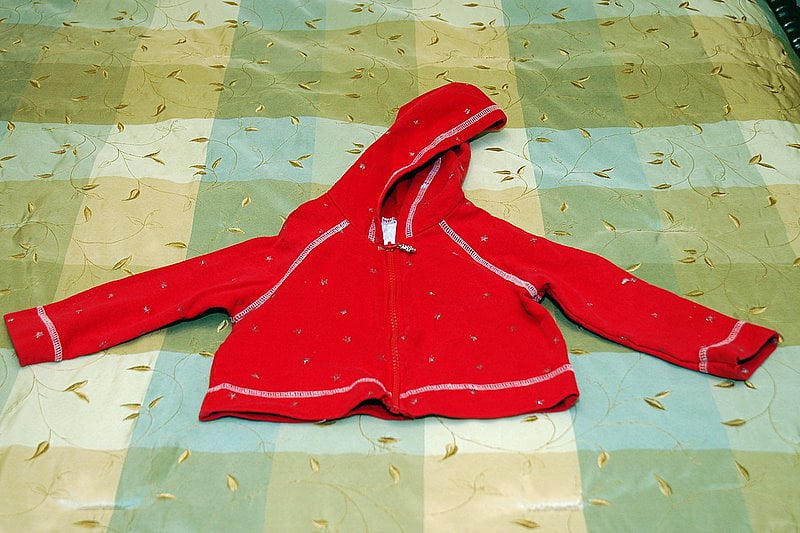
Very quickly, it became a favorite, though I'm not sure how. The name's origin was simple enough: unable to say "jacket," L turned it into a shorter "jack." The rest, though, is mystery.

Jack came to be for L what blankets and teddies are for other toddlers: her grounding. She had to have it with her, and when she was not wearing it (which was rare, if she had her way, even in summer), she was carrying it. Getting to her to agree to hang it in the closet was a Herculean task, and we simply decided that there was no reason why it should hang in the closet if it caused much turmoil in her life.

One parting was inevitable, though, and it happened soon enough. She outgrew it, and we introduced a new jack. She liked the new jack just as much as the old one, and quickly developed the same bond. Red jack was stowed away and quickly forgotten.

Until K decided to do some rearranging and repacking. And then, this morning, L discovered red jack. The original jack, the mother of all jacks.

Fast as her little increasingly nimble fingers could manage, she unzipped the plastic storage back that held jack, pulled it out, and held it close and tight, crying, "Jack!" as if she'd encountered a friend she hadn't seen since school days.

"Oh, no, sweetie," I said. "This jack is entirely too small."

The prospect of losing jack a second time -- "I've been looking everywhere for you" her babbling seemed to say -- was too much for her. L fell in the floor, distraught and screaming.

"But you have another jack," I reminded her. "Do you want to get it?"

The fussing quickly subsided and she meekly answered, "Tak."

That jack was held close for the rest of the morning.

I do this on a daily basis: in my teaching, with my interpersonal skills, in my parenting. The old seems to be so comfortable that, even when something new is working better, the old slips up and takes hold before I know it.

Perhaps L's rediscovery of the original jack suggests a goal for the year: to be more conscious about slipping into old, comfortable habits.